Prevod
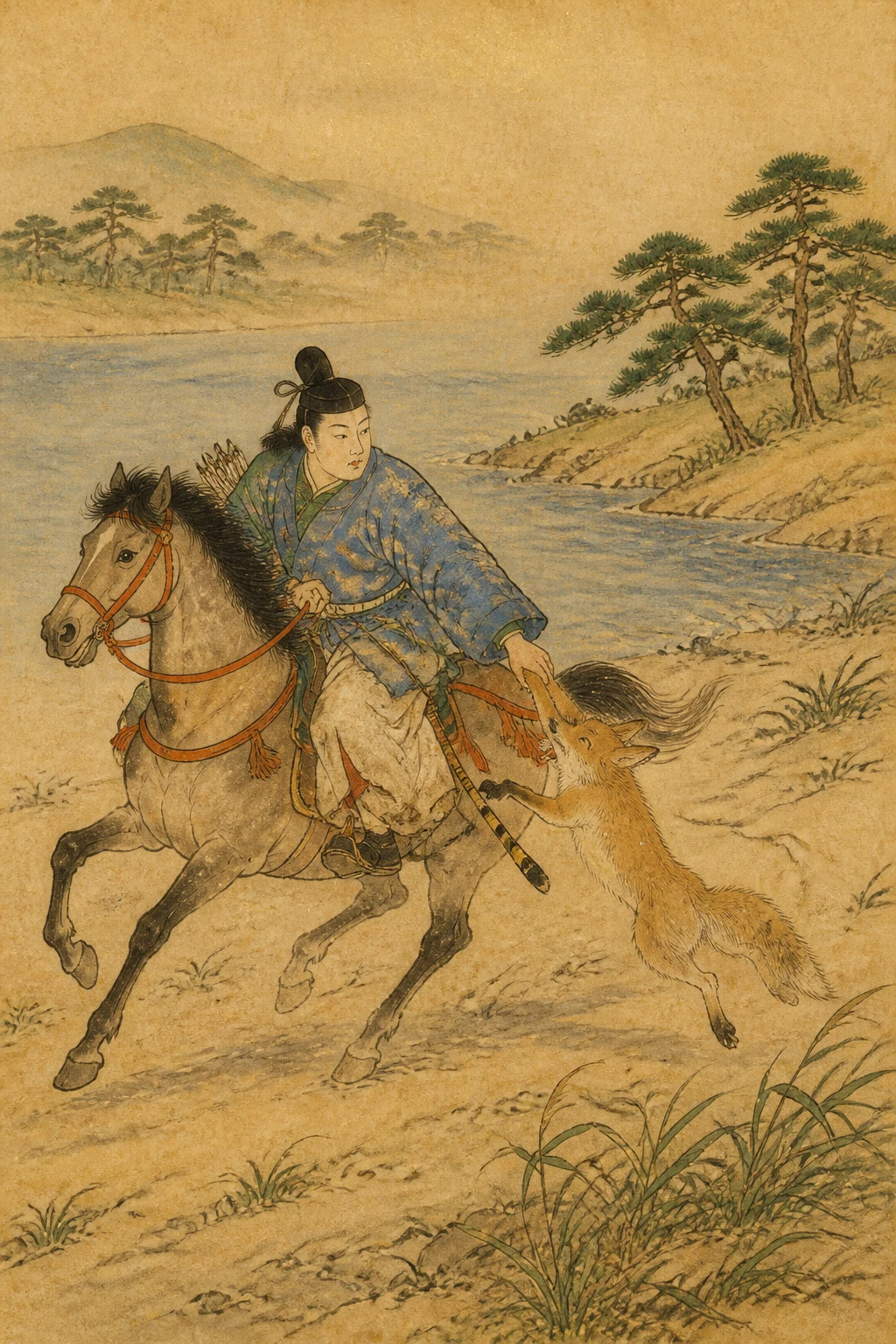
Long ago, when Emperor Yōzei was on the throne, a palace guard named Michinori received an imperial command to travel to Mutsu. On his way he stopped for the night at a place called Hikuni in Shinano Province, taking lodgings with the district governor. His host entertained him lavishly, then went out with his retainers. Michinori could not sleep, so he rose quietly and wandered about. Presently he came upon a place enclosed by folding screens, with clean mats laid out and a lamp burning, everything arranged most pleasingly. A delicious fragrance hung in the air, as though incense were being burned somewhere out of sight. His curiosity stirred, he peered more closely and saw a woman of about twenty-seven or twenty-eight lying there alone. Her face, her bearing, her figure—everything about her was extraordinarily lovely. The longer he looked, the less able he felt to leave her alone. There was no one nearby, and the lamp, set outside her curtained screen, gave a clear light. “The governor has treated me with such extraordinary kindness and goodwill,” Michinori thought. “It would be shameful to betray his trust by making advances to his wife. And yet, looking at her, how can I possibly keep away?” He approached and lay down beside her. The woman showed neither displeasure nor alarm, but lay smiling with a hand over her mouth. Michinori was delighted beyond words. It was about the tenth day of the ninth month, and neither of them wore much clothing, only a single light set of robes. Her fragrance was exquisite. He took off his own robe and tried to slip inside hers. For a little while she seemed to hold them closed, but she offered no very determined resistance, and he made his way into her embrace. Then he felt a kind of itching at his groin. He reached down—and found nothing there. Startled and bewildered, he felt about more carefully, but it was like stroking the beard on his chin: there was no trace of what should have been there. He was so appalled that he forgot even the woman’s beauty. As he fumbled about in a daze, she gave a faint smile, which only deepened his bewilderment. He got up quietly, returned to his own sleeping place, and felt again. Still there was nothing. Distraught, he called a retainer who served him closely. Without revealing what had happened, he said, “There is a wonderfully beautiful woman over there. I have just been with her myself.” The man went off eagerly, but after a little while he returned looking utterly aghast. “The same thing must have happened to him,” Michinori thought, and sent another man to try his luck. He too soon came back, gazing up at the sky in utter incomprehension. In this way Michinori sent seven or eight of his retainers, and every one returned with the same look on his face. By then dawn was breaking. “I was grateful for the splendid welcome my host gave me last night,” Michinori thought, “but after this dreadful, inexplicable business, I had better leave at once.” He hurried away before it was fully light. They had gone seven or eight chō when someone called from behind and came galloping after them. The rider caught up, holding out something wrapped in white paper. Michinori drew his horse aside and waited. It was a retainer he had seen coming and going at his lodgings. “What is that?” he asked. “My master, the district governor, told me to bring this to you,” the man replied. “How could you go off and leave such things behind? We did what we could to entertain you, but you were in such a hurry that you even dropped these. We have gathered them up and brought them to you.” “What can they be?” Michinori said, taking the parcel. When he opened it, he found nine members bundled together like matsutake mushrooms. He stared in horror. His eight retainers crowded round in bewilderment, and there, indeed, were nine of them. All cried out at once. The messenger promptly galloped away. At that very moment Michinori and all his retainers exclaimed, “It is back! It is back!” Later, after receiving the gold he had gone to collect in Mutsu, Michinori returned by way of Shinano and again lodged with the same district governor. He gave his host generous gifts of gold, horses, eagle feathers, and other things. The governor was overjoyed. “What can have moved you to such generosity?” he asked. Michinori drew close to him and said, “It is embarrassing to speak of it, but something very strange happened when I first stayed here. What could it have been?” Having received so many gifts, the governor felt he could hardly refuse an answer, and told him the truth. “When I was young, there was an elderly district governor in a remote part of this province whose wife was still young. I used to visit her in secret, and on one occasion I lost my member just as you did. I was so astonished that I devoted myself to winning the governor’s goodwill, and in the end he taught me the art. If you wish to learn it, you must first return to the capital without delay, for this time you are traveling on imperial business. Then come back expressly for that purpose, and I will teach you.” Michinori secured his promise, returned to the capital, and delivered the gold. Then he asked leave to travel again and went back down to Shinano, taking suitable gifts for the governor. Delighted, the governor resolved to teach him everything he could. “This is not an art to be learned lightly,” he said. “You must bathe in cold water and abstain from impure foods for seven days before you can begin.” Michinori purified himself as instructed. On the appointed day, the two of them went alone deep into the mountains. They came to the bank of a great river, where the governor made him perform all manner of rites and swear fearsome oaths too dreadful to repeat. Then the governor set off upstream. “Whatever comes floating down this river,” he said, “you must seize it and hold it in your arms. Whatever it may be—even a demon—you must embrace it.” A little while after he had gone, rain began falling upstream, a wind sprang up, the sky darkened, and the river rose. Presently an enormous serpent came down the water. Its head alone was as much as a man could clasp in his arms; its eyes looked like metal bowls set into its face, its back was blue as though painted with deep-blue pigment, and the underside of its neck was crimson. Though Michinori had been told to embrace whatever came first, he was helpless with terror and flung himself down among the grasses. After a while the governor returned. “Well? Did you catch it?” he asked. Michinori told him what he had seen and admitted that he had not. “What a pity!” said the governor. “Then you will not be able to learn this art. Still, let us try once more.” He went away again. Before long an enormous wild boar appeared. As it shattered the stones beneath its feet, sparks flashed in all directions. Its bristles stood on end, and it charged straight at Michinori. He was terrified beyond measure, but thought, “I cannot let this one escape me too!” Summoning his resolve, he ran forward and clasped it in his arms—only to find himself holding a rotten log about three feet long. His vexation and regret knew no bounds. “Then the first one must have been something like this as well! Why did I not seize it?” While he was thinking this, the governor returned and asked how he had fared. Michinori told him. “You can no longer learn the art of making a man lose his member,” the governor said. “But it seems you can learn some lesser arts, turning trifling things into other objects. Those I will teach you.” Michinori learned what the governor had to offer and returned to the capital, still bitterly regretting his failure. When he went to the palace, he would make wagers with the other guards, turn all the shoes they were wearing into puppies, and send them running about. He also turned old straw shoes into carp about three feet long and made them leap about on the serving tables. The emperor heard of these feats, summoned him to the Kurodo, and learned the art from him. His Majesty would then make such spectacles as the Kamo Festival procession pass along the top of his curtained screen.