Prevod
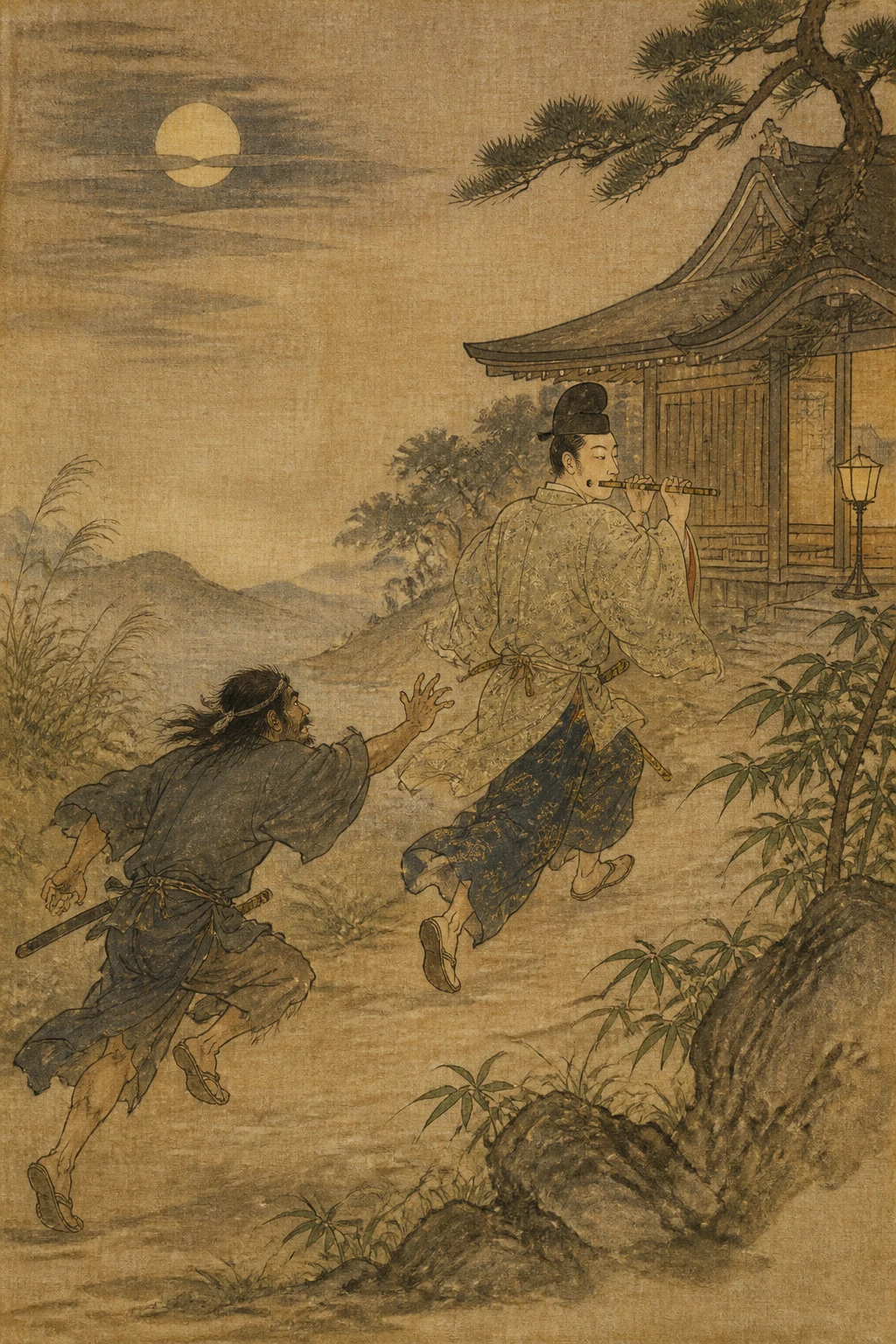
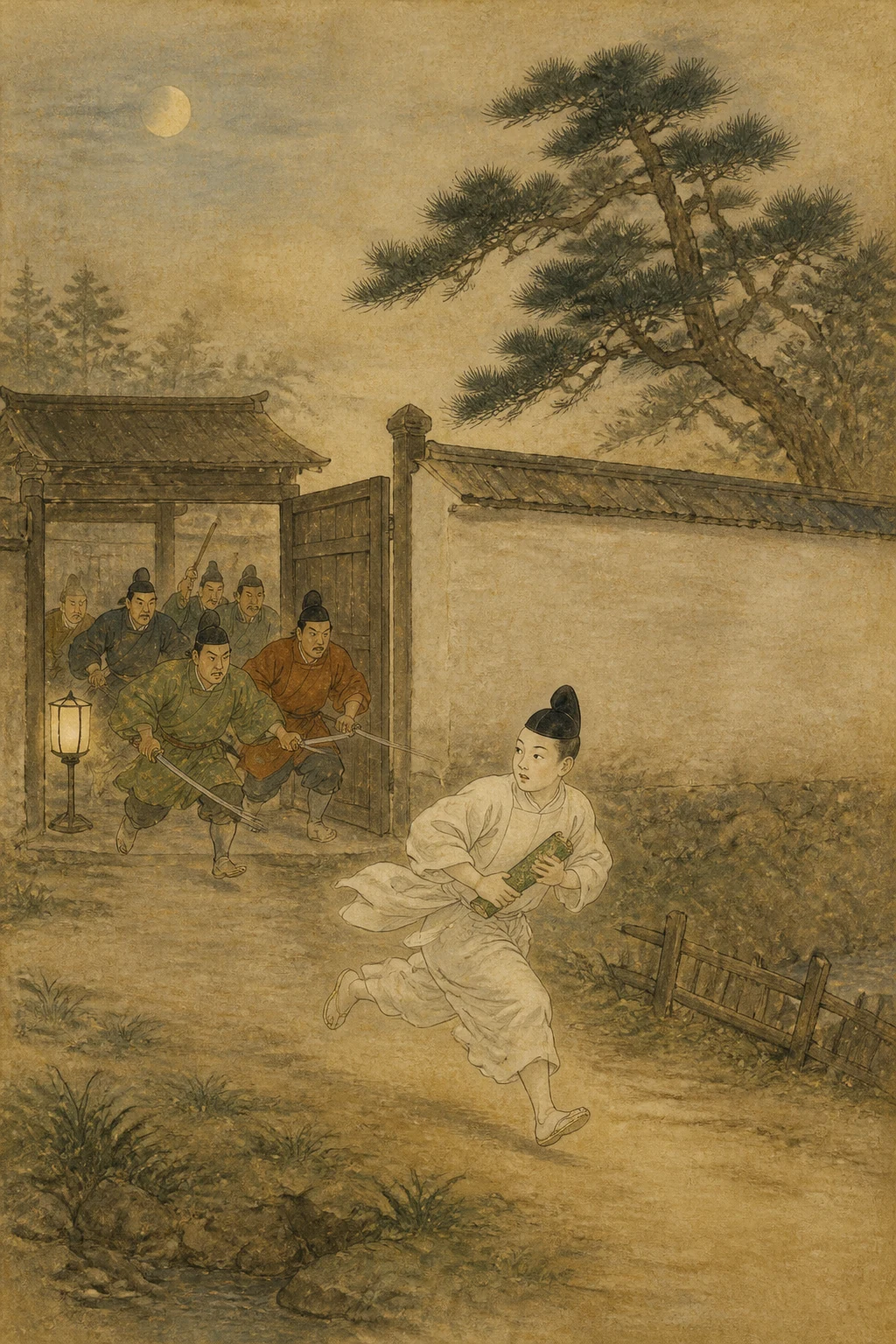
Long ago, there lived a man named Norimitsu, formerly governor of Mutsu, whose son was Tachibana no Suemichi, formerly governor of Suruga. Though Norimitsu did not come from a warrior family, men treated him with deference, for he possessed extraordinary strength and enjoyed a considerable reputation. When he was young, he served as an attendant in the Palace Guards. One night, he left the guards’ quarters to visit a woman, taking only his sword and a single page boy. As he walked south along Ōmiya Avenue, he sensed someone standing in the shadow of the great palace wall. Uneasy, he hurried past. It was late on the eighth or ninth night of the month, and the moon was already nearing the western hills, so that anyone standing beneath the western wall was hidden in its shadow. From that darkness a voice called out, “You there, passing by! Stop! There are gentlemen here. You cannot go past!” Just as I feared, Norimitsu thought, and quickened his pace. “You wretch! Do you think you can simply walk away?” Someone came running after him, drawing a weapon. Lowering his head, Norimitsu glanced back. He could see no bow, but a sword flashed in the moonlight. So it was no mere stick, he thought, and bent low as he fled. His pursuer was gaining on him, and, feeling that his head was about to be split open, he suddenly swerved to one side. The man was running so fast that he could not stop and overshot him. Norimitsu checked his own pace, drew his sword, and struck, cleaving the man’s head down the middle. The fellow pitched forward and tumbled to the ground. Good, Norimitsu thought. At that moment, another voice cried, “What has happened to him?” and someone else came rushing after him. With no time even to sheath his sword, Norimitsu tucked it under his arm and ran. “What an insolent wretch!” his new pursuer shouted as he charged after him. This man seemed swifter than the first. I shall never trick him the same way, Norimitsu thought, and abruptly dropped into a crouch. Unable to check his speed, the man tripped over him and fell flat on his face. Norimitsu turned on him at once and split his head open before he could rise. Now it is over, he thought. But there had been three men, and the last came doggedly after him, shouting, “Do you think you alone can get away? What a brazen scoundrel!” This time I am surely done for, Norimitsu thought, and prayed, Gods and Buddhas, save me! Taking his sword in both hands like a spear, he suddenly wheeled to face the charging man. His pursuer ran straight onto the outstretched blade. The fellow struck at him, too, but had come so close that he could put no force into the blow and failed to cut through Norimitsu’s clothing. Norimitsu’s sword, held like a spear, took the man full in the body and passed right through him. When Norimitsu twisted the hilt, the man fell backward. Norimitsu struck again and cut off his sword arm at the shoulder. Then he ran clear and listened for anyone else, but heard no sound. He hurried through the Nakamikado Gate and stood close against a pillar, waiting and wondering what had become of his page. Presently the boy came north along Ōmiya Avenue, weeping. Norimitsu called to him, and the delighted boy ran over. He sent him to the guards’ quarters to fetch a change of clothes. Once he had changed, he had the boy hide away the bloodstained robe and gathered trousers he had been wearing, and sternly charged him to tell no one. He washed the blood from his sword, put everything in order, and slipped into the guards’ quarters, where he lay down as though nothing had happened. All night his heart pounded as he wondered whether word would get about that he had done it. After daybreak, people began talking excitedly. “Three big men have been cut down near the corner of Ōmiya and Ōimikado, only a short distance from one another. What astonishing swordsmanship! At first you might think they had killed one another, but the same hand has struck all three. Perhaps an enemy did it. Still, they certainly look like thieves.” Amid all this commotion, some of the courtiers said, “Come, let us go and see,” and invited Norimitsu along. He was eager to look, but feared that his expression might betray him; yet refusing to go would seem suspicious too. Reluctantly, he joined them. They crowded into a carriage and drove to the spot, where the bodies still lay untouched. Standing nearby was a man of a little over forty, with thick whiskers. He wore plain, unpatterned trousers and a well-washed silk robe of faded indigo blue, and carried a sword with a boar-hide covering over its scabbard. His leather foot coverings were made of cowhide, and he wore his shoes cut short. Scratching his sides, pointing here and there, and turning first one way and then another, he was talking away. Norimitsu was wondering who he could be when a servant came running up. “That man says he fought those thieves and killed them.” What a welcome claim! Norimitsu thought. One of the courtiers sitting at the front of the carriage said, “Bring him here. We shall ask him what happened.” The servant ran over and brought the man to them. Seen close at hand, he had a great red beard, a shaven chin, and a drooping nose. His eyes were bloodshot. He knelt on one knee with his hand on the hilt of his sword. “How did this happen?” they asked. “Around midnight,” he said, “I was on my way somewhere and happened to be passing this spot when those three came running after me, saying, ‘You wretch! Do you think you can walk past us?’ I took them for thieves, so I fought them and laid them low. When I looked at them this morning, I found they were fellows who might well have had a grudge against me. So it seems they attacked me out of enmity. I have been waiting here for the police officials.” As he told his story, he sprang up, sat down, and pointed this way and that. “Indeed, indeed!” the courtiers said, questioning him further, and he grew more wildly animated still. Only then, with another man taking the credit, could Norimitsu bring himself to look the bodies squarely in the face, though he secretly wondered whether anyone might notice his expression. In his old age, he told his children the story: “Since someone came forward of his own accord and claimed the deed, I let him have it, and said no more.”