Waltey
Oklep
Cuentos de la Patria
Cuentos de Navidad, de la patria y antiguos · Emilia Pardo BazánO besedilu
Oklep
- Vir
- Cuentos de Navidad, de la patria y antiguos
- Avtor
- Emilia Pardo Bazán
- Jezik branja
- English
- Jezik izvirnika
- Español
- Čas branja
- 8 min branja
- Obseg
- 7 strani
- Naslov izvirnika
- 023 La armadura
O izvirniku
Cuentos de Navidad, de la patria y antiguos
Sedemintrideset avtorskih zgodb v treh zgodovinskih knjižnih skupinah. Bralni jezik je English, izvirnik pa prihaja iz vira Cuentos de Navidad, de la patria y antiguos v jeziku Español.
Besedilo
Oklep
There was talk of nothing but the ball, a great event in Madrid society. The capricious and lavish Señora de Cardona had insisted that not only the young but their elders too, not only the ladies but the gentlemen—in short, everyone—should come in costume. “The only exception,” Madame Insausti kept repeating, “is the Nuncio... and that is because he is always in costume.”
No getting out of it with clever little devices such as false noses, electric sunflowers in the buttonhole, wigs, or brightly coloured suits. A complete costume was obligatory: something distinctive, historical, or legendary.
Naturally, people gossiped about Cardona; the coats they cut for her behind her back would have clothed everyone at the party. They gave her a new nickname: Villaverde... But between one spiteful bite and the next, they consulted engravings and fashion plates, visited museums, wrote to Paris, drove tailors and dressmakers mad... and the longest faces were caused not by the drain on their purses, but by omissions from the guest list.
One person quite untroubled was the young Duke of Lanzafuerte. When Perico Gonzalvo asked what he meant to go as, a triumphant smile spread across his lips. “I’m going as my own grandfather. You’ll see what I have up my sleeve,” he added complacently.
The truth was—between ourselves—that extraordinary expenses did not suit the Duke. I am almost tempted to say that ordinary ones did not either. The family’s affairs were in a frightful tangle, and it was a mercy the Duke’s father had died in time; had he lasted another couple of years... Well, they had managed to scrape through, by the door or by the window... Mostly by the window. Country estates were being sold, valuable paintings, sedan chairs, tapestries... There still remained, as witnesses to their past grandeur, a few precious antiquities, among them a complete suit of armour belonging to a paladin who had fought beside Charles V. The Duke had taken notice of this armour, tucked away in a sort of lumber room, and had it cleaned of rust. Once clean, it proved worthy of the Royal Armoury, closely resembling—and perhaps made by the same hand—the Emperor’s celebrated armour for parade and battle, known as “the armour of the grotesque masks.” The same exquisite Milanese workmanship, the same gold and silver damascening, the same blued steel...
Had its existence been known, it would have lured antique dealers and made collectors envious. What better costume? What could be more fitting for a masquerade? Without expense or further thought, Lanzafuerte would be the king of the ball.
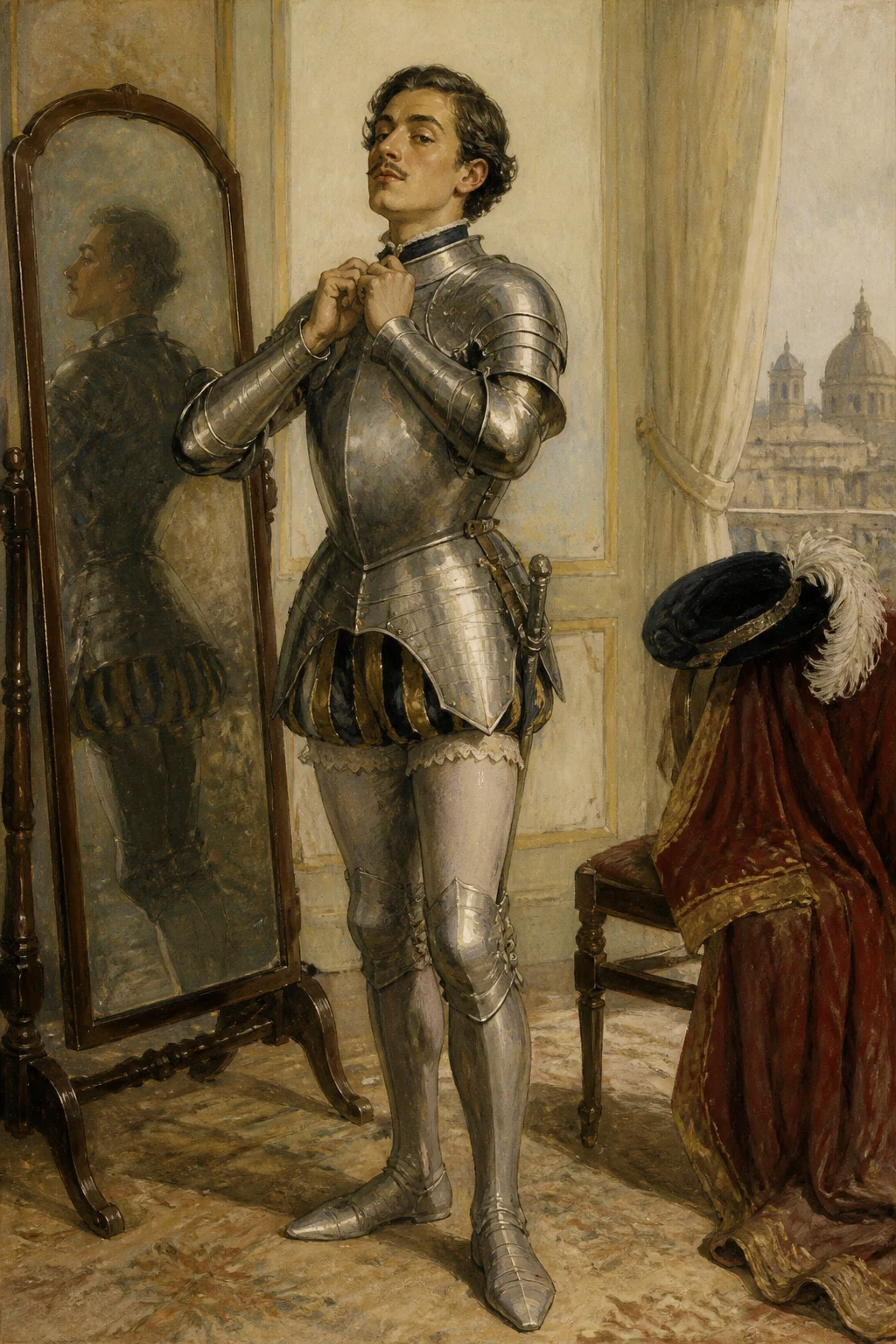
No sooner said than done. Two hours before the solemn moment of his entrance, the Duke stood with arms outstretched and legs apart, allowing the pieces of armour to be fastened upon him. Fitting the breastplate and backplate proved particularly difficult: the straps and buckles had been forgotten. When the arduous business was over, the Duke looked into a full-length mirror and failed to recognize himself. His moustache shaved off, the long locks of his wig falling on either side of his face, he was an old portrait stepped down from its canvas. His haughty bearing, his disdainful mouth, the cast of his features, at once manly and delicate, transformed the Duke into a young knight, and the blood of his lineage surged within him, filling him with longing for the heroic age. “If only I had been born then!” he murmured proudly. “But nowadays... of course! There’s no way...” His self-satisfaction grew at the discovery that the armour was a little tight. “I’m more of a man than the paladin...”
As he went downstairs, his thoughts took another turn. Without the servants’ help he would have pitched headfirst into the entrance hall. And endless precautions were needed to get into the carriage, to sit down, to get out, to ascend to Cardona’s palatial residence up marble steps between a double row of powdered footmen in blue livery and knee breeches. His entrance, however, was sensational. Standing out among costumes which were, after all, mere flashy disguises, the armour commanded attention through its artistry, its authenticity, its solemnity and strangeness. A warrior had risen from the tomb; a recumbent statue had stood upright. Like a figure carved by Pompeo Leoni and brought to life, the Duke advanced, stirring murmurs of admiration as he passed. The connoisseurs appraised that noble relic and valued it in resounding figures, with the shamelessness bred by the habit of seeing everything put up for sale. The artists, transported, cried out in praise. Those who prided themselves on their learning recalled the glories of the house of Lanzafuerte, and once again the classic roll of our triumphs passed in review: Saint-Quentin, Pavia, Oran, Cerignola. And the clash of steel as the Duke walked had a romantic echo, something like the sound of shields in a Wagnerian cavalcade. Only one mocking voice, almost to Lanzafuerte’s face, remarked, “He’s come disguised as a hero so that not even his own mother will recognize him...”
At last the marvellous armour mingled with the bustle of the ball, in a whirl of Gypsies, Andalusians, dandies, Louis XV marquises, roses, dragonflies, and little Japanese ladies with painted eyebrows. Charles V’s paladin was beginning to feel an indefinable discomfort, which steadily increased until it became unmistakable exhaustion.
There could be no doubt: the damned armour was weighing him down and squeezing him... What a notion, to shut himself up in such a shell! Unable to dance, or even to stand... Sit down? But how? What if the tassets sprang loose and left him there in his knitted drawers? Impossible... A sweat of anguish dampened his temples. To leave would be to invite ridicule... As ill luck would have it, the beautiful Inés Puenteancha came to beg him to be her opposite number in a quadrille. A quadrille? Walking, turning, bowing? Lanzafuerte, in distress, excused himself as best he could... In the dining room he asked for a glass of iced punch and felt momentary relief. Puenteancha smilingly asked whether he was ill. “It’s nothing... the heat...” And like a fugitive, pale and shivering, he slipped away into the almost deserted conservatory and made his laborious way to the anteroom. The footmen came to his aid, carried him downstairs, and called a carriage. The warrior collapsed inside with an alarming clatter. Phew! At last! At home they would tear the horrible armour off him.
“Get all this off, off!” he cried once he was in the hands of his servants, who exchanged looks of surprise and displeasure... They had been counting on a night of freedom! And besides... what a predicament!
“Everything off, this instant!” repeated the Duke, stretching out his arms again and spreading his legs. They removed his gorget, tassets, thigh pieces, greaves, arm guards, elbow cops, gauntlets... When they reached the cuirass, they stopped.
“What are you waiting for?” he demanded furiously. “This is what’s squeezing me most!” The valet stammered an apology. Did His Grace not remember? Since the cuirass lacked its buckles and straps, it had been soldered shut.
“Soldered! That’s right! Damn it! Hurry!... The armourer!... Fetch him here at once!” More excuses. Confusion. The armourer! If His Grace wished, they would go... but there was no hope of finding anyone at one in the morning on Carnival Sunday. Not until the following morning...
At a peremptory command they went out in search of the armourer, convinced they would not find him, and the Duke remained encased in his cuirass, lying on the bed, unable to turn over or draw breath. The pressure on his chest, the sensation of suffocation, had become unbearable torment. And the hours of the night passed with cruel slowness, while a leaden hand squeezed his lungs until he choked. Hateful armour! What would the descendant of paladins not have given to be free of it, to have it hanging on the wall in a decorative trophy, displaying its sumptuous workmanship, its pagan figures of the purest Renaissance! On the wall, yes; on his chest, no! What devilish impulse had possessed him? To wedge himself into the mould of other centuries... and be unable to get out! To feel upon a feeble rib cage, upon a heart without vigour, the shell of ancient heroism... and be unable to break it! A prisoner in a suit of armour! The pounding of his arteries mimicked the hoofbeats of warhorses; the rushing of his blood was the din of battle...
“Now you see it isn’t so easy to dress up as your own grandfather,” said Perico Gonzalvo with a burst of laughter. As was his custom, he had called at his friend’s house on leaving the ball, and entered Lanzafuerte’s bedroom blowing a cotillion trumpet trimmed all over with little golden bells. “Resemble the men of those days? My dear fellow! Not even in jest...”
And as Lanzafuerte groaned, half dead—by now he could scarcely breathe—the dandy added, “Do you know what strikes me? Spain is just like you... trapped in the moulds of the past, and dying because she can neither fit into them nor cast them off... A pretty bit of symbolism, eh? Come, I’ll go myself and bring you someone to free you from that contraption... Because if you wait for the servants!...”
Izvirnik
023 La armadura
Naslednje strani prikazujejo izvirno besedilo za primerjavo.
No se hablaba más que de aquel baile, un acontecimiento de la vida social madrileña. La antojadiza y fastuosa señora de Cardona había exigido que no sólo la juventud, sino la gente machucha; no sólo las damas, sino los caballeros, todas y todos, en fin, asistiesen de traje. «No hay--repetía Mad. Insausti--más excepción que el Nuncio... y eso porque va de traje siempre.»
Prohibido salir del apuro con habilidades, como narices, girasoles eléctricos en el ojal, pelucas ó trajes de colores. Obligatorio el traje completo, característico, histórico ó legendario.
Se murmuró, naturalmente, de la Cardona (con los sayos que la cortaron podrían vestirse los concurrentes á la fiesta); se la puso un nuevo apodo: Villaverde... Pero, entre dentellada y dentellada, la gente consultó grabados y figurines, visitó museos, escribió á París, volvió locos á sastres y modistas... y las caras más largas no fueron debidas á la sangría del bolsillo, sino á omisiones en la lista de invitados.
Quien estaba bien tranquilo era el joven duque de Lanzafuerte. Al preguntarle Perico Gonzalvo de qué pensaba ir, triunfante sonrisa dilató sus labios. «Voy de abuelo de mí mismo. Ya verás mi martingala», añadió satisfecho.
Y es que--en confianza--gastos extraordinarios no le convenían al duque. Estoy por decir que ni ordinarios. Embrolladísimos andaban los asuntos de la casa, y gracias que el padre del duque se había muerto á tiempo; que si dura dos añitos más... En fin, se salió adelante, por la puerta ó por la ventana... Por la ventana sobre todo. Se vendían cortijos, cuadros de mérito, literas, tapices... Quedaban aún, testimonio de la grandeza pasada, algunas antiguallas preciosas, y entre ellas una armadura completa de un paladín compañero de Carlos V. En esta armadura, arrinconada en una especie de leonera, se había fijado el duque, haciéndola limpiar de orín, y al aparecer limpia vió que era objeto digno de la Armería, muy semejante--y quizás de la misma mano--al célebre arnés de parada y guerra del Emperador, conocido por «el de los mascarones». Igual labor milanesa, finísima, de ataujia de oro y plata, igual empavonado...
A conocerse, hubiese sido cebo de anticuarios y envidia de coleccionistas. ¿Qué mejor disfraz? ¿Qué cosa más propia de máscaras? Sin gastos ni cavilaciones, Lanzafuerte sería el rey de la fiesta.
Dicho y hecho. Dos horas antes de la solemne de entrar en el baile, estaba el duque abierto de brazos y esparrancado de piernas, dejándose abrochar piezas de la armadura. Fue especialmente arduo el ajuste del peto y espaldar; se habían olvidado las correas con su hebillaje. Terminada la difícil obra, se miró el duque en un espejo de cuerpo entero y no se reconoció. Afeitado el bigote; cayendo á ambos lados del rostro las melenas de la peluca--era un retrato antiguo bajado del lienzo. La apostura arrogante; la boca desdeñosa; el diseño de las facciones viril y adamado á un tiempo,--convertían al duque en doncel, y la raza hirvió en su sangre, causándole la nostalgia de la edad heroica. «¡Si nazco entonces!» murmuró con orgullo. «¡Pero ahora... claro! No hay medio...» Aumentaba su engreimiento el que la armadura le venía un poco estrecha. «Soy más hombre que el paladín...»
Al bajar las escaleras sus ideas tomaron otro giro. Si no le ayudan los criados, de cabeza al portal. Y precauciones infinitas para meterse en el coche, para sentarse, para salir, para subir á la regia morada de Cardona, por peldaños de mármol, entre doble fila de lacayos empolvados, de azul librea y calzón corto. En cambio, la entrada, de sorprendente efecto. Destacándose sobre los trajes, que al fin eran disfraces de relumbrón, la armadura se imponía por el arte, por la verdad, por la seriedad y la extrañeza. Un guerrero se alzaba del sepulcro; una estatua yacente se había incorporado. Como animada figura debida al cincel de Pompeyo Leoni, avanzaba el duque, levantando á su paso murmullos de admiración. Los inteligentes tasaban aquel noble despojo y lo valuaban en cifras sonoras, con el impudor del hábito de que todo se venda. Los artistas, transportados, clamaban elogios. Los preciados de eruditos recordaban timbres de la casa de Lanzafuerte, y una vez más desfilaba la clásica lista de nuestros triunfos: San Quintín, Pavía, Orán, Cerinola. Y el choque del acero, al andar el duque, tenía un eco romántico, algo parecido al son de los escudos en la cabalgada wagneriana. Sólo una voz burlona, casi en la misma cara de Lanzafuerte, pronunció: «Se ha disfrazado de héroe para que no le conozca ni su madre...»
Por fin la maravillosa armadura se confundió entre el bullicio del baile, en un remolino de zíngaros, andaluces, gigerls, marquesas Luis XV, rosas, libélulas y japonesitas de cejas pintadas. El paladín de Carlos V empezaba á notar indefinible molestia, que fue acentuándose, convirtiéndose en declarada fatiga.
No podía dudarlo: le pesaba y le apretaba la maldita armadura... ¡Qué idea, haberse metido en semejante caparazón! Ni poder bailar, ni siquiera estar de pie... ¿Sentarse? ¿Y cómo? ¿Que á lo mejor saltasen las escarcelas y se quedase allí en calzón de punto? Imposible... Un sudor de angustia humedeció sus sienes. Irse era exponerse á la chacota... Por fatalidad, la bella Inés Puenteancha vino á rogarle que hiciese vis en un rigodón. ¿Rigodón? ¿Andar, volverse, inclinarse? Lanzafuerte, acongojado, se excusó lo mejor que supo... Pidió en el comedor un vaso de ponche helado y experimentó momentáneo alivio. La Puenteancha le preguntó risueña si estaba malo. «No es nada... calor...» Y á manera de quien huye, pálido, escalofriado, se escabulló á la serre, casi desierta, y con paso trabajoso se dirigió á la antesala. Los lacayos le socorrieron, le bajaron en vilo, avisaron á un coche. Dentro cayó el guerrero, produciendo temeroso ruido. ¡Uff! ¡Por fin! En casa le arrancarían la horrible armadura.
--¡Fuera todo esto, fuera!--gritó cuando estuvo en manos de sus servidores, que se miraban sorprendidos y descontentos... ¡Ellos que se prometían una noche de libertad! Y además... ¡qué compromiso!
--¡Fuera todo, volando!--repetía el duque, abriendo los brazos otra vez, esparrancando las piernas.
Quitáronle gola, escarcelas, quijotes, grevas, brazales, cubos, guanteletes... Al llegar á la coraza, se pararon.
--¿Qué aguardáis?--interrogó furioso.--¡Si esto es lo que más me oprime!
El ayuda de cámara, tartamudeando, se disculpó. ¿No se acordaba el señor duque? Su coraza, por faltarla el hebillaje y correas, estaba soldada á fuego.
--¡A fuego! ¡Es verdad! ¡Maldita sea! ¡Volando!... ¡El armero!... ¡Ya estáis aquí con él!
Nuevas excusas. Confusión. ¡El armero! Si el señor duque lo deseaba irían... pero inútil buscar á nadie, á la una de la noche del Domingo de Carnaval. Hasta la mañana siguiente...
Ante una orden á rajatabla salieron á caza del armero, con la convicción de no encontrarle, y quedóse el duque embutido en la coraza, echado sobre la cama, sin poderse revolver, ni resollar. La opresión de su pecho, la sensación de asfixia, eran ya tormento insufrible. Y pasaban las horas de la noche con cruel lentitud, y comprimía sus pulmones, hasta ahogarle, una mano de plomo. ¡Armadura odiosa! ¡Cuánto daría el descendiente de los paladines por verse libre de ella, por tenerla colgada en la pared, en panoplia decorativa, luciendo sus labores riquísimas, sus figuras paganas del más puro Renacimiento! ¡En la pared, sí; en el pecho, no! ¿Qué sugestión diabólica había sido aquella? Incrustarse en el molde de otros siglos... ¡y no poder salir! Sentir sobre un costillaje débil, sobre un corazón sin energía, la cáscara del heroísmo antiguo... ¡y no romperla! ¡Prisionero en una armadura! El golpe de sus arterias remedaba el trotar de bridones; el zumbido de la sangre era el fragor de la batalla...
--Así verás que no es tan fácil disfrazarse de abuelo de sí mismo--dijo soltando la carcajada Perico Gonzalvo, que, según costumbre, subió á casa de su amigo al retirarse del baile, y penetró en la alcoba de Lanzafuerte tocando una trompeta de cotillón, toda guarnecida de cascabelitos dorados. ¿Parecerse á la gente de entonces? ¡Hombre! Ni en guasa...
Y como Lanzafuerte gimiese medio muerto (ya ni respirar podía), añadió el gomoso:
--¿Sabes qué me ocurre? España está como tú... metida en los moldes del pasado, y muriéndose porque ni cabe en ellos ni los puede soltar... Bonito simbolismo, ¿eh? Vaya, voy en persona á traerte alguien que te libre de ese embeleco... Porque ¡si esperas á los criados!...
Nadaljuj z branjem