Prevod
Once upon a time there was a rich man who had a servant who worked for him faithfully and diligently. Every morning he was the first out of bed, and every evening the last to get into it; and whenever there was some hard task that no one wanted to tackle, he was always the first to set to work. Yet he never complained, but was content with everything and always cheerful. When his year was up, his master paid him no wages, thinking, “That is the cleverest way: I save a little money, and he will not leave me, but stay quietly in my service.” The servant said nothing, and worked through the second year just as he had the first. When, at the end of it, he again received no wages, he accepted this too and stayed on. When the third year was over as well, the master thought for a moment and reached into his pocket, but brought nothing out. At last the servant spoke up and said, “Master, I have served you faithfully for three years. Be so good as to give me what is rightfully mine. I should like to go away and see a little more of the world.” The miser answered, “Yes, my dear servant, you have served me tirelessly, and you shall be generously rewarded.” He reached into his pocket again and counted out three hellers to the servant, one by one. “There you are, a heller for each year. That is a handsome and plentiful wage, such as few masters would have paid you.” The good servant, who understood little about money, pocketed his fortune and thought, “Now you have plenty in your pocket. Why should you worry and wear yourself out with hard work any longer?”
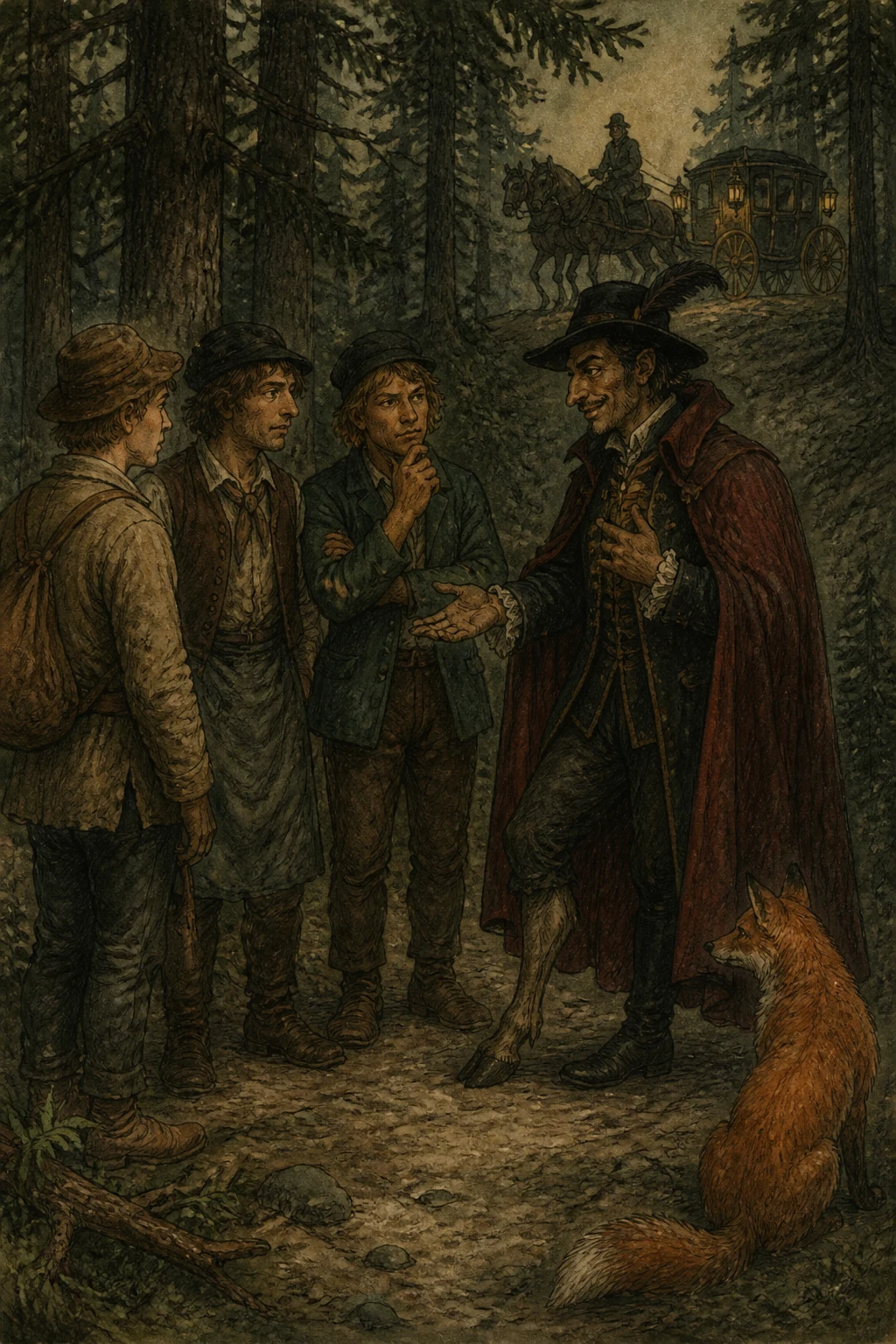
So off he went, uphill and down, singing and skipping to his heart’s content. Now, as he was passing a thicket, a little man stepped out and called to him, “Where are you bound, Brother Merry? I can see your cares do not weigh heavily on you.” “Why should I be sad?” answered the servant. “I have more than enough. Three years’ wages are jingling in my pocket.” “And how much is this treasure of yours?” the little man asked. “How much? Three good hellers, properly counted.” “Listen,” said the dwarf, “I am a poor, needy man. Give me your three hellers. I can no longer work, but you are young and can easily earn your bread.” Since the servant had a kind heart and felt sorry for the little man, he handed him his three hellers and said, “In God’s name, take them. I shall not go without.” Then the little man said, “Since I see how kind your heart is, I will grant you three wishes, one for each heller, and they shall all come true.” “Aha,” said the servant, “you are one of those who can work wonders. Well then, if that is how it is to be, first I wish for a fowling piece that will hit whatever I aim at; second, a fiddle that will make everyone who hears it dance whenever I play; and third, whenever I ask anyone a favor, he must not refuse it.” “You shall have all three,” said the little man. He reached into the bushes, and just imagine, there lay a fiddle and a fowling piece ready and waiting, as though they had been ordered in advance. He gave them to the servant and said, “Whatever you may ask for, no one in the world shall refuse you.”
“Well, heart, what more could you desire?” the servant said to himself, and went merrily on his way. Soon afterward he came upon a Jew with a long goatee, who stood listening to the song of a bird perched high in the treetop. “God’s wonders!” he exclaimed. “Such a little creature, and such a fearfully mighty voice! If only it were mine! If only someone could sprinkle salt on its tail!” “If that is all,” said the servant, “the bird will soon be down.” He took aim and hit it squarely, and the bird fell into a thorn hedge. “Go, you sly dog,” he said to the Jew, “and fetch your bird out.” “Why,” said the Jew, “leave out the ‘sly,’ sir, and a dog will come running. I will pick up the bird, since you have shot it.” He lay down on the ground and began working his way into the hedge. When he was right in the middle of the thorns, a mischievous urge seized the good servant, and he took down his fiddle and began to play. At once the Jew began lifting his legs and leaping into the air, and the more the servant played, the livelier the dance became. But the thorns tore his shabby coat, combed his goatee, and pricked and pinched him all over. “Oh!” cried the Jew. “What do I want with your fiddling? Stop playing, sir! I have no wish to dance.” But the servant paid no heed and thought, “You have fleeced people enough; now the thorn hedge shall treat you no better.” He began fiddling afresh, so that the Jew had to leap higher and higher, leaving scraps of his coat hanging on the thorns. “Oh, woe is me!” cried the Jew. “I will give you whatever you ask, sir, if only you stop fiddling—a whole purse of gold!” “If you are so generous,” said the servant, “I will gladly stop my music. But I must give you this much credit: you certainly put your heart into the dancing.” Then he took the purse and went on his way.
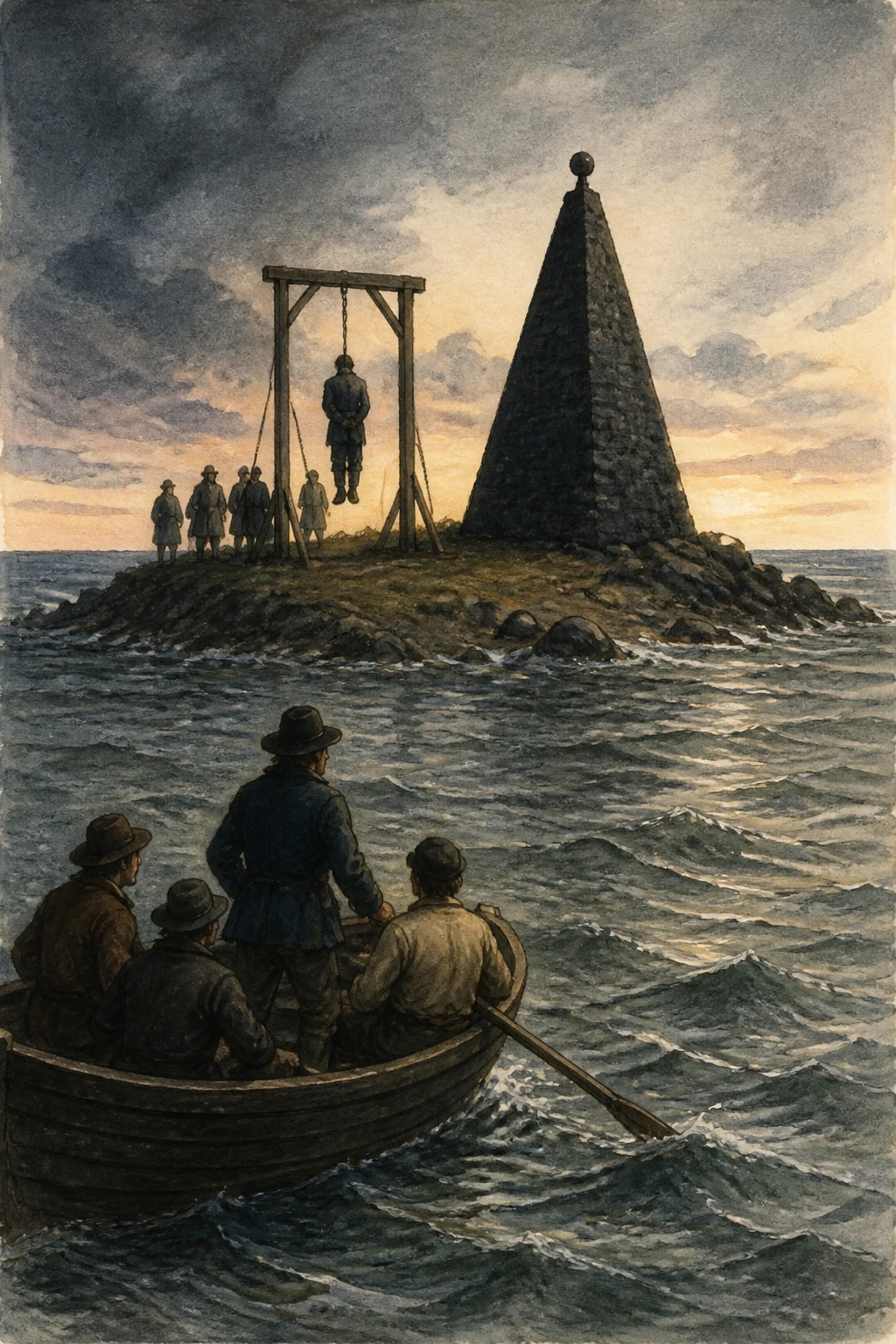
The Jew stood watching him and kept quiet until the servant was far away and quite out of sight. Then he shouted at the top of his voice, “You miserable musician, you tavern fiddler! Just wait till I catch you alone! I will chase you till the soles fall off your shoes! You scoundrel, put a groschen in your mouth, and then you will be worth six hellers!” And he went on hurling every insult he could think of. When he had comforted himself a little in this way and vented his anger, he ran into town to the judge. “Your Honor, oh, woe is me! Look how a godless fellow has robbed and maltreated me on the open highway! A stone lying on the ground would take pity on me! My clothes torn to shreds! My body pricked and scratched! My poor little savings taken, purse and all! Nothing but ducats, each one finer than the next! For God’s sake, have the fellow thrown into prison!” The judge said, “Was it a soldier who mauled you so with his saber?” “Heaven forbid!” said the Jew. “He had no drawn sword, but he had a gun hanging on his back and a fiddle round his neck. The villain is easy to recognize.” The judge sent his men after him. They found the good servant, who had been strolling slowly along, and they found the purse of gold on him as well. When he was brought before the court, he said, “I did not touch the Jew or take his money. He offered it to me of his own free will, if only I would stop fiddling, because he could not bear my music.” “Heaven forbid!” cried the Jew. “He snatches lies out of the air like flies off a wall!” The judge did not believe him either and said, “That is a poor excuse. No Jew would do such a thing.” And he sentenced the good servant to the gallows for committing robbery on the open highway. As he was led away, the Jew shouted after him, “You lazy lout, you dog of a fiddler! Now you will get the reward you deserve!” The servant climbed the ladder quite calmly with the hangman, but on the last rung he turned round and said to the judge, “Grant me one last request before I die.” “Yes,” said the judge, “provided you do not ask for your life.” “Not for my life,” answered the servant. “I ask only that you let me play my fiddle once more, for the last time.” The Jew raised a terrible outcry. “For God’s sake, do not allow it! Do not allow it!” But the judge said, “Why should I deny him this brief pleasure? He has been granted it, and that is that.” Nor could he have refused him, because of the gift bestowed upon the servant. But the Jew cried, “Oh, woe! Oh, woe! Tie me up! Tie me fast!” Then the good servant took the fiddle from his neck and set it in position. At the first stroke of his bow, everyone began to sway and reel—the judge, the clerks, and the court officers—and the rope fell from the hand of the man who was about to tie up the Jew. At the second stroke, they all lifted their legs, and the hangman let go of the good servant and made ready to dance. At the third stroke, everyone leaped into the air and began dancing, with the judge and the Jew at the front, leaping best of all. Soon everyone who had come to the marketplace out of curiosity was dancing too, old and young, fat and thin, all together. Even the dogs that had come running along rose onto their hind legs and joined in the hopping. And the longer he played, the higher the dancers leaped, until they knocked their heads together and began to cry out pitifully. At last the judge, quite out of breath, shouted, “I grant you your life! Only stop fiddling!” The good servant relented, lowered his fiddle, hung it round his neck again, and climbed down the ladder. Then he went over to the Jew, who lay on the ground gasping for breath, and said, “Rascal, now confess where you got the money, or I shall take my fiddle down and start playing again.” “I stole it! I stole it!” he cried. “But you have earned it honestly.” Then the judge had the Jew taken to the gallows and hanged as a thief.