Prevod
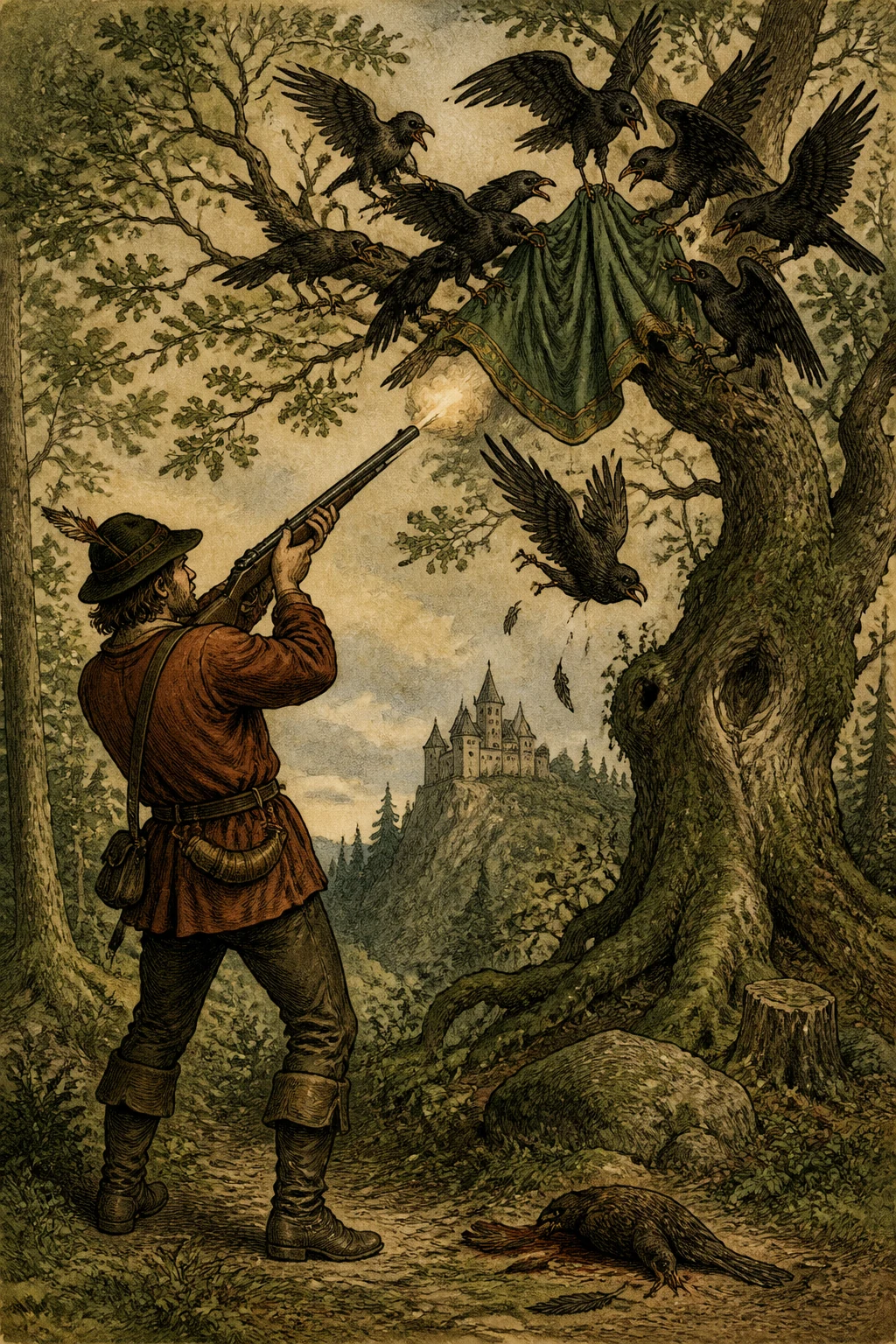
Once upon a time there was a young lad who had learned the locksmith’s trade. He told his father that he now wished to go out into the world and try his fortune. “Yes,” said his father, “I am quite content with that,” and gave him some money for the journey. So he travelled about, looking for work. After a time, however, the locksmith’s trade no longer went well for him, nor did he care for it any longer, and he took a fancy to hunting. On his travels he met a huntsman dressed in green, who asked him where he came from and where he was going. The lad said he was a journeyman locksmith, but no longer liked his trade and wished to become a huntsman, and asked whether the man would take him on as an apprentice. “Oh yes, if you care to come with me.” So the young lad went with him, bound himself to his service for several years, and learned the art of hunting. Then he wished to try his fortune elsewhere, and the huntsman gave him nothing for his wages but an air gun. Yet this gun had the virtue that whenever he fired it, he never failed to hit his mark. He set off and came to a vast forest, so large that he could not reach its end in a single day. When evening fell, he climbed a tall tree to be out of reach of the wild beasts. Towards midnight he thought he saw a little light glimmering in the distance. He peered at it through the branches and carefully noted where it was. Before climbing down, he took off his hat and threw it towards the light, intending to use it as a guide once he reached the ground. Then he climbed down, went over to his hat, put it on again, and walked straight ahead. The farther he went, the brighter the light grew, and when he came close he saw that it was a great fire. Three giants were sitting beside it, roasting an ox on a spit. One of them said, “I must taste the meat and see whether it is nearly ready to eat.” He tore off a piece and was about to put it into his mouth when the huntsman shot it out of his hand. “Well now,” said the giant, “the wind has blown the piece out of my hand,” and he took another. Just as he was about to bite into it, the huntsman shot it away again. At this the giant slapped the one sitting beside him and cried angrily, “Why are you snatching my meat away?” “I haven’t snatched it away,” said the other. “Some sharpshooter must have shot it out of your hand.” The giant took a third piece, but could not keep that in his hand either, for the huntsman shot it away. Then the giants said, “He must be a fine marksman to shoot a morsel away from a fellow’s very mouth. A man like that would be useful to us.” And they called out loudly, “Come here, sharpshooter! Sit beside our fire and eat your fill. We will do you no harm. But if you do not come, and we have to fetch you by force, you are lost.” So the lad stepped forward and said that he was a trained huntsman, and whatever he aimed at with his gun he was certain to hit. They told him that if he would go with them, he should be well treated, and explained that beyond the forest lay a great stretch of water, and on its farther shore stood a tower. In the tower lived a beautiful princess, whom they wished to carry off. “Yes,” he said, “I shall soon manage that.” But they went on, “There is one more thing. A little dog lies there, and the moment anyone approaches, it begins to bark. As soon as it barks, everyone at the royal court wakes up, and that is why we cannot get inside. Will you undertake to shoot the little dog dead?” “Yes,” he said, “that is child’s play to me.” Then he got into a boat and crossed the water, and as he neared the shore, the little dog came running and was about to bark. But he seized his air gun and shot it dead. When the giants saw this, they rejoiced, thinking the princess was as good as theirs. The huntsman, however, wished first to see how matters stood, and told them to remain outside until he called them. He entered the castle, where all was as quiet as a mouse, and everyone was asleep. When he opened the first room, he saw a sabre hanging on the wall. It was made of pure silver, and bore a golden star and the king’s name. Beside it, on a table, lay a sealed letter. He broke the seal and read that whoever possessed the sabre could kill anything that came before him. So he took the sabre down from the wall, buckled it on, and went farther. He came to the room where the princess lay asleep, and she was so beautiful that he stood still and gazed at her, holding his breath. He thought to himself, “How can I deliver an innocent maiden into the power of these savage giants? They mean her harm.” He looked about him and saw a pair of slippers beneath the bed. On the right one were her father’s name and a star, and on the left her own name and a star. She also wore a large silk kerchief embroidered with gold, with her father’s name on the right side and her own on the left, all in golden letters. The huntsman took a pair of scissors, cut off the right-hand end, and put it in his knapsack. Then he took the right slipper, bearing the king’s name, and put that in too. The maiden still lay sleeping, and she was sewn into her shift. He cut a little piece from it and put it with the other things, yet did all this without touching her. Then he went away, leaving her to sleep undisturbed. When he returned to the gateway, the giants were still standing outside, waiting for him and expecting him to bring the princess. But he called to them to come in, saying that the maiden was already in his power. He could not open the door for them, he said, but there was a hole through which they must crawl. The first came forward, and the huntsman wound the giant’s hair around his hand, pulled his head inside, and struck it off with a single blow of his sabre. Then he dragged the rest of him in. Next he called the second and cut off his head in the same way, and finally the third’s as well. Glad to have freed the beautiful maiden from her enemies, he cut out their tongues and put them in his knapsack. Then he thought, “I shall go home to my father and show him what I have already done. After that I shall wander through the world. Whatever good fortune God has in store for me will surely find me.”
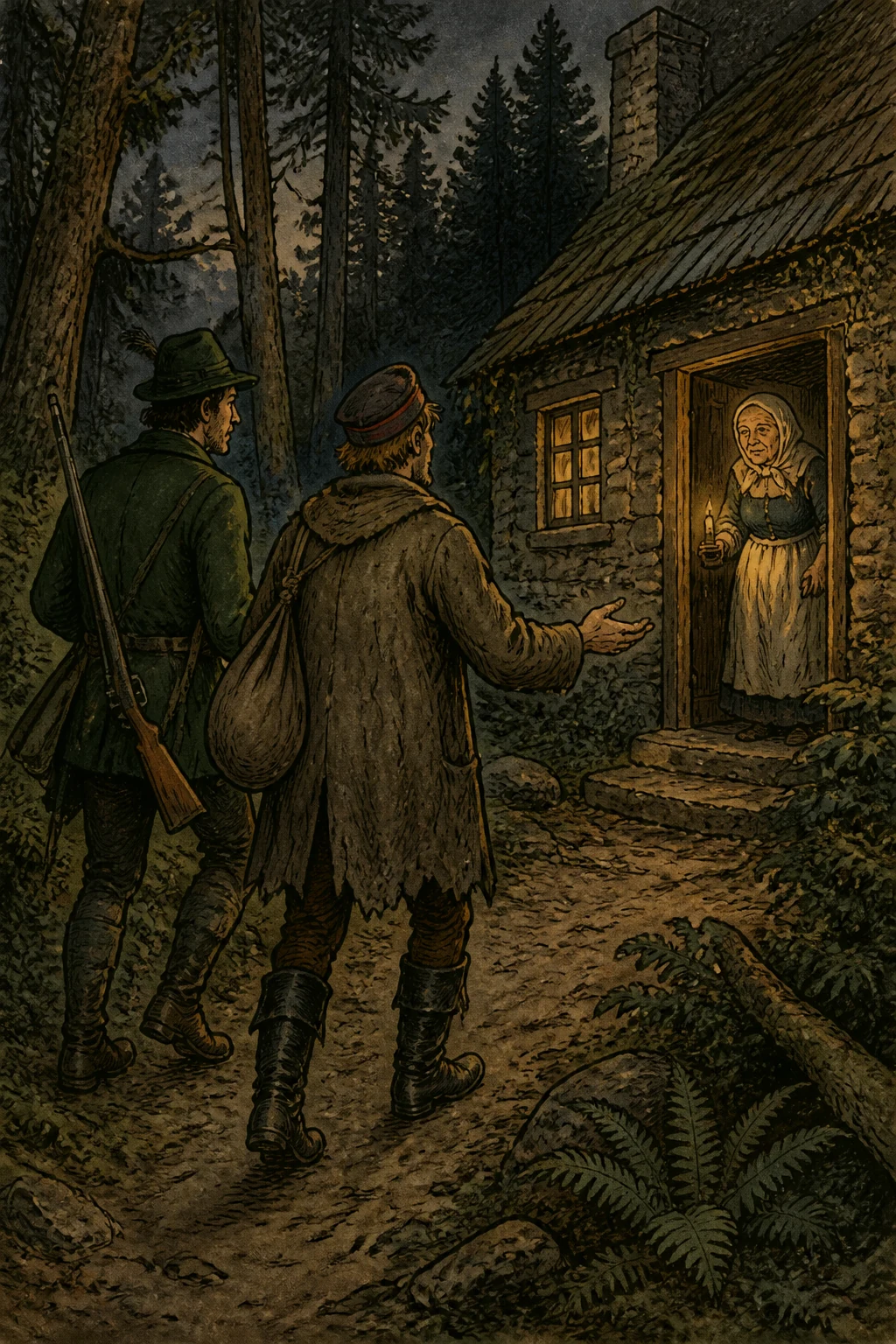
When the king in the castle awoke, he saw the three giants lying dead. He went into his daughter’s bedchamber, woke her, and asked who could have killed them. “Dear Father,” she said, “I do not know. I was asleep.” When she got up and went to put on her slippers, the right one was missing. When she looked at her kerchief, she found it had been cut, and the right-hand end was gone; and when she examined her shift, a little piece was missing from that as well. The king summoned the whole court, soldiers and everyone else who was there, and asked who had freed his daughter and killed the giants. Now he had a captain who was one-eyed and an ugly man, and he said that he had done it. The old king declared that if he had accomplished this, he should marry his daughter. But the maiden said, “Dear Father, rather than marry him, I would sooner go out into the world as far as my legs will carry me.” Then the king said that if she would not marry him, she must take off her royal clothes, put on peasant clothes, and leave. She was to go to a potter and begin trading in earthenware. So she took off her royal clothes, went to a potter, and obtained a stock of earthenware on credit, promising to pay him in the evening when she had sold it. The king told her to sit with it on a street corner and sell it. Then he arranged for several peasant wagons to drive straight through it, so that everything would be smashed into a thousand pieces. When the princess had set out her wares in the street, the wagons came and broke them all to shards. She began to weep and said, “Oh God, how am I to pay the potter now?” The king had meant to force her by this means to marry the captain. Instead, she went back to the potter and asked whether he would give her another stock on credit. He said no; she must first pay for the last. Then she went to her father, weeping and lamenting, and said she would go out into the world. He said, “I shall have a little house built for you out in the forest. There you must spend the rest of your life cooking for anyone who comes, but you must take no money.” When the little house was ready, a sign was hung outside the door, bearing the words, “Today free, tomorrow for money.” She lived there for a long time, and word spread through the world that there was a maiden who cooked for nothing, and that this was written on a sign outside her door. The huntsman heard of it too, and thought, “That would suit you, for you are poor and have no money.” So he took his air gun and his knapsack, which still held everything he had taken from the castle as tokens, went into the forest, and found the little house with the sign, “Today free, tomorrow for money.” He was also wearing the sword with which he had cut off the three giants’ heads. He entered the little house and asked for something to eat. He was delighted with the beautiful girl, for she was indeed as lovely as a picture. She asked where he came from and where he was going, and he said, “I am travelling about the world.” Then she asked where he had got the sword, for her father’s name was on it. He asked whether she was the king’s daughter. “Yes,” she answered. “With this sabre,” he said, “I cut off the heads of three giants.” As proof, he took their tongues out of his knapsack, and then showed her the slipper, the end of the kerchief, and the piece of her shift. She was filled with joy and said that he was the man who had saved her. Then they went together to the old king and brought him with them, and she led him into her chamber and told him that the huntsman was the true deliverer who had saved her from the giants. When the old king saw all the tokens, he could doubt no longer. He said he was glad to know how everything had happened, and that the huntsman should now have her for his wife. At this the maiden rejoiced with all her heart. Then they dressed him as though he were a lord from a foreign land, and the king ordered a feast to be prepared. When they sat down at table, the captain was seated on the princess’s left and the huntsman on her right. The captain supposed that he was a foreign lord who had come to visit. When they had eaten and drunk, the old king told the captain he had a riddle for him to solve: if a man claimed to have killed three giants, and was asked where their tongues were, and had to look and found none in their heads, how could that be explained? The captain said, “They cannot have had any.” “Not so,” said the king. “Every creature has a tongue.” Then he asked what punishment such a man deserved. The captain answered, “He deserves to be torn to pieces.” The king said that he had passed sentence on himself, and the captain was taken prisoner and then torn into four pieces, while the princess was married to the huntsman. Afterwards he sent for his father and mother, and they lived happily with their son, and when the old king died, he inherited the kingdom.