Prevod
Among the tales that are told is this account of Ishaq ibn Ibrahim al-Mawsili: “One day I grew weary of constantly attending the caliph’s palace and serving there, so I mounted my horse early in the morning and rode out, intending to roam the open country and take my pleasure. I said to my servants, ‘If a messenger comes from the caliph or anyone else, tell him that I went out early on some business of my own, and that you do not know where I have gone.’ Then I rode off alone and wandered through the city. As the day grew hot, I stopped in a street known as al-Haram…” But morning overtook Shahrazad, and she fell silent, leaving her tale untold.
When the four hundred and eighth night had come,
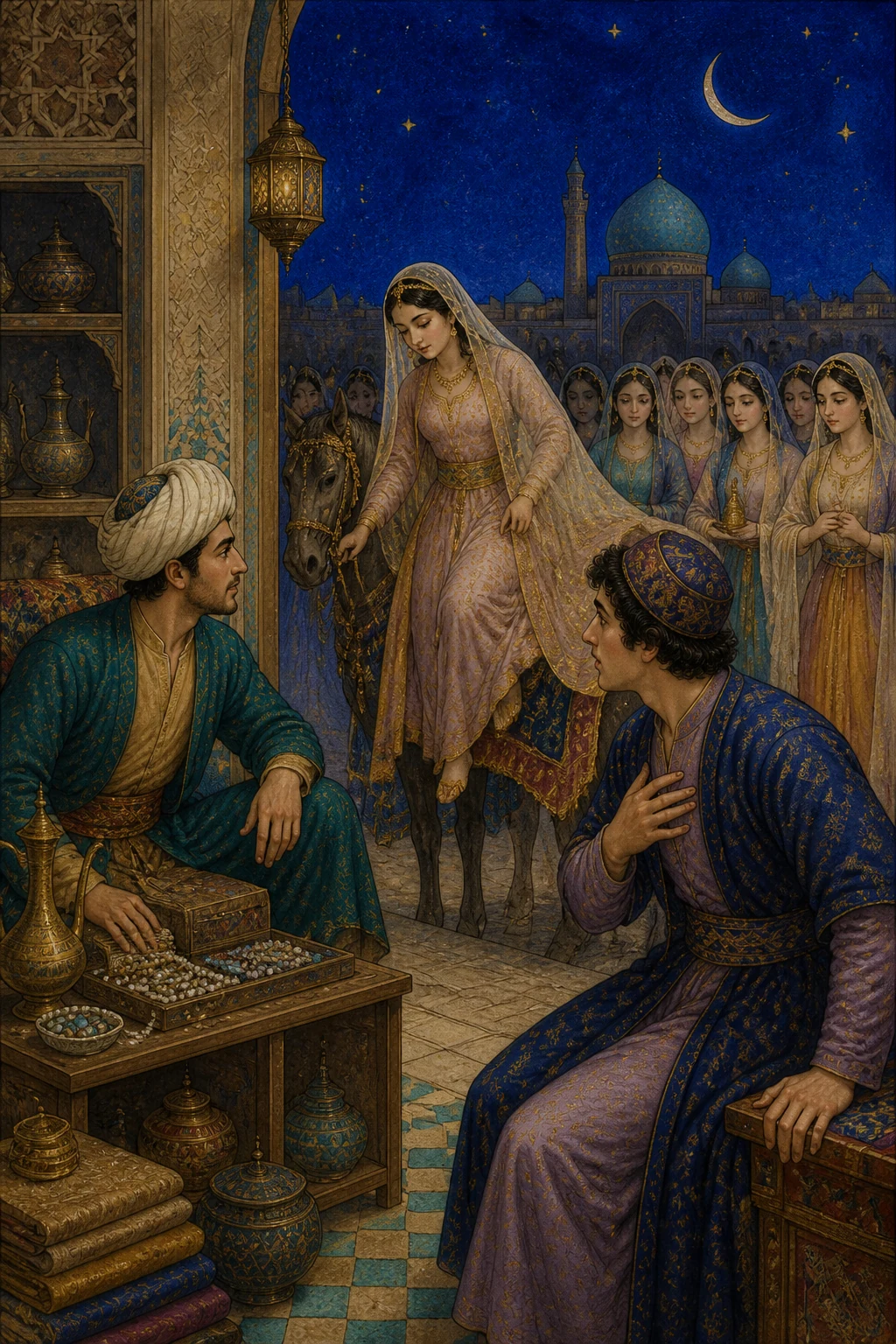
She said, “It has reached me, O fortunate king, that Ishaq ibn Ibrahim al-Mawsili said: ‘As the day grew hot, I stopped in a street known as al-Haram to shelter from the sun. A spacious upper room of one of the houses projected over the street. Before long, a black servant came along leading a donkey, on which sat a slave girl, with a jewel-studded cloth beneath her. Her clothes were as sumptuous as could be, and I saw that she had a lovely figure, languorous eyes, and graceful ways. I asked a passerby about her, and he told me, “She is a singer.” My heart had fallen in love with her at first sight, and I could scarcely keep still in my saddle. She entered the very house at whose door I had stopped, and I began to ponder some means of gaining access to her. While I stood there, two handsome young men arrived and asked leave to enter. The master of the house admitted them, and as they dismounted, I dismounted too and went in with them. They supposed that the master of the house had invited me. We sat for a while, then food was brought and we ate. Wine was set before us, and the girl came out with a lute in her hand. She sang, and we drank. Presently I rose to relieve myself, and the master of the house asked the two men about me. They told him they did not know me. “He is an uninvited guest,” he said, “but he is a pleasant fellow, so treat him kindly.” I returned and sat down in my place. The girl sang a delicate melody to these two verses:
Say to the gazelle who is no gazelle, the kohl-eyed fawn who is no fawn: masculine, not feminine, in the privacy of love; feminine, not masculine, in the grace of every step. She performed it beautifully, and the company drank and admired her singing. Then she sang various songs to rare melodies, among them a composition of my own, with these two verses:
The lovely maidens have forsaken the worn and crumbling traces of their homes. Once full of companionship, they now lie desolate, a wilderness fading from sight. She did better with this than with the first. Then she sang various songs to rare melodies, both old and new, and among them another composition of mine, to these two verses:
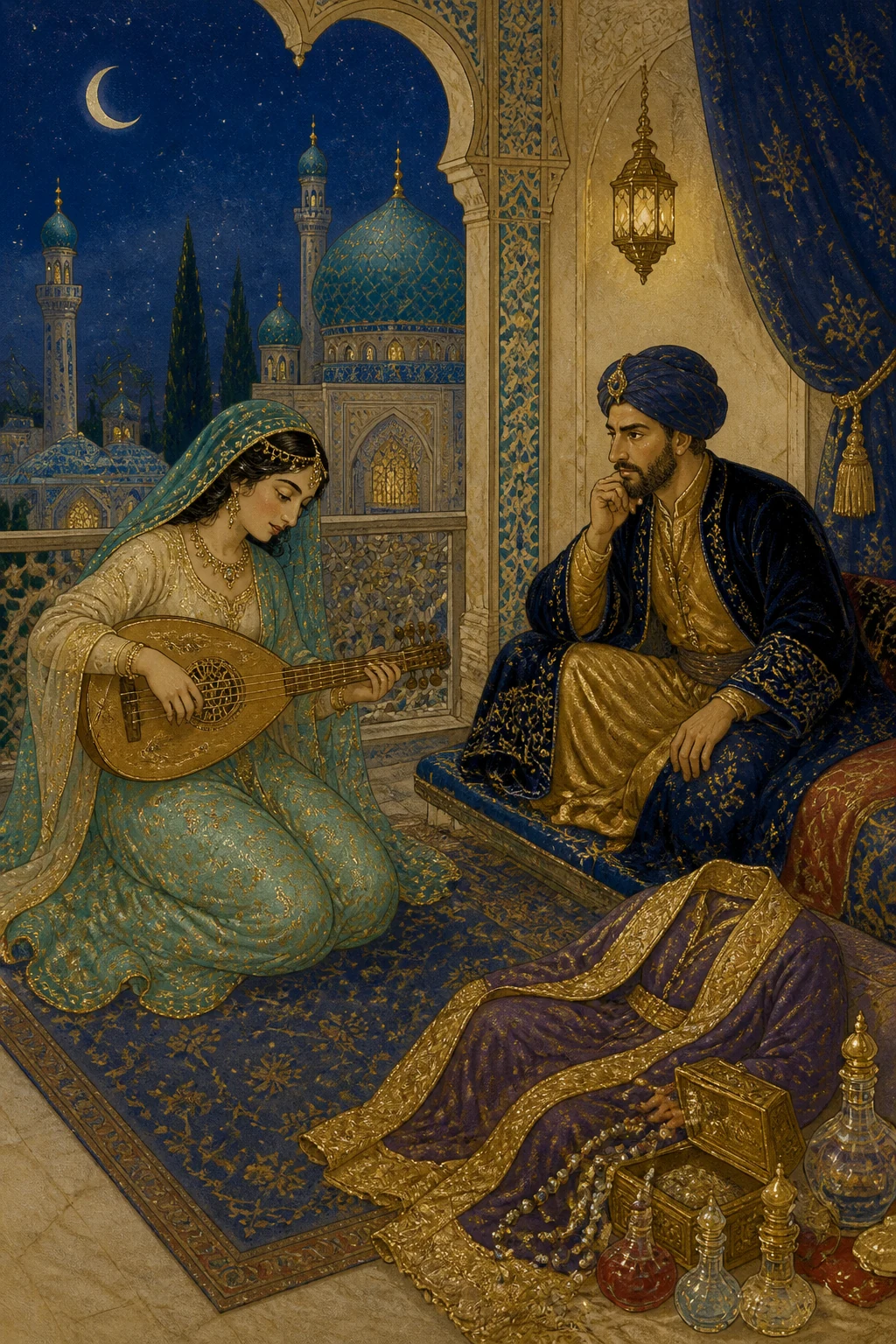
Say to the one who turned away in anger and withdrew far from you: “You have achieved all you sought, even if you meant it only in play.” I asked her to repeat it so that I could correct her rendering, whereupon one of the two men turned to me and said, “We have never seen a more brazen intruder than you! Is it not enough to come uninvited, without demanding songs as well? The proverb fits you to perfection: ‘An uninvited guest, and full of requests!’” I lowered my head in embarrassment and made no reply. His companion tried to restrain him, but he would not desist. Then they rose to pray. I lingered a little, took up the lute, tightened its strings, and tuned it with the utmost care. Then I returned to my place and prayed with them. When we had finished our prayers, the man began reproaching and abusing me again, persisting in his drunken insolence while I kept silent. The girl took up the lute and tried its strings. Finding it changed, she asked, “Who has touched my lute?” “None of us has touched it,” they replied. “Indeed, by God, someone has,” she said, “and a master of the art at that, for he has set its strings in perfect order and tuned it with an expert’s skill.” I said to her, “I am the one who tuned it.” “For God’s sake,” she said, “take it and play.” So I took it and played a wondrous, difficult melody, one that could almost kill the living and bring the dead to life, and sang these verses to it:
I had a heart by which I lived, but fire seared it, and it burned away. Her love was not allotted me; a servant has only what is allotted him. If what I have tasted is not the taste of love, then surely every lover has tasted it.’” But morning overtook Shahrazad, and she fell silent, leaving her tale untold.
When the four hundred and ninth night had come,
She said, “It has reached me, O fortunate king, that Ishaq ibn Ibrahim al-Mawsili said: ‘When I finished my verses, everyone in the company sprang from his place. They sat before me and said, “For God’s sake, our master, sing us another song!” “With pleasure and all my heart,” I replied. Then I played with a sure hand and sang these verses:
Ah, who will help a heart dissolved by affliction, beset on every side by sorrows? Forbidden to the archer who pierced my heart should be the lover’s blood, deep within his breast. On the day of parting it was plain that hope of his drawing near, despite our separation, was a lying fancy. He shed blood that, but for love, he would never have shed: is there none to avenge my blood, none to demand redress? When he had finished his verses, every one of them rose to his feet, then flung himself to the ground, so deeply had the music moved them. He continued: ‘I cast the lute from my hand, but they said, “For God’s sake, do not do this to us! Give us another song, and may God Most High increase His bounty to you!” I replied, “My friends, I will give you another song, and another, and another, and I will tell you who I am. I am Ishaq ibn Ibrahim al-Mawsili. By God, I make even the caliph wait when he sends for me, yet today you have subjected me to the harshest and most offensive abuse! By God, I will not utter another word or sit in your company until you have put this drunken lout out of the house.” His companion said to him, “This is what I warned you of, and what I feared would happen to you.” Then they took him by the hand and led him out. I took up the lute and sang the songs of my own composition that the girl had sung. Afterward, I confided to the master of the house that the girl had captured my heart and that I could not bear to be without her. “She is yours,” he said, “on one condition.” “What is it?” I asked. “That you stay with me for a month. Then the girl, with all her jewels and fine clothes, shall be yours.” “Yes,” I said, “I will do so.” Thus I stayed with him for a month, and no one knew where I was. The caliph searched for me everywhere, but could find no news of me. When the month was over, my host handed over the girl to me, together with all her precious belongings, and gave me another servant as well. I brought them home, feeling as though I had gained the whole world, so great was my joy in the girl. Then I rode at once to al-Ma’mun. When I stood before him, he said, “Confound you, Ishaq! Where have you been?” I told him my story, and he said, “Bring that man before me this very hour.” I directed them to his house, and the caliph sent for him. When he arrived, the caliph asked him about the affair, and he related what had happened. “You are a man of noble generosity,” the caliph said, “and such generosity deserves to be supported.” He ordered that the man be given a hundred thousand dirhams, then said to me, “Ishaq, bring the girl.” I brought her, and she sang for him, moving him to delight and giving him the greatest pleasure. “I have appointed her a turn every Thursday,” he said. “She is to attend and sing from behind the curtain.” Then he ordered fifty thousand dirhams to be given to her. By God, that one ride brought profit both to me and to others!’”