O besedilu
Iros, Penelopa in snubci
- Vir
- Odiseja
- Avtor
- Homer
- Jezik branja
- English
- Jezik izvirnika
- Ancient Greek
- Čas branja
- 21 min branja
- Obseg
- 17 strani
- Naslov izvirnika
- Irus, Penelope, and the Suitors
O izvirniku
Odiseja
Dolga vrnitev domov čez morja, otoke, preizkušnje in prepoznavanja. Bralni jezik je English, izvirnik pa prihaja iz vira Odiseja v jeziku Ancient Greek.
Besedilo
Iros, Penelopa in snubci
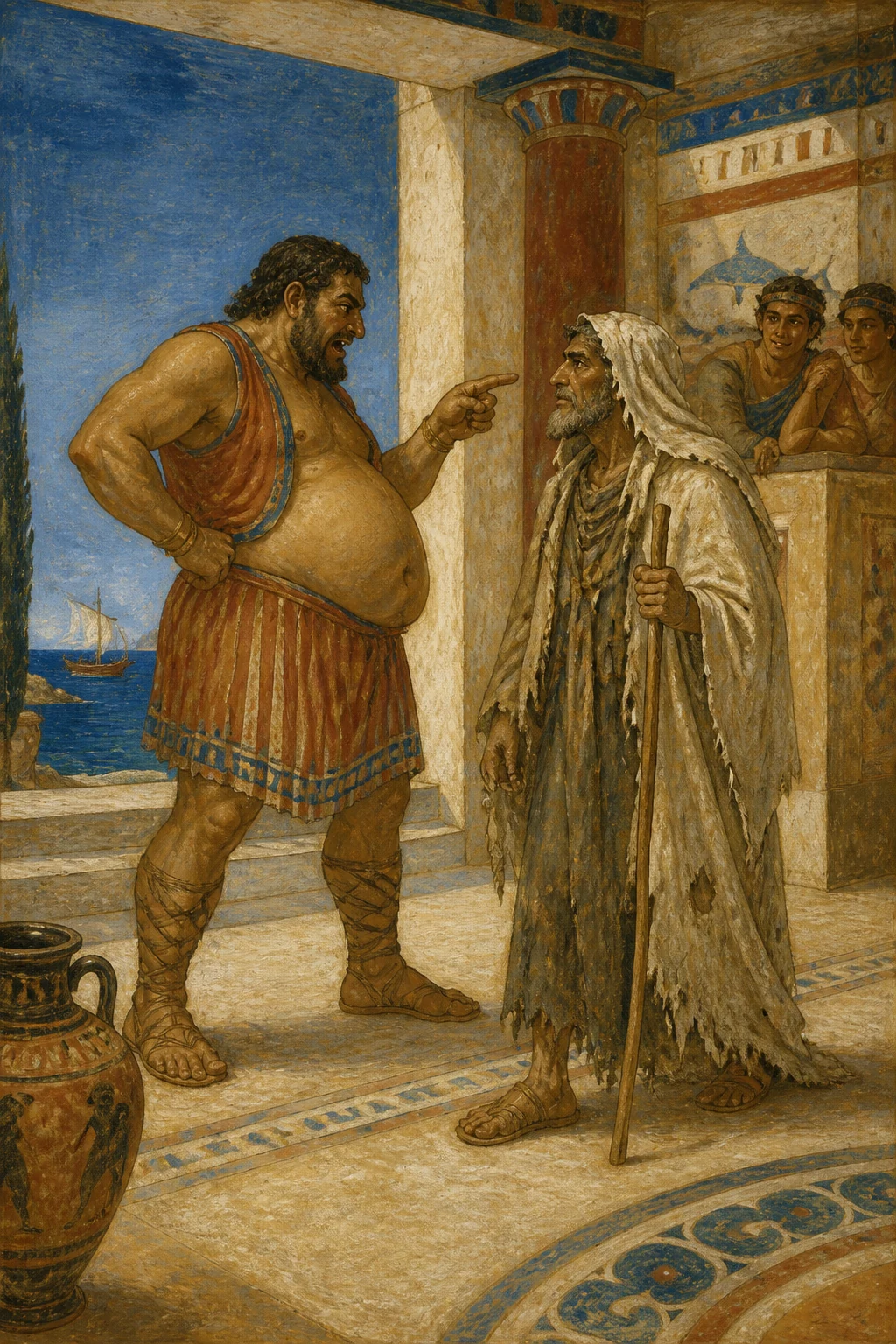
Then came a beggar known to all the people, who went begging through the town of Ithaca. He was famed for his ravenous belly, forever eating and drinking. Yet he had neither strength nor vigor, though he was a very big man to look at.
His name was Arnaeus, the name his honored mother had given him at birth; but all the young men called him Irus, because he would run with messages whenever anyone commanded him. Now he came and tried to drive Odysseus from his own house, assailing him with these winged words: “Out of the doorway, old man, or you’ll soon be dragged out by the foot.
“Don’t you see how they’re all winking at me, telling me to haul you off? Still, I’m ashamed to do it. Get up, then, before our quarrel comes to blows.” Resourceful Odysseus looked darkly at him and answered: “Strange fellow, I neither do you any harm nor speak against you, nor do I begrudge you anything a man may give, however much he takes up in his hands.
“This threshold has room for both of us. You have no need to begrudge another man his share. You seem to be a wanderer like myself, and it is the gods who grant prosperity.
“But don’t be too eager to challenge me to a fight. You may anger me, and old though I am, I may stain your chest and lips with blood. Then tomorrow I should have even greater peace, for I doubt you would come back a second time to the hall of Odysseus, son of Laertes.”
The beggar Irus answered in anger: “Well now, how glibly this glutton talks, like an old woman at the hearth! I could make him pay for that, battering him with both hands and knocking all his teeth out of his jaws onto the ground, as one does to a sow ravaging the crops.
“Gird yourself now, so all these men can watch us fight. How could you stand against a younger man?” So there before the lofty doors, on the polished threshold, the two of them quarreled furiously.
The mighty Antinous heard them. He laughed aloud with delight and called to the suitors: “Friends, never before has anything like this happened! What entertainment some god has brought into this house!
“The stranger and Irus are challenging one another to a fight. Come, let us set them at it at once.” So he spoke, and they all leaped up laughing and gathered around the ragged beggars.
Then Antinous, son of Eupeithes, addressed them: “Listen, proud suitors, while I tell you something. Here on the fire lie goats’ stomachs, which we put aside for supper after filling them with fat and blood. Whichever of these two wins and proves the stronger shall get up and choose whichever one he likes. From then on he shall always feast with us, and we shall let no other beggar come among us to ask for alms.”
So Antinous spoke, and his proposal pleased them. Then resourceful Odysseus, with cunning in his heart, said: “Friends, an old man worn down by hardship can hardly fight a younger man. But this accursed belly drives me on, only to be beaten down by blows.
“Come now, all of you swear me a solemn oath that none of you, to favor Irus, will strike me a reckless blow with his heavy hand and help him overpower me.” So he spoke, and they all swore as he requested.
When they had sworn and completed the oath, mighty Telemachus spoke among them: “Stranger, if your heart and proud spirit urge you to stand up to this man, you need fear none of the other Achaeans. Whoever strikes you will have more than one man to fight. I am your host, and the princes Antinous and Eurymachus, both men of good judgment, agree with me.”
So he spoke, and they all approved. Odysseus tucked his rags around his loins, revealing his fine, powerful thighs; his broad shoulders, chest, and sturdy arms came into view. Athena stood close beside the shepherd of his people and filled out his limbs.
All the suitors were astonished beyond measure. One would glance at his neighbor and say: “Irus will soon be Irus no more! He’ll find the trouble he asked for. Just look at the thigh the old man shows beneath his rags!”
So they spoke, and Irus’s heart was badly shaken. Even so, the servants girded him by force and led him forward, terrified, the flesh trembling on his limbs. Antinous rebuked him, calling him by name: “You great ox, I wish you had never been born, and were not alive now, if you tremble and are so dreadfully afraid of this old man, worn down by the hardship that has overtaken him!
“But I tell you this, and it shall be done: if this fellow beats you and proves the stronger, I’ll throw you into a black ship and send you to the mainland, to King Echetus, the scourge of all mankind. He’ll slice off your nose and ears with pitiless bronze, tear out your private parts, and give them raw to the dogs to devour.”
At these words an even greater trembling seized his limbs. They brought him into the middle, and both men raised their hands. Then steadfast, noble Odysseus considered whether to strike him so that he fell dead on the spot, or to hit him lightly and stretch him on the ground.
As he thought it over, this seemed the wiser course: to strike lightly, so the Achaeans would not recognize him. Then, as they raised their hands, Irus struck his right shoulder, but Odysseus hit him on the neck below the ear and crushed the bones inward. At once dark blood poured from his mouth. He fell bleating in the dust, his teeth clashing together as he kicked the ground. The lordly suitors threw up their hands and nearly died of laughter. Odysseus seized him by the foot and dragged him through the entrance to the courtyard and the doors of the porch. There he sat him down against the courtyard wall, put a staff in his hand, and addressed him with winged words: “Sit here now and keep the pigs and dogs away. Wretch that you are, don’t set yourself up as lord of strangers and beggars, or something worse may befall you.”
With that he slung his wretched bag over his shoulders, full of holes, with a twisted cord for its strap. He went back to the threshold and sat down. The suitors went inside, laughing merrily and greeting him with friendly words: “Stranger, may Zeus and all the other immortal gods grant you whatever you most desire and cherish in your heart! You have put an end to that insatiable fellow’s begging through the town. Soon we’ll ship him to the mainland, to King Echetus, the scourge of all mankind.”
So they spoke, and noble Odysseus rejoiced at the omen in their words. Antinous set beside him a great stomach stuffed with fat and blood. Amphinomus took two loaves from a basket and laid them before him, then raised a golden cup in greeting and said: “Your health, old stranger! May happiness be yours in days to come, though now you are beset by many troubles.”
Resourceful Odysseus answered him: “Amphinomus, you seem to me a man of sound judgment. Your father was such a man too: I have heard good reports of Nisus of Dulichium, a worthy man and wealthy. They say you are his son, and you have the look of a kindly man.
“So I will tell you something; listen and take it to heart. Of all things that breathe and move upon the earth, the earth nourishes nothing frailer than man. He never thinks that suffering will come to him while the gods grant him strength and his knees are quick beneath him. But when the blessed gods bring sorrow too, he bears it against his will, with an enduring heart. For the minds of men who live upon the earth change with the day the father of gods and men brings upon them.
“I too once seemed destined to prosper among men, and I did many reckless things, yielding to my own might and strength, trusting in my father and my brothers.
“So let no man ever be lawless, but quietly accept whatever gifts the gods may give. Yet look at the outrages I see these suitors plotting, wasting the wealth and dishonoring the wife of a man who, I tell you, will not long remain away from his loved ones and his native land. He is very near. May some god lead you safely home, and may you not meet him when he returns to his beloved country. For I do not think the suitors and he will settle their differences without bloodshed, once he steps beneath this roof.”
So he spoke, poured a libation, drank the honey-sweet wine, and put the cup back into the hands of the leader of men. Amphinomus went through the hall with grief in his heart, shaking his head, for his spirit foreboded evil.
Yet even so he did not escape his doom. Athena bound him too to fall beneath the hands and mighty spear of Telemachus. He went back and sat down on the chair from which he had risen.
Then the bright-eyed goddess Athena put it into the mind of wise Penelope, daughter of Icarius, to appear before the suitors, so that she might stir their hearts more deeply and become more honored in the eyes of her husband and son than ever before.
She gave a faint, idle laugh and said: “Eurynome, I feel a desire I have never felt before: to appear before the suitors, hateful though they are to me. And I might say a word to my son for his own good, telling him not to spend all his time with these arrogant men, who speak so pleasantly but harbor evil thoughts behind their words.”
Eurynome the housekeeper answered her: “Yes, child, everything you say is right. Go and speak openly to your son; hold nothing back. But first wash yourself and anoint your cheeks. Don’t go with your face all stained with tears. It is no good to grieve forever without respite.
“Your son is already the age you so often prayed the immortals to let you see him reach, with a beard upon his chin.” Wise Penelope answered: “Eurynome, though you mean well, do not urge me to wash myself and anoint myself with oil. The gods who dwell on Olympus destroyed my beauty when he sailed away in the hollow ships.
“But tell Autonoe and Hippodameia to come to me, so that they may stand beside me in the hall. I will not go alone among the men; I should be ashamed.” So she spoke, and the old woman went through the hall to tell the women and urge them to come.
Then the bright-eyed goddess Athena thought of something else. She shed sweet sleep upon the daughter of Icarius, and Penelope slept, leaning back in her chair, all her limbs relaxed. Meanwhile the glorious goddess bestowed immortal gifts upon her, so that the Achaeans would marvel at her.
First she cleansed her lovely face with immortal beauty, such as fair-crowned Cytherea anoints herself with when she goes to join the lovely dance of the Graces. She made her seem taller and fuller in form, and made her skin whiter than sawn ivory.
When she had done this, the glorious goddess departed. The white-armed maids came from the hall, talking as they approached, and sweet sleep released Penelope. She rubbed her cheeks with her hands and said: “How gently sleep has enfolded me, for all my suffering!
“If only chaste Artemis would grant me a death as gentle, here and now, so that I might no longer waste my life in grief, longing for my dear husband and his manifold virtues, for he was the foremost of the Achaeans.”
With these words she came down from her bright upper rooms, not alone: two maids accompanied her. When that noble woman reached the suitors, she stood beside a pillar of the well-built roof, holding her shining veil before her cheeks. A faithful maid stood on either side of her.
The suitors’ knees weakened where they sat, and desire enchanted their hearts. Every man prayed that he might lie beside her in bed. But she addressed Telemachus, her dear son: “Telemachus, your judgment and good sense are no longer steady. Even as a child you had a better understanding of what was wise. Now that you are grown and have reached manhood, a stranger looking at your stature and beauty would call you the son of a prosperous man; yet your judgment and good sense are no longer what they should be.
“What is this that has happened in our hall? How could you allow the stranger to be treated so shamefully? What if a stranger sitting in our house should suffer harm from such cruel manhandling?
“Shame and disgrace would fall upon you among men.” Thoughtful Telemachus answered her: “Mother, I do not blame you for being angry. But in my heart I understand and know what is good and what is bad. Before, I was still a child.
“Yet I cannot always judge things wisely. These men sit around me on every side, plotting harm and bewildering me, and I have no one to help me. Still, the fight between the stranger and Irus did not come about at the suitors’ bidding, and the stranger proved the stronger.
“Father Zeus, Athena, and Apollo, if only the suitors in our house were beaten down like that, their heads drooping, some in the courtyard, some inside the hall, every man’s limbs unstrung! Just as Irus now sits by the courtyard gates, his head lolling like a drunkard’s. He cannot stand upright on his feet or make his way home, wherever his home may be, for his limbs have failed him.”
So mother and son spoke together. Then Eurymachus addressed Penelope: “Daughter of Icarius, wise Penelope, if all the Achaeans throughout Iasian Argos could see you, still more suitors would be feasting in your house tomorrow morning. You surpass all women in beauty, stature, and sound understanding.”
Wise Penelope answered him: “Eurymachus, the immortals destroyed my excellence, my beauty, and my figure when the Argives sailed for Ilium, and my husband Odysseus went with them.
“If he returned and watched over my life, my fame would be greater and fairer. But now I grieve; so many troubles has some god brought upon me. Indeed, when he went away and left his native land, he took my right hand by the wrist and said: ‘Wife, I do not think all the well-greaved Achaeans will return from Troy safe and unharmed. They say the Trojans too are fighting men, skilled with spears and bows, and drivers of swift-footed horses, which can soon decide the great struggle of war that spares neither side.
“‘So I do not know whether a god will bring me home, or whether I shall fall there at Troy. Everything here must be your care. Remember my father and mother in this house as you do now, or even more, when I am far away. But when you see our son with a beard upon his chin, marry whomever you wish and leave your own house.’
“Those were his words, and now they are all coming true. A night will come when a hateful marriage falls to my wretched lot, since Zeus has robbed me of happiness. But this bitter sorrow strikes my heart and spirit: such was never the custom of suitors in former times. Men who wish to woo a noble woman, the daughter of a wealthy man, and compete with one another for her hand bring cattle and sturdy sheep themselves, to feast the maiden’s family, and give splendid gifts. They do not devour another man’s livelihood without repayment.”
So she spoke, and steadfast, noble Odysseus rejoiced, because she was drawing gifts from them and charming their hearts with gentle words, while her mind intended something else. Then Antinous, son of Eupeithes, answered her: “Daughter of Icarius, wise Penelope, accept whatever gifts any of the Achaeans may wish to bring here. It is not right to refuse a gift. But we will not go back to our estates or anywhere else until you marry the best man among the Achaeans.”
So Antinous spoke, and his words pleased them. Each sent a herald to fetch gifts. For Antinous his herald brought a large and lovely embroidered robe. It had twelve brooches, all of gold, fitted with finely curved clasps.
For Eurymachus a herald at once brought a richly wrought golden necklace, strung with amber beads, bright as the sun. For Eurydamas his servants brought two earrings, each with three clustered drops, from which great beauty shone.
From the house of lord Peisander, son of Polyctor, a servant brought a necklace, an exquisite ornament. Each of the other Achaeans brought a different beautiful gift. Then that noble woman went back to her upper rooms, and her maids carried the lovely gifts with her. The suitors turned to dancing and delightful song, amusing themselves while they waited for evening to come.
Dark evening came upon them as they made merry. At once they set up three braziers in the hall to give them light. Around them they laid dry firewood, long seasoned and hard, freshly split with bronze, and mixed in pine splinters. The maids of steadfast Odysseus took turns tending the flames. Then resourceful Odysseus, sprung from Zeus, himself addressed them: “Maids of Odysseus, your long-absent master, go to the rooms where your honored queen is. Sit beside her and turn your spindles to cheer her, or card wool with your hands. I will provide light for all these men.
“Even if they choose to wait for Dawn on her lovely throne, they will not outlast me. I have great endurance.” So he spoke, and the women laughed and glanced at one another. But fair-cheeked Melantho rebuked him shamefully. She was the daughter of Dolius, but Penelope had brought her up, cherished her as her own child, and given her toys to delight her heart. Yet even so she felt no sympathy for Penelope’s sorrow, but slept with Eurymachus and loved him.
She assailed Odysseus with insulting words: “Wretched stranger, you must be out of your mind! Why don’t you go and sleep in a smithy or a public shelter, instead of talking so much here, boldly among all these men, with no fear in your heart? Has the wine gone to your head, or are you always like this, babbling such nonsense?
“Are you beside yourself because you beat that beggar Irus? Look out, or a better man than Irus may soon get up, batter your head with his powerful hands, and drive you from the house drenched in blood.”
Resourceful Odysseus looked darkly at her and said: “You bitch, I’ll go straight to Telemachus and tell him what you’re saying, so he can cut you limb from limb here on the spot.” His words struck terror into the women.
They hurried through the hall, each woman’s limbs trembling beneath her in fear, for they thought he meant what he said. But he stood beside the blazing braziers, tending their light and looking at them all. In his heart he pondered other things, which were not to go unfulfilled.
Athena would not let the arrogant suitors hold back altogether from their bitter insults, so that anguish might sink still deeper into the heart of Odysseus, son of Laertes. Eurymachus, son of Polybus, began to speak, mocking Odysseus and making his companions laugh.
“Listen, suitors of our glorious queen, while I say what my heart urges me to say. Not without a god’s help has this man come to the house of Odysseus. At any rate, the light of the torches seems to shine from his head, for there is not so much as a little hair on it.”
Then he addressed Odysseus, sacker of cities: “Stranger, would you be willing to work for hire if I took you on at an outlying farm? You would have a proper wage, gathering stones for walls and planting tall trees.
“There I would give you food all year round, clothes to wear, and shoes for your feet. But since you have learned nothing but idle ways, you will not want to work. You would rather go begging through the town, so you can feed that insatiable belly of yours.”
Resourceful Odysseus answered him: “Eurymachus, if only you and I could have a contest at work, in springtime, when the days are long, out in a meadow! I would have a well-curved scythe, and you another like it, so we could try our strength at work without food until deep dusk, with plenty of grass before us.
“Or if there were oxen to drive, the very best, great tawny beasts, both well fed on grass, of the same age and equally matched in pulling, with no lack of strength, and a four-acre field whose soil yielded to the plow—then you would see whether I could cut a furrow straight from end to end.
“Or if the son of Cronus were to stir up war somewhere today, and I had a shield, two spears, and an all-bronze helmet fitted to my temples, then you would see me fighting among the foremost ranks. You would not speak insultingly of my belly then.
“But you are insolent beyond measure, and your mind is harsh. You think yourself a great and powerful man because you mix with only a few, and those no good.
“If Odysseus were to come back to his native land, these doors, wide as they are, would soon seem narrow to you as you fled through the entrance to get outside.” So he spoke, and Eurymachus grew still more furious at heart. He glared at him and addressed him with winged words: “Wretch, I’ll soon make you suffer for speaking so boldly among all these men, without a trace of fear! Has the wine gone to your head, or are you always like this, babbling such nonsense?
“Are you beside yourself because you beat that beggar Irus?” With these words he seized a footstool. Odysseus, wary of Eurymachus, crouched beside the knees of Amphinomus of Dulichium. The stool struck the wine-pourer on the right hand. His pitcher fell to the ground with a clang, and he himself cried out and fell backward in the dust.
The suitors raised an uproar through the shadowy hall. One would glance at his neighbor and say: “If only this stranger had died in his wanderings somewhere else before he came here! Then he would not have stirred up such a commotion.
“Now we are quarreling over beggars, and there will be no pleasure in our fine feast, since worse things prevail.” Then mighty Telemachus addressed them: “You are mad, strange men! You can no longer contain the food and drink within you. Some god must be stirring you up.
“Now that you have feasted well, go home and lie down whenever you please. I am driving no one away.” So he spoke, and they all bit their lips, marveling that Telemachus spoke so boldly.
Then Amphinomus, the glorious son of Nisus, son of lord Aretias, rose to speak among them: “Friends, when a man has spoken justly, no one should take offense and assail him with hostile words. Do not mistreat the stranger or any of the servants in the house of noble Odysseus.
“Come, let the wine-pourer fill our cups, so that we may pour libations and go home to bed. Let us leave the stranger here in Odysseus’s hall to the care of Telemachus, for it is to his house that he has come.”
So he spoke, and his words pleased them all. The gallant Mulius, a herald from Dulichium and servant of Amphinomus, mixed wine for them in a bowl. He went to each man in turn and served him, and they poured libations to the blessed gods and drank the honey-sweet wine.
When they had poured their libations and drunk as much as their hearts desired, each went away to his own house to sleep.
Izvirnik
Irus, Penelope, and the Suitors
Naslednje strani prikazujejo izvirno besedilo za primerjavo.
ἦλθε δʼ ἐπὶ πτωχὸς πανδήμιος, ὃς κατὰ ἄστυ πτωχεύεσκʼ Ἰθάκης, μετὰ δʼ ἔπρεπε γαστέρι μάργῃ ἀζηχὲς φαγέμεν καὶ πιέμεν· οὐδέ οἱ ἦν ἲς οὐδὲ βίη, εἶδος δὲ μάλα μέγας ἦν ὁράασθαι. Ἀρναῖος δʼ ὄνομʼ ἔσκε· τὸ γὰρ θέτο πότνια μήτηρ ἐκ γενετῆς· Ἶρον δὲ νέοι κίκλησκον ἅπαντες, οὕνεκʼ ἀπαγγέλλεσκε κιών, ὅτε πού τις ἀνώγοι· ὅς ῥʼ ἐλθὼν Ὀδυσῆα διώκετο οἷο δόμοιο, καί μιν νεικείων ἔπεα πτερόεντα προσηύδα· εἶκε, γέρον, προθύρου, μὴ δὴ τάχα καὶ ποδὸς ἕλκῃ.
οὐκ ἀΐεις ὅτι δή μοι ἐπιλλίζουσιν ἅπαντες, ἑλκέμεναι δὲ κέλονται; ἐγὼ δʼ αἰσχύνομαι ἔμπης. ἀλλʼ ἄνα, μὴ τάχα νῶϊν ἔρις καὶ χερσὶ γένηται. τὸν δʼ ἄρʼ ὑπόδρα ἰδὼν προσέφη πολύμητις Ὀδυσσεύς· δαιμόνιʼ, οὔτε τί σε ῥέζω κακὸν οὔτʼ ἀγορεύω, οὔτε τινὰ φθονέω δόμεναι καὶ πόλλʼ ἀνελόντα. οὐδὸς δʼ ἀμφοτέρους ὅδε χείσεται, οὐδέ τί σε χρὴ ἀλλοτρίων φθονέειν· δοκέεις δέ μοι εἶναι ἀλήτης ὥς περ ἐγών, ὄλβον δὲ θεοὶ μέλλουσιν ὀπάζειν.
χερσὶ δὲ μή τι λίην προκαλίζεο, μή με χολώσῃς, μή σε γέρων περ ἐὼν στῆθος καὶ χείλεα φύρσω αἵματος· ἡσυχίη δʼ ἂν ἐμοὶ καὶ μᾶλλον ἔτʼ εἴη αὔριον· οὐ μὲν γάρ τί σʼ ὑποστρέψεσθαι ὀΐω δεύτερον ἐς μέγαρον Λαερτιάδεω Ὀδυσῆος. τὸν δὲ χολωσάμενος προσεφώνεεν Ἶρος ἀλήτης· ὢ πόποι, ὡς ὁ μολοβρὸς ἐπιτροχάδην ἀγορεύει, γρηῒ καμινοῖ ἶσος· ὃν ἂν κακὰ μητισαίμην κόπτων ἀμφοτέρῃσι, χαμαὶ δέ κε πάντας ὀδόντας γναθμῶν ἐξελάσαιμι συὸς ὣς ληϊβοτείρης.
ζῶσαι νῦν, ἵνα πάντες ἐπιγνώωσι καὶ οἵδε μαρναμένους· πῶς δʼ ἂν σὺ νεωτέρῳ ἀνδρὶ μάχοιο; ὣς οἱ μὲν προπάροιθε θυράων ὑψηλάων οὐδοῦ ἔπι ξεστοῦ πανθυμαδὸν ὀκριόωντο. τοῖϊν δὲ ξυνέηχʼ ἱερὸν μένος Ἀντινόοιο, ἡδὺ δʼ ἄρʼ ἐκγελάσας μετεφώνει μνηστήρεσσιν· ὦ φίλοι, οὐ μέν πώ τι πάρος τοιοῦτον ἐτύχθη, οἵην τερπωλὴν θεὸς ἤγαγεν ἐς τόδε δῶμα. ὁ ξεῖνός τε καὶ Ἶρος ἐρίζετον ἀλλήλοιϊν χερσὶ μαχέσσασθαι· ἀλλὰ ξυνελάσσομεν ὦκα.
ὣς ἔφαθʼ, οἱ δʼ ἄρα πάντες ἀνήϊξαν γελόωντες, ἀμφὶ δʼ ἄρα πτωχοὺς κακοείμονας ἠγερέθοντο. τοῖσιν δʼ Ἀντίνοος μετέφη, Εὐπείθεος υἱός· κέκλυτέ μευ, μνηστῆρες ἀγήνορες, ὄφρα τι εἴπω. γαστέρες αἵδʼ αἰγῶν κέατʼ ἐν πυρί, τὰς ἐπὶ δόρπῳ κατθέμεθα κνίσης τε καὶ αἵματος ἐμπλήσαντες· ὁππότερος δέ κε νικήσῃ κρείσσων τε γένηται, τάων ἥν κʼ ἐθέλῃσιν ἀναστὰς αὐτὸς ἑλέσθω· αἰεὶ αὖθʼ ἡμῖν μεταδαίσεται, οὐδέ τινʼ ἄλλον πτωχὸν ἔσω μίσγεσθαι ἐάσομεν αἰτήσοντα.
ὣς ἔφατʼ Ἀντίνοος, τοῖσιν δʼ ἐπιήνδανε μῦθος. τοῖς δὲ δολοφρονέων μετέφη πολύμητις Ὀδυσσεύς· ὦ φίλοι, οὔ πως ἔστι νεωτέρῳ ἀνδρὶ μάχεσθαι ἄνδρα γέροντα, δύῃ ἀρημένον· ἀλλά με γαστὴρ ὀτρύνει κακοεργός, ἵνα πληγῇσι δαμείω. ἀλλʼ ἄγε νῦν μοι πάντες ὀμόσσατε καρτερὸν ὅρκον, μή τις ἐπʼ Ἴρῳ ἦρα φέρων ἐμὲ χειρὶ βαρείῃ πλήξῃ ἀτασθάλλων, τούτῳ δέ με ἶφι δαμάσσῃ. ὣς ἔφαθʼ, οἱ δʼ ἄρα πάντες ἀπώμνυον ὡς ἐκέλευεν.
αὐτὰρ ἐπεί ῥʼ ὄμοσάν τε τελεύτησάν τε τὸν ὅρκον, τοῖς δʼ αὖτις μετέειφʼ ἱερὴ ἲς Τηλεμάχοιο· ξεῖνʼ, εἴ σʼ ὀτρύνει κραδίη καὶ θυμὸς ἀγήνωρ τοῦτον ἀλέξασθαι, τῶν δʼ ἄλλων μή τινʼ Ἀχαιῶν δείδιθʼ, ἐπεὶ πλεόνεσσι μαχήσεται ὅς κέ σε θείνῃ· ξεινοδόκος μὲν ἐγών, ἐπὶ δʼ αἰνεῖτον βασιλῆες, Ἀντίνοός τε καὶ Εὐρύμαχος, πεπνυμένω ἄμφω. ὣς ἔφαθʼ, οἱ δʼ ἄρα πάντες ἐπῄνεον· αὐτὰρ Ὀδυσσεὺς ζώσατο μὲν ῥάκεσιν περὶ μήδεα, φαῖνε δὲ μηροὺς καλούς τε μεγάλους τε, φάνεν δέ οἱ εὐρέες ὦμοι στήθεά τε στιβαροί τε βραχίονες· αὐτὰρ Ἀθήνη ἄγχι παρισταμένη μέλεʼ ἤλδανε ποιμένι λαῶν.
μνηστῆρες δʼ ἄρα πάντες ὑπερφιάλως ἀγάσαντο· ὧδε δέ τις εἴπεσκεν ἰδὼν ἐς πλησίον ἄλλον· ἦ τάχα Ἶρος Ἄϊρος ἐπίσπαστον κακὸν ἕξει, οἵην ἐκ ῥακέων ὁ γέρων ἐπιγουνίδα φαίνει. ὣς ἄρʼ ἔφαν, Ἴρῳ δὲ κακῶς ὠρίνετο θυμός. ἀλλὰ καὶ ὣς δρηστῆρες ἄγον ζώσαντες ἀνάγκῃ δειδιότα· σάρκες δὲ περιτρομέοντο μέλεσσιν. Ἀντίνοος δʼ ἐνένιπεν ἔπος τʼ ἔφατʼ ἔκ τʼ ὀνόμαζεν· νῦν μὲν μήτʼ εἴης, βουγάϊε, μήτε γένοιο, εἰ δὴ τοῦτόν γε τρομέεις καὶ δείδιας αἰνῶς, ἄνδρα γέροντα, δύῃ ἀρημένον, ἥ μιν ἱκάνει.
ἀλλʼ ἔκ τοι ἐρέω, τὸ δὲ καὶ τετελεσμένον ἔσται· αἴ κέν σʼ οὗτος νικήσῃ κρείσσων τε γένηται, πέμψω σʼ ἤπειρόνδε, βαλὼν ἐν νηὶ μελαίνῃ, εἰς Ἔχετον βασιλῆα, βροτῶν δηλήμονα πάντων, ὅς κʼ ἀπὸ ῥῖνα τάμῃσι καὶ οὔατα νηλέϊ χαλκῷ, μήδεά τʼ ἐξερύσας δώῃ κυσὶν ὠμὰ δάσασθαι. ὣς φάτο, τῷ δʼ ἔτι μᾶλλον ὑπὸ τρόμος ἔλλαβε γυῖα. ἐς μέσσον δʼ ἄναγον· τὼ δʼ ἄμφω χεῖρας ἀνέσχον. δὴ τότε μερμήριξε πολύτλας δῖος Ὀδυσσεὺς ἢ ἐλάσειʼ ὥς μιν ψυχὴ λίποι αὖθι πεσόντα, ἦέ μιν ἦκʼ ἐλάσειε τανύσσειέν τʼ ἐπὶ γαίῃ.
ὧδε δέ οἱ φρονέοντι δοάσσατο κέρδιον εἶναι, ἦκʼ ἐλάσαι, ἵνα μή μιν ἐπιφρασσαίατʼ Ἀχαιοί. δὴ τότʼ ἀνασχομένω ὁ μὲν ἤλασε δεξιὸν ὦμον Ἶρος, ὁ δʼ αὐχένʼ ἔλασσεν ὑπʼ οὔατος, ὀστέα δʼ εἴσω ἔθλασεν· αὐτίκα δʼ ἦλθε κατὰ στόμα φοίνιον αἷμα, κὰδ δʼ ἔπεσʼ ἐν κονίῃσι μακών, σὺν δʼ ἤλασʼ ὀδόντας λακτίζων ποσὶ γαῖαν· ἀτὰρ μνηστῆρες ἀγαυοὶ χεῖρας ἀνασχόμενοι γέλῳ ἔκθανον. αὐτὰρ Ὀδυσσεὺς ἕλκε διὲκ προθύροιο λαβὼν ποδός, ὄφρʼ ἵκετʼ αὐλήν, αἰθούσης τε θύρας· καί μιν ποτὶ ἑρκίον αὐλῆς εἷσεν ἀνακλίνας· σκῆπτρον δέ οἱ ἔμβαλε χειρί, καί μιν φωνήσας ἔπεα πτερόεντα προσηύδα·
ἐνταυθοῖ νῦν ἧσο σύας τε κύνας τʼ ἀπερύκων, μηδὲ σύ γε ξείνων καὶ πτωχῶν κοίρανος εἶναι λυγρὸς ἐών, μή πού τι κακὸν καὶ μεῖζον ἐπαύρῃ. ἦ ῥα καὶ ἀμφʼ ὤμοισιν ἀεικέα βάλλετο πήρην, πυκνὰ ῥωγαλέην· ἐν δὲ στρόφος ἦεν ἀορτήρ. ἂψ δʼ ὅ γʼ ἐπʼ οὐδὸν ἰὼν κατʼ ἄρʼ ἕζετο· τοὶ δʼ ἴσαν εἴσω ἡδὺ γελώοντες καὶ δεικανόωντʼ ἐπέεσσι· Ζεύς τοι δοίη, ξεῖνε, καὶ ἀθάνατοι θεοὶ ἄλλοι, ὅττι μάλιστʼ ἐθέλεις καί τοι φίλον ἔπλετο θυμῷ, ὃς τοῦτον τὸν ἄναλτον ἀλητεύειν ἀπέπαυσας ἐν δήμῳ· τάχα γάρ μιν ἀνάξομεν ἤπειρόνδε εἰς Ἔχετον βασιλῆα, βροτῶν δηλήμονα πάντων.
ὣς ἄρʼ ἔφαν, χαῖρεν δὲ κλεηδόνι δῖος Ὀδυσσεύς. Ἀντίνοος δʼ ἄρα οἱ μεγάλην παρὰ γαστέρα θῆκεν, ἐμπλείην κνίσης τε καὶ αἵματος· Ἀμφίνομος δὲ ἄρτους ἐκ κανέοιο δύω παρέθηκεν ἀείρας καὶ δέπαϊ χρυσέῳ δειδίσκετο, φώνησέν τε· χαῖρε, πάτερ ὦ ξεῖνε, γένοιτό τοι ἔς περ ὀπίσσω ὄλβος· ἀτὰρ μὲν νῦν γε κακοῖς ἔχεαι πολέεσσι. τὸν δʼ ἀπαμειβόμενος προσέφη πολύμητις Ὀδυσσεύς· Ἀμφίνομʼ, ἦ μάλα μοι δοκέεις πεπνυμένος εἶναι· τοίου γὰρ καὶ πατρός, ἐπεὶ κλέος ἐσθλὸν ἄκουον, Νῖσον Δουλιχιῆα ἐΰν τʼ ἔμεν ἀφνειόν τε· τοῦ σʼ ἔκ φασι γενέσθαι, ἐπητῇ δʼ ἀνδρὶ ἔοικας.
τοὔνεκά τοι ἐρέω, σὺ δὲ σύνθεο καί μευ ἄκουσον· οὐδὲν ἀκιδνότερον γαῖα τρέφει ἀνθρώποιο, πάντων ὅσσα τε γαῖαν ἔπι πνείει τε καὶ ἕρπει. οὐ μὲν γάρ ποτέ φησι κακὸν πείσεσθαι ὀπίσσω, ὄφρʼ ἀρετὴν παρέχωσι θεοὶ καὶ γούνατʼ ὀρώρῃ· ἀλλʼ ὅτε δὴ καὶ λυγρὰ θεοὶ μάκαρες τελέσωσι, καὶ τὰ φέρει ἀεκαζόμενος τετληότι θυμῷ· τοῖος γὰρ νόος ἐστὶν ἐπιχθονίων ἀνθρώπων οἷον ἐπʼ ἦμαρ ἄγησι πατὴρ ἀνδρῶν τε θεῶν τε.
καὶ γὰρ ἐγώ ποτʼ ἔμελλον ἐν ἀνδράσιν ὄλβιος εἶναι, πολλὰ δʼ ἀτάσθαλʼ ἔρεξα βίῃ καὶ κάρτεϊ εἴκων, πατρί τʼ ἐμῷ πίσυνος καὶ ἐμοῖσι κασιγνήτοισι. τῷ μή τίς ποτε πάμπαν ἀνὴρ ἀθεμίστιος εἴη, ἀλλʼ ὅ γε σιγῇ δῶρα θεῶν ἔχοι, ὅττι διδοῖεν. οἷʼ ὁρόω μνηστῆρας ἀτάσθαλα μηχανόωντας, κτήματα κείροντας καὶ ἀτιμάζοντας ἄκοιτιν ἀνδρός, ὃν οὐκέτι φημὶ φίλων καὶ πατρίδος αἴης δηρὸν ἀπέσσεσθαι· μάλα δὲ σχεδόν. ἀλλά σε δαίμων οἴκαδʼ ὑπεξαγάγοι, μηδʼ ἀντιάσειας ἐκείνῳ, ὁππότε νοστήσειε φίλην ἐς πατρίδα γαῖαν· οὐ γὰρ ἀναιμωτί γε διακρινέεσθαι ὀΐω
μνηστῆρας καὶ κεῖνον, ἐπεί κε μέλαθρον ὑπέλθῃ. ὣς φάτο, καὶ σπείσας ἔπιεν μελιηδέα οἶνον, ἂψ δʼ ἐν χερσὶν ἔθηκε δέπας κοσμήτορι λαῶν. αὐτὰρ ὁ βῆ διὰ δῶμα φίλον τετιημένος ἦτορ, νευστάζων κεφαλῇ· δὴ γὰρ κακὸν ὄσσετο θυμός. ἀλλʼ οὐδʼ ὣς φύγε κῆρα· πέδησε δὲ καὶ τὸν Ἀθήνη Τηλεμάχου ὑπὸ χερσὶ καὶ ἔγχεϊ ἶφι δαμῆναι. ἂψ δʼ αὖτις κατʼ ἄρʼ ἕζετʼ ἐπὶ θρόνου ἔνθεν ἀνέστη. τῇ δʼ ἄρʼ ἐπὶ φρεσὶ θῆκε θεὰ γλαυκῶπις Ἀθήνη, κούρῃ Ἰκαρίοιο, περίφρονι Πηνελοπείῃ, μνηστήρεσσι φανῆναι, ὅπως πετάσειε μάλιστα θυμὸν μνηστήρων ἰδὲ τιμήεσσα γένοιτο
μᾶλλον πρὸς πόσιός τε καὶ υἱέος ἢ πάρος ἦεν. ἀχρεῖον δʼ ἐγέλασσεν ἔπος τʼ ἔφατʼ ἔκ τʼ ὀνόμαζεν· Εὐρυνόμη, θυμός μοι ἐέλδεται, οὔ τι πάρος γε, μνηστήρεσσι φανῆναι, ἀπεχθομένοισί περ ἔμπης· παιδὶ δέ κεν εἴποιμι ἔπος, τό κε κέρδιον εἴη, μὴ πάντα μνηστῆρσιν ὑπερφιάλοισιν ὁμιλεῖν, οἵ τʼ εὖ μὲν βάζουσι, κακῶς δʼ ὄπιθεν φρονέουσι. τὴν δʼ αὖτʼ Εὐρυνόμη ταμίη πρὸς μῦθον ἔειπεν· ναὶ δὴ ταῦτά γε πάντα, τέκος, κατὰ μοῖραν ἔειπες.
ἀλλʼ ἴθι καὶ σῷ παιδὶ ἔπος φάο μηδʼ ἐπίκευθε, χρῶτʼ ἀπονιψαμένη καὶ ἐπιχρίσασα παρειάς· μηδʼ οὕτω δακρύοισι πεφυρμένη ἀμφὶ πρόσωπα ἔρχευ, ἐπεὶ κάκιον πενθήμεναι ἄκριτον αἰεί. ἤδη μὲν γάρ τοι παῖς τηλίκος, ὃν σὺ μάλιστα ἠρῶ ἀθανάτοισι γενειήσαντα ἰδέσθαι. τὴν δʼ αὖτε προσέειπε περίφρων Πηνελόπεια· Εὐρυνόμη, μὴ ταῦτα παραύδα, κηδομένη περ, χρῶτʼ ἀπονίπτεσθαι καὶ ἐπιχρίεσθαι ἀλοιφῇ· ἀγλαΐην γὰρ ἐμοί γε θεοί, τοὶ Ὄλυμπον ἔχουσιν, ὤλεσαν, ἐξ οὗ κεῖνος ἔβη κοίλῃς ἐνὶ νηυσίν.
ἀλλά μοι Αὐτονόην τε καὶ Ἱπποδάμειαν ἄνωχθι ἐλθέμεν, ὄφρα κέ μοι παρστήετον ἐν μεγάροισιν· οἴη δʼ οὐκ εἴσειμι μετʼ ἀνέρας· αἰδέομαι γάρ. ὣς ἄρʼ ἔφη, γρηῢς δὲ διὲκ μεγάροιο βεβήκει ἀγγελέουσα γυναιξὶ καὶ ὀτρυνέουσα νέεσθαι. ἔνθʼ αὖτʼ ἄλλʼ ἐνόησε θεὰ γλαυκῶπις Ἀθήνη· κούρῃ Ἰκαρίοιο κατὰ γλυκὺν ὕπνον ἔχευεν, εὗδε δʼ ἀνακλινθεῖσα, λύθεν δέ οἱ ἅψεα πάντα αὐτοῦ ἐνὶ κλιντῆρι· τέως δʼ ἄρα δῖα θεάων ἄμβροτα δῶρα δίδου, ἵνα μιν θησαίατʼ Ἀχαιοί.
κάλλεϊ μέν οἱ πρῶτα προσώπατα καλὰ κάθηρεν ἀμβροσίῳ, οἵῳ περ ἐϋστέφανος Κυθέρεια χρίεται, εὖτʼ ἂν ἴῃ Χαρίτων χορὸν ἱμερόεντα· καί μιν μακροτέρην καὶ πάσσονα θῆκεν ἰδέσθαι, λευκοτέρην δʼ ἄρα μιν θῆκε πριστοῦ ἐλέφαντος. ἡ μὲν ἄρʼ ὣς ἔρξασʼ ἀπεβήσετο δῖα θεάων, ἦλθον δʼ ἀμφίπολοι λευκώλενοι ἐκ μεγάροιο φθόγγῳ ἐπερχόμεναι· τὴν δὲ γλυκὺς ὕπνος ἀνῆκε, καί ῥʼ ἀπομόρξατο χερσὶ παρειὰς φώνησέν τε· ἦ με μάλʼ αἰνοπαθῆ μαλακὸν περὶ κῶμʼ ἐκάλυψεν.
αἴθε μοι ὣς μαλακὸν θάνατον πόροι Ἄρτεμις ἁγνὴ αὐτίκα νῦν, ἵνα μηκέτʼ ὀδυρομένη κατὰ θυμὸν αἰῶνα φθινύθω, πόσιος ποθέουσα φίλοιο παντοίην ἀρετήν, ἐπεὶ ἔξοχος ἦεν Ἀχαιῶν. ὣς φαμένη κατέβαινʼ ὑπερώϊα σιγαλόεντα, οὐκ οἴη· ἅμα τῇ γε καὶ ἀμφίπολοι δύʼ ἕποντο. ἡ δʼ ὅτε δὴ μνηστῆρας ἀφίκετο δῖα γυναικῶν, στῆ ῥα παρὰ σταθμὸν τέγεος πύκα ποιητοῖο, ἄντα παρειάων σχομένη λιπαρὰ κρήδεμνα· ἀμφίπολος δʼ ἄρα οἱ κεδνὴ ἑκάτερθε παρέστη.
τῶν δʼ αὐτοῦ λύτο γούνατʼ, ἔρῳ δʼ ἄρα θυμὸν ἔθελχθεν, πάντες δʼ ἠρήσαντο παραὶ λεχέεσσι κλιθῆναι. ἡ δʼ αὖ Τηλέμαχον προσεφώνεεν, ὃν φίλον υἱόν· Τηλέμαχʼ, οὐκέτι τοι φρένες ἔμπεδοι οὐδὲ νόημα· παῖς ἔτʼ ἐὼν καὶ μᾶλλον ἐνὶ φρεσὶ κέρδεʼ ἐνώμας· νῦν δʼ, ὅτε δὴ μέγας ἐσσὶ καὶ ἥβης μέτρον ἱκάνεις, καί κέν τις φαίη γόνον ἔμμεναι ὀλβίου ἀνδρός, ἐς μέγεθος καὶ κάλλος ὁρώμενος, ἀλλότριος φώς, οὐκέτι τοι φρένες εἰσὶν ἐναίσιμοι οὐδὲ νόημα.
οἷον δὴ τόδε ἔργον ἐνὶ μεγάροισιν ἐτύχθη, ὃς τὸν ξεῖνον ἔασας ἀεικισθήμεναι οὕτως. πῶς νῦν, εἴ τι ξεῖνος ἐν ἡμετέροισι δόμοισιν ἥμενος ὧδε πάθοι ῥυστακτύος ἐξ ἀλεγεινῆς; σοί κʼ αἶσχος λώβη τε μετʼ ἀνθρώποισι πέλοιτο. τὴν δʼ αὖ Τηλέμαχος πεπνυμένος ἀντίον ηὔδα· μῆτερ ἐμή, τὸ μὲν οὔ σε νεμεσσῶμαι κεχολῶσθαι· αὐτὰρ ἐγὼ θυμῷ νοέω καὶ οἶδα ἕκαστα, ἐσθλά τε καὶ τὰ χέρεια· πάρος δʼ ἔτι νήπιος ἦα.
ἀλλά τοι οὐ δύναμαι πεπνυμένα πάντα νοῆσαι· ἐκ γάρ με πλήσσουσι παρήμενοι ἄλλοθεν ἄλλος οἵδε κακὰ φρονέοντες, ἐμοὶ δʼ οὐκ εἰσὶν ἀρωγοί. οὐ μέν τοι ξείνου γε καὶ Ἴρου μῶλος ἐτύχθη μνηστήρων ἰότητι, βίῃ δʼ ὅ γε φέρτερος ἦεν. αἲ γάρ, Ζεῦ τε πάτερ καὶ Ἀθηναίη καὶ Ἄπολλον, οὕτω νῦν μνηστῆρες ἐν ἡμετέροισι δόμοισι νεύοιεν κεφαλὰς δεδμημένοι, οἱ μὲν ἐν αὐλῇ, οἱ δʼ ἔντοσθε δόμοιο, λελῦτο δὲ γυῖα ἑκάστου, ὡς νῦν Ἶρος κεῖνος ἐπʼ αὐλείῃσι θύρῃσιν ἧσται νευστάζων κεφαλῇ, μεθύοντι ἐοικώς, οὐδʼ ὀρθὸς στῆναι δύναται ποσὶν οὐδὲ νέεσθαι
οἴκαδʼ, ὅπη οἱ νόστος, ἐπεὶ φίλα γυῖα λέλυνται. ὣς οἱ μὲν τοιαῦτα πρὸς ἀλλήλους ἀγόρευον· Εὐρύμαχος δʼ ἐπέεσσι προσηύδα Πηνελόπειαν· κούρη Ἰκαρίοιο, περίφρον Πηνελόπεια, εἰ πάντες σε ἴδοιεν ἀνʼ Ἴασον Ἄργος Ἀχαιοί, πλέονές κε μνηστῆρες ἐν ὑμετέροισι δόμοισιν ἠῶθεν δαινύατʼ, ἐπεὶ περίεσσι γυναικῶν εἶδός τε μέγεθός τε ἰδὲ φρένας ἔνδον ἐΐσας. τὸν δʼ ἠμείβετʼ ἔπειτα περίφρων Πηνελόπεια· Εὐρύμαχʼ, ἦ τοι ἐμὴν ἀρετὴν εἶδός τε δέμας τε ὤλεσαν ἀθάνατοι, ὅτε Ἴλιον εἰσανέβαινον Ἀργεῖοι, μετὰ τοῖσι δʼ ἐμὸς πόσις ᾖεν Ὀδυσσεύς.
εἰ κεῖνός γʼ ἐλθὼν τὸν ἐμὸν βίον ἀμφιπολεύοι, μεῖζόν κε κλέος εἴη ἐμὸν καὶ κάλλιον οὕτως. νῦν δʼ ἄχομαι· τόσα γάρ μοι ἐπέσσευεν κακὰ δαίμων. ἦ μὲν δὴ ὅτε τʼ ᾖε λιπὼν κάτα πατρίδα γαῖαν, δεξιτερὴν ἐπὶ καρπῷ ἑλὼν ἐμὲ χεῖρα προσηύδα· ὦ γύναι, οὐ γὰρ ὀΐω ἐϋκνήμιδας Ἀχαιοὺς ἐκ Τροίης εὖ πάντας ἀπήμονας ἀπονέεσθαι· καὶ γὰρ Τρῶάς φασι μαχητὰς ἔμμεναι ἄνδρας, ἠμὲν ἀκοντιστὰς ἠδὲ ῥυτῆρας ὀϊστῶν ἵππων τʼ ὠκυπόδων ἐπιβήτορας, οἵ κε τάχιστα ἔκριναν μέγα νεῖκος ὁμοιΐου πολέμοιο.
τῷ οὐκ οἶδʼ ἤ κέν μʼ ἀνέσει θεός, ἦ κεν ἁλώω αὐτοῦ ἐνὶ Τροίῃ· σοὶ δʼ ἐνθάδε πάντα μελόντων. μεμνῆσθαι πατρὸς καὶ μητέρος ἐν μεγάροισιν ὡς νῦν, ἢ ἔτι μᾶλλον ἐμεῦ ἀπονόσφιν ἐόντος· αὐτὰρ ἐπὴν δὴ παῖδα γενειήσαντα ἴδηαι, γήμασθʼ ᾧ κʼ ἐθέλῃσθα, τεὸν κατὰ δῶμα λιποῦσα. κεῖνος τὼς ἀγόρευε· τὰ δὴ νῦν πάντα τελεῖται. νὺξ δʼ ἔσται ὅτε δὴ στυγερὸς γάμος ἀντιβολήσει οὐλομένης ἐμέθεν, τῆς τε Ζεὺς ὄλβον ἀπηύρα.
ἀλλὰ τόδʼ αἰνὸν ἄχος κραδίην καὶ θυμὸν ἱκάνει· μνηστήρων οὐχ ἥδε δίκη τὸ πάροιθε τέτυκτο· οἵ τʼ ἀγαθήν τε γυναῖκα καὶ ἀφνειοῖο θύγατρα μνηστεύειν ἐθέλωσι καὶ ἀλλήλοις ἐρίσωσιν, αὐτοὶ τοί γʼ ἀπάγουσι βόας καὶ ἴφια μῆλα, κούρης δαῖτα φίλοισι, καὶ ἀγλαὰ δῶρα διδοῦσιν· ἀλλʼ οὐκ ἀλλότριον βίοτον νήποινον ἔδουσιν. ὣς φάτο, γήθησεν δὲ πολύτλας δῖος Ὀδυσσεύς, οὕνεκα τῶν μὲν δῶρα παρέλκετο, θέλγε δὲ θυμὸν μειλιχίοις ἐπέεσσι, νόος δέ οἱ ἄλλα μενοίνα.
τὴν δʼ αὖτʼ Ἀντίνοος προσέφη, Εὐπείθεος υἱός, κούρη Ἰκαρίοιο, περίφρον Πηνελόπεια, δῶρα μὲν ὅς κʼ ἐθέλῃσιν Ἀχαιῶν ἐνθάδʼ ἐνεῖκαι, δέξασθʼ. οὐ γὰρ καλὸν ἀνήνασθαι δόσιν ἐστίν· ἡμεῖς δʼ οὔτʼ ἐπὶ ἔργα πάρος γʼ ἴμεν οὔτε πῃ ἄλλῃ, πρίν γέ σε τῷ γήμασθαι Ἀχαιῶν ὅς τις ἄριστος. ὣς ἔφατʼ Ἀντίνοος, τοῖσιν δʼ ἐπιήνδανε μῦθος· δῶρα δʼ ἄρʼ οἰσέμεναι πρόεσαν κήρυκα ἕκαστος. Ἀντινόῳ μὲν ἔνεικε μέγαν περικαλλέα πέπλον, ποικίλον· ἐν δʼ ἀρʼ ἔσαν περόναι δυοκαίδεκα πᾶσαι χρύσειαι, κληῗσιν ἐϋγνάμπτοις ἀραρυῖαι.
ὅρμον δʼ Εὐρυμάχῳ πολυδαίδαλον αὐτίκʼ ἔνεικε. χρύσεον, ἠλέκτροισιν ἐερμένον ἠέλιον ὥς. ἕρματα δʼ Εὐρυδάμαντι δύω θεράποντες ἔνεικαν, τρίγληνα μορόεντα· χάρις δʼ ἀπελάμπετο πολλή. ἐκ δʼ ἄρα Πεισάνδροιο Πολυκτορίδαο ἄνακτος ἴσθμιον ἤνεικεν θεράπων, περικαλλὲς ἄγαλμα. ἄλλο δʼ ἄρʼ ἄλλος δῶρον Ἀχαιῶν καλὸν ἔνεικεν. ἡ μὲν ἔπειτʼ ἀνέβαινʼ ὑπερώϊα δῖα γυναικῶν, τῇ δʼ ἄρʼ ἅμʼ ἀμφίπολοι ἔφερον περικαλλέα δῶρα οἱ δʼ εἰς ὀρχηστύν τε καὶ ἱμερόεσσαν ἀοιδὴν τρεψάμενοι τέρποντο, μένον δʼ ἐπὶ ἕσπερον ἐλθεῖν.
τοῖσι δὲ τερπομένοισι μέλας ἐπὶ ἕσπερος ἦλθεν. αὐτίκα λαμπτῆρας τρεῖς ἵστασαν ἐν μεγάροισιν, ὄφρα φαείνοιεν· περὶ δὲ ξύλα κάγκανα θῆκαν, αὖα πάλαι, περίκηλα, νέον κεκεασμένα χαλκῷ, καὶ δαΐδας μετέμισγον· ἀμοιβηδὶς δʼ ἀνέφαινον δμῳαὶ Ὀδυσσῆος ταλασίφρονος. αὐτὰρ ὁ τῇσιν αὐτὸς διογενῆς μετέφη πολύμητις Ὀδυσσεύς· δμῳαὶ Ὀδυσσῆος, δὴν οἰχομένοιο ἄνακτος, ἔρχεσθε πρὸς δώμαθʼ, ἵνʼ αἰδοίη βασίλεια· τῇ δὲ παρʼ ἠλάκατα στροφαλίζετε, τέρπετε δʼ αὐτὴν ἥμεναι ἐν μεγάρῳ, ἢ εἴρια πείκετε χερσίν· αὐτὰρ ἐγὼ τούτοισι φάος πάντεσσι παρέξω.
ἤν περ γάρ κʼ ἐθέλωσιν ἐΰθρονον Ἠῶ μίμνειν, οὔ τί με νικήσουσι· πολυτλήμων δὲ μάλʼ εἰμί. ὣς ἔφαθʼ, αἱ δʼ ἐγέλασσαν, ἐς ἀλλήλας δὲ ἴδοντο. τὸν δʼ αἰσχρῶς ἐνένιπε Μελανθὼ καλλιπάρῃος, τὴν Δολίος μὲν ἔτικτε, κόμισσε δὲ Πηνελόπεια, παῖδα δὲ ὣς ἀτίταλλε, δίδου δʼ ἄρʼ ἀθύρματα θυμῷ· ἀλλʼ οὐδʼ ὣς ἔχε πένθος ἐνὶ φρεσὶ Πηνελοπείης, ἀλλʼ ἥ γʼ Εὐρυμάχῳ μισγέσκετο καὶ φιλέεσκεν.
ἥ ῥʼ Ὀδυσῆʼ ἐνένιπεν ὀνειδείοις ἐπέεσσιν· ξεῖνε τάλαν, σύ γέ τις φρένας ἐκπεπαταγμένος ἐσσί, οὐδʼ ἐθέλεις εὕδειν χαλκήϊον ἐς δόμον ἐλθών, ἠέ που ἐς λέσχην, ἀλλʼ ἐνθάδε πόλλʼ ἀγορεύεις, θαρσαλέως πολλοῖσι μετʼ ἀνδράσιν, οὐδέ τι θυμῷ ταρβεῖς· ἦ ῥά σε οἶνος ἔχει φρένας, ἤ νύ τοι αἰεὶ τοιοῦτος νόος ἐστίν· ὃ καὶ μεταμώνια βάζεις. ἦ ἀλύεις, ὅτι Ἶρον ἐνίκησας τὸν ἀλήτην; μή τίς τοι τάχα Ἴρου ἀμείνων ἄλλος ἀναστῇ, ὅς τίς σʼ ἀμφὶ κάρη κεκοπὼς χερσὶ στιβαρῇσι δώματος ἐκπέμψῃσι, φορύξας αἵματι πολλῷ.
τὴν δʼ ἄρʼ ὑπόδρα ἰδὼν προσέφη πολύμητις Ὀδυσσεύς· ἦ τάχα Τηλεμάχῳ ἐρέω, κύον, οἷʼ ἀγορεύεις, κεῖσʼ ἐλθών, ἵνα σʼ αὖθι διὰ μελεϊστὶ τάμῃσιν. ὣς εἰπὼν ἐπέεσσι διεπτοίησε γυναῖκας. βὰν δʼ ἴμεναι διὰ δῶμα, λύθεν δʼ ὑπὸ γυῖα ἑκάστης ταρβοσύνῃ· φὰν γάρ μιν ἀληθέα μυθήσασθαι. αὐτὰρ ὁ πὰρ λαμπτῆρσι φαείνων αἰθομένοισιν ἑστήκειν ἐς πάντας ὁρώμενος· ἄλλα δέ οἱ κῆρ ὥρμαινε φρεσὶν ᾗσιν, ἅ ῥʼ οὐκ ἀτέλεστα γένοντο.
μνηστῆρας δʼ οὐ πάμπαν ἀγήνορας εἴα Ἀθήνη λώβης ἴσχεσθαι θυμαλγέος, ὄφρʼ ἔτι μᾶλλον δύη ἄχος κραδίην Λαερτιάδεω Ὀδυσῆος. τοῖσιν δʼ Εὐρύμαχος, Πολύβου πάϊς, ἦρχʼ ἀγορεύειν, κερτομέων Ὀδυσῆα· γέλω δʼ ἑτάροισιν ἔτευχε. κέκλυτέ μευ, μνηστῆρες ἀγακλειτῆς βασιλείης, ὄφρʼ εἴπω τά με θυμὸς ἐνὶ στήθεσσι κελεύει. οὐκ ἀθεεὶ ὅδʼ ἀνὴρ Ὀδυσήϊον ἐς δόμον ἵκει· ἔμπης μοι δοκέει δαίδων σέλας ἔμμεναι αὐτοῦ κὰκ κεφαλῆς, ἐπεὶ οὔ οἱ ἔνι τρίχες οὐδʼ ἠβαιαί.
ἦ ῥʼ, ἅμα τε προσέειπεν Ὀδυσσῆα πτολίπορθον· ξεῖνʼ, ἦ ἄρ κʼ ἐθέλοις θητευέμεν, εἴ σʼ ἀνελοίμην, ἀγροῦ ἐπʼ ἐσχατιῆς—μισθὸς δέ τοι ἄρκιος ἔσται— αἱμασιάς τε λέγων καὶ δένδρεα μακρὰ φυτεύων; ἔνθα κʼ ἐγὼ σῖτον μὲν ἐπηετανὸν παρέχοιμι, εἵματα δʼ ἀμφιέσαιμι ποσίν θʼ ὑποδήματα δοίην. ἀλλʼ ἐπεὶ οὖν δὴ ἔργα κάκʼ ἔμμαθες, οὐκ ἐθελήσεις ἔργον ἐποίχεσθαι, ἀλλὰ πτώσσειν κατὰ δῆμον βούλεαι, ὄφρʼ ἄν ἔχῃς βόσκειν σὴν γαστέρʼ ἄναλτον.
τὸν δʼ ἀπαμειβόμενος προσέφη πολύμητις Ὀδυσσεύς· Εὐρύμαχʼ, εἰ γὰρ νῶϊν ἔρις ἔργοιο γένοιτο ὥρῃ ἐν εἰαρινῇ, ὅτε τʼ ἤματα μακρὰ πέλονται, ἐν ποίῃ, δρέπανον μὲν ἐγὼν εὐκαμπὲς ἔχοιμι, καὶ δὲ σὺ τοῖον ἔχοις, ἵνα πειρησαίμεθα ἔργου νήστιες ἄχρι μάλα κνέφαος, ποίη δὲ παρείη. εἰ δʼ αὖ καὶ βόες εἶεν ἐλαυνέμεν, οἵ περ ἄριστοι, αἴθωνες, μεγάλοι, ἄμφω κεκορηότε ποίης, ἥλικες, ἰσοφόροι, τῶν τε σθένος οὐκ ἀλαπαδνόν, τετράγυον δʼ εἴη, εἴκοι δʼ ὑπὸ βῶλος ἀρότρῳ· τῷ κέ μʼ ἴδοις, εἰ ὦλκα διηνεκέα προταμοίμην.
εἰ δʼ αὖ καὶ πόλεμόν ποθεν ὁρμήσειε Κρονίων σήμερον, αὐτὰρ ἐμοὶ σάκος εἴη καὶ δύο δοῦρε καὶ κυνέη πάγχαλκος, ἐπὶ κροτάφοις ἀραρυῖα, τῷ κέ μʼ ἴδοις πρώτοισιν ἐνὶ προμάχοισι μιγέντα, οὐδʼ ἄν μοι τὴν γαστέρʼ ὀνειδίζων ἀγορεύοις. ἀλλὰ μάλʼ ὑβρίζεις, καί τοι νόος ἐστὶν ἀπηνής· καί πού τις δοκέεις μέγας ἔμμεναι ἠδὲ κραταιός, οὕνεκα πὰρ παύροισι καὶ οὐκ ἀγαθοῖσιν ὁμιλεῖς.
εἰ δʼ Ὀδυσεὺς ἔλθοι καὶ ἵκοιτʼ ἐς πατρίδα γαῖαν, αἶψά κέ τοι τὰ θύρετρα, καὶ εὐρέα περ μάλʼ ἐόντα, φεύγοντι στείνοιτο διὲκ προθύροιο θύραζε. ὣς ἔφατʼ, Εὐρύμαχος δʼ ἐχολώσατο κηρόθι μᾶλλον, καί μιν ὑπόδρα ἰδὼν ἔπεα πτερόεντα προσηύδα· ἆ δείλʼ, ἦ τάχα τοι τελέω κακόν, οἷʼ ἀγορεύεις θαρσαλέως πολλοῖσι μετʼ ἀνδράσιν, οὐδέ τι θυμῷ ταρβεῖς· ἦ ῥά σε οἶνος ἔχει φρένας, ἤ νύ τοι αἰεὶ τοιοῦτος νόος ἐστίν· ὃ καὶ μεταμώνια βάζεις.
ἦ ἀλύεις, ὅτι Ἶρον ἐνίκησας τὸν ἀλήτην; ὣς ἄρα φωνήσας σφέλας ἔλλαβεν· αὐτὰρ Ὀδυσσεὺς Ἀμφινόμου πρὸς γοῦνα καθέζετο Δουλιχιῆος, Εὐρύμαχον δείσας· ὁ δʼ ἄρʼ οἰνοχόον βάλε χεῖρα δεξιτερήν· πρόχοος δὲ χαμαὶ βόμβησε πεσοῦσα, αὐτὰρ ὅ γʼ οἰμώξας πέσεν ὕπτιος ἐν κονίῃσι. μνηστῆρες δʼ ὁμάδησαν ἀνὰ μέγαρα σκιόεντα, ὧδε δέ τις εἴπεσκεν ἰδὼν ἐς πλησίον ἄλλον· αἴθʼ ὤφελλʼ ὁ ξεῖνος ἀλώμενος ἄλλοθʼ ὀλέσθαι πρὶν ἐλθεῖν· τῷ οὔ τι τόσον κέλαδον μετέθηκε.
νῦν δὲ περὶ πτωχῶν ἐριδαίνομεν, οὐδέ τι δαιτὸς ἐσθλῆς ἔσσεται ἦδος, ἐπεὶ τὰ χερείονα νικᾷ. τοῖσι δὲ καὶ μετέειφʼ ἱερὴ ἲς Τηλεμάχοιο δαιμόνιοι, μαίνεσθε καὶ οὐκέτι κεύθετε θυμῷ βρωτὺν οὐδὲ ποτῆτα· θεῶν νύ τις ὔμμʼ ὀροθύνει. ἀλλʼ εὖ δαισάμενοι κατακείετε οἴκαδʼ ἰόντες, ὁππότε θυμὸς ἄνωγε· διώκω δʼ οὔ τινʼ ἐγώ γε. ὣς ἔφαθʼ, οἱ δʼ ἄρα πάντες ὀδὰξ ἐν χείλεσι φύντες Τηλέμαχον θαύμαζον, ὃ θαρσαλέως ἀγόρευε.
τοῖσιν δʼ Ἀμφίνομος ἀγορήσατο καὶ μετέειπε Νίσου φαίδιμος υἱός, Ἀρητιάδαο ἄνακτος· ὦ φίλοι, οὐκ ἂν δή τις ἐπὶ ῥηθέντι δικαίῳ ἀντιβίοις ἐπέεσσι καθαπτόμενος χαλεπαίνοι· μήτε τι τὸν ξεῖνον στυφελίζετε μήτε τινʼ ἄλλον δμώων, οἳ κατὰ δώματʼ Ὀδυσσῆος θείοιο. ἀλλʼ ἄγετʼ, οἰνοχόος μὲν ἐπαρξάσθω δεπάεσσιν, ὄφρα σπείσαντες κατακείομεν οἴκαδʼ ἰόντες· τὸν ξεῖνον δὲ ἐῶμεν ἐνὶ μεγάροις Ὀδυσῆος Τηλεμάχῳ μελέμεν· τοῦ γὰρ φίλον ἵκετο δῶμα.
ὣς φάτο, τοῖσι δὲ πᾶσιν ἑαδότα μῦθον ἔειπε. τοῖσιν δὲ κρητῆρα κεράσσατο Μούλιος ἥρως, κῆρυξ Δουλιχιεύς· θεράπων δʼ ἦν Ἀμφινόμοιο· νώμησεν δʼ ἄρα πᾶσιν ἐπισταδόν· οἱ δὲ θεοῖσι σπείσαντες μακάρεσσι πίον μελιηδέα οἶνον. αὐτὰρ ἐπεὶ σπεῖσάν τʼ ἔπιόν θʼ ὅσον ἤθελε θυμός, βάν ῥʼ ἴμεναι κείοντες ἑὰ πρὸς δώμαθʼ ἕκαστος.
Nadaljuj z branjem