Prevod
1. As Heracles was sailing from Troy, Hera sent violent storms against him. Enraged at this, Zeus suspended her from Olympus. Heracles approached Cos, but the Coans, thinking he commanded a fleet of pirates, pelted him with stones and prevented him from putting ashore. He forced his way in by night, captured the island, and killed its king, Eurypylus, the son of Astypalaea and Poseidon. During the battle Heracles was wounded by Chalcodon, but Zeus snatched him away, and he suffered no lasting harm. After sacking Cos, he was brought by Athena to Phlegra, where he fought beside the gods and defeated the Giants.
2. Not long afterward he marched against Augeas, having assembled an Arcadian army and enlisted volunteers from among the bravest men in Greece. When Augeas heard that Heracles was making war on him, he appointed Eurytus and Cteatus commanders of the Eleans. These two were joined together at birth and surpassed all men of their time in strength. They were the sons of Molione and Actor, though they were said to be sons of Poseidon; Actor was Augeas’s brother. During the campaign Heracles happened to fall ill, and for this reason he made a truce with the sons of Molione. But when they later learned of his illness, they attacked his army and killed many of his men. Heracles therefore withdrew for the time being. Later, when the third Isthmian festival was being celebrated and the Eleans sent the sons of Molione to take part in the sacrifices, Heracles ambushed and killed them at Cleonae. He then marched against Elis and captured the city. After killing Augeas and his sons, he recalled Phyleus from exile and gave him the kingdom. He also founded the Olympic Games, established an altar to Pelops, and built six altars to the twelve gods.
3. After the capture of Elis, he marched against Pylos. He took the city and killed Periclymenus, the strongest of Neleus’s sons, who fought by changing his shape. He also killed Neleus and all his sons except Nestor, who was still a boy and was being brought up among the Gerenians. During the battle he even wounded Hades, who was helping the Pylians. After taking Pylos, he marched against Lacedaemon, wishing to punish the sons of Hippocoon. He was angry with them for having fought alongside Neleus, but still more because they had killed the son of Licymnius. While the young man was looking at Hippocoon’s palace, a Molossian hound had rushed out and charged at him. He threw a stone and hit the dog, whereupon the sons of Hippocoon ran out and beat him to death with their clubs. To avenge his death, Heracles gathered an army against the Lacedaemonians. On reaching Arcadia, he asked Cepheus to join him with his twenty sons. But Cepheus feared that the Argives would attack Tegea in his absence and refused to take part in the campaign. Heracles, however, received from Athena a lock of the Gorgon’s hair in a bronze jar and gave it to Sterope, the daughter of Cepheus. He told her that if an army attacked, she need only raise the lock three times from the walls, without looking at it herself, and the enemy would take flight. With this safeguard in place, Cepheus marched out with his sons.
In the battle both he and his sons were killed, as was Heracles’s brother Iphicles. Heracles killed Hippocoon and his sons, subdued the city, and restored Tyndareus from exile, entrusting the kingdom to him.
4. While passing through Tegea, Heracles lay with Auge, not knowing that she was the daughter of Aleus. She gave birth in secret and laid the infant in Athena’s sacred precinct. When the country was ravaged by a plague, Aleus entered the precinct, searched it, and discovered the child his daughter had borne. He exposed the infant on Mount Parthenion, but through some divine providence it survived: a doe that had recently given birth suckled it, and shepherds found the child and named him Telephus. Auge he handed over to Nauplius, the son of Poseidon, to be sold abroad. Nauplius gave her to Teuthras, the ruler of Teuthrania, who made her his wife.
5. On reaching Calydon, Heracles sought the hand of Deianira, the daughter of Oeneus. He wrestled for her with Achelous, who had assumed the form of a bull, and broke off one of his horns. Heracles married Deianira, while Achelous recovered his horn by giving him the horn of Amalthea in exchange. Amalthea was a daughter of Haemonius and possessed a bull’s horn. According to Pherecydes, this horn had the power to provide an inexhaustible supply of whatever food or drink one wished for.
6. Heracles campaigned with the Calydonians against the Thesprotians and captured the city of Ephyra, whose king was Phylas. There he lay with the king’s daughter Astyoche and became the father of Tlepolemus. While staying among them, he sent word to Thespius to keep seven of his sons, send three to Thebes, and dispatch the remaining forty to the island of Sardinia to found a colony. After these arrangements had been carried out, Heracles was feasting at the house of Oeneus when he struck Eunomus, the son of Architeles, with his fist and killed him as the boy was pouring water over his hands. The boy was a relative of Oeneus. His father forgave Heracles, since the incident had been unintentional, but Heracles wished to submit to exile in accordance with the law and decided to go to Ceyx at Trachis.
Taking Deianira with him, he came to the river Evenus. There the Centaur Nessus had his station and carried travelers across for a fee, claiming that the gods had granted him the ferrying rights as a reward for his righteousness. Heracles crossed the river himself, but agreed to the fee Nessus asked and entrusted Deianira to him to carry across. While carrying her, Nessus attempted to rape her. Heracles heard her cry out and shot Nessus through the heart as he emerged from the river. As he lay dying, Nessus called Deianira to him and told her that if she wished to possess a love charm to use on Heracles, she should mix the semen he had spilled on the ground with the blood flowing from the arrow wound. She did so and kept it by her.
7. While traveling through the land of the Dryopians, Heracles ran short of food. He met Theiodamas driving a team of oxen, unyoked one of the bulls, slaughtered it, and feasted on it. When he reached Ceyx at Trachis, he was welcomed by him and defeated the Dryopians in war. Setting out from there once more, he fought as an ally of Aegimius, king of the Dorians. The Lapiths, under the command of Coronus, were waging war against Aegimius over the boundaries of their land. Besieged by them, he called on Heracles for help, offering him a share of the territory. Heracles came to his aid, killed Coronus and others, and handed over the whole country to Aegimius, free of its enemies. He also killed Laogoras, king of the Dryopians, together with his children, as he feasted in Apollo’s sacred precinct, for Laogoras was a violent man and an ally of the Lapiths. As Heracles was passing Itonus, Cycnus, the son of Ares and Pelopia, challenged him to single combat. Heracles fought and killed him too.
When he reached Ormenium, King Amyntor would not allow him to pass through under arms. Prevented from proceeding, Heracles killed him as well. On reaching Trachis, he gathered an army against Oechalia, wishing to punish Eurytus.
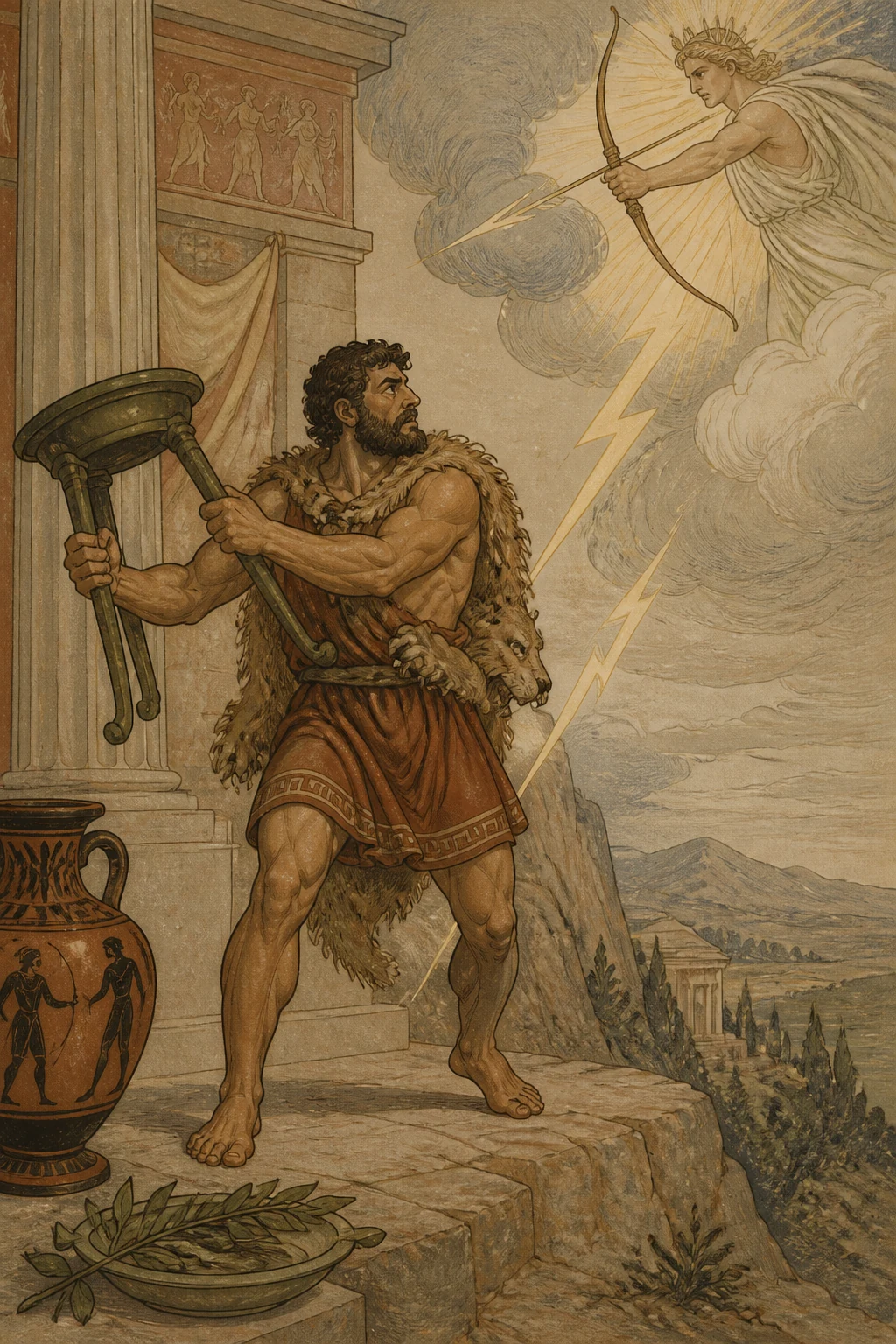
With the Arcadians, the Malians of Trachis, and the Epicnemidian Locrians as his allies, he killed Eurytus and his sons and captured the city. He buried those of his fellow warriors who had fallen—Hippasus, the son of Ceyx, and Argeius and Melas, the sons of Licymnius—then plundered the city and led Iole away as a captive. Putting in at Cenaeum, a headland of Euboea, he established an altar to Cenaean Zeus. As he was preparing to sacrifice, he sent the herald Lichas to Trachis to fetch fine clothing. Deianira learned from Lichas about Iole, and, fearing that Heracles might love the captive more than herself, she smeared the tunic with the blood that had flowed from Nessus, believing it truly to be a love charm. Heracles put it on and began the sacrifice. But as the tunic grew warm, the Hydra’s venom began to eat away his skin. He seized Lichas by the feet and hurled him down from †Boeotia, then tried to tear off the tunic, which clung to his body; his flesh came away with it. In this terrible plight he was carried by ship to Trachis. When Deianira learned what had happened, she hanged herself. Heracles instructed Hyllus, his eldest son by Deianira, to marry Iole when he came of age. Then he went to Mount Oeta, which lies in the territory of Trachis, built a pyre there, climbed onto it, and ordered it to be lit. No one was willing to do this, until Poeas, passing by in search of his flocks, set it alight. In return, Heracles gave him his bow and arrows. As the pyre burned, it is said that a cloud descended with a peal of thunder and carried Heracles up to heaven. There he was granted immortality, became reconciled with Hera, and married her daughter Hebe, by whom he had two sons, Alexiares and Anicetus.
8. By the daughters of Thespius he had the following children: by Procris, Antileon and Hippeus, for the eldest daughter bore twins; by Panope, Threpsippas; by Lyse, Eumedes; Creon; by Epilais, Astyanax; by Certhe, Iobes; by Eurybia, Polylaus; by Patro, Archemachus; by Meline, Laomedon; by Clytippe, Eurycapys; Eury pylus, Eubotes; by Aglaia, Antiades; by Chryseis, Onesippus; by Oreia, Laomenes; by Lysidice, Teles; by Menippis, Entelides; by Anthippe, Hippodromus; by Eury, Teleutagoras; by Capylo, Hippotus; by Euboea, Olympus; by Nice, Nicodromus; by Argele, Cleolaus; by Exole, Erythras; by Xanthis, Homolippus; by Stratonice, Atromus; by Iphis, Celeustanor; by Laothoe, Antiphus; by Antiope, Alopius; by Calametis, Astybies; by Phyleis, Tigasis; by Aeschreis, Leucones; by Antheia; by Eurypyle, Archedicus; by Erato, Dynastes; by Asopis, Mentor; by Eone, Amestrius; by Tiphyse, Lyncaeus; by Olympusa, Halocrates; by Heliconis, Phalias; by Hesychia, Oestro bles; by Euryope, Terpsicrates; by Elacheia, Bouleus; by Nicippe, Antimachus; by Pyrippe, Patroclus; by Praxithea, Nephus; by Lysippe, Erasippus; by Toxicrate, Lycurgus; by Marse, Bucolus; by Eurytele, Leucippus; by Hippo, Hippocrates; Hippozygus. These were his children by the daughters of Thespius. By other women he had the following: by Deianira, the daughter of Oeneus, Hyllus, Ctesippus, Glenus, and Oneites; by Megara, the daughter of Creon, Therimachus, Deicoon, and Creontiades; by Omphale, Agelaus, from whom the family of Croesus was descended; by Chalciope, the daughter of Eurypylus, Thessalus; by Epicaste, the daughter of Augeas, Thestalus; by Parthenope, the daughter of Stymphalus, Eueres; by Auge, the daughter of Aleus, Telephus; by Astyoche, the daughter of Phylas, Tlepolemus; by Astydameia, the daughter of Amyntor, Ctesippus; and by Autonoe, the daughter of Peireus, Palaemon.