Waltey
Grimsborken
Norske Folkeeventyr · Peter Christen Asbjørnsen in Jørgen MoeO besedilu
Grimsborken
- Vir
- Norske Folkeeventyr
- Avtor
- Peter Christen Asbjørnsen in Jørgen Moe
- Jezik branja
- English
- Jezik izvirnika
- Norsk
- Čas branja
- 19 min branja
- Obseg
- 16 strani
- Naslov izvirnika
- 037 Grimsborken
O izvirniku
Norske Folkeeventyr
Norveške ljudske pravljice o gozdu, gorah, prebrisanih junakih in nevarnih bitjih. Bralni jezik je English, izvirnik pa prihaja iz vira Norske Folkeeventyr v jeziku Norsk.
Besedilo
Grimsborken
Once upon a time there was a wealthy couple who had twelve sons. When the youngest was grown, he no longer wanted to stay at home; he wanted to go out and try his luck in the world. His parents said they thought he had everything he could wish for at home, and that he was welcome to stay with them. But he could find no peace; go he would and go he must, and so at last they had to let him. When he had been walking for a good while, he came to a king’s palace. There he asked for work, and work he was given.
The king’s daughter in that country had been carried off into the mountain by a troll, and the king had no other children. Both he and the whole country were therefore in great sorrow and distress, and the king had promised the princess and half his kingdom to whoever could rescue her. But no one could do it, though there were plenty who tried. When the lad had been there a year or so, he wanted to go home again and visit his parents;
but when he reached home, his parents were dead, and his brothers had divided everything they owned among themselves, so that there was nothing left for the lad. “Am I to have no share of what my parents left?” he asked. “Who could have known you were still alive, when you’ve been roving and wandering about like that?” his brothers answered.
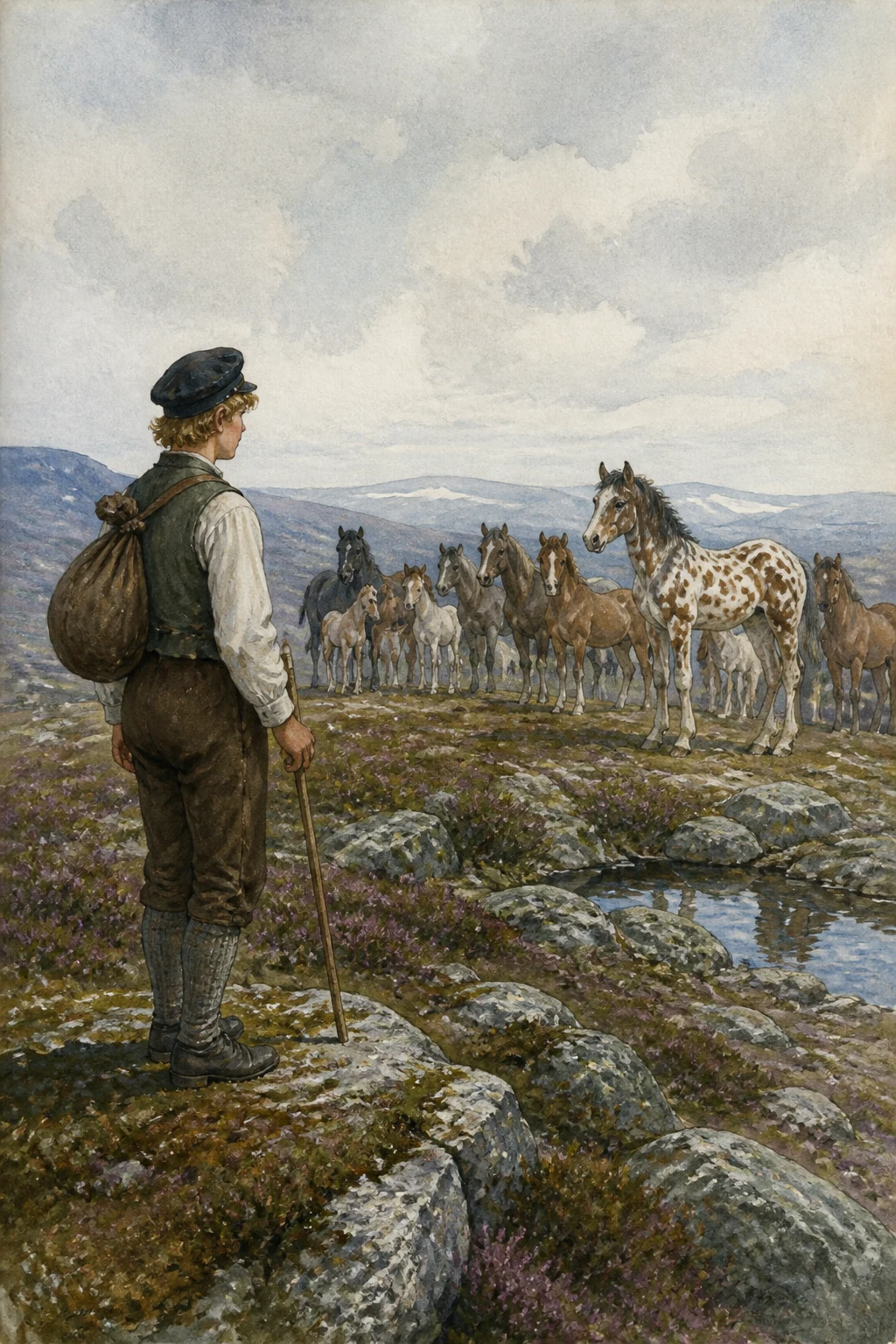
“But never mind; there are twelve mares up on the moors that we haven’t divided yet, and if you’ll have them for your share, you may take them.” The lad was well pleased with this. He thanked them and set off at once for the moors, where the twelve mares were grazing. When he got there and found them, each had a suckling foal, and beside one of the mares there was a big dun colt, so sleek and well fed that his coat shone.
“You’re a handsome fellow, my little colt!” said the lad. “Yes, but if you kill the other foals, so that I can suckle all the mares for a year, you’ll see how big and handsome I shall grow,” said the colt. So the lad did as he was asked: he killed all twelve foals and went home again.
When he came back the following year to look after the colt and the mares, the colt was so fat that his hide gleamed, and so tall that the lad could barely climb onto his back; and all the mares had foaled again. “Well, I certainly got something in return for letting you suckle all my mares,” said the lad to the yearling. “But now you’re big enough, and you must come with me.” “No, I must stay here another year,” said the colt. “Kill the twelve foals now, so that I can suckle all the mares this year too, and you’ll see how big and handsome I shall be by next summer!” So the lad did as he was asked once more. When he came up to the moors the second year to see to his colt and his mares, each mare had a foal, but the dun colt was so big that the lad could not reach up to feel his neck and see how fat he was, and his coat was so glossy that it shone. “You were big and handsome last year, my colt, but this year you’re finer still,” said the lad. “There’s no horse like you in the king’s stables. But now you must come with me.” “No,” said the dun colt again. “I must stay here one more year. Just kill the twelve foals again, so that I can suckle the mares this year too, and then you’ll have something to look at next summer!” The lad did that too: he killed all the foals and went home again.
But when he returned the following year to look after the dun colt and his mares, he was quite taken aback. He had never thought a horse could grow so huge and powerful;
for the dun had to lie down before the lad could mount him, and even with the horse lying down, he had all he could do to climb onto his back. And the horse was so sleek and fat that he gleamed and glittered like a looking glass. This time the dun was quite willing to go with the lad. So the lad mounted him, and when he came riding home to his brothers, they threw up their hands and crossed themselves, for they had never seen or heard of such a horse. “If you’ll have my horse shod as well as can be, and get him the finest saddle and bridle to be had,” said the lad, “you shall have all twelve of my mares, just as they stand up on the moors, and their twelve foals as well”—for that year too each mare had foaled. The brothers were glad to agree, and the lad had his horse shod so well that splinters of stone flew high into the air when he rode over the mountain moors. And he was given a golden saddle and a golden bridle that shone and glittered from far away. “Now we’ll go to the king’s palace,” said Grimsborken—for that was his name—“but be sure to ask the king for a good roomy stable and good fodder for me.” The lad promised not to forget, and rode away; and you may be sure it did not take him long to reach the palace, with such a horse as his.
When he arrived, the king was standing outside on the steps, and he stared and stared at the rider coming towards him. “Well, well!” he said. “Never in all my life have I seen such a fellow or such a horse!” And when the lad asked whether he could have work at the palace, the king was so delighted that he was ready to leap and dance where he stood on the steps. Work? Of course he should have work! “Yes, but I must have a good roomy stable and proper fodder for my horse,” said the lad.
Yes, he should have meadow hay and oats, as much as the dun could eat, and the other knights must lead their horses out of the stable. Grimsborken should have it all to himself, so that he would have plenty of room.
But it was not long before the others at the palace grew jealous of the lad, and there was no end to the harm they would have done him, if only they had dared. At last they hit upon telling the king that the lad had boasted he could rescue the princess, whom the troll had carried off into the mountain long ago, if only he chose. The king at once summoned him and said he knew what the lad had claimed he could do, and now he must do it. If he succeeded, he knew the king had promised both his daughter and half the kingdom, and these he should duly and honestly receive; but if he failed, he should be put to death. The lad denied having said any such thing, but it was no use, for the king would not listen, and there was nothing for it but to say he would have to try.
So he went down to the stable, gloomy and sorrowful. Grimsborken asked what made him so downhearted. The lad told him, and said he did not know what to do. “For rescuing the princess is surely quite impossible,” he said. “Oh, it might well be managed,” said Grimsborken. “I’ll help you, but first you must have me properly shod. You must ask for twenty pounds of iron and twelve pounds of steel for the shoes, and one smith to forge them and another to fit them.” The lad did so, and his request was not refused: he was given the iron and steel and the smiths, and Grimsborken was shod well and truly. Then off the lad rode from the palace, leaving a cloud of dust behind him. But when he reached the mountain into which the princess had been carried, the difficulty was to climb the rock face to the place where he must enter; for the mountain rose straight up, as steep as the wall of a house and as smooth as a pane of glass. The first time the lad charged at it, he got some way up the rock face, but then the dun slipped with both forefeet, and down they came again with a crash that thundered over the moors. The second time he charged, he got a little farther up, but then one forefoot slipped, and down they came with a roar like a landslide. But the third time the dun said, “Now we must give it our all!” And off he went, sending stones flying sky-high about them, and this time they reached the top;
the lad rode in at full gallop, swept the princess up onto the pommel of his saddle, and was out again before the troll could so much as rise to his feet—and so the princess was saved.
When the lad returned to the palace, the king was happy and delighted to have his daughter back, as you may well imagine. But somehow or other the rest of the court had set the king against the lad, so that he was angry with him all the same. “Thank you for rescuing my princess,” he said when the lad came into the palace with her, and then he made to walk away. “She should be mine now as well as yours, for surely you are a man of your word,” said the lad. “Yes, yes,” said the king, “you shall have her, since I have said so. But first you must make the sun shine into the palace.” For just outside the windows stood a great high mountain, casting its shadow over the palace so that no sunlight could enter. “That wasn’t part of the bargain,” answered the lad. “But I suppose there’s no use pleading. I must do my best, for I mean to have the princess.” Down he went to the dun again and told him what the king demanded. Grimsborken thought it could be managed, but first he must have new shoes, and for those he would need twenty pounds of iron and twelve pounds of steel. He would need two smiths as well, one to forge them and one to fit them; then they would surely make the sun shine into the palace. When the lad asked for these things, he was given them at once; the king felt he could not refuse for very shame. So Grimsborken was shod afresh, and with shoes worth having. The lad mounted, and off they went again. With every leap Grimsborken took, the mountain sank fifteen ells into the earth, and so they kept on until the king could no longer see a trace of it.
When the lad came back down to the palace, he asked the king whether the princess should not be his now, for, as far as he could tell, the sun was shining into the palace.
But the others at court had been setting the king against him again, and he answered that of course the lad should have her; he had never meant otherwise. But first he must find her as fine a bridal horse as he himself had for a bridegroom’s mount. The lad said the king had never spoken of that before, and he thought he had earned the princess by now. But the king stood his ground, and said that if the lad could not do it, he should lose his life into the bargain.
The lad went down to the stable again, and sorrowful and downhearted he was, as you may well imagine. There he told Grimsborken that the king had now ordered him to find the princess as fine a bridal horse as his own bridegroom’s mount, or else he should lose his life. “But that won’t be easy,” he said, “for surely there’s not your equal in all the world.” “Oh yes, there is a horse to match me,” answered Grimsborken, “but getting hold of it won’t be easy;
it is in Hell. Still, we shall have to try. Now go up to the king and ask for new shoes for me, and for those we shall need twenty pounds of iron and twelve pounds of steel again, and two smiths, one to forge them and one to fit them. But be sure the hooks and calkins are good and sharp. We must also take twelve barrels of rye and twelve barrels of barley, and twelve slaughtered oxen. And you must ask for all twelve oxhides as well, with twelve hundred nails in each. We shall need it all.” The lad went up to the king and asked for everything Grimsborken had named. Once again the king felt it would be shameful to refuse him, and so he was given it all.
Then he mounted Grimsborken and rode away, and when he had ridden far, far over mountains and moors, the dun asked, “Do you hear anything?” “Yes, there’s a dreadful rushing sound up in the air. I’m beginning to feel afraid,” said the lad.
“Those are all the wild birds of the forest coming on the wing; they have been sent to stop us,” said Grimsborken. “But cut holes in the grain sacks, and they’ll be so busy with the grain that they’ll forget about us.” The lad did so: he cut holes in the sacks, and the barley and rye poured out on every side.
Then came all the wild birds of the forest, so thickly that they darkened the sun. But when they saw the grain, they could not help themselves: they settled down and began pecking and picking up the grain and rye, and at last they began fighting among themselves;
they did no harm to the lad and Grimsborken, but forgot them entirely. Now the lad rode on for a long, long way, over mountains and valleys, over ridges and moorlands. Then Grimsborken pricked up his ears again and asked the lad whether he could hear anything now.
“Yes, now I hear a dreadful crashing in the forest on every side. I think I’m getting frightened now,” said the lad. “Those are all the wild beasts of the forest,” said Grimsborken. “They have been sent to stop us. But just throw out the twelve ox carcasses, and they’ll have enough to keep them busy, and forget about us.” So the lad threw out the ox carcasses, and up came all the wild beasts of the forest—bears and wolves and lions and every kind of fearsome creature. But when they saw the ox carcasses, they began fighting over them till the blood flowed, and forgot the lad and Grimsborken entirely.
Then the lad rode far on again, over many and many a blue horizon, for Grimsborken did not go slowly, you may be sure. Then the dun neighed. “Do you hear anything?” he asked. “Yes, I heard what sounded like a little foal whinnying, far, far away,” answered the lad. “That’s a well-grown foal, I can tell you!” said Grimsborken. “His voice only sounded so thin because he is so far from us.” Then they travelled another good stretch, over another blue ridge or so. Grimsborken neighed again.
“Do you hear anything now?” he asked. “Yes, now I distinctly heard a neigh like a full-grown horse’s,” answered the lad. “You’ll hear him once more yet,” said Grimsborken, “and then you’ll hear what a voice he has.” They travelled over another blue ridge or so, and Grimsborken neighed for the third time. But before he could ask the lad whether he heard anything, a neigh rang out across the moor so loud that the lad thought the mountains and crags would split apart. “Now he’s here,” said Grimsborken. “Quickly, throw the oxhides with the nails in them over me, and roll the barrel of tar out across the ground. Then climb up that great spruce tree. When he comes, he’ll breathe fire from both nostrils, and the tar barrel will catch alight. Watch carefully: if the flame rises, I am winning; but if it sinks, I am losing. And when you see that I am winning, throw the bridle over him—you must take it off me—and then he’ll be tame.” The lad had only just thrown the nail-studded hides over Grimsborken, rolled the tar barrel out across the ground, and climbed safely into the spruce, when up came a horse with fire streaming from him, and at once the tar barrel burst into flame. Then he and Grimsborken fell to fighting, so that the stones danced sky-high. They bit and struck out with both forelegs and hind legs, and the lad looked now at them and now at the tar barrel. At last the flame rose, for wherever the other horse bit or struck, he met the nail-studded hides, and at last he had to yield. When the lad saw this, he was not long in climbing down from the tree and throwing the bridle over the horse. Then it grew so tame that he could have guided it with a thread;
that horse was dun too, and so like Grimsborken that no one could tell one from the other. The lad mounted the dun horse he had caught and rode home to the palace, while Grimsborken ran loose beside him. When he arrived, the king was standing in the courtyard. “Can you tell me now which horse I caught, and which I had before?” said the lad. “If you cannot, I think your daughter belongs to me.” The king went round looking at both the duns, high and low, in front and behind, but not a hair on one was different from the other. “No,” said the king, “I cannot tell you; and since you have found my daughter so fine a bridal horse, you shall gladly have her. But first we must try one thing: whether it is meant to be. Now she must hide twice,” he said, “and afterwards you must hide twice. If you can find her both times she hides, but she cannot find you in your hiding place, then it is meant to be, and you shall have the princess.” “That isn’t in the bargain either,” said the lad. “But we must try, I suppose, if that is how it must be.” And so the princess was to hide first.
She turned herself into a duck and swam about on the water close by the palace. But the lad simply went down to the stable and asked Grimsborken where she had gone. “Oh, you need only take your gun and go down to the well and aim at the duck swimming there,” said Grimsborken, “and she’ll soon show herself again.” The lad snatched up his gun and hurried down to the water. “I think I’ll take a shot at this duck,” he said, and began to aim at it. “No, no, dear fellow, don’t shoot! It’s me!” said the princess, and so he had found her that time.
The second time the princess turned herself into a loaf of bread and lay on the table among four others. She was so like the other loaves that no one could tell them apart. But the lad went down to Grimsborken in the stable again and said that the princess had hidden once more, and he had no idea where she had gone. “Oh, just sharpen a good big bread knife and pretend you are going to cut straight through the third loaf from the left of the four loaves lying on the palace kitchen table, and she’ll soon show herself again,” said Grimsborken. So up went the lad to the kitchen and began sharpening the largest bread knife he could find. Then he seized the third loaf from the left and set the knife against it, as though he meant to cut it right through. “I think I’ll have a crust off this loaf,” he said. “No, dear fellow, don’t cut! It’s me!” said the princess again, and so he had found her the second time too.
Now it was his turn to hide; but Grimsborken gave him such good advice that he was no easy thing to find. First he turned himself into a horsefly and hid in Grimsborken’s left nostril. The princess went searching and prying everywhere, high and low, and she wanted to go into Grimsborken’s stall as well. But he began biting and kicking so fiercely that she dared not come near, and so she could not find the lad.
“Well, since I cannot find you, you must come out of your own accord,” she said, and at once the lad stood there on the stable floor. The second time Grimsborken again told him what to turn himself into, and this time he became a clod of earth and lodged between the hoof and the shoe of the dun’s left foreleg. The princess went searching and searching again, both outdoors and in, and at last she came to the stable and wanted to enter Grimsborken’s stall. This time he let her come right up to him, and she searched high and low;
but she could not get beneath his hoofs, for Grimsborken stood too firmly on his feet for that, and so she could not find the lad. “Well, then, you must come out of your own accord, since I cannot find you,” said the princess, and that very moment the lad stood beside her on the stable floor. “Now you are mine,” said the lad to the princess. “For now you can see it is meant to be,” he said to the king. “Yes, if it is meant to be, then so it must be,” said the king. Fine preparations were soon made for the wedding, and the lad mounted Grimsborken and the princess his match; and you may be sure they were not long on the road to church.
Izvirnik
037 Grimsborken
Naslednje strani prikazujejo izvirno besedilo za primerjavo.
Der var en Gang et Par rige Folk, som havde tolv Sønner; men den yngste vilde ikke være hjemme længer, da han var bleven voxen; han vilde ud at prøve sin Lykke i Verden. Forældrene sagde, de syntes han havde det godt og vel der hjemme, og at han gjerne kunde blive hos dem; men han havde ingen Ro paa sig; han vilde og han skulde i Veien, og saa maatte han da faae Lov. Da han havde gaaet en god Stund, kom han til en Kongsgaard. Der bad han om Tjeneste, og den fik han.
Kongsdatteren der i Landet var tagen ind i Fjeldet af Troldet, og Kongen havde ikke flere Børn; derfor var baade han og hele Landet i stor Sorg og Bedrøvelse, og Kongen havde lovet ud Prindsessen og halve Riget til den, som kunde frelse hende; men der var Ingen som kunde det, endda der var nok af dem, som prøvede paa. Da nu Gutten havde været der et Aars Tid eller saa, vilde han hjem igjen og besøge Forældrene sine; men da han kom hjem, vare Forældrene hans døde, og Brødrene havde deelt Alt, de eiede og havde, mellem sig, saa der ikke var Noget igjen til Gutten. „Skal jeg da ikke have Noget efter Forældrene mine?“ spurgte Gutten. „Hvem kunde vide, at du var til endnu, som har ranglet og flakket saa omkring?“ svarede Brødrene.
„Men det er det samme; oppe i Heierne gaaer der tolv Hopper, dem har vi ikke deelt endnu, og vil du have dem for din Deel, kan du tage dem.“ Ja, det var Gutten vel fornøiet med; han takkede til og lagde strax afsted op i Heierne, hvor de tolv Hopperne gik paa Havn. Da han kom derop og fandt dem, havde hver sin Sugerfole, og med den ene Hoppen gik der en stor borket Foleunge; den var i sligt et Huld, at det skinnede i den.
„Du er vakker du, vesle Foleungen min!“ sagde Gutten. „Ja, men vil du slaae ihjel de andre Foleungerne, saa jeg kan faae suge alle Hopperne et Aar, skal du see jeg skal blive stor og vakker da,“ sagde Folen. Ja, det gjorde Gutten; han slog ihjel alle tolv Folerne, og gik saa hjem igjen. Da han saa kom igjen næste Aaret og skulde see til Folen og Hoperne, var den saa fed, saa fed at det glindsede i Huden paa den, og saa stor var den, at Gutten med Nød og Neppe kunde komme op paa den; og alle Hopperne havde faaet hver sin Foleunge igjen. „Ja, det er sandt at jeg fik Lige for det, jeg lod dig suge alle Hopperne mine,“ sagde Gutten til Eenaaringen, „men nu er du stor nok, nu faaer du være med mig.“ „Nei, jeg faaer gaae her eet Aar til,“ sagde Folen, slaa nu
ihjel de tolv Foleungerne, saa jeg kan suge alle Hopperne dette Aaret ogsaa, saa skal du see, jeg skal blive stor og vakker til Sommeren!“ Ja, det gjorde Gutten igjen; og da han kom op i Heierne det andet Aar og skulde see til Folen sin og Hopperne sine, havde de hver sin Foleunge, men Borkfolen var saa stor at Gutten slet ikke naaede op, da han vilde tage i Nakken paa den forat kjende, hvor fed den var, og saa blank var den, at det lyste af den. „Stor og vakker var du i Fjor, Folen min, men i Aar er du endnu gjildere,“ sagde Gutten: „slig Hest findes ikke i Kongens Gaard. Men nu faaer du være med mig.“ „Nei,“ sagde Borken igjen; „jeg faaer gaae her endnu eet Aar til. Slaa nu bare ihjel de tolv Folungerne igjen,
saa jeg kan suge Hopperne dette Aaret ogsaa, saa skal du vel faae see mig til Sommeren!“ Ja, Gutten gjorde det ogsaa; han slog ihjel alle Foleungerne, og saa gik han hjem igjen. Men da han kom igjen det næste Aar og skulde see til Borkefolen og Hopperne sine, blev han reent forfærdet. Saa stor og grovvoxen havde han aldrig troet at Hest kunde blive; for Borken maatte lægge sig ned paa alle Fire, førend Gutten kunde tage op paa den, han havde nok med at komme op paa den, endda den laa, og saa smækfed var den, at det glindsede og blinkede i den som i Speilglas. Og den Gang var ikke Borken uvillig til at følge med Gutten; han satte sig da op paa den, og da han kom ridende hjem til Brødrene sine, slog de Hænderne
sammen og forkorsede sig, for slig Hest havde de hverken seet eller hørt tale om før. „Dersom I nu vil skaffe mig saa god Skoning under Hesten min, og saa gjild Sadel og Bidsel, som gives kan,“ sagde Gutten, „saa skal I faae alle tolv Hopperne mine, slige de staae og gaae oppe i Heierne, og de tolv Foleungerne deres ogsaa,“ — det Aar havde ogsaa hver Hoppe faaet sin Fole —. Det vilde Brødrene gjerne, og saa fik Gutten slig Skoning under Hesten, at Stenstykkerne fløi høit i Luften, naar han red bortover Fjeldheierne, og slig Guldsadel og sligt Guldbidsel fik han, at det lyste og blinkede lang Vei af det. „Nu reiser vi til Kongsgaarden,“ sagde Grimsborken — det var Navnet dens, — „men kom vel ihu at bede
Kongen om godt Staldrum og godt Foder til mig.“ Ja, det lovede Gutten, han ikke skulde glemme, han red af Gaarde og En kan nok vide, han ikke var længe om at komme til Kongsgaarden, slig Hest som han havde. Da han kom der, stod Kongen ude paa Trappen, og han stirrede og han saa paa ham, som kom ridende. „Nei, nei!“ sagde han, „slig Karl og slig Hest har jeg aldrig seet i mit levende Liv før;“ og da Gutten spurgte, om han kunde faae Tjeneste i Kongsgaarden, blev Kongen saa glad, at han var færdig at hoppe og dandse, der han stod paa Trappen; det kan vel hænde, at han skulde faae Tjeneste. „Ja, men godt Staldrum og forsvarligt Foder vil jeg have til Hesten min,“ sagde Gutten.
Ja, han skulde faae Voldhø og Havre, saa meget Borken vilde have, og de andre Ridderne maatte lede Hestene sine ud af Stalden, der skulde Grimsborken staae alene, saa den kunde have rigtig godt Rum. Men det varede ikke længe før de Andre i Kongsgaarden bleve misundelige paa Gutten, og de vidste ikke alt det Onde, de vilde gjøre ham, naar de bare turde. Tilsidst fandt de paa at sige til Kongen, at han havde sagt sig god for at frelse Kongsdatteren, som Troldet for lang Tid siden havde taget ind i Bjerget, naar han bare vilde. Strax kaldte Kongen ham frem for sig og sagde, at det og det vidste han, Gutten havde sagt sig god for, og nu skulde han gjøre det; kunde han det, saa vidste han, at
Kongen havde lovet ud baade Datteren og halve Riget, og det skulde han rigtig og redelig faae, men kunde han det ikke, skulde han dræbes. Gutten negtede, at han havde sagt det, men det hjalp ikke, for Kongen vilde ikke høre paa det Øre, og saa var der ikke andet Raad end at han maatte sige, han vel fik prøve. Han gik da ned i Stalden stur og sørgmodig som han var.
Saa spurgte Grimsborken ham, hvad han var saa bedrøvet for; det fortalte Gutten og sagde, at han ikke vidste, hvorledes han skulde stelle sig; „for at faae frelst Prindsessen, det er vel reent umuligt, det,“ sagde Gutten. „Aa, det kunde vel lade sig gjøre,“ sagde Grimsborken, „jeg skal hjælpe dig, men vel skoet maa du først faae mig. Du maa forlange tyve Pund Jern og tolv Pund Staal til Skoning, og en Smed til at smide og en til at lægge under.“ Ja, det gjorde Gutten, og der var ikke svaret Nei til det, han fik baade Jernet og Staalet og Smedene, og saa blev Grimsborken skoet baade godt og vel, og Gutten ud af Kongsgaarden saa Støvskodden stod efter. Men da han kom til Bjerget, som Prindsessen var taget ind i, saa gjældte
det at komme op efter Bjergvæggen did, hvor han skulde ind i Fjeldet, for Bjerget stod, Ende op og ned, saa brat som en Stuevæg og saa glat som en Glasrude. Første Gang, Gutten red i Veien, kom han nok et Stykke op efter Fjeldvæggen, men saa gled Borken med begge Forbenene, og de ned igjen, saa det dundrede i Heien. Anden Gang, han red, kom han et Stykke længer op, men saa glap det ene Forbenet, og ned bar det, som du skulde hørt et Jordskred. Men tredie Gangen sagde Borken: „Nu faaer vi prøve os!“ og saa satte han i Veien, saa Stenene sprutede Himmels høit om dem, og saa kom de op; Gutten red ind i fuldt Fiirsprang og nappede Kongsdatteren op paa Sadelknappen, og ud igjen, før Troldet kom sig fore saa
meget som at reise sig — og saa var Prindsessen frelst. Da Gutten kom tilbage til Kongsgaarden, var Kongen baade glad og fornøiet i det, at han havde faaet Datteren sin igjen, det kan du nok vide; men hvorledes det var og ikke var, saa havde de Andre paa Kongsgaarden faaet stelt op Kongen, saa han var vred paa Gutten ligevel. „Tak skal du have, for du har frelst Prindsessen min,“ sagde han til Gutten, da denne kom ind i Slottet med hende, og vilde saa gaae sin Vei. „Hun skulde være min, ligesaa vel som din nu, for du er vel ordstød Mand,“ sagde Gutten. „Ja, ja,“ sagde Kongen, „have hende skal du, siden jeg har sagt det; men først skal du skaffe Solen til at skinne her ind i Kongsgaarden,“ — for der var et stort, høit Fjeld lige udenfor Vinduerne, som stod og skyggede,
saa at Solen ikke kunde skinne ind —. „Det stod nok ikke i Akkorden det,“ svarede Gutten; „men der hjælper vel ingen Bøn, jeg faaer vel prøve mit Bedste, for Prindsessen vil jeg have.“ Han ned til Borken igjen og fortalte, hvad Kongen forlangte, og saa meente Grimsborken, at det vel gik an; men ny Skoning maatte først under ham, og den maatte der tyve Pund Jern og tolv Pund Staal til; to Smede vilde der ogsaa til, en til at smide og en til at lægge under, saa skulde de vel faae Solen til at skinne i Kongsgaarden. Da Gutten forlangte dette, fik han det strax; det syntes Kongen for Skams Skyld ikke han kunde negte ham, og saa blev der da lagt ny Skoning under Grimsborken, og det Skoning, som duede. Gutten
satte sig paa, og saa bar det sagtens i Veien igjen, og for hvert Hop, Grimsborken gjorde, sank Fjeldet femten Alen ned i Jorden, og saaledes holdt de paa til Kongen ikke kunde see mere til Fjeldet. Da Gutten kom ned igjen i Kongsgaarden, spurgte han Kongen, om ikke endnu Prindsessen skulde være hans, for nu vidste han ikke Andet end at Solen skinte i Slottet, sagde han.
Men saa havde de Andre i Kongsgaarden sat Kongen op igjen, og saa svarede han, at Gutten nok skulde faae hende, han havde aldrig Andet tænkt, men først skulde han skaffe hende saa gjild Brudehest, som han havde Brudgomshest. Gutten sagde, at det havde Kongen aldrig talt om før, og nu syntes han, at han havde fortjent Prindsessen; men Kongen blev ved Sit, og dersom Gutten ikke kunde det, skulde han miste Livet til, sagde Kongen.
Gutten gik ned i Stalden igjen, og sørgmodig og bedrøvet var han, det kan du sagtens vide; der fortalte han til Grimsborken, at nu havde Kongen paalagt ham at skaffe Prindsessen saa gjild Brudehest, som han havde Brudgomshest, ellers skulde han miste Livet; „men det bliver nok ikke let,“ sagde han, „for din Mage gives vel ikke i Verden.“ „Aa jo, der er Mage til mig,“ svarede Grimsborken; „men let bliver det ikke at faae den; den er i Helvede den. Men vi faae vel prøve. Nu skal du gaae op til Kongen og forlange ny Skoning under mig, og til den maa der tyve Pund Jern og tolv Pund Staal igjen, og to Smede, en til at smide og en til at lægge under, men see endelig til, at Hagerne og Grævene blive vel hvasse; og tolv
Tønder Rug og tolv Tønder Byg, og tolv slagtede Oxer maae vi have med os, og alle tolv Oxehuderne, med tolv hundrede Spiger i hver, maa du ogsaa forlange; alt det maae vi have.“ Gutten gik op til Kongen og forlangte Alt, Grimsborken havde sagt, og Kongen syntes nu igjen det var Skam at negte ham det, derfor fik han det Altsammen. Saa satte han sig op paa Grimsborken og red af Gaarde, og da han saa havde redet langt, langt bort over baade Bjerg og Heier, spurgte Borken: „Hører du Noget?“ „Ja, det suser saa fælt oppe i Luften; jeg mener jeg bliver ræd jeg,“ sagde Gutten.
„Det er alle de vilde Fugle, i Skoven ere, som komme flyvende; de ere udsendte for at standse os,“ sagde Grimsborken. „Men skjær Hul paa Kornsækkene, du, saa faae de saa travlt med Kornet, at de glemme os.“ Ja, det gjorde Gutten, han skar Hul paa Kornsækkene, saa Bygget og Rugen randt udover til alle Sider. Saa kom alle de vilde Fugle, i Skoven vare, saa tykt, at det sortnede for Solen; men da de fik see Kornet, saa kunde de ikke bare sig, men slog sig ned og begyndte at hakke og pikke op Kornet og Rugen, og tilsidst begyndte de at slaaes sig imellem; Gutten og Grimsborken gjorde de ikke Noget, dem glemte de reent.
Nu red Gutten igjen baade langt og længe, over Bjerge og Dale, over Aaser og Moer; saa begyndte Grimsborken at lye igjen, og saa spurgte den Gutten, om han hørte Noget nu. „Ja, nu hører jeg det brager saa stygt i Skoven paa alle Kanter; jeg mener jeg bliver ræd nu,“ sagde Gutten. „Det er alle de vilde Dyr, i Skoven ere, det,“ sagde Grimsborken; „de ere udsendte for at standse os. Men kast bare ud de tolv Oxeskrotterne, saa have de nok at gjøre med dem, og saa glemme de os.“ Ja, Gutten kastede ud Oxeskrotterne, og saa kom alle de vilde Dyr i Skoven, baade Bjørne og Graabener og Løver og alle Slags fæle Dyr; men da de fik see Oxeskrotterne, begyndte de at slaaes om dem, saa Blodet flømmede, og Gutten og Grimsborken
glemte de reent. Saa red Gutten langt bortover igjen, det var mange mange Blaaner, for med Grimsborken gik det ikke sagte, kan En nok vide; saa knæggede Borken. „Hører du Noget?“ sagde den. „Jo jeg hørte ligesom en Foleunge knægge saa grant, langt, langt borte,“ svarede Gutten. „Det var nok en voxen Foleunge det!“ sagde Grimsborken, „det hørtes saa grant af det, han er saa langt fra os.“ Derpaa reiste de et godt Stykke, en Blaane eller Noget, igjen. Saa knæggede Grimsborken paa Nyt.
„Hører du Noget nu?“ sagde han. „Ja, nu hørte jeg tydelig det knæggede, som en voxen Hest,“ svarede Gutten. „Ja du faaer nok høre den en Gang endnu,“ sagde Grimsborken, „da skal du høre, der er Maal i den.“ De reiste en Blaane eller Noget igjen, saa knæggede Grimsborken tredie Gang, men førend den nu fik spurgt Gutten om han hørte Noget, saa knæggede det borte i Heien, saa Gutten tænkte at baade Bjerg og Fjeld skulde revne. „Nu er den her,“ sagde Grimsborken. „Skynd dig nu og kast Oxehuderne med Spigerne i over mig, og Tjæretønden kaster du bortover Marken; klyv saa op i den store Granen der. Naar den kommer, spruder den Ild ud af begge Næseborene, og saa tager det Varme i Tjæretønden. Læg saa
vel Mærke: dersom Luen stiger, saa vinder jeg; men dersom den falder, saa taber jeg. Men seer du jeg vinder, saa kaster du paa den Bidslet — det maa du tage af mig — og saa er den spag.“ Netop Gutten havde faaet kastet Spigerhudene over Grimsborken og Tjæretønden bortefter Marken og vel var kommen op i Granen, saa kom der en Hest, saa Varmen sprudede af den, og saa fløi der Ild i Tjæretønden med det samme; og den og Grimsborken til at slaaes, saa Stenene dandsede Himmels høit. De bed og de slog baade med Frembenene og Bagbenene, og somme Tider saa Gutten paa dem og somme Tider saa han paa Tjæretønden, men tilsidst steg Luen: for hvor den anden Hest bed og hvor den slog, saa traf den Spigerhuderne, og saa maatte den give sig. Da Gutten saa det, var han ikke længe
om at komme ned af Træet og faae kastet Bidslet paa den, og saa var den saa spag, at han kunde styret den med en Tvindetraad; den Hesten var ogsaa borket, og saa lig Grimsborken, at Ingen kunde skille den ene fra den anden. Gutten satte sig op paa den borkede Hesten, han havde fanget, og red hjem igjen til Kongsgaarden, og Grimsborken sprang med løs. Da han kom der, stod Kongen ude i Gaarden. „Kan du nu sige mig, hvad for en Hest jeg har fanget, og hvad for en jeg havde før?“ sagde Gutten. „Kan du ikke det, saa mener jeg, Datteren din hører mig til.“ Kongen gik og saa paa begge Borkene, baade høit og lavt, baade fremme og bag, men der var ikke et Haar anderledes paa den ene end paa den anden. „Nei,“ sagde Kongen,
„det kan jeg ikke sige dig; og siden du har skaffet Datteren min saa gjild Brudehest skal du gjerne faae hende. Men Eet maae vi prøve først: om det er saa laget. Nu skal først hun gjemme sig to Gange,“ sagde han, „og siden skal du gjemme dig to Gange; dersom du da kan finde hende de Gange, hun har gjemt sig, men hun ikke finder dig i dit Gjemsel, saa er det saa laget, og saa skal du faae Prindsessen.“ „Det staaer nu ikke i Akkorden, det heller,“ sagde Gutten; „men vi faae vel prøve, siden det saa skal være,“ og saa skulde Kongsdatteren til at gjemme sig først.
Hun skabte sig til en And og laa og svømmede i Vandet, som var tæt udenfor Kongsgaarden. Men Gutten gik bare ned i Stalden, og spurgte Grimsborken, hvor hun havde gjort af sig. „Aa, du behøver bare at tage Geværet dit og gaae ned til Brønden og sigte paa den Anden, som ligger og svømmer der,“ sagde Grimsborken, „saa kommer hun nok frem igjen.“ Gutten nappede Geværet og lagde ned til Vandet, han; „jeg vil nok klemme paa denne Anden,“ sagde han, og gav sig til at sigte paa den. „Nei, nei, kjære Vene, skyd ikke; det er mig!“ sagde Prindsessen, saa havde han fundet hende den Gangen.
Den anden Gang skabte Prindsessen sig til et Brød og lagde sig paa Bordet mellem fire andre; og saa lig var hun de andre Brødene, at Ingen kunde skille dem fra hverandre. Men Gutten gik igjen ned i Stalden til Grimsborken, og sagde at nu havde Prindsessen gjemt sig igjen, og han vidste slet ikke, hvor der var bleven af hende. „Aa, tag bare og bryn en dygtig Brødkniv og lad som du vilde skjære tvers igjennem det tredie Brødet fra venstre Haand af de fire Brødene, som ligge paa Kjøkkenbordet i Kongsgaarden, saa kommer hun nok frem igjen,“ sagde Grimsborken. Ja, Gutten op i Kjøkkenet og til at bryne den største Brødkniven, han kunde finde, greb saa det tredie Brødet fra venstre Haand og satte Kniven paa det, som han vilde skjære
det tvært igjennem. „Jeg vil nok have mig en Skalk af dette Brødet,“ sagde han. „Nei, kjære Vene, skjær ikke, det er mig!“ sagde Prindsessen igjen, og saa havde han fundet hende anden Gang ogsaa. Saa skulde han til at gjemme sig; men ham sagde Grimsborken saa vel fore, at han ikke var god at finde igjen. Først skabte han sig til en Klæg og gjemte sig i det venstre Næseboret til Grimsborken; og Prindsessen gik og ledte og snuste allesteds, baade høit og lavt, og saa vilde hun ogsaa op i Spiltauget til Grimsborken; men han til at bide og slaae om sig, saa at hun ikke turde komme der, og saa kunde hun ikke finde ham.
„Ja, siden jeg ikke kan finde dig, saa faaer du komme frem igjen af dig selv,“ sagde hun, og strax stod Gutten der paa Staldgulvet. Anden Gang sagde Grimsborken ham igjen, hvad han skulde gjøre sig til, og den Gang skabte han sig til en Jordklump og satte sig mellem Hoven og Skoen paa det venstre Forbenet til Borken; Kongsdatteren gik og ledte og ledte igjen, baade, ude og inde, og tilsidst kom hun da i Stalden og vilde op i Spiltauget til Grimsborken. Ja denne Gangen lod han hende komme op i til sig, og hun snuste baade høit og lavt; men under Hovene kunde hun ikke komme, han stod for fast paa Benene til det, Grimsborken; og saa kunde hun ikke finde Gutten.
„Ja, saa faaer du komme frem igjen af dig selv da, siden jeg ikke kan finde dig,“ sagde Prindsessen, og idet samme stod Gutten ved Siden af hende paa Staldgulvet. „Ja nu er du min,“ sagde Gutten til Prindsessen; „for nu kan du see, det er saa laget,“ sagde han til Kongen. „Ja, er det saa laget, saa faaer det saa blive,“ sagde Kongen; der blev lavet til Bryllup baade vel og snart, og Gutten satte sig paa Grimsborken og Kongsdatteren paa Magen hans; saa kan du nok vide, de ikke var længe om Kirkeveien.
Nadaljuj z branjem