Prevod
It was so lovely out in the country; it was summer, the wheat stood golden, the oats were green, and the hay was piled in stacks down in the green meadows. There the stork walked on his long red legs, chattering Egyptian, for that was the language his mother had taught him. Around the fields and meadows lay great forests, and deep lakes lay in the midst of the forests; yes, it really was lovely out in the country! In the sunshine stood an old manor house surrounded by deep canals, and from its walls down to the water grew great burdock leaves, so tall that little children could stand upright beneath the largest of them. It was as wild in there as in the thickest forest, and here a duck lay on her nest. She was waiting for her little ducklings to hatch, but by now she was almost tired of it, because it took so long and she seldom had visitors. The other ducks preferred swimming about in the canals to scrambling up and sitting beneath a burdock leaf to chatter with her.
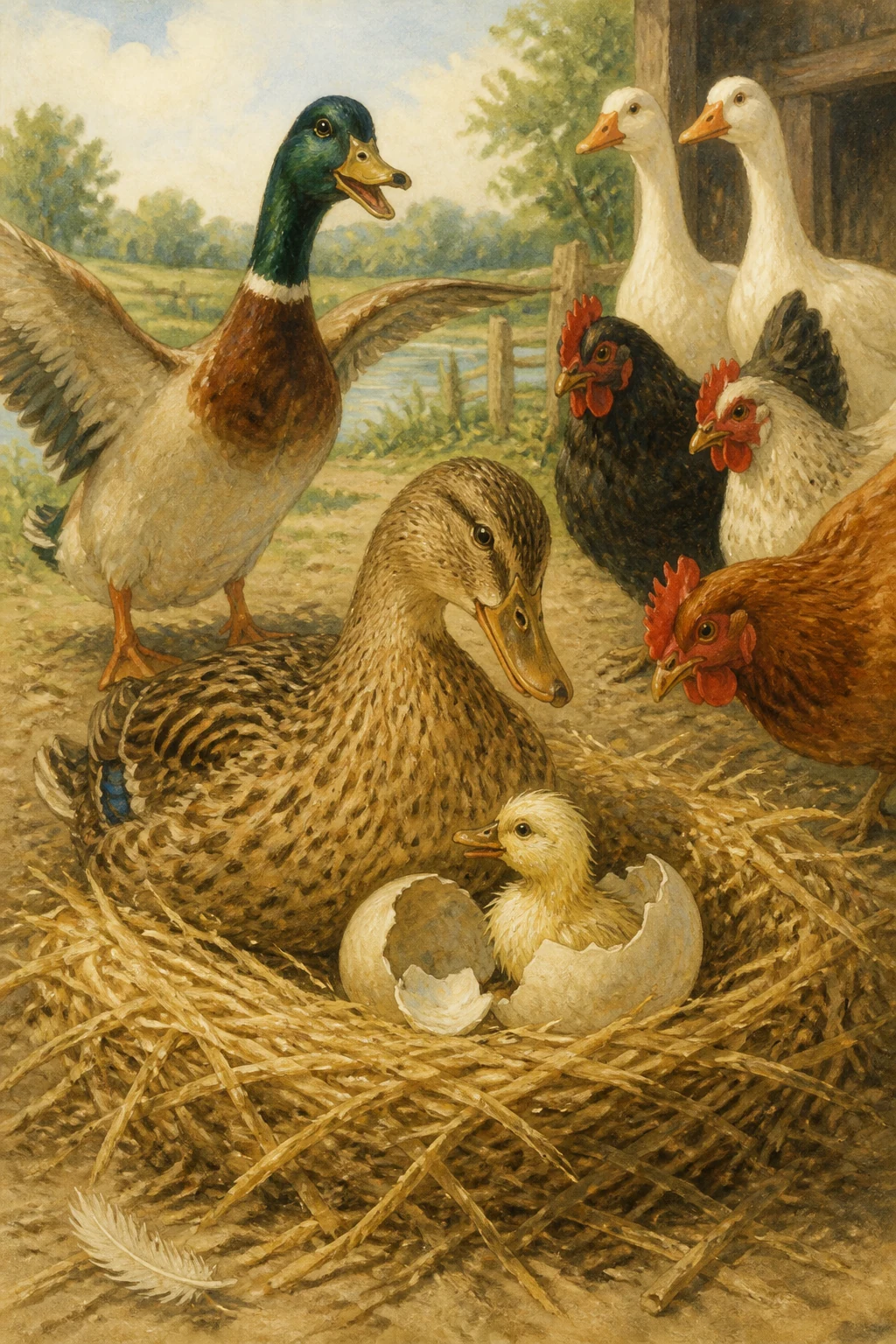
At last one egg after another began to crack. “Peep! Peep!” came the sound; all the yolks had come to life and were poking out their heads. “Quack! Quack!” she said, and they scrambled out as fast as they could and looked about them in every direction beneath the green leaves. Their mother let them look as much as they liked, for green is good for the eyes.
“How big the world is!” said all the little ones, for now they certainly had far more room than when they lay inside their eggs. “Do you think this is the whole world?” said their mother. “It stretches far beyond the garden, right into the parson’s field! But I’ve never been there!—You are all here, aren’t you?” And she got up. “No, I haven’t got you all! The biggest egg is still lying there. How much longer will it take? I’m nearly tired of it!” And she settled down again.
“Well, how are things going?” said an old duck who had come to pay a visit. “This one egg is taking so long!” said the duck on the nest. “It simply won’t crack! But just look at the others! They’re the loveliest ducklings I’ve ever seen! They all look just like their father, the scoundrel—he never comes to visit me.”
“Let me see the egg that won’t crack!” said the old duck. “You may be sure it’s a turkey’s egg! I was fooled like that once myself, and what trouble and worry I had with those youngsters, for they’re afraid of water, I can tell you! I couldn’t get them into it! I quacked and snapped, but it was no use!—Let me see the egg! Yes, it’s a turkey’s egg! Leave it where it is and teach the other children to swim!”
“Still, I’ll sit on it a little longer!” said the duck. “Now that I’ve sat here so long, I might as well stay through the fair season too!” “Please yourself!” said the old duck, and off she went.
At last the big egg cracked. “Peep! Peep!” said the youngster, tumbling out. He was so big and ugly. The duck looked at him. “That’s a terribly big duckling!” she said. “None of the others looks like that! Surely he can’t be a young turkey! Well, we’ll soon find out! Into the water he shall go, even if I have to kick him in myself!”
The next day the weather was gloriously fine; the sun shone on all the green burdock leaves. The mother duck appeared down by the canal with her whole family. Splash! She jumped into the water. “Quack! Quack!” she said, and one duckling after another plopped in. The water closed over their heads, but they came straight up again and floated beautifully. Their legs moved of their own accord, and they were all in the water, even the ugly grey youngster, swimming along with the rest.
“No, he’s no turkey!” she said. “See how beautifully he uses his legs, how straight he holds himself! He’s my own child! Really, he’s quite handsome when you look at him properly! Quack! Quack!—Now come with me, and I’ll take you out into the world and introduce you to the duckyard. But always stay close to me, so that no one steps on you, and mind you watch out for the cats!”
And so they entered the duckyard. There was a dreadful noise, for two families were fighting over an eel’s head, and in the end the cat got it.
“You see, that’s the way of the world!” said the mother duck, licking her bill, for she too wanted the eel’s head. “Now use your legs!” she said. “See that you hurry along, and bow your heads to that old duck over there! She’s the grandest of everyone here! She’s of Spanish blood, which is why she’s so stout, and look, she has a red rag round her leg! That’s something wonderfully fine, the greatest distinction any duck can receive. It means they don’t want to part with her, and that both animals and people must be able to recognize her!—Hurry along!—Don’t turn your toes in! A well-brought-up duckling keeps his legs wide apart, just like his father and mother! There now! Bow your heads and say, ‘Quack!’”
And they did; but the other ducks all round looked at them and said quite loudly, “Well, now! Here’s another whole brood for us to put up with! As if there weren’t enough of us already! And ugh, just look at that one duckling! We won’t have him here!” And at once a duck flew over and bit him on the neck.
“Leave him alone!” said his mother. “He isn’t doing anyone any harm!” “Yes, but he’s too big and too odd-looking!” said the duck that had bitten him. “So he needs putting in his place!”
“You have some pretty children, mother!” said the old duck with the rag round her leg. “All pretty except that one. He hasn’t turned out well! I wish you could make him over again!”
“That can’t be done, Your Grace!” said the mother duck. “He isn’t handsome, but he has a truly good nature, and he swims as beautifully as any of the others—indeed, I dare say a little better! I think he’ll grow handsome, or perhaps in time he’ll grow a little smaller! He lay too long in the egg, and that’s why he hasn’t got the proper shape!” And she nibbled gently at his neck and smoothed his feathers. “Besides, he’s a drake,” she said, “so it doesn’t matter so much! I think he’ll be strong; he’ll manage to make his way!”
“The other ducklings are delightful!” said the old duck. “Now make yourselves at home, and if you find an eel’s head, you may bring it to me!”—And so they made themselves at home.
But the poor duckling who had been the last to come out of his egg, and who looked so ugly, was bitten, shoved about, and made fun of by ducks and hens alike. “He’s too big!” they all said, and the turkey cock, who had been born with spurs and therefore thought himself an emperor, puffed himself up like a ship under full sail, marched straight at him, and gobbled until his whole head turned red. The poor duckling did not know where he dared stand or walk. He was so unhappy because he looked so ugly and was the laughingstock of the whole duckyard.
That was how the first day went, and after that things grew worse and worse. They all chased the poor duckling, and even his brothers and sisters were cruel to him, always saying, “If only the cat would catch you, you ugly fright!” And his mother said, “I wish you were far away!” The ducks bit him, the hens pecked him, and the girl who fed the animals kicked at him with her foot.
Then he ran and flew over the fence. The little birds in the bushes shot into the air in fright. “It’s because I’m so ugly,” thought the duckling, closing his eyes, but running on all the same. At last he came to the great marsh where the wild ducks lived. There he lay all night, so tired and sorrowful.
In the morning the wild ducks flew up and looked at their new companion. “What sort of creature are you?” they asked, and the duckling turned from side to side, greeting them as best he could.
“You’re dreadfully ugly!” said the wild ducks. “But that’s no concern of ours, so long as you don’t marry into our family!”—Poor thing! He certainly had no thought of marrying; he only hoped they would let him lie among the reeds and drink a little marsh water.
He lay there for two whole days. Then two wild geese came along—or rather, two wild ganders, for they were both males. It had not been long since they had come out of their eggs, which was why they were so full of spirit.
“Listen, friend!” they said. “You’re so ugly that we quite like you! Will you come roaming with us and be a bird of passage? Close by, in another marsh, there are some sweet, lovely wild geese, all unmarried young ladies who can say, ‘Quack!’ You might make your fortune, ugly as you are!”—“Bang! Bang!” sounded overhead at that very moment, and both wild ganders fell dead among the reeds, and the water turned blood-red. “Bang! Bang!” came the sound again, and whole flocks of wild geese rose from the reeds, and the shots rang out once more. A great hunt was in progress. The hunters lay all round the marsh; some were even perched in the branches of trees that stretched far out over the reeds. Blue smoke drifted like clouds among the dark trees and hung far out over the water. Through the mud came the hunting dogs, splashing and slapping; reeds and rushes swayed in every direction. It was terrifying for the poor duckling. He turned his head to tuck it under his wing, and just then a fearfully large dog stood close beside him, its tongue hanging far out of its mouth and its eyes gleaming horribly. It thrust its open jaws down towards the duckling, showed its sharp teeth—and splash! splash! off it went again without taking him.
“Oh, thank God!” sighed the duckling. “I’m so ugly that even the dog can’t be bothered to bite me!” And he lay quite still while the shot whistled through the reeds and gunfire rang out again and again.
It was not until late in the day that all grew quiet, but the poor youngster still dared not get up. He waited several more hours before looking about him, and then he hurried away from the marsh as fast as he could. He ran across fields and meadows, and the wind blew so hard that he could scarcely make his way.
Towards evening he reached a poor little cottage. It was so ramshackle that it could not decide which way to fall, and so it remained standing. The wind whistled round the duckling so fiercely that he had to sit down on his tail to brace himself against it, and it grew worse and worse. Then he noticed that the door had come off one hinge and hung so crookedly that he could slip through the crack into the room, and that was what he did.
Here lived an old woman with her cat and her hen. The cat, whom she called Sønnike, could arch his back and purr; he could even give off sparks, though for that you had to stroke his fur the wrong way. The hen had very short little legs, and so she was called Kykkelilavben. She laid good eggs, and the woman loved her as though she were her own child.
In the morning the strange duckling was noticed at once, and the cat began to purr and the hen to cluck. “What’s all this?” said the woman, looking about her. But her sight was poor, and she thought the duckling was a plump duck that had strayed. “What a lucky catch!” she said. “Now I can have duck eggs, so long as it isn’t a drake! We must put that to the test!”
And so the duckling was taken in on trial for three weeks, but no eggs appeared. Now the cat was master of the house and the hen was mistress, and they were always saying, “We and the world!” for they thought they made up half of it, and by far the better half. The duckling thought it might be possible to hold a different opinion, but the hen would not tolerate that.
“Can you lay eggs?” she asked. “No!” “Then kindly hold your tongue!” And the cat said, “Can you arch your back, purr, and give off sparks?” “No!” “Then you mustn’t have an opinion when sensible people are talking!”
And the duckling sat in the corner, feeling very low. Then he began to think of the fresh air and sunshine, and he felt such a strange longing to float on the water that at last he could not help himself: he had to tell the hen.
“What’s come over you?” she asked. “You’ve nothing to do, and that’s why these fancies take hold of you! Lay eggs or purr, and they’ll pass.” “But it’s so lovely to float on the water!” said the duckling. “So lovely to have it close over your head and to dive right down to the bottom!”
“Yes, what a great pleasure that must be!” said the hen. “You must have gone mad! Ask the cat—he’s the wisest creature I know—whether he likes floating on the water or diving under it! I won’t even mention myself.—Ask our mistress, the old woman; there’s no one in the world wiser than she is! Do you suppose she wants to float about and have water over her head?”
“You don’t understand me!” said the duckling. “Well, if we don’t understand you, who would? Surely you don’t think you’re wiser than the cat and the woman, not to mention me! Don’t be foolish, child! And thank your Maker for all the good that’s been done for you! Haven’t you found a warm room and company you can learn something from? But you’re a tiresome creature, and no pleasure to be with! You can believe me! I mean you well; I tell you unpleasant truths, and that’s how you recognize your true friends! Now just see that you lay eggs and learn to purr or give off sparks!”
“I think I’ll go out into the wide world!” said the duckling. “Yes, you do that!” said the hen. And so the duckling left. He floated on the water and dived beneath it, but all the animals shunned him because he was ugly.
Now autumn came. The leaves in the forest turned yellow and brown, and the wind caught them up and sent them dancing. High in the sky the very air looked cold; the clouds hung heavy with hail and snowflakes, and on the fence the raven sat crying, “Caw! Caw!” from sheer cold. It made you shiver just to think of it. The poor duckling was having a very hard time indeed.
One evening, as the sun was setting so beautifully, a whole flock of lovely great birds came out of the bushes. The duckling had never seen any so beautiful. They were dazzling white, with long, graceful necks. They were swans. They uttered a strange, wonderful cry, spread their magnificent long wings, and flew away from the cold regions to warmer lands, to lakes free of ice! They rose so high, so very high, and a strange feeling came over the little ugly duckling. He spun round in the water like a wheel, stretched his neck high into the air after them, and uttered a cry so loud and strange that it frightened him. Oh, he could not forget those lovely birds, those happy birds! And as soon as they were out of sight, he dived straight to the bottom, and when he came up again he was quite beside himself. He did not know what the birds were called or where they were flying, and yet he loved them as he had never loved anyone before. He did not envy them at all; how could it occur to him to wish for such beauty? He would have been happy if only the ducks had allowed him to stay among them!—The poor ugly creature!
And the winter grew so cold, so very cold. The duckling had to swim about in the water to keep it from freezing over completely, but every night the hole in which he swam grew smaller and smaller. The frost was so hard that the crust of ice crackled. The duckling had to keep moving his legs all the time to stop the water from closing over; at last he grew exhausted, lay quite still, and froze fast in the ice.
Early in the morning a farmer came by and saw him. He went out onto the ice, broke it with his wooden shoe, and carried the duckling home to his wife. There the duckling was revived.
The children wanted to play with him, but the duckling thought they meant to hurt him, and in his fright he flew straight into the milk pan, splashing milk all over the room. The woman screamed and threw up her hands, and then he flew into the trough where the butter was, and from there down into the flour barrel and out again. Oh, what a sight he was! And the woman screamed and struck at him with the tongs, while the children tumbled over one another trying to catch him, laughing and shrieking!—Luckily the door stood open, and out he flew among the bushes into the newly fallen snow. There he lay as though in a stupor.
But it would be far too sad to tell of all the hardship and misery he had to endure that bitter winter.—He was lying in the marsh among the reeds when the sun began to shine warmly again. The larks were singing—it was lovely spring.
Then all at once he raised his wings. They beat more strongly than before and carried him swiftly away; before he quite knew it, he was in a great garden where the apple trees were in blossom, where lilacs scented the air and hung from long green branches right down towards the winding canals. Oh, it was so lovely here, so fresh with spring! And just ahead, out of the thicket, came three beautiful white swans, rustling their feathers and gliding so lightly on the water. The duckling recognized the magnificent creatures and was overcome by a strange sadness.
“I’ll fly over to them, those royal birds! And they’ll peck me to death because I, who am so ugly, dare to approach them! But no matter! Better to be killed by them than bitten by ducks, pecked by hens, kicked by the girl who tends the poultry yard, and made to suffer through the winter!” And he flew down onto the water and swam towards the magnificent swans. They saw him and swept towards him with rustling feathers. “Go on, kill me!” said the poor creature, and he bowed his head towards the surface of the water and waited for death—but what did he see in the clear water? Beneath him he saw his own reflection, but he was no longer a clumsy, dark grey bird, ugly and hideous: he was himself a swan.
It does not matter if you were born in a duckyard, so long as you have lain in a swan’s egg! He felt truly glad of all the hardship and trouble he had endured, for now he could fully appreciate his happiness and all the beauty that greeted him. And the great swans swam round him and stroked him with their bills.
Some little children came into the garden and threw bread and grain into the water, and the smallest cried, “There’s a new one!” The other children joined in joyfully: “Yes, a new one has come!” They clapped their hands and danced about, then ran to fetch their father and mother. Bread and cake were thrown into the water, and everyone said, “The new one is the most beautiful! So young and so lovely!” And the old swans bowed before him.
Then he felt quite shy and tucked his head behind his wings; he hardly knew what to do! He was so very happy, but not at all proud, for a good heart never grows proud! He thought of how he had been persecuted and mocked, and now he heard everyone saying he was the loveliest of all lovely birds. The lilacs bent their branches down into the water towards him, and the sun shone so warm and kind. Then his feathers rustled, his slender neck rose, and from his heart he cried in delight, “I never dreamed of so much happiness when I was the ugly duckling!”