Prevod
Once upon a time there was an ancient little woman who lived with her flock of geese in a lonely place among the mountains, where she had a little house. A great forest surrounded this wilderness, and every morning the old woman would take her crutch and hobble into the woods. There she bustled about far more briskly than anyone would have expected at her great age, gathering grass for her geese and picking whatever wild fruit she could reach with her hands, then carrying it all home on her back. You would have thought the heavy load must crush her to the ground, but she always brought it safely home. Whenever she met anyone, she greeted them most pleasantly: “Good day, dear neighbor. What fine weather we are having! Yes, you are surprised to see me lugging this grass along, but everyone must shoulder their own burden.” Yet people did not like meeting her and preferred to go out of their way to avoid her, and when a father passed her with his little boy, he would say softly to him, “Beware of that old woman. She is a sly one, and no mistake: she is a witch.”
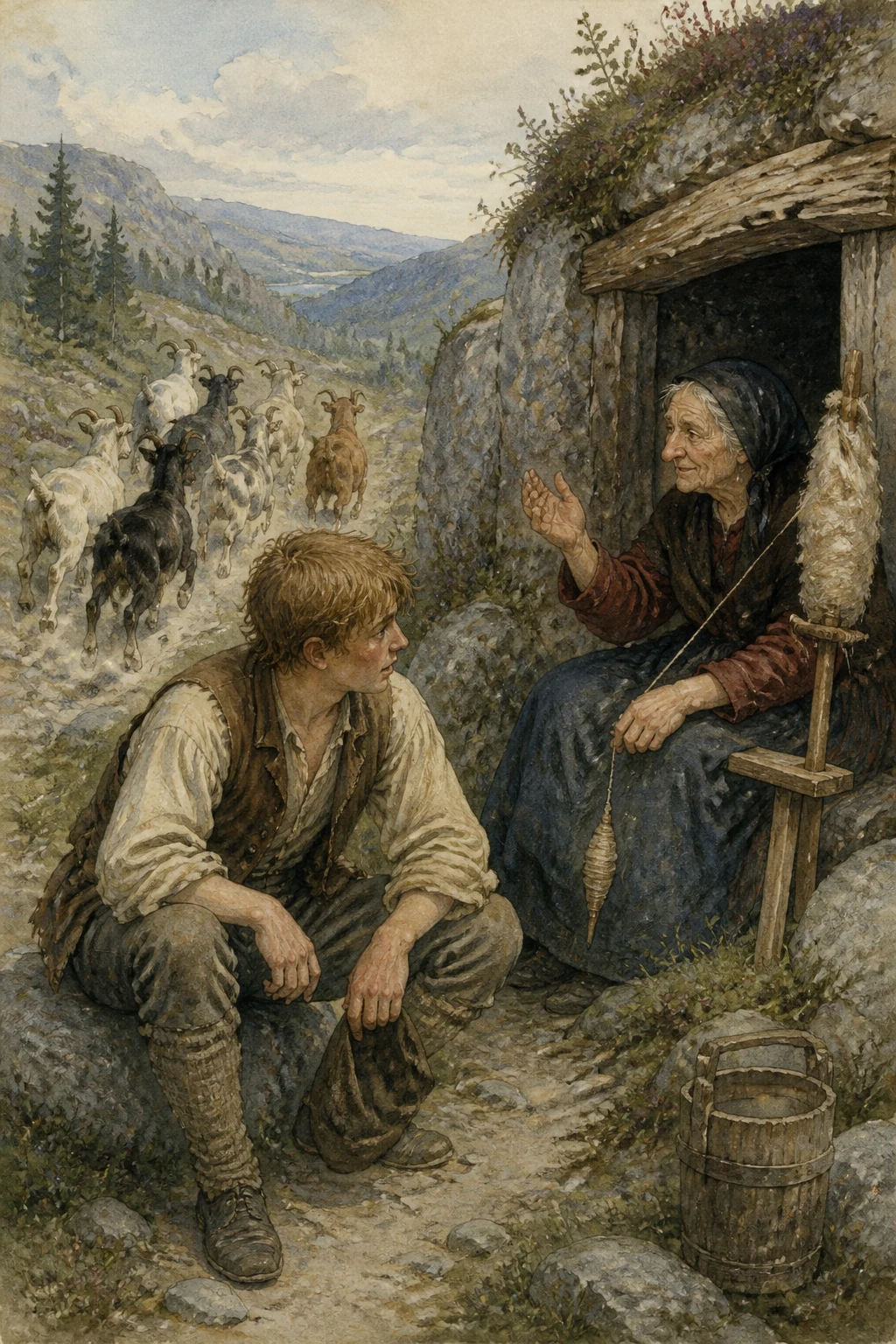
One morning a handsome young man was walking through the forest. The sun shone brightly, the birds sang, and a cool breeze rustled through the leaves, and his heart was full of joy. He had not met a soul when suddenly he caught sight of the old witch, kneeling on the ground and cutting grass with a sickle. She had already bundled a whole load into her carrying-cloth, and beside it stood two baskets filled with wild pears and apples. “But, good mother,” he said, “how can you carry all that away?” “I have to carry it, dear sir,” she answered. “Rich people’s children have no need to do such things. But for us peasants, the saying goes:
Don’t look behind; your back is bent.” “Will you help me?” she asked when he stopped beside her. “Your back is still straight and your legs are young. It will be an easy matter for you. Besides, my house is not so very far from here; it stands on a heath beyond that mountain. You will be up there in no time.” The young man felt sorry for the old woman. “My father is not a peasant,” he replied, “but a rich count. Still, to show you that peasants are not the only ones who can carry things, I will take up your bundle.” “If you are willing to try,” she said, “I shall be glad of it. You will have to walk a good hour, of course, but what is that to you? You must carry those apples and pears as well.” The young count did feel a little uneasy when he heard of an hour’s walk, but the old woman would not let him back out. She hoisted the carrying-cloth onto his back and hung both baskets on his arm. “There, you see how easy it is,” she said. “No, it is not easy,” answered the count, pulling a pained face. “The bundle weighs as though it were full of boulders, and the apples and pears are as heavy as lead. I can hardly breathe.” He was ready to put everything down again, but the old woman would not allow it. “Just look at that,” she said mockingly. “The young gentleman will not carry what I, an old woman, have hauled along so often. They are ready enough with fine words, but when it comes to doing anything, they want to make themselves scarce. Why are you standing there hesitating?” she went on. “Get those legs moving! No one is going to take that bundle off you.” As long as he walked on level ground, it was bearable, but when they reached the mountain and had to climb, with stones rolling away behind his feet as though they were alive, it became more than he could endure. Beads of sweat stood on his forehead and ran down his back, now hot, now cold. “Good mother,” he said, “I cannot go any farther. I must rest a little.” “Nothing of the sort,” answered the old woman. “You may rest when we arrive, but now you must keep going. Who knows what good it may do you!” “Old woman, you are growing insolent,” said the count, and tried to throw off the carrying-cloth, but all his efforts were in vain. It clung to his back as tightly as though it had grown there. He twisted and turned, but could not get rid of it. The old woman laughed and skipped merrily about on her crutch. “Do not lose your temper, dear sir,” she said. “Your face is growing as red as a rent-day rooster’s. Carry your bundle patiently, and when we get home I shall give you a handsome tip.” What could he do? He had to submit to his fate and trudge patiently after the old woman. She seemed to grow nimbler by the moment, while his load grew heavier. All at once she gave a leap, sprang onto the bundle, and perched on top of it. Thin as a rail though she was, she weighed more than the stoutest peasant girl. The young man’s knees shook, but whenever he stopped, the old woman struck his legs with a switch and stinging nettles. Groaning all the way, he climbed the mountain and at last reached the old woman’s house, just as he was about to collapse. When the geese saw her, they raised their wings, stretched out their necks, and ran to meet her, crying, “Wulla, wulla!” Behind the flock, with a rod in her hand, came an aging woman, tall and sturdy but as ugly as night. “Mother,” she said to the old woman, “has something happened to you? You have been away so long.” “Heaven forbid, my little daughter,” she replied. “Nothing bad has happened to me. Quite the contrary: this kind gentleman carried my load for me. Just think, when I grew tired, he even took me on his back. The journey did not seem long at all; we were merry and kept making jokes together.” At last the old woman slid down, took the bundle from the young man’s back and the baskets from his arm, looked at him kindly, and said, “Now sit down on the bench by the door and rest. You have fairly earned your reward, and you shall certainly have it.” Then she said to the goose girl, “Go into the house, my little daughter. It is not proper for you to be alone with a young gentleman. We must not pour oil on the fire; he might fall in love with you.” The count did not know whether to laugh or cry. Such a sweetheart, he thought, could never stir my heart, even if she were thirty years younger. Meanwhile, the old woman petted and stroked her geese as though they were children, then went into the house with her daughter. The young man stretched out on the bench beneath the wild apple tree. The air was soft and mild; all around lay a green meadow strewn with cowslips, wild thyme, and a thousand other flowers. A clear brook murmured through its midst, sparkling in the sunlight, and the white geese strolled to and fro or splashed about in the water. “It is lovely here,” he said, “but I am so tired I can hardly keep my eyes open. I shall sleep a little. I only hope no gust of wind comes and blows my legs clean off, for they are as brittle as tinder.”
After he had slept a little while, the old woman came and shook him awake. “Get up,” she said. “You cannot stay here. It is true I made things hard enough for you, but it has not cost you your life. Now I will give you your reward. You have no need of money or property, so here is something else.” With that she put a little box into his hand, carved from a single emerald. “Keep it safe,” she added. “It will bring you good fortune.” The count sprang up, and finding himself quite refreshed and strong again, he thanked the old woman for her gift and set off without so much as a backward glance at her pretty daughter. When he was already some distance away, he could still hear the merry cries of the geese in the distance.
The count had to wander through the wilderness for three days before he could find his way out. At last he came to a great city, and since no one knew him, he was taken to the royal palace, where the king and queen sat on their thrones. The count sank to one knee, drew the emerald box from his pocket, and laid it at the queen’s feet. She bade him rise and hand the little box up to her. But scarcely had she opened it and looked inside when she fell to the floor as though dead. The king’s servants seized the count and were about to lead him away to prison when the queen opened her eyes and cried out that they must release him. Then she ordered everyone to leave, for she wished to speak with him in private.
When the queen was alone with him, she began to weep bitterly and said, “What use are all the splendor and honor that surround me? Every morning I wake to sorrow and care. I once had three daughters, and the youngest was so beautiful that everyone thought her a marvel. She was as white as snow, as rosy as apple blossom, and her hair shone like sunbeams. When she wept, no tears fell from her eyes, but only pearls and precious stones. When she was fifteen, the king summoned all three sisters before his throne. You should have seen how the people stared when the youngest entered: it was as though the sun were rising. The king said, ‘My daughters, I do not know when my last day will come, and today I wish to decide what each of you shall receive after my death. You all love me, but whichever of you loves me best shall have the best of all.’ Each said that she loved him best. ‘Can you not tell me,’ the king replied, ‘how much you love me? Then I shall know what you mean.’ The eldest said, ‘I love my father as much as the sweetest sugar.’ The second said, ‘I love my father as much as my finest dress.’ But the youngest remained silent. Then her father asked, ‘And you, my dearest child, how much do you love me?’ ‘I do not know,’ she answered, ‘and I can compare my love to nothing.’ But her father insisted that she must name something. At last she said, ‘Even the finest food does not taste good to me without salt, so I love my father as much as salt.’ When the king heard this, he flew into a rage and said, ‘If you love me as much as salt, then your love shall be rewarded with salt.’ He divided his kingdom between the two eldest, but ordered a sack of salt to be tied to the youngest’s back, and two servants had to lead her out into the wild forest. We all pleaded and begged for her,” said the queen, “but nothing could soften the king’s anger. How she wept when she had to leave us! The whole road was strewn with the pearls that flowed from her eyes. Before long, the king regretted his great cruelty and had the entire forest searched for the poor child, but no one could find her. When I think that wild beasts may have devoured her, I am beside myself with grief. Sometimes I comfort myself with the hope that she is still alive and has hidden in a cave or found shelter with some compassionate people. But imagine how I felt when I opened your emerald box and found a pearl inside, exactly like those that flowed from my daughter’s eyes. You can understand how the sight moved my heart. You must tell me how you came by that pearl.” The count told her that he had received it from the old woman in the forest, who had seemed uncanny to him and must surely be a witch; but he had neither seen nor heard anything of her child. The king and queen resolved to seek out the old woman. They thought that wherever the pearl had been, they must also find some news of their daughter.
Far away in the wilderness, the old woman sat at her spinning wheel and spun. It was already dark, and a wooden splint burning beside the hearth gave a scant light. Suddenly there was a clamor outside: the geese were coming home from the pasture, raising their hoarse cries. Soon afterward the daughter came in too. But the old woman scarcely acknowledged her and merely shook her head a little. The daughter sat down beside her, took up her spinning wheel, and spun the thread as nimbly as a young girl. So they sat for two hours without speaking a word to each other. At last something rustled at the window, and two fiery eyes stared in. It was an old owl, which called “Hoo-hoo” three times. The old woman merely glanced up, then said, “Now it is time for you to go out, little daughter. Do your work.”
She rose and went out. And where did she go? On and on across the meadows, down into the valley. At last she came to a spring beside which stood three old oak trees. Meanwhile the moon had risen, large and round, above the mountain, and it was so bright that one could have found a pin on the ground. She pulled off a skin that covered her face, then bent over the spring and began to wash. When she had finished, she dipped the skin in the water too, then laid it on the grass to bleach and dry again in the moonlight. But how the girl had changed! You have never seen anything like it! As the gray braid fell away, golden hair streamed out like sunbeams and spread over her whole figure like a cloak. Only her eyes shone through, as bright as the stars in heaven, and her cheeks glowed a soft pink like apple blossom.
But the beautiful girl was sad. She sat down and wept bitterly. Tear after tear welled from her eyes and rolled through her long hair to the ground. There she sat, and would have remained a long while had there not been a crackling and rustling in the branches of a nearby tree. She sprang up like a deer at the sound of a hunter’s shot. Just then a black cloud covered the moon, and in an instant the girl had slipped back into the old skin and vanished like a light blown out by the wind.
Trembling like an aspen leaf, she ran back to the house. The old woman stood at the door, and the girl was about to tell her what had happened, but the old woman laughed kindly and said, “I know all about it.” She led her into the room and lit a fresh splint. But instead of sitting down at her spinning wheel again, she fetched a broom and began sweeping and scrubbing. “Everything must be clean and tidy,” she said to the girl. “But Mother,” said the girl, “why are you beginning work at this late hour? What are you planning?” “Do you know what time it is?” asked the old woman. “Not yet midnight,” answered the girl, “but past eleven.” “Do you not remember,” the old woman went on, “that you came to me three years ago today? Your time is up; we can no longer stay together.” The girl was frightened and said, “Oh, dear Mother, do you mean to cast me out? Where shall I go? I have no friends and no home to turn to. I have done everything you asked, and you have always been pleased with me. Do not send me away!” The old woman would not tell the girl what lay ahead of her. “I can stay here no longer,” she said, “but when I leave, the house and room must be clean, so do not keep me from my work. As for yourself, have no fear. You shall find a roof to shelter you, and you will be well pleased with the reward I mean to give you.” “But please tell me, what is going to happen?” the girl persisted. “I tell you again, do not disturb me at my work! Say no more. Go to your chamber, take the skin from your face, and put on the silk dress you wore when you came to me. Then wait in your chamber until I call you.”
But now I must tell you again of the king and queen, who had set out with the count to seek the old woman in the wilderness. During the night the count had become separated from them in the forest and had to go on alone. The next day he thought he was on the right path. He walked on until darkness fell, then climbed a tree, meaning to spend the night there, for he was afraid of losing his way. When the moon lit up the countryside, he saw a figure coming down the mountain. She had no rod in her hand, but he could still tell that she was the goose girl he had seen earlier at the old woman’s house. “Aha!” he cried. “Here she comes, and once I have caught one witch, the other shall not escape me either.” But how astonished he was when she went to the spring, took off her skin, and washed, and her golden hair fell down about her! She was more beautiful than anyone he had ever seen in the world. He scarcely dared breathe, but stretched his neck as far as he could through the leaves and gazed at her without looking away. Whether he leaned out too far or something else was to blame, suddenly the branch cracked, and at that very instant the girl slipped into her skin and bounded away like a deer. As the moon was covered just then, she vanished from his sight.
Scarcely had she disappeared when the count climbed down from the tree and hurried after her. He had not gone far when he saw two figures walking across the meadow in the dim light. They were the king and queen, who had seen the light in the old woman’s little house from afar and were making their way toward it. The count told them of the wonderful things he had seen at the spring, and they had no doubt that the girl was their lost daughter. Full of joy, they went on and soon reached the little house. The geese sat all around it, asleep with their heads tucked under their wings, and not one stirred. They looked in through the window, and there sat the old woman, quietly spinning, nodding her head without looking round. The room was spotless, as though it were inhabited by the little mist sprites who carry no dust on their feet. But they could not see her daughter. For a while they stood looking at it all; at last they took courage and tapped gently on the window. The old woman seemed to have been expecting them. She rose and called out kindly, “Come in! I know who you are.” When they had entered the room, the old woman said, “You might have spared yourselves this long journey if you had not unjustly cast out your child, so good and loving, three years ago. It has done her no harm. She has had to tend the geese for three years, but she has learned no evil in doing so and has kept her heart pure. You, meanwhile, have been punished enough by the anguish in which you have lived.” Then she went to the chamber and called, “Come out, my little daughter!” The door opened, and the princess came out in her silken gown, with her golden hair and shining eyes, and it was as though an angel had come down from heaven.
She went to her father and mother, threw her arms around their necks, and kissed them. There was no helping it: they all had to weep for joy. The young count stood beside them, and when she saw him, her face grew as red as a moss rose, though she herself did not know why. The king said, “Dear child, I have given away my kingdom. What shall I give you?” “She needs nothing,” said the old woman. “I give her the tears she has wept for you. They are all pearls, more beautiful than any found in the sea, and worth more than your entire kingdom. And as a reward for her service, I give her my little house.” When the old woman had said this, she vanished before their eyes. There was a little creaking and cracking in the walls, and when they looked around, the little house had become a magnificent palace, a royal table stood laid, and servants were hurrying to and fro.
The story goes on, but my grandmother, who told it to me, had grown forgetful and could not remember the rest. I have always thought that the beautiful princess married the count, and that they stayed together in the palace and lived there in perfect happiness for as long as God allowed. Whether the snow-white geese that were tended at the little house were all girls whom the old woman had taken in—no one need take offense at the thought—and whether they now regained their human form and remained as attendants to the young queen, I do not know for certain, but I suspect it was so. One thing is certain: the old woman was no witch, as people believed, but a wise woman who meant well. Most likely it was she, too, who had given the princess, at her birth, the gift of weeping pearls instead of tears. Such things do not happen nowadays, or poor people could soon grow rich.