Prevod
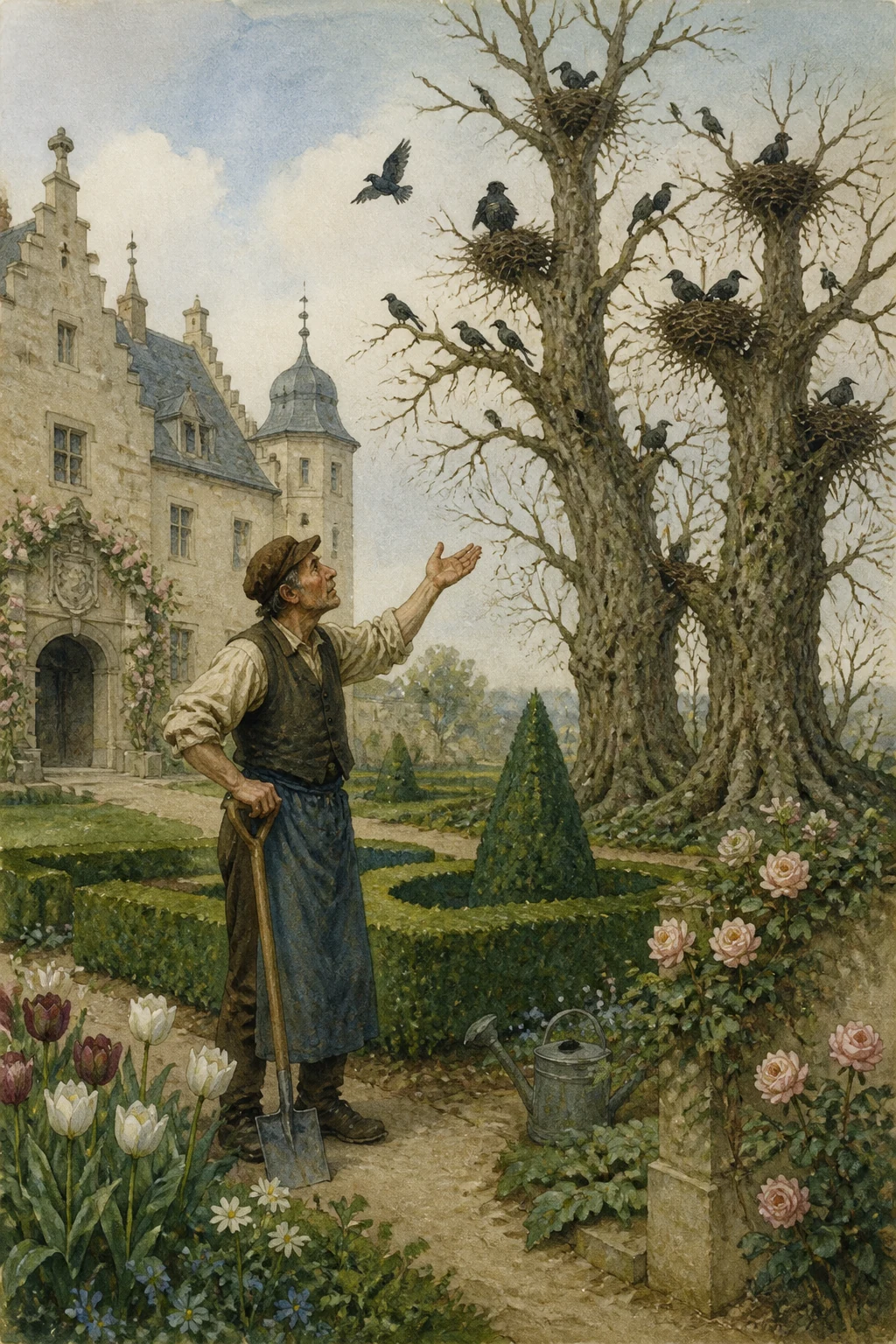
Hen-Grethe was the only human being living in the fine new house built for the hens and ducks on the manor estate. It stood where the old knightly manor had stood, with its tower, stepped gable, moat, and drawbridge. Close by was a wilderness of trees and bushes; here the garden had once been, stretching down to a great lake that was now a marsh. Rooks, crows, and jackdaws flew shrieking and clamouring over the old trees, a teeming multitude of birds. Shooting among them did nothing to lessen their numbers; if anything, they increased. They could be heard even inside the henhouse, where Hen-Grethe sat while the ducklings scurried over her wooden shoes. She knew every hen and every duck from the moment it crept out of its egg. She was proud of her hens and ducks, proud of the splendid house built for them. Her little room was clean and neat, as the lady of the manor, to whom the henhouse belonged, insisted it should be. She often came here with grand and distinguished guests to show them “the hens’ and ducks’ barracks,” as she called it.
There was a wardrobe and an armchair, and even a chest of drawers, on which stood a brightly polished brass plate engraved with the word “Grubbe,” the very name of the old noble family who had lived here in the knightly manor. The brass plate had been found while digging on the site, and the parish clerk had said it had no value except as a relic of the past. The clerk knew a great deal about the place and the old days; he had learned it from books, and there was much written down in his desk drawer. His knowledge of bygone times was considerable; yet perhaps the oldest crow knew more, and cried it out in her own tongue. But that was crow-language, which the clerk, for all his learning, could not understand.
After a warm summer’s day, vapour would rise from the marsh until it seemed that a whole lake lay before the old trees where the rooks, crows, and jackdaws flew. So it had looked when Sir Grubbe lived here and the old manor stood with its thick red walls. In those days the watchdog’s chain reached right past the gate. Through the tower one entered the stone-paved passage leading to the rooms; the windows were narrow and the panes small, even in the great hall where the dancing took place. But in the last Grubbe’s time there had been no dancing within living memory, though an old kettledrum once used by the musicians still lay there. An intricately carved cupboard stood in the hall, and rare flower bulbs were kept in it, for Mistress Grubbe loved planting and tended trees and herbs. Her husband preferred riding out to shoot wolves and wild boar, and his little daughter Marie always went with him. At five years old she sat proudly on her horse, looking boldly about her with great black eyes. She delighted in cracking her whip among the hounds; her father would rather have seen her use it among the peasant boys who came to stare at the gentry. A peasant in the earthen cottage close to the manor had a son, Søren, the same age as the little noble maiden. He was a good climber and was always having to climb up and fetch birds’ nests for her. The birds shrieked as loudly as they could, and one of the largest struck him just above the eye, so that the blood streamed down. People thought the eye had been lost, but it had suffered no harm. Marie Grubbe called him her Søren, which was a great favour, and one that benefited his father, poor Jøn. One day he had committed some offence and was to be punished by riding the wooden horse. It stood in the courtyard, with four posts for legs and a single narrow plank for a back. Jøn was to sit astride it, with heavy bricks tied to his legs so that he should not sit too lightly. He made a dreadful face; Søren wept and pleaded with little Marie. At once she ordered them to let Søren’s father down, and when they would not obey her, she stamped on the paving stones and tugged at her father’s coat sleeve until it tore. She wanted what she wanted, and she had her way: Søren’s father was released. Mistress Grubbe came up, stroked her little daughter’s hair, and looked at her with gentle eyes. Marie did not understand why. She wanted to go to the hounds, not with her mother, who went into the garden and down towards the lake, where white and yellow water lilies were in bloom. Bulrushes and flowering rush swayed among the reeds. She gazed at all that freshness and luxuriance. “How delightful!” she said. In the garden stood a tree, rare in those days, which she herself had planted. A “copper beech” it is called, a kind of Moor among the other trees, so dark brown were its leaves. It needed strong sunshine; kept always in shade, it would turn green like the other trees and so lose its distinction. There were many birds’ nests in the tall chestnuts, as well as in the bushes and on the grass. It was as though the birds knew they were protected here, where no one dared fire a gun. Little Marie came with Søren, who, as we know, could climb, and both eggs and downy nestlings were fetched for her. The birds flew about in fear and terror, large and small alike! The lapwing from the field, the rooks, crows, and jackdaws from the tall trees, cried and cried, with the same cry their descendants utter to this very day.
“Children, whatever are you doing?” cried the gentle lady. “This is wicked work!” Søren stood abashed, and the little noble maiden too glanced aside, but then said curtly and sullenly, “My father lets me!”
“Away! Away!” cried the great black birds, and off they flew, but the next day they returned, for this was their home. The quiet, gentle lady, however, did not remain at home there much longer. Our Lord called her to Him, and with Him she was more truly at home than here at the manor. The church bells rang solemnly as her body was taken to church, and the eyes of the poor filled with tears, for she had been good to them. Once she was gone, no one tended her plantings, and the garden fell into decay. Sir Grubbe was a hard man, people said, but his daughter, young as she was, could manage him; he had to laugh, and she had her way. She was now twelve years old and strong-limbed. She looked people straight in the face with her black eyes, rode her horse like a man, and fired her gun like a practised hunter.
Then a great visitor came to the district, the grandest of all: the young king, with his half-brother and companion, Sir Ulrik Frederik Gyldenløve. They intended to hunt wild boar there and spend a day and a night at Sir Grubbe’s manor. Gyldenløve sat beside Marie Grubbe at table, put his arm round her head, and kissed her as though they were relations. But she slapped his mouth and said she could not bear him, and everyone laughed heartily, as though it were wonderfully amusing.
Perhaps it was, for five years later, when Marie had turned seventeen, a messenger arrived with a letter: Sir Gyldenløve was asking for the noble maiden’s hand. That was something indeed!
“He is the grandest and most gallant gentleman in the kingdom!” said Sir Grubbe. “This is not an offer to refuse.” “I care little enough for him!” said Marie Grubbe, but she did not refuse the foremost man in the land, who sat at the king’s side. Silver, woollens, and linen were sent by ship to Copenhagen; she travelled overland, a journey of ten days. Her trousseau met with contrary winds, or none at all; four months passed before it arrived, and by then Mistress Gyldenløve was gone. “I would sooner lie on coarse tow-cloth than in his silken bed!” she said. “I would sooner go barefoot than ride in a coach with him!” Late one November evening two women rode into Århus: Gyldenløve’s wife, Marie Grubbe, and her maid. They came from Vejle, having sailed there from Copenhagen. They rode up to Sir Grubbe’s stone-built house. He was not pleased by the visit. She received harsh words, but nevertheless a room to sleep in; she had her beer soup in the morning, but no comforting words to go with it. Her father’s ill nature was turned upon her as she had never known it before. She was not gentle-tempered herself; as people speak to you, so you answer them. And answer she did, speaking with bitterness and hatred of her husband, with whom she would not live: she was too well-bred and honourable for that. A year passed, and not a pleasant one. Bitter words fell between father and daughter, as they never should. Bitter words bear bitter fruit. How would it end?
“We two cannot live under one roof!” her father said one day. “Go to our old manor, but bite your tongue off rather than set lies abroad!” So they parted. With her maid she went to the old manor where she had been born and bred, and where the quiet, devout lady, her mother, lay in the church vault. An old cattle keeper lived at the manor; he was the entire household. Cobwebs hung in the rooms, black and heavy with dust. The garden grew as it pleased; hop vines and bindweed wove a net among the trees and bushes, while hemlock and nettles grew ever stronger and more abundant. The copper beech was overgrown and shaded; its leaves were now green like those of the other, ordinary trees. Its glory was gone. Rooks, crows, and jackdaws flew in teeming multitudes over the tall chestnuts, clamouring and shrieking as though they had important news to tell one another: now she was here again, the little girl who had had their eggs and young stolen. The thief himself, who had fetched them, was climbing a leafless tree far away, perched high on a mast, and getting a sound rope’s-ending whenever he misbehaved. All this was told in our own day by the parish clerk. He had gathered it together from books and records; it lay written down, along with much else, in his desk drawer.
“Up and down goes the world!” he said. “It is a strange tale to hear!” And we shall hear what became of Marie Grubbe, without forgetting Hen-Grethe, who sits in her splendid henhouse in our own day. Marie Grubbe sat in hers in her day, but not with old Hen-Grethe’s peace of mind.
Winter passed, and spring and summer passed; then came the windy autumn again, with its cold, wet sea mists. It was a lonely life, a tedious life at the manor.
Then Marie Grubbe took her gun and went out on the heath, shooting hares and foxes and whatever birds she could hit. Out there she met more than once the nobleman Palle Dyre of Nørrebæk, who also went about with his gun and dogs. He was big and strong, and boasted of it when they talked. He would have dared to pit himself against the late Sir Brockenhuus of Egeskov on Funen, whose strength was still renowned. Following his example, Palle Dyre had hung an iron chain with a hunting horn in his gateway; when he rode home, he seized the chain, lifted himself and his horse off the ground, and blew the horn. “Come and see for yourself, Mistress Marie!” he said. “There is fresh air at Nørrebæk!” When she came to his manor is not recorded, but the candlesticks in Nørrebæk Church bore an inscription saying that they were given by Palle Dyre and Marie Grubbe of Nørrebæk Manor. Palle Dyre had bulk and strength; he drank like a sponge, like a barrel that could never be filled. He snored like a whole pigsty, and his face was red and bloated.
“He is a swinish, spiteful fellow!” said Mistress Palle Dyre, Grubbe’s daughter. She soon tired of that life, but that did nothing to improve it. One day the table stood laid and the food grew cold; Palle Dyre was out fox-hunting, and his wife was nowhere to be found. Palle Dyre came home at midnight, but Mistress Dyre came neither at midnight nor in the morning. She had turned her back on Nørrebæk and ridden away without a word of farewell.
The weather was grey and wet, and the wind blew cold. A flock of black, shrieking birds passed over her; they were not as homeless as she was. First she travelled south, all the way towards the German lands. A couple of gold rings set with precious stones were turned into money. Then she went east, then turned back west again. She had no destination in mind and was angry with everyone, even with the good Lord, so wretched was her spirit. Soon her body was wretched too; she could scarcely move a foot. A lapwing flew up from its tussock as she stumbled over it. The bird cried as it always does, “You thief! You thief!” She had never stolen her neighbour’s goods, but as a little girl she had had birds’ eggs and nestlings fetched for her from tussock and tree. That came back to her now.
From where she lay she could see the dunes. Fishermen lived over there by the shore, but she was too ill to reach them. Great white gulls came flying over her, crying as the rooks, crows, and jackdaws had cried over the manor garden at home. The birds flew very close; at last she thought they turned coal-black, but then night fell before her eyes as well. When she opened them again, she was being lifted and carried. A big, strong fellow had taken her in his arms. She looked straight into his bearded face; he had a scar above one eye that seemed to divide the eyebrow in two. Wretched as she was, he carried her to the ship, where the skipper gave him harsh words for his deed.
The next day the ship sailed. Marie Grubbe did not go ashore, so she went with it. But surely she came back? Yes, but when and where? The parish clerk could tell that too, and it was no tale of his own invention. He had the whole strange course of it from a trustworthy old book that we ourselves may take down and read. The Danish historian Ludvig Holberg, who wrote so many books worth reading, and those amusing comedies from which we may truly learn to know his age and its people, tells in his letters where and how in the world he met Marie Grubbe. It is well worth hearing, and still we shall not forget Hen-Grethe, who sits happy and comfortable in the splendid henhouse.
The ship sailed away with Marie Grubbe; that was where we left her. Years passed, and more years passed. The plague was raging in Copenhagen; it was the year 1711. The Queen of Denmark departed for her German homeland, the king left the capital, and everyone who could hurried away. Even the students who had free lodging and board sought to leave the city. One of them, the last still remaining at what was called “Borchs Collegium,” close to Regensen, now set off as well. It was two o’clock in the morning. He came with his knapsack, filled more with books and papers than with clothes. A wet, clammy fog hung over the city. Not a soul was to be seen in the whole street along which he walked. Here and there crosses had been marked on doors and gateways; within, there was sickness, or everyone had died. No one was to be seen either in the broader, winding “Kjødmangergade,” as the street running from the Round Tower towards the royal palace was called. Now a great hearse rumbled past. The driver brandished his whip, the horses galloped, and the cart was piled with the dead. The young student held his hand before his face and sniffed a strong spirit with which he had soaked a sponge kept in a brass pencil case. From a tavern in one of the lanes came bawling songs and dreadful laughter: people were drinking the night away to forget that the plague stood at their door, waiting to take them off in the hearse to join the other dead. The student made for the palace bridge, where a couple of small vessels lay. One was weighing anchor to escape the stricken city. “If God lets us live and gives us a fair wind, we are bound for Grønsund by Falster!” said the skipper, and asked the student, who wished to come aboard, his name.
“Ludvig Holberg,” said the student, and the name sounded like any other name. Now it rings among Denmark’s proudest names; then he was merely a young, unknown student.
The ship glided past the palace. Dawn had not yet broken when it reached open water. A light breeze sprang up, the sail swelled, and the young student sat with his face to the fresh wind and fell asleep, which was not the wisest thing to do.
By the third morning the vessel lay off Falster. “Do you know anyone here with whom I might lodge for little money?” Holberg asked the captain.
“I think you would do well to go to the ferrywoman at Borrehuset!” he said. “If you want to be very polite, her name is Mother Søren Sørensen Møller. Though she may fly into a temper if you are too grand with her! Her husband has been arrested for a crime, and she rows the ferry herself. She has a strong pair of fists!”
The student took his knapsack and went to the ferry house. The door was not locked; he lifted the latch and entered a stone-paved room, whose chief piece of furniture was a box-bed bench with a large fur coverlet. A white hen with chicks was tethered to the bench and had upset the water dish, so that water ran across the floor. There was no one here or in the adjoining chamber, only a cradle with a child in it. The ferryboat was coming back with just one person aboard; whether man or woman was not easy to tell. The figure wore a great overcoat and a cap that fitted round the head like a bonnet. The boat drew in. It was a woman who came and entered the room. As she straightened her back, she looked quite imposing; two proud eyes shone beneath black eyebrows. This was Mother Søren, the ferrywoman. Rooks, crows, and jackdaws would have cried another name, one we know better.
She looked sullen and seemed little inclined to talk, but enough was said and settled for the student to arrange board and lodging for an indefinite time, while things were so bad in Copenhagen.
From the nearby market town, a pair of respectable citizens would now and then come out to the ferry house. Frands the Cutler and Sivert the Customs Inspector came, drank a mug of ale, and debated with the student. He was an able young man who knew his practica, as they called it; he read Greek and Latin and knew about learned matters. “The less you know, the less it weighs upon you!” said Mother Søren.
“You have a hard life!” said Holberg one day, as she steeped her washing in strong lye and had to chop the logs for fuel herself. “Leave that to me!” she answered.
“Have you always had to toil and drudge, ever since you were little?” “You can read that in my fists, surely!” she said, showing two hands that were indeed small, but hard and strong, with bitten nails. “You have the learning to read.”
At Christmastime heavy snowstorms began. The cold took hold, and the wind blew as sharply as though it had nitric acid to wash people’s faces with. Mother Søren was not troubled; she threw her overcoat round her and pulled her bonnet down over her head. The house was dark by early afternoon. She put wood and peat on the hearth, then sat down to mend the soles of her stockings; there was no one else to do it. Towards evening she spoke more to the student than was her custom. She spoke of her husband.
“He killed a skipper from Dragør by misadventure, and now he must work in irons at the naval dockyard for three years. He is only a common sailor, so the law must take its course.” “The law applies to the higher ranks too!” said Holberg. “Do you think so?” said Mother Søren, looking into the fire. Then she began again. “Have you heard of Kai Lykke, who had one of his churches pulled down? When the parson Mads thundered against it from the pulpit, he had him put in fetters and irons, set up a court, and himself sentenced Master Mads to lose his head. And his head was struck off. That was no misadventure, yet Kai Lykke went scot-free!” “He was within his rights in those days!” said Holberg. “We are past that now!”
“Tell that to fools!” said Mother Søren. She rose and went into the chamber where “the girl,” the little child, lay, picked her up and settled her again, then made up the student’s box-bed bench. He had the fur coverlet, for he felt the cold more than she did, though he had been born in Norway.
New Year’s morning was bright and clear with sunshine. The frost had been, and still was, so hard that the drifting snow had frozen into a crust one could walk on. The bells in the town rang for church; the student Holberg wrapped himself in his woollen cloak and prepared to go into town.
Over Borrehuset flew rooks, crows, and jackdaws, shrieking and clamouring so loudly that the church bells could not be heard. Mother Søren stood outside filling a brass kettle with snow, to put on the fire and melt for drinking water. She looked up at the swarming birds and had thoughts of her own.
The student Holberg went to church. Both going and returning, he passed Sivert the Customs Inspector’s house by the town gate, and there he was invited in for a bowl of warm ale with syrup and ginger. The talk turned to Mother Søren, but the customs inspector knew little about her; probably few people did. She was not from Falster, he said. She had once had a little money, he believed. Her husband was a common sailor with a violent temper; he had killed a skipper from Dragør. “He beats his wife, yet she takes his part.” “I would not put up with such treatment!” said the customs inspector’s wife. “But then I come of better people! My father was a royal stocking-weaver!”
“And that is why you are married to a royal official,” said Holberg, bowing to her and the customs inspector. It was Twelfth Night. Mother Søren lit a Three Kings candle for Holberg; that is to say, three tallow tapers she had dipped herself.
“A candle for each man!” said Holberg. “Each man?” said the woman, staring hard at him. “Each of the wise men from the East!” said Holberg. “Oh, in that sense!” she said, and was silent for a long while. Yet that Twelfth Night he learned more than he had known before.
“You have a loving heart towards the man you are married to,” said Holberg. “Yet people say he ill-treats you every day.” “That is no one’s business but mine!” she answered. “Those beatings might have done me good when I was little. Now I suppose I get them for my sins! I know what good he has done me.” And she drew herself up to her full height. “When I lay sick on the open heath and no one cared to have anything to do with me, except perhaps the rooks and crows, who would have pecked at me, he carried me in his arms and got harsh words for the catch he brought aboard. I am not made to lie sick, and so I recovered. Everyone has his own ways, Søren has his; you must not judge a nag by its halter! With all that, I have lived more happily with him than with the man they called the most gallant and distinguished of all the king’s subjects. I was once married to the governor-general Gyldenløve, the king’s half-brother; after that I took Palle Dyre! Much of a muchness, each in his own way, and I in mine. That was a long tale, but now you know!” And she went out of the room.
It was Marie Grubbe! Such strange turns had fortune’s wheel taken for her. She did not live to see many more Twelfth Nights. Holberg wrote that she died in June 1716, but he did not write, for he did not know, that when Mother Søren, as she was called, lay dead at Borrehuset, a multitude of great black birds flew over the place. They did not cry out, as though they knew a funeral called for silence. As soon as she was in the ground, the birds were seen no more. But that same evening, over in Jutland by the old manor, an immense multitude of rooks, crows, and jackdaws was seen. They cried out over one another as though they had something to proclaim, perhaps about the peasant’s son who as a little boy had taken their eggs and downy nestlings, and who had been given iron garters at the royal dockyard, and the noble maiden who had ended as a ferrywoman at Grønsund. “Caw! Caw!” they cried.
And their descendants cried, “Caw! Caw!” when the old manor was pulled down. “They cry it still, and there is nothing left to cry about!” said the parish clerk when he told the tale. “The family has died out, the manor has been pulled down, and where it stood now stands the splendid henhouse with its gilded weather vanes and old Hen-Grethe. She is so happy in her lovely home. If she had not come here, she would have had to go to the poorhouse.”
The pigeons cooed above her, the turkeys gobbled round her, and the ducks quacked. “Nobody knew her!” they said. “She has no family. It is an act of charity to keep her here. She has neither drake for father nor hen for mother, and no offspring!”
Yet she did have a family. She did not know it, nor did the parish clerk, for all the writings in his desk drawer. But one of the old crows knew and told of it. From her mother and grandmother she had heard of Hen-Grethe’s mother and of her grandmother, whom we too know: from the days when, as a child, she rode across the drawbridge and looked so proudly about her, as though the whole world and all its birds’ nests belonged to her. We saw her on the heath by the dunes, and last at Borrehuset. Her granddaughter, the last of the family, had come home again to the place where the old manor had stood and the wild black birds cried. But she sat among the tame birds, who knew her as she knew them. Hen-Grethe had nothing more to wish for. She was content to die, old enough to die.
“Grave! Grave!” cried the crows. And Hen-Grethe was given a good grave, which no one knows except the old crow, unless she too is dead. And now we know the story of the old manor, the old family, and all Hen-Grethe’s kin.