Waltey
Dogodivščine Hasiba Karima ad Dina
Tisoč in ena noč · arabska pripovedna tradicijaO besedilu
Dogodivščine Hasiba Karima ad Dina
- Vir
- Tisoč in ena noč
- Avtor
- arabska pripovedna tradicija
- Jezik branja
- English
- Jezik izvirnika
- Arabic
- Čas branja
- 17 min branja
- Obseg
- 13 strani
- Naslov izvirnika
- حكاية مغامرات حاسب كريم الدين - الليالي ٤٨٢ إلى ٤٨٦
O izvirniku
Tisoč in ena noč
Zgodbe v zgodbah, polne trgovcev, dvorov, preoblek in nočnih zapletov. Bralni jezik je English, izvirnik pa prihaja iz vira Tisoč in ena noč v jeziku Arabic.
Besedilo
Dogodivščine Hasiba Karima ad Dina
It is told that in ancient times, in ages long gone by, there lived a sage among the sages of Greece whose name was Daniel. He had disciples and soldiers, and the sages of Greece bowed to his authority and relied upon his learning. Yet for all this, he had been granted no son. One night, as he sat pondering his lot and weeping because he had no son to inherit his knowledge after him, it occurred to him that God, glory be to Him, answers the prayer of those who turn to Him; that no doorkeeper bars the gate of His bounty; that He provides without measure for whom He wills, and never turns away a petitioner, but showers him with goodness and kindness. So he prayed to God the Most Generous to grant him a son who would succeed him, and to bestow His abundant favor upon him. Then he returned home and lay with his wife, and she conceived that very night. But morning overtook Shahrazad, and she fell silent, leaving her tale untold.
When it was the four hundred and eighty-third night,
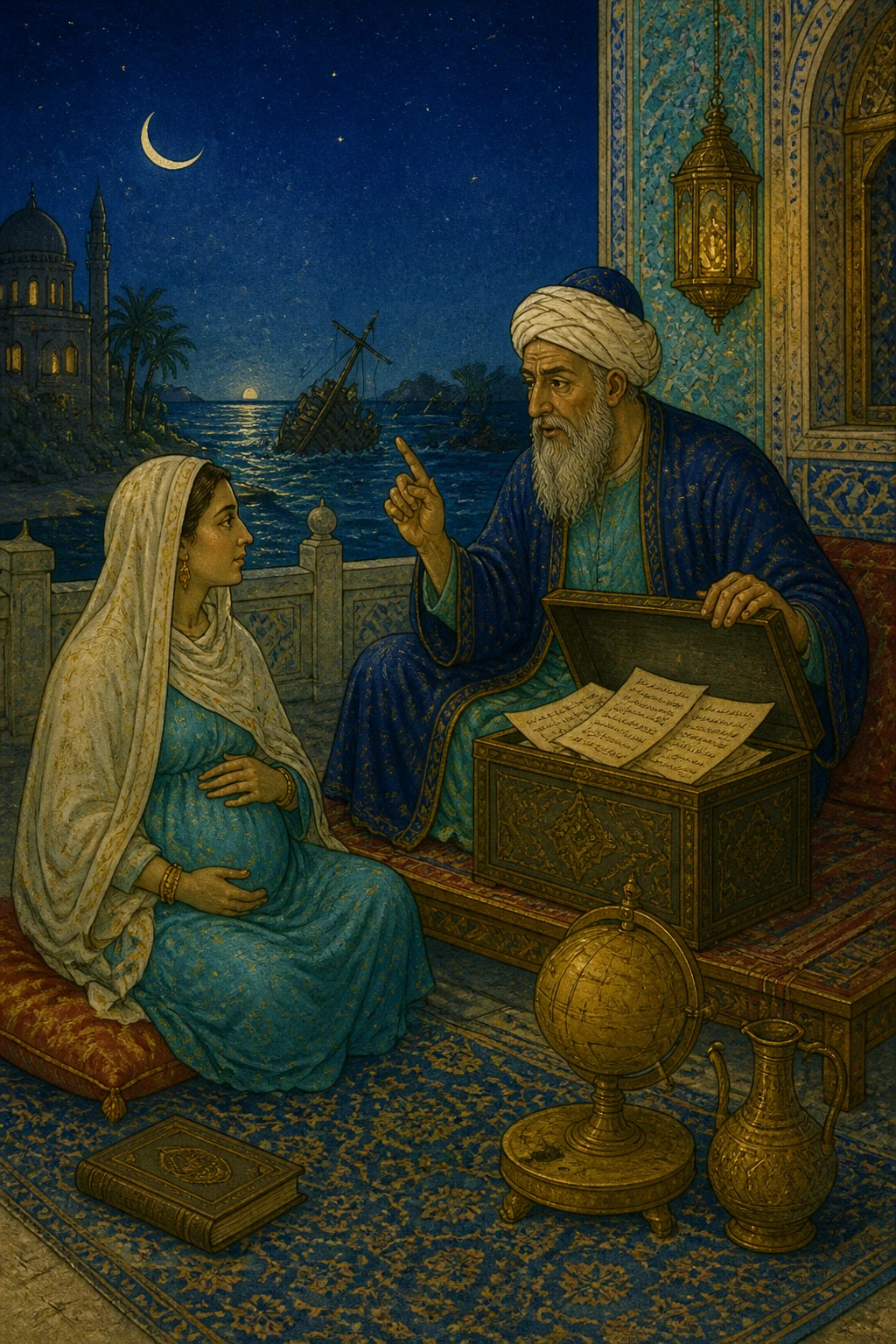
She said: It has reached me, O fortunate King, that the Greek sage returned home and lay with his wife, and she conceived that very night. Some days later, he set out on a voyage, but his ship was wrecked and his books were lost in the sea. He clambered onto a plank from the vessel, carrying with him five leaves that remained of the books that had fallen into the water. When he returned home, he placed these leaves in a chest and locked it. By then his wife’s pregnancy had become apparent, and he said to her, “Know that my death draws near, and that I shall soon pass from the abode of mortality to the abode of eternity. You are with child, and perhaps you will bear a son after my death. If you do, name him Hasib Karim al-Din, and bring him up with the greatest care. When he is grown and asks you, ‘What inheritance did my father leave me?’ give him these five leaves. Once he has read them and understood their meaning, he will become the most learned man of his age.” Then he bade her farewell, gave one last gasp, and departed this world and all it held. May God have mercy upon him! His family and friends mourned him, then washed his body, bore him forth in a grand funeral procession, buried him, and returned home. A few days later, his wife gave birth to a handsome boy and named him Hasib Karim al-Din, as her husband had instructed. At his birth she summoned astrologers, who calculated his horoscope and the aspects of the stars, then said to her, “Know, woman, that this child will live many years, but only after suffering a great ordeal early in life. If he survives it, he will thereafter be granted knowledge of wisdom.” The astrologers then went their way. She nursed him for two years and weaned him, and when he reached the age of five, she sent him to school to acquire some learning. But he learned nothing, so she took him out of school and apprenticed him to a trade. He learned nothing of that either, and could produce no work with his hands. His mother wept over this, and people said to her, “Find him a wife. Perhaps concern for her will spur him to take up a trade.” So she sought a girl’s hand for him and married him to her. He remained thus for some time, without taking up any trade at all.
Now they had neighbors who were woodcutters. These men came to his mother and said, “Buy your son a donkey, a rope, and an axe, and let him come with us to the mountain. He can gather wood alongside us, and we shall share the proceeds of its sale, so that he may support you with his portion.” His mother was overjoyed to hear this from the woodcutters. She bought her son a donkey, a rope, and an axe, then took him to the men, entrusted him to them, and asked them to look after him. “Do not worry about the lad,” they told her. “Our Lord will provide for him. He is the son of our venerable master.” They took him with them to the mountain, where they cut wood, loaded their donkeys, and returned to the city. There they sold the wood and provided for their families. The next day, and the day after, they made their donkeys ready and went back to gather wood. They continued in this way for some time, until one day, while they were out gathering wood, a tremendous rainstorm broke over them. They fled into a great cave to shelter from the rain. Hasib Karim al-Din rose from among them and went to sit alone in another part of the cave. He began striking the ground with his axe, and heard a hollow sound beneath it. Realizing that there was a cavity below, he dug for a while until he uncovered a round slab with a ring set into it. Delighted at the sight, he called to his companions the woodcutters. But morning overtook Shahrazad, and she fell silent, leaving her tale untold.
When it was the four hundred and eighty-fourth night,
She said: It has reached me, O fortunate King, that when Hasib Karim al-Din saw the slab with the ring in it, he rejoiced and called his companions. They came over, saw the slab, and hurried to lift it. Beneath it they found a door. They opened the door under the slab, and there lay a pit filled with honey. The woodcutters said to one another, “This pit is full of honey. We need only go to the city, bring vessels, fill them with the honey, and sell it, then divide the proceeds. One of us must stay here to guard it from others.” Hasib said, “I will stay and guard it until you return with the vessels.” So they left Hasib Karim al-Din to watch over the pit and went to the city. They brought back vessels, filled them with honey, loaded their donkeys, and returned to the city, where they sold the honey. Then they came back to the pit a second time. They continued in this way for some time, selling in the city and returning to the pit to fill their vessels, while Hasib Karim al-Din remained there guarding it for them. One day they said to one another, “It was Hasib Karim al-Din who found the honey pit. Tomorrow he may come down to the city and bring a claim against us, taking the money from the honey and saying, ‘I was the one who found it.’ The only way to rid ourselves of this danger is to lower him into the pit to fill our vessels with the honey that remains, then leave him there to die of misery, with no one the wiser.” They all agreed to this plan and set out, traveling until they reached the pit. “Hasib,” they said, “go down into the pit and fill our vessels with the honey that is left.” Hasib descended and filled their vessels with the remaining honey, then called, “Pull me up! There is nothing left.” Not one of them answered him. They loaded their donkeys and set off for the city, leaving him alone in the pit. He began to cry and call for help, saying, “There is no power and no strength save in God the Almighty! I shall die of misery!”
Such was the plight of Hasib Karim al-Din. As for the woodcutters, when they reached the city, they sold the honey and went weeping to Hasib’s mother. “May your life be spared to mourn your son Hasib,” they said. “What caused his death?” she asked. They told her, “We were sitting on the mountain when a tremendous rainstorm broke over us, so we took refuge in a cave. Before we knew it, your son’s donkey had run off into the valley. He went after it to bring it back, but there was a great wolf in the valley, and it tore your son to pieces and ate the donkey.” When his mother heard the woodcutters’ words, she slapped her face, heaped dust upon her head, and held mourning rites for him. Thereafter the woodcutters brought her food and drink every day.
Such was the lot of his mother. As for the woodcutters, they opened shops and became merchants, passing their days in eating and drinking, laughter and merriment. Hasib Karim al-Din, meanwhile, wept and sobbed. As he sat in this plight at the bottom of the pit, a large scorpion suddenly fell upon him. He sprang up and killed it, then thought to himself, “This pit was full of honey. Where could the scorpion have come from?” He began examining the place from which it had fallen, looking to right and left about the pit, until he saw light glimmering through the spot where the scorpion had entered. Taking out a knife he had with him, he widened the opening until it was the size of a small window, then climbed through. He walked on inside for a while and came upon a vast passageway. Following it, he reached a great door of black iron secured with a silver lock, in which there was a golden key. He approached the door and peered through it, seeing a brilliant light shining within. He took the key, unlocked the door, and passed through. After walking for a while, he came to a great lake, where he saw something gleaming like water. He continued toward it until he reached a lofty hill of green chrysolite, upon which stood a golden throne set with jewels of every kind. But morning overtook Shahrazad, and she fell silent, leaving her tale untold.
When it was the four hundred and eighty-fifth night,
She said: It has reached me, O fortunate King, that when Hasib Karim al-Din reached the hill, he found it to be of green chrysolite, with a golden throne upon it, set with jewels of every kind. Around the throne stood chairs, some of gold, some of silver, and some of green emerald. When he came among these chairs, he sighed, then counted them and found that there were twelve thousand. He climbed onto the throne that stood in their midst and sat down, marveling at the lake and the chairs arrayed about it. He continued to gaze in wonder until sleep overcame him. He had slept a little while when he heard hissing and whistling and a tremendous commotion. Opening his eyes, he sat up and saw enormous serpents upon the chairs, each a hundred cubits long. He was seized with terror; his mouth went dry with fear, and he despaired of his life. As they sat upon their chairs, he saw that each serpent’s eyes glowed like live coals. He turned toward the lake and saw it filled with little serpents whose number God alone could know. After a while, a great serpent as large as a mule approached him. On its back it carried a golden platter, and in the middle of the platter lay a serpent that shone like crystal, with a human face and an eloquent tongue. When she drew near Hasib Karim al-Din, she greeted him, and he returned her greeting. Then one of the serpents upon the chairs came forward, and the serpent on the platter cried out to them in their own tongues. All the serpents came down from their chairs, bowed low, and invoked blessings upon her. She motioned to them to sit, and they took their seats. Then she said to Hasib Karim al-Din, “Do not fear us, young man, for I am the queen and sovereign of the serpents.”
When Hasib Karim al-Din heard these words from the serpent, his heart was reassured. She signaled to the other serpents to bring food, and they brought apples, grapes, pomegranates, pistachios, hazelnuts, walnuts, almonds, and bananas, setting them before him. Then the Queen of the Serpents said, “Welcome, young man. What is your name?” “My name is Hasib Karim al-Din,” he replied. “Hasib,” she said, “eat some of this fruit, for we have no other food, and have no fear of us.” On hearing these words from the serpent, Hasib ate his fill and gave thanks to God Most High. When he had finished, they cleared the food from before him. Then the Queen of the Serpents said, “Tell me, Hasib, where are you from? How did you come to this place, and what has befallen you?” Hasib told her what had happened to his father, how his mother had given birth to him and sent him to school at the age of five, and how he had learned nothing. He told her how she had apprenticed him to a trade, then bought him a donkey, and how he had become a woodcutter. He related how he had found the honey pit, how his fellow woodcutters had abandoned him in it and gone away, how the scorpion had fallen upon him and he had killed it, and how he had widened the crack through which it had fallen and climbed out of the pit. Finally, he told her how he had come to the iron door and opened it, making his way at last to the Queen of the Serpents, to whom he was now speaking. “That is my story from beginning to end,” he said, “and God alone knows what will befall me after all this.” When the Queen of the Serpents had heard Hasib Karim al-Din’s tale from beginning to end, she said, “Nothing but good shall befall you.” But morning overtook Shahrazad, and she fell silent, leaving her tale untold.
When it was the four hundred and eighty-sixth night,
She said: It has reached me, O fortunate King, that when the Queen of the Serpents had heard Hasib Karim al-Din’s tale from beginning to end, she said, “Nothing but good shall befall you. But I wish you, Hasib, to remain with me for a time, so that I may tell you my story and relate the wonders that have befallen me.” He replied, “I hear and obey whatever you command.” Then she said, “Know, Hasib, that in the city of Misr there lived a king of the Children of Israel who had a son named Buluqiya. This king was a learned and devout man, much given to reading books of knowledge. When he grew weak and drew near death, the great men of his realm came to pay their respects. Once they had greeted him and seated themselves beside him, he said, ‘My people, know that the time is near for me to leave this world for the next. I have no charge to lay upon you save that of my son Buluqiya. Take good care of him.’ Then he said, ‘I bear witness that there is no god but God,’ gave one last gasp, and departed this world. May God have mercy upon him! They prepared his body, washed him, bore him forth in a grand funeral procession, and buried him. Then they made his son Buluqiya their sultan. He ruled his subjects justly, and the people lived in peace during his reign. One day he opened his father’s treasuries to inspect them. On opening one of them, he discovered what appeared to be a door. He opened it and entered a small, secluded chamber containing a pillar of white marble, upon which stood an ebony chest. Buluqiya took it down and opened it. Inside he found another chest, this one of gold, and when he opened it, he saw a book. He opened the book and read it, finding within a description of Muhammad, may God bless him and grant him peace: how he would be sent forth at the end of time, and how he was the lord of all who came before and all who would come after. When Buluqiya read this book and learned the qualities of our lord Muhammad, may God bless him and grant him peace, his heart became bound to him in love. He summoned the great men of the Children of Israel—the priests, rabbis, and monks—showed them the book, and read it aloud to them. Then he said, ‘My people, I ought to take my father out of his grave and burn him.’ ‘Why would you burn him?’ they asked. Buluqiya answered, ‘Because he concealed this book from me and never showed it to me. He had compiled it from the Torah and the scrolls of Abraham, then placed it in his treasuries without letting anyone see it.’ They said, ‘Our king, your father is dead, and his judgment rests with his Lord. He lies now in the dust; do not take him from his grave.’ When Buluqiya heard these words from the elders of the Children of Israel, he realized that they would not allow him to lay hands upon his father. He left them and went to his mother, saying, ‘Mother, in my father’s treasuries I have found a book describing Muhammad, may God bless him and grant him peace, a prophet who will be sent forth at the end of time. My heart has become bound to him in love, and I wish to wander through the lands until I meet him. If I do not meet him, I shall die of longing for him.’ Then he took off his clothes and put on a woolen cloak and a pair of coarse shoes. ‘Do not forget me in your prayers, Mother,’ he said. His mother wept over him and asked, ‘What will become of us when you are gone?’ Buluqiya replied, ‘I can bear this no longer. I entrust my fate and yours to God Most High.’ Then he set out on his wanderings toward Syria, without any of his people knowing. He journeyed until he reached the seashore, where he saw a ship and went aboard with the other passengers. They sailed on until they came to an island. The passengers went ashore, and he went with them. Then he wandered away from the others and sat beneath a tree, where sleep overcame him. When he awoke, he went to the ship to board it, only to find that it had sailed away. On the island he saw serpents as large as camels and as tall as palm trees, remembering God Almighty, invoking blessings upon Muhammad, may God bless him and grant him peace, and crying aloud that there is no god but God and that all glory belongs to Him. At the sight of this, Buluqiya was filled with the utmost wonder.” But morning overtook Shahrazad, and she fell silent, leaving her tale untold.
Izvirnik
حكاية مغامرات حاسب كريم الدين - الليالي ٤٨٢ إلى ٤٨٦
Naslednje strani prikazujejo izvirno besedilo za primerjavo.
فلما كانت الليلة ٤٨٢
ومما يُحكَى أنه كان في قديم الزمان، وسالف العصر والأوان، حكيم من حكماء اليونان، وكان ذلك الحكيم يُسمَّى دانيال، وكان له تلامذة وجنود، وكان حكماء اليونان يذعنون لأمره، ويعوِّلون على علومه، ومع هذا لم يُرزَق ولدًا ذَكَرًا، فبينما هو ذات ليلة من الليالي يتفكَّر في نفسه ويبكي على عدم وجود ولد يرثه في علومه من بعده، إذ خطر بباله أن الله سبحانه وتعالى يجيب دعوةَ مَن إليه أناب، وأنه ليس على باب فضله بوَّاب، ويرزق مَن يشاء بغير حساب، ولا يرد سائلًا إذا سأله، بل يجزل الخير والإحسان له، فسأل الله تعالى الكريم أن يرزقه ولدًا يخلفه من بعده، ويجزل له الإحسان من عنده، ثم رجع إلى بيته، وواقَعَ زوجته، فحملَتْ منه تلك الليلة. وأدرك شهرزاد الصباح فسكتَتْ عن الكلام المباح.
فلما كانت الليلة ٤٨٣
قالت: بلغني أيها الملك السعيد، أن الحكيم اليوناني رجع إلى بيته، وواقَعَ زوجته، فحملت منه تلك الليلة، ثم بعد أيام سافَرَ إلى مكان في مركب فانكسرت به المركب، وراحت كتبه في البحر، وطلع هو على لوحٍ من تلك السفينة، وكان معه خمس ورقات بقيت من الكتب التي وقعت منه في البحر، فلما رجع إلى بيته وضع تلك الأوراق في صندوق، وقفل عليها، وكانت زوجته قد ظهر حملها، فقال لها: اعلمي أني قد دَنَتْ وفاتي، وقرب انتقالي من دار الفناء إلى دار البقاء، وأنت حامل فربما تلدين بعد موتي صَبِيًّا ذَكَرًا، فإذا وضعتِه فسمِّيه حاسب كريم الدين، وربِّيه أحسن التربية، فإذا كبر وقال لك: ما خلَّفَ لي أبي من الميراث؟ فأَعْطِيه هذه الخمس ورقات، فإذا قرأها وعرف معناها يصير أعلم أهل زمانه. ثم إنه ودَّعَها وشهق شهقة ففارَقَ الدنيا وما فيها، رحمة الله تعالى عليه؛ فبكى عليه أهله وأصحابه، ثم غسَّلوه وأخرجوه خرجة عظيمة، ودفنوه ورجعوا، ثم إن زوجته بعد أيام قلائل وضعَتْ ولدًا مليحًا، فسمَّتْه حاسب كريم الدين، كما أوصاها به، ولما ولدته أحضرَتْ له المنجِّمُون، فحسبوا طالعه، وناظره من الكواكب، ثم قالوا لها: اعلمي أيتها المرأة أن هذا المولود يعيش أيامًا كثيرة، ولكن بعد شدة تحصل له في مبدأ عمره، فإذا نجا منها فإنه يُعطَى بعد ذلك عِلْمَ الحكمة. ثم مضى المنجِّمُون إلى حال سبيلهم، فأرضعَتْه اللبن سنتين، وفطمته، فلما بلغ خمس سنين حطته في المكتب ليتعلم شيئًا من العلم، فلم يتعلم؛ فأخرجَتْه من المكتب، وحطَّتْه في الصنعة فلم يتعلَّم شيئًا من الصنعة، ولم يطلع من يده شيء من الشغل، فبكت أمه من أجل ذلك، فقال لها الناس: زوِّجِيه لعله يحمل هَمَّ زوجته، ويتَّخِذ له صنعة، فقامت وخطبت بنتًا وزوَّجَتْه بها، ومكث على ذلك الحال مدة من الزمان، وهو لم يتَّخِذ له صنعة قطُّ.
ثم إنهم كان لهم جيران حطَّابون، فأتوا إلى أمه وقالوا لها: اشتري لابنك حمارًا وحبلًا وفأسًا، ويروح معنا إلى الجبل، فنحتطب نحن وإياه، ويكون ثمن الحطب له ولنا، وينفق عليكم ممَّا يخصه. فلما سمعَتْ أمه ذلك من الحطَّابين فرِحَتْ فرحًا شديدًا، واشترَتْ لابنها حمارًا وحبلًا وفأسًا، وأخذَتْه وتوجَّهَتْ به إلى الحطَّابين، وسلَّمته إليهم، وأوصتهم عليه، فقالوا لها: لا تحملي هَمَّ هذا الولد؛ ربنا يرزقه، وهذا ابن شيخنا. ثم أخذوه معهم، وتوجَّهوا إلى الجبل، فقطعوا الحطب، وحملوا حميرهم وأتوا إلى المدينة وباعوا الحطب، وأنفقوا على عيالهم، ثم إنهم شدوا حميرهم، ورجعوا إلى الاحتطاب في ثاني يوم وثالث يوم، ولم يزالوا على هذه الحالة مدةً من الزمان؛ فاتفق أنهم ذهبوا إلى الاحتطاب في بعض الأيام، فنزلت عليهم مطرة عظيمة، فهربوا إلى مغارة عظيمة ليداروا أنفسهم فيها من تلك المطرة، فقام من عندهم حاسب كريم الدين، وجلس وحده في مكانٍ من تلك المغارة، وصار يضرب الأرضَ بالفأس، فسمع حسَّ الأرض خالية من تحت الفأس، فلما عرف أنها خالية مكث يحفر ساعة، فرأى بلاطة مدوَّرة، وفيها حلقة، فلما رأى ذلك فرِحَ ونادى جماعته الحطَّابين. وأدرك شهرزاد الصباح فسكتَتْ عن الكلام المباح.
فلما كانت الليلة ٤٨٤
قالت: بلغني أيها الملك السعيد أن حاسب كريم الدين لما رأى البلاطة التي فيها الحلقة فرح ونادى جماعته، فحضروا إليه فرأوا تلك البلاطة، فتسارعوا إليها وقلعوها، فوجدوا تحتها بابًا، ففتحوا الباب الذي تحت البلاطة، فإذا هو جبٌّ ملآن عسل نحل، فقال الحطَّابون لبعضهم: هذا جبٌّ ملآن عسلًا، وما لنا إلا أن نروح المدينة، ونأتي بظروف، ونعبِّئ هذا العسل فيها، ونبيعه ونقتسم حقَّه، وواحد منَّا يقعد ليحفظه من غيرنا. فقال حاسب: أنا أقعد وأحرسه حتى تروحوا وتأتوا بالظروف. فتركوا حاسب كريم الدين يحرس لهم الجب، وذهبوا إلى المدينة، وأتوا بظروفٍ، وعبَّوها من ذلك العسل، وحمَّلوا حميرهم، ورجعوا إلى المدينة، وباعوا ذلك العسل، ثم عادوا إلى الجب ثاني مرة؛ وما زالوا على هذه الحالة مدةً من الزمان، وهم يبيعون في المدينة ويرجعون إلى الجب يعبُّون من ذلك العسل، وحاسب كريم الدين قاعد يحرس لهم الجبَّ، فقالوا لبعضهم يومًا من الأيام: إن الذي لقي جبَّ العسل حاسب كريم الدين، وفي غدٍ ينزل إلى المدينة، ويدَّعِي علينا، ويأخذ ثمن العسل ويقول: أنا الذي لقيتُه، وما لنا خلاص من ذلك إلا أن نُنزِله في الجبِّ ليعبِّي العسل الذي بقي فيه، ونتركه هناك فيموت كمدًا، ولا يدري به أحد، فاتفق الجميع على هذا الأمر، ثم ساروا، وما زالوا سائرين حتى أتوا إلى الجب، فقالوا له: يا حاسب، انزل الجبَّ، وعبِّ لنا العسلَ الذي بقي فيه، فنزل حاسب في الجب وعبَّى لهم العسل الذي بقي فيه، وقال لهم: اسحبوني فما بقي فيه شيء. فلم يردَّ عليه أحدٌ منهم جوابًا، وحمَّلوا حميرهم، وساروا إلى المدينة، وتركوه في الجبِّ وحدَه، وصار يستغيث ويبكي ويقول: لا حول ولا قوة إلا بالله العظيم، قد متُّ كمدًا.
هذا ما كان من أمر حاسب كريم الدين، وأما ما كان من أمر الحطَّابين، فإنهم لما وصلوا إلى المدينة باعوا العسل، وراحوا إلى أم حاسب وهم يبكون، وقالوا لها: تعيش رأسك في ابنك حاسب. فقالت لهم: ما سبب موته؟ قالوا لها: إنَّا كنَّا قاعدين فوق الجبل، فأمطرت علينا السماء مطرًا عظيمًا، فأوينا إلى مغارة لنتدارى فيها من ذلك المطر، فلم نشعر إلا وحمار ابنك هرب في الوادي، فذهب خلفه ليردَّه من الوادي، وكان فيه ذئب عظيم فافترس ابنك، وأكل الحمار، فلما سمعَتْ أمه كلامَ الحطَّابين، لطمَتْ على وجهها، وحثَّتِ التراب على رأسها، وأقامت عزاءَه، وصار الحطَّابون يجيئون لها بالأكل والشرب في كل يوم.
هذا ما كان من أمر أمه، وأما ما كان من أمر الحطَّابين، فإنهم فتحوا لهم دكاكين، وصاروا تجَّارًا، ولم يزالوا في أكل وشرب وضحك ولعب.
وأما ما كان من أمر حاسب كريم الدين، فإنه صار يبكي وينتحب، فبينما هو قاعد في الجب على هذه الحالة، وإذا بعقربٍ كبير وقع عليه، فقام وقتله، ثم تفكَّرَ في نفسه وقال: إن الجبَّ كان ملآن عسلًا، فمن أين أتى العقرب؟ فقام ينظر المكان الذي وقع منه العقرب، وصار يلتفت يمينًا وشمالًا في الجبِّ، فرأى المكان الذي وقع منه العقرب يلوح منه النور، فأخرج سكينًا كانت معه، ووسَّعَ ذلك المكان حتى صار قدر الطاقة، وخرج منه، وتمشَّى ساعةً في داخله، فرأى دهليزًا عظيمًا، فمشى فيه فرأى بابًا عظيمًا من الحديد الأسود، وعليه قفل من الفضة، وعلى ذلك القفل مفتاح من الذهب، فتقدَّمَ إلى ذلك الباب، ونظر من خلاله، فرأى نورًا عظيمًا يلوح من داخله، فأخذ المفتاح وفتح الباب، وعبر إلى داخله، وتمشَّى ساعةً حتى وصل إلى بحيرة عظيمة، فرأى في تلك البحيرة شيئًا يلمع مثل الماء، فلم يزل يمشي حتى وصل إليه، فرأى تلًّا عاليًا من الزبرجد الأخضر، وعليه تخت منصوب من الذهب مرصَّع بأنواع الجواهر. وأدرك شهرزاد الصباح فسكتَتْ عن الكلام المباح.
فلما كانت الليلة ٤٨٥
قالت: بلغني أيها الملك السعيد، أن حاسب كريم الدين لما وصل إلى التل وجده من الزبرجد الأخضر، وعليه تخت منصوب من الذهب، مرصَّع بأنواع الجواهر، وحول ذلك التخت كراسيُّ منصوبة، بعضها من الذهب وبعضها من الفضة، وبعضها من الزمرد الأخضر، فلما أتى إلى تلك الكراسي تنهَّدَ، ثم عدَّها فرآها اثني عشر ألف كرسي، فطلع على ذلك التخت المنصوب في وسط تلك الكراسي، وقعد عليه، وصار يتعجَّب من تلك البحيرة، وتلك الكراسي المنصوبة، ولم يزل متعجبًا حتى غلب عليه النوم، فنام ساعة، وإذا هو يسمع نفخًا وصفيرًا، وهرجًا عظيمًا، ففتح عينَيْه وقعد، فرأى على الكراسي حيَّات عظيمة، طول كلٍّ منها مائة ذراع، فحصل له من ذلك فزع عظيم، ونشف ريقه من شدة خوفه، ويئس من الحياة، وخاف خوفًا عظيمًا، ورأى عين كل حية تتوقَّد مثل الجمر، وهن فوق الكراسي، والتفت إلى البحيرة، فرأى فيها حياتٍ صغارًا، لا يعلم عددُها إلا الله تعالى، وبعد ساعة أقبلَتْ عليه حية عظيمة مثل البغل، وعلى ظهر تلك الحية طبق من الذهب، وفي وسط ذلك الطبق حية تضيء مثل البلور، ووجهها وجه إنسان، وهي تتكلَّم بلسانٍ فصيح، فلما قربت من حاسب كريم الدين سلَّمَتْ عليه، فردَّ عليها السلام، ثم أقبلَتْ حية من تلك الحيات التي فوق الكراسي، ثم إن تلك الحية زعقت على تلك الحيات بلُغَاتها، فخَرَّتْ جميع الحيات من فوق كراسيها، ودعَيْنَ لها، وأشارت إليهن بالجلوس فجلسن، ثم إن الحية قالت لحاسب كريم الدين: لا تَخَفْ منَّا أيها الشاب؛ فإني أنا ملكة الحيات وسلطانتهن.
فلما سمع حاسب كريم الدين ذلك الكلام من الحية اطمأنَّ قلبه، ثم إن الحية أشارَتْ إلى تلك الحيات أن يأتوا بشيء من الأكل، فأتوا بتفاح وعنب ورمان، وفستق وبندق وجوز ولوز وموز، وحطوه قدام حاسب كريم الدين، ثم قالت له ملكة الحيات: مرحبًا بك يا شاب، ما اسمك؟ فقال لها: اسمي حاسب كريم الدين. فقالت له: يا حاسب، كُلْ من هذه الفواكه، فما عندنا طعام غيرها، ولا تَخَفْ منَّا أبدًا. فلما سمع حاسب هذا الكلام من الحية، أكل حتى اكتفى، وحمد الله تعالى، فلما اكتفى من الأكل رفعوا السماط من قدَّامه، ثم بعد ذلك قالت له ملكة الحيات: أخبرني يا حاسب مِن أين أنت؟ ومِن أين أتيتَ إلى هذا المكان؟ وما جرى لك؟ فحكى لها حاسب ما جرى لأبيه، وكيف ولدَتْه أمه، وحطته في المكتب، وهو ابن خمس سنين، ولم يتعلَّم شيئًا من العلم، وكيف حطته في الصنعة، وكيف اشترَتْ أمه له الحمار، وصار حطَّابًا، وكيف لقي جبَّ العسل، وكيف تركه رفقاؤه الحطَّابون في الجب وراحوا، وكيف نزل عليه العقرب وقتله، وكيف وسَّعَ الشق الذي نزل منه العقرب، وطلع من الجب، وأتى إلى الباب الحديد وفتحه حتى وصل إلى ملكة الحيات التي يكلِّمها، ثم قال لها: وهذه حكايتي من أولها إلى آخِرها، والله أعلم بما يحصل لي بعد هذا كله. فلما سمعت ملكة الحيات حكايةَ حاسب كريم الدين من أولها إلى آخِرها، قالت له: ما يحصل لك إلا كلُّ خير. وأدرك شهرزاد الصباح فسكتَتْ عن الكلام المباح.
فلما كانت الليلة ٤٨٦
قالت: بلغني أيها الملك السعيد، أن ملكة الحيات لما سمعَتْ حكايةَ حاسب كريم الدين من أولها إلى آخِرها، قالت له: ما يحصل لك إلا كلُّ خير، ولكن أريد منك يا حاسب أن تقعد عندي مدة من الزمان حتى أحكي لك حكايتي، وأُخبِرك بما جرى لي من العجائب. فقال لها: سمعًا وطاعةً فيما تأمرينني به. فقالت له: اعلم يا حاسب أنه كان بمدينة مصر مَلِك من بني إسرائيل، وكان له ولد اسمه بلوقيا، وكان هذا الملك عالِمًا عابدًا مُكِبًّا على قراءة كتب العلم، فلما ضعف وأشرف على الموت طلع له أكابر دولته ليسلِّموا عليه، فلما جلسوا عنده وسلَّموا عليه، قال لهم: يا قوم، اعلموا أنه قد دنَا رحيلي من الدنيا إلى الآخرة، وما لي عندكم شيء أوصيكم به إلا ابني بلوقيا، فاستوصوا به. ثم قال: أشهد أن لا إله إلا الله. وشهق شهقة ففارَقَ الدنيا رحمة الله عليه؛ فجهَّزوه وغسَّلوه ودفنوه، وأخرجوه خرجة عظيمة، وجعلوا ولده بلوقيا سلطانًا عليهم، وكان ولده عادلًا في الرعية، واستراحت الناس في زمانه، فاتفق في بعض الأيام أنه فتح خزائن أبيه ليتفرَّج فيها، ففتح خزانة من تلك الخزائن، فوجد فيها صورة بابٍ، ففتحه ودخل، فإذا هي خلوة صغيرة، وفيها عمود من الرخام الأبيض، وفوقه صندوق من الأبنوس، فأخذه بلوقيا وفتحه فوجد فيه صندوقًا آخَر من الذهب، ففتحه فرأى فيه كتابًا، ففتح الكتاب وقرأه، فرأى فيه صفة محمد ﷺ ، وأنه يُبعث في آخِر الزمان، وهو سيد الأولين والآخِرين، فلما قرأ بلوقيا هذا الكتاب، وعرف صفات سيدنا محمد ﷺ تعلَّقَ قلبه بحبه، ثم إن بلوقيا جمع أكابر بني إسرائيل من الكهان والأحبار والرهبان، وأَطْلَعَهم على ذلك الكتاب، وقرأه عليهم وقال لهم: يا قوم، ينبغي أن أُخرِج أبي من قبره وأحرقه. فقال له قومه: لأي شيء تحرقه؟ فقال لهم بلوقيا: لأنه أخفى عني هذا الكتاب ولم يُظهِره لي، وقد كان استخرجه من التوراة، ومن صحف إبراهيم، ووضع هذا الكتاب في خزائنه، ولم يُطلِع عليه أحدًا من الناس. فقالوا له: يا ملكنا، إن أباك قد مات، وأمره مفوَّض إلى ربه، وهو الآن في التراب، ولا تُخرِجه من قبره. فلما سمع بلوقيا هذا الكلام من أكابر بني إسرائيل، عرف أنهم لا يمكِّنونه من أبيه، فتركهم ودخل على أمه وقال لها: يا أمي، إني رأيت في خزائن أبي كتابًا فيه صفة محمد ﷺ ، وهو نبي يُبعَث في آخِر الزمان، وقد تعلَّقَ قلبي بحبه، وأنا أريد أن أسيح في البلاد حتى أجتمع به، فإنني إنْ لم أجتمع به متُّ غرامًا في حبه. ثم نزع ثيابه، ولبس عباءة وزربونًا، وقال: لا تنسيني يا أمي من الدعاء. فبكت عليه أمه، وقالت له: كيف يكون حالنا بعدك؟ قال بلوقيا: ما بقي لي صبر أبدًا، وقد فوَّضْتُ أمري وأمرك إلى الله تعالى. ثم خرج سائحًا نحو الشام، ولم يدرِ به أحدٌ من قومه، وسار حتى وصل إلى ساحل البحر، فرأى مركبًا فنزل فيها مع الركاب، وسارت بهم إلى أن أقبلوا على جزيرة، فطلع الركاب من المركب إلى تلك الجزيرة، وطلع معهم، ثم انفرد عنهم في الجزيرة، وقعد تحت شجرة، فغلب عليه النوم فنام، ثم إنه أفاق من نومه، وقام إلى المركب لينزل فيها، فرأى المركب قد أقلعت، ورأى في تلك الجزيرة حيات مثل الجِمَال، ومثل النخل، وهم يذكرون الله عزَّ وجلَّ ويصلون على محمد ﷺ ، ويصيحون بالتهليل والتسبيح، فلما رأى بلوقيا تعجَّبَ غايةَ العجب. وأدرك شهرزاد الصباح فسكتَتْ عن الكلام المباح.
Nadaljuj z branjem