Prevod
The limits of the earth may be found, and those of the sea and mountains too;
but no one, anywhere, by any means, can fathom the limits of a king’s mind.
“So stay here while I find a suitable moment to see him. Then I shall come back and take you to him.” When this had been agreed, Damanaka went to Piṅgalaka and said, “My lord, this is no ordinary creature. He is a bull who serves as the mount of the blessed Maheśvara. When I questioned him, he told me, ‘Maheśvara, being pleased with me, commanded me to graze on the tender shoots along the Kālindī. In short, the blessed god has given me this forest as my pleasure ground.’”
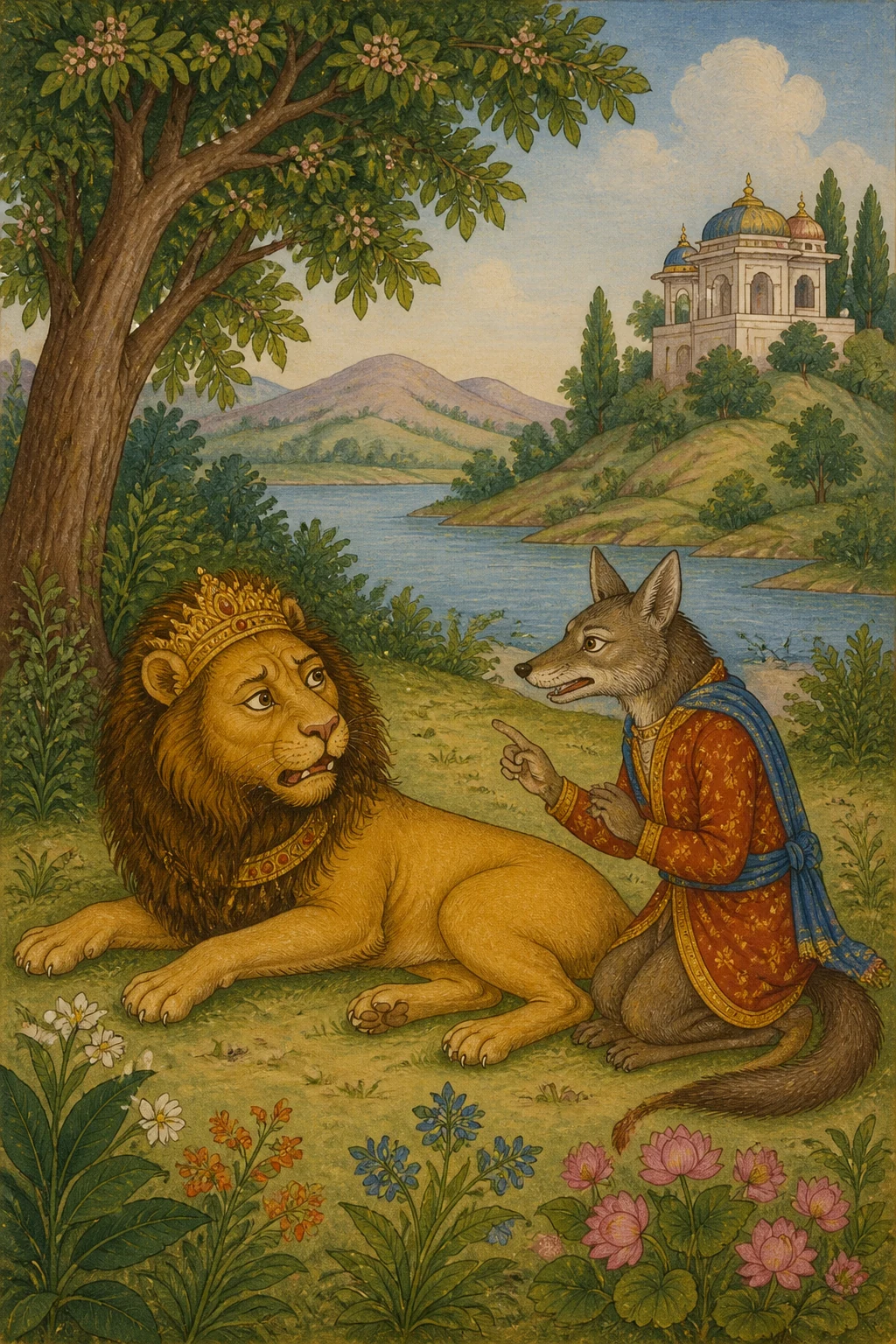
Piṅgalaka said fearfully, “Now I understand the truth. Without a deity’s favor, grass-eating creatures could never roam so joyfully and fearlessly through a forest like this, swarming with beasts of prey. What did you say to him then?”
Damanaka replied, “My lord, I told him, ‘This forest is the domain of Piṅgalaka, who serves as the mount of Caṇḍikā. You have come as a welcome guest. Go to him, and live together in brotherly affection, sharing food, drink, and recreation in a common home.’ He agreed to all this, and added gladly, ‘You must obtain from your master the gift of safe conduct for me.’ The decision now rests with my lord.” Hearing this, Piṅgalaka said, “Well done, wise counselor, well done! Excellent, learned minister! You have spoken as though you had consulted my very heart. I grant him the gift of safety. But obtain the same assurance from him on my behalf, and bring him here at once.” Well indeed is it said:
With ministers of inner strength, upright, sound, and thoroughly tested,
a kingdom is upheld, as a house is upheld by sturdy pillars.
And again:
A minister’s wisdom is revealed in healing a breach, a physician’s in treating a grave disorder;
when all is well, who is not an expert?
Damanaka bowed to him and set off for Saṃjīvaka, thinking joyfully, “Ah, our master has become gracious toward me and now follows my advice! No one is more fortunate than I.” For it is said:
Fire in winter is nectar; the sight of a loved one is nectar;
honor from a king is nectar; a meal of milk is nectar.
Coming to Saṃjīvaka, he said courteously, “My friend, I have asked our master to grant you safety. Go to him without fear. But once you have won the king’s favor, you must honor your agreement with me. You must not grow proud and act as though you were your own master. With your support, I too shall attain the rank of minister and shoulder the whole burden of government. If we act in this way, we shall both share in the blessings of royal fortune. For:
Men may bring riches within their grasp by following the hunters’ method:
one drives the subjects toward the other, who slays them like deer.
And again:
He who, out of pride, fails to honor those close to the king, whether high, low, or middling,
falls from favor, however respected he may be, as Dantila did.
Saṃjīvaka asked, “How was that?” Damanaka replied: “Story 3: The Tale of Dantila and Gorambha. There is a city on this earth called Vardhamāna. In it lived a merchant named Dantila, who dealt in many kinds of wares and was the foremost citizen of the town. By attending both to civic affairs and to the king’s business, he had won the satisfaction of the townspeople and the king alike. In short, no one had ever seen or heard of anyone so capable. Yet it has truly been said: A man who serves the king’s interests becomes hated by the people;
a man who serves the people’s interests is abandoned by kings.
With so great a conflict continually prevailing,
rare is the man who can serve both king and people.
“As time passed, Dantila’s wedding took place. He respectfully invited all the townspeople and the members of the royal household, feasted them, and honored them with gifts of clothing and other presents. After the wedding, he brought the king and his household to his own home and entertained them with great ceremony. Now a royal servant named Gorambha, whose duty was to sweep the palace, also came to the house, but seated himself in a place above his station. Dantila treated him contemptuously, seized him by the neck, and threw him out. From that moment Gorambha sighed over the insult and could not sleep even at night. ‘How can I make this merchant lose the king’s favor?’ he kept thinking. ‘But why torment myself to no purpose? There is nothing I can do to harm him.’ For it is well said: If a man grows angry when he has no power to strike back,
is he not shameless?
A chickpea may leap into the air,
but can it break the roasting pan?
“Then one day at dawn, while the king lay half asleep, Gorambha was sweeping beside his bed and said, ‘Ah, how brazen Dantila has become! He even embraces the queen!’
“Hearing this, the king sprang up in agitation and said, ‘Gorambha! Is what you have just said true? Has Dantila embraced her?’
“Gorambha replied, ‘Your Majesty, I was up all night gambling, and sleep has overpowered me. I do not know what I said.’ Jealousy stirred in the king, and he thought, ‘This man has unrestricted access to my house, and so does Dantila. Perhaps he has seen Dantila embracing the queen, and that is why he said this. For it is said:
Whatever a man desires, sees, or does by day,
he speaks of or acts out in dreams as well, through the force of habit.
And again:
Whatever lies in a person’s heart, whether good or evil,
however carefully concealed, may be discovered from words spoken in sleep or drunkenness.
Indeed, where women are concerned, what room is there for doubt?
They talk with one man, cast alluring glances at another,
and think of a third who dwells in their hearts. Who, then, is truly dear to women?
And further:
With smiling, rosy lips they chatter freely with one man, while their eyes, bright as blossoming water lilies, turn toward another;
and in their minds they dwell on yet another, far away, distinguished in conduct and splendid in wealth. For whom, then, do these fair-browed women truly feel the love they seem to show?
And again:
Fire is never sated with wood, nor the ocean with rivers,
nor Death with living creatures, nor a lovely-eyed woman with men.
There is no secluded place, no opportunity, no man to woo them:
that, Nārada, is how women come to be chaste.
The fool who fondly thinks, “This woman is in love with me,”
remains forever in her power, like a pet bird.
He carries out their commands and tasks, whether trivial or burdensome,
and through such deeds becomes an object of contempt throughout the world.
The man who courts a woman, seeks her company,
and pays her even a little attention is the very man she desires.
Only for lack of suitors and for fear of their attendants
do women, who know no restraint, remain within the bounds of propriety.
No man is forbidden to them; no age confines their choice.
Handsome or ugly, he is enjoyed merely because he is male.
A man dyed with passion becomes a woman’s plaything, like her dyed skirt;
clinging to its hem, he is pressed against her hips and worn away.
Like red lac, a man inflamed with passion is squeezed dry
and then cast at the feet of women, those supposedly powerless creatures.
“After brooding at length in this way, the king withdrew his favor from Dantila. Indeed, he even forbade him to enter the palace gates. Seeing the king suddenly turn against him, Dantila thought, ‘Ah, how well it is said: Who has gained wealth without becoming proud? What sensualist has seen the end of his troubles?
Whose heart in this world has not been broken by women? Who is ever truly dear to kings?
Who has escaped the reach of Time? What beggar has attained respect?
And what man caught in the snares of the wicked has come safely away?
And again:
Purity in a crow, truthfulness in gamblers, patience in a snake, freedom from lust in women,
courage in a eunuch, contemplation of truth in a drunkard, friendship in a king—who has ever seen or heard of these?
‘Yet I have never, even in a dream, done anything to offend this king or anyone connected with his court. Why, then, has he turned against me?’
“One day the sweeper Gorambha saw Dantila being stopped at the palace gates. Laughing, he said to the gatekeepers, ‘Ho there, gatekeepers! This is Dantila, the king’s favorite! He has the power to punish and reward on his own authority. If you bar his way, you too will be seized by the neck and thrown out, just as I was.’ Hearing this, Dantila thought, ‘Surely this is Gorambha’s doing. Well indeed is it said:
Even a man of low birth, even a fool, if he serves the king,
is honored everywhere, though otherwise he commands no respect.
Even a worthless coward, if he is a servant of the king,
will not suffer contempt at other people’s hands.
“After much troubled reflection, Dantila, humiliated, anxious, and stripped of his influence, summoned Gorambha to his house at nightfall. He honored him with a gift of two garments and said, ‘My good man, I did not throw you out that day out of personal anger. You were sitting above the Brahmins in a place unsuited to your rank, and that was why I treated you so harshly. Please forgive me.’ Receiving the two garments, which seemed to him as precious as sovereignty over heaven, Gorambha was delighted and said, ‘Merchant, I forgive you. In return for this honor, you shall see the power of my ingenuity and regain the king’s favor.’ With these words he went away content. Well indeed is it said:
A little makes him rise; a little makes him fall:
how alike are the movements of a scoundrel and a balance beam!
“The next day Gorambha went to the palace. As he swept near the king, who was half asleep, he said, ‘Ah, how foolish our king is! He eats cucumber while relieving himself!’ Astonished, the king said, ‘You wretch, Gorambha! What nonsense are you babbling? It is only because you are a household servant that I do not have you killed. Have you ever seen me do such a thing?’
“He replied, ‘I stayed up all night gambling, and sleep overpowered me as I was sweeping. Under its spell I must have babbled something, but I do not know what. May my lord forgive a man who was helpless in the grip of sleep.’ Hearing this, the king reflected, ‘Never in my life have I eaten cucumber while relieving myself. This fool has attributed to me something utterly impossible. Surely the same must be true of his story about Dantila. I did wrong to deprive the poor man of my favor. Such conduct is unthinkable in a man of his character. And in his absence, are not all the affairs of the court and city falling into neglect?’
“After considering the matter at length, he summoned Dantila, presented him with garments and ornaments from his own person, and restored him to his former office. That is why I say, ‘He who, out of pride, fails to honor…’”
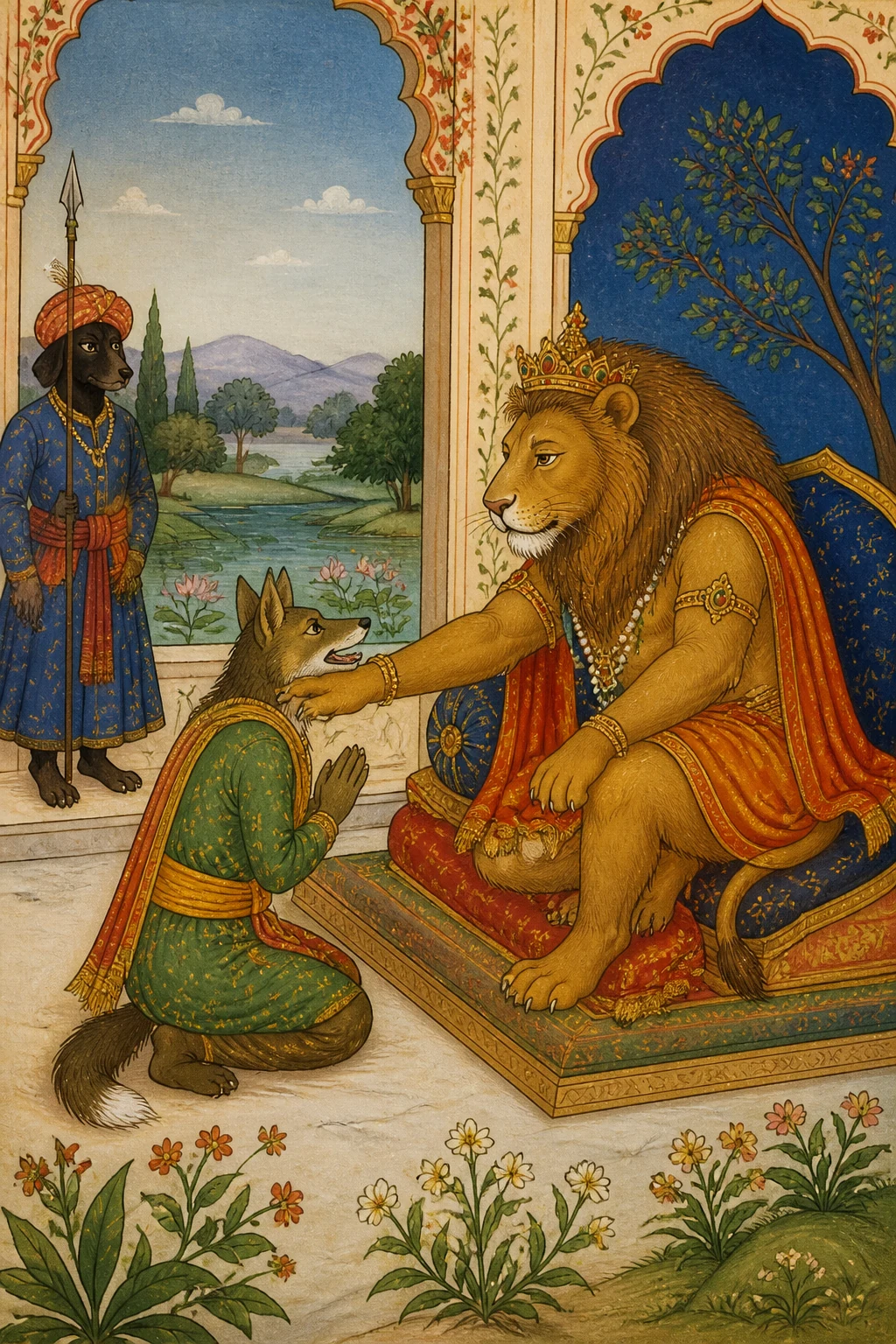
Saṃjīvaka said, “My friend, you are quite right. I shall do exactly as you advise.” With that assurance, Damanaka took him to Piṅgalaka and said, “Your Majesty, here is Saṃjīvaka, whom I have brought to you. The decision now rests with you.” Saṃjīvaka bowed respectfully and stood humbly before him. Piṅgalaka laid his right paw, adorned with thunderbolt-like claws, upon the bull’s broad, powerful hump and said graciously, “Are you well? How did you come to this deserted forest?”
Saṃjīvaka told him his story, relating everything, including how he had become separated from Vardhamāna. Hearing it, Piṅgalaka spoke still more kindly: “My friend, have no fear. Protected by the cage of my arms, you may now live as you please. But you must always remain close to me. This forest is full of dangers and frequented by savage creatures. It is no safe dwelling even for mighty beasts, much less for those that live on grass.” Having said this, he went down to the banks of the Yamunā, surrounded by all the animals, drank his fill, and returned at leisure to the forest. Thereafter, entrusting the burden of government to Karaṭaka and Damanaka, he spent his time with Saṃjīvaka, enjoying discussions of wise sayings. Well indeed is it said:
A single meeting with a good person, even if it comes by chance,
can become a bond that never ages; it need not await the growth of long acquaintance.
Saṃjīvaka’s intellect had been sharpened by his study of many learned works. In only a few days he made the dull-witted Piṅgalaka so discerning that he drew him away from the ways of the wilderness and turned him toward civilized conduct. In short, Piṅgalaka and Saṃjīvaka now spent every day talking alone together in private. All the other animals were kept at a distance. Even Karaṭaka and Damanaka could gain no admittance. Moreover, since the lion no longer went out hunting, all the animals, including the two jackals, were tormented by hunger and withdrew to a corner of the forest. For it is said:
Servants abandon a king who brings them no reward, however noble and exalted he may be,
and go elsewhere, as birds forsake a withered tree.
And again:
Even servants of noble birth, devoted and treated with honor,
will abandon a king when their livelihood fails.
And further:
A king who never lets his servants’ pay fall overdue
will never be deserted by them, even if he scolds them.
Nor is it only servants who behave in this way. The entire world waits to feed upon others, employing conciliation and the other expedients. Thus:
Kings look to their territories, physicians to the sick,
merchants to their customers, and scholars to fools;
thieves to the heedless, beggars to householders,
courtesans to the lustful, and craftsmen to all the world.
With snares fashioned from persuasion and the other arts, they lie in wait day and night,
drawing their livelihood as best they can, as water creatures depend upon rain clouds.
Well indeed is it said:
It is because the designs of snakes, scoundrels, and robbers
do not always succeed that this world continues to exist.
Śiva’s hungry serpent longs to eat Gaṇapati’s mouse;
the peacock of Krauñca’s foe would eat that serpent, and the Mountain Daughter’s lion would eat the peacock.
If even in Śiva’s household his dependents live together in such a fashion,
how could it be otherwise in this world? Such is its very nature.
Deprived of their master’s favor, their throats wasted with hunger, Karaṭaka and Damanaka took counsel together. Damanaka said, “Noble Karaṭaka, we have lost all importance. This Piṅgalaka has become so attached to Saṃjīvaka that he has turned away from his proper duties. All his attendants have left him. What are we to do?” Karaṭaka replied, “Even if he will not follow your advice, our master must still be warned, so that he may correct his faults. For it is said:
Ministers must admonish a king even when he will not listen,
as Vidura admonished Ambikā’s son, to deliver him from his faults.
And again:
When a king maddened by pride, or an elephant in rut, goes astray,
the ministers or keepers beside him bear the blame.
“But it was you who brought this grass-eater to our master. You have raked hot coals onto yourself with your own hands.”
Damanaka said, “That is true. The fault is mine, not our master’s. For it is said:
The jackal through the rams’ battle, I through Āṣāḍhabhūti,
and the go-between through another’s business—all three brought trouble upon themselves.
Karaṭaka asked, “How was that?” Damanaka replied: “Story 4: The Tale of the Wandering Ascetic Devaśarman. In a secluded place there stood a monastery, where a wandering ascetic named Devaśarman lived. Over time, by selling the fine garments given to him by many pious people, he had amassed a considerable sum of money. As a result, he trusted no one. Day and night he never let the money out from under his arm. Well indeed is it said:
There is sorrow in acquiring wealth, and in guarding it once acquired;
sorrow in losing it, sorrow in spending it. A curse on wealth, the source of so much misery!
“Now a swindler named Āṣāḍhabhūti, who lived by stealing other people’s money, noticed the sum Devaśarman kept tucked under his arm and thought, ‘How can I get that money away from him?
‘The monastery walls are built of solid stone, so I cannot break through them. And the entrance is too high to gain access that way. I shall therefore win him over with deceitful words and become his disciple, so that in time he will come to trust me completely. For it is said:
A man without ambition does not seek office; a man without desire does not delight in adornment;
a man unversed in artifice does not speak to please; a plain speaker is no deceiver.’