Waltey
Džuder ben Omar
Tunisische Märchen und Gedichte · Hans StummeO besedilu
Džuder ben Omar
- Vir
- Tunisische Märchen und Gedichte
- Avtor
- Hans Stumme
- Jezik branja
- English
- Jezik izvirnika
- Tunisian Arabic in Latin transcription
- Čas branja
- 32 min branja
- Obseg
- 26 strani
- Naslov izvirnika
- 003 Zûdër ben jjamúr
O izvirniku
Tunisische Märchen und Gedichte
Tunizijske pripovedi v zgodovinskem latiničnem zapisu govorjenega arabskega jezika. Bralni jezik je English, izvirnik pa prihaja iz vira Tunisische Märchen und Gedichte v jeziku Tunisian Arabic in Latin transcription.
Besedilo
Džuder ben Omar
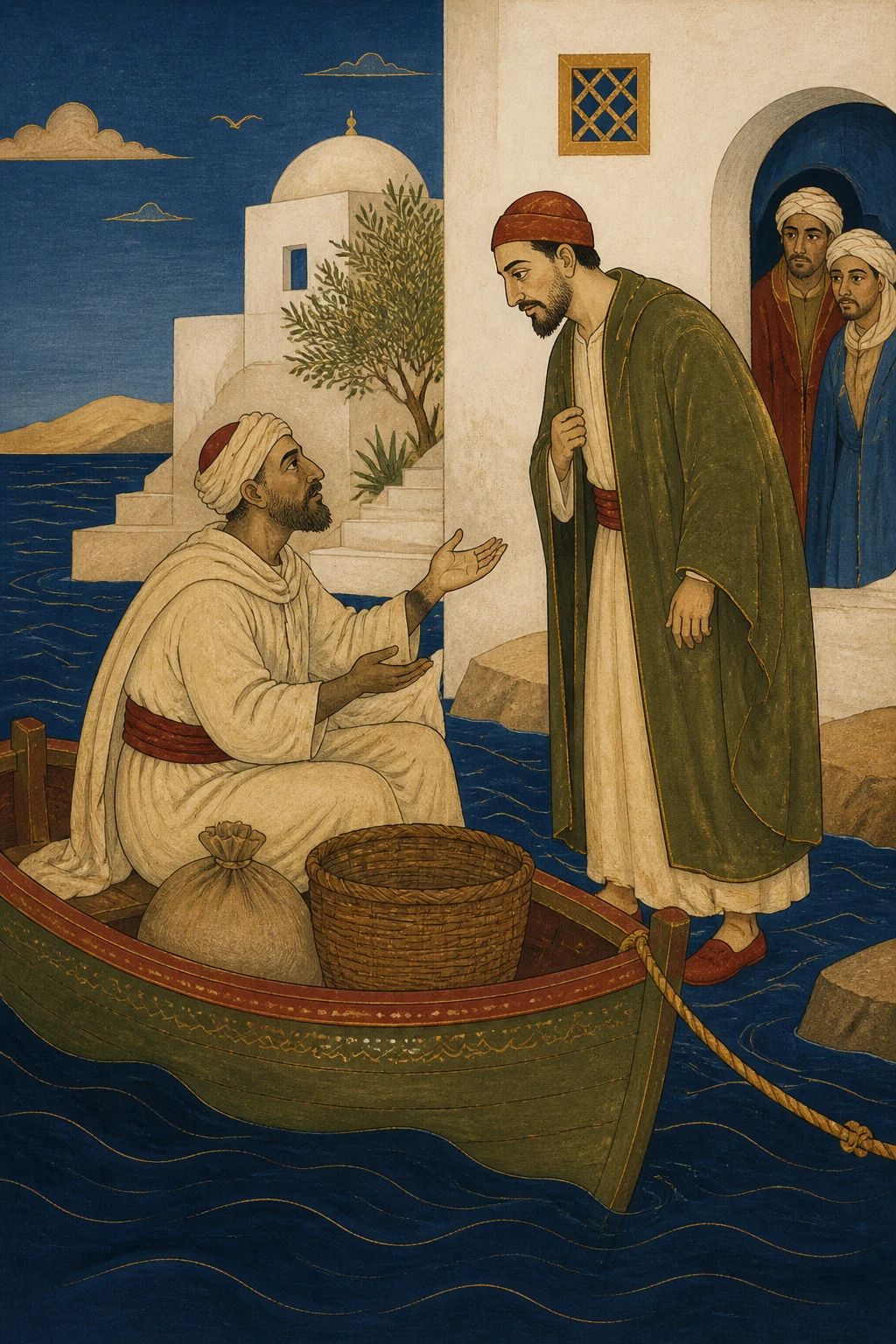
There was once a man called Juder ben Amur who lived in the city of Cairo. He was a fisherman by trade, and he had a mother and two brothers. The two brothers were idle wastrels, while poor Juder ben Amur supported his mother by catching fish.
Every day he went down to the seashore and spent the whole day casting his net. Toward evening he would catch a few small fish and sell them for three or four coins, or perhaps a rial. He lived like this for some time. Then he said to himself, “This work brings me nothing.” One day he went down to the shore and cast his net once, then twice, but caught nothing. “Come,” he said, “I’ll rest a while. What is allotted to me will come to me.
“Toward evening I’ll catch a couple of fish, by God’s power.” While he sat resting on the shore, a man came riding up on a mule. “Peace be upon you,” the man said. “And upon you be peace.” “Are you Juder ben Amur?” “Yes, I am.” The man dismounted and said, “Take these hundred mahbubs.” He gave him the hundred gold coins and handed him a silken cord. “Bind me with this and carry me into the sea until you reach deep water.
“When you reach deep water, throw me in. Once you have thrown me in, stay where you are. If you see white foam rise upon the sea, rejoice, for I shall be coming back to you. But if you see red foam, reckon me dead.” Juder ben Amur looked at him and said, “Why?
“What is the reason?” “Ask me no questions. If I return to you safe and sound, you will be a rich man. If I die, my son, God will provide for you. This is what God has decreed for you.” Juder said no more. He took hold of the man and bound him securely. “Tighter,” the man said, until Juder had bound him fast.
He hoisted him onto his shoulder, waded into the sea, threw him into deep water, and stood watching. The man had told him, “Wait at least an hour.” He waited there an hour, until red foam rose before him. “God!” he said. “He is dead. A fool does to himself what an enemy would do to his enemy.” He mounted the mule and rode back to the city. At the gate a Jew met him and said, “Give me the mule.” “Take it.” The Jew turned to Juder and said, “Greed and the desire to risk one’s neck lead a man to destruction.” Juder ben Amur went home to his mother, delighted with the money. He went to the butcher and bought meat, then bought vegetables and clarified butter, made ample provision for the household, and went home. His mother looked at him and said, “My dear, where did this money come from?” “God gave it to me. Why ask? Eat and drink, and pray that good may come to me.” “My son,” she said, “if you want me to pray for you, bring your brothers to eat with you. They may be good-for-nothings, but what can we do with them?” “Mother dear,” he answered, “whatever God sends, you and I and my brothers shall eat together.” He went and fetched them from the coffeehouse.
They ate their supper, filled their bellies, and slept in comfort. In the morning he took his net and said, “Come, let me seek God’s bounty.” He went to the shore and sat down. He had scarcely settled himself to rest when another man came riding up on a mule. “Peace be upon you,” he said. “And upon you be peace.”
“Are you Juder ben Amur?” “Yes.” “Did a man riding a mule come to you yesterday?” “I saw no one. I know nothing about it.” “Did no man come and give you a silken cord and tell you to bind him with it?” “No.” “Tell me the truth. You are going to do the same for me.” Juder told him the truth. “So his appointed hour had come,” the man said, “and that was how he chose to die!” He got down from the mule and put his hand into his purse.
He took out a hundred mahbubs and handed the money to Juder ben Amur. Then he drew out a silken cord. “Bind me as you bound my brother, and throw me into deep water, in the very place where you threw him. If red foam rises before you, reckon me dead. But if white foam rises, rejoice and count yourself a rich man.” “God bless us,” said Juder. He took hold of him, bound him, and threw him into the sea in the same place where he had thrown his brother. He stood looking out over the water. Red foam rose before him. Juder ben Amur stared at it. “What possesses them to kill themselves?” he said. “Well, a hundred mahbubs comes to you every day! Yet who knows what may happen to me, whether I shall live or die?” He took the mule and went away.
The Jew met him and said, “Give me the mule.” “Take it.” “Did he come to you?” “Yes.” “Is he dead?” “He is dead.” “So his appointed hour had come!” Juder went home happily to his mother. He bought clothes for her and for his brothers, who were in rags. They had a fine supper. Then he took his net and went to the shore. He reached his usual place and sat down. While he was still lost in thought, he saw a man approaching on a mule, just like the others. “Come,” he said, “I won’t cast my net. Perhaps God will provide me with another hundred mahbubs.” The old man said to him, “Are you Juder ben Amur?”
“Yes.” The man dismounted. “Did two men come to you, one yesterday and one the day before?” “Yes, they came.” “Did they die?” “They died and passed into God’s mercy.” The man put his hand into his purse and gave him five hundred mahbubs, more than the others had given him. Then he took off his clothes, reached into a saddlebag, and brought out a suit of leather, which he put on. “These clothes I have taken off,” he said, “be sure not to touch them. Put them in the saddlebag, and give everything to the man who comes to claim the mule. If I come out alive, I shall take my clothes myself.” Juder ben Amur looked at him. “Why do you throw yourselves away?” he asked. “Ask me no questions. If I come out again, I shall tell you everything. If I do not, farewell.
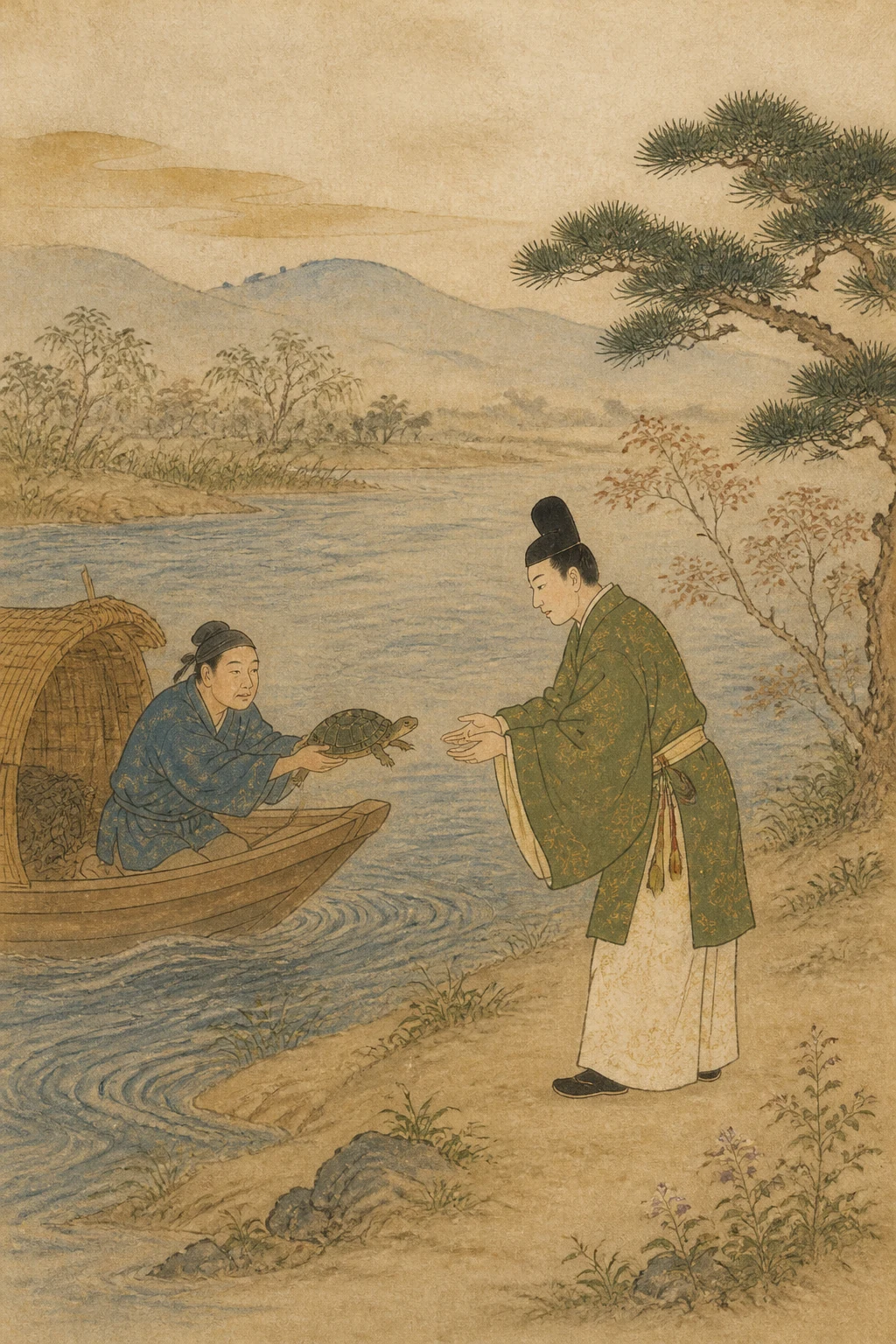
“What God has given you is yours.” Juder took hold of him, bound him with a red cord, and lifted him onto his shoulder. “Throw me where you threw my brothers,” the man said. Juder waded into the sea and threw him in. He waited an hour. White foam rose before him, and he rejoiced. The old man came out to him with a red fish in each hand and a golden rod in his mouth. As soon as he emerged, he said, “Untie me.” Juder untied him. The man reached into the saddlebag, took out a box, put the two fish inside, and shut it on them. He looked at Juder and said, “You are a fortunate man.
“This rod I hold contains kohl, magical kohl. We are three brothers, all versed in magic. There is a treasure in the Maghreb, and we have read in our books that it can be opened only by means of the kohl in this rod. Whoever anoints his eyes with it can see treasures and hoards beneath the earth. Those fish in the box are the daughters of a king of the jinn, and they hold dominion over that treasure. You must come with me, and we shall bring it forth. When we first came to conjure them, they seized the kohl-rod and fled into the sea with it. My eldest brother came and died; my second brother came and died. Come with me to the Maghreb. You will stay there with me a year.” “And my mother?” said Juder ben Amur. “Who will look after her? Who will support her when I am gone?” “We shall leave her all she needs.” He reached into the saddlebag and took out another bag, folded up. “Look at this bag. Whenever it is opened, whatever you ask for will come to you, food or drink, and the food comes cooked and ready to serve.” Juder ben Amur looked at him and said, “Let us open it now and try it, so that I may be easy in my mind about my mother.” The man opened it for him. “Ask for whatever you like.” “I want stuffed chickens, gazelle fried in clarified butter, and young pigeons—a splendid feast.”
Everything came to him ready to eat. He and the old man ate their meal. Then they folded the bag as it had been before. “Take it and give it to your mother,” the old man said. “Show her how to use it to obtain food, and warn her not to show it to your brothers.” Juder went and told her, “I am going on a journey. I shall be away from you for a year, and I want your blessing and your prayers.”
“My son,” she said, “if you go away, who will care for me, poor woman that I am? You know your brothers are wastrels.” “I shall leave you something that will provide for you.” He brought out the bag. “Ask for whatever you like, and it will come to you.” When he opened it, she said, “My son, you are deceiving me. What is there in this bag?” “Ask for what you want!” “I want a few barley loaves and a dish of stew.” He laughed at her. “Let me ask for you instead,” he said, and ordered a royal banquet. “Now I shall be away from you for a year.” “Go, my son. May you go in safety and return in safety.” “Be careful not to show the bag to my brothers. Let them share your food; do not leave them in want. But do not show them the bag.” He gave her five hundred mahbubs. “Buy clothes for yourself and my brothers, and go to the bathhouse. If I return, we shall meet again. If I do not, we shall meet before God. I ask you to forgive me.”
He took his leave of her and said, “Farewell, mother dear.” Juder ben Amur went to the old man, who gave him a mule. They both mounted their mules and set off. They traveled from morning until night. “Come,” Juder said, “let us stop, rest, and have our supper.” The old man turned to him. “Do you know how far we have traveled from your country?” “No.” “Today we have covered a journey of three months.” There they spent the night until morning.
They traveled on until nightfall, then stopped for supper. They had covered another three months’ journey. The next day they traveled until nightfall, when they came to a town. They entered it, turned the mules loose, and made themselves comfortable. It was the old man’s own town, and he had a house there. Juder went up to the house with him. They ate and drank and spent the night. Juder ben Amur stayed as his guest for three days. Then he said, “Come, let us go.” “Give me time. I want you to stay here with me for a month.” The month passed. “Stay another month.” A second month passed, and then a third. One day Juder said to the old man, “Come, let us go. I miss my mother.” The old man looked at him. “I brought you here for a year. You came only after giving up hope of your country and your family. Once our business is done, you can be home in two hours.” One day he said, “Come, my son. Today God will make our way easy.” They set out and traveled until they reached the foot of a mountain. The old man began his incantations. He gathered wood, lit a fire, and threw incense into it. “Stand there like a stone,” he told Juder. “Do not speak.” The Maghrebi went on chanting until the treasure chamber opened at his spell. Juder saw a foreign woman emerge from it, carrying golden scales. She came up to the Maghrebi and said, “Give me what you have.” He handed her packets of incense. She put them on the scales and weighed them, and found the weight exact. “Enter,” she said. “You have nothing to fear, fellow.” The Maghrebi turned to Juder. “Go in. I shall stay here.
“You will pass through a narrow passage until you come to a wide space. There you will find a house with four rooms facing one another. Go into the room opposite you. You will find a sword and a tablet. The jinn will begin talking to you. Be careful not to answer them. If you speak, you and I shall both die. Go in, and you will find the sword hanging up, with the tablet hanging beneath it. Take them, sling the sword over your shoulder, carry the tablet in your hand, and come back to me quickly.” Juder ben Amur entered the treasure chamber and went on through the narrow passage.
He heard a voice calling out. He looked this way and that and heard, “Help me, Juder ben Amur!” Turning, he saw a young woman chained by her neck and hands. “Come,” Juder ben Amur said to himself, “let me free this girl from her irons. The sword and tablet are hanging there; I can take them once I have set her free.” He went up to the girl. “How did this happen to you, my daughter?” he asked—and found himself outside the passage, with the treasure chamber closed. He was so stricken that he fainted. The Maghrebi lifted him onto his back and carried him home. Juder was senseless and knew nothing of where he was being taken. The Maghrebi laid him in the house and sprinkled water over him until he came to. When he recovered, the Maghrebi said, “Ah, Juder ben Amur, why did you do this to me?
“For all my warnings, my advice did you no good!” “I remembered everything you told me, except the one thing about speaking. I forgot that I must not speak. Now tell me about that girl. Is she human or one of the jinn?” “She is human, and a king’s daughter. An ifrit brought her there and has been tormenting her for three years. He has tried to make her marry him, but she has refused. It is written that she can be set free only by your hand.” Juder ben Amur looked at him. “How can she be freed?” The old man said, “If you had gone up to her without speaking and laid your hand on the chains, they would have opened of their own accord. Now you must stay with me another year.” “Very well. Since she is a Muslim, I would stay ten years for her sake.” When the second year was over, the Maghrebi said, “Come, let us go back.” He went and prepared his incense.
He lit the fire and warned Juder. “I am giving you instructions. Mind them carefully. Do not forget as you did the first time. When you go up to the girl to free her, lay your hand on the chains without speaking. Once you have freed her, you will find a recess behind her. In it you will find a spear covered with writing from top to bottom. On that spear it is written that the guardian of the treasure can be killed with it, for his life is bound up in it. Take it in your hand. The ifrit will speak and say, ‘Spare me, my lord Juder.’ If you speak, we shall both die.” “Put your trust in God,” Juder said. The treasure chamber opened, and the foreign woman came out as before. “Give me what you have,” she said. “Have you not learned your lesson? Do you not fear for your life?” He handed her the incense. She weighed it and found the weight exact. “Enter,” she said. “You have nothing to fear, fellow.” Juder ben Amur went in and continued until he reached the courtyard. He saw the tablet and sword hanging up. He took the tablet and put it in his pouch, and slung the sword at his left side. Then he went to the girl and laid his hand on her chains. They opened, and she was free. He turned to the recess, opened it, and took the spear.
He held it in his hand, and the ifrit appeared before him. “Spare me, my lord Juder,” he said. But Juder remained silent and did not answer. He brandished the spear, and fire flared up in the jinni and burned him. The treasure chamber remained open. Juder ben Amur came out to the Maghrebi, carrying the sword and tablet. “Let us go home,” the Maghrebi said. “It does not matter if the treasure chamber stays open. No one but you can see it.” They took the girl and made their way home. When they reached the house, the Maghrebi sent her to the women’s quarters, while he and Juder sat upstairs. They had their supper and spent the night. Juder said, “Show me what the sword is for, and what the tablet is for.”
“This sword, when you take it in your hand and brandish it, will cut off heads as far as your eye can see. As for the tablet, whatever you wish for will come to you. There are two kings of the jinn within it. If you wish to return to your country, you can be home in two hours. If you wish to travel with an army, you can do so.” Juder ben Amur said, “I am worried about the treasure we left standing open.” “Do not be afraid. No one can see it.
“Whenever you wish, the whole treasure is yours. As for the girl, do not covet her. Let us do her father a kindness and send her back to him. Come, my son, do you wish to return to your mother? This sword is no use to you. I shall give you the tablet; that will serve you.” Now the tale returns to Juder ben Amur’s mother. Her sons saw the fine food and drink that appeared every day. They turned to one another. “Brother, this money and this food come to us every day. Where do they come from?” The eldest looked at his mother. “Where do this food and money come from? We have never seen the like in our lives.” “My son,” she answered, “what more do you want? Eat and drink. Why ask questions?” “No, no,” they said. “You must tell us.” They seized her by the hands and threatened to kill her. Frightened, she gave them the bag.
They took the bag and abandoned her. They went to the tavern, opened it, and ate and drank and treated their friends. The poor woman was left starving. She began selling her belongings to buy food. When everything was gone, she took to begging. Now Juder ben Amur said to himself, “I have the tablet now. Come, let me summon the jinn.” He commanded the kings of the jinn to bring him an army. “I shall return by land and see the sights, and at the same time go home in state, like the bey.” They brought him a horse. He mounted it, with troops to his right and left, and rode in their midst like the leader of a host. He traveled on. When he reached a place where he wished
to camp, he commanded the kings of the jinn, “I want a pavilion with four golden poles, golden arches, an ivory bed, and silken bedding.” He slept in that bed, and in the morning continued his journey. A month passed. Then he came upon a palace.
Juder ben Amur turned to the king of the jinn. “How did this palace come to be here?” “Forty sorcerers built it. They read in their books that they could die only at the hand of Juder ben Amur. In this palace they hold a woman prisoner. You would do a kindness by delivering her from captivity. These sorcerers are Magians, worshippers of fire.” “How can I kill them? They are men of magic.” The king looked at him. “I shall write you a talisman. Place it between your eyes and go to the palace. You will find the door open. When you enter, you will find the floor paved with marble, some white and some black. Do not step on the black marble. If you do, you will die, for it has been laid with deadly magic. Step only on the white marble, leaping from one slab to the next, until you reach the middle of the palace and go upstairs. You will come to a cupboard with a key in it. Open it, and you will find a sword hanging inside.
“Draw that sword from its sheath. The moment you lay your hand on it, the sorcerers, wherever they may be, will come hurrying to you. Their lives are bound up in that sword, and they can die only by it. When you have killed them, turn to the room on your right. There is a key in the door. Lay your hand on it, and the room will open. Inside you will find a girl chained by her hands and feet.” “God bless us,” Juder said. He went to the palace, reached its gate, and entered. Leaping from white slab to white slab, he reached the courtyard.
There he found the cupboard. He went up to it, opened it, took out the sword, and drew it. The sorcerers appeared. “My lord Juder ben Amur, spare us!” they cried. He said nothing, but gripped the sword and swept it toward all forty of them. Fire consumed them, and they died. He was left alone in the palace.
He went to the room. As soon as he laid his hand on the key, the door opened. He entered and found a girl chained by her hands and feet. He freed her, and she said, “What brought you to me, good man?” “The Lord of the heavens brought me to you, so that your deliverance might come through my hands. How did this happen to you?” “I am a Muslim, and my father is one of the kings of China. These sorcerers came to my father and asked for me, but he refused to give me to them. They stole me away and brought me here. For three years now they have tormented me, saying, ‘Become a Magian and embrace our faith.’ But I refused.” “Now that you are free,” he said, “what would you like? Shall I send you to your father and mother?” “One who does good has no need to ask. I have been in torment for three years.” He brought out the tablet. The kings of the jinn appeared. “Ask, my lord Juder. What do you wish?” “Let one of you carry this girl home. Her mother and father are sitting in their palace. Set her down between them.” “Yes, God bless us.” One of the kings lifted her and flew away with her. In the twinkling of an eye he brought her home. Her father and mother were sitting together, and she descended into their midst. Juder ben Amur commanded the kings, “I want this palace, with everything in it, its wealth and furnishings, set down in the middle of Cairo.” “God bless us,” they said. When night fell, they told him, “Go to sleep. When you open your eyes, you will find yourself in Cairo.” Night came. He ate his supper and went to sleep. In the morning he opened his eyes and found himself in the city of Cairo. He rose and thought, “I must not leave this palace of mine unattended.” He commanded the kings of the jinn, and they brought him ten doorkeepers in human form. He stationed them at the gate to keep watch. Then he went down. “Let me go and see my mother.” As he walked along the road, he saw an old woman begging before him. “That looks like my mother,” he said. “Let me see.” He went up to her. “What are you doing, old woman?” “Begging, my son.” “Why? Have you no one?” “No.
“My good son, the one who provided for me, has gone away. The others are wicked men, roaming about Cairo.” He looked at her. “Do you not recognize me?” “No, I do not know you.” “Am I not your son Juder?” She flung herself upon him and began to weep. “Ah, my son!” she cried, kissing him. “Mother dear,” he said, “the bag I left you could have supported you for the rest of your life.”
“They took it from me,” she said, “and since they took it, I have not seen their faces.” He took his mother and brought her up to the palace. He had her dirty clothes removed, sent her to the bathhouse, and dressed her in new clothes. Then he summoned the king of the jinn. “I want my two brothers brought before me at once.” The king went and found his brothers in the tavern, where they had laid out a feast from which everyone was eating. The king of the jinn seized them and the bag, flew up into the sky with them, and set them down before their brother. Juder looked at them. “Why did you leave your mother to starve?
“Even if you had not had the bag, you should have worked on a building site to feed her.” The king looked at Juder. “What do you command me to do with them now?” “They are my brothers. What can I do to them?” Juder’s mother looked at him. “Forgive them for my sake.” “Very well, Mother.” So he clothed them and made them ministers in his palace, one on his right and one on his left. He had two benches placed in the entrance hall and covered them with fine cushions. He brought the doorkeepers, five to his right and five to his left, and sat in the middle of the hall like the bey. People passing by gazed at the new palace. “Where did this palace come from?” they asked. “And who is that sitting in its entrance hall just like the sultan?”
Word reached the Sultan of Cairo. “My lord,” they told him, “never in our lives have we seen such magnificence.” The sultan turned to his vizier. “Go to him, and be courteous. Tell him, ‘Our lord the sultan summons you.’” “Yes,” said the vizier, and went. When Juder ben Amur saw him, he rose, greeted him, seated him beside him, and served him coffee and a meal. After they had eaten, the vizier said, “Our lord the sultan commands you to come to him.” Juder ben Amur looked at the vizier. “I shall not go. The sultan must first come here to me.” The sultan had warned his vizier, “Do not argue with him. Whatever he tells you, come and report it to me.” The vizier returned to the sultan. “My lord,” he said, “that man has the majesty of kings about him. He must have a magic tablet or a ring.” “Come,” said the sultan, “you and I shall go to him. We shall treat him courteously and see for ourselves.” The sultan and vizier went, taking four or five other ministers with them.
They reached Juder ben Amur’s palace. He welcomed them gladly, gave them a meal, and brought them coffee. The sultan turned to Juder ben Amur. “What is the meaning of this? I send for you, and you do not come?” “Forgive me, my lord. I was ill and weary.”
The sultan looked at Juder. “Let us have no more words, either from you or from me. Come, you shall be my son and I shall be your father. I shall give you my daughter, and you shall be the vizier at my right hand. When my eyes close in death, the throne shall be yours.” “God bless us,” Juder answered.
They raised their hands and recited the Fatiha. “I want the marriage celebrated tonight,” Juder said. “The kings of these latter days are treacherous.” “I give you my covenant before God: I shall not betray you.” Juder married her that night. He went in to his bride, and she delighted in him and he in her. He stayed with her seven days. Then he brought out the tablet and said, “My dear, keep this safe.” He commended his mother to her care. “She is an old woman. Be considerate of her.” His brothers turned to one another. “Our brother has risen high, and his word carries more weight than ours. Come, let us kill him.” “No, no,” said the other. “Let us not kill him. Let us send him away to another country.” They went to him. “Come, brother, let us all eat together today.” He came, and they brought the meal.
They drugged him, put him in a chest, and went to a ship’s captain. “Will you buy a slave from us?” “Bring him.” He bought him from them. “Do not wake him here,” they said. “Wake him when you reach another country.” When the captain arrived, he opened the chest.
Juder sneezed and woke. He looked at the captain. “In whose presence am I now?” “In mine. I am the captain.” “What brought me to you?” “Two men brought you and sold you to me, and I bought you.” “God bless us,” said Juder. “Come, my son,” said the captain, “work with the sailors.”
He gave him seafaring clothes, a leather coat and leather trousers. Juder worked with them for three years. After three years he said, “Do me a kindness. Let me go on the pilgrimage.” “I shall not keep you from the pilgrimage. Go.” He gave him a share of the money and a paper. “Go, my son. You are released and free.” Juder embarked from Jeddah and went to Mecca. As he was walking about Mecca, he saw a Maghrebi—the very Maghrebi with whom he had brought forth the treasure. The Maghrebi looked at him. “Do you not recognize me?”
“Who are you?” “I am the Maghrebi who did you a kindness, and to whom you did a kindness in return. What has happened to you?” “My misfortune! I opened my eyes and found myself at sea. My brothers betrayed me and sold me.” “And the tablet?” “I left it with my wife. Had it been with me, my brothers would have taken it.” The Maghrebi brought out a ring. “This ring is better than the tablet. It bears the name of a mighty king of the jinn. It is better than the tablet and better than anything else.” He gave it to him. Juder took it and turned it on his finger. The king appeared before him. “Ask, my lord. What do you wish?” “I want to be in my palace in Cairo this instant.” The king carried him away. He opened his eyes and found himself in his palace in Cairo, beside his wife. His wife rose and greeted him, and the maidservants hurried up. “Give us a reward for the good news! Our master has returned!”
His poor mother wept. “My son, you have been away from us so long!” “Do not ask what happened.” He spent that night beside his wife, and in the morning went up to the sultan. The sultan seated him in his place at his right hand. He had questioned Juder’s brothers, and they had told him, “We do not know where he has gone.” Juder continued for some time to govern alongside the sultan. Then the sultan fell ill. He summoned the ministers, judges, and muftis. “This is my successor,” he told them. “When I die, he shall take my place.” The sultan died, and Juder assumed the throne. He made his brothers ministers again, one at his right and one at his left. They turned to one another. “He was a vizier, and now he has become sultan. Come, let us kill him, so that we may become sultans ourselves.” One said, “Have you seen how he became sultan? The magic is in the ring on his finger. Let us invite him to eat with us and put poison in his food.” “Very good,” said the other. They said to Juder ben Amur, “Come and eat with us. Do us that kindness.” “No, I cannot,” he said, remembering the first time, when they had drugged him. “Brother, we pledge ourselves before God. We shall not harm you.” “No, no, I cannot.” “By the milk we suckled at our mother’s breast, we shall not harm you or do anything to you.” He went with them. “God bless us,” he said. They served the meal and set the poisoned dish before him. He took the first mouthful and fell down without a sound. As soon as he was dead, his elder brother sprang up, slipped the ring off his finger, put it on his own, and turned it. The king of the jinn appeared. “Come, my lord, ask for whatever you wish.” “Kill this brother of mine at once.” He killed him at once. The elder brother ordered Juder ben Amur to be carried away and buried. They lifted him and took him to his wife, and his poor wife and mother began to cry out. Then they buried him.
Juder ben Amur’s wife looked at his mother. “Do not be afraid,” she said. “Do not trouble yourself about anything. You are my mother, and I am your daughter. You shall not become a poor, forsaken woman. Stay with me always.” Now the tale returns to Juder ben Amur’s brother, who had killed him and had the other brother killed. He went and sat upon the sultan’s throne, turned the ring, and one of the kings appeared. “I want ten men on my right and ten on my left, with drawn swords.” The twenty appeared. “Whoever disobeys me, cut off his head.” He sent for the leading men of the city and the ministers. They came. “Do you accept me as sultan?” “Yes,” they said, terrified at the sight of the twenty men with drawn swords.
He ruled the city for a week and filled it with wickedness, forcing himself upon girls and women. He sent for the qadi and told him, “I want you to ask for my brother’s wife on my behalf. I shall marry her.” “Yes, God bless us,” said the qadi. He went to her and knocked at the door. “Who is it?” asked the doorkeeper.
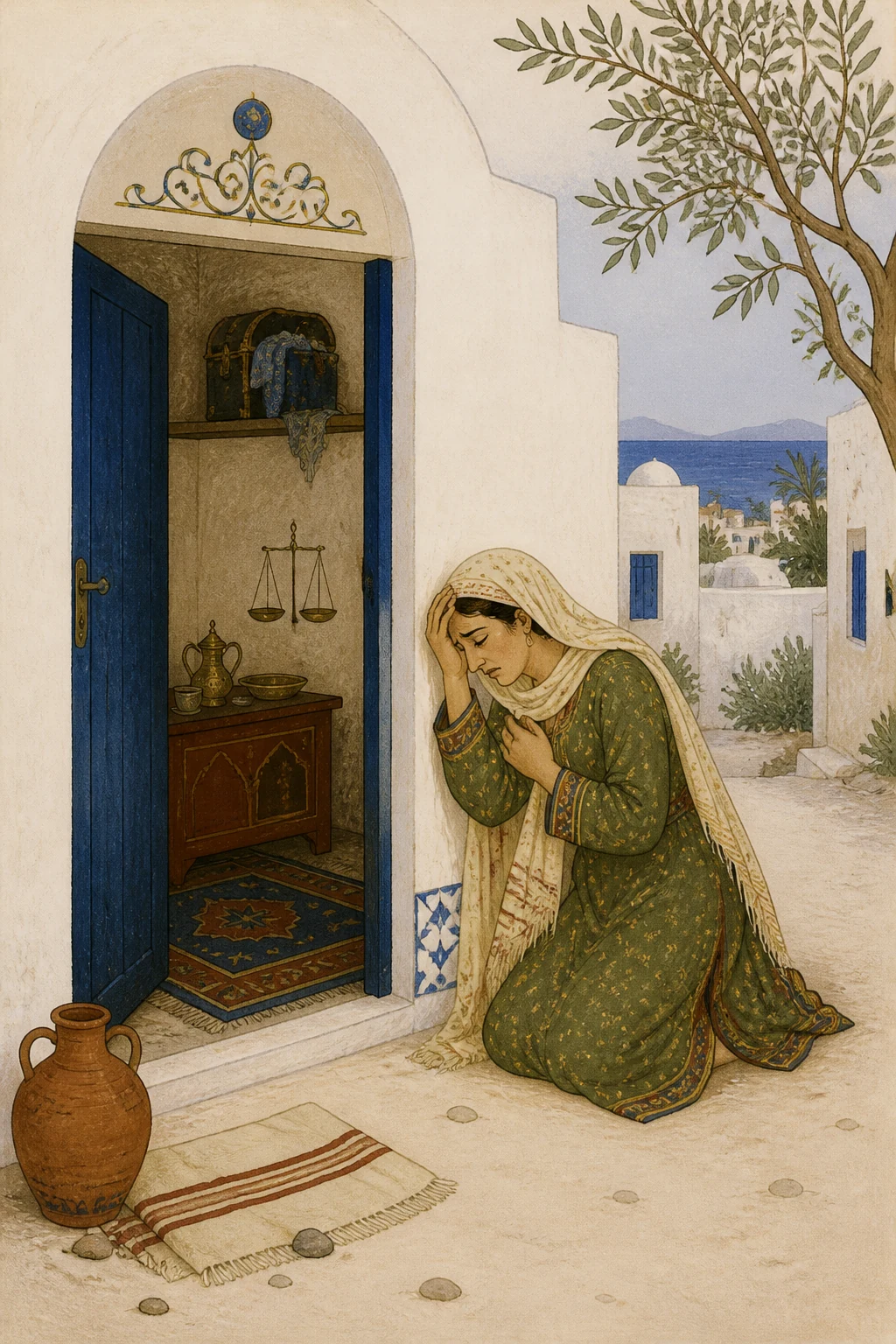
“Go and tell your mistress that the qadi has come.” “Tell him to come up,” she said. He went upstairs, and she placed herself behind a curtain so that he could not see her. “My daughter,” he said, “what do you say? The new sultan, who fears neither God nor man, has sent to ask for your hand.” She sat thinking for a while, then asked him, “What sort of rule is his?” “What can I tell you of his rule?” said the qadi. “Neither God nor man approves of it. He has ruined the country with his wickedness.” “There is no need for another visit. I shall marry him. Go and tell him, ‘It is as though your brother had not died, for you are the same as he.’” Then she said to the qadi, “Let this conversation remain between us.” “Will you put him right?” he asked. “I shall put him right. I shall not let him live through even this one night with me.” The qadi returned to him. “What is the news?” he asked.
“Your wish is granted.” He sent word to her. “I want the wedding tonight.” “God bless us,” she replied. She made her preparations, dyed her hands with henna, went to the bathhouse, and put on splendid clothes to delight him. Then she sent to him. “Come up. I am ready.”
She received him. “Your visit brings us blessing. Sit down.” She gave him coffee, brought the food, and said, “Come, let us eat.” He took the first mouthful and fell down without a sound. She sprang upon the ring, summoned the ministers, and told them, “Take him away and cast him out.” Then she sent for the leading men of the city. They came. “The man who ruled you unjustly is dead,” she told them. “You shall be queen,” they said. “Rule in the place of your father and your husband.” “Religion does not permit a woman to rule over men,” she answered. “Choose for yourselves a man fit to govern you, and make him sultan.” They chose a good man and set him over them as sultan.
They made him sultan, and she stipulated that they should provide her with an allowance to maintain her until her death. They rose and thanked her. “God bless you,” they said. “The whole country is yours!”
Izvirnik
003 Zûdër ben jjamúr
Naslednje strani prikazujejo izvirno besedilo za primerjavo.
Fémma wâhed iqulûlû zûdër ben xamúr fiiudîënt mâsr, sánxátú îo sarjad bût, uxándu úmmü uzûz â'hwa. ezzûz â'hwa hëmmâl , diâx . uzûdër ben xamúr bûa lî jihëdim xalúmmü, istâd elhût miskîn. kúlljüm jímsl xalasótt elbhár, ennbär elkúll jërmï filkîs, xaqâb elxasîjâ isiddë zwÉjiz bût, ibîhhum bytlät' arbâx willä briäl. qxád múdda minzmän héfcka. tléffet bîn' ubin néfsü, qâl halhidma mâ qämitsi bîjâ. nhâr minnhärät msä xalasótt elbáhar, rmâ 'lkîs elmárra hila, elmárra 'ttäniä, mâ sedd hâza. qâl âja nirtäh, elqásm hûa hûa; xaqâb elxasîjâ ntállax alhûtîn bqúdert rábbl. hûa qâxad xassótt jirtah, uzä râzel ríikib xalabáxla. qâl sëlâmu xalêkum. qâl xalêkum essëlâm. qâllû énti zûdër ben xamúr? qâllû naxám äna. habát mymfôq elbâxla, qâllû hûd miét mahbûb. xatâh elmiét mahbûb
umäddlu hît ahrîr. qâllû kettéfni uzáñúzni lilbhár hátta tûsël lilxryq. kif tûsël lilxrîq, laïïwàhni fémma. kîf tlaüwáhni, óqxod wâqëf flbúq- xotek. kan sift keskûst elbhár zat byda, ëfrah râni zîtek, ukän siftha hámra, ähsibnl râni mytt. tâiïwa hzárlü zûdër ben xamúr, qâllû snû' essbéb? qâllû mâ tinsidnîsi; kän wallîtlek sälim, râk taxnît, ukän ja ulîdi, mytt, îll wîlek râbbï; hada élli ktiblek min xandâllâ. skit xalîh, séddû, kéttfu tektîfâ mlîha. qâllû zîdnï, hátta kéttëfu mlîh.
hiízzu xalakitfû uzaz bïh lilbhár, rmâh filxrîq uqxád itfárrez. errâzel qâllû úsbur muhkâr sâxa minzmän. qxád sâxa fémma, hátta tale- xátlú keskûsa hámra. qâl allá, mât, fxál ezzâhël fînéfsû kîfmâ jifxal elxadû lilxadû. rkib fôq elbâxla, räuwah lilbläd, xurdu ihûdï filbäb, qâllû hät elbâxla. qâllû hôd. tläffet lihûdï lizûdër, qâllû ettamâx uqátx erráqba idízz ëbnfidem lilhëlâk. zûdër ben xamúr räuwah lúmmú farliân bilflûs. msä lizzäzzär , srä 'lhám, srä 'lhúdra ussmén, xamén-nyfqaf' mùhymma uräuwah. tläfftitlu úmmü, qâlet jä sîdî, halflûs ëmnîn? qâl xâtâni rábbl, was tínsid? kûl wûsrob wudexîlî bilhîr. qâlet jä ulîdï, thäbb nidëxîlek bilhîr uhäijänek zîbhum jâkëlû mxâk; kanhûma hemmäl, As naxmëlûlhum? qâlhâ jä 'mîmtï, élli '2ïb rábbi, nâkëlù äna wäljäk wâ'hïitï. msâ zâbhum millqâliwa.
txaSsau, sibxü ubätü finnáxina. essbíih häzz elkîs, qâl Aja nûqsëd bäb râbbï. zä xassótt uqxád. búa mäzäl kïf qxád jirtäh, uzà räzl âhor räkib xalabáxla. qállü sëlâmu xalêkum. qAl xalêkuru essëlâm. qâllû énti zûdër ben xaniúr? qállü naxám. qállü zâksi éllï räkib xalabáxla 'lbärah? qállü ma rîtsi, ma fixëlmîs. qâllû ma zâksi râzel îo lï xatâk hît ahrîr uqAllek kettéfnï bîh? qâl la. qâl qyrrli 'lbáqq, häk mas' taxmélli kífü. qárrlü 'lbáqq; qâllû häkka hadd ézlû uhäkka bâbbët néfsû bas tmût! nzü mymfôq elbáxla umädd îdu fimektûbû.
zliíd miét mahbûb. mädd elflûs lizûdër ben xamúr. zbid hît ahrîr. qâl kettéfni kïf hûja, rmînï fïxrîq elbáhr, filbúqxa élli rmît fîba hûja. kän talxátlek keskûsa hámra, hsíbnl mytt, ukän talxátlek keskûsa byda, ëfrah, ähsib rûhëk staxnît. qâl allâh ibärek, séddû kéttfû, rmâb filbhár; wïr-rmâ hûh, rmâh búa. qxád wâqëf júhzur filbhár. talxëtlû keskûsa hámra. hzár zûdër ben xamúr, qâl äs bîlium júqtlü farwâhhum? qâl âja kûll jûm dzlk miét mahbûb; 2 nüfäha*, mâ náxref xalarûhï, nmût willâ nxîs. lii'izz elbáxla umsä.
xûrdû lihûdi, qâllû hat elbáxla. qâllu hôd. qâllu zäk? qâllû naxám. qâllu mât? qâllu mât. qâllû hákka hádd elazél! râûwah farhân Mmmü, ksä úmmu üksä aljutü xarâja. txassAu mlîëh. h häzz elkîs umsä lissótt. zä Ibúqxotü uqxád. hûa mäzäl ihámmem usäf fïrâzel zêi xalabáxla kïf luhrîn. qâl âja mâ narmîsi 'lkîs. bälek rábbi jurzûqnî bmiét mahbûb uhra. qâllu 'ssêib énti zûdër ben xâmûr?
qâllù naxám. habát mymfôq elbáxla, qâllû zâuksi tnîn, wâhd elbárah uwâhed wuttelbärah ? qâllû naxám, zäu. qâllû mâtû? qâllû mätü umsâu xalarâhmët rábbi. dáhhel îdu fïmektûbu, mädlü hamsumiét mahbûb, xâtâh áktar milluhrîn. nzáx errâzel hwâizû umädd îdù fühúrz, hárrez kíswa zíld. lbísba uqâllû, halhwâiz lî ninzáhhum, balek tmísshum. háthum filhúrz uqal élli 'zl jâhud minxándek elháxla, axtíh elkúll filkúll. ukan tlaxt haï, nhízz hwâizi bîdl. hzar zûdër ben xamúr lirräzel, qâl xäläs tarmîu rwAhkum lilxâdém? qâllû mâ tinsid- nîsi; kän hráztlek, nahkîlek ñqúllek, ukän mâ hráztsi, bisseläma; élli xatâk râbbï, hákka hûa. séddû, kéttfû bhît áhmar uhäzzu xala- kítfü. qâllû wîr-rmït â'hutï, armîni äna. zäz bïh lilbhár, rmâh. qxad sâxa minzmän. talxetlu keskûsa byda. fráh. hrázlu essêib, fîdû hûta
hámra, fîdû hûta hámra, uqá§ba dhéb fïfûmmû. kïf hráz, qâllû hell elktäf. hállu elktäf. dáhhel ídü lilhúrz, zbid húkka, hátt elhütät litnîn fïwûst elhúkka uxláq xâlîhum. hzár lzûdër, qâllu énti missxâd. (|âl halqásba hfîdï fíha klml, khül mtah-hykma. qâl áhna tlät' ähwa húkma, ufémma kínz filxárb, qrîna fîlazfâr, mâ ikûn hëllânû illä xalîdek elkhûl lï fizzáxba, élli 'káhhel bîh xaïnîh, isûf elknûz filárd ulhzänl . qâl hâk elhütät élli filhukka, bnät ëmlék mizzan, hûma lï mitmellëkîn bhakelkinz. qâllû lâzim timsi mxâja, ntàllëxu 'lkinz. qâllû kïf zîna nxàzzëmû xâlîhum qbél, häzzu elqásba mtâx elkhûl uhárbü lo bîha lilbhár. zä hûja lûël mât, za hûj' ettânï mât. qâllû âja timsi mxâja lilxárb; râk mas' tuqxod mxâja xâm fémma. qâllû zûdër ben
xâmûr ùmmi âskûn bîha, âskûn jihëdim xalîha bàxdï? qâl nlialli- ûlhâ âs jizzîha . zaïiuz îdu lilhûrz, barrez Tmrz âhor mtabbaq. qâl bâu 'lhûrz hâda, kïf jitháll, élli tûtlub izîk, mâkëla usrâb, ulmäkla (Izik tâiba, hadrubâs. ljzâr zûdër ben xâmûr, qâl nhëllûh täüwa, näüfüh, bäs îiithénna xalûmmï. hallhôlû, qâl ûtlub äs thäbb. qâl nhäbb edzäz mâhsï uhzél mûqlï fissmén ufrûh ähmäm, sûfra xadyma.
zäh kiillse hâdrubâs. klâu, fatrû hûa ussêib. twâu elhûrz kîfma kän, uqâllû hizzu waxtîh lûmmuk uwarrîha kïfâs táxmel, bä§ ïdzîha elmäkla; uwässi úmmuk bälek twârrîh lâ'hutek. hkälha, qälilha rânï msâfer, nxîb xalîk xâm, nhäbbek tërda xâlîjâ utedëxîlï dáxwut hîr. qâlet jâ ulîdl, énti txîb xâlîjâ wäna âskûn ibézbiz bîjâ miskîna? ahiitek taxréfhum diâx. qâl nljallîlek sê lï 'qûm bîk. zbid elhiirz, qâl ûtlub Es thäbb, tâuw' izîk. kïf háll elhûrz, qátlü ja wúldl énti tikdib xâlîjâ, halhûrz äs fîh? qâl ûtlub thäbb! qâlet nhäb hubzät sf'xír ushán tbîha. qxad jídhak xalîha, qälilha hâu nûtlub äna fïxûdek, ullsän, sûfërt elmûlûk. qâlilhâ tâuwa mas' eñxíb xalîk xâm. qátlü barra ulîdï, timsi filämän udzî filämän. qâl rûddë bälek twárri elhûrz
läljutl; elmäkela jâkëlû mxâk, mâ tljallihûms mâhsûsîn; 3 twarrîhum elhûrz. waxtâha hamsumiét mahbûb, qâl bas tiksï rûhëk ntiksi â'hutï utimsï lilhämmfim. kâr-rzâxtlek *, hâuka nitlaqâu, ukân ma rzaxtléksï, elmûlaqât bin idîn alla, nûtlub minnek essamâh. baqqâha bhîr uqàlilha ja 'mîmtî bissëlâma. — zûdër ben xamûr msä lissêib, xatâli báxla, rikëbû litnîn xallabxâl utémmû sâirîn. sârû mussbâh lillîl. qâllû âja néqoxdu nirtähü 'nitxassâu. tläffet essêib, qâl xâréftsi bînek ubin blädek qaddââ msîna? qâl mâ xaréfts. qâl tâuwa msîna mäsjet tläta shot fïnhâr. Hâu, bätü hátta lyssbâli.
zädu särü hátta tâh ellîl, qáxadu txassâu; taílwa msâu tläta shór uhrîn. särü mynxudwîka hátta tâh ellîl, qabléthum qábra. zäzü lilbläd, séjïbu labxâl, rasâu xalarwâhhum. elbläd bläd essêib, xándü fîha dârû. tláx mxâh ëldârû, klâu usarbu ubätü. qxád zûdër ben xamúr xand essêib tlät' aljäm dyf. tlâffétlû qâllu âja nínisju. qâllu ämhel xâlîjâ, nhäbb tuqxod hûni hdâja shár. mät e§§hár. qällü zîd shar âhor. zäd esshár ettânï, zäd esshár ettälit; nhâr minnhârât qâl îo lissêib, âja nimsîu, twáhhast úmmi. hzárlü, qällü fina zíbtek xalaxâm, wúnti zît hûni illä mâ ëijist mimblädek wählek; ukîf naqdîu elhâza, tnäzzem fîsâxatîn träuwah. nhâr minnhârât qâllu âja nimsîu ja wúldi, eljûm rábbi isehhëlénna . msâu, särü hátta wúslü táht ëzëbél. essêib
ëbdà ixázzem, zäb htáb usâxxan-nâr , bdä järmi fîh' elbhûr. qâl is óqxod wâqëf fémma kîf elházra, mâ titkellémsi. bdä ixázzem elxàrbï, hátta tháll elkínz bilxazzíma. säf rünüjä hârza millkinz ufidhä mlzän clliéb. hárzet lilxárbi, qâlet hat ma xándek. mäddilha qrâtës 2 bhûr, hattéthum filmïzân, wuznythum, lqâthum qádqád. qâlet zûz, mâ xalîksi jâsâq. elxârbl tläffet lizûdër, qâllu âja zûz, qâxad hûnï; râk ëdzûz fiddyq hátta tûsël lillusâx. râk téxordëk dâr uddâr fîha ârbxa biût mitnâdrîn. zûz lilbît elmuqäbbjä, télqa syf ulûëh. râhum ezznûn jibdâu jitkéllëmû fîk, rûddë bälek lâ dzâubbùms; kîf tit- kéllem, râna nmûtu äna waîjâk. zûz, télqa 'ssyf mxállaq ullûëh táht essyf mxállaq. hîzzlmm uxállaq essyf xalakítfek uhízz ellûh fîdek
wçzâni fîsa. zûdër ben xämur zäz lilkínz, täm mäsi dâhel fiddyq; jísmax fïsût ixâjet, säf hékka usaf hékka, jísmax xîtnï jä zûdër ben xamúr. kîf tläffet, säf ftzäriä mhádda merraqäbytha wïdîha. jibdä zûdër ben xamúr qâl âja nseijib hazzäriä millhadîd, essyf ullûh mxallqîn, báxdla sëîjîbtha nhízzhum. dhál lizzäriä, qälilhä kîf sibbtek jä bintï, — jélqa rûhu quddäm eddämüs ulkínz taxláq . mâ xaréf xalarûhû bäs tiblä-*. elxárbi häzzü xaladáhrü uräüwah bih klârû, däih, mâ jáxref xalarûhû wlm-mâsï. háttü fiddâr, rássü bilmâ hátta fâq. kîf fâq, qâllù âh, jä zûdër ben xamúr, xaläs taxmélli hékka; äna xalaqadmä wâssîtek mâ nefxétsi bîk lusâja! qâllù kùllsë 11 wâssîtnï dîmâ mustâhfëd xalîh, illä elkläm bárk, bäs mâ nitkelléms, nsît. qâl habbyrni tâuwa xála hazzäriä mellîns willä mizzän? qällü
hadîka mellîns ubînt ëmlék. uzäbha xafrît lfémma wixáddeb fîha lü unhâr tâûwa tlilta snîn. wihâwul filia xazzwäz, mâ babbits, umek- tübíllia ma titseíjib illä bîdek. hzárlü zûdër ben xamúr, qâl lufäs elfsâla? essêib qâl lükän dhaltílha urna tkellémts, thott ídek xas- slasel, jithállu úhádhum . qâl läzim tûqxod mxäjä xäm âhor. qâl mlîh, klf hädl misilma, nûqxod xalaljatárha, xásra snîn. klf xláq elxâm ettänl, elxárbi qâl âja, nwallîu. msä 'lxàrbï, tänjmem bljûrû.
sàxxan-nâr uwassa fïzûdër, qâllû nwâssîk uçâjâ, amina rûddë bälek. bälek tinsäha kîf elmárra lûla; zäxmä klf túdhul lizzäriä, mäs' tseijibhä, hott îdek xassläsel, mâ titkelléms. kîf tseijibhä, télqa urâha tâqa. télqa fîha hárba uhalhârba mektûba mymfôq hátta lôta. uliäl- îo hárba mektfib fîha, nkîl elkinz imût bîha; rûhù marçûda fîha. qâllû râk énti tsiddha fîdek, ulxafrît itkéllem wiqûl asnáxni jâ sîdi zûdër, îla tkellémt, nimsîu nmûtû. qâllû twákkel xalálla. tháll elkinz, hárzet errümrjä kîf elmárra lûla, qâlitlû hilt ma xándek. qâlitlû ma tûbtsi, mâ thâf xalarûhëk?, mäddilhä 'lbhûr, wuznyttû, lqâtu qádqád. qâlitlû zûz, mâ xalîks jâsâq. dljál zûdër bon xamúr, tem zäz hattalîn usúl lwúst eddâr. säf ellûh ussyf mxallqîn; häzz ellûh uháttu fïmek-
tûbû ussyf xâllqû xalazénibu llsâr. msä lizzäriä, hatt îdu xalasläsilhä, thállü, tsÉjibit ezzäriä. tlaffet littâqa, hall ettâqa, häzz elhárba. hûa séddha fîdû ulxafrît tail xalîli, qâllu asnáxnl , jä sîdi zûdër. uzûdër siikit bâqï, mâ kellëmûs. sëljir fillniâ unnâr säxlet fizzän, thráq. qxád elkinz mahlûl. hraz zûdër ben xamúr täuwa lilxárbi, minxándu essyf ullûëh uqâl râuwahû, balkinz mâ isäls mahlûl, mâ isûfu hátta hádd ill' wúnti bárk. häzzn ezzäriä utémmu mräü- wahîn, wùçlu liddâr. ezzäriä bxátha lilhrîm uhûa uzûdër qáxádü filxalî. txassâ' ubâtû. qâllû warrmi snîâ háslt essyf uháslt ellûëh.
qâllû hassyf, klf tsiddû fîdek utsëïjir bîh, xalaqádwm tsûf xÉnek ináhhi 'rrôs. háslt ellûëh, elbâza élli titmennäha dzîk; fth zûz ëmlûk mizziin; hâbbît ëtrâuwah xalablädek, ftsäxätm trällwah, thäbb etsäfer bymhálla, tnäzzem tsäfer. zûdër ben xamúr qâl äna xâdni elkinz élli hallinâh hakkâka mahlûl. qâllû ma thäfsi, mâ isûfû hádd ; wäqtmä thäbb, elkinz kúllü lîk. qâllû hazzäriä mâ tatmâxsi fîha; nàxmëlu mrûwa xalabûha, rudduhâlû. qâllû âja wùldï, thäbb ëtrâuwah lúmmuk? qâllû hassyf mâ juslóhsi bîk. hâu naxtîk ellûëh jûsloh bîk. — jërzax elklâm tÉiwa lúmm zûdër ben xamúr. säfu lüläd elmäkla ussrâb mlîh kulljûm. tlâftû lbxáilhum, qâlû ja hûja halflûs uhalmäkla dzîna kulljûm, mnîn hâda? hzár elhû lákbar lúmmü, qâl mnîn halmäkla uhalflûs, xômrnâ niâ rîna hékk? qalitlii
ja, vúldi, as thäbb, kûlu wûsorbû, was tínsid! qälülhä läla, läzini tqülinna. seddûha bîdîhâ, häbbu juqtlûha. hâfet, xâtâthum elhúiv.. ljdâu Ihúrz uhárbu xalîha, msâu litbärna , hállü 'lhúrz ujâkëlu ujísorbu ujáxtiu lashâbhum. qáxdet liîâ misiona mîta bissárr. dâret xalafrwâizha tbîëx fîhum, bas tâkul. hátta 2 elkúll, wällät tútlub. — zûdër ben xamúr hämmern bîn' ubîn néfsü, qâl äna täuwa xándi ellûëh, aja nâmer ezzän izîu. amar liña mlûk ezzän izîbû lo mhálla; qâl râuwâh filbárr, nitfárraz uminnï räuwah filxúrdl kîf elbäi. zâbûlu lisan, rkib hûa xallahsân ulxasâker xallïmîn uxallîsâr nhûa mâsî flwústhum kîf raïs elqäuni. sär. kîf usúl lmä'drab lï nias' hizëlu fxh, amàr xàlamlûk ezzän, qâl nbäbb utâq , nhâbbë fîb árbxa rmâmen mindhéb unhäbb elqnâtës 5 mindhéb usrîr minxâz
ufárs âl.irîr. bât fhelfrás; sbáh eççtibâh, sär mútt eshár. qâblû qçiàr. tleffet zûdër ben xamúr lilmlék, qâllû hálqsár kîf sibtü ? qâl halqsár xamlûh arbaxîn hkîm, qrâu tilazfâr mâ ikûn mëmâtlmm illä xalaîd zûdër ben xamúr. ulialqsár bâda fîb éntâ mjâssrînha fémina. táxniel mrûwa kîf tfúkklia milljúsr. uhalhúkma áslhmu min miizûs, xabbâdîn ennâr. qâl kifäs näzzem nuqtylhum? hadûla näs húkma. hzárlú 'lmlék, qâl niktíblek tískra, thóttha bin xâlnîk utimsï lilqsár, télqa 'lbäb mal.ilfd; kîf dzûz lilqsár, télqa 'lqâxa mafrûsa byrhâm; râu 'lqsár rhâma byda urhâma káhla fîh. mâ taxfissï xalarhâma káhla, kîf táxfes xalîha, tmût, râhl maxmûla bilqattäl. áxfes xarrhâm làb- jâd bárk, fàhhâz, hátta titxádda lwúst elqsár utëtlax elfôq; tqâblek
tâqa, hattâqa fîha muftäh. hëll hattâqa hâdîka, télqa syf mxállaq; ézbid hâkeççyf munxûlâfù. énti thott îdek xassyf uhûma èlhùkma, hûma xaibîn, fîsa iziûk; arwâhhum marsûdîn fhäkessyf, mâ imûtn illä bib. qâllû báxdnia tuqtylhum, tléffet lilbît xalaimînek; filbäb muftäh, énti thott îdek xallmuftâh ulbît titháll. télqa fîha zâriâ mhädda millárbxa qwâim. qâl allâh ibärek. msä lilqsár, hátta usúl lbäb elqsár, zäz, fáhhaz xalblâtât elbjúd, hátta usúl lwúst eddâr.
qáblíttú tâqa, tqáddem lhattâqa, hállha, zbíd essyf, séllü, ulhúkma háderü. qâlû ja sîdi zûdër ben xamúr asnáxna. skít, sédd essyf usájir xalîhum larbxîn, harqythum ennâr, mätü. qxád filqçàr wáhedü. msä lilbît; hûa hatt îdû xallmuftâh ulbît thállet. zaz lilbît, jélqa zariä mhádda millárbxa qwâim. seljibhä, qälitlü âs zäbek lêjii ja râzl elmlîh? qälühä zäbni lîk rább essmawât, bas ikûn sbéb misjâbek xalâ idÉjâ. qâl kîf sibtek? qâlet äna mísilma ubâbâ mlék mymmlûk essyn. zâu halhûkma lbâba utâlbûni, baba ma häbs jaxtînî. sarqûni uzabûni lhûni wixâddëbu fîjâ täuwa tläta snîn wiqu- lûli wálli mzusîjâ xaladînna; ma babbits, qalílha täuwa kîf tsëijibt, âs thäb täuwa, nébxatek elbûk ulûmmuk? qâlt élli jáxmel elhîr ma isäwurs; täuwa tläta snîn wäna filxadäb. zbíd ellûëh, hádrü
mlûk ezzän, qâlû útlub jä sîdi zûdër, äs thäbb. qälilhum wâhed mynkum ibízz hazzariä; úmmh' ubûha qâxadîn filbâlâs wuntûma îo thabbëtûha fïwûstum. qâlû naxám, allâh ibärek. häzzba mlék utâr bîha, flrámset xÉn wâssâlha; úmmha ubûha qâxadîn uhîâ hábtet ñwústhuin. — zûdër ben xamúr amár xalinlûk qälilhum äna nhäbb halqsár hâda bmâ fîh, bmäl' ubmöbütü nhäbbü fiwúst másr. qalúlü allâh ibärek. hátta tâh ellîl, qalúlü úrqud; kîf thëll xâïnîk, télqa rûhëk fiwúst másr. tâh ellîl, txássa urqád; fussbâh hall xälnih, jélqa rühü fimdîënt másr. qâm, hámmem bîn' ubîn xáqlü, qâl mâ nhallîs halqsár mtâxi wàhëdû. amár xalamlûk ezzän, zäbCilu xásra bäuwäba xalakiäft elíns. háttlmm filbäb ixëssû. habát, qâl nimsi ntúll xala- úmmi. msä hûa mäsi fittnîjâ, jélqa quddämu xazûza tútlub. tläffet,
qâl hâdï 2 úmml, äjatra 3 nsûf. msälhä, qählha äs táxmel jä xazûza? qâlet nútlub ulîdî. qâl las, mä xándek hádd? qâlet lä; elidid elmlîh, Il jizri xälijä, msä xälijä, uluhrîn fsäd, idûru fimásr. hzarilha, qâl mâ xareftnîsi? qâlet lâ, mâ xareftéks. qâl mânï ulîdek zûdër? thâmmëlet bîh ubdât tibkl, qâlet âh jä ulîdî, utbûs fïh. qâl jä umîmtï, elhúrz, élli hallîtlek, tnäzzem txîs bîh xáltñl xômrëk.
qátlü fakkûhôli, mílli fakküholi mâ rïts wúzhuni. häzz úmmü utal- láhha lilqsár unäzzähhä 'lhwâiz elmâsshîn 4 weddäha lilhäinmäm uläbbisha kiswa zdîda. näda lilmlék, qällü nhäbb ähuti litnin täuwa ikûnu quddämi. msä 'lmlék, jélqa ähutu fittbárna, jelqâhum xamlîn sufra unnâs elkúll jâkëlû minhâk essúfra. zähum mélik ezzän, häzz- hum hûma wulhúrz utâr bîhum lissëmâ, hátta háthum quddäm hûhum. hzar zûdër, qälilhum xäläs thalliû 'mkum tmût bissárr?
hátta kîf mâ xandëkùms elhúrz, tihïdïmû xalîha filmrámma utqäü- ûtûhâ. hzár elmlék hzûdër, qâl äs tâmer xalîhum täuwa? qâl hâdûla â'hutï, âs naxmlylhum? házert um zûdër, qâlet seflaxni fîhuni. qâl mlîh ja úinmi. elhâsel ksähum uháttum wúzra fiqásrü, wâhed xallïmîn uwâhed xallîsâr. xamél zûz ëbnâk i'ïsqîft elqsár waxmél früsät emläh. ïab elbäüwäba, hámsa xallïmîn uhámsa xallîsâr; uhûa qâxad filwûst fissqîfa, kîf elbäi. ennäs mitxëddîn, jitfárrezü filiale el¬ qsár ezzdîd, qâlû mnîn helqsár wuskûn Ma fissqîfa kîf kîf essultân?
msä elhbár lïsûltân másr. qälülü ja sîdi, halruúlk hada xómrna mâ rlnäh. hzár essultân liluzîr mtâxû, qâllû ämsüu énti, timsîlu bissjasà, tqúllü müläna 'ssultAii inâdîlek. qâllû naxám. msalû. zûdëi' ben xâmûr säf luzîr, qâm uséllem xalîh uháttü bahdäh, sárrbü 'lqálnva ufátterü. báxdla í'átrü, qállü müläna essultân amer xalîk dzîh. bzár lo zûdër ben xâmûr liluzîr, qâl äna mâ nimsîs, lazim essultân izîni hûnï qbél. hâuka 'ssultân wâ'ssa luzîr, qâllû mâ titkellémsi mxâli ezzêid, élli 'qûllek îza habbyrni. msä luzîr, walla lyssultân, qâl jâ sîdi, barrâzel hâdâka xalîh hêbt elmlûk; läzim xándü lûëb mtali -bykma willä bâtem. qâl essultân âja nimsîulu äna wäijäk, náxmlu siäsa unsûfûh. msâu 'ssultân uluzîr, häzzu árbxa bámsa wûzra mxâhum.
wúslü lilqsár mtax zûdër ben xamúr; fráh bîhum ufattárlium uzäbil- hum elqáhwa. tläffet essultân lizûdër ben xamúr, qâllû âs maxnâh nebxátlek, mâ dzlnîsi? qâllû samábni, ja sîdi, kunt mryd, täxeb. hzár essultân lizûdër, qâl énti mâ titkelléms ezzêid wäna mâ nit- kéllem ezzêid; âja náxmlü, énti wûldi wäna bûk unaxtîk binti utkûn uzîr xalimîni, ubáxd mnam xalnï, elkûrsi lîk. qâllu allâb ibärek.
mäddu idîhum lilfätha, qrâu 'lfätha. qâllû nhäbb ellîla rûhe xârôs; elmlûk mtäx ihir ezzmän xaddâra. qâllû naxtîk xáhed râbbï mâ naxdrékse. xárres xalîba, bât xarôs. zäz xallxarôsa, fàrhët bîh ufráh bîha, qxád mxâha sébx' äljäm. zbíd ellûëh, qâl jâ bintï thabbîb filämän. wâssâba xalaùmmù, qâl mra kbyra, hûd bhatárha. — â'hutû tlâfi'ëtû libxádhum, qâlû hûna kbyr fittrîeq ukilmtu mäsjä áktar minn' áhna, âja nuqtlûli. qâl lâhor, lälä, mâ nuqtlûs, nimfiûli lbläd úhra. zâu, qâlûlû âja bûna, nûftrû 'ljûm ïzmîax. zä, zäbü 'lftfu'.
tbännez hûa; hattûb fisandûq uzâu lirais merriäs, qâlûlû tisrîsi minxánna memlûk? qâl âja. srah minxándbum. uqalûlû mâ tfëîjëqûs liûni, fÉjëqû fybläd úhra kîf tûsël. hall xalîh essandûq kîf usúl. xatás, fäq, hzár lirrâis, qâl äna fîhà(lërt 'skûn tâûwa? qâl fïhàdertî äna errais, qâl az-zäbni lîk? qâllû zâbûk zûz minnäs, baxûk lêjâ wäna srîtek. qâl allâb ibärek. qâl âja wûldi, ihëdim mxalbahrîjâ.
xâtâh kíswa mtáx bhár, kabbôt 2 zíld usirwal zíld, qxad jíhedhn mxâhuni tläta snîn. baxtläta snîn qal zûdër elfâ'cjël míimek, sëîjibnî nímsi lilhëzz. qâllû mâ nmenxéksi millhëzz, barr' ämsi lilhëzz. xatâh nsyb millmâl. xatâh tiskra, qâl barra ulid, msärrah maxtûq. rkib mizziddä, msä lmékkâ. hûa idûr hakkâka flmékka usaf fïxàrbï, ul- xárbi bûa lï tállax bîb elkínz. hzárlü Ixárbl, qâllû mâxreftnîsi?
qâllû âskûn énti? qâl äna elxárbi Ii xamílt fîk elhîr uxämilt fîj' elhîr. qâl az-zrâlek? qâl sibbtl, hallît xainÉjâ, nélqa rûhï filbhár; aliuti xadrûnj ubâxônï. qâllu ullûëh? qâllû hallîtu xandmárti, lukân xándi, râhum áhuti fakkùbôli. zbid hâtem, qâllû halhâtem liâda hîr millûëh, flh lism mtäx mlék ëkbîr mtâx ezzän, bîr millûëh uljîr mynkùllsë. xätähölü. báxdla häzz, däuur 'lhâtem ftsóbxü; hrázlu ÍO 'lmlék, qâllû útlub ja sídi, äs thäbb. qâl nhäb rûhi ftwúst qásn rimásr täuwa. häzzü, háll xamîh, jélqa rûhu ftwúst qásrú fimásr, l.ujä mártú. qâmet mártü uséllëmet xalîli uqâmu ezzwäri, qälülhä âj' axtîna 'lbsâra, bâu sîdï zä! xîmmû mskîna qáxdet tibkï, qâlet jä wûldï, xybt xäliiiä jâser! qâl mâ tínsid xála mä zrâ. bât bâkellîla
hâdîka báhda mártü, ussbâh tláx lissultân. qáxxadü fíbúqxotü xal- lîmîn. nsid à'hutû 'ssultân, qâlûlû mâ naxarfûs xalîh wïm-msâ. qxád múdela jáhkum mxassultân; essultân mrúd, näda lihvúzra ulqúdja ulmfäti, qälillmm liâda blîfti, kîf ënmût, hâclâ fîxûdi. mât essultân, stâûla sï zûdër íilmúlk uradd áhutü wúzra, wâhed xallîmîn uwâhed xallisâr. — tlâffëtû lbáxdhum, qâlû kän üzír, täuwa wálla sultán, âja nuqtlûh, bäs nwállju alma slâten. qâl wâhed rîtsi bäs wálla sultán? elhykma filhâtem élli fisóbxü. âja nistadnûh júftur lidänä, nhûttûlû 'lqattäl filmäkela. qâl lâhor mlîëh. qâlû lizûdër ben xamúr âj' úftur mxâna, taxmlinna mrûwa. qâl lä mâ nâzzéms, hilf milmárra lûla, élli baimëzûli. qâlûlû jä bûna, xàliëd rábbi, mâ ndurrûks. qâl
lälä mâ nâzzéms. qâlû ulhlîb lî rdaxnâh bézzült úmna, mâ ndurrûk, mâ naxmlûlek sê. msa mxâhum, qâl allâh ibârek. hattûlû 'lftûr, hattûlu ettëbsi élli fîh elqattäl quddämü. bûa häzz elfúmme lûl uhûa tâh, habát sakit. kîf mât, hûh elkbîr qâm fîsa, nahhâlu myñsóbxü 'lhâtem, liáttu ftsóbxü, dâuurû. hrázlu mlék ezzän, qâllu âja sîdi, útlub äs thább, qâl jä sîdi, úqtul hûja hâda fîsa. qátlü fîsa. âniàr elhû 'lkbîr xalazûdër ben xamúr bäs ihizzûh widefënûh. hâzzûb, daûh elmártü, umártu miskîna bdät tsyëh hîâ wúmmü. defënûh.
ljázert elmrâ mtäx zûdër ben xamúr lúmmü, qâlet mä thäfs, mä thótt ftbälek hátta sê, énti úmmi wäna bíntek. qâlet mâ twallîsi qallîla zâûwalîjâ, dîme nixâja. — tâuwa jërzax elkläm lilhû mtax zûdër ben xaniúr élli qátlu uqtél hü labor, msä, qxácl fuq-qúrsi 1 'ssultân, däuur elhâtem, hraz mlék milmlûk. qâllû nhäb xásra xallïmîn uxásra xallïsâr salín essiûf. hádrü 'lxasrîn. qälilhum élli ma jismax kläml, nahhiûlu rásü. bxat léhl elbläd úlwúzra. zâu. qâl rdïtûs bîjâ sultan? qâlû naxám; bíifü klf safu xasrîn salín essiûf.
hkum zymxa filbläd, dázzet elbläd milfsäd, ixázzez xalbnät unnsä. bxát lilqâdi. nädälü, qâlhî nhäbb tuhtiibli mart ljûja nähüha. elqâdï qâl nxám, allâh ibärek. msälha, dáqq elbäb, qallü 'Ibâuwâb äskün? qâl ämsi qúl lilläk sîh elqâdy zä. qälitlü qúllü jëtlax. tláx, thabbat biä fïsîra, bäsmä 'süfhäs. qälhä jä binti, as tqûl, hâu 'ssultân ezzdîd, élli mâ ihäf lä mirrábbi lä millxábed, bxátlek xallmâhëda. qáxdet thámmem sâxa, báxda nizdíttü, qälitlü snûa húkmü? qâl sîh elqâdi Es ñqúllek xalahúkmü, la jërda lä rábbi lä elxábed; elbläd hläkhä bilfsäd. qalitlü muswâr âhor, âja nähüh, nxárres xalîh, wúnti msílü, qúllü hûk mä mätsi, máhsüb énti kîf kîf. utläftet lilqâdi, qâlet halklam bïnâtna. qälilha tséggedü? qâlet nséggedü, hátt' ellîla mâ
nhallîsi 'kemmélha mxâjâ. wallälü sîh elqâdï. qâllu âsnû' elhbár? qallü hâztek muqdîâ. bxát, qälilha ellîla nhäbb elxërs. qalitlü allâh ibärek. xámlet hadrubäs, hannät umsat lilhämmam, ulíbsit kiswa muhymrua, bäs jifrah bília. baxtitlü, qälitlü äj' ëtlax, äna hädrubäs. qyblittü, qälitlü zäritnä bárka, ûqxod. xätatü 'lqáhwa, zâbet elmäkela, qâlt âja nistqâtû. hûa häzz elfúmm lui, hûa habát säkit. näggezet xallhâtem, ámret xallwúzra, qältilhum hizzûh, lâïïuhûh. ubáxtet léhl elbläd. zâu. qältilhum Aja, Il kän jáhkum xalîkum filbâtel, hâuka mät. qälülhä énti twálli mélika, fïxûd hûk urâzlek táhkum. qältil¬ hum eddîn mâ jaxtîsi tard táhkum xalarzäl; entûma sûfû, élli júsloh bîkum, rûddûh sultán, háttu sultán xalarwâhhum, htâru râzel ëmlîh.
hattûh sultan uhîâ sártet xalîhum rätibhä, Il jizri xalîha hattalîn tmût. qâmû jyskrü fîha, qâlu allâh ibärek, elbläd elkúll lîk!
Nadaljuj z branjem