Prevod
_Cannetella can find no husband to her liking, but her own folly delivers her into the hands of an ogre, who treats her cruelly; she is rescued, however, by a locksmith, a vassal of her father’s._ _It is a bad business, my lords, to look for bread finer than wheat can make, for one may end by longing for what one has thrown away. A person ought to be content with what is reasonable: grasp at everything and you lose everything, and whoever walks along the treetops has as much madness in his skull as danger beneath his heels. So it proved with a king’s daughter, who will be the subject of the tale I am about to tell you._ Once upon a time there was a King of Bello-Puojo who longed to beget children more keenly than the funeral attendants long for burials at which they can gather up the wax. At last he vowed to the goddess Serenga that, if she granted him a daughter, he would name her Cannetella in remembrance of the goddess’s transformation into a reed. He prayed and prayed until his wish was granted, and when his wife Renzolla gave birth to a pretty little girl, he gave her the name he had promised. The girl grew by leaps and bounds, until she was as tall as a pole, and the king said to her, “My daughter, Heaven bless you, you have grown as tall as an oak, and it is high time you were paired with a worthy little husband to match that pretty face and keep our family line alive. Since I love you as dearly as the pupils of my eyes and wish to please you, I should like to know what sort of husband you want, what kind of man would suit your fancy. Would you have a scholar or a swordsman? A young fellow or a man of years? Dark-complexioned, or fair and rosy? A long beanpole or a squat little stump? Slender about the waist, or round as an ox? You choose, and I shall abide by it.”
When Cannetella heard these generous offers, she thanked her father and told him that she had dedicated her virginity to Diana and had no wish whatever to choke herself with a husband. Nevertheless, after the king had begged and begged her, she said, “Rather than seem unloving in return for so much love, I am willing to do as you wish, provided I am given a man whose like is not to be found anywhere else in the world.” Delighted to hear this, her father stood at the window from morning till night, inspecting, measuring, and scrutinizing every man who crossed the square. When a handsome fellow passed, the king said to his daughter, “Quick, Cannetella, come to the window and see whether this one is cut to the measure of your wishes.” She had him brought upstairs, and they gave him a splendid banquet, with everything his heart could desire. While he was eating, an almond fell from the suitor’s mouth; he bent down, deftly picked it up, and slipped it beneath the tablecloth. When the feasting was over, he departed. “How do you like the bridegroom, my darling?” the king asked Cannetella. “Get that nincompoop out of my sight,” she replied. “A great hulking man like that ought not to let an almond escape from his mouth.” Hearing this, the king returned to his window, and when another well-built fellow passed, he called his daughter to find out whether she liked this one. Cannetella told him to have the man brought upstairs. He was summoned, another feast was laid before him, and when the meal was over and the man had gone, the king asked his daughter whether he pleased her. “And what should I do with that sorry creature?” she said. “At the very least he ought to have brought a pair of servants to take his cloak off his shoulders.” “If that is how it stands, we are in a pretty pickle!” said the king. “These are a bad debtor’s excuses, and you are picking holes in everything rather than give me this pleasure. So make up your mind, for I mean to marry you off and find a root stout enough to make the succession of my house sprout anew.” To these heated words Cannetella replied, “To tell you plainly, my lord father, just as I feel it, you are ploughing the sea and reckoning wrongly on your fingers. I shall never submit to any living man unless his head and teeth are made of gold.” The unhappy king, seeing how stubborn his daughter was, had a proclamation issued that any man in his kingdom who answered his daughter’s wishes should come forward, and he would give him both his daughter and his kingdom.
Now this king had a bitter enemy named Scioravante, whom he could not bear to see even painted on a wall. When Scioravante heard the proclamation, being a skilled necromancer, he summoned a band of those creatures Heaven keep far from us, and commanded them to make his head and teeth of gold at once.
They replied that it would take a mighty effort to perform such a service, since it was a thing unheard of in this world. They could much more readily have given him golden horns, those being rather more fashionable nowadays. Nevertheless, compelled by his spells and incantations, they did as he wished. Finding himself with a head and teeth of twenty-four-carat gold, he passed beneath the king’s windows. The king, seeing exactly what he had been looking for, called his daughter, who exclaimed the moment she saw him, “Now this is the one! I could not have done better if I had moulded him with my own hands!” When Scioravante made to rise and leave, the king said, “Wait a little, brother! What a fire you have in your breeches! Anyone would think you had a pledge at the Jewish pawnbroker’s, quicksilver at your backside, and a stick beneath your tail. Easy now! I shall give you baggage and attendants to accompany you and my daughter, for I mean her to be your wife.” “Thank you,” said Scioravante, “but there is no need. A horse will do, so that I can clap her up behind me. At home I have servants and furnishings as plentiful as the sand.” They argued a while, but in the end Scioravante had his way. Seating her behind him on a horse, he rode off. That evening, when the red horses are taken out of Heaven’s mill and the white oxen put in their place, he reached a stable where some horses were feeding and made Cannetella go inside. “Keep your wits about you,” he told her. “I must make a little trip to my house, which takes seven years to reach. Mind you wait for me inside this stable, and neither go out nor let any living soul see you, or I shall give you something to remember for as long as you live and breathe.” “I am subject to you,” Cannetella replied, “and shall obey your commands to the smallest detail. But I should just like to know what you are leaving me to live on in the meantime.” Scioravante answered:
“Whatever fodder these horses leave will be enough for you.” Imagine now how poor Cannetella’s heart sank, and how she cursed the very hour and moment when the matter had first been spoken of! Left cold and numb, she fed herself on tears in place of the food she lacked, cursing her fate and railing at the stars that had brought her from a royal palace to a stable, from perfumes to the stench of dung,
from mattresses of Barbary wool to straw, and from dainty morsels to the horses’ leavings. She endured this wretched life for several months. The horses were given their fodder, though she never saw by whom, and the scraps from their table kept her body alive. At length, peeping through a hole, she saw a beautiful garden, with so many trellises of oranges, so many bowers of citrons, so many flower beds, fruit trees, and grape arbours that it was a joy to behold. The sight set her longing for a fine bunch of inzolia grapes she had spied, and she said to herself:
“I shall creep out very quietly and nibble some, and let what will come, come—even if the sky falls! What could possibly happen between now and a hundred years hence? Who is going to tell my husband? And even if, by ill luck, he should learn of it, what can he do to me? After all, these are grapes I am taking, not a lover.” So out she went and revived her hunger-wasted spirits. But a little while later, before the appointed time, her husband returned, and one of the horses accused Cannetella of having taken the grapes. Furious, Scioravante drew a knife from his breeches and made to kill her. But she fell to her knees and begged him to stay his hand, since hunger drives even the wolf from the wood. She pleaded so long that Scioravante said, “I forgive you this once, and grant you your life as an act of charity. But if the devil tempts you again, and I learn that you have shown yourself in the sunlight, I shall make dried meat of you.
“So keep your wits about you, for I am going away again, and this time I shall truly be gone seven years. Plough a straight furrow, for you will get no further warning, and I shall settle both the old account and the new.” With these words he left, and Cannetella shed a river of tears, wringing her hands, beating herself, and tearing out her hair. “Oh, would that I had never been born,” she cried, “if such a bitter fate was waiting for me! Oh, my father, how you have drowned me in misery! Yet why should I complain of my father, when I myself have done the harm and built my own misfortune? I longed for a head of gold, only to sink like lead and die by steel! How fitting that, for wanting golden teeth, I should pay through my own! This is Heaven’s punishment: I should have done as my father wished, instead of making so many fusses and quibbles. Whoever will not listen to mother and father takes a road she does not know.” Not a day passed without this lament,
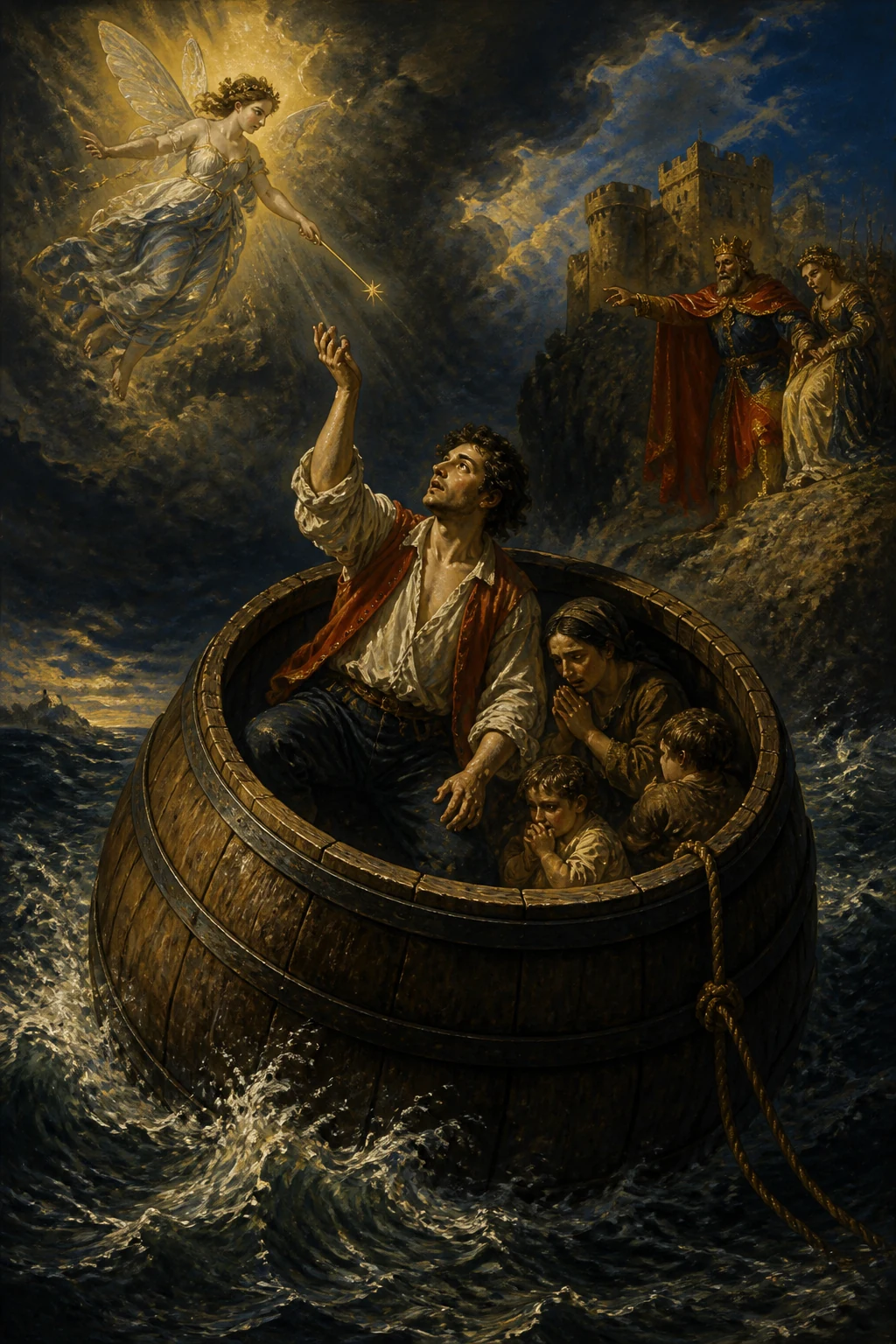
until her eyes had become two fountains and her face had grown so gaunt and yellow that the sight of her moved one to pity. Where were those sparkling eyes? Where those sweet cheeks? Where the little treasure of that mouth? Her own father would not have known her. Now, at the end of a year, the king’s locksmith happened to pass the stable. Cannetella recognized him, called out to him, and came outside. Hearing himself called by name, yet failing to recognize the poor girl, so altered was she, he was utterly astonished. But when he learned who she was and how she had come to be so changed, partly out of pity for the young woman and partly to win the king’s favour, he put her inside an empty barrel he was carrying on a pack animal. Trotting off towards Bello-Puojo, he reached the king’s palace four hours after nightfall.
He knocked at the door, and the servants looked out. When they learned it was the locksmith, they let fly at him with a torrent of abuse, calling him a senseless brute for coming at such an hour to disturb everyone’s sleep, and telling him he was getting off cheaply if they did not drop some ballast or a great stone on his skull. The king heard the commotion, and when a chamberlain told him who it was, he ordered the man admitted at once, reasoning that if he had taken such a liberty at so unusual an hour, something important must have happened. The locksmith unloaded his beast and knocked the head out of the barrel, from which Cannetella emerged. It took more than words for her father to recognize her: had it not been for a mole on her right arm, she might have had to go away again. But once he was quite certain, he embraced and kissed her a thousand times.
He immediately had a warm bath prepared for her, and when she had been washed and thoroughly tidied, he had a meal served, for she was faint with hunger. “Who would ever have told me, my daughter,” her father said, “that I should see you in such a state?
“What has happened to your face? What has brought you to this dreadful pass?” She replied, “Such is my lot, my dear lord. That Barbary Turk has made me suffer worse than a dog, so that every hour I felt my soul between my teeth. But I shall not tell you all I have endured,
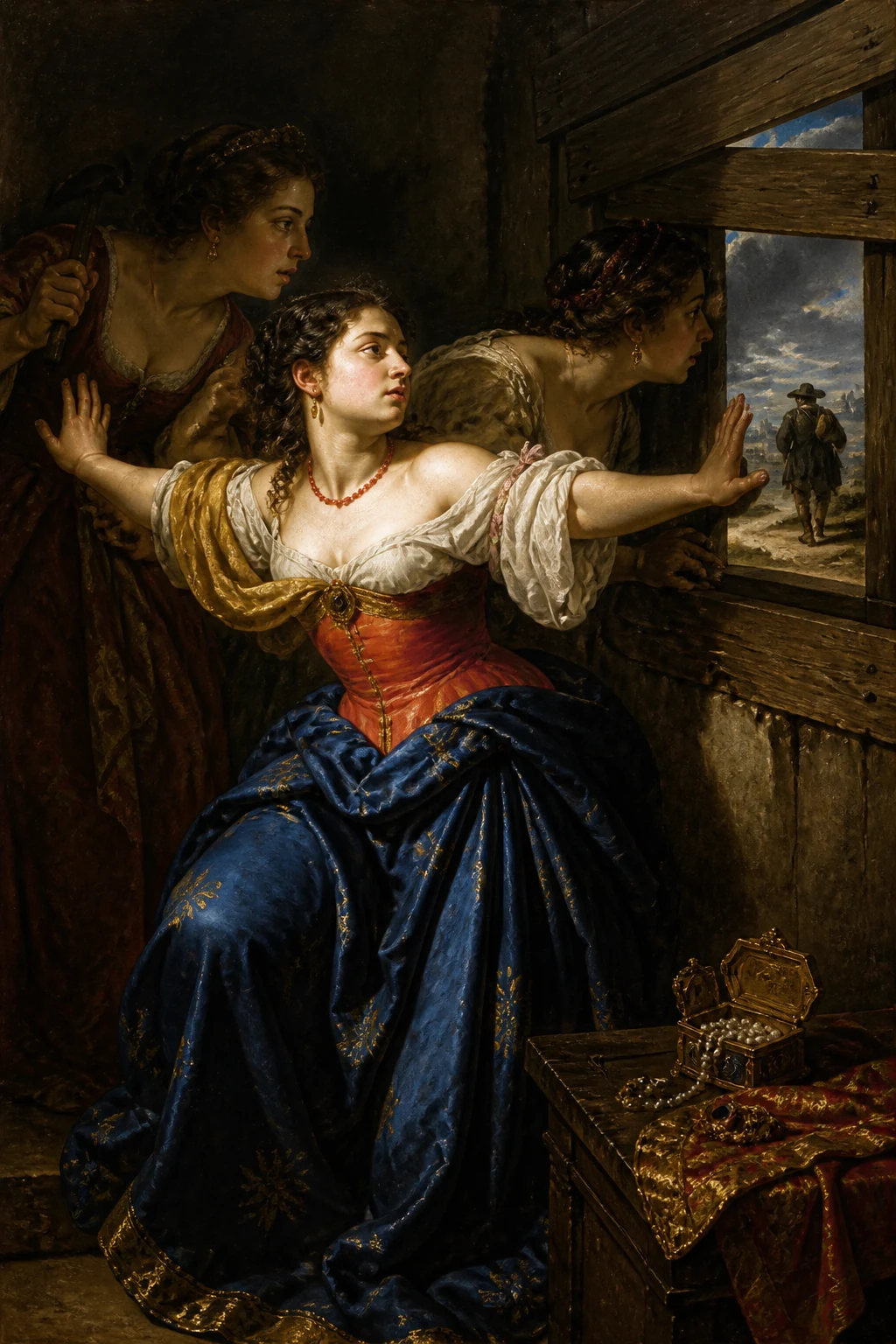
“for just as it surpasses human endurance, so it surpasses human belief. Enough that I am here, my father, and never again shall I leave your feet. I would rather be a scullery maid in your house than a queen in another’s; rather wear a rag where you are than a mantle of gold far from you; rather turn a spit in your kitchen than hold a sceptre beneath another’s canopy.” Meanwhile, Scioravante returned from his travels, and the horses told him that the locksmith had carried Cannetella away in a barrel. Burning with shame and boiling with rage, he hurried to Bello-Puojo. Finding an old woman who lived opposite the king’s palace, he said to her, “What will you take, my good madam, to let me see the king’s daughter?” She asked him for a hundred ducats. Scioravante put his hand in his purse and counted them out at once, one on top of another. Once she had pocketed the money, she took him up to the roof terrace, from which he saw Cannetella on a balcony, drying her hair. As though her heart had warned her, she turned in his direction and discovered the ambush. Flying down the stairs, she ran to her father, crying, “My lord, unless you have a room with seven iron doors made for me this very instant, I am lost!” “Am I to lose you for so little?” said the king. “Let it cost an eye out of my head, so long as this lovely daughter of mine is satisfied!”
No sooner said than done: the doors were forged at once. When Scioravante learned of this, he went back to the old woman and said, “What more would you like from me? Go to the king’s house on the pretext of selling a little pot of rouge, and when you get into his daughter’s room, slip this little paper packet between her mattresses. As you put it there, say under your breath:
_Let everyone lie fast asleep, and Cannetella alone her vigil keep._” The old woman struck a bargain for another hundred ducats and served him handsomely. Woe to the man who lets such filthy hags frequent his house! Under the pretence of bringing cosmetics to adorn you, they will tan both your honour and your life into leather. Once the old woman had performed this fine service, such an overpowering sleep fell upon everyone in the house that they might all have had their throats cut. Cannetella alone remained with her eyes open. When she heard the doors being broken down, she began to scream as though she were burning alive, but no one came running at her cries. Thus Scioravante battered all seven doors to the ground, entered the room, and seized Cannetella, mattresses and all, to carry her off. But as her good fortune would have it, the little packet the old woman had hidden fell to the floor and the powder scattered. The whole household awoke, and at Cannetella’s screams everyone came running, down to the dogs and cats. They laid hands on the ogre and chopped him into mincemeat. So he was caught in the very trap he had laid for unfortunate Cannetella, learning to his cost _that no grief cuts so deep_ _as to die by the weapons you yourself keep._