Waltey
Brezkrvna ženska
Cuentos de la Patria
Cuentos de Navidad, de la patria y antiguos · Emilia Pardo BazánO besedilu
Brezkrvna ženska
- Vir
- Cuentos de Navidad, de la patria y antiguos
- Avtor
- Emilia Pardo Bazán
- Jezik branja
- English
- Jezik izvirnika
- Español
- Čas branja
- 8 min branja
- Obseg
- 6 strani
- Naslov izvirnika
- 022 La exangüe
O izvirniku
Cuentos de Navidad, de la patria y antiguos
Sedemintrideset avtorskih zgodb v treh zgodovinskih knjižnih skupinah. Bralni jezik je English, izvirnik pa prihaja iz vira Cuentos de Navidad, de la patria y antiguos v jeziku Español.
Besedilo
Brezkrvna ženska
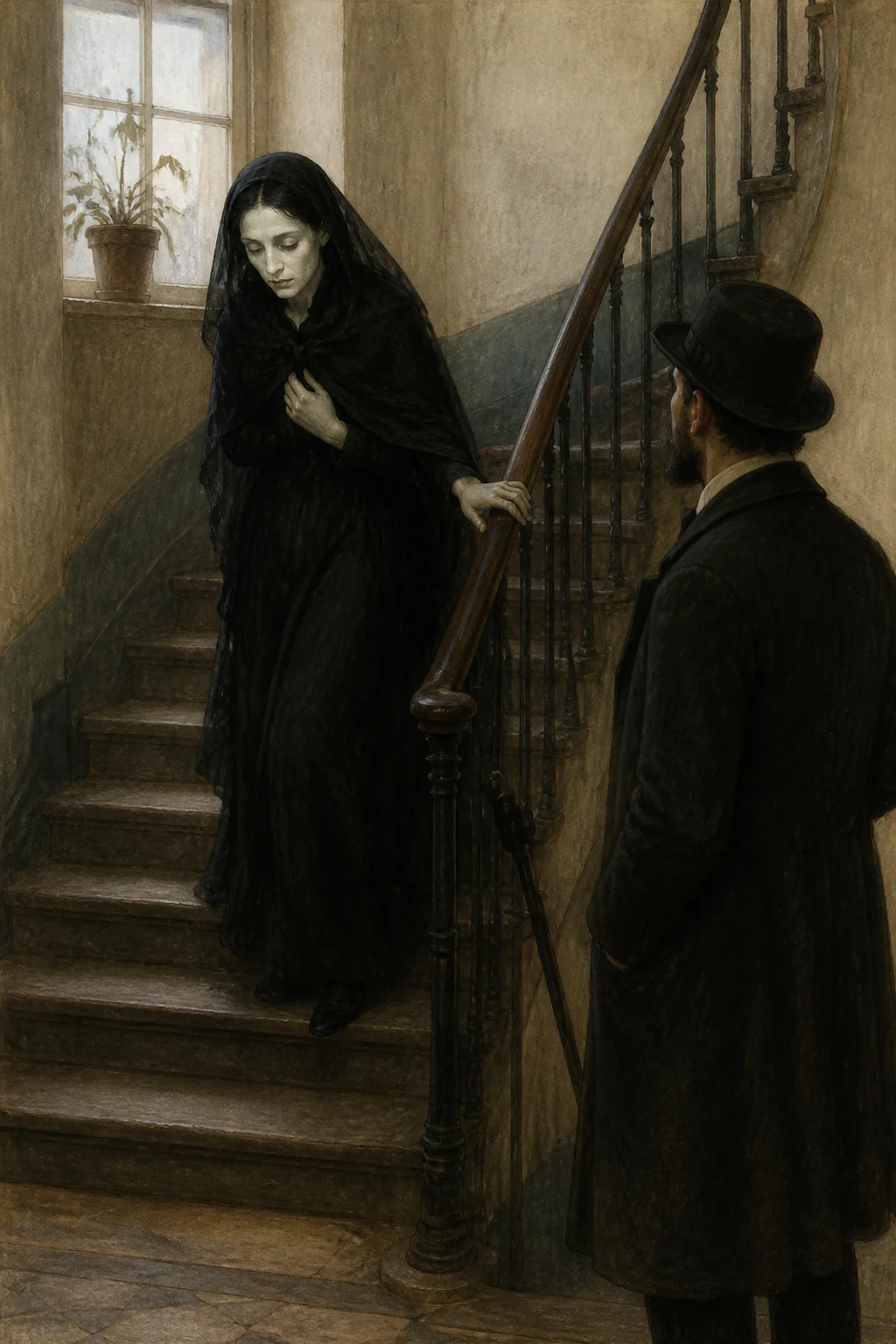
“A lady rented the third-floor apartment in my house, which had stood empty for some time,” the eminent Doctor Sánchez del Abrojo told us. “She caught my attention when I happened to meet her on the stairs. At first glance there was nothing remarkable about her: she was neither pretty nor plain, neither old nor young; she wore deep mourning and passed like a shadow, timid and silent, distressed by the breathlessness of the climb. What struck me was the cadaverous pallor of her face. To imagine such a complexion, one must recall the vampire stories told by Edgar Poe and other writers of the Romantic age, and resort to phrases belonging to the language of poetry: one must speak of a sepulchral pallor. Only death gives such a hue to a human face.
“Her black mantle framed and heightened that waxen face, and in it I observed a most peculiar expression, a mingling of grief and contentment, of calm and suffering. My habit of seeing the sick made me understand that this was more than a physical condition betrayed by her complexion; I recognized the traces of some tremendous inner upheaval, the ravages of an unknown catastrophe. Filled with sympathy and respect, I greeted my neighbor whenever we crossed on the landing, and yielded the handrail to her with particular deference and courteous haste.
“A fortnight passed without my seeing her, until one day the pale woman’s maid came down to beg me to visit her mistress, who was ill in bed. I went up to the third floor and found a poor, clean, icy dwelling. Without needing to take her pulse, I recognized in my new patient the symptoms of profound anemia, at the stage when it attacks the tissues and causes serious disorders. Her swollen legs, her extreme lassitude, her inability to raise her eyelids were signs that she lacked the vital fluid, that precious liquor which carries energy and strength throughout the body.
“Everyone,” the doctor went on after a brief pause, “has his whims and his pleasures. Others collect trinkets, curios, paintings, furniture, prized for their beauty or rarity; I—not out of charity or philanthropy, but out of an obsession, out of sheer stubbornness—collect lives; I gather resurrections... To snatch its prey from oblivion is an exquisite delight to me... I take pleasure in knowing that, thanks to me, more than a hundred people walk the streets who had already earned their places in the cemetery. To see the pale woman and resolve to enrich my collection with her were one and the same thing. Spare me,” he added, cutting short our expressions of approval, “praise I do not deserve... Believe me. Surely I know myself! Those born to be Tenorios will go to any lengths to add one more woman to the list. Do you imagine there is any great difference at bottom? I have no streak of Tenorio in me, but I am another of his kind, gathering and filing away in memory emotions of a particular sort. Love of humanity? Not a bit of it! Hatred of the gravedigger, which is not the same thing!...
“With that explanation, you will understand that I deserve no praise either for what I did to expand and strengthen my catalogue. Anemia is cured less by medicines than by food and restoratives. The lady could not afford certain nourishing things—meat extract, for instance; since I wished to bring her back to life, I provided the means, and matters went well. She is still pale; I do not think she will ever pride herself on a rosy complexion, but she no longer calls vampires to mind... Nor would there be any reason for me to speak of this cure, less difficult than others, had it not given me the opportunity to learn the story behind that terrible pallor. Before she would tell it to me, it took all the gratitude the poor woman had come to feel toward me, accompanied, I know not why, by boundless reverence and trust.
“My patient was a young lady of good family who had lost her parents and had no support in the world beyond a younger brother, employed through the influence of a powerful relative in our Overseas offices. His modest salary barely supported the two of them; I suspect she took in work, but even so they lived in the greatest straits. This gave rise to the wish for a transfer to the Philippines. The sister followed the only being she loved, and they settled in one of those villages of bamboo huts lost in the ocean of greenery of that beautiful archipelago which no longer belongs to us.
“To pass over the details of the years they lived there in peace, I shall say that at first the uprising did not alarm them. They believed those drowsy, obedient natives harmless, and felt certain that merely raising their voices in Castilian would bring them back to submission and their time-honored respect. Their mistake was dispelled when hordes of diabolical ferocity surrounded the village, uttering hideous cries and brandishing the bolo and the kampilan. The parish friar, who had taken refuge in the church, defended himself with a guerrilla fighter’s courage, performing feats that will never find their way into history. The clerk helped him as best he could; they were overwhelmed by numbers. The friar was cut to pieces on the spot; the clerk was taken alive, and his sister was dragged to a hut where the victorious Tagalog chieftain—his name scarcely matters—had his headquarters. The Spanish woman threw herself at his feet in tears, pleading in heartrending tones for her brother to be spared. The chieftain’s yellowish face did not change: it expressed the inert coldness of his race, and might have been carved from boxwood but for the gleam in his small, slanting, jet-black eyes. In that impassive countenance the young lady, frantic with horror, read her beloved brother’s sentence; and, kissing the chieftain’s feet, she offered him ‘her blood in exchange for his.’ ‘Agreed,’ the yellow man suddenly replied. ‘His blood shall not flow. Bleed this woman.’
“The bloodletting—it makes one shudder to say it—lasted... a week. Every morning they collected the wretched woman’s blood in a coconut-shell bowl, after which she fell to the ground in a deathlike swoon. From the fifth day onward, weakness brought on a kind of delirium. She imagined herself aboard the ship carrying her to Spain, free and happy, beside her brother; she heard the sound of the sea beating against the ship’s sides, and felt—effects of her dizziness—the ebb and flow of the waves, the rolling and pitching of the vessel, the breath of the wind, the smoke pouring from the funnel. One moment her hallucination showed her a school of sharks, the next an attack by canoes filled with natives; now she shrieked because the ship was burning, now she heard cannonballs whistling and saw the great ocean liner, split in two, sinking into the abyss. At dawn on the eighth day—the last of her torment, as they had told her—when the exhausted vein in her arm yielded its fluid only drop by drop, and her heart was failing, close to fatal collapse, in a moment of lucidity, or perhaps of fever, Spain appeared before her: its shores, her beloved, merciful homeland. Believing she was kissing it, she pressed her mouth to the floor of the hut, where she lay on old reed mats, half naked, dying, consumed by a terrible thirst, the cry of her dry, drained veins...
“That same afternoon a column of Spanish and native infantry closed in on the village, putting the insurgents to flight and freeing the prisoners and the wounded. They tended the unfortunate woman, reviving her a little through unremitting care. The first thing the bloodless woman asked for was her brother. They tried to hide the truth from her, but she guessed it: the Spaniard was hanging from a massive tree... The chieftain had kept his word, drawing not a drop of blood from his veins...”
Among those who always listened to Sánchez del Abrojo was the modernist painter Blanco Espino, ever on the hunt for symbolic subjects... He clapped his hands enthusiastically.
“I shall make a study of that lady’s head. I’ll surround it with red and yellow carnations, give it a background of flames... write underneath, ‘The Bloodless Woman...’ And that will get us away from the everlasting matron with the inevitable lion that represents Spain!”
Izvirnik
022 La exangüe
Naslednje strani prikazujejo izvirno besedilo za primerjavo.
--Alquiló el cuarto tercero de mi casa, desocupado hacía tiempo--nos dijo el eminente Doctor Sánchez del Abrojo--una señora que me llamó la atención al encontrarla casualmente en la escalera. Nada tenía, á primera vista, de particular; ni era guapa ni fea, ni vieja ni joven; vestía de riguroso luto, y pasaba como una sombra, tímida y muda, acongojada por el sobrealiento de la subida. Lo que en ella me extrañó fue la palidez cadavérica de su rostro. Para formarse idea de un color semejante, hay que recordar las historias de vampiros que cuentan Edgardo Poe y otros escritores de la época romántica, y servirse de frases que pertenecen al lenguaje poético: hay que hablar de palidez sepulcral: sólo la muerte da un tono así á una faz humana.
El manto negro encuadraba y realzaba aquel rostro de cera, y en él observé una expresión peculiarísima, mezcla de dolor y de satisfacción, de calina y de sufrimiento. Mi costumbre de ver enfermos me hizo comprender que allí no existía sólo un estado físico delatado por el color; reconocí las huellas de algún sacudimiento moral formidable, los estragos de una catástrofe ignorada; y penetrado de simpatía y respeto, saludé á mi vecina siempre que nos cruzábamos en la meseta, y la cedí el pasamanos con especial deferencia y apresuramiento cortés.
Transcurrió una quincena sin que la viese, hasta que un día, la criada de la pálida bajó á rogarme que visitase á su señora, encamada y enferma. Subí al tercero y encontré una vivienda pobre, limpia, glacial. Sin necesidad de tomar el pulso reconocí en mi nueva cliente los síntomas de la anemia profunda, cuando ya ataca los tejidos y produce desórdenes graves. Las piernas hinchadas, la extremada languidez, el no poder alzar los párpados, eran señales de que faltaba el jugo vital, licor precioso que reparte por todo el organismo energía y fuerza.
Cada quisque--prosiguió el médico, después de ligera pausa--tiene sus caprichos y sus goces. Otros coleccionan dijes, baratijas, cuadros, muebles, que avalora su belleza ó su rareza; yo--no por caridad, ni por filantropía; por tema, por mi carácter tozudo--colecciono vidas; junto resurrecciones... Es para mí deleite refinado arrancar á la nada su presa... Me complazco en saber que gracias á mí andan por la calle más de un centenar de personas que ya tenían ganado el puesto en la Sacramental.--Ver á la pálida y prometerme enriquecer con ella mi colección, fue todo uno. Déjense ustedes--añadió atajando nuestras manifestaciones--de elogios que no merezco... Créanme. ¡Si me conoceré yo! Los que nacen para Tenorios se desviven por una más en la lista. ¿Se figuran ustedes que en el fondo hay gran diferencia? No tengo veta de Tenorio, pero soy otro como él, que reune y archiva en la memoria emociones de un género dado. ¿Amor á la humanidad? ¡Quiá! Odio al sepulturero, ¡que no es lo mismo!...
Explicado así, comprenderán que no hay que alabarme tampoco por lo que hice para ampliar y reforzar mi catálogo. La anemia se cura, más que con medicinas, con alimentos y reconstituyentes. La señora no podía costear ciertos manjares, substancia de carne, v. gr.; como yo deseaba hacerla revivir, puse los medios, y la cosa marchó bien. Todavía está descolorida; no creo que llegue nunca á preciarse de frescachona; pero ya no sugiere ideas de vampirismo... Y no vendría á cuento que yo hablase de esta curación, menos difícil que otras, si no me hubiese proporcionado ocasión de saber la historia de la tremenda palidez. Fue necesario, para que me la refiriese, todo el agradecimiento que la pobrecilla me cobró, no sé por qué, acompañándolo de una veneración y una confianza sin límites.
Era mi enferma una señorita bien nacida, y se había quedado sin padres, ni más amparo en el mundo que el de un hermano menor, empleado por influencia de un pariente poderoso en nuestras oficinas de Ultramar. El sueldo módico sostenía mal á los dos hermanos; sospecho que ella trabajaba para fuera; con todo eso, pasaban suma estrechez. Nació de aquí el deseo de un traslado á Filipinas: la hermana siguió al único sér á quien amaba, y se establecieron en uno de esos poblados, de barracas de bambú, perdidos en el océano de verdor del hermoso Archipiélago que ya no nos pertenece.
Abreviando detalles de los años que allí residieron en paz, diré que la sublevación al pronto no les asustó; creían inofensivos á aquellos adormilados y obedientes indígenas, y les parecía seguro reducirles, con sólo alzar la voz en lengua castellana, á la sumisión y al inveterado respeto. Disipóse su error al cercar el poblado hordas diabólicamente feroces, que lanzaban gritos horrendos y esgrimían el bolo y el campilán. Defendióse con valor de guerrillero el fraile párroco, refugiado en la iglesia, realizando proezas que no pasarán á la historia; ayudóle como pudo el empleado: cedieron al número; quedó el fraile acuchillado allí mismo; al empleado le cogieron vivo, y á su hermana la llevaron arrastra á una choza donde el vencedor cabecilla tagalo--poco importa su nombre--tenía su cuartel general. La española se arrojó á sus pies llorando, implorando el perdón del hermano con acentos desgarradores. La cara amarillenta del cabecilla no se alteró: expresaba la frialdad inerte de la raza, y se creería que era de madera de boj, á no brillar en ella la chispa de los oblicuos ojuelos de azabache. En el semblante impasible leyó la señorita, enloquecida de horror, la sentencia del hermano adorado; y besando los pies del cabecilla, le ofreció «su sangre por la de él». «Se admite», contestó de pronto el amarillo. «La sangre de él no correrrá. Que sangren a ésta.»
La sangría--estremece decirlo--duró... una semana.--Cada mañanita, en una escudilla de coco, recogían la sangre de la desdichada, que caía después al suelo en mortal desmayo. Desde el quinto día, la debilidad la produjo una especie de delirio; creíase á bordo del barco que la conducía á España, libre y feliz, al lado de su hermano; escuchaba el ruido del mar, batiendo los costados del buque, y notaba--efectos del vértigo--el ir y venir de las olas, el balance y cuchareo de la embarcación, el soplo del viento, la humareda que la chimenea lanzaba. Tan pronto su alucinación la mostraba una bandada de tiburones, como un asalto de piraguas llenas de indígenas; ya exhalaba chillidos porque ardía el barco, ya oía silbar las balas de los cañones y veía que el gran trasatlántico, partido en dos, hundíase en el abismo. Al amanecer del octavo día--último de su suplicio según le habían anunciado--cuando ya la vena del brazo, exhausta, sólo gota á gota soltaba su jugo, y el corazón desfallecía próximo al colapso mortal--en un momento lúcido, ó acaso de fiebre, se le apareció España, sus costas, su tierra amada, clemente; y creyendo besarla, pegó la boca al suelo de la cabaña, donde yacía sobre petates viejos, medio desnuda, agonizando, devorada por sed horrible, clamor de las secas venas sin jugo...
La misma tarde cerró sobre el poblado una columna de infantería española é indígena, poniendo en fuga á los insurrectos y libertando á los prisioneros y heridos. Atendieron á la infeliz, reanimándola un poco á fuerza de cuidados. Lo primero que pidió la exangüe fue á su hermano; quisieron ocultarle la verdad, pero la adivinó: el castila colgaba de un árbol corpulento... El cabecilla había cumplido su palabra, no sacándole gota de sangre de las venas...
Entre los que escuchaban á Sánchez del Abrojo siempre, contábase el pintor modernista Blanco Espino, á caza de asuntos simbólicos... Batió palmas con entusiasmo.
--Voy á hacer un estudio de la cabeza de esa señora. La rodeo de claveles rojos y amarillos, la doy un fondo de incendio... escribo debajo «La exangüe...», y así salimos de la sempiterna matrona con el inevitable león, que representa á España!
Nadaljuj z branjem