Prevod
Once upon a time there was a great war, and when it was over, many soldiers were discharged. Brother Lustig received his discharge too, and nothing else but a small loaf of army bread and four kreuzers in money; with these he set off. Now Saint Peter had seated himself by the roadside in the guise of a poor beggar, and when Brother Lustig came along, he asked him for alms. “My dear beggar,” he replied, “what am I to give you? I was a soldier, and now I’ve been discharged, and I’ve nothing but this little loaf of army bread and four kreuzers. When that’s all gone, I’ll have to beg just as you do. Still, I’ll give you something.” With that he divided the loaf into four pieces and gave the apostle one, along with a kreuzer. Saint Peter thanked him, went on ahead, and sat down by the soldier’s path again, in another guise, as a beggar. When the soldier reached him, he asked for a gift as before. Brother Lustig answered as he had the first time, and again gave him a quarter of the bread and a kreuzer. Saint Peter thanked him and went on, but for a third time he sat down by the roadside in a different guise as a beggar and called to Brother Lustig. Brother Lustig gave him the third quarter of the bread and the third kreuzer too. Saint Peter thanked him, and Brother Lustig went on his way with no more than a quarter of a loaf and one kreuzer. With these he went into an inn, ate the bread, and spent his kreuzer on beer to drink with it. When he had finished, he set off again, and Saint Peter came towards him, this time also in the guise of a discharged soldier, and spoke to him. “Good day, comrade. Could you give me a piece of bread and a kreuzer for a drink?” “Where am I to get them?” answered Brother Lustig. “I was given my discharge, and nothing else but a loaf of army bread and four kreuzers. I met three beggars on the highway, and I gave each of them a quarter of my bread and a kreuzer. I ate the last quarter at the inn and spent the last kreuzer on a drink to go with it. Now I’ve nothing left, and if you’ve nothing either, we can go begging together.” “No,” answered Saint Peter, “that won’t really be necessary. I know a little about doctoring, and I’ll earn as much as I need that way.” “Well,” said Brother Lustig, “I know nothing about that, so I’ll have to go begging on my own.” “Just come along with me,” said Saint Peter. “Whatever I earn, you shall have half.” “That suits me very well,” said Brother Lustig. So they went on together.
Presently they came to a farmhouse and heard a terrible wailing and crying inside. They went in and found the farmer lying there desperately ill and close to death, while his wife sobbed and wept aloud. “Stop your wailing and weeping,” said Saint Peter. “I’ll make your husband well again.” He took an ointment from his pocket and healed the sick man in an instant, so that he could get up and was quite well. In their great joy, the man and his wife said, “How can we repay you? What shall we give you?” But Saint Peter would take nothing, and the more the farmers begged him, the more firmly he refused. Brother Lustig nudged Saint Peter and said, “Do take something. We need it, after all.” At last the farmer’s wife brought a lamb and told Saint Peter he must accept it, but he would not. Then Brother Lustig nudged him in the side and said, “Take it, you silly fool. We need it.” At last Saint Peter said, “Very well, I’ll take the lamb, but I won’t carry it. If you want it, you must carry it yourself.” “That’s no trouble,” said Brother Lustig. “I’ll carry it readily enough,” and he hoisted it onto his shoulder. They went on and came to a forest. By now the lamb had grown heavy on Brother Lustig’s shoulder, and he was hungry, so he said to Saint Peter, “Look, there’s a fine spot where we could cook the lamb and eat it.” “That suits me,” answered Saint Peter, “but I know nothing about cooking. If you’ll do the cooking, here’s a kettle. Meanwhile I’ll walk about until it’s ready. But you mustn’t begin eating before I return. I’ll be back in good time.” “Off you go,” said Brother Lustig. “I know how to cook. I’ll see to it.” So Saint Peter went away, and Brother Lustig slaughtered the lamb, lit a fire, threw the meat into the kettle, and cooked it. But the lamb was done and the apostle had still not returned, so Brother Lustig took it out of the kettle, cut it up, and found the heart.
“That’s supposed to be the best part,” he said, and tasted it; in the end he ate it all. At last Saint Peter returned and said, “You may eat the whole lamb yourself. I only want the heart; give me that.” Brother Lustig took his knife and fork and pretended to search eagerly among the meat, but he could not find the heart. At last he said bluntly, “There isn’t one.” “Well, where can it be, then?” said the apostle. “I don’t know,” answered Brother Lustig. “But look here, what fools we both are, searching for a lamb’s heart, and neither of us remembering that a lamb has no heart!” “Why,” said Saint Peter, “that’s something quite new. Every animal has a heart. Why should a lamb have none?” “No, truly, brother, a lamb has no heart. Just think it over properly and you’ll remember. It really hasn’t one.” “Very well, then,” said Saint Peter. “If there’s no heart, I don’t want any of the lamb either. You may eat it all yourself.” “Whatever I can’t finish, I’ll take along in my knapsack,” said Brother Lustig. He ate half the lamb and put the rest into his knapsack.
They went on, and Saint Peter caused a great stream to flow across their path, so that they had to wade through it. “You go first,” said Saint Peter. “No,” answered Brother Lustig, “you go first,” thinking, “If the water’s too deep for him, I’ll stay behind.” So Saint Peter waded across, and the water came only to his knees. Brother Lustig then tried to cross as well, but the water grew deeper and rose to his neck. “Brother, help me!” he cried. Saint Peter said, “Will you admit that you ate the lamb’s heart?” “No,” he answered, “I didn’t eat it.” Then the water rose still higher, right up to his mouth. “Help me, brother!” cried the soldier. Once more Saint Peter said, “Will you admit that you ate the lamb’s heart?” “No,” he answered, “I didn’t eat it.” But Saint Peter would not let him drown, so he made the water fall again and helped him across.
They travelled on and came to a kingdom where they heard that the king’s daughter lay at death’s door. “Hello, brother,” said the soldier to Saint Peter, “here’s a fine catch for us. If we make her well, we’ll be provided for till the end of our days.” Saint Peter was not moving fast enough to please him. “Come, pick up your feet, dear brother,” he said, “so we get there in time.” But Saint Peter walked more and more slowly, however much Brother Lustig urged and pushed him, until at last they heard that the king’s daughter had died. “There we are,” said Brother Lustig. “That comes of your sleepy pace.” “Be quiet,” answered Saint Peter. “I can do more than heal the sick. I can also bring the dead back to life.” “Well, if that’s so,” said Brother Lustig, “I’ve no objection, but you must earn us at least half the kingdom for it.” Then they went to the royal palace, where everyone was in deep mourning, and Saint Peter told the king that he would restore his daughter to life. He was led to her, and then he said, “Bring me a kettle of water.” When it had been brought, he ordered everyone to leave; only Brother Lustig was allowed to stay with him. Then he cut the dead girl’s limbs apart and threw them into the water, lit a fire beneath the kettle, and left them to boil. When all the flesh had fallen from the bones, he took out the lovely white bones and laid them on a table, arranging and fitting them together in their natural order. When this was done, he stood before them and said three times, “In the name of the most Holy Trinity, dead maiden, arise.” At the third time, the king’s daughter rose, alive, healthy, and beautiful. The king was overjoyed and said to Saint Peter, “Name your reward. Even if it is half my kingdom, I will give it to you.” But Saint Peter answered, “I ask nothing for it.” “Oh, you great fool!” thought Brother Lustig. He nudged his companion in the side and said, “Don’t be so stupid. If you want nothing, I still need something.” But Saint Peter would take nothing. The king, however, seeing that the other man would gladly have something, ordered his treasurer to fill Brother Lustig’s knapsack with gold.
They went on their way, and when they came to a forest, Saint Peter said to Brother Lustig, “Now we shall divide the gold.” “Yes,” he answered, “so we shall.” Saint Peter divided the gold into three shares. Brother Lustig thought, “What strange notion has he got into his head now? He makes three shares, and there are only two of us.” But Saint Peter said, “Now I’ve divided it fairly: one share for me, one for you, and one for whoever ate the lamb’s heart.” “Oh, I ate that,” answered Brother Lustig, quickly scooping up the gold. “You may believe me.” “How can that be true?” said Saint Peter. “A lamb has no heart.” “Oh, come, brother, what are you thinking of? A lamb has a heart just like any other animal. Why should it alone have none?” “Very well, then,” said Saint Peter. “Keep all the gold yourself. But I shall stay with you no longer; I mean to go my own way.” “As you please, dear brother,” answered the soldier. “Farewell.”
Saint Peter took another road, and Brother Lustig thought, “It’s just as well he’s trotting off. He’s a peculiar sort of saint.” Now, although he had plenty of money, he did not know how to manage it. He squandered it and gave it away, and after a while he had nothing again. Then he came to a country where he heard that the king’s daughter had died. “Aha!” he thought. “This could turn out well. I’ll bring her back to life and make them pay me handsomely for it.” So he went to the king and offered to raise the dead girl. Now the king had heard that a discharged soldier was travelling about bringing the dead back to life, and he thought Brother Lustig was the man. Yet since he had no confidence in him, he first consulted his councillors. They said he might venture it, since his daughter was dead in any case. Brother Lustig then had a kettle of water brought to him, ordered everyone to leave, cut off the limbs, threw them into the water, and lit a fire underneath, just as he had seen Saint Peter do. The water began to boil and the flesh fell away, so he took out the bones and put them on the table. But he did not know the order in which they belonged and laid them all in a muddle. Then he stood before them and said, “In the name of the most Holy Trinity, dead maiden, arise.” He said it three times, but the bones did not stir. He said it another three times, but again in vain. “You confounded girl, get up!” he cried. “Get up, or it’ll be the worse for you!” Just as he said this, Saint Peter suddenly came in through the window in his former guise as a discharged soldier and said, “You godless man, what are you doing? How can the dead girl rise when you’ve thrown her bones together in such a jumble?” “Dear brother, I did it as well as I could,” he answered. “This time I’ll help you out of trouble, but I warn you, if you ever attempt such a thing again, you’ll come to grief. And you must neither ask nor accept the slightest thing from the king in return.” Then Saint Peter laid the bones in their proper order and said to her three times, “In the name of the most Holy Trinity, dead maiden, arise.” The king’s daughter stood up, healthy and beautiful as before. Saint Peter went out through the window again. Brother Lustig was glad things had turned out so well, yet he was annoyed that he was to take nothing for it. “I’d only like to know,” he thought, “what queer notions he has in his head. What he gives with one hand, he takes away with the other. There’s no sense in it.” The king now offered Brother Lustig whatever he wished, but he was not allowed to accept anything. Still, by hints and cunning, he contrived to have the king order his knapsack filled with gold, and with that he departed. When he came out, Saint Peter was standing before the gate and said, “See what sort of man you are! Didn’t I forbid you to take anything? And now your knapsack is full of gold after all.” “How can I help it,” answered Brother Lustig, “if they put it in for me?” “I warn you not to attempt such things again, or you’ll fare badly.” “Oh, brother, don’t worry. Now that I have gold, why should I bother with washing bones?” “Yes,” said Saint Peter, “that gold will last a long time indeed! But so that you don’t turn to forbidden ways again afterwards, I shall give your knapsack the power to hold whatever you wish into it. Farewell. You will not see me again.” “God be with you,” said Brother Lustig, thinking, “I’m glad you’re going, you queer fellow. I certainly shan’t follow you.” And he gave no further thought to the wondrous power bestowed on his knapsack.
Brother Lustig roamed about with his gold, wasting and squandering it as he had before. When he had only four kreuzers left, he passed an inn and thought, “This money must go.” So he ordered three kreuzers’ worth of wine and one kreuzer’s worth of bread. As he sat there drinking, the smell of roasting geese reached his nose. Brother Lustig peered about and saw that the innkeeper had two geese in the oven. Then he remembered that his companion had told him whatever he wished into his knapsack would be there. “Aha, you must try that with the geese!” So he went outside, and at the door he said, “I wish those two roast geese out of the oven and into my knapsack.” As soon as he had said it, he unbuckled the knapsack and looked inside, and there they both lay. “Ah, that’s the way!” he said. “Now I’m a made man.” He went off to a meadow and took out the roast geese. While he was eating with great enjoyment, two journeymen came along and gazed hungrily at the one goose that was still untouched. Brother Lustig thought, “One is enough for you.” He called the two young men over and said, “Here, take this goose and eat it to my health.” They thanked him, took it to the inn, ordered half a measure of wine and a loaf of bread, unpacked the goose they had been given, and began to eat. The innkeeper’s wife watched them and said to her husband, “Those two are eating a goose. Go and see whether it’s one of ours from the oven.” The innkeeper ran to look, and the oven was empty. “What’s this, you thieving scoundrels? You think you can eat geese so cheaply? Pay up at once, or I’ll give you a taste of my green hazel stick!” The two said, “We’re not thieves. A discharged soldier gave us the goose out in the meadow.” “Don’t try to pull the wool over my eyes. The soldier was here, but he went out through the door an honest fellow. I kept an eye on him. You’re the thieves, and you shall pay.” But since they could not pay, he took his stick and beat them out of the door.
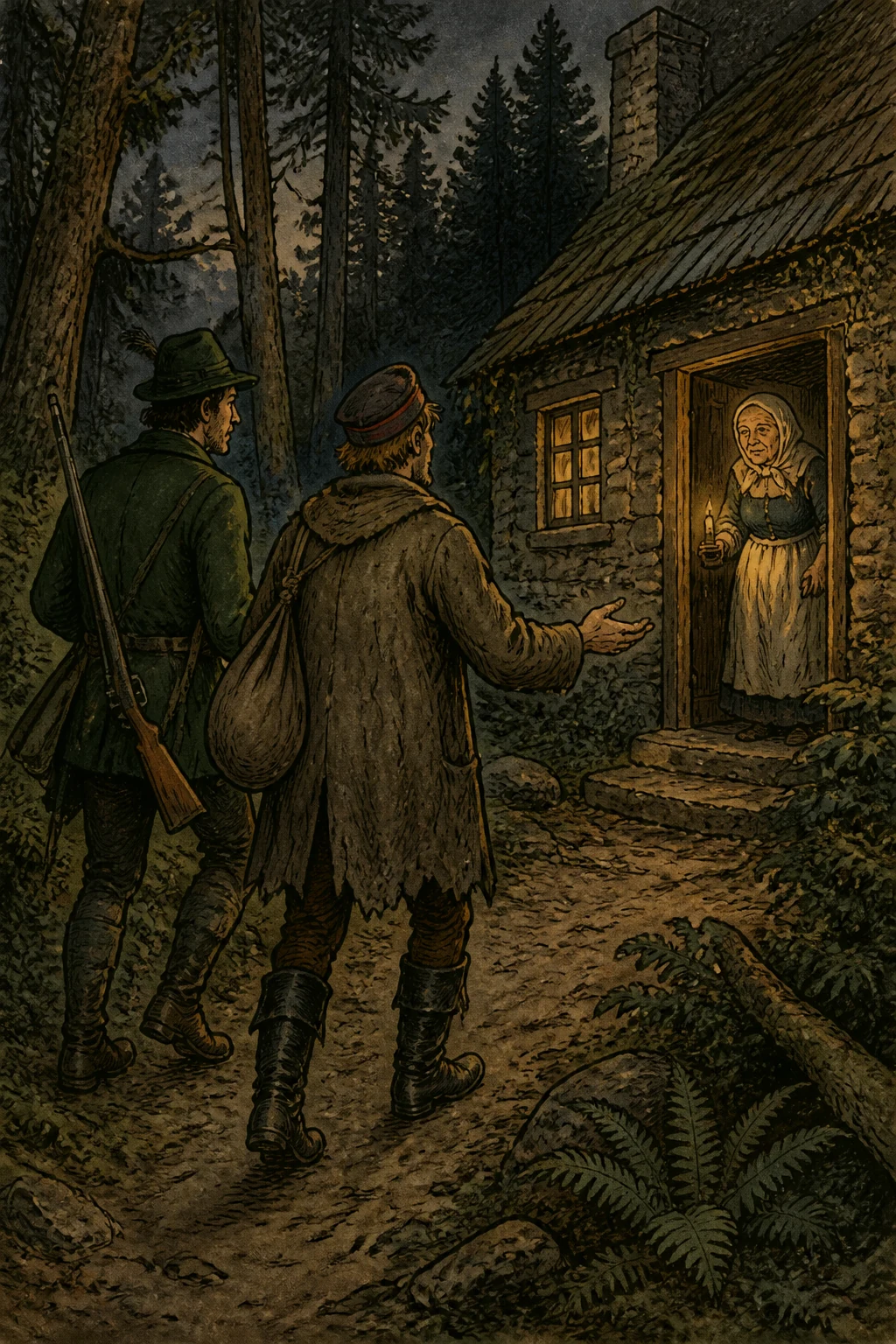
Brother Lustig went on his way and came to a place where there stood a splendid castle, with a shabby inn not far away. He went into the inn and asked for a night’s lodging, but the innkeeper turned him away, saying, “There’s no room left. The house is full of distinguished guests.” “That surprises me,” said Brother Lustig, “that they come to you instead of going to that splendid castle.” “Yes,” answered the innkeeper, “but spending a night there is no simple matter. No one who has tried it has ever come out alive.” “If others have tried it,” said Brother Lustig, “I’ll try it too.” “Leave well alone,” said the innkeeper. “It’ll cost you your neck.” “It won’t come to that so quickly,” said Brother Lustig. “Just give me the keys, and plenty to eat and drink.” The innkeeper gave him the keys and food and drink, and Brother Lustig went to the castle and enjoyed his supper. When at last he grew sleepy, he lay down on the floor, for there was no bed. He soon fell asleep, but in the night he was woken by a tremendous noise. When he roused himself, he saw nine hideous devils in the room, who had formed a circle round him and were dancing about him. Brother Lustig said, “Dance as long as you like, but let none of you come too close.” But the devils pressed nearer and nearer, almost treading on his face with their filthy feet. “Keep quiet, you devilish phantoms,” he said, but they only grew worse. Then Brother Lustig became angry and cried, “Aha, I’ll soon put a stop to this!” He seized a chair leg and struck into their midst. But nine devils against one soldier were too many, and whenever he struck at those in front, the others seized him by the hair from behind and tugged at it cruelly. “You devil’s rabble!” he cried. “This is too much! But just you wait! All nine of you into my knapsack!” In a flash they were inside, and he buckled it shut and threw it into a corner. At once all was quiet, and Brother Lustig lay down again and slept until broad daylight. Then the innkeeper and the nobleman who owned the castle came to see what had become of him. When they found him safe and sound, they were astonished and asked, “Did the spirits do you no harm?” “Not a bit of it,” answered Brother Lustig. “I have all nine of them in my knapsack. You may live in your castle in perfect peace again. From now on, nothing will haunt it!” The nobleman thanked him, gave him rich gifts, and begged him to remain in his service, promising to provide for him for the rest of his life. “No,” he answered. “I’m used to wandering about. I’ll travel on.” So Brother Lustig went away, called at a smithy, and laid the knapsack with the nine devils inside it on the anvil. Then he asked the smith and his journeymen to hammer away at it. They struck with their great hammers with all their might, until the devils set up a pitiful shrieking. When he opened the knapsack afterwards, eight were dead, but one, who had been sitting in a fold, was still alive. He slipped out and fled back to hell.
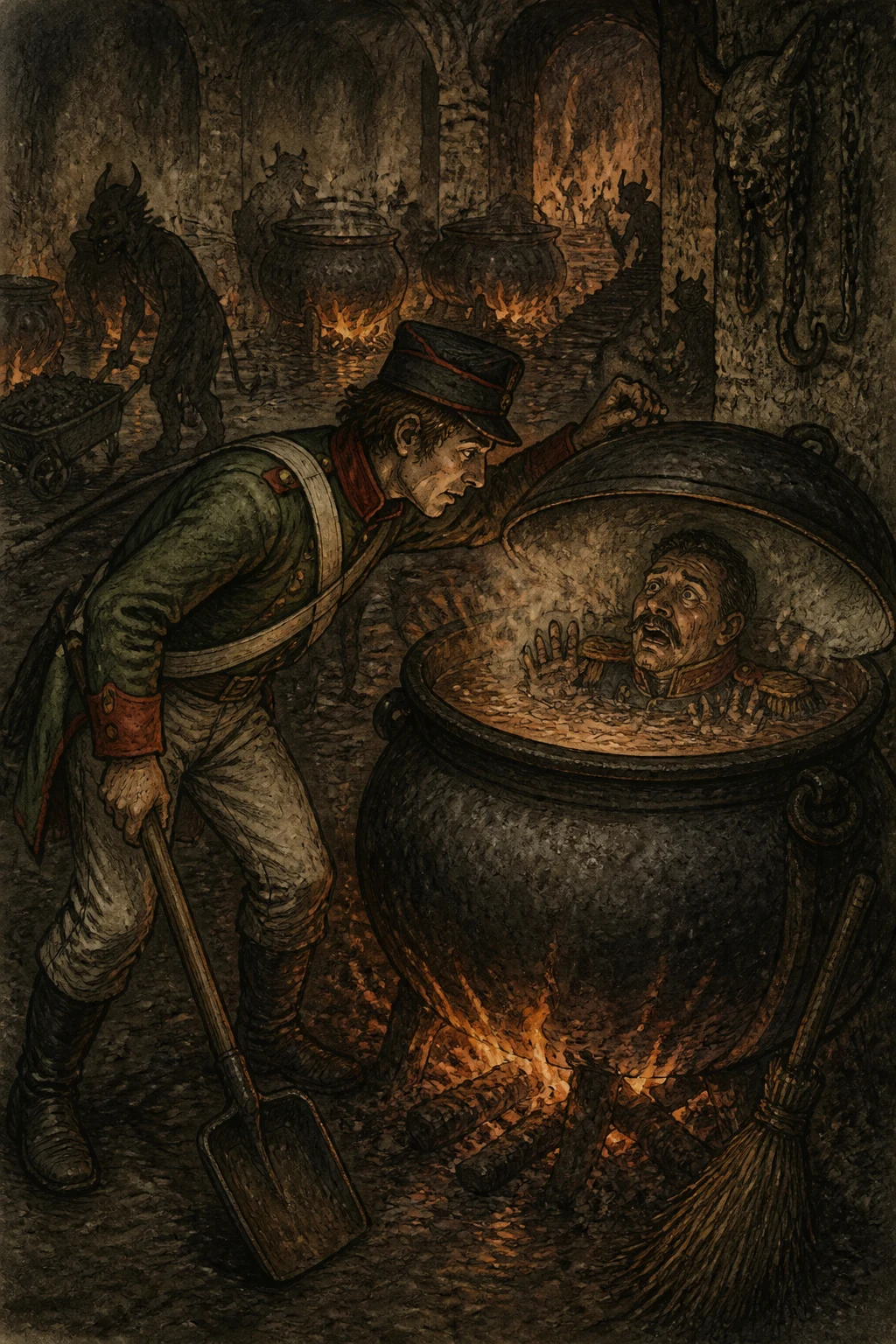
After this, Brother Lustig wandered about the world for a long time, and anyone who knew his adventures could tell many a tale of them. At last, however, he grew old and began to think of his end. He went to a hermit who was known to be a devout man and said to him, “I’m tired of wandering, and now I want to try to enter the kingdom of heaven.” The hermit answered, “There are two roads. One is broad and pleasant and leads to hell; the other is narrow and rough and leads to heaven.” “I’d have to be a fool,” thought Brother Lustig, “to take the narrow, rough road.” He set off along the broad, pleasant road and at last came to a great black gate, which was the gate of hell. Brother Lustig knocked, and the gatekeeper peered out to see who was there. But when he saw Brother Lustig, he took fright, for he was none other than the ninth devil, who had been in the knapsack and had escaped with a black eye. So he quickly shot the bolt again, ran to the chief of the devils, and said, “There’s a fellow outside with a knapsack who wants to come in. But on no account let him in, or he’ll wish the whole of hell into his knapsack. He once had me hammered horribly inside it.” So they called out to Brother Lustig that he must go away again; he would not be admitted. “If they don’t want me here,” he thought, “I’ll see whether I can find lodgings in heaven. I must stay somewhere.” So he turned back and travelled on until he came to the gate of heaven, where he knocked as well. Saint Peter happened to be sitting there as gatekeeper. Brother Lustig recognized him at once and thought, “Here’s an old friend. Things will go better here.” But Saint Peter said, “Surely you don’t mean to come into heaven?” “Do let me in, brother. I must find shelter somewhere. If they’d taken me into hell, I wouldn’t have come here.” “No,” said Saint Peter, “you shall not come in.” “Well, if you won’t let me in, take back your knapsack. Then I’ll have nothing at all from you,” said Brother Lustig. “Give it here, then,” said Saint Peter. Brother Lustig passed the knapsack through the bars into heaven, and Saint Peter took it and hung it beside his chair. Then Brother Lustig said, “Now I wish myself into my knapsack.” In a flash he was inside it, and there he sat in heaven, and Saint Peter had to let him stay.