O besedilu
Borej in Oritija
- Vir
- Ovidove preobrazbe
- Avtor
- Ovid
- Jezik branja
- English
- Jezik izvirnika
- Latin
- Čas branja
- 3 min branja
- Obseg
- 2 strani
- Naslov izvirnika
- Boreas and Orithyia
O izvirniku
Ovidove preobrazbe
Pesniški tok antičnih preobrazb, kjer bogovi, ljudje in narava stalno menjavajo obliko. Bralni jezik je English, izvirnik pa prihaja iz vira Ovidove preobrazbe v jeziku Latin.
Besedilo
Borej in Oritija
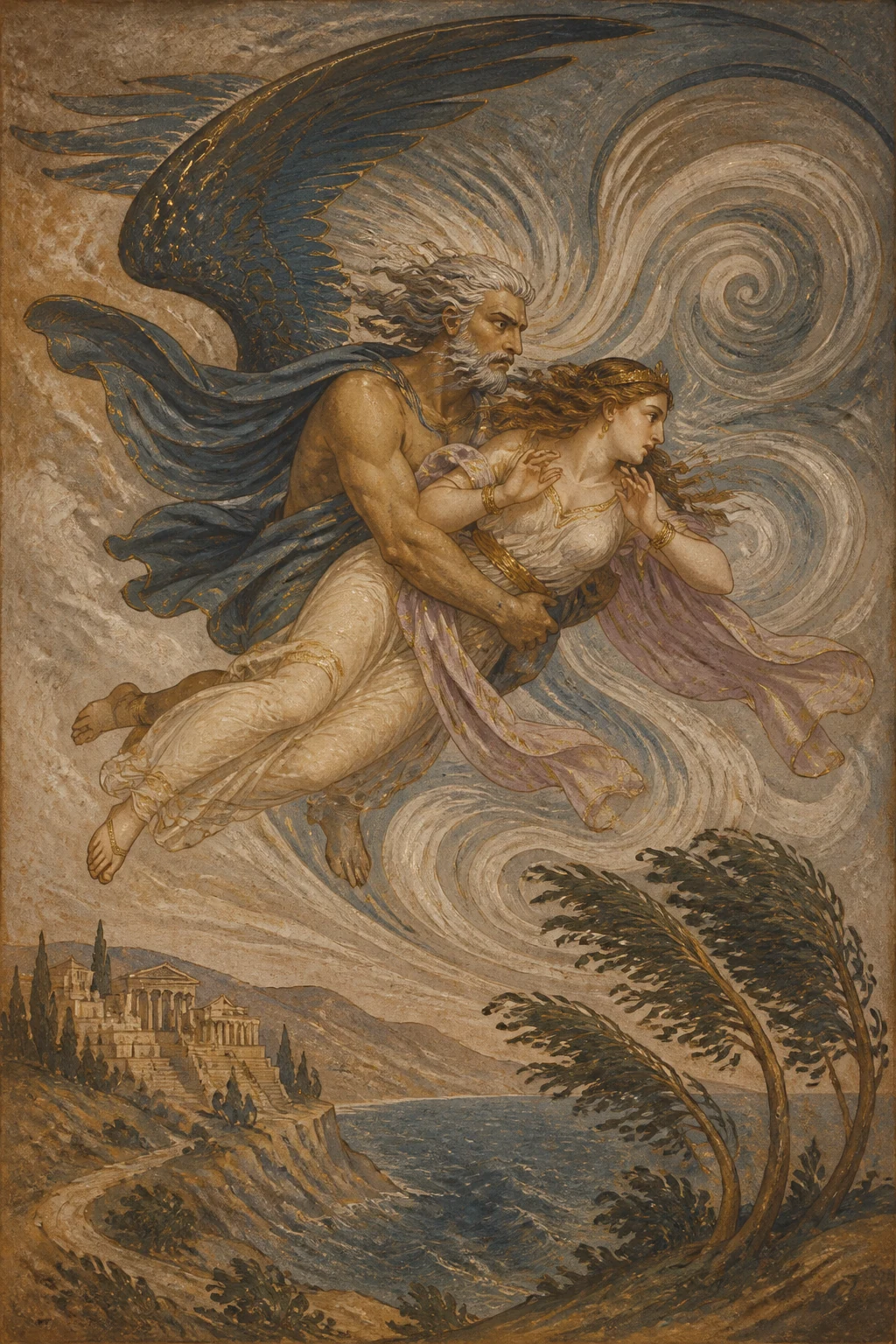
This grief, before his time, before the final years of a long old age, sent Pandion down to the shadows of Tartarus. Erechtheus took the kingdom’s sceptre and the reins of power, as mighty in justice as in the strength of his arms. He had fathered four sons and as many daughters; but two of the girls were equally beautiful. Of these, Procris, you made Cephalus, descendant of Aeolus, happy as your husband. But Tereus and the Thracians stood in Boreas’ way, and long the god went without his beloved Orithyia, while he pleaded, preferring prayers to force.
But when his coaxing achieved nothing, bristling with anger— so usual with him, so much a part of this wind’s nature— he said, “And rightly so! Why have I laid aside my weapons, my fierceness and strength, my anger and threatening spirit, and resorted to prayers, which it disgraces me to use? Force is my proper way: by force I drive away the gloomy clouds, by force I churn the seas and uproot the knotted oaks, harden the snow and batter the earth with hail.
And when I meet my brothers in the open sky— for that is my battlefield—I wrestle with such fury that the heavens between us thunder with our clashes, and fire leaps out, struck from the hollow clouds. And when I enter the vaulted passages of the earth and thrust my savage back beneath its deepest caverns, I trouble the shades below and shake the whole world. With these powers I should have sought my bride: Erechtheus should not have been entreated, but forced to become my father-in-law.”
With these words, or others no less proud, Boreas shook out his wings, whose beating blasted the whole earth and sent a shudder across the broad sea. Trailing a cloak of dust over the mountain summits, he swept the ground and, shrouded in darkness, clasped the terrified Orithyia in his tawny wings. As he flew, the fanning wind made his passion burn more fiercely. Nor did the ravisher rein in his flight through the air until he reached the people and walls of the Cicones.
There the Athenian girl became the icy monarch’s wife and a mother, giving birth to twin sons, who had their mother’s features, but their father’s wings. Yet those wings, they say, were not theirs from birth, and while no beard yet grew beneath their ruddy hair, the boys, Calais and Zetes, remained unfeathered. Soon, like birds, they both began to sprout wings along their sides, and golden down appeared on both their cheeks.
So when boyhood gave way to youth, they sailed with the Minyans in quest of the fleece with its gleaming golden wool, across an unknown sea, aboard the first ship.
Izvirnik
Boreas and Orithyia
Naslednje strani prikazujejo izvirno besedilo za primerjavo.
Source ID: ovid_metamorphoses_story_044 Citation: Ovid, Metamorphoses 6.675-6.721 Original language: Latin Source: PerseusDL canonical-latinLit Source URL: https://github.com/PerseusDL/canonical-latinLit/blob/master/data/phi0959/phi006/phi0959.phi006.perseus-lat2.xml Segmentation certainty: medium 675: Hic dolor ante diem longaeque extrema senectae 676: tempora Tartareas Pandiona misit ad umbras.
677: Sceptra loci rerumque capit moderamen Erechtheus, 678: iustitia dubium validisne potentior armis. 679: Quattuor ille quidem iuvenes totidemque crearat 680: femineae sortis: sed erat par forma duarum. 681: E quibus Aeolides Cephalus te coniuge felix, 682: Procri, fuit; Boreae Tereus Thracesque nocebant, 683: dilectaque diu caruit deus Orithyia, 684: dum rogat et precibus mavult quam viribus uti.
685: Ast ubi blanditiis agitur nihil, horridus ira, 686: quae solita est illi nimiumque domestica vento, 687: “et merito!” dixit: “quid enim mea tela reliqui, 688: saevitiam et vires iramque animosque minaces, 689: admovique preces, quarum me dedecet usus? 690: Apta mihi vis est: vi tristia nubila pello, 691: vi freta concutio nodosaque robora verto 692: induroque nives et terras grandine pulso.
693: Idem ego cum fratres caelo sum nactus aperto 694: (nam mihi campus is est), tanto molimine luctor, 695: ut medius nostris concursibus insonet aether 696: exsiliantque cavis elisi nubibus ignes. 697: Idem ego cum subii convexa foramina terrae 698: supposuique ferox imis mea terga cavernis, 699: sollicito manes totumque tremoribus orbem. 700: Hac ope debueram thalamos petiisse, socerque 701: non orandus erat, vi sed faciendus Erechtheus.”
702: Haec Boreas aut his non inferiora locutus 703: excussit pennas: quarum iactatibus omnis 704: adflata est tellus latumque perhorruit aequor. 705: Pulvereamque trahens per summa cacumina pallam 706: verrit humum pavidamque metu caligine tectus 707: Orithyian amans fulvis amplectitur alis. 708: Dum volat, arserunt agitati fortius ignes. 709: Nec prius aerii cursus suppressit habenas, 710: quam Ciconum tenuit populos et moenia raptor.
711: Illic et gelidi coniunx Actaea tyranni 712: et genetrix facta est, partus enixa gemellos, 713: cetera qui matris, pennas genitoris haberent. 714: Non tamen has una memorant cum corpore natas, 715: barbaque dum rutilis aberat subnixa capillis, 716: implumes Calaisque puer Zetesque fuerunt. 717: Mox pariter pennae ritu coepere volucrum 718: cingere utrumque latus, pariter flavescere malae.
719: Ergo ubi concessit tempus puerile iuventae, 720: vellera cum Minyis nitido radiantia villo 721: per mare non notum prima petiere carina.
Nadaljuj z branjem