Prevod
Long ago there lived a king whose wisdom was renowned throughout the land. Nothing escaped his knowledge, and it was as though word of the most hidden things were carried to him on the air. But he had a strange custom. Every day at noon, when everything had been cleared from the table and no one else was present, a trusted servant had to bring him one more dish. It was covered, and even the servant did not know what lay inside. Nor did anyone else, for the king never uncovered it or ate from it until he was quite alone. This had gone on for a long time when, one day, the servant carrying the dish away was overcome by a curiosity he could not resist, and took it to his room. After carefully locking the door, he lifted the lid and saw a white snake lying inside. At the sight of it, he could not restrain his desire to taste it; he cut off a little piece and put it in his mouth. Scarcely had it touched his tongue when he heard a strange whispering of delicate voices outside his window. He went over and listened, and realized that it was the sparrows talking to one another, telling all manner of things they had seen in the fields and woods. Eating the snake had given him the power to understand the language of animals.
Now it happened that on that very day the queen lost her most beautiful ring, and suspicion fell on the trusted servant, who had access everywhere. The king summoned him and, after scolding him fiercely, threatened that unless he could name the thief by the next morning, he himself would be taken for the culprit and put to death. It was no use protesting his innocence; he was dismissed with no better answer. In his distress and fear, he went down into the courtyard and considered how he might escape his predicament. There the ducks sat peacefully side by side beside a stream, resting, smoothing their feathers with their beaks, and having a confidential chat. The servant stopped and listened. They were telling one another where they had waddled that morning and what good food they had found. Then one of them said crossly, "Something is lying heavy in my stomach. In my haste, I swallowed a ring that was lying beneath the queen's window." At once the servant seized her by the neck, carried her to the kitchen, and said to the cook, "Slaughter this one, will you? She's nice and fat." "Yes," said the cook, weighing her in his hand, "she's spared no effort to fatten herself up, and she's been waiting a long time to be roasted." He cut her throat, and when she was gutted, the queen's ring was found in her stomach. The servant could now easily prove his innocence to the king, who wished to make amends for the wrong he had done him. He therefore allowed the servant to ask a favour and promised him the highest position of honour he might desire at court.
The servant declined everything and asked only for a horse and money for his journey, for he longed to see the world and wander through it for a while. When his wish had been granted, he set out, and one day he passed a pond where he noticed three fish caught in the reeds and gasping for water. Though people say that fish are mute, he could hear them lamenting that they must perish so miserably. As he had a compassionate heart, he dismounted and put the three captives back into the water. They wriggled with joy, poked out their heads, and called to him, "We shall remember this and repay you for saving us!" He rode on, and after a little while he thought he heard a voice in the sand at his feet. He listened and heard an ant king complaining, "If only people and their clumsy beasts would leave us alone! That stupid horse is trampling my people mercilessly beneath its heavy hooves!" He turned onto a side path, and the ant king called after him, "We shall remember this and repay you!" The path led him into a forest, where he saw a father raven and a mother raven standing beside their nest and throwing their young out of it. "Away with you, you young good-for-nothings!" they cried. "We can no longer fill your bellies. You're big enough to feed yourselves." The poor young birds lay on the ground, fluttering and beating their wings, and cried, "We helpless children! We're supposed to feed ourselves, yet we cannot even fly! What can we do but starve to death here?" Then the kind young man dismounted, killed his horse with his sword, and left it for the young ravens to eat. They hopped over, ate their fill, and cried, "We shall remember this and repay you!"
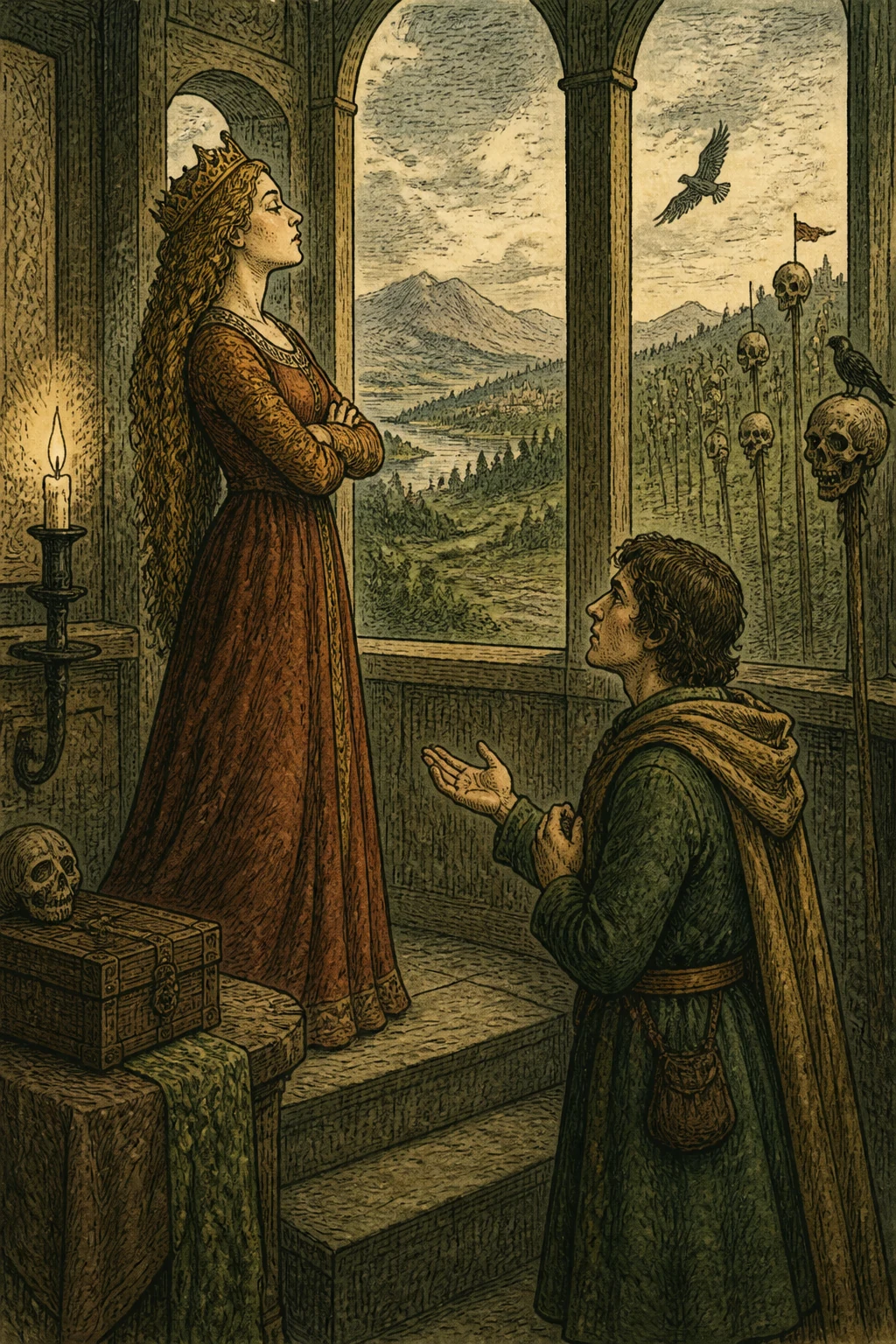
Now he had to use his own legs, and after walking a great distance, he came to a large city. There was a great commotion and a throng of people in the streets, and a man rode through on horseback proclaiming that the king's daughter was seeking a husband. But anyone wishing to court her must accomplish a difficult task, and if he failed, his life would be forfeit. Many had already tried, only to lose their lives in vain. When the young man saw the king's daughter, he was so dazzled by her great beauty that he forgot all danger, went before the king, and offered himself as a suitor.
He was immediately led down to the sea, and a golden ring was thrown into it before his eyes. Then the king ordered him to fetch the ring from the bottom of the sea, adding, "If you come back up without it, you will be thrown in again and again until you perish in the waves." Everyone pitied the handsome young man, and then they left him alone beside the sea. He stood on the shore, wondering what he should do. Suddenly he saw three fish swimming towards him, and they were none other than those whose lives he had saved. The middle one held a shell in its mouth and laid it on the shore at the young man's feet. When he picked it up and opened it, the golden ring lay inside. Full of joy, he took it to the king, expecting him to grant the promised reward. But when the proud princess learned that he was not her equal in rank, she scorned him and demanded that he first perform a second task. She went down into the garden and scattered ten sacks of millet over the grass with her own hands. "He must have gathered it all up by tomorrow, before the sun rises," she said, "and not a single grain must be missing." The young man sat down in the garden and wondered how he could possibly accomplish the task. But he could think of nothing, and sat there sorrowfully, expecting to be led to his death at daybreak. Yet when the first rays of sunlight fell upon the garden, he saw all ten sacks standing side by side, filled to the brim, with not a single grain missing. The ant king had arrived in the night with his thousands upon thousands of ants, and the grateful creatures had worked diligently to gather the millet and put it into the sacks. The princess herself came down into the garden and saw with amazement that the young man had accomplished the task she had set him. But she still could not overcome her proud heart, and said, "Even though he has accomplished both tasks, he shall not become my husband until he has brought me an apple from the Tree of Life." The young man did not know where the Tree of Life stood. He set out, meaning to keep walking as long as his legs would carry him, but he had no hope of finding it. After he had already travelled through three kingdoms, he came one evening to a forest and sat down beneath a tree to sleep. Then he heard a rustling in the branches, and a golden apple fell into his hand. At the same moment, three ravens flew down to him, perched on his knees, and said, "We are the three young ravens you saved from starvation. When we had grown up and heard that you were searching for the golden apple, we flew across the sea to the end of the world, where the Tree of Life stands, and fetched the apple for you." Full of joy, the young man set off home and brought the golden apple to the beautiful princess, who now had no excuse left. They divided the apple of life and ate it together. Then her heart was filled with love for him, and they lived to a great age in untroubled happiness.