Prevod
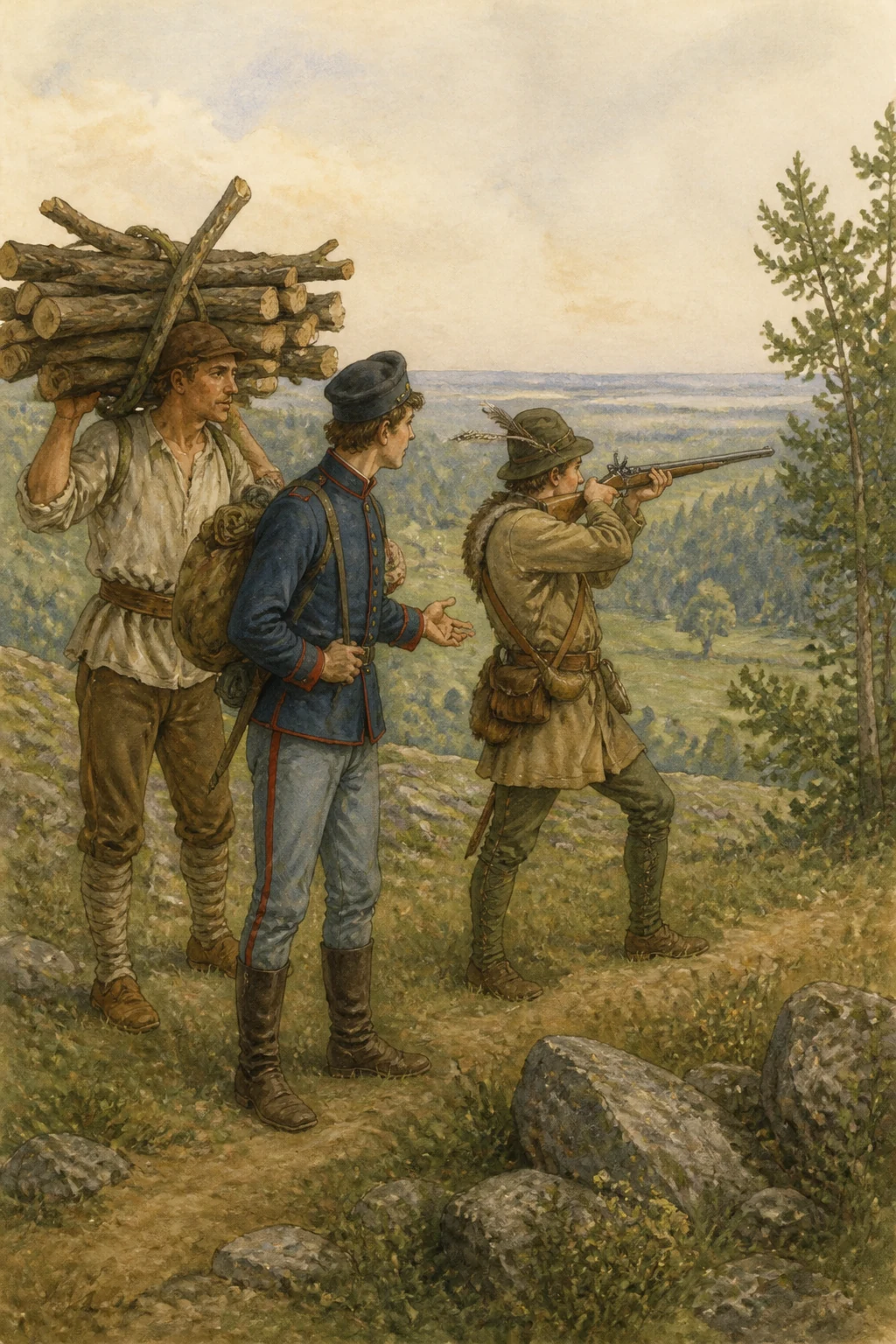
Once upon a time there was a man who was skilled in all manner of arts. He served in the war and fought bravely and gallantly, but when the war was over, he was discharged with three farthings to see him on his way. “Just wait,” he said, “I won’t stand for this. If I can find the right companions, the king shall yet hand over all the treasures in his kingdom to me.” Full of anger, he went into the forest, where he saw a man who had pulled up six trees as though they were stalks of corn. He said to him, “Will you be my servant and come with me?” “Yes,” the man replied, “but first I must take this little bundle of firewood home to my mother.” He took one of the trees and wound it round the other five, hoisted the bundle onto his shoulder, and carried it away. Then he returned and went with his master, who said, “The two of us should be able to make our way through the whole world.”
When they had walked a little way, they found a huntsman kneeling on the ground, his gun raised as he took aim. The master said to him, “Huntsman, what are you going to shoot?” He answered, “Two miles from here, a fly is sitting on the branch of an oak tree, and I mean to shoot out its left eye.” “Oh, come with me,” said the man. “With three of us together, we should be able to make our way through the whole world.” The huntsman agreed and went with him. They came to seven windmills whose sails were spinning furiously, yet there was no wind to right or left, and not a leaf was stirring. “I cannot tell what is driving those windmills,” said the man. “There isn’t a breath of wind.” He went on with his servants, and when they had gone two miles farther, they saw a man sitting in a tree, holding one nostril shut and blowing through the other. “Why, what are you doing up there?” asked the man. He answered, “Two miles from here there are seven windmills. You see, I’m blowing to keep them turning.” “Oh, come with me,” said the man. “With four of us together, we should be able to make our way through the whole world!”
Then the blower climbed down and went with them. After a while they saw a man standing on one leg; he had unstrapped the other and laid it beside him. The master said, “You’ve certainly made yourself comfortable for a rest.” “I’m a runner,” he answered, “and I’ve unstrapped one leg so that I won’t run too fast. When I run on two legs, I go faster than a bird can fly.” “Oh, come with me. With five of us together, we should be able to make our way through the whole world!”
So he went with them, and before long they met a man wearing a little hat tipped right over onto one ear. The master said to him, “Manners, manners! Don’t leave your hat hanging over one ear like that. You look like a jester.” “I dare not straighten it,” said the other, “for if I set my hat on straight, such a terrible frost will come that the birds in the sky will freeze and fall dead to the ground.” “Oh, come with me,” said the master. “With six of us together, we should be able to make our way through the whole world!”
Now the six came to a town where the king had proclaimed that whoever raced against his daughter and won should become her husband, but whoever lost must forfeit his head. The man came forward and said, “But I shall have my servant run for me.” The king answered, “Then you must stake his life as well, so that both your heads depend upon his winning.” When this had been agreed and settled, the man strapped the runner’s other leg on and said to him, “Now be swift, and help us win!” It had been decided that whoever first brought back water from a distant well would be the winner. The runner was given a pitcher, and the king’s daughter another, and they began to run at the same moment. But in an instant, when the king’s daughter had gone only a little way, the runner was already out of sight of all the spectators, and it was just as though the wind had rushed past. In no time he reached the well, filled his pitcher with water, and turned back. Halfway home, however, he grew tired, so he set down his pitcher, lay down, and fell asleep. He had taken a horse’s skull that lay on the ground for his pillow, so that he would lie uncomfortably and soon wake again. Meanwhile the king’s daughter, who could run as well as any ordinary person, had reached the well and was hurrying back with her pitcher full of water. When she saw the runner lying there asleep, she was delighted and said, “My enemy has been delivered into my hands.” She emptied his pitcher and ran on. Now all would have been lost if, by good fortune, the keen-eyed huntsman had not been standing high up on the castle, watching everything. “The king’s daughter shall not get the better of us,” he said, and loaded his gun. He fired so skilfully that he shot the horse’s skull out from under the runner’s head without hurting him. The runner woke, sprang to his feet, and saw that his pitcher was empty and the king’s daughter far ahead. But he did not lose heart. He ran back to the well with his pitcher, filled it afresh, and still reached home ten minutes before the king’s daughter. “You see,” he said, “only now have I really stretched my legs. Before that, you could hardly call it running.” But the king was bitterly disappointed, and his daughter still more so, that a common discharged soldier should carry her off. They took counsel together about how to rid themselves of him and his companions. The king said to her, “I have found a way. Don’t be afraid; they shall never go home again.” Then he said to the men, “Now you must all make merry, and eat and drink together,” and led them to a room with an iron floor, iron doors, and windows guarded by iron bars. In the room stood a table spread with delicious food, and the king said, “Go in and enjoy yourselves!” Once they were inside, he had the door shut and bolted. Then he summoned the cook and ordered him to keep a fire burning beneath the room until the iron glowed red-hot. The cook did so, and as the six sat at the table, they began to feel very warm, but thought it was the food that was making them hot. When the heat grew ever fiercer, however, and they tried to leave but found the doors and windows locked, they realized that the king had meant them harm and intended to suffocate them. “But he shall not succeed,” said the man with the little hat. “I shall bring on a frost that will make the fire shrink away in shame.” He set his little hat straight, and at once such a frost fell that all the heat vanished and the food began to freeze on the dishes. When a couple of hours had passed and the king thought they must have perished in the heat, he had the door opened and went to look at them himself. But as the door swung open, there stood all six, hale and hearty. They said they were glad to be able to come out and warm themselves, for the cold in the room was so bitter that the food was freezing fast to the dishes. Furious, the king went down to the cook, scolded him, and asked why he had not done as he was ordered. But the cook answered, “There is fire enough. See for yourself.” The king saw that a tremendous fire was blazing beneath the iron room, and realized that he could do the six no harm that way.
Now the king pondered once more how to rid himself of these unwelcome guests. He sent for their master and said, “If you will take gold and give up your claim to my daughter, you shall have as much as you wish.” “Oh yes, Your Majesty,” he answered. “Give me as much as my servant can carry, and I shall ask no more for your daughter.” The king was satisfied, and the man went on, “Then I shall come in a fortnight to fetch it.” He summoned all the tailors in the kingdom, and for fourteen days they had to sit and sew a sack. When it was finished, the strong man who could uproot trees had to take it on his shoulder and go with his master to the king. “What sort of mighty fellow is this, carrying a house-sized bundle of linen on his shoulder?” said the king. He took fright and thought, “How much gold will he carry away?” Then he ordered a barrel of gold to be brought in, which took sixteen of the strongest men to carry. But the strong man seized it with one hand, put it into the sack, and said, “Why don’t you bring more at once? That scarcely covers the bottom.” So the king had his entire treasury brought in, little by little. The strong man thrust it all into the sack, which was still not even half full. Then seven thousand wagons laden with gold had to be gathered from all over the kingdom, and the strong man pushed them into his sack, oxen and all. “I won’t waste time looking things over,” he said. “I’ll take whatever comes, just to fill the sack.” Even when everything was inside, there was still plenty of room. Then he said, “I’ll make an end of it now. A sack may as well be tied up even if it isn’t quite full.” He hoisted it onto his back and went away with his companions. When the king saw a single man carrying off all the wealth of his kingdom, he flew into a rage and ordered his cavalry to mount and pursue the six, with orders to take the sack back from the strong man. Two regiments soon caught up with them and shouted, “You are our prisoners! Put down the sack of gold, or we shall cut you to pieces!” “What’s that?” said the blower. “We are your prisoners? You shall all go dancing through the air first!” He held one nostril shut and blew through the other at the two regiments, sending them flying apart and up into the blue sky, over all the mountains, one this way and another that. A sergeant cried out for mercy, saying that he had nine wounds and was a brave fellow who did not deserve such disgrace. Then the blower eased off a little, so that he came down again unharmed, and said to him, “Now go home to the king and tell him to send more cavalry if he likes. I’ll blow them all into the air.” When the king heard the message, he said, “Let the fellows go. There is something uncanny about them.”
So the six carried the riches home, shared them among themselves, and lived happily to the end of their days.