Prevod
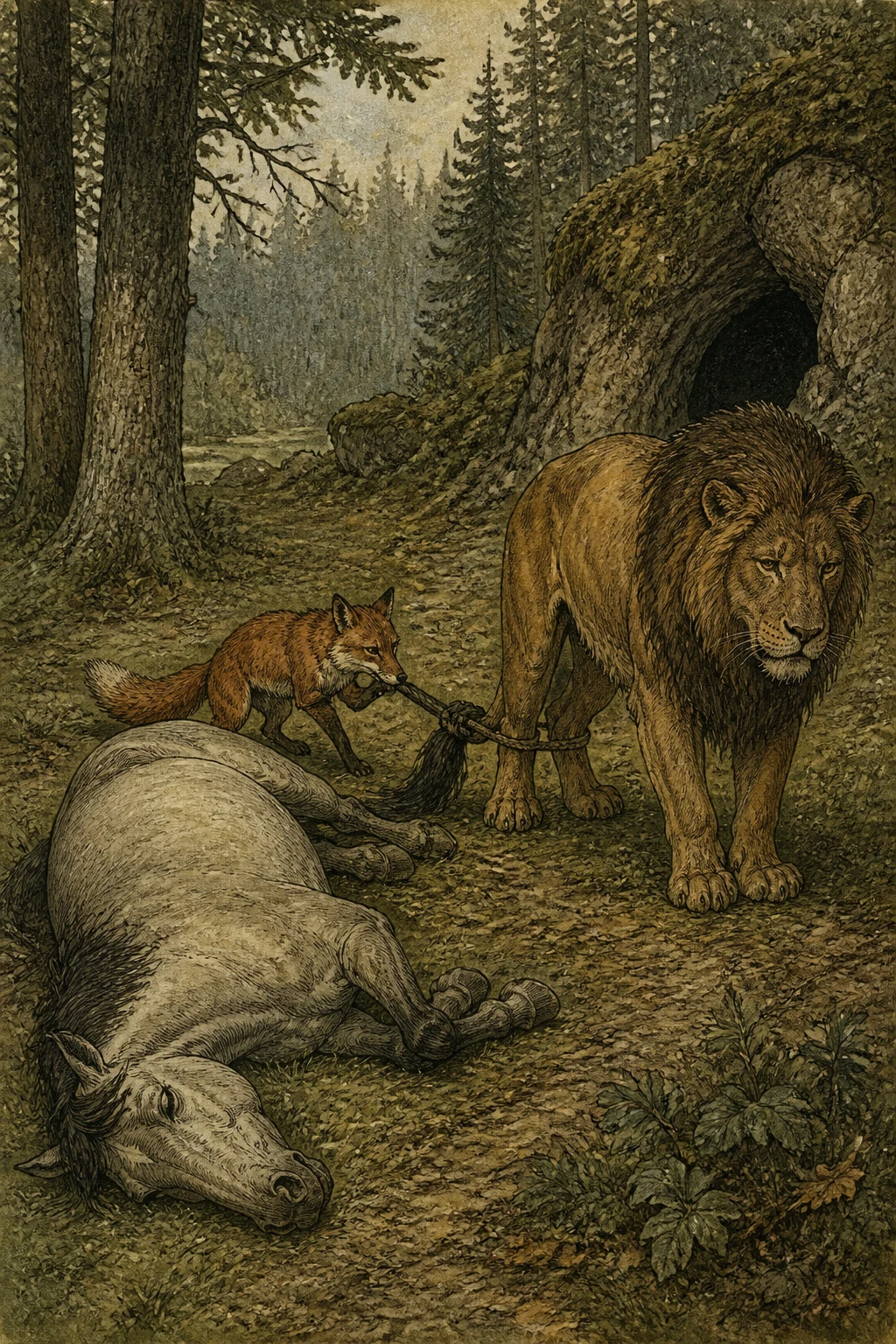
Meanwhile, the owner of the cave, a jackal named Dadhipuccha, returned. Looking about, he saw a trail of lion’s footprints leading into the cave, but none coming out. He thought, “Alas, I am done for! There must be a lion inside. What shall I do? How can I find out?” After pondering this, he stood at the entrance and began to call, “Hello, cave! Hello, cave!” He fell silent, then called again: “Come now! Have you forgotten the agreement we made? Whenever I come back from outside, I am to speak to you, and you are to call me in. If you will not call me, I shall go to another cave.” Hearing this, the lion thought, “Surely this cave always calls out to him when he returns. Today, however, it says nothing because it is afraid of me. Indeed, it is well said:
When the mind is stricken with fear, the hands and feet cease to move,
The voice falls silent, and the trembling grows more violent.
“So I shall call him in myself. He will follow the call, enter, and become my meal.” Having decided this, the lion called out to him. His roar filled the cave with echoes and terrified even the creatures of the forest far away. The jackal fled, reciting the verse that begins, “He who provides against dangers yet to come will prosper.”
“Reflect on this, then, and come away with me.” With these words, Raktaksha departed for a distant country, followed by his household and all who remained loyal to him.
When Raktaksha had gone, Sthirajivin thought with great delight, “Ah, good fortune has come our way! Raktaksha, the farsighted one, has left, while these others are fools. They will now be easy for me to kill. For it is said:
If a king has no farsighted ministers,
Even his ancestral kingdom will surely perish before long.
And this too is well said:
The discerning should regard as enemies in ministers’ guise
Those who abandon sound policy and counsel its opposite.
With this in mind, he added a little stick of forest wood to his nest each day, intending to set the cave on fire. The foolish owls never realized that he was enlarging his nest in order to burn them alive. Indeed, it is well said:
A man whom fate has doomed makes an enemy his friend, and hates and harms his friend;
He takes good for evil, and wickedness for virtue.
When a pile of wood had thus been gathered at the fortress entrance under the pretext of building a nest, Sthirajivin waited until sunrise, when the owls became blind. Then he hurried to Rishyamuka and said to Meghavarna, “My lord, the enemies’ caves are now ready to be destroyed by fire. Come with all your followers, each carrying a burning stick of forest wood, and throw them into my nest at the cave entrance. Then all our enemies will die in agony like that of the hell of boiling cauldrons.”
Delighted to hear this, Meghavarna said, “Father, tell me what has happened to you. It is so long since I last saw you!”
Sthirajivin replied, “My child, this is no time for stories. Some spy of the enemy may report that I have come here. Once he knows, that blind creature may withdraw elsewhere. Make haste! For it is said:
When a man delays a task that calls for speed,
The gods in their anger will surely thwart his work.
And again:
When any undertaking, especially one already ripe for success,
Is not promptly carried out, time drinks away its fruit.
“Once you have reached their cave and destroyed your enemies, I shall tell you everything at leisure and in full.” Hearing this, Meghavarna and his followers each took a burning stick in the tip of the beak, flew to the cave entrance, and cast it into Sthirajivin’s nest. All those day-blind owls, remembering Raktaksha’s warnings, found their way out blocked. Unable to escape, they died inside the cave as though plunged into the hell of boiling cauldrons. Having thus utterly destroyed his enemies, Meghavarna returned to his old fortress in the banyan tree. Seated on his throne amid the assembly, he joyfully asked Sthirajivin, “Father, how did you manage to spend so long among the enemy? We are eager to hear. Tell us, for:
For the virtuous, it is better to plunge into a blazing fire
Than to endure the company of enemies for even a moment.
Hearing this, Sthirajivin replied, “My dear king, a servant intent on future success takes no account of hardship. For it is said:
Even poison, swallowed for the sake of accomplishing one’s purpose, becomes nectar;
This holds for all living creatures: there need be no hesitation.
When danger draws near, a discerning mind must follow whatever path serves its purpose, whether noble or lowly.
Did not the diademed Arjuna deck with women’s bracelets those two elephant-trunk-like arms, scarred by the bowstring and skilled in mighty weapons?
Even a powerful and learned man, awaiting a favorable turn of time,
Must live among base and wicked people whose words strike like thunderbolts.
Did not mighty Bhima, his hand busy with a ladle, begrimed with smoke,
Live laboriously as a cook in the palace of the Matsya king?
Fallen into hardship, a wise man must do whatever is needed, worthy or shameful,
Keeping his purpose hidden in his heart and awaiting the proper time.
Did not the ambidextrous archer, whose hands were hardened by the fierce twanging of Gandiva’s mighty string,
Wear a dancer’s girdle and display his skill in graceful dancing?
A wise man seeking success must restrain his own splendor;
Though endowed with courage and vigor, he must steadily endure the workings of fate.
Though his brothers were the equals of Indra, Kubera, and the god of death,
Did not glorious Yudhishthira, the son of Dharma, suffer long in Virata’s palace?
Madri’s two sons, handsome, nobly born, and strong,
Became Virata’s servants, tending his cattle and horses.
She whose incomparable beauty, youth, noble birth,
And radiance made her seem the goddess Shri herself was brought low by the course of time.
Did not Draupadi grind sandalwood in the Matsya king’s palace,
While the young women haughtily and contemptuously called her ‘the maid’?
Meghavarna said, “Father, I think that living with an enemy is like observing a vow to walk upon a sword’s edge.”
Sthirajivin replied, “Your Majesty, that is true. But nowhere have I ever seen such a gathering of fools. Not one of them was wise except Raktaksha, a man of great insight and unrivaled understanding of many branches of learning. He alone understood my true intentions. The other ministers were utter fools, living on the mere title of minister, with no grasp of reality. They did not understand even this:
A servant who comes over from the enemy, eager to attach himself to you, is suspect;
He shares the nature of a spy, is a constant source of anxiety, and cannot be trusted.
While their enemies sit, sleep, travel, drink, or eat,
Foes watch for an opening and strike when they are off their guard.
Therefore a wise man should take every care to protect himself,
The foundation of virtue, wealth, and pleasure; for negligence brings destruction.
And this too is well said: Whom does disease not torment when he eats unwholesome food?
What king with wicked counselors escapes disastrous policy?
Whom does prosperity not make arrogant? Whom does death not strike down?
Whom do sensual pleasures, once embraced, fail to afflict?
The greedy lose their good name; the slanderous, their friendships;
Those who neglect their duties lose their family’s standing; those bent on wealth, their virtue.
The vicious lose the fruits of learning; the miserly, happiness;
And a king whose ministers are negligent loses his kingdom.
“So, Your Majesty, when you said that by living among enemies I had observed a vow to walk upon a sword’s edge, you spoke of something I have experienced firsthand. For it is said:
A wise man should put humiliation before him and honor behind him,
And accomplish his purpose; to ruin one’s undertaking is folly.
A wise man should even carry his enemy upon his shoulders while awaiting his opportunity.
Thus a great black snake killed many frogs.
Meghavarna asked, “How was that?” Sthirajivin told the tale: Tale 15. The Snake Mandavisha. In a certain place near Mount Varuna lived an aged black snake named Mandavisha. He thought to himself, “How can I find an easy way to make a living?” So he went to a lake full of frogs and made himself appear dejected.
As he lay there, a frog that had come to the water’s edge asked him, “Uncle, why are you not roaming about in search of food today as you used to?”
He replied, “My dear fellow, how can an unfortunate creature like me have any appetite? This evening, just after nightfall, I was hunting for food when I saw a frog. I prepared to catch it, but it saw me and, in fear of death, fled among some Brahmins who were absorbed in reciting the sacred texts. I could not see where it had gone. Mistaking it for the frog, I bit the big toe of a Brahmin’s son as he stood in the water at the edge of the lake. He died at once. His grief-stricken father cursed me, saying, ‘Wretch! You have bitten my innocent son. For this crime you shall become a mount for frogs, and live only on whatever they choose to give you.’ That is why I have come to carry you.” The frog reported this to all the others. Delighted, they went together to inform their king, Jalapada. Thinking this a great marvel, the king hurried out of the lake, surrounded by his ministers, and mounted the hood of Mandavisha. The others climbed onto his back in order of seniority. Indeed, those who could find no place on top ran along behind him. To please them, Mandavisha displayed many different styles of movement. Enjoying himself greatly, Jalapada said:
No ride upon an elephant, a horse, or a chariot,
Nor even in a palanquin, gives me such pleasure as riding Mandavisha.
The next day, Mandavisha deliberately crawled along very slowly. Seeing this, Jalapada said, “My good Mandavisha, why do you not carry us as well today as you did before?”
Mandavisha replied, “Your Majesty, I have had nothing to eat today, and lack the strength to carry you.”
The king said, “My good fellow, eat some of the lesser frogs.”
At these words, delight thrilled through Mandavisha’s whole body. He hastened to reply, “That is precisely what the Brahmin’s curse prescribed! I am pleased that you have given me permission.”
From then on he ate frogs continually, and within a few days had grown strong. Delighted, he laughed inwardly and said:
All these different frogs have been brought within my reach by trickery.
How long can their numbers hold out while I keep eating them?
Jalapada, his mind bewitched by Mandavisha’s deceptive words, understood nothing. Meanwhile, another huge black snake came to that place. Seeing Mandavisha carrying the frogs, he was astonished and said, “Friend, how is it that you let creatures who are our food ride upon you? This is quite contrary to nature!” Mandavisha replied:
I know all this, and know very well that the frogs are riding me.
I am merely biding my time, like the Brahmin blinded by ghee.
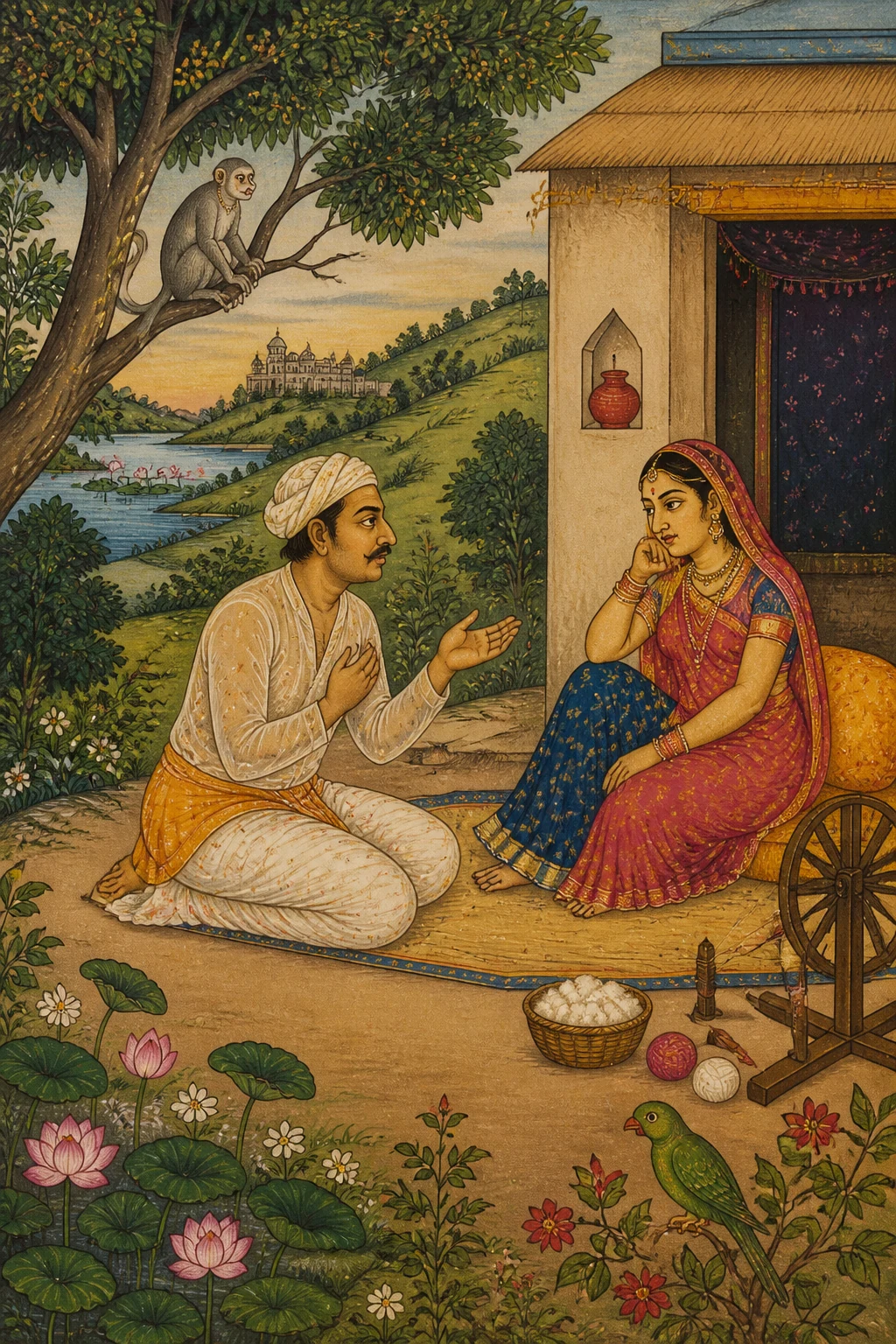
The other asked, “How was that?” Mandavisha told the tale: Tale 16. The Brahmin Blinded by Ghee. In a certain town lived a Brahmin named Yajnadatta. His wife was unfaithful and had given her heart to another man. She was forever making rich cakes with ghee and sugar and secretly giving them to her lover behind her husband’s back. One day her husband saw her and asked, “My dear, what are you cooking? And where do you keep taking it? Tell me the truth.”
Thinking quickly, she answered her husband with a lie: “Not far from here is a shrine of the blessed Goddess. I fast and take offerings and special delicacies there.”
Then, before his eyes, she gathered up all the food and set off toward the Goddess’s shrine. By making an offering there, she meant to convince her husband that she was indeed preparing it for the Goddess. While she went down into the river to bathe, her husband took another path to the shrine and concealed himself behind the image. After bathing, the Brahmin’s wife entered the shrine, bathed and anointed the image, offered garlands, incense, and food, bowed to the Goddess, and prayed, “Blessed Goddess, how can I make my husband blind?”
Hearing this, the Brahmin spoke from behind the image in a disguised voice: “If you continually feed your husband ghee-cakes and other such delicacies, he will soon become blind.”
The adulterous woman, deceived by this false reply, began serving the Brahmin those very foods every day. Then one day he said, “My dear, I can hardly see at all.”
Hearing this, she thought, “The Goddess has granted her favor!” Her beloved now began visiting her openly every day, without fear, thinking, “The Brahmin is blind. What can he do to me?” One day, when the Brahmin saw him enter and come within reach, he seized him by the hair and beat him with a club, his heels, and whatever else he could use, until the man was dead. He then cut off his wicked wife’s nose and drove her away. ***********************************************************************
“That is why I say, ‘A wise man should even carry his enemy upon his shoulders,’ and so forth.” (238)
“Thus, Your Majesty, just as Mandavisha destroyed the frogs through the power of his intelligence, so have I destroyed all our enemies. And this too is well said:
A forest fire burns the trees but leaves their roots unharmed;
The wind, though gentle and cool, can tear them out roots and all.
Meghavarna said, “Father, that is quite true. Great souls possess great courage: even in adversity they do not abandon what they have begun. For it is said:
This is the greatness of the great, adorned with wisdom in affairs:
Even when grievous disaster comes, they do not abandon what they have begun.
And again: The low-minded never begin, for fear of obstacles;
Ordinary men begin, but give up when obstacles defeat them.
Those of the highest character, though assailed by obstacles a thousandfold,
Never abandon what they have begun.
“By utterly destroying my enemies, you have rid my kingdom of every thorn. Indeed, this is only fitting for one who understands statecraft. For it is said:
Debt, fire, enemies,
And illness: the wise man who leaves no trace of these will not come to grief.
Sthirajivin replied, “Your Majesty, it is you who are fortunate, since everything you undertake succeeds. Courage alone does not accomplish a task; it is action guided by wisdom that brings victory. For it is said: Enemies struck down by weapons are not truly destroyed;
Those struck down by wisdom are utterly destroyed.
A weapon kills only a man’s body;
Wisdom destroys his family, his wealth, and his renown as well.
“Thus, when intelligence and vigorous effort are joined, undertakings succeed with ease. For it is said: When a man is destined to prosper, his understanding expands as he begins his work, and his memory grows firm;
His counsel, bringing its own rewards, does not go astray.
His reasoning shines forth and bears fruit; his spirit rises;
And he takes delight in praiseworthy deeds.
“Moreover, sovereignty belongs to the man endowed with sound policy, generosity, and courage. For it is said:
Worthy people seek the company of one who is generous, brave, and learned.
Wealth comes to the worthy; from wealth comes splendor; from splendor, authority; and from authority, kingship.
Meghavarna said, “Surely the teachings of statecraft bear immediate fruit, for by feigning loyalty and entering the enemy’s ranks, you have destroyed Arimardana and all his followers.”
Sthirajivin replied: “Even when an objective can be attained only through harsh measures,
It is wise to begin with a show of deference.
The lordly tree, towering high, the finest in the forest,
Is honored and worshipped before it is cut down.
“But, my lord, what use are words that later prove impossible to carry out, or hard to bring to fruition? It is well said: The words of those who cannot make up their minds, who shrink from firm resolve,
And whose only aim is the pleasure of talking as they please,
Become, when the outcome belies them,
A laughingstock in the world.
“Nor should the wise neglect even small duties. For: ‘I can do this; it is a small matter, easily accomplished. Why trouble about it?’
Thinking thus, men neglect the task before them.
Through such carelessness, some come to suffer anguish and remorse,
The ready fruits of a disastrous turn of events.
“Now that my lord has conquered his enemies, he will once again sleep as peacefully as before. For it is said:
In a house with no snake, or with its snake securely confined, one sleeps at ease;
But where a serpent is always in sight, sleep is hard to find.
And again: Until men devoted to honor, high ambition, and valor have brought to completion
Those great undertakings that demand far-reaching effort, supported by the good wishes of friends,
Advanced through policy and courage, and raised toward the goal of their desires,
How can peace find room in their ardent hearts?
“Now that our undertaking is complete, my heart too seems at last to rest. Devote yourself to the protection of your subjects, and long enjoy this kingdom, now cleared of its thorns. May the glory of your royal parasol and throne remain unshaken, passing in due succession to your sons and grandsons. Furthermore:
A king who does not gladden his subjects by protecting them and exercising the other royal virtues
Has a kingdom as useless as the teat hanging from a goat’s neck.
The king who loves virtue, despises vice,
And takes delight in faithful servants
Long enjoys the glory of sovereignty, with its waving yak-tail fans
And its adornment of a white parasol.