Prevod
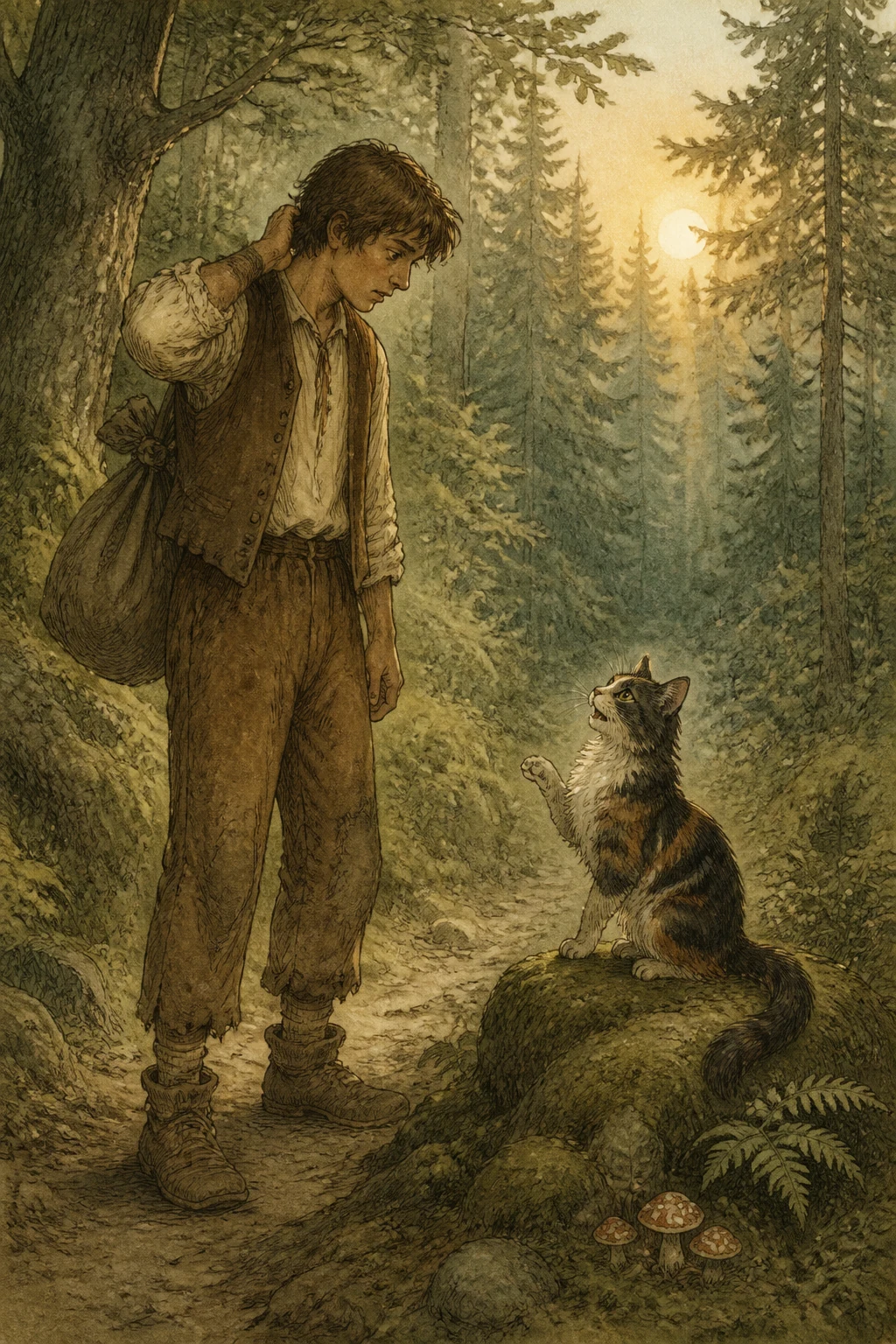
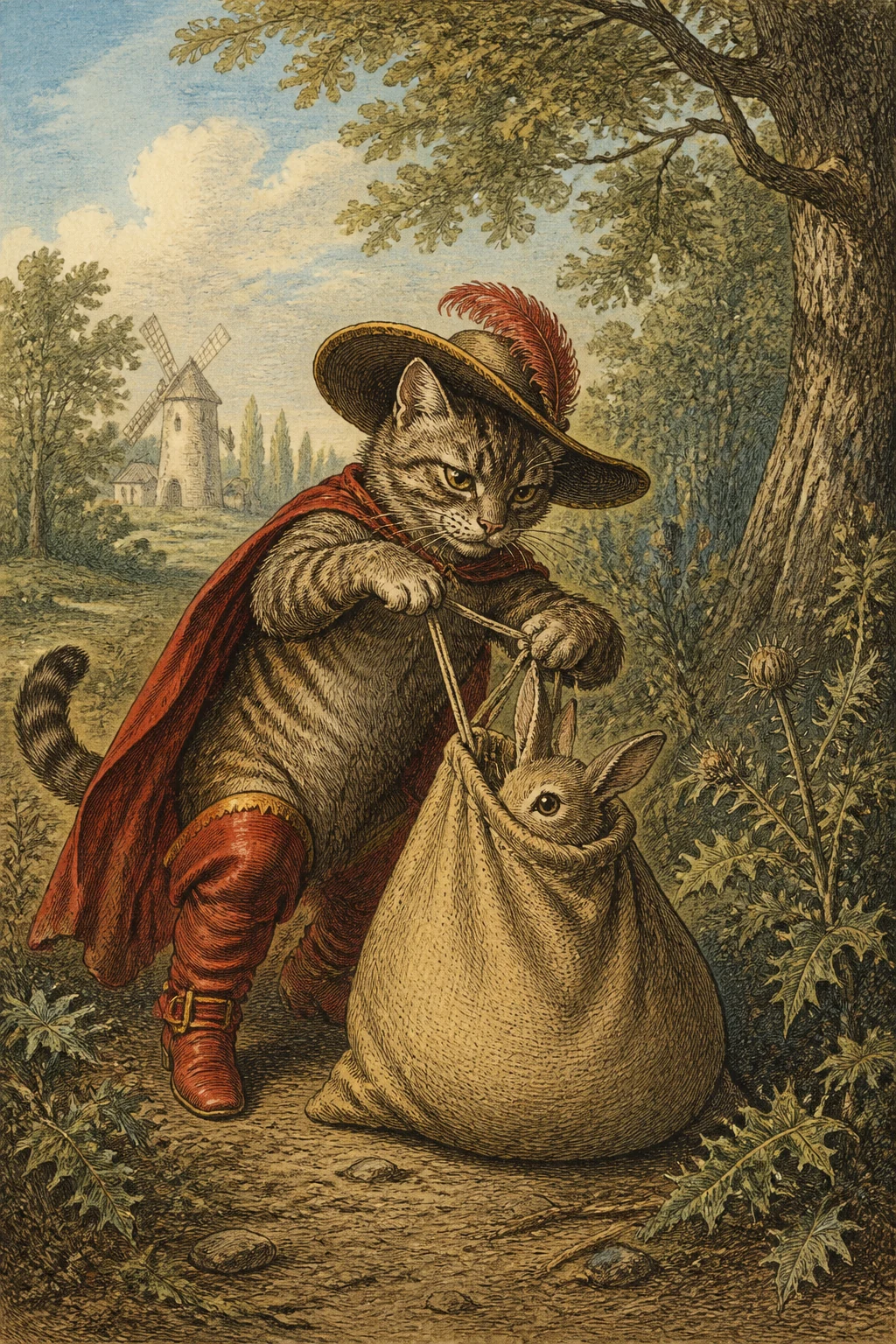
Once upon a time, as never before, there lived a husband and wife. They had no children. One day, when he was in good spirits, the husband said to his wife, “Wife, by God’s will we have no children. Let us go out into the fields, and whatever we find shall be our child.” “You speak wisely, husband. Let us do so, if that is what you think best.” You see, they lived happily together, and his wife never went against his word, not by so much as the black beneath a fingernail. They baked a flatbread, took a little food to go with it, put everything into their bag, and set off. On they went, talking and laughing as they walked, looking about them on every side. Before long, they came upon a scrawny little kitten, all skin and bones, with rheumy eyes. They picked him up and brought him home. They tended him and raised him as their own child. With every passing day he grew handsomer, until he became a splendid tomcat, a pleasure to behold. The couple could scarcely contain their joy, for now they too had someone in their house to set eyes upon when they rose in the morning. Before, their home had seemed deserted. The tomcat was a sensible creature. Not a mouse could make its home in that house any longer. When the household sat at their work on those long winter nights, telling funny stories and riddles, the cat would sit beside them and purr. When the mistress of the house knitted stockings, he played with her ball of yarn. But tangle it? Heaven forbid! Somehow or other he contrived to play so prettily that the ball neither unwound nor became snarled. Sometimes he took it between his forepaws, holding it like a man, and rolled onto his back with it; at other times he sent it rolling with a tap of his paw and darted after it as though it were a mouse. When the master of the house played with him, he took the greatest care not to scratch him; you would have thought his claws had been filed down. When his master stroked him, the cat knew he was loved, and in return he would reach out his little paws and stroke his master, always with his claws sheathed, giving a caress as soft as silk. Besides all this, he was so trustworthy that the household let him look after the chicks and feed them, and he never so much as thought of attacking them. He was not one of those cats that poke their noses into every pot. As for the pot of cream, there was no question of ever catching him at it, or of finding him among the pieces of meat roasting on the gridiron. He was a cat such as you will not find another in this day and age. Not long afterward, the wife found herself with child. Then you should have seen the joy in that household! They could scarcely keep their feet on the ground. When her time came, she gave birth to a plump, handsome, healthy boy. The child grew and grew. He would not be parted from the cat for so much as the time it takes to strike a spark from flint. The two played together, ate together at the table, and slept together. It never entered the parents’ heads to neglect the tomcat. On the contrary, they cared for him just as they did for their child, for, as they said, he had brought good fortune into their house: since his arrival, they had been blessed with a son. After a while, however, they saw that their fortunes were declining. Where once there had been plenty in their house, now they were, as the saying goes, prosperous merchants as a feather is heavy upon the water. Even so, the couple never thought of murmuring against God. They were content to have been granted a child, and that was enough. More time passed, and at last both old people breathed their last, leaving behind an empty house and bitter poverty. All the boy had left was the tomcat. When he saw that he had nothing, and no parents either, the poor child began to weep and wail so pitifully that it would have broken your heart. Then the tomcat said to him, “Master, I never thought you so fainthearted. You have me beside you. Do not grieve so much. Just as your parents cared for me, so I am bound to care for you. And just as you never let me leave your side, not even for the blink of an eye, so I shall never leave you until I have settled you in life and seen you take your place among men.” As it turned out, the tomcat was an enchanted creature. But the boy stared at him wide-eyed when he heard him speak. The two set off, the tomcat in front and the boy behind. When they reached a forest, they found a great hollow tree and made their home there. The tomcat made his master a bed entirely of birds’ down, so that he sank into softness whenever he lay down. He brought him food and drink. He kept him company, telling him all manner of tales and merry stories. He explained what the crickets’ singing meant, and what the grasshoppers’ leaping through the grass signified. He taught him that love between brothers is as boundless as the water of the spring that flowed near their dwelling. When they walked together through a clearing in the forest or went out into the fields, he showed him all the little flowers and told him their names. The child could not understand why cranes travelled in a line, why swallows came and went, why nightingales sang so beautifully, while the hooting of owls sent shivers of dread through you. And the tomcat explained everything in turn, helping him understand that all things here on earth have their appointed order. He kept the hollow tree so clean that you almost hesitated to set foot inside. Not even a little insect was allowed to linger there. The tomcat would not let the boy lift a finger. He did everything himself. In time, the boy became a young man of marriageable age. Then the cat said to him, “Master, the time has come for you to marry.” “Very well, I shall marry,” replied the young fellow, “but I have nothing to my name, not even a bed to sleep in. I am a pauper, as you can see, with nothing but my cap and the clothes on my back.” “Do not trouble yourself about that. I have made provision for it long ago. You need only do as I tell you. From this day forward, you must know that your name is Emperor Matahuza.” Not long afterward, the tomcat went in search of a bride for his master. Evidently he already had someone in mind, for he went straight as an arrow to the palace of a great boyar. When he reached the gate, he turned three somersaults and became a man. On being brought before the boyar, he said, “My lord, my master, Emperor Matahuza, was out hunting, but he came upon nothing except little birds. They were not game worthy of an emperor, so he passed them by and left them to their laying.” “And what need have I to know that your master, Emperor Matahuza, had no luck at the hunt?” “Sweeten your words with honey, my lord. If you will hear me to the end, you will learn that my errand brings you joy.” “Very well, say all you please. I am listening. But I cannot tell why—there seems to be something rather catlike about your speech.” “A fancy, honoured sir. Just as gloomy weather breeds frightening dreams, perhaps I have a few ill-favoured hairs that lead your fancy astray.” “Very well, very well; finish as you began.” “And so, illustrious sir, as I was telling you, my master paid no heed to the paltry game that crossed his path. He searched every corner of the forest, but it seemed that all the beasts had agreed among themselves not to leave their lairs. Disgusted by the folly of the wild creatures that kept themselves hidden, my master decided to return home. Then, all at once, on the crest of a little hill rising proudly from a clearing, he caught sight of a nimble doe with gentle eyes. One glance was enough: she stole his heart. My master, Emperor Matahuza, set off after her. The doe fled, and he pursued. But she, being swifter of foot, left him far behind and came here, where she hid herself in this very dwelling of yours. My master has sent me to seek his heart and ask you to place that little thief of a doe in his hands. That is why I have come to you, and I beg your help, so that I may return with my errand accomplished.” “Well, what a sly rogue you are! Your master, Emperor Matahuza, must have searched a long time to find such a rascal as you!” “Say what you please of me, my lord, but do not be tempted to speak slightingly of my master the emperor, or, mark my words, the devil will be to pay.” “Nothing could be further from my thoughts. But let your emperor the hunter come and seek his doe himself.” And since one word leads to another, the tomcat and the boyar sat talking and came to an understanding. They agreed that Emperor Matahuza should come and meet the boyar’s daughter. Returning to his master, the tomcat told him how well his mission had succeeded, and they arranged to go together on the next feast day. The young man could not understand how he was to go in such ragged poverty. But the tomcat gave him no time to dwell on such matters; he led him gently into conversation and, with subtle persuasion, made him understand that happiness lay ahead. The days passed as swiftly as yesterday, and the awaited feast day came. The tomcat took his master and set off to ask for the girl’s hand. They walked and walked until they reached a forest near the palace of the boyar whose daughter they were to visit, and there they stopped. The young man stayed hidden in a green thicket, for he had not a stitch to his name worth showing. The tomcat, meanwhile, ran as fast as he could to the great boyar’s courtyard. As soon as he arrived, he began shouting at the top of his voice, “Help! Help! We have been robbed!” Everyone came running out to see what had happened. Barely able to catch his breath, with terror written on his face, the tomcat said to the boyar, “Is it possible, my lord, that here on your own lands thieves can fall upon us in broad daylight?” “Where? How? What has happened?” asked the boyar. “What has happened? Why, just as I was bringing Emperor Matahuza, my master, to meet your daughter, a band of brigands seized us and stripped my master to his very shirt. I slipped away, took to my heels, and ran here without stopping to bring you word and ask for your help. Look at me—I scarcely escaped with my life!”
“What!” cried the boyar. “How can such a thing be, that thieves should rob your Emperor Matahuza so near my palace? Everyone, young and old, turn out and help!” “There is no need now, my lord. The robbers have taken to their heels. Better give me a suit of clothes to take to my master, so that he can come here. As for the thieves, rest assured that he will know how to deal with them.” He took the clothes the boyar gave him and returned to his master. After dressing him and teaching him how to conduct himself before the boyar, he set off with him. When they arrived, the boyar came out to meet them and received them with every honour. Once inside, Emperor Matahuza kept looking down at himself. The people of the house began to whisper and nudge one another, saying, “Either this Emperor Matahuza is very vain, or he is a fool.” Noticing this, the tomcat said to the boyar, “I beg you not to take offence, but my master has never worn such poor clothes before.” At once the boyar ordered another suit to be brought, one woven all through with gold thread. Meanwhile, the tomcat slipped close to his master, gave him a secret nudge, and whispered in his ear that he must control himself and stop looking down at his clothes like a country bumpkin. After putting on the fine garments, the young man kept himself in hand and no longer stared at himself. Then they fell into conversation, and the affair was brought to a happy conclusion. Nor could it have been otherwise. For even if the bridegroom was only Emperor Matahuza, his noble bearing, his handsome face as fair as snow, his slender figure as though drawn through a ring, and his height like a fir tree were worth more than all the empires and all the noble estates in the world. Once the wedding day had been fixed, they left. Until then, the poor young man fretted over what he would do and where he would take his bride. The tomcat gave him no peace to brood, but distracted him with all manner of jokes and stories and kept his spirits up. When the appointed wedding day came, the two went back together. The boyar was thunderstruck. He had expected him to arrive with an army and all the splendour befitting an emperor, yet here he came like some ragged fellow from nowhere. The boyar began to have doubts and to hesitate over giving him his daughter. The tomcat at once scented how matters stood and took the boyar aside. “My lord,” he said, “do not take it amiss that you see only the two of us here. This is how the matter stands: offers of marriage, with rich dowries, pour down like rain upon Emperor Matahuza’s parents. But he will not hear of marrying anyone except your daughter. His parents oppose the match. I, however, have urged him, and continue to urge him, to choose you for his father-in-law. You see, I know what I know. A family as honourable and well spoken of as yours is not to be found elsewhere in the world; and young men like Emperor Matahuza—no, no, no, they are rarer still. As for the household this pair will establish, it will have no equal. That is why my master, taking my advice, has decided to marry her without his parents’ consent and retire to his estates, to live there as a great lord.” “You speak very prettily, but I know that parents’ blessings make their children’s homes secure.” “But there is another saying too,” replied the tomcat. “With an ugly wife beside the hearth, the house turns upside down, with its roof in the loft and its windows under the bed. Better to work and earn your bread, and love the one who pleases you.” “There is something in what you say. Still, I am minded to postpone the wedding.” “So be it. I shall not oppose you. But I advise you not to let slip from your hand a jewel such as this, sent to you by God. When good fortune comes a man’s way, he must know how to seize it and keep it.” “Well, then, let us go ahead. Your glib tongue has got the better of me.” Everything being ready, the two were married, and they held a wedding feast whose fame spread through seven villages. For three days and three nights the celebrations lasted. On the fourth day, the wedding party was to travel to Emperor Matahuza’s estates. He was quite beside himself. He did not know what to do, and shame left him scarcely knowing what he said. The tomcat drew close to him and said, “Keep your head, man; do not be a child. I have seen to everything. You need not worry about a thing. Hold your tongue and let them take you wherever I say.” Emperor Matahuza’s heart grew a little steadier when he heard the tomcat’s words. Still, he could not understand how it would be managed, or to what estates he was to be taken. All the arrangements were made. Everything was ready for departure. The bride and groom climbed into the carriage, and off they went. The tomcat went ahead, telling the coachmen to follow him, for he would show them the way. And so they did. They crossed fields where thousands of little flowers adorned the earth. A faint breeze stirred and gently shook the leaves of the trees scattered here and there along their road. Little frogs croaked in the distance. From time to time, a cuckoo called on their right. Birds twittered, while in the flowering thickets the nightingales poured out lively tunes that stole your heart away. The tomcat went ahead so swiftly that the carriages could scarcely keep up. Now he vanished like a phantom, now he wheeled back and signalled which way they were to take. For, you see, as he guided them, he was also making his arrangements farther along the road. Coming upon the herds of cattle belonging to some zmei, he told the cowherds what to say if anyone asked whose herds they were; otherwise, the doom that God would send down upon their heads would be terrible. When he came to the flocks, he likewise told the shepherds what they must say, warning them that, if they did not, the Mother of the Forest would torment them by plunging their hands into a cauldron of boiling pitch until they died, and their souls would suffer everlasting punishment. The poor men, frightened out of their wits and knowing that words cost nothing, answered those who questioned them exactly as the tomcat, who was in human form, had instructed them. When the carriages came up and the bride’s companions saw the multitude of cattle, they asked the cowherds, “Whose herds are these, friends?” “Whose should they be?” the cowherds answered. “Why, Emperor Matahuza’s.” Everyone marvelled at this emperor’s wealth. Farther on, they came upon flocks of sheep, so many that the eye could not take them all in. “Whose are all these flocks, friends?” they asked. The shepherds answered, “Why, good heavens, whose should they be? They belong to Emperor Matahuza—and these are nothing!” At this, everyone clapped a hand to their cheek. They could no longer contain their astonishment and congratulated the bride on having found so young, handsome, and wealthy a husband. Emperor Matahuza, meanwhile, sat silent as a fish, stunned by all he saw. He heard their words and felt that he must be dreaming, that the things before his eyes could not be real. The tomcat strutted and boasted of his master’s riches. Then, all at once, he was nowhere to be seen. No one knew what had become of him. He seemed to have sunk into the earth. But he had merely dashed ahead. Reaching the palace of the zmei, whose estates they were crossing, he cried in a terrified voice, “Flee, zmei, and hide yourselves! Here come Ilie and Palie to overwhelm you and burn you to ashes, and behind them comes Luceflender, the soul-snatcher!” A shudder of terror seized the zmei at this sudden news of such danger. They did not know where to turn for shelter until the fiery scourge the tomcat spoke of had passed. He pretended to be their friend and to offer them sound advice. His words so bewildered them that they were utterly lost with fear and could see no way out. Then, with great haste and feigned concern, he said, “Come, come, quickly, over here! I shall hide you in this stack of straw in the courtyard.” The poor zmei were so frightened that they no longer knew what they were doing. They let him hide them. The tomcat thrust them into the straw stack and set it alight. At once the flames leapt to the heavens, while the poor zmei screamed in the searing fire so piteously that you might have wept for them. They screamed and screamed until, with the dying flames, their voices too died away, and they were reduced to ashes. Just then, the wedding party came in through the palace gate. The servants, as the tomcat had instructed them, said that this palace stood upon Emperor Matahuza’s estates. And when they entered the palace, what do you think they saw? All the riches in the world seemed gathered there. The walls were covered in gold. The floors were of marble, and the roof was of bronze and lead. Once again, the bride’s companions marvelled. After the young couple had settled in, the others returned to the boyar and told him everything they had seen. The boyar did not regret having given his daughter to Emperor Matahuza. As for Matahuza himself, he wondered how such wealth could ever have come to him. The married pair lived in peace and happiness, and they may be living still, if they have not died. And I mounted a saddle, and rode off to tell you the tale.