Prevod
Religious history and civil and military history are so closely intertwined among the ancient peoples of India that even scholars make no attempt to separate them; historical texts are found in the sacred books; the epics themselves are theological in character, and are the work of Brahmins, or priests. In one of the most prolix of these epics I find the account of the supernatural event you are about to read, if you read it, and ponder, if you please. For my part, I can say that it left me deep in thought for some time.
The city and dominions of Kapala, flourishing under the kings of the house of Dapatamali, gradually declined from their ancient splendor, and in a relatively short time were invaded and subjugated by their inveterate enemies, the people of Kamurti. Burdensome tribute, intolerable abuses, continual humiliations, Kapala’s laws and institutions, commerce and agriculture subjected to the scrutiny and grasping greed of the enemy—all this the people of Kapala had to endure with patience, for their arrogant conqueror thought it more than enough to have spared their lives. It is true that when this misfortune befell Kapala, it was already much weakened and disordered by misgovernment, the rapacity and excesses of tax collectors, and countless vices that had taken root in its constitution and sickened it, until they produced a torpor that made its people indifferent to their own decline and shame.
As though every expression of the spirit were being exhausted at once in Kapala, religion too fell into oblivion, and the marvelous temple of the goddess Durga was abandoned. It stood at the foot of Mount Sindoro, the Javanese Olympus, the favored dwelling of the immortals. And Kapala must indeed have sunk low for that sacred mountain to lie deserted, covered with flowering shrubs and watered by rivers and springs of delicious coolness, in whose still pools blue, white, and pink lotuses opened their round, geometrical corollas; a mountain peopled by lovely apsaras—the nymphs of Hindu mythology—and sweet songbirds whose warbling makes one lose all sense of the passing hours, years, and even centuries.—On the mountainside rose the massive temple of Durga, whose imposing ruins still astonish archaeologists and travelers today. Once through the gateway, the first thing one sees is the colossal effigy of the goddess, venerable in appearance. Her eyes lowered as though in mysterious ecstasy, her head covered by a tall miter with an enormous emerald gleaming at its center, her feet resting on the back of the bull Nandi, Durga stretches out her eight arms, each bearing an attribute of her teachings and doctrines. The first grasps the tail of a buffalo, emblem of agriculture; the second a sword, signifying heroism; the third the sacred vessel, symbol of religion; the fourth a mace, representing vigor and strength; the fifth the moon, image of wisdom; the sixth a shield, counseling prudence and courage in self-defense; the seventh a banner, which is the law; and finally, the eighth firmly and violently grips the hair of the little figure Maikasur, the personification of vice, the goddess thus commanding that the guilty should never escape the punishment so necessary as an example and deterrent in well-ordered republics. Within, there were other effigies of Durga as well, and those of Siva and Ganesa were worshipped.—It was a sorrowful sight, that magnificent temple without priests or acolytes, empty and silent, overrun by parasitic plants that clung to the stone and completed its destruction.
Apart from the birds and reptiles, no living being remained within Durga’s sanctuary but a solitary old man. He was, it is true, worth a hundred Brahmins: the incredible austerity of his mortifications, which had dried up his body and wasted him away to his very bones, draining even their marrow, had made a mummy of him, yet had brought him into such close communion with the higher sphere of Brahma that whenever he planted his staff in the ground, the dry wood put forth branches and flowers, and at times, without being aware of it, the penitent rose seven cubits above the earth, besides performing other wonders recounted at length in the epic. The fame of the most holy Majamí, for such was his name, began to spread, and when it reached the ears of three men of Kapala who could not resign themselves to their nation’s present misery, they resolved to make a pilgrimage to Durga’s sanctuary and ask Majamí for counsel and the goddess for effective intervention.
These last three patriots of Kapala belonged to the caste of Kshatriyas, or warriors, which ranks immediately after the Brahmins, or priests, in the aristocracy of India. On fine mounts and carrying offerings for the deity, they set out for Sindoro at daybreak, and, passing through the fragrant forest and by the delightful lakes, soon caught sight of the arcaded galleries and innumerable little domes of the vast temple. Overcome with religious awe, they passed beneath the enormous entrance gate, whose jambs were guarded by two colossi, each armed with a club; and within the courtyard, at the foot of the goddess’s statue, sitting cross-legged and gazing at the place where his belly ought to have been—the posture in which Buddhas are commonly represented—scorched beneath a fiery sun, like a piece of tinder or a tree trunk seared by summer, they saw the holy Majamí, so motionless that a bird had perched upon his skull and flew away only when the three Kshatriyas appeared.
“Great and venerable ascetic,” said their spokesman, “we have come to disturb your stillness and interrupt the mystical meditations that bring you into communion with the divine spheres, to beg you to remember the suffering, ruin, and destruction of our lands and kingdom of Kapala, and to exercise the formidable power your holiness grants you, that you may obtain our restoration from the goddess Durga, once so favorable to our people. Durga alone can work a miracle to raise us from the abyss. Concentrate your will, and obtain from the goddess the favor we seek.”
Majamí remained as though carved in stone. Respecting his immobility, the Kshatriyas prostrated themselves and worshipped Durga, admiring the attributes of her eight arms and the emerald that shone in her miter like a sweet hope. Then, with imposing slowness, the solitary man’s white eyes rolled in their sockets; his scorched, blackened mouth solemnly opened; his breastbone, where one could count the ribs scarcely held together by skin, heaved as he struggled to recover the forgotten rhythm of breathing; and at last, in a harsh, hollow voice like the screech of a door on rusty hinges, he murmured gravely:
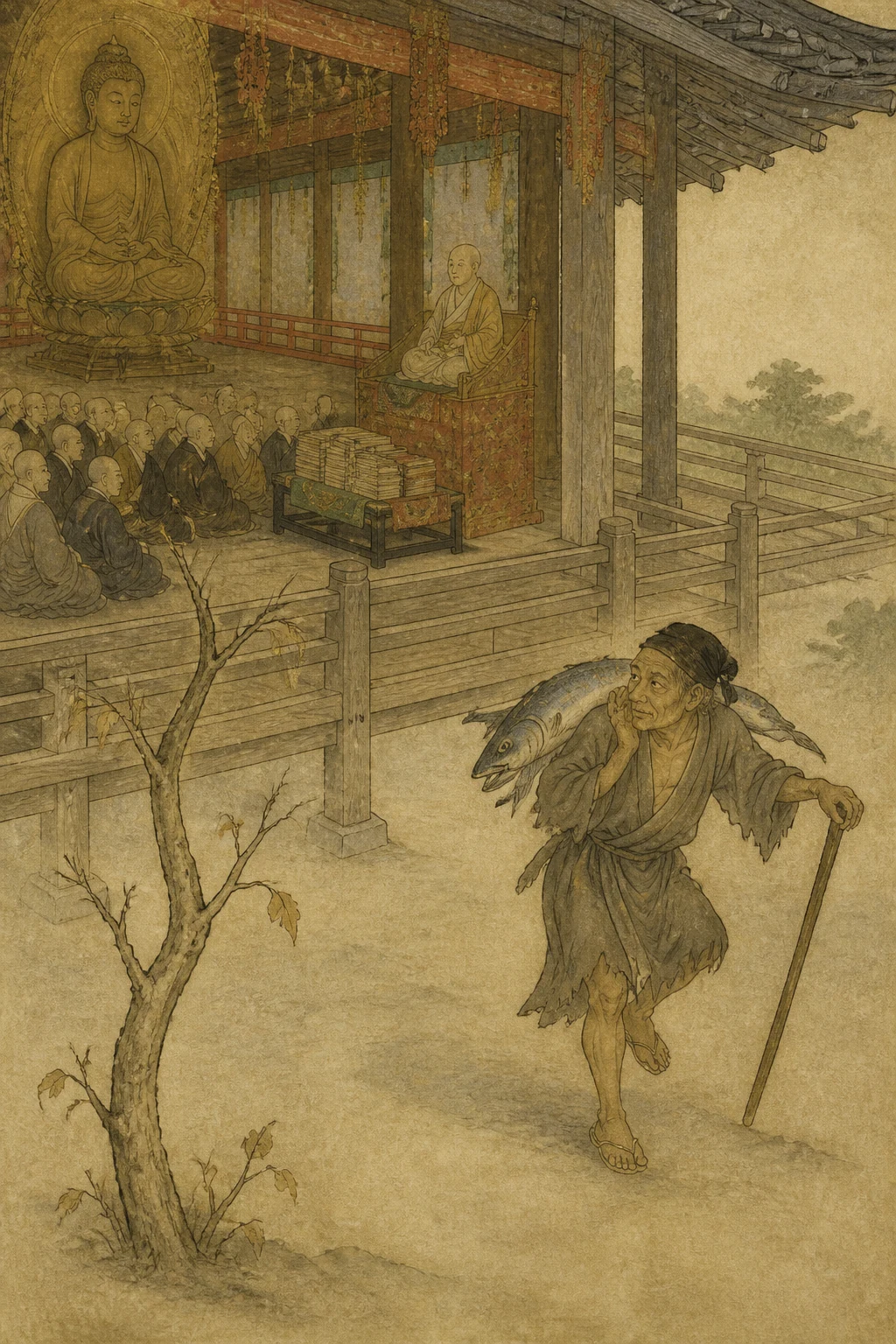
“Contemplate, O Kshatriyas, the attributes of the goddess. They will tell you how miracles are wrought!” The answer did not satisfy them, and they persisted. The great Majamí could beseech Durga to intervene miraculously: the goddess’s power was so infinite! Then the penitent rose with difficulty and, limping and tottering on his bony shins, searched beneath the statue’s pedestal and drew out a dead fish—or rather, a fish already dried, metallic in color, mummified like Majamí himself—a fish that looked as though it were made of tin and copper—and held it out to the Kshatriyas, who, unable to understand the meaning of so strange a gift, took it without a word.
“Durga commands you to feed upon this fish,” Majamí declared. “When you rest at midday on the mountain, roast it... and the fish will tell you how miracles are wrought.”
The three patriots of Kapala took their leave in considerable vexation, discussing the gift of the fish and agreeing that Durga, whether angry or indifferent, had no wish to help Kapala. Nevertheless, at their first halt beneath a grove of lemon and tamarind trees, they obediently lit a fire and laid the fish against the embers. And as it fell upon the glowing coals, the fish began to swell and fill out; its metallic scales grew supple; after a few moments its fins spread, its open mouth flushed red, its gills quivered, and—O miracle of Durga!—with a leap the fish sprang from the flames onto the grass, fresh, alive, and flapping.
“Durga bids us imitate this fish!” exclaimed the first Kshatriya. “I understand, my brothers. Let us come back to life!”