Prevod
It is also related that Abd Allah ibn Ma‘mar al-Qaysi said: One year I made the pilgrimage to the Sacred House of God. When I had completed its rites, I went to visit the tomb of the Prophet, peace and blessings be upon him. One night, as I sat in the Rawda, between the tomb and the pulpit, I heard a soft lament in a melodious voice. I listened closely and heard these words:
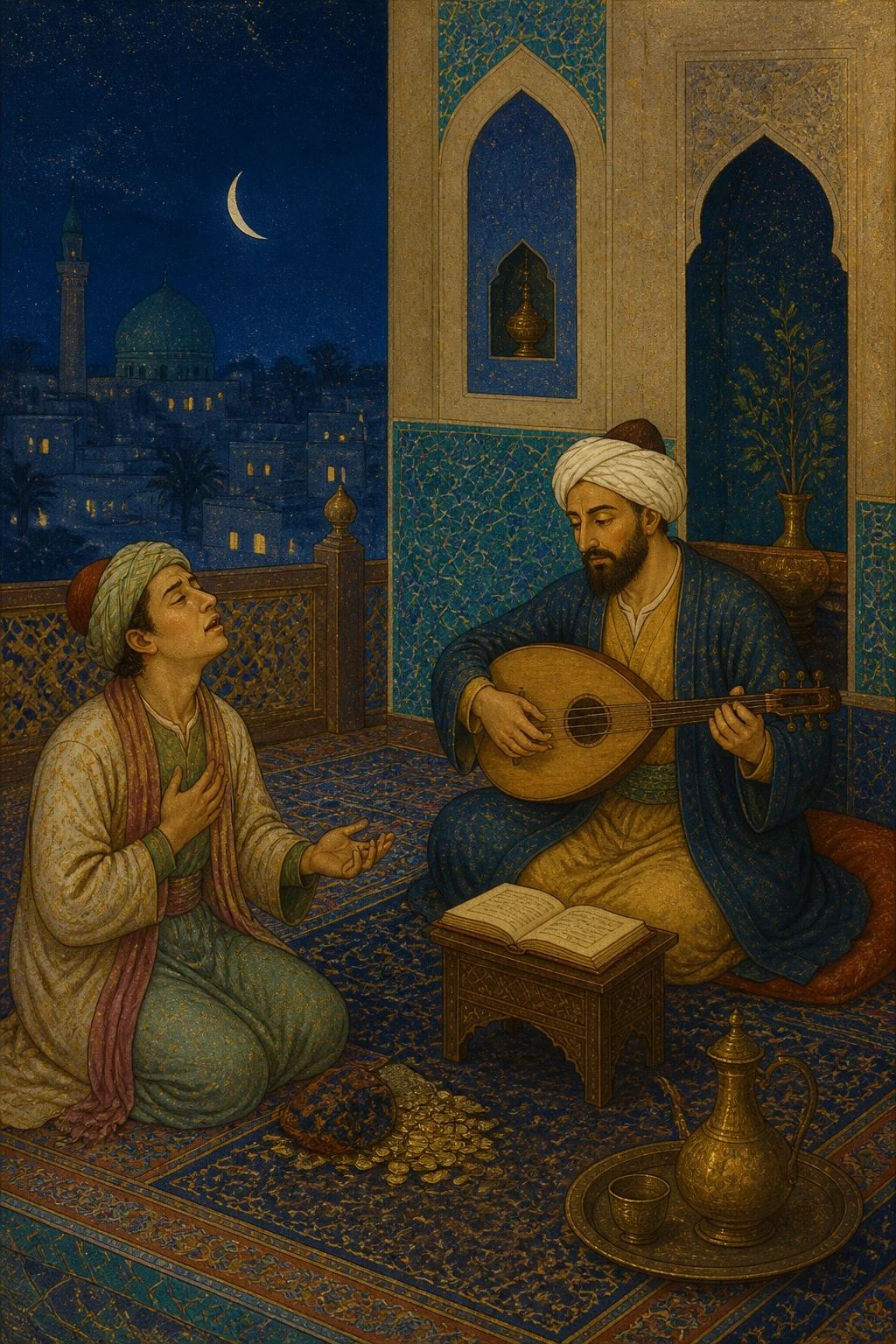
“Has the mourning of the doves in the lote trees saddened you, stirring the sorrows in your breast? Or has the memory of a lovely woman brought you grief and filled your mind with restless thoughts? O night, how long you linger over a lovesick man who bewails his passion and his failing patience! You keep awake one scorched by longing, burning like glowing coals. The full moon bears witness that I am love-stricken, enthralled by one as fair as the moon. I never thought myself a prey to love until it took me unawares.” Then his voice ceased, and I could not tell where it had come from. I remained bewildered until he began to lament again and recited:
“Has a visiting vision of Rayya grieved you, while night hangs dark and troubled, its tresses black? Love has returned to haunt your eyes with sleeplessness, and that visiting vision has stirred your heart. I called out to my night, while the darkness seemed a sea whose surging waves crashed together: ‘O night, how long you linger over a lover who has no friend or helper but the dawn!’ It answered me: ‘Do not complain of my length, for love itself is humiliation close at hand.’” He said: As soon as he began these verses, I rose and made my way toward the voice. Before he had finished, I had reached him. I saw a youth of surpassing beauty, whose beard had not yet begun to grow, and tears had worn two furrows down his cheeks. Then morning overtook Shahrazad, and she fell silent, leaving her tale untold.
When it was the six hundred and eighty-first night
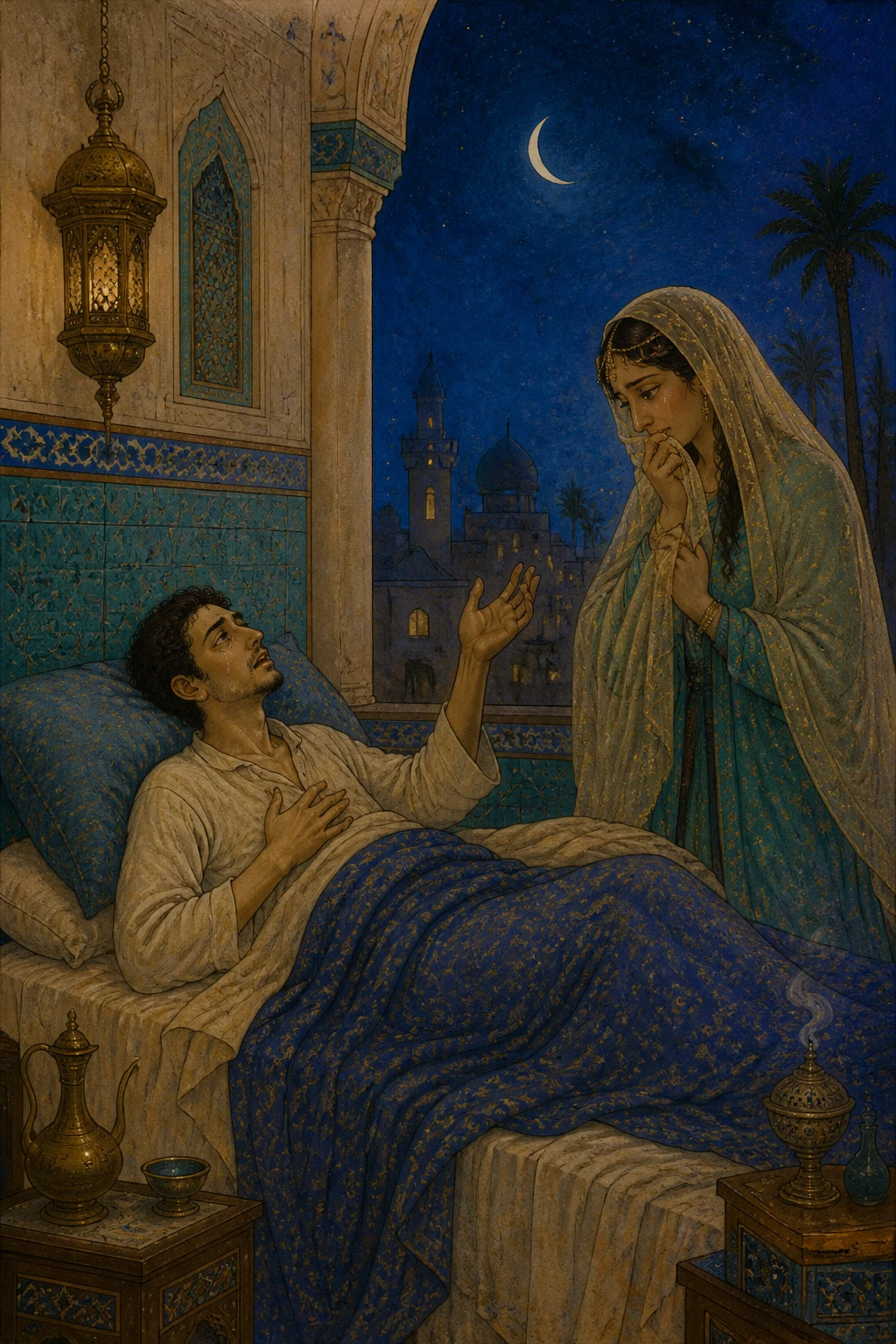
She said: It has reached me, O fortunate king, that Abd Allah ibn Ma‘mar al-Qaysi said: As soon as he began the verses, I rose and made my way toward the voice. Before he had finished, I had reached him. I saw a youth whose beard had not yet begun to grow, and tears had worn two furrows down his cheeks. I said to him, “May joy be yours, young man.” “And yours,” he replied. “Who are you?” I said, “Abd Allah ibn Ma‘mar al-Qaysi.” He asked, “Do you need something?” I said, “I was sitting in the Rawda, and nothing startled me tonight but your voice. May my life be your ransom: what is it that afflicts you?” “Sit down,” he said. So I sat, and he continued, “I am Utba ibn al-Jabban ibn al-Mundhir ibn al-Jamuh al-Ansari. I went to the Mosque of the Confederates and spent some time bowing and prostrating in prayer. Then I withdrew to worship alone. Suddenly, a company of women came swaying gracefully along, lovely as moons. Among them was a maiden of wondrous beauty and perfect charm. She stopped before me and said, ‘Utba, what would you say to union with one who seeks union with you?’ Then she left me and went away. Since then I have heard no news of her and found no trace of her, and here I am, wandering bewildered from place to place.” Then he gave a cry and fell face down upon the ground in a swoon. When he came to himself, the silken skin of his cheeks looked as though it had been dyed yellow with wars, and he began to recite these verses:
“I see you in my heart from distant lands; do you, so far away, see me within your hearts? My heart and eyes pine for you. My soul is with you, while your memory stays with me. Life will hold no sweetness until I see you, though I dwell in Paradise itself, in the Garden of Eternity.” I said to him, “Utba, my nephew, turn in repentance to your Lord and ask forgiveness for your sin, for the terrors of the Day of Judgment lie before you.” He replied, “Never! I shall not ask it until the two bark-gatherers return.” I stayed with him until dawn broke, then said, “Come, let us go to the mosque.” We sat there until we had offered the noon prayer, when the women approached, but the maiden was not among them. They said, “Utba, what do you think of the girl who seeks your love?” “What has happened to her?” he asked. They said, “Her father has taken her away to al-Samawa.” I asked them the maiden’s name, and they said, “Rayya, daughter of al-Ghitrif al-Sulami.” Utba lifted his head and recited these two verses:
“My two friends, Rayya has indeed departed at dawn, and her caravan has journeyed to the land of al-Samawa. My two friends, weeping has overcome me; has anyone a tear that I may borrow?” I said to him, “Utba, I have brought a great sum of money with which I mean to relieve worthy people in need. By God, I shall spend it on your behalf until you are satisfied, and more than satisfied. Come with me to the assembly of the Ansar.” We rose and went until we came upon their gathering. I greeted them, and they returned my greeting graciously. Then I said, “Gentlemen, what do you say of Utba and his father?” They replied, “They are among the noblest of the Arabs.” I said, “Know, then, that he has been stricken by the calamity of love, and I ask you to accompany us to al-Samawa and lend us your aid.” “We hear and obey,” they said. So we mounted, and they rode with us until we approached the encampment of the Banu Sulaym. Al-Ghitrif learned of our arrival and hurried out to meet us, saying, “Welcome, noble guests!” We replied, “And welcome to you! We have come as your guests.” He said, “You have come to a most generous home, where there is ample room for you.” He dismounted and called, “Slaves, dismount!” The slaves dismounted, leather mats and cushions were spread, and camels and sheep were slaughtered. But we said, “We shall not taste your food until you grant our request.” “What is your request?” he asked. We said, “We seek the hand of your noble daughter for Utba ibn al-Jabban ibn al-Mundhir, a man of lofty renown and pure lineage.” He replied, “My brothers, the woman whose hand you seek has the right to decide for herself. I shall go in and tell her.” Then he rose angrily and went in to Rayya. She said, “Father, why do I see anger so plainly written on your face?” He replied, “A company of the Ansar has come to ask me for your hand.” She said, “They are noble lords, for whom the Prophet, upon whom be the best of blessings and peace, prayed for forgiveness. On whose behalf do they ask?” He said, “A young man known as Utba ibn al-Jabban.” She said, “I have heard of this Utba: he keeps his promises and attains what he seeks.” Her father said, “I have sworn never to marry you to him, for some report of what passed between you has reached me.” She replied, “Nothing of the sort happened. But I have sworn that the Ansar shall not be rudely turned away, so give them a gracious answer.” “How?” he asked. She said, “Demand a heavy bride-price, and they will withdraw.” “An excellent suggestion!” he said. Then he hurried out and said, “The maiden of our tribe has consented, but she asks for a bride-price befitting her station. Who will undertake to pay it?” Abd Allah said: I replied, “I will.” He said, “I demand for her a thousand bracelets of red gold, five thousand dirhams minted in Hajar, a hundred robes of striped and figured cloth, and five skins filled with ambergris.” I said, “You shall have all that. Do you consent?” “I consent,” he replied.
Then Abd Allah sent a party of the Ansar to Medina the Radiant, and they brought back everything he had pledged. Camels and sheep were slaughtered, and the people gathered to feast. He said: We remained thus for forty days. Then her father said, “Take your bride.” We seated her in a howdah, and he furnished her with thirty camel-loads of precious gifts. He bade us farewell and turned back, while we journeyed on until we were one day’s march from Medina the Radiant. Then a band of horsemen rode out against us, intent on plunder; I believe they were of the Banu Sulaym. Utba ibn al-Jabban charged them and killed several men, then wheeled away with a spear wound and fell to the ground. The people of that district came to our aid and drove the horsemen away, but Utba had breathed his last. We cried, “Alas for Utba!” When the maiden heard this, she flung herself down from the camel and cast herself upon him, crying out in anguish and reciting these verses:
“I have borne this—not because I have patience, but only because I comfort myself that I shall soon follow you. Had my soul dealt fairly, it would have gone before you into death, ahead of all mankind. After you and me, no lover will do justice to a beloved, nor will one soul be so true to another.” Then she gave a single gasp and died. We dug one grave for them both and laid them together in the earth. I returned to my people’s homeland and remained there seven years. Then I went back to the Hijaz and entered Medina the Radiant to visit the Prophet’s tomb. I said, “By God, I shall visit Utba’s grave again.” When I came to it, I found a tall tree growing over it, hung with strips of red, yellow, and green cloth. I asked the people who lived there, “What is this tree called?” They said, “The Tree of the Bride and Bridegroom.” I stayed by the grave for a day and a night, then departed. That was the last I saw of him. May God Most High have mercy upon him.