Prevod
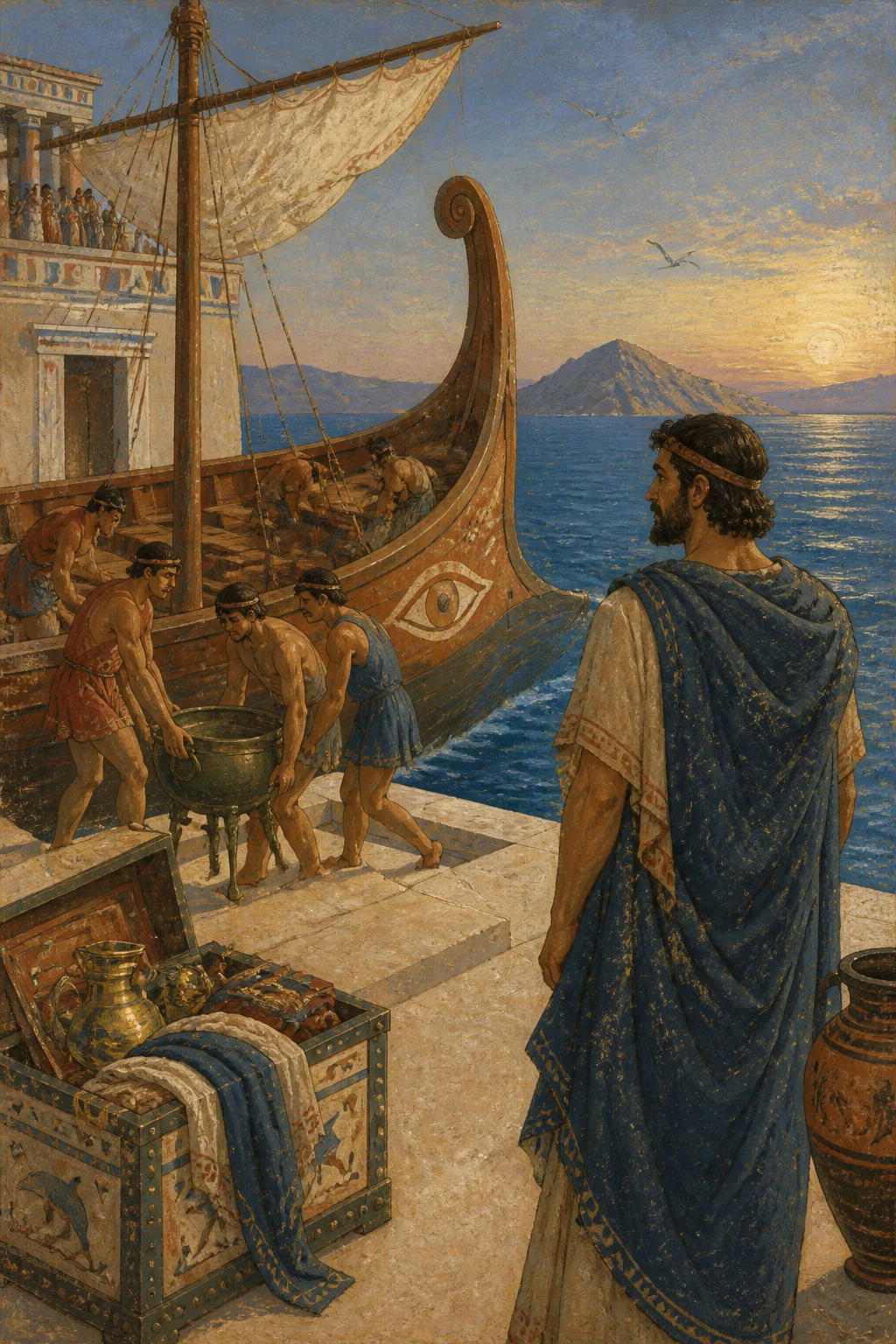
The third calender stepped forward and said, “Noble lady, my story is unlike those of my two companions; indeed, it is stranger still. For fate and destiny came upon them, whereas I brought destiny upon myself and sorrow upon my own heart, and so lost my eye and shaved my beard. I was a king and the son of a king. When my father died, I inherited his kingdom, ruled justly, and treated my subjects well. I loved voyaging at sea, and my city stood upon the coast. The sea stretched far and wide, and around us lay islands fortified for war. Wishing to visit these islands, I set out with ten ships, taking provisions for a full month. We sailed for twenty days. Then one night contrary winds assailed us until the first light of dawn, when the wind dropped and the sea grew calm, and at last the sun rose.
“We then came in sight of an island, went ashore, and cooked ourselves something to eat. After eating, we stayed there for two days, then sailed for another twenty. But the currents bewildered both us and the captain, and he no longer recognized the sea we were in. We told the lookout, ‘Examine the sea carefully.’ He climbed the mast, then came down and said to the captain, ‘Captain, to my right I saw fish on the surface of the water, and when I looked out into the open sea I saw a dark shape in the distance, appearing now black, now white.’ When the captain heard the lookout’s words, he dashed his turban to the deck and tore at his beard, crying, ‘Rejoice in the news that we are all doomed! Not one of us will escape!’ He began to weep, and we all wept for ourselves as well. I said, ‘Captain, tell us what the lookout has seen.’ He replied, ‘My lord, you must know that we lost our way on the day those contrary winds struck us, and the wind did not subside until morning. Then we stayed for two days and went astray at sea. We have now been wandering for eleven days since that night, with no wind to carry us back toward our destination by the end of the day. Tomorrow we shall reach a mountain of black stone called lodestone, and the currents are dragging us toward it against our will. The ships will be torn apart, and every nail in them will fly to the mountain and cling to it, for God has placed a secret virtue in lodestone that draws all iron to itself. There is so much iron on that mountain that only Almighty God knows its measure, for since ancient times countless ships have been wrecked because of it. Overlooking that sea is a brass dome supported on ten pillars. Above the dome stands a horseman on a brass horse, with a brass spear in his hand. Hanging upon his breast is a lead tablet engraved with names and talismans. O King, so long as that horseman remains mounted on his horse, the ships that pass beneath him will be shattered, all aboard them will perish, and every piece of iron in them will cling to the mountain. There can be no deliverance until the horseman falls from his horse.’
“Then, my lady, the captain wept bitterly, and we knew beyond doubt that we were doomed. Each of us bade his companion farewell. When morning came, we drew near the mountain, and the currents drove us helplessly toward it. As the ships passed beneath it, their timbers sprang apart, and the nails and every piece of iron in them flew toward the lodestone. By the end of the day we were circling the mountain, and the ships broke to pieces. Some of us drowned and some survived, but most were drowned. Those who escaped knew nothing of one another’s fate, so bewildered were they by the waves and the contrary winds. As for me, my lady, Almighty God saved me for the hardship, suffering, and trials He had ordained for me. I clambered onto a plank, and the wind and waves cast it against a mountain. There I found a path leading upward, like steps hewn into the rock, and I invoked the name of Almighty God.” And dawn overtook Shahrazad, and she fell silent, leaving her tale untold.
When the fifteenth night came
She said, “It has reached me, O fortunate King, that the third calender said to the young woman, while the company sat with their hands bound behind them and the slaves stood over their heads with drawn swords: ‘Then I invoked God’s name, prayed to Him, and implored His aid. I tried to climb the mountain, clinging to the hollows cut into it, until God stilled the wind at that very moment and helped me ascend. I reached the mountaintop safely and rejoiced beyond measure at my deliverance. My sole concern was to reach the dome. I entered it and offered two rak‘ahs in thanksgiving to God for my safety. Then I lay down beneath the dome and slept, and I heard a voice saying, “Son of Khasib, when you wake from sleep, dig beneath your feet and you will find a brass bow and three lead arrows engraved with talismans. Take the bow and arrows, shoot the horseman above the dome, and deliver mankind from this great affliction. When you shoot him, the horseman will fall into the sea, and the bow will fall. Take the bow from your hand and bury it where you found it. When you have done this, the sea will swell and rise until it reaches the height of the mountain. A boat will appear upon it, bearing a figure other than the one you shot down. He will come to you with an oar in his hand. Board the boat with him, but do not invoke the name of Almighty God. He will carry you away and travel with you for ten days, until he brings you to the Sea of Safety. Once there, you will find someone to take you to your own country. But all this will come to pass only if you do not invoke God’s name.”
“‘Then I awoke, rose briskly, and made for the water as the unseen voice had directed. I shot at the horseman and struck him, and he fell into the sea. The bow fell from my hand, so I picked it up and buried it. The sea surged and rose until it reached the height of the mountain on which I stood. Before an hour had passed, I saw a boat making toward me across the sea, and I praised Almighty God. When the boat reached me, I found in it a figure of brass, with a lead tablet upon his breast engraved with names and talismans. I climbed into the boat and sat silent, without speaking. The figure carried me through the first day, the second, and the third, until ten full days had passed and I saw the Islands of Safety. I rejoiced exceedingly, and in the fullness of my joy I remembered God, invoked His name, and proclaimed His oneness and His greatness. As soon as I did so, the figure flung me out of the boat into the sea, then returned into the sea himself. I knew how to swim, and I swam all that day until nightfall, when my arms grew weary, my shoulders ached, and I was close to perishing. I recited the profession of faith, certain that I was about to die. The sea raged under the force of the winds, and a wave like a mighty fortress came upon me, lifted me up, and hurled me onto dry land, as God willed. I climbed ashore, wrung out my clothes, spread them on the ground to dry, and passed the night there. In the morning I dressed and rose to see which way I should go. I found a grove and went toward it, then walked around it and discovered that I was on a small island, surrounded by the sea. I said to myself, “Whenever I escape one calamity, I fall into a greater one!”
“‘While I was pondering my plight and wishing for death, I caught sight of a ship with people aboard. I rose and climbed a tree. The ship drew alongside the shore, and ten slaves disembarked, carrying spades. They walked to the middle of the island, dug into the earth, and uncovered a trapdoor. They lifted its cover and opened the entrance, then returned to the ship and brought from it bread, flour, clarified butter, honey, sheep, and everything a person might need to live. The slaves went back and forth between the ship and the trapdoor, carrying things from the vessel and taking them below, until they had unloaded everything aboard. Then the slaves came ashore with clothes of the finest kind. In their midst was a very old man, who had lived many years and whom time had so weakened that he was all but spent. His hand rested in that of a youth cast in the mould of beauty and clothed in the perfect raiment of loveliness, so handsome that his beauty might serve as a proverb. He was like a tender bough, enchanting every heart with his grace and stealing every mind with his perfection. They walked on, my lady, until they reached the trapdoor, descended through it, and vanished from my sight.
“‘When they had gone, I climbed down from the tree and walked to the place where the earth had been heaped. I dug it up and carried it away, patiently persevering until I had removed it all and uncovered the trapdoor. It was made of wood and was the size of a millstone. I lifted it and saw beneath it a vaulted stone stairway. Marvelling at this, I descended to the bottom, where I found a clean and pleasant place. I came upon a garden, then a second, then a third, until I had counted thirty-nine. In every garden I saw trees, streams, fruits, and treasures beyond description. Then I saw a door and said to myself, “What can be in this place? I must open it and see what lies within.” I opened it and found a horse, saddled and bridled, standing tethered there. I untied it and mounted, whereupon it flew away with me until it set me down on a rooftop and threw me off. It struck me with its tail, destroying my eye, and fled. I went down from the roof and found ten one-eyed young men. When they saw me, they said, “You are not welcome here!” I asked, “Will you let me stay with you?” They replied, “By God, you shall not stay with us!” So I left them, grieving at heart and weeping from my remaining eye. God granted me safe passage until I reached Baghdad, where I shaved my beard and became a calender. There I met these two one-eyed men, greeted them, and said, “I am a stranger here.” They replied, “We too are strangers.” Such is the reason for the loss of my eye and the shaving of my beard.’ She said to him, ‘Stroke your head and go your way.’ But he replied, ‘By God, I shall not leave until I have heard these men’s story.’
“Then the young woman turned to the Caliph, Ja‘far, and Masrur, and said, ‘Tell me your story.’ Ja‘far stepped forward and repeated the tale he had told the doorkeeper when they entered. After hearing him, she said, ‘For one another’s sake, I spare you all.’ They went out into the alley, and the Caliph said to the calenders, ‘My friends, where will you go?’ They replied, ‘We do not know where to go.’ The Caliph said, ‘Come and spend the night with us.’ Then he told Ja‘far, ‘Take them with you and bring them before me tomorrow, so that we may see what is to be done.’ Ja‘far obeyed the Caliph’s command. The Caliph returned to his palace, but no sleep came to him that night. In the morning he sat upon the royal throne, and the officers of state came before him. After they had withdrawn, he turned to Ja‘far and said, ‘Bring me the three young women, the two bitches, and the calenders.’ Ja‘far rose and brought them into his presence. He ushered the young women behind the curtains, then turned to them and said, ‘We have pardoned you because of the kindness you showed us before, when you did not know who we were. Now I shall make it known to you: you stand before the fifth of the Abbasid line, Harun al-Rashid. Tell him nothing but the truth.’ When the young women heard Ja‘far speaking on behalf of the Commander of the Faithful, the eldest stepped forward and said, ‘Commander of the Faithful, mine is a tale which, were it written with needles upon the inner corners of the eyes, would be a lesson to all who would take heed.’” And dawn overtook Shahrazad, and she fell silent, leaving her tale untold.