Prevod
I have also heard that there was once a merchant named Omar, who had three sons: the eldest was called Salim, the youngest Judar, and the middle son Sulaym. He brought them up until they were grown men, but he loved Judar more than his two brothers. When they discovered this, jealousy seized them and they came to hate Judar. Their father saw their hatred for their brother, and, being an old man, feared that when he died Judar would suffer at their hands. So he summoned a number of his relatives, together with men appointed by the judge to divide estates and a company of learned men, and said, “Bring me my money and my cloth.” They brought him all his money and cloth, and he said, “My friends, divide this money and cloth into four portions, according to the sacred law.” They did so, and he gave each son a portion, keeping one for himself. Then he said, “This is my wealth, and I have divided it among them. They have no further claim upon me or upon one another. When I die, there will be no dispute among them, for I have divided their inheritance in my lifetime. As for the portion I have kept, it shall belong to my wife, the mother of these boys, to help provide for her livelihood.” And dawn overtook Shahrazad, and she fell silent, leaving her tale untold.
When it was the six hundred and seventh night,
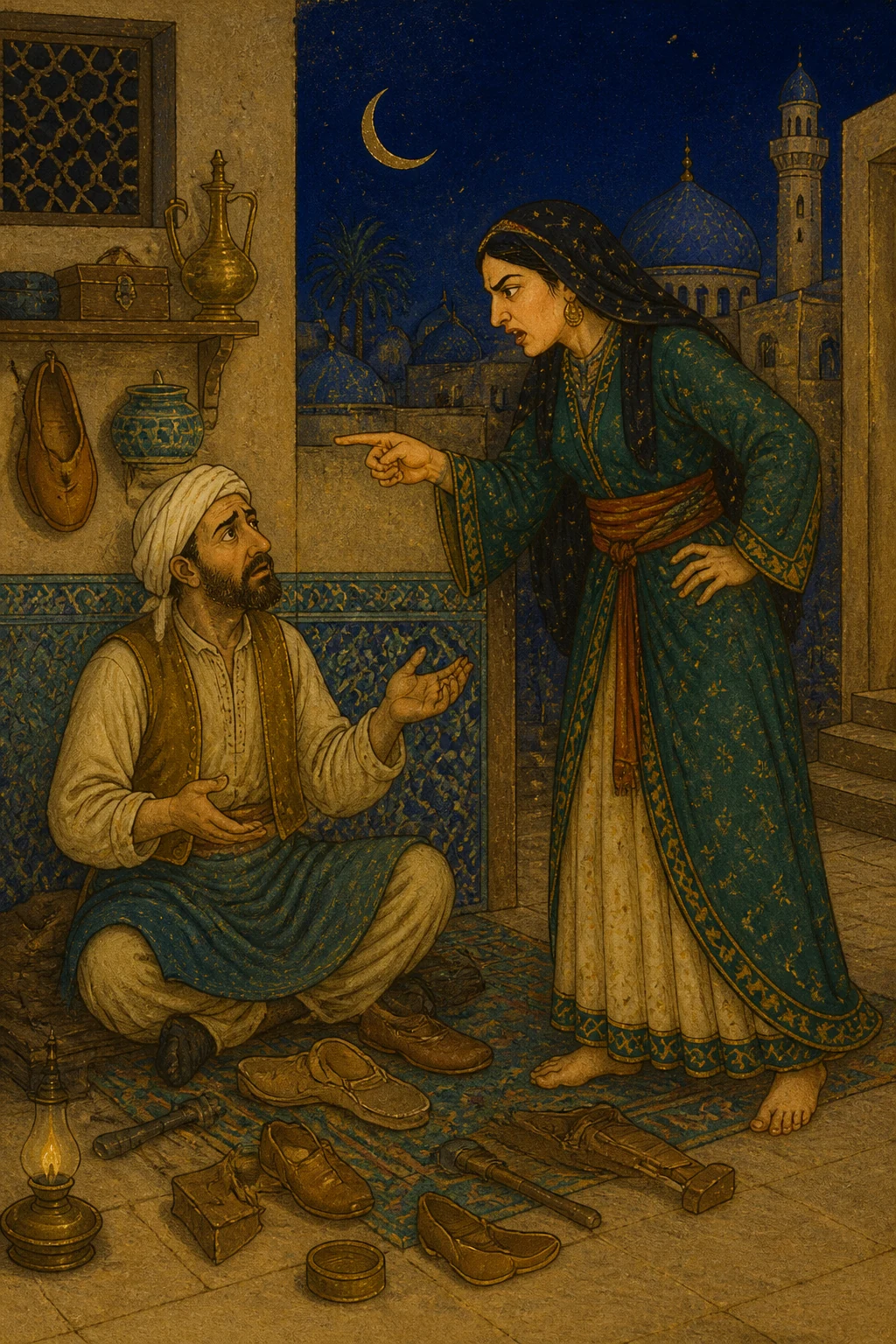
She said: It has reached me, O fortunate King, that when the merchant had divided his money and cloth into four portions, he gave each of his three sons a portion and kept the fourth himself, saying, “This portion shall belong to my wife, the mother of these boys, to help provide for their livelihood.” A little while afterward their father died, but neither of the older sons was content with what their father Omar had done. They demanded more from Judar, saying, “Our father’s money is in your hands.” He went with them before the magistrates, and the Muslims who had witnessed the division came and testified to what they knew. The magistrate forbade the brothers to molest one another, but Judar lost some of his money, and his brothers likewise, through the dispute. They left him alone for a time, then plotted against him again. Once more he went with them before the magistrates, and once more they lost a considerable sum through the courts. They kept seeking to harm him, taking him from one unjust official to another, while both they and he lost money, until they had fed all their wealth to these oppressors and all three were reduced to poverty. Then his two brothers went to their mother, deceived her, took her money, beat her, and drove her away. She came to her son Judar and said, “Your brothers have done such and such to me, and taken my money.” She began calling down curses upon them, but Judar said to her, “Mother, do not curse them. God will requite each according to his deeds. But I am poor now, Mother, and my brothers are poor, and lawsuits cost money. I have disputed with them many times before the magistrates, and it has done us no good. We have only lost everything our father left us and dragged people into the indignity of giving evidence. Am I now to quarrel with them over you, and take them before the magistrates? That shall never be. You will stay here with me, and the loaf I would eat I shall give to you. Pray for me, and God will provide for me through your blessing. Leave them to receive from God the reward of their deeds, and take comfort in the poet’s words:
If some ignorant man oppresses you, leave him be, And wait for time to avenge the wrong. Shun oppression and its grievous end: Were mountain to oppress mountain, the oppressor would be crushed. He went on soothing his mother until she was content, and she stayed with him. He got himself a net and began going to the river, the ponds, and every place where there was water, trying a different spot each day. One day he would earn ten, another twenty, another thirty, and he spent his earnings on his mother, so that he ate well and drank well. His brothers, meanwhile, had neither trade nor business, buying nothing and selling nothing. Ruin, desolation, and calamity descended upon them. They squandered what they had taken from their mother and became penniless wretches, without even clothes to cover them. Sometimes they would come to their mother, making a great show of humility and complaining of hunger. A mother’s heart is tender, so she would give them stale bread, and if there was any stew left from the day before, she would say, “Eat it quickly and go before your brother comes. He could not bear this, and his heart would harden against me. You will disgrace me before him.” They would eat in haste and leave. One day they came to their mother, and she set stew and bread before them. They were eating when their brother Judar came in. Their mother was ashamed and embarrassed, and, fearing he would be angry with her, lowered her head and looked at the ground. But he smiled at them and said, “Welcome, my brothers! A blessed day! What has happened to bring you to visit me on this blessed day?” He embraced them affectionately and said, “I never expected you to leave me so lonely, never coming to see me or even looking in on me and your mother!” They replied, “By God, brother, we have missed you. Nothing kept us away but shame for what passed between us. We have deeply regretted it. It was the work of Satan, may Almighty God curse him! We have no blessing but you and our mother.” And dawn overtook Shahrazad, and she fell silent, leaving her tale untold.
When it was the six hundred and eighth night,
She said: It has reached me, O fortunate King, that when Judar entered his house and saw his brothers, he welcomed them and said, “I have no blessing but you two.” His mother said, “My son, may God brighten your face and increase your bounty! You are the more generous, my son.” He said, “Welcome to you both. Stay with me. God is bountiful, and I have plenty.” He made peace with them, and they supped with him and stayed the night. Next morning they ate breakfast, and Judar took his net and went to Bab al-Futuh. His brothers went out too, returning at noon, when their mother served them lunch. In the evening their brother came home with meat and vegetables. They lived like this for a month: Judar caught fish, sold them, and spent the proceeds on his mother and brothers, while the two of them ate and made merry. Then one day Judar took his net to the river, cast it, and drew it up empty. He cast it a second time, and again it came up empty. “There are no fish in this spot,” he said to himself. He moved elsewhere and cast his net, but it came up empty. He went to another place, and kept moving from morning until evening without catching so much as a minnow. “How strange!” he said. “Have all the fish vanished from the river? What can be the matter?” He shouldered his net and went home dejected and distressed, worried about his brothers and mother, for he did not know what he could give them for supper. He came to a bakery and saw a crowd clamoring for bread, money in their hands, while the baker paid them no heed. Judar stopped and sighed. “Welcome, Judar,” the baker said. “Do you need bread?” He remained silent. “If you have no money,” the baker continued, “take what you need. You can pay me later.” “Give me ten half-dirhams’ worth of bread,” said Judar. “Take these ten half-dirhams as well,” the baker replied, “and tomorrow bring me twenty’s worth of fish.” “With pleasure,” said Judar. He took the bread and the ten half-dirhams, bought meat and vegetables with the money, and said, “Tomorrow the Lord will bring relief.” He went home, his mother cooked the food, and he ate supper and slept. Next morning he took his net, and his mother said, “Sit down and have breakfast.” “You and my brothers eat,” he replied. He went to the river and cast his net once, twice, and three times, moving from place to place. He continued until the afternoon without catching anything, then shouldered his net and walked away in distress. His way home necessarily took him past the baker’s shop. When the baker saw him, he counted out bread and money for him and said, “Come, take these and go. If it has not come today, it will come tomorrow.” Judar tried to excuse himself, but the baker said, “Go on, there is no need for excuses. If you had caught anything, you would have it with you. When I saw you empty-handed, I knew you had caught nothing. If you catch nothing tomorrow either, come and take bread without embarrassment. You may pay me when you can.”
On the third day he went from pond to pond until the afternoon, but found nothing in them. He went to the baker and took bread and money from him. This went on for seven days, until at last he grew desperate and said to himself, “Today I shall go to Qarun’s Pool.” He was about to cast his net when suddenly a Maghribi came toward him riding a mule. He wore a magnificent robe, and on the mule’s back was an embroidered saddlebag; indeed, all its trappings were embroidered. The man dismounted and said, “Peace be upon you, Judar son of Omar.” “And upon you be peace, my lord pilgrim,” Judar replied. The Maghribi said, “Judar, I have a favor to ask of you. If you do as I say, great good will come to you. You shall become my companion and help me accomplish my purposes.” Judar replied, “My lord pilgrim, tell me what you wish. I shall obey you without objection.” “Recite the Opening Chapter of the Quran,” said the Maghribi. Judar recited it with him, and afterward the man brought out a silken cord and said, “Bind my arms behind my back, tie them very tightly, and throw me into the pool. Wait a little while. If you see me raise my hands above the water before I appear, cast your net over me and pull me out quickly. But if you see my feet come up, know that I am dead. Leave me, take the mule and saddlebag, and go to the merchants’ market. There you will find a Jew named Shami‘a. Give him the mule, and he will give you a hundred dinars. Take them, keep the secret, and go your way.” Judar bound his arms tightly, while the man kept saying, “Tighten the bonds.” Then he said, “Push me into the pool.” Judar pushed him in, and he sank beneath the water. He stood waiting for a while, and presently the Maghribi’s feet appeared. Knowing that he was dead, Judar left him, took the mule, and went to the merchants’ market. There he saw the Jew seated on a chair at the door of his warehouse. When the Jew saw the mule, he said, “The man has perished.” Then he added, “Nothing but greed destroyed him.” He took the mule from Judar and gave him a hundred dinars, charging him to keep the secret. Judar took the money and went to the baker, where he took the bread he needed and said, “Here, take this dinar.” The baker took it, reckoned what he was owed, and said, “You still have two days’ bread to your credit.” And dawn overtook Shahrazad, and she fell silent, leaving her tale untold.
When it was the six hundred and ninth night,
She said: It has reached me, O fortunate King, that when the baker had settled Judar’s account for the bread and told him, “You still have two days’ bread to your credit from this dinar,” Judar left him and went to the butcher. He gave him another dinar, took some meat, and said, “Keep the rest of the dinar on account.” Then he bought vegetables and went home, where he found his brothers asking their mother for something to eat, while she told them, “Wait until your brother comes. I have nothing.” He entered and said, “Here, eat.” They fell upon the bread like ghouls. Then Judar gave his mother the rest of the gold and said, “Take this, Mother. When my brothers come, give them money to buy food and eat while I am away.” He spent the night at home, and in the morning took his net and went to Qarun’s Pool. He stood there about to cast his net when another Maghribi approached on a mule, more splendidly equipped than the man who had died. He had a saddlebag with two caskets, one in either pouch. “Peace be upon you, Judar,” he said. “And upon you be peace, my lord pilgrim,” Judar replied. “Did a Maghribi come to you yesterday riding a mule like this one?” the man asked. Judar grew afraid and denied it, saying, “I saw no one.” He feared the man would ask, “Where did he go?” If he said he had drowned in the pool, the stranger might accuse him of drowning him, so he could do nothing but deny it. The man said, “Poor fellow, he was my brother, and he came before me.” “I know nothing about it,” Judar replied. “Did you not bind him and throw him into the pool?” the man asked. “And did he not tell you, ‘If my hands appear, cast your net over me and pull me out quickly; but if my feet appear, I shall be dead. Take the mule to Shami‘a the Jew, and he will give you a hundred dinars’? His feet appeared, and you took the mule to the Jew, who gave you a hundred dinars, did he not?” “Since you know all this,” said Judar, “why ask me?” “I want you to do to me as you did to my brother,” he replied. He brought out a silken cord and said, “Bind me and throw me in. If the same thing happens to me as happened to my brother, take the mule to the Jew and collect a hundred dinars from him.” “Come forward,” Judar said. The man came forward, and Judar bound him and pushed him into the pool, where he sank. Judar waited a while, and then his feet appeared. “He has gone to perdition, God willing,” he said. “Every day these Maghribis come to me, and I bind them and they die. A hundred dinars for every dead man is enough for me.” He took the mule away, and when the Jew saw him, he said, “The other one is dead.” “May your own life be spared,” Judar replied. “Such is the reward of the greedy,” said the Jew. He took the mule and gave Judar a hundred dinars. Judar carried them home to his mother and handed them to her. “My son,” she asked, “where did you get this?” He told her, and she said, “Do not go to Qarun’s Pool again. I am afraid of these Maghribis.” “Mother,” he replied, “I only throw them in with their consent. What else am I to do? Here is a trade that brings us a hundred dinars every day, and I come home quickly. By God, I shall not stop going to Qarun’s Pool until not a trace of these Maghribis remains, and there is not one of them left.”
On the third day he went and stood by the pool, and there came a Maghribi riding a mule with a saddlebag, more splendidly equipped than either of the first two. “Peace be upon you, Judar son of Omar,” he said. “How is it that they all know me?” Judar wondered. He returned the greeting, and the man asked, “Have any Maghribis passed this way?” “Two,” he replied. “Where did they go?” “I bound them and threw them into this pool, and they drowned. Your turn will come next.” The man laughed and said, “Poor fellow, every living creature has its appointed hour.” He dismounted and said, “Judar, do to me as you did to them.” He brought out the silken cord, and Judar said, “Put your hands behind you so that I may bind you. I am in a hurry, and time is slipping away.” The man put his hands behind his back, and Judar bound him and pushed him into the pool. He stood waiting, and presently the Maghribi raised his hands and said, “Cast the net, poor fellow!” Judar cast the net over him and pulled him out. He was clutching two fish as red as coral, one in either hand. “Open the two caskets,” he said. Judar opened them, and the man put a fish in each and closed their lids. Then he embraced Judar and kissed him on both cheeks, saying, “May God deliver you from every hardship! By God, if you had not cast your net over me and drawn me out, I should have remained underwater, holding these two fish until I died, unable to come up.” Judar said, “My lord pilgrim, I beg you by God to tell me about those two who drowned before you, the true nature of these two fish, and the matter of the Jew.” And dawn overtook Shahrazad, and she fell silent, leaving her tale untold.
When it was the six hundred and tenth night,
She said: It has reached me, O fortunate King, that when Judar questioned the Maghribi, saying, “Tell me about those two who drowned before you,” he replied, “Judar, know that those two were my brothers. One was named Abd al-Salam and the other Abd al-Ahad. My own name is Abd al-Samad. The Jew is our brother, Abd al-Rahim. He is not a Jew at all, but a Muslim of the Maliki school. Our father taught us to decipher mysteries, open hidden treasures, and practice magic. We worked at these arts until mighty jinn and ifrits became our servants. We are four brothers, and our father’s name was Abd al-Wadud. When he died, he left us a great deal. We divided the precious possessions, the money, and the enchanted treasures, until we came to the books. These too we divided, but we quarreled over a book called Tales of the Ancients. It has no equal, no one can set a price upon it, and no jewels could match its worth, for it describes every hidden treasure and the means of deciphering its mysteries. Our father used to work from it, and we had learned a little of it by heart. Each of us wanted to possess it so that he could discover all it contained. While we were disputing, our father’s master, who had brought him up and taught him magic and divination, came into our gathering. His name was al-Kahin al-Abtan. ‘Bring me the book,’ he said. We gave it to him, and he said, ‘You are the sons of my son, and I cannot wrong any one of you. Whoever wishes to take this book must attempt to open the treasure of al-Shamardal and bring me the celestial sphere, the kohl vessel, the ring, and the sword. The ring has a mighty spirit in its service named Roaring Thunder. Neither king nor sultan can prevail against whoever possesses it. Should he wish to rule the earth in all its length and breadth, he could do so. As for the sword, if it is drawn against an army and its bearer brandishes it, that army will be routed. If, as he brandishes it, he says, “Slay this army,” a flash of fire will issue from the sword and kill the entire host. As for the celestial sphere, whoever possesses it may, if he wishes, behold all the lands from east to west, looking upon them while seated where he is. Whichever region he desires to see, he need only turn the sphere toward it and look into it, and he will behold that region and its people as though they were all before him. If he is angered with a city, he may turn the sphere toward the sun’s disk and will that city to burn, and it will burn. As for the kohl vessel, whoever anoints his eyes with its kohl will see the treasures of the earth. But I lay one condition upon you: whoever fails to open this treasure shall have no claim to the book. Whoever opens it and brings me these four precious objects shall be entitled to take the book.
“We accepted the condition, and he said, ‘My sons, know that the treasure of al-Shamardal is under the power of the sons of the Red King. Your father told me that he had tried to open it and failed. The sons of the Red King fled from him to a pool in the land of Egypt called Qarun’s Pool, and there they held out against him. He followed them to Egypt but could not overcome them, for they had slipped into that pool, which is protected by enchantments.’” And dawn overtook Shahrazad, and she fell silent, leaving her tale untold.
When it was the six hundred and eleventh night,
She said: It has reached me, O fortunate King, that after al-Kahin al-Abtan had told the sons this, he continued, “‘Your father returned defeated, unable to wrest the treasure of al-Shamardal from the sons of the Red King. When he could not overcome them, he came to me and complained. I cast a horoscope for him and saw that this treasure could be opened only through a young man of Egypt named Judar son of Omar, who would be the means of capturing the sons of the Red King. That young man would be a fisherman, and you would meet him at Qarun’s Pool. The enchantment cannot be broken unless Judar binds the man destined for this task and throws him into the pool, where he will fight the sons of the Red King. Whoever is destined to succeed will capture them; whoever is not will perish, and his feet will appear above the water. The survivor’s hands will appear, and Judar must then cast his net over him and draw him from the pool.’ My brothers said, ‘We shall go, even if we perish,’ and I said I would go too. But our brother who is dressed as a Jew said, ‘I have no desire to try.’ So we agreed that he should go to Egypt in the guise of a Jewish merchant. If any of us died in the pool, he was to receive the mule and saddlebag from you and give you a hundred dinars. When the first man came to you, the sons of the Red King killed him, and they killed my second brother too. But they could not overcome me, and I captured them.” Judar asked, “Where are those you captured?” “Did you not see me shut them in the two caskets?” he replied. “Those are fish,” Judar said. “They are not fish,” the Maghribi told him, “but ifrits in the shape of fish. Yet know, Judar, that the treasure can be opened only through you. Will you consent to come with me to the city of Fez and Meknes, so that we may open the treasure? I shall give you whatever you ask. You have become my brother under God’s covenant, and you will return to your family with a happy heart.” “My lord pilgrim,” Judar said, “I have my mother and two brothers to support.” And dawn overtook Shahrazad, and she fell silent, leaving her tale untold.
When it was the six hundred and twelfth night,
She said: It has reached me, O fortunate King, that Judar said to the Maghribi, “I have my mother and two brothers to support. I am the one who provides for them. If I go with you, who will give them bread?” “That is a poor excuse,” he replied. “If it is a matter of expenses, we shall give you a thousand dinars to leave with your mother, so that she may spend them until you return home. Your absence will last less than four months.” When Judar heard of the thousand dinars, he said, “Give me the thousand dinars, pilgrim, and I shall leave them with my mother and go with you.” The man brought out the thousand dinars, and Judar took them home to his mother. He told her what had passed between him and the Maghribi and said, “Take these thousand dinars and spend them on yourself and my brothers. I am traveling west with the Maghribi and shall be away four months. Much good will come to me, so pray for me, Mother.” “My son,” she said, “I shall miss you, and I fear for you.” “Mother,” he replied, “no harm can come to one whom God protects, and the Maghribi is a good man.” He went on praising him until she said, “May God incline his heart toward you. Go with him, my son. Perhaps he will give you something.” Judar bade his mother farewell and went away. When he reached the Maghribi, Abd al-Samad asked, “Have you consulted your mother?” “Yes,” he replied, “and she prayed for me.” “Mount behind me,” said the Maghribi. Judar mounted the mule, and they traveled from noon until the afternoon. Judar grew hungry, but saw nothing to eat among the Maghribi’s belongings. “My lord pilgrim,” he said, “perhaps you forgot to bring us something to eat on the road?” “Are you hungry?” the man asked. “Yes,” he replied. The Maghribi dismounted, and Judar did likewise. “Take down the saddlebag,” he said. Judar took it down, and the man asked, “What would you like, my brother?” “Anything at all.” “I beg you by God, tell me what you would like.” “Bread and cheese,” Judar said. “Poor fellow, bread and cheese are not worthy of you. Ask for something fine.” “Just now,” Judar replied, “anything would taste fine to me.” “Would you like roast chicken?” “Yes.” “Would you like rice with honey?” “Yes.” “Would you like this dish, and that dish?” He went on until he had named twenty-four kinds of food. Judar thought to himself, “Is he mad? Where will he get all these dishes he has named? He has neither kitchen nor cook. I had better tell him that is enough.” So he said, “Enough! Are you only whetting my appetite with dishes I shall never see?” “You are most welcome, Judar,” said the Maghribi. He put his hand into the saddlebag and drew out a golden platter holding two hot roast chickens. He reached in again and brought out a golden platter of kebabs, and continued drawing dishes from the saddlebag until he had brought out all twenty-four kinds he had named, without exception. Judar was astonished. “Eat, poor fellow,” the man said. “My lord,” Judar asked, “have you put a kitchen and cooks inside this saddlebag?” The Maghribi laughed and said, “It is enchanted and has a servant. If we asked for a thousand dishes every hour, the servant would bring them at once.” “What a splendid saddlebag!” Judar said.
They ate their fill, and the Maghribi threw away what remained and returned the empty platters to the saddlebag. Then he put in his hand and brought out a ewer. They drank, performed their ablutions, and offered the afternoon prayer. He returned the ewer to the saddlebag, put the two caskets inside, loaded it onto the mule, and mounted. “Mount, so that we may travel on,” he said. Then he asked, “Judar, do you know how far we have come from Egypt?” “By God, I do not,” Judar replied. “We have covered a full month’s journey.” “How can that be?” “Judar, know that the mule beneath us is a mighty female jinn. In a single day she can travel a year’s journey, but for your sake she has been going slowly.” They mounted and traveled westward. When evening came, he brought supper out of the saddlebag, and in the morning he brought out breakfast. They continued in this way for four days, traveling until midnight, then dismounting to sleep and setting out again in the morning. Whatever Judar desired, he asked the Maghribi for it, and the man brought it out of the saddlebag. On the fifth day they reached Fez and Meknes and entered the city. Everyone who met the Maghribi greeted him and kissed his hand. At last they reached a door, and he knocked. It opened to reveal a girl as lovely as the moon. “Rahma, my daughter,” he said, “open the palace for us.” “With pleasure, Father,” she replied. She went in, swaying gracefully as she walked, and Judar was so dazzled that he thought, “She can only be a king’s daughter.” The girl opened the palace, and the Maghribi took the saddlebag off the mule and said to her, “Go, and God bless you.” At once the earth split open, the mule descended into it, and the ground closed as before. “O Protector!” Judar exclaimed. “Praise be to God who kept us safe upon her back!” “Do not be surprised, Judar,” said the Maghribi. “I told you the mule was an ifrit. Now come up into the palace.” When they entered, Judar was amazed by the abundance of sumptuous furnishings, the rare objects, and the ornaments of jewels and precious metals that he saw. Once they were seated, the Maghribi said to the girl, “Rahma, bring me such-and-such a bundle.” She rose, fetched a bundle, and set it before her father. He opened it, took out a robe worth a thousand dinars, and said, “Put this on, Judar. You are most welcome.” Judar put it on and looked like one of the kings of the West. The Maghribi set the saddlebag before him and reached inside, bringing out platters of different foods until he had laid a table with forty dishes. “My lord,” he said, “come and eat, and pardon our shortcomings.” And dawn overtook Shahrazad, and she fell silent, leaving her tale untold.
When it was the six hundred and thirteenth night,
She said: It has reached me, O fortunate King, that when the Maghribi brought Judar into the palace, he laid before him a table with forty dishes and said, “Come and eat, and pardon our shortcomings. We do not know what foods you prefer. Tell us what you would like, and we shall bring it without delay.” “By God, my lord pilgrim,” Judar replied, “I like every kind of food and dislike nothing. Do not ask me about anything; bring whatever comes to mind.” They ate and went to sleep. Judar stayed with him for twenty days. Each day the Maghribi dressed him in a new robe, and their food came from the saddlebag. He bought neither meat nor bread and did no cooking, but brought everything he needed out of the saddlebag, even the different kinds of fruit. On the twenty-first day he said, “Judar, rise and come with me. This is the appointed day for opening the treasure of al-Shamardal.” Judar rose and went with him. They walked through the city and out beyond it, then Judar mounted a mule and the Maghribi another. They traveled until noon, when they reached a flowing river. Abd al-Samad dismounted and said, “Dismount, Judar.” Judar did so. Then Abd al-Samad said, “Go,” and motioned to the two slaves. They took the mules, each slave going a different way. They were gone a little while, then one returned with a tent and pitched it. The other brought bedding, spread it inside, and arranged cushions and bolsters around it. One of them then went and fetched the two caskets containing the fish, while the other brought the saddlebag. The Maghribi rose and said, “Come, Judar.” Judar came and sat beside him, and the Maghribi brought platters of food out of the saddlebag, and they ate lunch. Afterward he took the two caskets and began reciting an incantation over them. From within, voices cried, “At your service, O diviner of the world! Have mercy on us!” They pleaded for help while he continued his incantation, until the caskets split apart and their fragments flew in all directions. Two figures appeared, their arms bound behind their backs. “Mercy, O diviner of the world!” they cried. “What do you mean to do with us?” “I mean to burn you,” he replied, “unless you pledge yourselves to open the treasure of al-Shamardal.” “We will pledge ourselves and open the treasure for you,” they said, “but only if you bring Judar the fisherman. The treasure can be opened only through him, and no one but Judar son of Omar can enter it.” “I have brought the man you speak of,” he replied. “He is here, hearing and seeing you.” They pledged themselves to open the treasure, and he released them.
Then he brought out a rod and tablets of red agate, which he set upon the rod. He took a brazier, put charcoal in it, and with a single breath blew it into flame. He brought incense and said, “Judar, I shall recite the incantation and cast in the incense. Once I begin the incantation, I cannot speak, or it will be broken. I wish to teach you what to do so that you may attain your desire.” “Teach me,” Judar said. “Know,” he replied, “that when I recite the incantation and cast in the incense, the river will dry up, and a golden gate as large as the city gate will appear before you, with two metal rings. Go down to it and knock lightly. Wait a while, then knock a second time, harder than the first. Wait again, then give three knocks in quick succession. You will hear a voice say, ‘Who knocks at the gate of treasures without knowing how to decipher the mysteries?’ Say, ‘I am Judar the fisherman, son of Omar.’ The gate will open, and a man will come out with a sword in his hand. He will say, ‘If you are that man, stretch out your neck so that I may strike off your head.’ Stretch out your neck and do not be afraid. When he raises his sword and strikes you, he will fall before you, and after a moment you will see him lying there, a lifeless body. You will feel no pain from the blow, and no harm will come to you. But if you disobey him, he will kill you. Once you have broken his enchantment by obeying, enter, and you will see another door. Knock, and a horseman will come out, mounted on a horse, with a lance over his shoulder. He will say, ‘What has brought you to this place, where neither human nor jinn may enter?’ He will level his lance at you. Bare your breast to him, and he will strike you and fall at once, and you will see him a lifeless body. If you disobey, he will kill you. Then enter the third gate, and a man will come out with a bow and arrows in his hand and shoot at you. Bare your breast so that he may strike you, and he will fall before you, a lifeless body. If you disobey, he will kill you. Then enter the fourth gate…” And dawn overtook Shahrazad, and she fell silent, leaving her tale untold.
When it was the six hundred and fourteenth night,
She said: It has reached me, O fortunate King, that the Maghribi said to Judar, “Go to the fourth gate and knock. It will open, and an enormous lion will come out. It will rush at you with its jaws open, making you think it means to devour you. Do not be afraid or run away. When it reaches you, offer it your hand. The moment it bites your hand, it will fall, and no harm will come to you. Then enter the fifth gate, and a black slave will come out and ask, ‘Who are you?’ Say, ‘I am Judar.’ He will say, ‘If you are that man, open the sixth gate.’ Go up to the gate and say, ‘Jesus, tell Moses to open the gate.’ The gate will open. Enter, and you will find two great serpents, one on the left and the other on the right. Both will open their mouths and rush at you at once. Hold out your hands, and each will bite one hand. If you disobey, they will kill you. Then go to the seventh gate and knock. Your mother will come out and say, ‘Welcome, my son. Come here and let me greet you.’ Say to her, ‘Keep away from me and take off your clothes.’ She will say, ‘My son, I am your mother. You owe me a duty for nursing and raising you. How can you strip me naked?’ Say, ‘If you do not take off your clothes, I shall kill you.’ Look to your right, and you will find a sword hanging on the wall. Take it, draw it against her, and say, ‘Undress.’ She will try to deceive you and humble herself before you, but show her no pity. Each time she removes a garment, say, ‘Take off the rest.’ Keep threatening to kill her until she has taken off everything she is wearing and falls down. Then you will have deciphered the mysteries, broken the enchantments, and secured your safety. Enter, and you will find heaps of gold within the treasury. Pay no attention to any of it. At the far end you will see a curtained chamber. Draw back the curtain, and you will see the diviner al-Shamardal lying upon a golden couch. At his head is a round object shining like the moon: that is the celestial sphere. He wears the sword at his side and a ring upon his finger, and around his neck is a chain bearing a kohl vessel. Bring those four precious objects. Take care not to forget anything I have told you, and do not disobey, lest you regret it and your life be endangered.”
Then he repeated his instructions a second, third, and fourth time, until Judar said, “I have learned them by heart. But who could face these enchanted guardians you have described and endure such terrible horrors?” He replied, “Judar, do not be afraid. They are mere phantoms without souls.” He went on reassuring him until Judar said, “I put my trust in God.” Then Abd al-Samad the Maghribi cast on the incense and recited his spells for a time. Suddenly the water vanished, the riverbed lay bare, and the door of the treasure appeared. Judar went down to the door and knocked, and heard a voice saying, “Who knocks at the doors of treasures without knowing how to unravel their mysteries?” He answered, “I am Judar son of Omar.” The door opened, and the figure came out, drew its sword, and said, “Stretch out your neck.” He stretched out his neck, and the figure struck at him, then fell down. So it was with the second, until he had overcome the guardians of all seven doors. Then his mother came out and said, “Welcome, my son!” He asked her, “What are you?” She replied, “I am your mother, and you owe me a debt for nursing and raising you. I carried you for nine months, my son.” He said, “Take off your clothes.” She answered, “You are my son. How can you strip me naked?” He said, “Take off your clothes, or I will strike off your head with this sword.” He reached out, took the sword, and brandished it at her, saying, “If you do not undress, I will kill you.” They argued for a long time, but when he pressed her with threats, she took off one garment. “Take off the rest,” he said. He struggled with her a great while before she took off another, and so it continued, while she said, “My son, all my care in raising you has come to nothing!” At last she had nothing left on but her drawers. Then she said, “My son, is your heart made of stone, that you would shame me by exposing my nakedness? My son, is this not a sin?” He replied, “You are right. Keep your drawers on.” No sooner had he spoken than she cried out, “He has made a mistake! Beat him!” Blows rained down on him, and the servants of the treasure gathered around him and gave him a beating he would never forget as long as he lived. Then they thrust him out through the door of the treasure, and its doors closed as before. The moment they threw him out, the Maghribi seized him, and the waters flowed again as they had before. And dawn overtook Shahrazad, and she fell silent, leaving her tale untold.
When it was the six hundred and fifteenth night
She said: I have heard, O fortunate King, that when the servants of the treasure had beaten Judar and thrown him outside the door, the doors closed and the river flowed as before. Abd al-Samad the Maghribi rose and recited over Judar until he revived and came to his senses. Then he asked him, “What have you done, you poor fellow?” Judar replied, “I overcame all the obstacles and reached my mother. We argued for a long time, brother, and she began taking off her clothes until she had nothing left but her drawers. Then she said to me, ‘Do not shame me, for exposing one’s nakedness is a sin.’ Out of pity, I let her keep her drawers on. At once she cried, ‘He has made a mistake! Beat him!’ People came out at me from I know not where and beat me until I was nearly dead. Then they thrust me out, and after that I do not know what happened to me.” The Maghribi said, “Did I not tell you not to disobey? You have harmed both me and yourself. Had she taken off her drawers, we would have gained our desire. But now you must stay with me until this same day next year.” He immediately called the two slaves, who struck the tent and carried it away. They disappeared for a little while, then returned with the two mules. Each man mounted a mule, and they returned to the city of Fez. Judar stayed with him, enjoying fine food and drink, and every day the Maghribi dressed him in a splendid robe, until the year had passed and the appointed day came. Then the Maghribi said, “This is the promised day. Let us go.” “Yes,” Judar replied. He took him outside the city, where they found the two slaves with the mules. They rode until they reached the river, and the slaves pitched and furnished the tent. The Maghribi brought out the food, and they ate their midday meal. Then he took out the reed and the tablets as before, lit the fire, brought the incense, and said, “Judar, I wish to give you your instructions.” Judar replied, “My lord pilgrim, if I have forgotten the beating, then I have forgotten the instructions.” He asked, “Do you remember them?” “Yes,” said Judar. “Then take care of your life. Do not imagine that the woman is your mother. She is only an enchanted guardian in your mother’s shape, and she means to lead you astray. Though you came out alive the first time, if you make a mistake this time, they will throw you out dead.” Judar said, “If I make a mistake, I deserve to be burned.”
Then the Maghribi laid on the incense and recited his spell, and the river dried up. Judar went forward to the door and knocked. It opened, and he overcame the seven guardians until he reached his mother. “Welcome, my son,” she said. He answered, “How am I your son, you accursed woman? Undress!” She began trying to deceive him, taking off one garment after another until only her drawers remained. “Take them off, you accursed woman!” he said. She took them off and became a lifeless phantom. Judar entered and saw gold piled in heaps, but paid no attention to it. He went on to the inner chamber, where he saw the soothsayer al-Shamardal lying with his sword belted on, the ring on his finger, the kohl flask upon his breast, and the celestial sphere above his head. Judar approached, unfastened the sword, and took the ring, the celestial sphere, and the kohl flask, then went out. At once a ceremonial band struck up in his honor, and the servants called, “May you rejoice in what you have been given, Judar!” The music continued until he had left the treasure and reached the Maghribi, who ended the spell and extinguished the incense. He rose, embraced Judar, and greeted him. Judar handed him the four treasures, and he took them and called to the two slaves. They carried away the tent and returned with the mules. The two men mounted and entered the city of Fez. There the Maghribi brought out the saddlebag and began drawing from it dishes filled with all manner of food, until a whole feast was spread before them. “Brother Judar,” he said, “eat.” Judar ate his fill, then emptied the remaining food into other dishes and put the empty ones back in the saddlebag.
Then Abd al-Samad the Maghribi said, “Judar, you left your homeland and your country for our sake and fulfilled our need. Now you have a wish to claim from us. Ask for whatever you desire, for God Most High has bestowed His bounty on you through us. Ask what you will, and do not be shy, for you deserve it.” Judar said, “My lord, my wish, first of God and then of you, is that you give me this saddlebag.” He said, “Bring me the saddlebag.” Judar brought it, and the Maghribi said, “Take it, for it is yours by right. Had you wished for anything else, we would have given it to you. But, poor fellow, this will provide you with nothing but food. You have endured hardship with us, and we promised to send you home content. You shall eat from this saddlebag, and we shall give you another filled with gold and jewels and send you home, so that you may become a merchant, clothe yourself and your family, and never lack money to spend. You and your family may eat from this bag. This is how to use it: put your hand inside and say, ‘By the mighty names that bind you, servant of this saddlebag, bring me such-and-such a dish.’ It will bring whatever you ask, even if you ask for a thousand dishes every day.” Then he summoned a slave with a mule and filled one pouch of a saddlebag with gold and the other with jewels and precious minerals. He said, “Mount this mule, and the slave will walk before you and show you the way until he brings you to your own door. When you arrive, take the two saddlebags and give him the mule, for he will bring it back. Reveal your secret to no one. We entrust you to God’s keeping.” Judar replied, “May God multiply your blessings.” He put the two saddlebags on the mule’s back and mounted, while the slave walked ahead. The mule followed the slave all that day and through the night. The next morning Judar entered through the Gate of Victory and saw his mother sitting there, saying, “Something for the sake of God!” Beside himself, he dismounted and flung himself into her arms. When she saw him, she wept. He seated her on the mule and walked beside her stirrup until they reached the house. Then he helped his mother down, took the two saddlebags, and left the mule to the slave, who took it back to his master, for both the slave and the mule were demons.
As for Judar, he was distressed to find his mother begging. When he entered the house, he asked her, “Mother, are my brothers well?” “They are well,” she replied. “Then why were you begging in the street?” She said, “My son, because I was hungry.” He said, “Before I left, I gave you a hundred dinars on the first day, another hundred on the second, and a thousand on the day I set out!” She replied, “My son, they tricked me and took the money, saying, ‘We want to buy merchandise with it.’ They took it and drove me out, and I began begging in the streets because I was starving.” He said, “Mother, all will be well now that I have returned. Never worry again. Here is a saddlebag full of gold and jewels, and there is wealth in plenty.” She replied, “My son, you are blessed with good fortune. May God be pleased with you and increase His bounty to you. Get up, my son, and bring us some bread, for I went to bed last night terribly hungry, without any supper.” He laughed and said, “With pleasure, Mother. Ask for whatever you would like to eat, and I shall bring it this very moment, without buying it in the market or needing anyone to cook it.” She said, “My son, I see nothing with you.” He replied, “I have every kind of dish in the saddlebag.” She said, “My son, whatever is at hand will do.” “True,” he answered. “When there is nothing, a man is content with very little. But when there is plenty, he longs to eat fine food. I have plenty, so ask for whatever you crave.” She said, “My son, some hot bread and a piece of cheese.” “Mother,” he replied, “is that worthy of you?” She said, “You know what I am worthy of, so feed me accordingly.” He answered, “Mother, you deserve roast meat, roast chickens, rice with every grain separate, stuffed sausages, stuffed gourds, stuffed lamb, stuffed ribs, kunafa with nuts and honey and sugar, and qatayif and baklava.”
His mother thought he was making fun of her and mocking her. “Oh, oh!” she cried. “What has happened to you? Are you dreaming, or have you gone mad?” He asked, “How do you know I have gone mad?” She replied, “Because you are naming all these splendid dishes. Who can afford them? And who knows how to cook them?” He said, “By my life, you shall eat every dish I have named this very moment.” She replied, “I see nothing.” “Bring me the saddlebag,” he said. She brought it, feeling it and finding it empty, and handed it to him. He began reaching inside and drawing out full dishes, until he had produced everything he had named. His mother said, “My son, the saddlebag is small, and it was empty, with nothing inside. Yet you have taken all this out of it! Where were these dishes?” He answered, “Mother, this saddlebag was given to me by the Maghribi. It is enchanted and has a servant. Whenever anyone wants something, he recites the names over it and says, ‘Servant of this saddlebag, bring me such-and-such a dish,’ and the servant brings it.” His mother asked, “May I put in my hand and ask it for something?” “Put in your hand,” he replied. She did so and said, “By the names that bind you, servant of this saddlebag, bring me stuffed ribs.” She saw a dish appear in the bag, reached in, and took it out. It held a magnificent portion of stuffed ribs. Then she asked for bread and every kind of food she desired. He said, “Mother, when you have finished eating, empty the food that remains into other dishes and put these empty ones back into the saddlebag. That is how the enchantment works. Keep the saddlebag safe.” She took it away and put it in a safe place. He said, “Mother, keep the secret to yourself and let the bag remain with you. Whenever you need anything, take it from the bag. Give alms and feed my brothers, whether I am here or away.”
He and his mother began to eat, and just then his two brothers came in. They had heard the news from a man of their quarter, who told them, “Your brother has returned, riding a mule with a slave walking before him, and wearing a robe the like of which has never been seen.” They said to one another, “If only we had not mistreated our mother! She is sure to tell him what we did to her. How ashamed we shall be before him!” One of them said, “Our mother is tenderhearted. And even if she tells him, our brother is kinder to us than she is. If we apologize, he will accept our apology.” Then they entered, and Judar rose to his feet and greeted them most warmly. “Sit down and eat,” he said. They sat and ate, for they were weak with hunger, and went on eating until they were full. Then Judar said, “My brothers, take the food that is left and distribute it among the poor and needy.” They replied, “Brother, leave it for our supper.” He said, “At suppertime you shall have more than this.” They carried out the remaining food, and whenever a poor person passed, they said, “Take this and eat,” until nothing was left. Then they brought back the dishes and said to their mother, “Put them in the saddlebag.” And dawn overtook Shahrazad, and she fell silent, leaving her tale untold.
When it was the six hundred and sixteenth night
She said: I have heard, O fortunate King, that when Judar’s brothers had finished their midday meal, he said to his mother, “Put the dishes in the saddlebag.” In the evening he went into the hall and drew from the saddlebag a feast of forty dishes, then came out. When he had seated himself between his brothers, he said to his mother, “Bring supper.” She went in and found the dishes full. She laid the table and carried them out one after another until all forty were set out. They ate their supper, and afterward he said, “Take this and feed the poor and needy.” They took the remaining food and distributed it. Later he brought out sweetmeats for them, and they ate some. Of what remained he said, “Give it to the neighbors.” The next morning it was the same at breakfast, and they continued in this way for ten days. Then Salem said to Salim, “What is the meaning of all this? Our brother produces a feast for us in the morning, a feast at noon, and a feast at sunset, and late at night he brings out sweetmeats. Whatever remains he distributes among the poor. This is how sultans behave! Where did all this good fortune come from? Do you never wonder about these varied dishes and sweetmeats? Everything left over he gives to the poor and needy, yet we never see him buy anything or light a fire. He has neither kitchen nor cook!” His brother replied, “By God, I do not know. But do you know who could tell us the truth of the matter?” “No one but our mother,” he said. So they devised a trick and went to their mother while their brother was away. “Mother,” they said, “we are hungry.” “You shall have something at once,” she replied. She went into the hall, asked the servant of the saddlebag, and brought out hot food for them. They said, “Mother, this food is hot, yet you have neither cooked nor blown on a fire!” She replied, “It comes from the saddlebag.” “What is this saddlebag?” they asked. She said, “The saddlebag is enchanted, and one asks its guardian.” She told them the story and said, “Keep the secret.” They replied, “The secret is safe, Mother, but teach us how to do it.” She taught them, and they began reaching in and drawing out whatever they asked for, while their brother knew nothing of it. When they had learned the nature of the saddlebag, Salem said to Salim, “Brother, how long must we stay with Judar like servants, eating his charity? Shall we not play a trick on him, take this saddlebag, and have it for ourselves?” Salim asked, “What trick can we play?” He replied, “We shall sell our brother to a sea captain from Suez.” “How shall we manage to sell him?” Salim asked. Salem said, “You and I will go to the captain and invite him here with two of his men. Whatever I tell Judar, you must confirm it, and late tonight I shall show you what I mean to do.”
Having agreed to sell their brother, they went to the house of the sea captain from Suez. Salem and Salim entered and said, “Captain, we have come to you on a matter that will please you.” “What is it?” he asked. They replied, “We are two brothers, and we have a third brother, a worthless scoundrel. Our father died and left us a considerable sum of money. We divided it, and our brother took his share of the inheritance and squandered it on vice and debauchery. When he was penniless, he turned on us, complaining to corrupt officials and saying, ‘You have taken my money and my father’s money.’ We were dragged before the magistrates and lost our wealth. He left us alone for a while, then brought complaints against us again until he reduced us to poverty. Still he will not leave us in peace, and we are weary of him. What we want is for you to buy him from us.” The captain asked, “Can you trick him and bring him here? I will send him straight out to sea.” They replied, “We cannot bring him, but you can come as our guest. Bring two men with you, no more. When he falls asleep, the five of us will seize him together and gag him. Then you can take him away under cover of darkness. We shall carry him out of the house, and you may do whatever you please with him.” He said, “Willingly. Will you sell him for forty dinars?” “Yes,” they replied. “Come after supper to such-and-such a quarter, and you will find one of us waiting for you.” “Go, then,” he said.
They returned to Judar and waited a while. Then Salem came forward and kissed his hand. “What is it, brother?” Judar asked. He replied, “I have a friend who invited me to his house many times while you were away. He has done me a thousand kindnesses and has always treated me generously, as my brother here knows. Today I greeted him, and he invited me again, but I said, ‘I cannot leave my brother.’ He said, ‘Bring him with you.’ I replied, ‘He would not agree to that. But perhaps you and your brothers would honor us with a visit.’ His two brothers were sitting with him, so I invited them too. I thought they would decline, but when I invited him and his brothers, he accepted and said, ‘Wait for me at the door of the prayer lodge, and I will come with my brothers.’ Now I am afraid he will come, and I feel ashamed before you. Will you oblige me and entertain them tonight? Your bounty is great, brother. But if you do not agree, give me leave to take them into the neighbors’ house.” Judar replied, “Why should you take them into the neighbors’ house? Is our house too small? Have we nothing to give them for supper? You should be ashamed to ask my permission. You shall have fine food and sweetmeats, more than they can eat. If you ever bring guests while I am away, ask your mother to bring out plenty of food. Go and fetch them. Blessings attend their coming!” Salem kissed his hand and went out. He sat at the door of the prayer lodge until after supper, when they arrived. He brought them into the house, and when Judar saw them, he said, “Welcome!” He seated them and kept them company, knowing nothing of what they concealed. Then he asked his mother for supper. She began drawing dishes from the saddlebag as he said, “Bring such-and-such a dish,” until forty kinds of food stood before them. They ate their fill, and the table was cleared. The seamen thought that all this hospitality came from Salem. When a third of the night had passed, Judar brought out sweetmeats. Salem waited on them while Judar and Salim remained seated, until the guests asked to sleep. Judar rose and lay down, and they too lay down until he was sound asleep. Then they rose and joined forces against him. He did not wake until the gag was in his mouth. They bound his arms, lifted him, and carried him out of the house under cover of darkness. And dawn overtook Shahrazad, and she fell silent, leaving her tale untold.
When it was the six hundred and seventeenth night
She said: I have heard, O fortunate King, that when they had seized Judar and carried him out of the house under cover of darkness, they sent him to Suez and put fetters on his feet. He labored in silence, and for a whole year continued to do the work of captives and slaves.
Such was Judar’s case. As for his brothers, the next morning they went to their mother and said, “Mother, our brother Judar has not woken up.” “Wake him,” she replied. They asked, “Where is he sleeping?” “With the guests,” she said. They replied, “Perhaps he went away with the guests while we were asleep, Mother. It seems our brother has acquired a taste for foreign travel and longs to enter treasure chambers. We heard him talking with the Maghribis, and they were saying, ‘We shall take you with us and open the treasure for you.’” She asked, “Did he meet some Maghribis?” They said, “Were they not our guests?” She replied, “Perhaps he has gone with them. May God guide his steps. He is a fortunate man and is sure to return with great wealth.” She wept, grieving at his departure. They said to her, “You accursed woman, do you love Judar so much? Whether we are away or here, you neither rejoice in us nor grieve for us. Are we not your sons, just as Judar is?” She replied, “You are my sons, but you are both wicked and have never done me a kindness. Since your father died, I have seen no good from either of you. But from Judar I have received much kindness. He has comforted and honored me, and I have every right to weep for him, for his bounty has sustained both me and you.”
When they heard this, they cursed and beat her. Then they went inside and searched for the saddlebags until they found them. They took the jewels from one pouch and the gold from the other, as well as the enchanted saddlebag, saying, “This is our father’s money.” She replied, “No, by God! It is your brother Judar’s money, which he brought from the land of the Maghribis.” They said, “You lie! It is our father’s money, and we shall do as we please with it.” They divided it between them, then quarreled over the enchanted saddlebag. Salem said, “I shall take it,” and Salim said, “I shall take it.” They grew stubborn in their dispute, and their mother said, “My sons, you have divided the saddlebag of jewels and gold. But this one cannot be divided, nor can any sum of money equal its worth. If it is cut in two, its enchantment will be broken. Leave it with me, and I shall bring out your food whenever you need it, contenting myself with a mouthful between you. If you clothe me, it will be a kindness on your part. Let each of you set up in trade. You are my sons, and I am your mother. Let us go on as we are, lest your brother return and expose our shame.” They would not listen to her and spent the night quarreling. A bowman in the king’s service, who was a guest in a house beside Judar’s, heard them through an open window. He looked out and listened to their whole dispute, all they said, and the division of the property. In the morning the bowman went to the king, whose name was Shams al-Dawla and who ruled Egypt at that time. He told him everything he had heard. The king sent for Judar’s brothers, had them brought before him, and put them to torture. They confessed, and he took the two saddlebags from them and cast them into prison. Then he allotted Judar’s mother a daily allowance sufficient for her needs.
Such was their case. As for Judar, he spent a whole year laboring at Suez. At the end of that year, while they were aboard ship, a wind arose and drove their vessel against a mountain, where it broke apart. Everything aboard sank, and Judar alone reached the shore; all the others died. Once on land, he traveled until he came to an Arab encampment. They asked about his circumstances, and he told them that he had been a sailor aboard a ship and related his story. In the camp was a merchant from Jeddah, who took pity on him and said, “Will you work for us, Egyptian? I shall clothe you and take you with me to Jeddah.” Judar entered his service and traveled with him until they reached Jeddah, where the merchant treated him with great kindness. Then his master wished to make the pilgrimage and took him to Mecca. When they entered the city, Judar went to make his circuits in the Sacred Mosque. While he was circling the Kaaba, he suddenly saw his friend Abd al-Samad the Maghribi doing the same. And dawn overtook Shahrazad, and she fell silent, leaving her tale untold.
When it was the six hundred and eighteenth night
She said: I have heard, O fortunate King, that while Judar was making his circuits, he suddenly saw his friend Abd al-Samad the Maghribi circling the Kaaba. When he saw him, he greeted him, and the Maghribi asked how he had fared. Judar wept and told him all that had happened. The Maghribi took him to his lodging, treated him with honor, and clothed him in a robe without equal, saying, “Your troubles are over, Judar.” Then he cast a geomantic figure in the sand, which revealed what had happened to Judar’s brothers. He said, “Know, Judar, that such-and-such has befallen your brothers, and they are imprisoned in the jail of the King of Egypt. But you are welcome here until you have completed your rites, and all will be well.” Judar replied, “Give me leave, my lord, to go and take leave of the merchant I am serving, and I shall return to you.” He asked, “Do you owe him any money?” “No,” Judar said. “Then go and bid him farewell, and come back at once. Honorable men do not forget the bread they have shared.” Judar went to take leave of the merchant and said, “I have met my brother.” The merchant replied, “Go and bring him, and we shall entertain him.” Judar said, “There is no need. He is a wealthy man and has many servants.” The merchant gave him twenty dinars and said, “Release me from any obligation to you.” Judar bade him farewell and left. Seeing a poor man, he gave him the twenty dinars. Then he went to Abd al-Samad the Maghribi and stayed with him until they had completed the pilgrimage rites. The Maghribi gave him the ring he had taken from al-Shamardal’s treasure and said, “Take this ring, for it will fulfill your desires. It has a servant named al-Ra‘d al-Qasif, the Crashing Thunder. Whatever worldly thing you need, rub the ring, and the servant will appear and do whatever you command.” He rubbed it before Judar, and the servant appeared, crying, “At your service, my lord! Ask, and you shall be given. Would you rebuild a ruined city or lay a thriving city waste? Would you kill a king or rout an army?” The Maghribi said, “Ra‘d, this man is now your master. Serve him faithfully.” Then he dismissed him and said, “Rub the ring, and its servant will appear before you. Command him to do whatever you wish, and he will not disobey. Return to your own country and guard it well, for with it you can overcome your enemies. Do not underestimate the worth of this ring.” Judar said, “My lord, with your permission, I shall set out for home.” He replied, “Rub the ring, and the servant will appear. Mount upon his back, and if you say, ‘Take me to my country this very day,’ he will not disobey your command.”
Then Judar took leave of Abd al-Samad and rubbed the ring. Al-Ra‘d al-Qasif appeared and said, “At your service! Ask, and you shall be given.” Judar said, “Take me to Cairo this very day.” “It shall be done,” he replied. He lifted Judar and flew with him from noon until midnight, then set him down in the courtyard of his mother’s house and departed. Judar went in to his mother. When she saw him, she rose, wept, and embraced him. She told him what the king had done to his brothers, how he had beaten them and taken the enchanted saddlebag and the saddlebag of gold and jewels. When Judar heard this, he could not bear the thought of his brothers’ suffering. He said to his mother, “Do not grieve over what you have lost. This very moment I shall show you what I can do and bring my brothers here.” He rubbed the ring, and the servant appeared, saying, “At your service! Ask, and you shall be given.” Judar said, “I command you to bring my brothers out of the king’s prison.” The servant sank into the earth and emerged only when he was in the middle of the prison. Salem and Salim were in the greatest distress and anguish from the pains of imprisonment and had begun to wish for death. One was saying to the other, “By God, brother, our suffering has lasted too long. How much longer must we remain in this prison? Death would be a relief to us.” While they were in this state, the ground suddenly split open, and al-Ra‘d al-Qasif rose before them. He seized them both and sank with them into the earth. They fainted from terror, and when they recovered, they found themselves in their own house and saw their brother Judar sitting with his mother beside him. He said, “Welcome home, my brothers! Your presence gladdens me.” They lowered their faces to the ground and began to weep. He said, “Do not weep. The devil and greed drove you to this. But how could you sell me? Yet I take comfort in the example of Joseph, for his brothers did worse to him than you did to me when they threw him into the well.” And dawn overtook Shahrazad, and she fell silent, leaving her tale untold.
When it was the six hundred and nineteenth night
She said: I have heard, O fortunate King, that Judar said to his brothers, “How could you do such a thing to me? But repent before God and ask His forgiveness, and He will forgive you, for He is the All-Forgiving, the Merciful. I have pardoned you. You are welcome here and have nothing to fear.” He went on comforting them until their hearts were at ease. Then he told them all he had suffered at Suez, up to his meeting with Sheikh Abd al-Samad, and told them about the ring. They said, “Brother, do not punish us this time. If we ever return to our old ways, do with us as you please.” He replied, “You have nothing to fear. But tell me what the king did to you.” They said, “He beat us, threatened us, and took the two saddlebags from us.” Judar said, “Has he no scruples?” He rubbed the ring, and the servant appeared. When his brothers saw him, they were frightened and thought Judar would order the servant to kill them. They ran to their mother, saying, “Mother, we place ourselves under your protection! Mother, intercede for us!” She said, “My sons, do not be afraid.” Then Judar said to the servant, “I command you to bring me everything in the king’s treasury, jewels and all the rest. Leave nothing there. Bring me also the enchanted saddlebag and the saddlebag of jewels that the king took from my brothers.” “I hear and obey,” he replied. He went at once, gathered everything in the treasury, and brought the two saddlebags with their contents intact. He laid all that had been in the treasury before Judar and said, “My lord, I have left nothing there.” Judar told his mother to keep the saddlebag of jewels safe and set the enchanted saddlebag before him. Then he said to the servant, “I command you to build me a lofty palace tonight, embellish it with gold, and furnish it magnificently. Let dawn find you finished with it all.” “It shall be done,” he replied, and sank into the earth. Then Judar brought out food, and they ate, made merry, and went to sleep.
As for the servant, he gathered his helpers and ordered them to build the palace. Some quarried stone, some built, some plastered, some painted decorations, and some laid out the furnishings. Before dawn the palace was complete in every detail. Then the servant came up to Judar and said, “My lord, the palace is finished and all is in order. If you wish to come and see it, come.” Judar went up with his mother and brothers and saw a palace without equal, its lovely design dazzling the mind. Judar rejoiced in it. It stood beside the main road, yet had cost him nothing. He said to his mother, “Would you like to live in this palace?” “My son, I would,” she replied, and prayed for him. He rubbed the ring, and the servant appeared, saying, “At your service.” Judar said, “I command you to bring me forty beautiful white slave girls, forty black slave girls, forty mamluks, and forty black male slaves.” “It shall be done,” he replied. He went with forty of his helpers to the lands of India, Sind, and Persia. Whenever they saw a beautiful girl or a handsome youth, they snatched them away. He sent another forty helpers who brought charming black slave girls, and forty more who brought male slaves. They all came to Judar’s house and filled it. The servant presented them to Judar, who was pleased with them and said, “Bring each of them a suit of the finest clothes.” “At once,” he replied. Judar added, “And bring a robe for my mother and one for me.” He brought everything, and Judar had the slave girls dressed, then said to them, “This is your mistress. Kiss her hand, obey her, and serve her, white and black alike.” The mamluks dressed and kissed Judar’s hand, and his brothers dressed as well. Judar now looked like a king and his brothers like viziers. His house was spacious, so he lodged Salem and his slave girls in one wing, and Salim and his slave girls in another. He and his mother lived in the new palace, and each of them was like a sultan in his own quarters.
Such was their case. As for the king’s treasurer, he wished to fetch something from the treasury. He entered and saw nothing there, but found it as the poet said:
They were beehives, once alive with bees; when the bees had gone, they were empty hives. He gave a terrible cry and fell unconscious. When he came to his senses, he left the treasury with its door standing open and went before King Shams al-Dawla. “Commander of the Faithful,” he said, “I must inform you that the treasury was emptied last night.” The king asked, “What have you done with the wealth in my treasury?” He replied, “By God, I have done nothing with it, and I do not know how it came to be empty. Yesterday I entered and found it full; today I entered and found it empty, with nothing at all inside. The doors were locked, no hole had been made in the walls, the lock had not been broken, and no thief had entered.” The king asked, “Have the two saddlebags gone as well?” “Yes,” he replied. The king was beside himself. And dawn overtook Shahrazad, and she fell silent, leaving her tale untold.
When it was the six hundred and twentieth night
She said: It has reached me, O fortunate King, that when the royal treasurer came before the king and told him that everything in the treasury had vanished, together with the two saddlebags, the king almost lost his wits. He sprang to his feet and said to the treasurer, “Go before me.” The man went, and the king followed him until they reached the treasury, where he found nothing. Overcome with fury, he cried, “Who has dared plunder my treasury without fearing my might?” His anger blazed fiercely, and he went out and held court. The chief officers of the army came before him, each supposing that the king was angry with him. “Soldiers,” he said, “know that my treasury was plundered last night, and I do not know who has done this deed and dared attack me without fear.” “How can that be?” they asked. “Ask the treasurer,” he replied. They questioned him, and he said, “Yesterday it was full. Today I entered it and found it empty, yet no hole had been made in the walls, nor had its door been broken.” All the officers marvelled at these words. Scarcely had they answered when the guardsman who had previously informed against Selim and Salim came before the king and said, “O King of the Age, all night long I watched builders at work, and when day broke I saw a palace standing there the like of which has never been seen. I asked about it and was told, ‘Judar has returned and built this palace. He has mamluks and slaves, has brought great riches, and has freed his two brothers from prison. He sits in his house like a sultan.’” The king said, “Go and inspect the prison.” They went, but found neither Salim nor Selim there. Returning, they told him what had happened, and he said, “Now my enemy is revealed! The man who freed Salim and Selim from prison is the one who took my money.” “My lord,” asked the vizier, “who is he?” “Their brother Judar,” he replied. “He took the two saddlebags as well. Vizier, send an emir with fifty men to seize him and his two brothers, put a seal on all his possessions, and bring them here for me to hang.” His fury grew greater still, and he cried, “Quickly! Send an emir to fetch them so that I may kill them!” The vizier said, “Be patient. God is forbearing and does not hasten to punish His servant when he disobeys Him. A man who can build a palace in a single night, as they say he has done, has no equal in this world. I fear that Judar may deal harshly with the emir. Wait until I devise a plan for you and you discover the truth of the matter. Whatever you wish to do can still be done, O King of the Age.” “Devise a plan for me, Vizier,” said the king. He replied, “Send the emir to invite him here. Then I shall take him in hand, show him friendship, and ask about his circumstances. After that we shall see: if he proves formidable, we shall use guile against him; if he proves weak, you may seize him and do with him as you please.” “Send and invite him,” said the king. He ordered an emir named Emir Uthman to go to Judar and invite him, saying, “The king invites you to a feast.” And the king told him, “Do not return without him.”
Now this emir was a foolish, conceited man. When he arrived, he saw a eunuch sitting on a chair at the palace gate. As Emir Uthman approached, the eunuch did not rise, but behaved as though no one were coming towards him, although the emir had fifty men with him. Uthman came up and said, “Slave, where is your master?” “In the palace,” he replied, remaining at his ease as he spoke. Emir Uthman grew angry and said, “You wretched slave! Are you not ashamed to lie sprawling like a catamite while I speak to you?” “Go on your way,” the eunuch replied, “and do not chatter so much.” At these words the emir was consumed with rage. He drew his mace and made to strike the eunuch, not knowing that he was a demon. When the eunuch saw him draw the mace, he sprang up, rushed at him, snatched it from his hand, and struck him four times with it. The fifty men could not bear to see their master beaten, so they drew their swords and tried to kill the slave. “Would you draw your swords, you dogs?” he cried. He fell upon them, and every man he struck with the mace was battered and drenched in blood. They fled before him, and he pursued them, beating them as they ran, until they were far from the palace gate. Then he returned, sat down on his chair, and paid no heed to anyone. Dawn overtook Shahrazad, and she fell silent, leaving her tale untold.
When it was the six hundred and twenty-first night
She said: It has reached me, O fortunate King, that when the eunuch had routed Emir Uthman, the king’s servant, and his men, driving them far from the gate of Judar’s house, he returned to his chair at the palace gate and paid no heed to anyone. As for Emir Uthman and his men, they returned beaten and defeated, and stood before King Shams al-Dawla to tell him what had happened. Emir Uthman said, “O King of the Age, when I reached the palace gate, I saw a eunuch sitting there on a golden chair, full of arrogance. When he saw me approaching, he lay back instead of sitting upright, showing his contempt for me, and did not rise. I spoke to him, and he answered me while still reclining. Anger seized me, and I drew my mace to strike him, but he snatched it from me and beat me with it. He beat my men too, knocking them to the ground, and we fled before him, unable to overcome him.” The king was enraged and said, “Let a hundred men go against him!” They went down and advanced upon him, but he rose to meet them with the mace and went on beating them until they fled. Then he returned and sat down on his chair. When the hundred men came back to the king, they told him what had happened and said, “O King of the Age, we fled before him out of fear.” “Let two hundred go!” said the king. They went, but he defeated them too, and they returned. Then the king said to the vizier, “I charge you, Vizier, to go with five hundred men and bring me this eunuch at once, together with his master Judar and his two brothers.” “O King of the Age,” he replied, “I need no soldiers. I shall go to him alone and unarmed.” “Go,” said the king, “and do as you think best.” The vizier laid aside his weapons, dressed in a white robe, took a string of prayer beads in his hand, and set out alone, without a single companion, until he reached Judar’s palace. Seeing the slave seated there, he approached him unarmed, sat down respectfully beside him, and said, “Peace be upon you.” “And upon you be peace, mortal,” he replied. “What do you want?” When the vizier heard him say “mortal,” he knew that he was one of the jinn, and trembled with fear. “My lord,” he said, “is your master Judar here?” “Yes, in the palace.” “My lord, go to him and say, ‘King Shams al-Dawla invites you to visit him. He has prepared a feast for you, sends you his greetings, and asks that you honour his house and partake of his hospitality.’” “Wait here,” the eunuch replied, “while I consult him.”
The vizier waited respectfully while the marid went up into the palace and said to Judar, “Know, my lord, that the king sent an emir to you, and I beat him. He had fifty men with him, and I routed them. Then the king sent a hundred men, and I beat them; then he sent two hundred, and I routed them. Now he has sent his vizier unarmed to invite you to his feast. What do you say?” “Go and bring the vizier here,” Judar replied. The marid went down from the palace and said, “Vizier, come and speak to my master.” “On my head be it,” he answered. He went up and entered Judar’s presence, finding him more magnificent than the king, seated upon a couch the king could never have furnished. The beauty of the palace, its decoration and its furnishings bewildered him, and beside Judar he seemed a pauper. He kissed the ground and prayed for him. “What is your business, Vizier?” Judar asked. “My lord,” he replied, “your friend King Shams al-Dawla sends you his greetings and longs to look upon your face. He has prepared a feast for you. Will you gratify his wish?” Judar said, “Since he is my friend, give him my greetings and tell him to come here to me.” “On my head be it,” said the vizier. Then Judar took out the ring and rubbed it. The servant appeared, and he said, “Bring me a robe of the finest kind.” He brought a robe, and Judar said, “Put this on, Vizier.” The vizier put it on, and Judar told him, “Go and tell the king what I have said.” He went down wearing a robe the like of which he had never worn, then entered the king’s presence and told him of Judar’s splendour, praising the palace and all it contained. “Judar has invited you,” he said. “Rise, soldiers!” cried the king. They all rose to their feet, and he said, “Mount your horses and bring me my steed, so that we may go to Judar.” The king mounted and set out for Judar’s house with his troops. Meanwhile, Judar said to the marid, “I want you to bring some of your helpers, ifrits in human form, to serve as soldiers. Let them stand in the courtyard of the house so that when the king sees them they will terrify and alarm him. His heart will tremble, and he will know that my might is greater than his.” The marid brought two hundred in the guise of soldiers, armed with splendid weapons, fierce and mighty men. When the king arrived and saw these fierce, mighty figures, his heart quailed. He went up into the palace and entered Judar’s presence, finding him enthroned in a manner no king or sultan had ever enjoyed. He greeted him and offered his good wishes, but Judar did not rise for him or pay him any honour. Nor did he tell him to sit, but left him standing. Dawn overtook Shahrazad, and she fell silent, leaving her tale untold.
When it was the six hundred and twenty-second night
She said: It has reached me, O fortunate King, that when the king entered Judar’s presence, Judar neither rose for him nor paid him any heed, nor did he invite him to sit. He left him standing until fear took hold of him, and he could neither sit down nor leave. He said to himself, “If he were afraid of me, he would not treat me with such indifference. Perhaps he will harm me for what I did to his brothers.” Then Judar said, “O King of the Age, it does not become men such as you to oppress people and seize their wealth.” “My lord,” the king replied, “do not call me to account. Greed drove me to it, and fate took its course. Were there no sin, there would be no forgiveness.” He began to excuse his past conduct and beg Judar’s pardon, reciting these verses among his pleas:
“O you of noble ancestry and generous nature, do not reproach me for what I have done. If you have wronged me, I have pardoned you; if I have wronged you, let your pardon fall on me.” He continued to humble himself before Judar until at last Judar said, “May God forgive you,” and bade him sit. The king sat down, and Judar bestowed upon him robes as a pledge of safety and ordered his brothers to spread the feast. When they had eaten, he gave robes to the king’s attendants and treated them with honour. Afterwards the king gave the order to depart and left Judar’s house. From then on he came there every day and held court nowhere else. Their intimacy and affection grew, and they continued in this way for some time. At last the king took his vizier aside and said, “Vizier, I fear that Judar will kill me and take my kingdom.” “O King of the Age,” he replied, “as for his taking the kingdom, have no fear. Judar’s present estate is greater than that of a king, and to take the throne would lower his standing. But if you fear he may kill you, you have a daughter: marry her to him, and you and he will become as one.” “Vizier,” said the king, “you shall be the go-between.” He replied, “Invite him here, and we shall spend the evening in one of the halls. Order your daughter to adorn herself in her finest array and pass before him through the doorway. As soon as he sees her, he will fall in love with her. Once we perceive this, I shall lean towards him and tell him that she is your daughter. I shall lead him on in conversation, while you appear to know nothing of the matter, until he asks you for her hand. When you have married your daughter to him, you and he will become one, and you will be safe from him. If he dies, you will inherit much from him.” “You speak truly, my vizier,” said the king. He prepared a feast and invited Judar, who came to the sultan’s palace. They sat in the hall in great conviviality until the close of day. The king had sent word to his wife to dress their daughter in her finest array and bring her past the hall door. She did as he had said and led the girl past. Judar saw her, a maiden of matchless beauty and loveliness, and when he looked closely at her, he cried, “Ah!” His limbs grew weak, love and longing overwhelmed him, passion and rapture seized him, and his face turned pale. The vizier said, “May no harm befall you, my lord! Why do I see you so changed and troubled?” “Vizier,” he replied, “whose daughter is that girl? She has stolen my heart and carried away my reason.” “She is the daughter of your friend the king,” he replied. “If she pleases you, I shall speak to him about marrying her to you.” “Vizier,” said Judar, “speak to him! By my life, I shall give you whatever you ask, and give the king whatever he demands for her marriage portion. Then we shall be both friends and kinsmen.” “Your wish shall certainly be fulfilled,” the vizier replied. Then he spoke privately to the king, saying, “O King of the Age, your friend Judar wishes to enter into kinship with you. He has asked me to intercede with you to give him your daughter, the Lady Asiya, in marriage. Do not disappoint me; accept my mediation. Whatever marriage portion you ask, he will pay it.” The king replied, “I have already received the marriage portion. The girl is a handmaid at his service, and I shall marry her to him. The favour lies in his acceptance.” Dawn overtook Shahrazad, and she fell silent, leaving her tale untold.
When it was the six hundred and twenty-third night
She said: It has reached me, O fortunate King, that when the vizier told King Shams al-Dawla, “Judar wishes to enter into kinship with you by marrying your daughter,” he replied, “I have already received the marriage portion. The girl is a handmaid at his service, and the favour lies in his acceptance.” They passed that night, and in the morning the king held court, summoning high and low alike. The Shaykh al-Islam attended, and Judar asked for the maiden’s hand. “I have received the marriage portion,” said the king. They drew up the marriage contract, and Judar sent for the saddlebag containing the jewels and gave them to the king as the girl’s marriage portion. Drums beat, pipes sang, and the festivities unfolded in a splendid train. Judar went in to his bride, and he and the king became as one. They remained together for some time, until the king died. The army then called upon Judar to take the throne. They continued to urge him, while he refused, until at last he consented, and they made him sultan. He ordered a mosque to be built over the tomb of King Shams al-Dawla and endowed it with charitable estates. It stands in the district of al-Bunduqaniyyin. Judar’s house had been in the quarter of al-Yamaniyya, and when he became sultan he put up buildings and a mosque there. The quarter was named after him and came to be called al-Judariyya. He reigned for a time and made his brothers viziers, Salim his vizier of the right hand and Selim his vizier of the left. They continued thus for just one year, no more. Then Salim said to Selim, “Brother, how long must this go on? Are we to spend our whole lives as Judar’s servants? We shall never enjoy power or happiness while Judar is alive.” “How can we kill him,” asked Selim, “and take the ring and saddlebag from him?” Then Selim said to Salim, “You know better than I do. Devise some scheme by which we may kill him.” Salim replied, “If I devise a way to kill him, will you agree that I shall be sultan and you my vizier of the right hand, with the ring for me and the saddlebag for you?” “I agree,” he said. Thus, out of love for worldly riches and power, they conspired to murder Judar.
Selim and Salim laid their plot against Judar and said to him, “Brother, we wish to boast of having you visit our houses and partake of our hospitality. Grant us this favour.” They went on coaxing him deceitfully, saying, “Gratify our hearts and eat at our table.” “Very well,” he replied. “At which of your houses is the feast to be?” Salim said, “At mine. After you have eaten with me, you shall eat with my brother.” “Very well,” said Judar. He went with Selim to his house, where a feast was set before him with poison in it. When he ate, his flesh and bones began to crumble. Salim rose to take the ring from his finger, but it would not come off, so he cut off the finger with a knife. Then he rubbed the ring, and the marid appeared and said, “At your service! Ask what you will.” “Seize my brother and kill him,” he said. “Then take the two of them, the poisoned man and the slain, and throw them before the army.” The marid seized Selim and killed him, then carried the two bodies out and threw them before the chief officers, who were sitting at table in the reception room of the house, eating. When they saw Judar and Selim lying dead, they took their hands from the food, overcome with terror, and said to the marid, “Who has done this to the king and the vizier?” “Their brother Salim,” he replied. At that moment Salim came up to them and said, “Soldiers, eat and make merry! I have taken possession of my brother Judar’s ring, and here before you is the marid who serves it. I ordered him to kill my brother Selim so that he would not dispute the throne with me, for he was a traitor, and I feared he would betray me. Judar is dead, and I am now your sultan. Will you accept me? If not, I shall rub the ring, and its servant will kill you all, great and small.” Dawn overtook Shahrazad, and she fell silent, leaving her tale untold.
When it was the six hundred and twenty-fourth night
She said: It has reached me, O fortunate King, that when Salim said to the soldiers, “Will you accept me as your sultan? If not, I shall rub the ring, and he will kill you all, great and small,” they replied, “We accept you as our king and sultan.” He ordered his two brothers to be buried and summoned the court. Some went with the funeral procession, while others marched before him in his royal train. When they reached the audience chamber, he sat upon the throne, and they swore allegiance to him as king. Then he said, “I wish to have a marriage contract drawn up between me and my brother’s wife.” “You must wait until her prescribed period of mourning is over,” they told him. “I know nothing of waiting periods or anything else,” he replied. “By my head, I shall go in to her this very night.” So they drew up the contract and sent word to Judar’s wife, the daughter of King Shams al-Dawla. “Let him come in,” she said. When he entered, she made a show of delight and welcomed him warmly, then put poison in his water and killed him. She took the ring and broke it so that no one else could possess it, and tore the saddlebag to pieces. Then she sent word to the Shaykh al-Islam and sent them this message: “Choose a king to rule over you.” Such is the story of Judar, as it has come down to us, complete and entire.