Waltey
Zgodba o Liongu
Swahili Tales · Edward Steere; pripovedovalci z ZanzibarjaO besedilu
Zgodba o Liongu
- Vir
- Swahili Tales
- Avtor
- Edward Steere; pripovedovalci z Zanzibarja
- Jezik branja
- English
- Jezik izvirnika
- Kiswahili
- Čas branja
- 10 min branja
- Obseg
- 8 strani
- Naslov izvirnika
- 017 Hadithi ya Liongo
O izvirniku
Swahili Tales
Svahilijske pripovedi z Zanzibarja o zvijači, živalih, vladarjih in nenavadnih preobratih. Bralni jezik je English, izvirnik pa prihaja iz vira Swahili Tales v jeziku Kiswahili.
Besedilo
Zgodba o Liongu
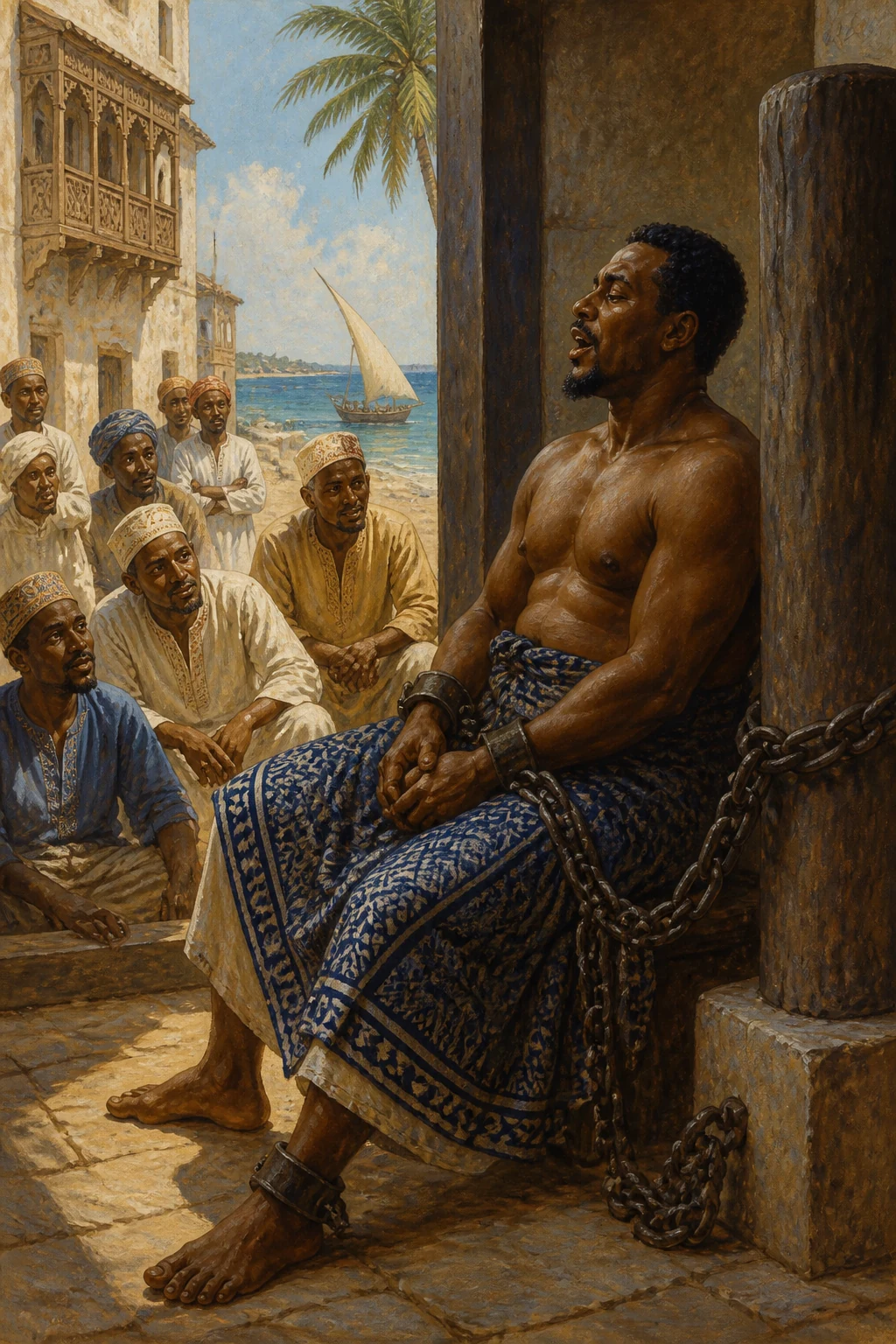
Long ago in Shanga there lived a man named Liongo, a man of immense strength and great stature in the town. He tormented the people so much that one day they agreed to go to his house and bind him. A great crowd went there, burst suddenly into the house, seized him, bound him, and took him away to prison.
He remained there for many days, until he found a way to free himself. He came out and went on tormenting the people as before, for a long time. People could not go to their fields, cut firewood, or draw water. They suffered greatly.
The people said, “What plan can we devise to catch him and kill him?” One of them said, “Let us go to him where he sleeps and kill him outright.” Others said, “If you catch him, bind him and bring him here.” They went and devised a trick, until they caught him, bound him, and brought him into town. There they secured him with a chain, fetters, and a wooden stock.
They left him there for many days, and his mother brought him food every day. Outside the door of the place where he was confined, guards had been stationed to watch him. They never all left at once, but took turns.
Many days and many months passed. Every night he sang beautiful songs, and everyone who heard them loved them dearly. Each person would say to a friend, “Let us go and listen to the songs Liongo sings in his cell.” They would go and listen. Every night people came and said to him, “We have come for your songs; sing so that we may hear.” He would sing, for he could not refuse them, and the townspeople grew very fond of his songs. Every day he composed new ones out of the sorrow of his imprisonment. Little by little, the people came to know those songs, but he, his mother, and his servant knew them thoroughly. His mother understood their meaning, while the townspeople did not.
One day their maidservant brought him food, but the guards snatched it from her and ate it, leaving him only scraps. The maidservant said to her master, “I brought you food, but these guards took it from me and ate it. These scraps are all they have left.” He said to her, “Give them to me.” He took them, ate, and thanked God for what had befallen him.
Then he said to his maidservant, while he was inside and she stood outside the door, “O maidservant, I send you on an errand. Tell my mother: I am a fool who has learned no wisdom. Let her make a loaf and put a file within it, that I may saw my fetters and loosen my chains, slip into the passage, glide like a snake, and climb the terraces and walls, looking this way and that.”
His meaning was: “You, maidservant, must carry a message to my mother. Tell her I am a fool who has not grown wise. Let her make a loaf and put a file in the middle, so that I may cut my fetters; and when the chains come loose, I may make my way out, slip along like a snake, and climb the terraces and walls, looking this way and that.”
He told her, “Give my mother my warm greetings, and tell her what I have told you.” She went to his mother and said, “Your son sends you his warm greetings. He has given me words to bring to you.” His mother asked, “What words?” And she repeated what she had been told.
His mother understood. She went to the shop, traded for some millet, and gave it to her servant to pound. Then she went to buy several files and brought them home. She took the flour and made many fine loaves. Then she took some sour dough, made one large loaf, put the files inside it, and gave the bread to her servant to take to him.
The servant set off with it. When she reached the door, the guards snatched it from her, picked out the fine loaves, and ate them themselves. Of the sour loaf they said, “Take that to your master.” She brought it to him, and he broke it open, took out the files, and put them aside. He ate the bread, drank some water, and thanked God.
Now the townspeople wanted him put to death. He himself heard that he was to be killed. He asked the guards, “When am I to die?” They told him, “Tomorrow.” He said, “Then call my mother, the ruler of the town, and all the townspeople, so that I may bid them farewell.”
They went and called them, and a great crowd came, along with his mother and his servant. He asked them, “Have you all gathered?” They answered, “We have.” He said, “I want a horn, cymbals, and a gong.” These were fetched. He told them, “Today I wish to hold a performance, to bid you farewell.” They said, “Very well, then. Play.” He told them, “Let one person take the horn, another the cymbals, and another the gong.” They asked him, “How shall we play?” He taught them how, and they began.
From inside his cell he sang, and when the music swelled, he took a file and began cutting through his fetters. Whenever the music fell silent, he too stopped. He sang, and as they played, he sawed at his fetters.
The people knew nothing of what was happening inside. At last the fetters broke, and he cut through the chain as well. In their excitement over the music, the people noticed nothing. Before they knew it, he had broken down the door and burst out among them. They flung down their instruments and tried to flee, but could not escape him. He seized them and dashed their heads together, killing them. On his way out of town, he took leave of his mother, never to see her again.
He went into the wilderness and lived there for a long time, still tormenting people and killing them. Some cunning men were sent after him, with these instructions: “Go and make friends with him, until you have a chance to kill him.” They set off in fear. When they arrived, they befriended him. One day they said to him, “Let us share a meal, Sultan, each contributing in turn.” Liongo answered, “If I join your feast, what have I to give?”
He meant, “If I take my share, what shall I contribute, poor as I am?” They said, “Let us feast on doum-palm fruit.” He asked, “How shall we do that?” They told him, “One man will climb a palm and knock down fruit for us to eat. When we have finished, another will climb, and so on until we have all had our turn.” He said, “Very well.”
The first man climbed, and they ate. The second climbed, and they ate. The third climbed, and they ate. But they had made a plan: “When Liongo climbs, we shall shoot him with arrows up there in the tree.”
Liongo, in his wisdom, saw through them. When all the others had finished, they said, “Now it is your turn.” He answered, “Very well.” He took his bow and arrows in his hands and said, “I shall shoot the cluster high above, and we shall eat the fruit within.”
He meant, “I shall shoot at the upper cluster, and we shall eat what is in the middle.” He shot, and a branch fell. He shot again, and a second fell. He stripped the whole palm, until the ground beneath was covered with fruit. They ate. When they had finished, the men said among themselves, “He has seen through us. What shall we do now?” They said, “Let us leave.” They bade him farewell, saying, “You have not fallen into folly, Lord Liongo. You are no ordinary man; like a spirit, Liongo, you have escaped.”
They meant, “You have not been taken in, King Liongo. You are no mortal man; you have escaped like a spirit.” They went back to their chief in the town and told him, “We could not do it.”
They took counsel together. “Who can kill him?” They said, “Perhaps his brother’s son.” They sent for the young man, and he came. They told him, “Go and ask your father what can kill him. Once you know, come and tell us, and when he is dead, we shall give you the kingship.” He answered, “Very well.”
He went. When he arrived, Liongo welcomed him and asked, “What have you come to do?” He answered, “I have come to see you.” Liongo said, “I know you have come to kill me, and those people have deceived you.”
He asked, “Father, what can kill you?” Liongo told him, “A brass needle. If someone pierces my navel with it, I die.” The young man returned to town and reported to them, saying, “A brass needle is what will kill him.” They gave him a needle, and he returned to his father. When Liongo saw him, he sang to him, “I, the bad one, am the one who wishes you well. Do not wrong me. No fool am I; I, the bad one, am the one who wishes you well.”
His meaning was: “Though I am bad, I am the one who wishes you well. Do not harm me. I, the bad one, am the one who wishes you well.” He welcomed him, knowing, “This one has come to kill me.” The young man stayed for two days. Then one night, while Liongo slept, he pierced his navel with the needle. Liongo woke in agony, seized his bow and arrows, and went as far as the well. He knelt down and propped himself against his bow. There he died.
In the morning, the people who came to draw water saw him, thought he was alive, and ran back. They spread the news through the town: “Today we cannot fetch water.” Everyone who went there fled back. A large crowd went out, but when they arrived and saw him, they dared not approach and returned. For three days people went in search of water and could get none.
They called his mother and told her, “Go and speak to your son. Tell him to move away so that we may get water, or we shall kill you.” She went, and when she reached him, she took hold of her son, soothing him with songs, and he fell over. His mother wept, knowing that her son was dead.
She went and told the townspeople that he was dead. They came to look, saw that he was dead, and buried him. His grave can still be seen at Ozi to this day.
They seized the young man and killed him, and did not give him the kingship.
Izvirnik
017 Hadithi ya Liongo
Naslednje strani prikazujejo izvirno besedilo za primerjavo.
Hapo zamaiii za Sliauga palikuwa mtu, jina lake Liougo, naye ana nguvu saaa, mtu mkubwa sana katika mji. Akauthi mno watu, hatta siku liiyo, wakafanya sliauri kumweiirlea nyumbani kwake kumfunga. Wakaenda watu wengi saua wakamingilia nyiimbaui ghufula, wakamkamata wakamfunga, wakaeucla naye hatta gerezani, wakamtia.
Akakaa siku nyingi, akafanya hila hatta kufungua. Akatoka nje, akauthi watu vilevile, siku nyingi. "Watu liawawezi kwenda mashamba, wala kukata kuni, wala kuteka maji, Wakauthika sana.
Watu wakasema, tufanye hila gani, hatta tumpate, tumwue ? Akanena mmoja, tumwendee anapolala, tuniwulie mbali. Wakasema wangine, mkimpata, mfungeni, mmlete. Wakaenda wakafanya hila, hatta wakampata, wakamfunga, wakamchukua mjini. Wakaenda wakamfunga mnyororo, na pingu, na mti kati.
Wakamwacha siku nyingi, mamaye humpelekca kula knlla siku. Na mbele ya mlango kule alikofungwa, wamewckwa asikari wanayomngojea, hawaoudoki marra moja ela kwa zamu.
Siku nyingi na miezi mingi imepita. Kulla siku,
usiku usiku, kuimba nyimbo nzuri, kulla asikiaye liuzipenda sana zile nyimbo. Kulla mtu bumwambia ratiki yake, twende tukasikilize nyimbo za Liongo, anazokwimba cbumbani. Huenenda, wakisikiliza. Kulla siku ikipata usiku, buenda watu, wakamwambia, tumekuja kwimba nyimbo zako, tusikie. Huimba, bawezi kukataa, wakazipenda mno watu mjini. Na kulla siku kutunga nyingiue nyingiue kwa sikitiko la kufuugwa. Hatta watu wamezijua nyimbo zile kidogo kidogo, lakini yeye, na mamaye, na mtumwa wake wauazijua sana. Na maana yake zile nyimbo mamaye azijua, na wale watu mjini bawajui maana yake.
Hatta siku biyo kijakazi cbao ameleta cbakula wakamnyang'anya wale asikari, wakala, wakamsazia makombo, wakampa. Yule kijakazi akamwambia bwana wake, nimeleta cbakula, wameninyang'anya bawa asikari, wamekula, wamesaza baya makombo. Akamwambia, nijie. Akapokea, akala, akasbukuru Muungu kwa yale yaliompata.
Akamwambia kijakazi cliake (na yeye ndaui na kijakazi yu uje ya mlango)
Ewo kijakazi nakutuma uwatumika, Kamwambia mama, nl mwinga siyalimka. Afaiiye mkate, pale kati tupa kaweka, Nikeze piugu ua minyoo ikinyoka, Ningie ondoni niuyinyirike ja maua nyoka, Tatauge madari na makuta kuno kimeta.
Maana yake — Wee kijakazi utatumika kamwambia mama, ui mjinga sijaercvuka, afanye mkate, katikati aweke tupa nikatc pingu, na minyololo ikifuuguka, niingie njiani,
niteleze kama nyoka, uipande maclari na kuta, nikitezama huko na liiiko.
Akarawambia, salaam saua mama, mwamLio kama liaya niliokwambia. Akaenda, akamwambia mamaye, akamwambia, salaam sana mwanao, ameniambia maneuo kuja kukwambia. Akamwambia, maneuo gaui ? Akamwambia, kama yale yalioambiwa.
Mamaye akajua, akaenda zake dukani, akabadili mtama, akampa mtmnwa wake kutwanga. Yeye akaenda kununua tupa nyiugi, akaleta. Akatwaa unga ule, akafanya mikate mizuri mingi. Akatwaa cbacliii, akafanya mkate mkubwa, akatwaa tupa akatia ndani, akampa mtumwa wake, kumpelekea.
Akaeuda uao, akifilia mlangoni asikari wakamnyang'auya, wakacbegua mikate mizuri, wakala wao. Ule wa cbacbu wakamwambia, mpelekea bwana wako. Yule akampelekea, akauvunja, akatoa tupa zile akaziweka, akala mkate buu akanywa maji, akasbukuru Muuugu.
Na wale watu mjini wataka auawe. Mwenyewe akasikia ya kuwa ya kwaraba utauawa. Akawaambia asikari, nitauawa lini? Wakamwambia, kesho. Akawaambia, kanitieni mama yaugu na mwenyi mji, na watu mjini wote, nije niagane nao.
Wakaenda, Avakawaita, wakaja watu wengi wote, na mama yake na yule mtumwa wake.
Akawauliza, mmekutanika nyote ? Wakamjibu, tumekutanika. Akawaambia, nataka pembe, na matoazi, na upato, zikaenda zikatwaliwa. Akawaambia, nna machezo leo nataka kuagana nanyi. Wakamwambia, vema, baya,
pige. Akawaambia, mmoja asliike pembe, na mmoja asbike matoazi, na mmoja asbike upato. Wakamwambia, tupigeje ? Akawafundisba kui^iga, '«•akapiga.
Naye mwenyewe ndaui kule aliko akaimba, batta ilipositawi ngoma, akasbika tupa, akakata pingu. He ngoma ikinyamaa naye bunyamaa, akaimba, wakipiga, yeye akakata piugu.
Na -n-atu wale bawana kbabari ilioko ndani, batta ikakatika pingu, akakata na mnyororo batta ukakatika. Xa wale watu bawana kbabari kwa sbanko ya ngoma. Wakitabamaka amevunja mlango amewatokea uje. Wakitui)a vitu bivi kwenda mbio wasidiriki, akawakamata akawapiga vitwa kwa vitwa akiwaiia. Akitokea uje ya mji, akaagana na mamaye, kutuonana tena.
Akaenda zake mwitimi akakaa kitako siku nyingi buutbi watu vilevile na kuwaua watii.
Wakatuma watu wa bila, wakawaambia, enendi, mkafanya rafiki batta mmwue. Wale wakaenda wa kbofu. Walipofika wakafanya lu-afiki, llatta siku biyo wakamwambia, tule kikoa, Sultani. Yeye Liougo akawajibu —
Hila kikoa halipani nikatanmo ?
Maana yake — Xikila kikoa nitalipa nini, masikini mno ? Wakamwambia, tule kikoa cba makoma. Akawauliza, tutakulaje ? Wakamwambia. atapanda mtu mmoja juu ya
mkoma akaangue, tule, tukiisha apande mgine, iiatta tuishe. Akawaambia, vema.
Akapauda wa kwauza. wakala. Akapauda wa pili, wakala. Akapanda wa tatu, wakala. Na wale wamefanya hila, atakaj)opauda Liougo tumpige kwa mishare kulekule juu.
Liongo akatambua kwa akili yake. Hatta walipokwislia wote, wakamwambia, baya, zamu yako. Akawaambia, vema. Akasbika mkonoui iita wake na viembe, akawaambia—
Tafuma wivu la angania, tule cha yayi.
Maaua yake, !Xitapiga bivu la jiiu tule cba kati. Akapiga, likakatika tawi, akapiga tena, likakatika la pili, akaupukusa mkoma mzima, yakajaa tele cbini. Wakala. Hatta walipokwisba, wale watu wakasema wao kwa wao, ametambiia buyii, sasa tufanyeje ? Wakanena, tweudeui zetu. Wale wakam\'\aga, wakamwambia —
Kukuingia Uadaaiii Liongo fumo si mtu, Yuuga jiui Liougo okoka.
Maaua yake, Hukuingia ujingani, Liougo mfalme, wewe si mtu, kamma Sbcitaui umeokoka.
Wakaenda zao, wakajibu kwa yule mkuu wao, alioko mjini, wakamwambia, batukuweza.
Wakafauya masbauri — nani atakaycweza ku'mua? Wakaneua, labuda mtoto wa nduguye. "Wakaenda wakamwita. Akaja. Wakamwambia, enenda, kamwuliza babayo, kitu gaui kiuacbomwua, ukiisba kujua, uje utwa-
mbie, na akiisba kufa tiitakupa iifaume. Akawajibu, vema.
Akacnda. Alipofika akamkaribisha, akamwambia, iirnekiija fanya nini ? Akamwambia, nimekuja kukutazama. Akamwambia, najua mimi irmekuja kuniiia, na hao wamekudaugauya.
Akamwuliza, baba, kitu gani kinachokuua ? Akamwambia, sindauo ya shaba, mtu akinichoma ya kitovu, hufa.
Akaenda zake mjini, akawajibu, akawaambia, sindano ya sbaba ndio itakayo'mua. Wakami)a siudano, akanidi hatta kwa babaye. Alipomwona, akaimba yule babaye, akamwambia —
ISIimi muyi ndimi mwe mao, situe
Si mbweuge inimi muyi ndimi mwe mao.
Maaua yake, Mimi mbaya ndiye mwema wako, si nifanya mbaya, mimi ndimi mbaya ndiye mwema wako. Akamkaribisha, akajua, huyu amekuja kuniua.
Akakaa siku mbili, liatta siku liiyo usiku amelala, akamchoma sindano ya kitovu. Akaamka kwa ucliimgu wake, alisliika uta wake na viembe, akaeuda liatta karibia Aasima. Akapiga magote, akajitega na uta wake. Akafa palepale.
Hatta assubui, watu wanaokuja teka maji wakamwoua, wakamtliani mzima, wakarudi mbio. Wakatoa kliabari mjini. leo maji hayapatikani. Kulla endaye liurudi mbio. Wakatoka watu wengi wakaenda, wakifika, walipomwona wasiweze kukaribia, wakarudi. Siku tatu watu wanathii kwa maji, kuyakosa.
Wakaniwita mamaye, wakamwambia, euenda kasema naye mwanao, aoudoke, tupato maji, ao tutakuua wewe.
Akaenda Latta alipofika akamshika mwauawe kiuutumbuiza kwa nyinibo, akaanguka. Mamaye akalia, akajua mwanavve amekufa.
Akaenda kuwaambia watu mjini, ya kwamba amekufa, wakaenda kumtezama, wakamwoua amekufa, wakamzika, na kaburi lake laouekana katika Ozi hatta leo.
Wakamkamata kile kijaua, waka'mua, wasimjie ufaume.
Nadaljuj z branjem