Prevod
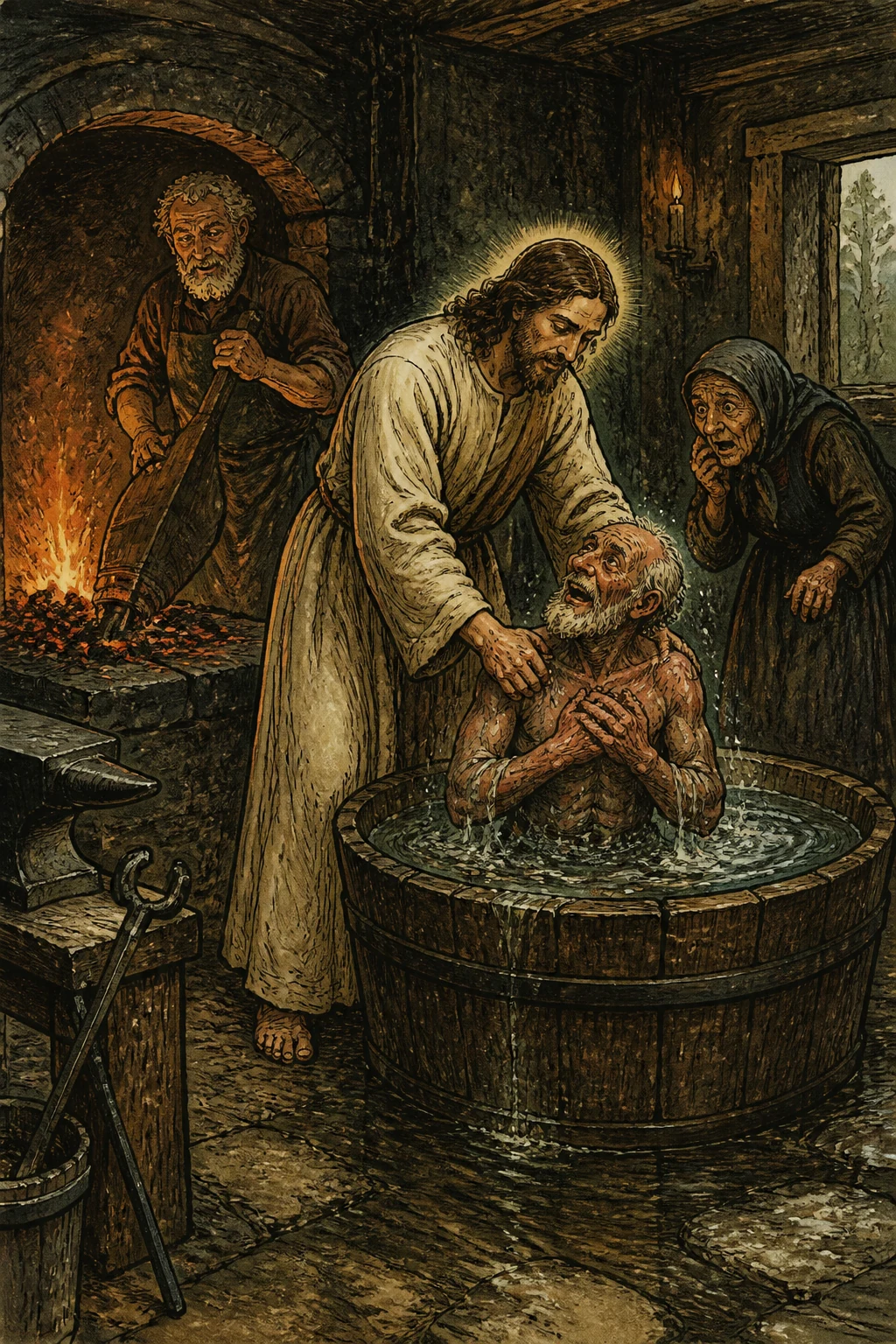
It is told that a certain righteous man heard of a blacksmith in a distant town who would thrust his hand into the fire and draw out the heated iron without being harmed by the flames. So he journeyed to that town and asked after the blacksmith, and was directed to him. When he watched him closely, he saw him doing just as he had been told. He waited until the smith had finished his work, then approached, greeted him, and said, “I should like to be your guest tonight.” “With pleasure and honor,” replied the smith. He took him home, and they supped together and lay down to sleep. The visitor saw no sign of night prayers or other devotions, and thought to himself, “Perhaps he conceals them from me.” So he stayed with him a second night and a third, but found that he performed no more than the prescribed prayers and the customary additional ones, and spent only a little of the night in prayer. At last he said, “My brother, I have heard of the favor God has bestowed upon you, and have seen its signs for myself. Yet when I observed your devotions, I found in you none of the exertions of those through whom miracles are manifested. How, then, did this come to you?” The smith replied, “I shall tell you how it came about. I once became infatuated with a young woman and was consumed with love for her. Time and again I tried to seduce her, but could not prevail, for she held fast to her virtue. Then came a year of drought, famine, and hardship. Food grew scarce, and hunger became grievous. One day, as I sat at home, someone knocked at the door. I went out, and there she stood. ‘My brother,’ she said, ‘I am suffering terribly from hunger, and have turned to you to feed me for God’s sake.’ I said to her, ‘Do you not know how I have loved you and what I have suffered on your account? I will give you nothing to eat unless you yield yourself to me.’ ‘Death rather than disobedience to God,’ she answered, and went away. Two days later she returned and made the same plea, and I gave her the same answer. She came inside and sat down in the house, on the brink of death. When I set food before her, tears streamed from her eyes, and she said, ‘Feed me for the sake of God, the Almighty and Glorious.’ ‘No, by God,’ I replied, ‘not unless you yield yourself to me.’ ‘Death is better for me than the punishment of God Most High,’ she said, and rose, leaving the food untouched.” And dawn overtook Shahrazad, and she fell silent, leaving her tale untold.
When it was the four hundred and seventy-second night,
She said, “It has reached me, O fortunate king, that when the man brought the woman food, she said, ‘Feed me for the sake of God, the Almighty and Glorious.’ ‘No,’ he replied, ‘not unless you yield yourself to me.’ ‘Death rather than God’s punishment,’ she answered. Then she rose, left the food, and went out without eating anything, reciting these verses:
O One whose goodness embraces all creation, You hear my lament and see what I endure. Hardship and want have struck me down; a fraction of my suffering would leave one speechless. I am like a thirsty man whose eyes behold water, yet neither are his eyes refreshed nor is he given a draught. My soul urges me to gain a morsel whose savor will pass, while the sin of it remains. “Then she stayed away for two days before coming again to knock at my door. I went out and found that hunger had all but robbed her of her voice. ‘My brother,’ she said, ‘I have exhausted every means, and cannot bring myself to show my face to anyone but you. Will you feed me for the sake of God Most High?’ ‘No,’ I answered, ‘not unless you yield yourself to me.’ She entered and sat down in the house. I had no food ready, but when it was cooked and I had put it in the bowl, God Most High came to my aid, and I said to myself, ‘Woe to you! Here is a woman, deficient in understanding and religion, refusing food, though hunger has left her no strength to endure without it. She has turned you down time after time, yet you will not turn away from disobedience to God Most High!’ So I said, ‘O God, I repent to You of the thoughts I have harbored.’ I took up the food, went in to her, and said, ‘Eat, and have no fear. It is given for the sake of God, the Almighty and Glorious.’ She raised her eyes to heaven and said, ‘O God, if this man is sincere, forbid the fire to touch him in this world and the next. You have power over all things, and are worthy to answer prayer.’” The smith continued, “I left her and went to remove the coals from the brazier, for it was winter and the weather was cold. An ember fell upon my body, but by the power of God, the Almighty and Glorious, I felt no pain. It occurred to me that her prayer had been answered, so I took the ember in my palm, and it did not burn me. I went in to her and said, ‘Rejoice, for God has answered your prayer!’” And dawn overtook Shahrazad, and she fell silent, leaving her tale untold.
When it was the four hundred and seventy-third night,
She said, “It has reached me, O fortunate king, that the blacksmith said to her, ‘Rejoice, for God has answered your prayer!’ She dropped the morsel from her hand and said, ‘O God, as You have shown me my wish fulfilled in him and answered my prayer on his behalf, take now my soul, for You have power over all things.’ And God took her soul that very hour. May God have mercy upon her.” And the story itself seemed to speak in these verses:
She prayed, and her Lord answered her prayer, accepting the repentance of the erring man who had sought to lure her. In His bounty He showed her wish fulfilled in him, and granted her the desire of her heart. She had come to his door in hope of a gift, seeking him out in the distress that had befallen her. But he inclined toward his waywardness, yielding to lust and hoping to gain his end. He knew not what God intended for him; repentance came to him, though he had not sought it. God’s decrees are blessings allotted: whoever finds them not brought to him is brought to them.