Prevod
Then I said, “As for my fourth brother, Commander of the Faithful, the one who has lost an eye, he was a butcher in Baghdad, selling meat and raising sheep. The great men and the wealthy used to come to him to buy their meat, and in this way he amassed a great fortune and acquired houses and riding beasts. He prospered thus for many years. One day, while he was in his shop, an old man with a long beard stopped before him, handed him some dirhams, and said, ‘Give me meat for these.’ My brother took the money and gave him the meat, and the old man went away. When my brother examined the old man’s silver, he saw that the coins were dazzlingly white, so he set them apart. For five months the old man kept coming to him, and my brother put his coins away in a box by themselves. At last he decided to take them out and buy some sheep, but when he opened the box, he found nothing in it but pieces of white paper cut to shape. He struck his face and cried out, and the people gathered round him. He told them what had happened, and they were astonished. Then my brother returned to his shop as usual, slaughtered a ram, and hung it inside, cutting off some meat and hanging it outside. He said to himself, ‘Perhaps that old man will come, and I can seize him.’ Scarcely an hour had passed when the old man appeared with his silver. My brother sprang up, caught hold of him, and began shouting, ‘Muslims! Come to my aid, and hear what this scoundrel has done to me!’
“When the old man heard him, he said, ‘Which would you prefer: to spare me disgrace, or to have me disgrace you before everyone?’ ‘How could you disgrace me?’ my brother asked. ‘By revealing that you sell human flesh as mutton.’ ‘You lie, you accursed wretch!’ said my brother. ‘The only accursed wretch is the man who has a human body hanging in his shop,’ replied the old man. My brother said, ‘If it is as you say, then my wealth and my blood are yours to take.’ The old man cried, ‘People! This butcher slaughters human beings and sells their flesh as mutton. If you wish to know whether I speak the truth, enter his shop!’ The crowd rushed into my brother’s shop and saw that the ram had become a man hanging there. At this sight they seized my brother, shouting, ‘You unbeliever! You villain!’ Even those dearest to him began to beat him, and the old man struck him across the eye and knocked it out. The people carried the slaughtered body to the chief of police, and the old man said, ‘My lord, this man slaughters people and sells their flesh as mutton. We have brought him to you, so arise and uphold the law of God, mighty and glorious.’ My brother tried to defend himself, but the chief of police would not listen. Instead, he ordered him to be beaten with five hundred strokes of the stick, and they confiscated all his wealth. Had his fortune not been so great, they would have killed him. Then they banished my brother from the city, and he wandered away, not knowing where to turn, until he came to a large city. There he thought it best to become a cobbler, so he opened a shop and settled down to earn his living. One day he went out on an errand and heard horses neighing. He asked what was happening and was told, ‘The king is riding out to hunt.’ My brother went to watch the procession, congratulating himself on his wisdom in taking up the cobbler’s trade. But the king turned, and his gaze fell upon my brother’s eye. He lowered his head and said, ‘I seek refuge in God from the evil of this day.’ Then he wheeled his horse about and rode back, and all his soldiers returned with him. The king ordered his servants to catch my brother and beat him. They overtook him and gave him such a terrible beating that he nearly died, though he had no idea why. He returned to his lodging in a wretched state, then went to a man of the king’s household and told him what had happened. The man laughed until he fell upon his back, then said, ‘My brother, you must understand that the king cannot bear the sight of a one-eyed man, especially one whose left eye is missing: such a man he will not shrink from killing.’
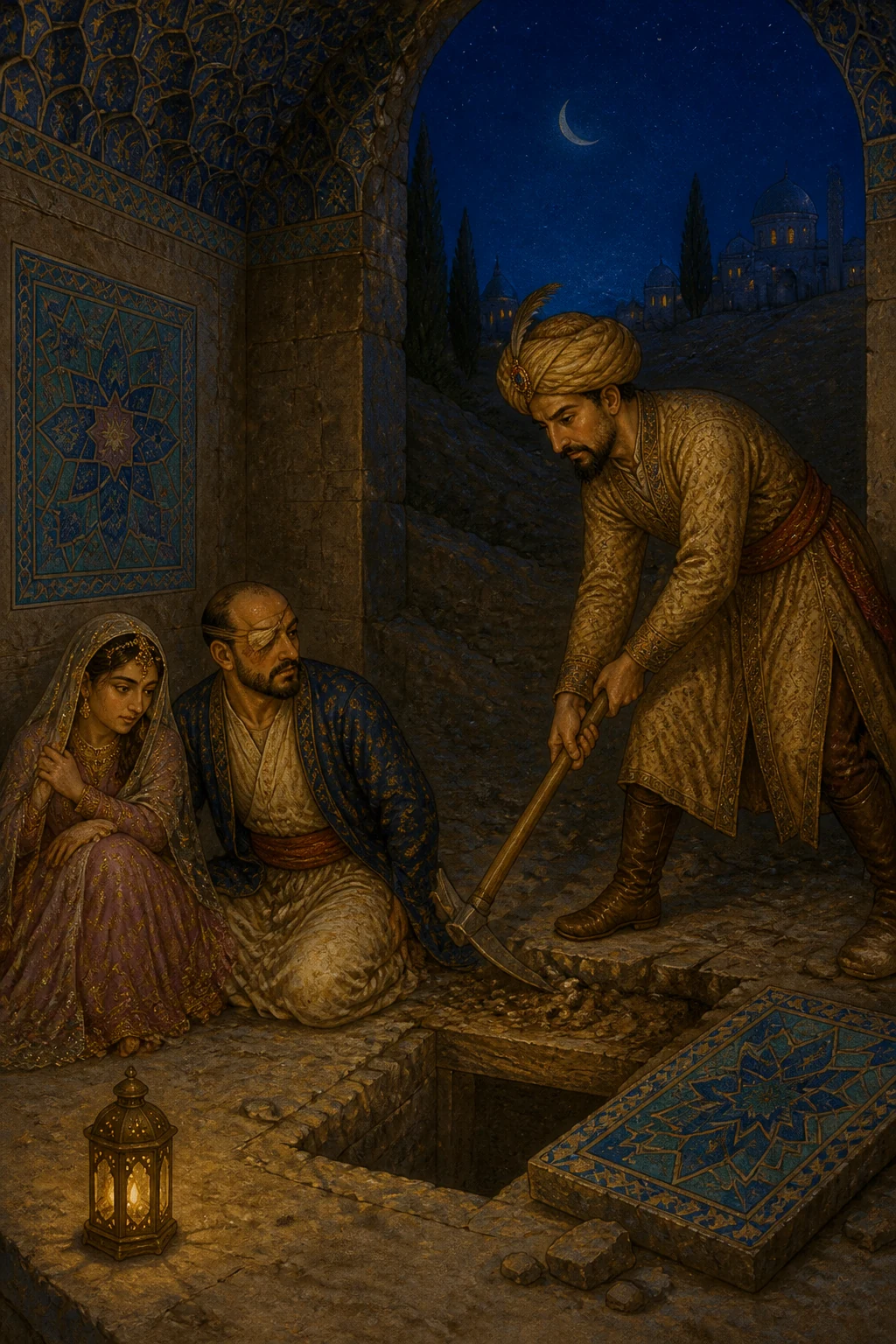
“When my brother heard this, he resolved to flee the city. He left and moved to another city, where there was no king, and lived there for a long time. Then, one day, after reflecting on his circumstances, he went out for a stroll and heard horses neighing behind him. ‘God’s decree has come!’ he said, and fled in search of somewhere to hide, but could find nowhere. At last he spotted a doorway, pushed open the door, and entered. Before him lay a long passage, and he went farther in. Suddenly two men seized him, saying, ‘Praise be to God, who has delivered you into our hands, you enemy of God! For three nights you have given us no peace, allowed us no sleep, and left us no rest in our beds. You have made us taste death itself!’ My brother said, ‘Good people, what is the matter with you?’ They replied, ‘You spy on us and mean to expose us and the master of this house. Is it not enough that you have impoverished him and your companions too? Now hand over the knife you threaten us with every night!’ They searched him and found at his waist the knife he used to cut leather for shoes. ‘Good people,’ he said, ‘fear God in your treatment of me, for mine is a strange tale.’ ‘And what is your tale?’ they asked. He told them his story, hoping they would release him, but they paid no heed to his words and took no notice of him. Instead, they beat him and tore his clothes. When his garments were in tatters and his body lay bare, they saw the marks of the lash on his sides. ‘You accursed wretch,’ they said, ‘these scars bear witness to your crimes!’ Then they brought my brother before the governor, and he said to himself, ‘My sins have brought me to this, and none but Almighty God can save me.’ When he stood before the governor, the governor said, ‘You villain! Only a terrible crime could have earned you such a flogging.’ He then had my brother given a hundred lashes. After that they mounted him on a camel and paraded him about, crying, ‘This is the punishment of those who break into people’s houses!’ When I heard of his plight, I went out to him and followed him about as they made their proclamation, until at last they let him go. Then I took him away, brought him secretly into the city, and made arrangements for his food and drink.”