Prevod
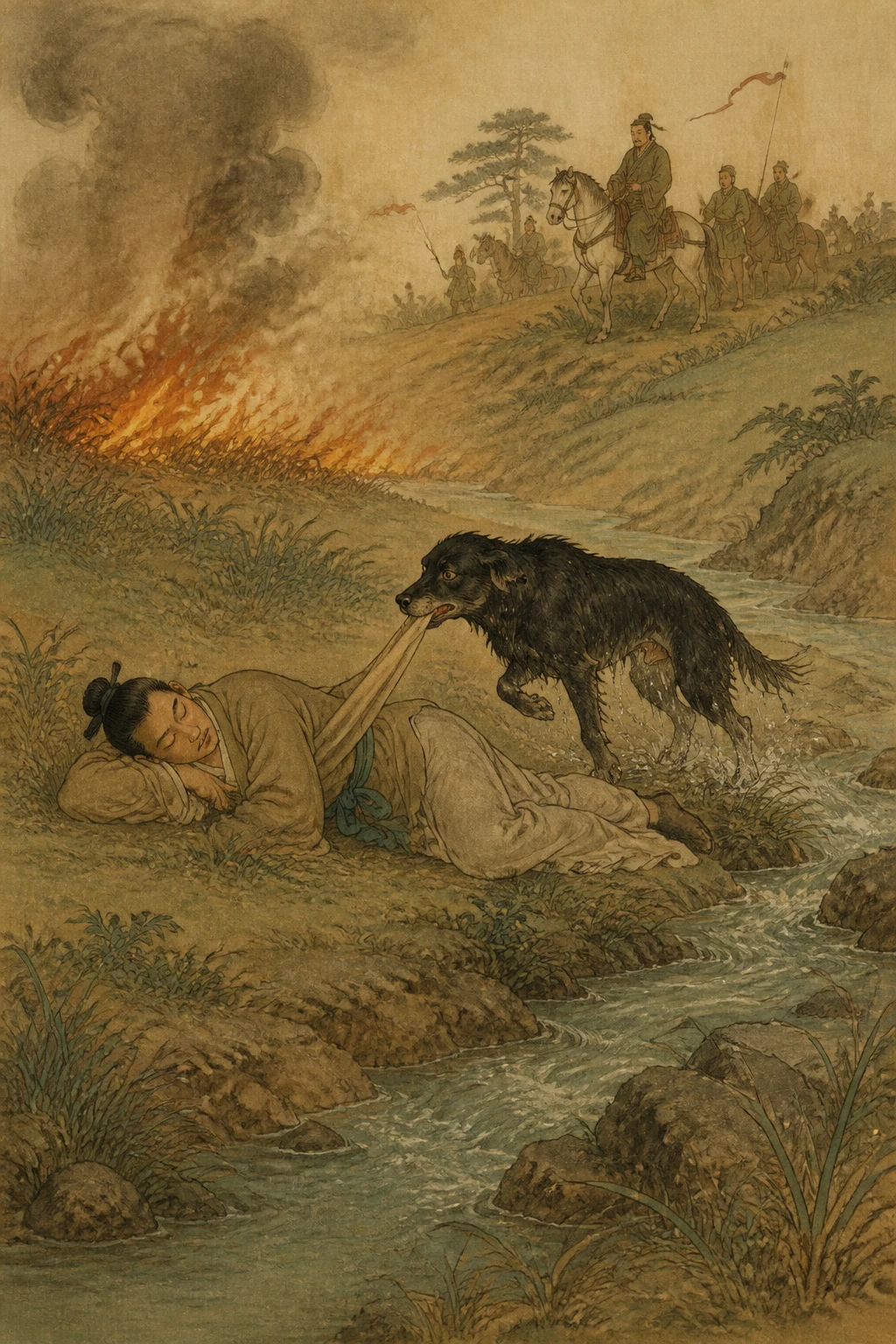
Long ago, in the reign of Emperor Mizunoo (Seiwa), the Ōten Gate burned down. Someone had set it alight. A major counselor named Tomo no Yoshio reported to the court that the deed was the work of Minister Makoto, and the emperor was about to have the minister punished. At the time, Duke Chūjin had entrusted the government to his younger brother, the Minister of the Right of West Third Avenue (Lord Yoshimi), and was living in seclusion at Shirakawa. Alarmed when he heard the news, he mounted a horse just as he was, in his court cap and informal robes, and rode all the way to the northern guard post of the palace. Going before the emperor, he said, “What has been reported may be slander. It would be most improper to treat it as a grave offense without further inquiry. In a matter of this kind, Your Majesty must investigate with the greatest care, establish what is true and what is false, and only then pass judgment.” The emperor acknowledged the justice of his words and ordered an investigation. As nothing could be established with certainty, the duke received an imperial command to announce that the minister was pardoned, and then withdrew. The Minister of the Left, grieving that he should face so unjust a charge when he had done nothing wrong, had put on his formal robes, spread a coarse straw mat in the courtyard, and gone out to appeal to Heaven. When the imperial messenger, the captain of the palace chamberlains, came galloping up without dismounting, everyone in the household thought he had come to carry out the punishment at once, and a great wailing arose. But when he proclaimed the pardon and departed, there was another outburst, this time of tears of joy. Though the minister had been pardoned, he said, “Serving at court has nearly brought a wrongful conviction upon me,” and thereafter he no longer attended to his duties as he had before. Now, in the autumn before this, a guardsman of the Right Military Guard who lived in the eastern part of Seventh Avenue had gone on duty and was returning home late at night. As he passed in front of the Ōten Gate, he heard people moving about and whispering. He concealed himself beside a gallery and watched. Someone came down, clinging to a pillar. Wondering who it could be, he looked closely and saw that it was Major Counselor Tomo. Next came the counselor’s son, followed by a servant named Toyokiyo. What could they have been doing up there? He watched without the least idea. The moment all three had reached the ground, they ran off as fast as they could toward the Suzaku Gate to the south. The guardsman, too, went on toward his home. When he reached the neighborhood of Second Avenue and Horikawa, people in the street were shouting that there was a fire in the palace compound. Looking back, he saw flames in the direction of the palace. He ran back and found that about half the upper story of the Ōten Gate was burning. He realized that the men he had just seen must have climbed up to set the fire. But since this was a matter of the utmost gravity, he did not dare let a word of it pass his lips. Later, when everyone was saying that the Minister of the Left had done it and was to be punished, he thought, “How dreadful! The men who did it are still at large.” Yet it was not something he felt able to speak of, and he went about feeling sorry for the minister. When he heard that the minister had been pardoned, he thought, “In the end, an innocent man does escape punishment.” In due course, it was about the ninth month. Around this time, a young child of Major Counselor Tomo’s steward got into a quarrel with the guardsman’s little boy. Hearing the steward shouting, the guardsman came out to separate them. The steward likewise came out, pulled the children apart, sent his own child indoors, then seized the guardsman’s son by the hair, threw him to the ground, and stamped on him until he was nearly dead. The guardsman thought, “My child and his are both children; this is only a children’s quarrel. Instead of settling it fairly, he singles out my boy and stamps on him so mercilessly. This is outrageous.” In his anger he said, “How can you treat a little child with such cruelty?” The steward replied, “What are you babbling about? You may call yourself a guardsman, but what could happen to me for striking a petty public servant like you? With my lord the major counselor behind me, what could come of it, even if I did something terribly wrong? What an idiot you are, talking such nonsense!” At this the guardsman flew into a rage. “What are you saying? Do you think your master the major counselor is so powerful? Don’t you know that it is only because I keep my mouth shut that your master still enjoys his position? If I were to open my mouth, would he remain a man of standing?” The steward, his anger checked, slunk back into his house. Neighbors had gathered in such numbers to watch the quarrel that the place was like a market, and they all heard what had been said. Wondering what the guardsman could have meant, some told their wives and children, while others passed the story from one person to the next. Soon it was being discussed everywhere, until at last it reached the emperor’s ears. The guardsman was summoned and questioned. At first he denied knowing anything, but when the questioning grew so pressing that he feared he might himself be punished, he told the whole story just as it had happened. After that, the major counselor too was questioned, and when the truth had come to light, he was sent into exile. He had burned the Ōten Gate and laid the blame on Minister Makoto, scheming to have the minister punished so that, as the senior major counselor, he might become a minister himself. How bitterly he must have regretted that his plot had recoiled upon him and brought about his own punishment.