O besedilu
Vardiello
- Vir
- Pentameron
- Avtor
- Giambattista Basile
- Jezik branja
- English
- Jezik izvirnika
- Neapolitan
- Čas branja
- 11 min branja
- Obseg
- 9 strani
- Naslov izvirnika
- Jornata I IV VARDIELLO
O izvirniku
Pentameron
Baročna, divja starejša plast evropske pravljice, polna obratov in pretiravanj. Bralni jezik je English, izvirnik pa prihaja iz vira Pentameron v jeziku Neapolitan.
Besedilo
Vardiello
_Vardiello, a born fool, after doing his mother a hundred bad turns, loses a length of cloth belonging to her, and, foolishly trying to recover it from a statue, becomes rich._ _When Meneca had finished her tale, which was judged no less charming than the previous one, being so packed with curious adventures that it kept the listeners in suspense to the very end, Tolla followed at the Prince’s command, and without wasting time began as follows._ If nature had obliged animals to wear clothes and pay for their food, the whole race of four-footed creatures would surely have perished. Instead, they find their food ready to hand, without a gardener to gather it, a buyer to purchase it, a cook to prepare it, or a carver to cut it up; their own hides protect them from rain and snow, without a merchant to supply the cloth, a tailor to make the clothes, or an apprentice to ask for a tip. But nature has not troubled to give man, who has his wits, these conveniences, knowing that he can provide for his own needs. This is why clever people are so often seen begging, and fools rolling in riches, as you may gather from the tale I am about to tell you.
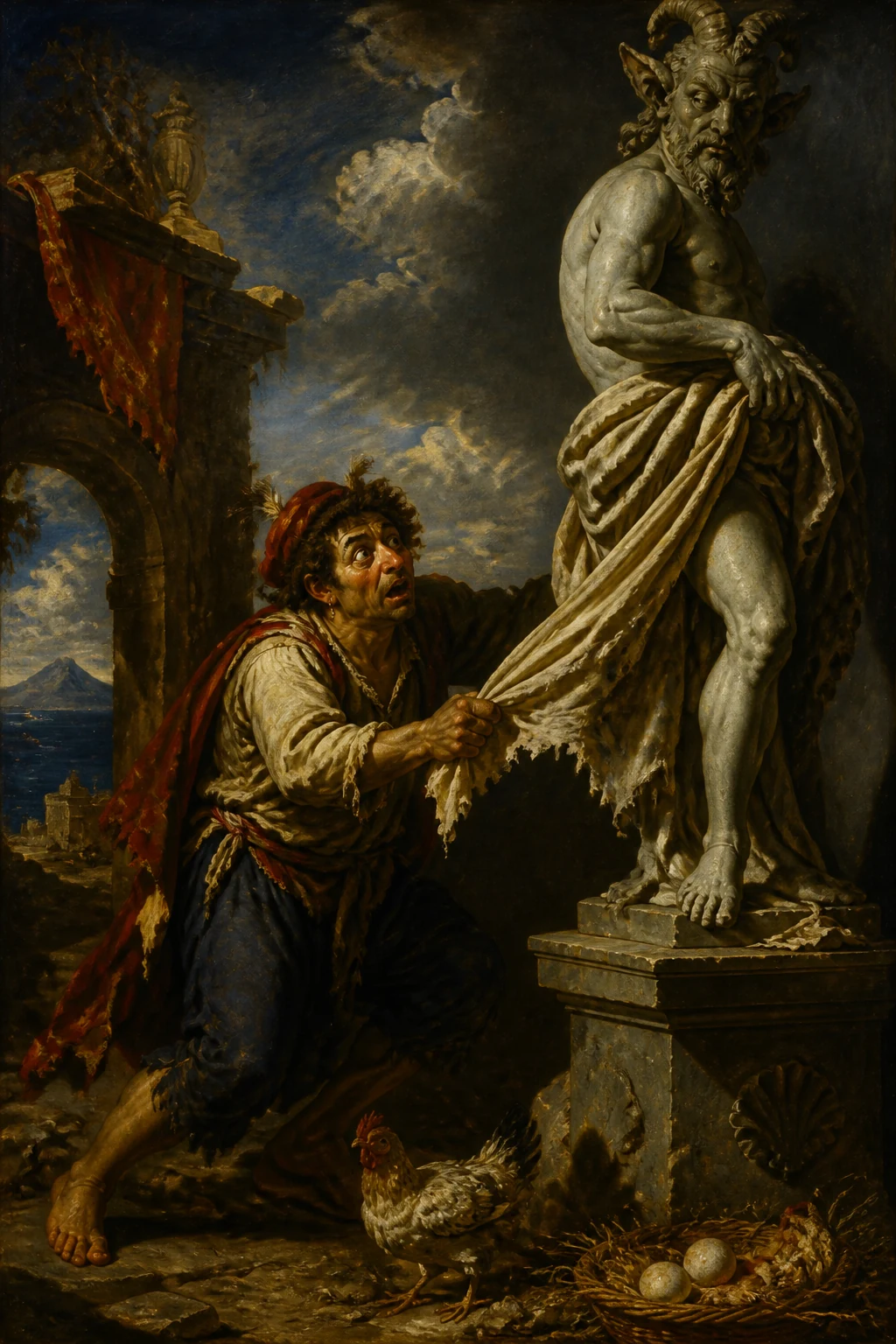
Grannonia d’Aprano was a woman of excellent judgment, but she had a son called Vardiello, the most hopeless simpleton in the whole country. Yet since a mother’s eyes are bewitched and see things that are not there, she loved him with all her heart, forever fondling and petting him as though he were the finest creature in the world. Now this Grannonia had a hen sitting on a clutch of eggs, and she had set all her hopes on raising a fine brood and making a handsome profit from it. Having to go out on some necessary business, she called her son and said, “Mother’s handsome boy, listen to me. Keep an eye on this hen, and if she gets up to peck about, take care to put her back on her nest, or the eggs will grow cold, and then I shall have neither chicks nor chickens.” “Leave it to this fine fellow,” said Vardiello. “You haven’t been talking to a deaf man.” “One thing more,” his mother went on. “Look here, my blessed boy: in that cupboard there is a jar of poisonous stuff. Mind the wicked devil doesn’t tempt you to touch it, or you’ll be stretching out your legs for good.” “Heaven forbid!” answered Vardiello. “Poison won’t catch me! And thank your lucky stars you warned me, for I might have blundered straight into it, and there would have been no help for it.” So his mother went out, and Vardiello was left alone. Not to waste time, he went into the garden to make little pits covered with twigs and earth, to catch the children. Just as he was in the thick of his work, he noticed the hen strolling outside the room. At once he began crying, “Shoo, shoo! Away with you! Get along there!” But the hen would not budge. Seeing that she was as stubborn as a donkey, Vardiello followed his shooing with a stamping of feet; after stamping his feet he threw his cap, and after his cap he threw a rolling pin, which struck her square in the middle and made her flop over and stretch out her legs. Faced with this unfortunate accident, Vardiello thought how he might repair the damage, and, making a virtue of necessity, promptly pulled down his breeches and sat on the nest to keep the eggs from growing cold. But his weight turned them into an omelet. Seeing that he had now made a double mess of things, he was ready to dash his head against the walls. At last, since every sorrow gives way to a mouthful, he felt his stomach rumbling and resolved to gobble up the hen. So he plucked her, ran a fine spit through her, built a great fire, and began to roast her. When she was nearly cooked, so that everything should be ready at the proper time, he spread a clean, freshly washed cloth over an old chest, took a pitcher, and went down to the cellar to draw some wine from a small cask. In the very midst of filling it, he heard such a noise, such a clatter and commotion in the house, that it sounded like a troop of armored horses. Greatly startled, he looked up and saw a huge cat that had made off with the hen, spit and all, while another cat ran after it, clamoring for a share. To put this mishap right, Vardiello hurled himself at the cat like a lion let loose, and in his haste left the cask running. After a game of catch-me-if-you-can through every corner of the house, he recovered the hen, but meanwhile the cask had drained dry. When he returned and saw what a fine washing he had given the floor, he too tapped the barrel of his soul through the spigots of his eyes. But since he had his wits to help him, he thought to repair this damage as well, so that his mother should not discover so much havoc. He took a sack of flour filled to the brim, packed tight, crammed full, heaped up and overflowing, and scattered it over the spilled wine. Even so, as he counted off these disasters on his fingers and reflected that, after such a cartload of foolishness, he had lost the game where Grannonia’s favor was concerned, he firmly resolved not to let his mother find him alive. Accordingly, he fell upon the jar of preserved walnuts that his mother had told him was poison, and never stopped until he had laid the bottom bare. Then, with his belly well filled, he crawled into an oven. Meanwhile his mother returned and knocked for a good while. Finding that no one heard her, she kicked the door open and went inside, calling loudly for her son. When no one answered, she began to suspect disaster, and, growing more distressed, raised her voice still higher. “Vardiello! Vardiello! Are you deaf, that you can’t hear? Have you gout, that you can’t run? Have you the pip, that you can’t answer? Where are you, gallows-face? Where have you melted away to, you wicked wretch?
Would that I had smothered you at birth!” Hearing all this uproar, Vardiello at last said in a pitiful little voice, “Here I am! I’m inside the oven, and you’ll never see me again, Mother dear.” “Why?” answered his unhappy mother. “Because I’ve poisoned myself,” replied her son. “Alas!” cried Grannonia. “How did you do it? What reason had you to commit such a murder? And who gave you the poison?” Vardiello told her, one by one, all the fine feats he had performed, on account of which he wished to die and remain no longer in the world as a warning to others. When his mother heard all this, she was beside herself with grief and misery, and had much to do and much to say before she could rid Vardiello’s head of this melancholy notion. Since she loved him with all her heart, she gave him some other sweetmeats, and so put the preserved walnuts out of his mind, explaining that they were not poison but a cordial for the stomach. Having thus soothed him with kind words and a thousand caresses, she drew him out of the oven, gave him a fine length of cloth, and told him to go and sell it, warning him not to deal with people who talked too much. “Excellent!” said Vardiello. “Now I’ll serve you up something sweet, never fear!” Taking the cloth, he went through the city of Naples, where he had brought his wares, crying, “Cloth! Cloth!” But whenever anyone asked him, “What sort of cloth is that?” he answered, “You’re no use to me: you talk too much.” If another asked, “How much do you want for it?” he called him a loudmouth and said he had addled his brains and split his skull. At last he noticed a stucco statue in the courtyard of a house abandoned because of the Monaciello. The poor fellow, footsore and weary of wandering about so much, sat down on a stone bench. Seeing no one coming or going in the house, which looked like a plundered village, he said to the statue in great surprise, “Tell me, friend, does nobody live in this house?” When it made no answer, he took it for a man of few words and said, “Would you like to buy this cloth? I’ll let you have it cheap.” And as the statue still kept silent, he said, “Upon my word, I’ve found what I was looking for! Take it, have it looked over, and give me whatever you please. I’ll come back tomorrow for the money.” With that he left the cloth where he had been sitting, and the first mother’s son who came in on some necessary business, finding his good fortune there, carried it off. When Vardiello returned to his mother without the cloth and told her exactly what had happened, she nearly had a fit, and said:
“When will you ever get your wits in order? Look how many tricks you’ve played me—just count them! But I have only myself to blame: I was too softhearted to settle accounts with you at the very first, and now I see that a tenderhearted doctor makes the wound incurable. But keep it up, and sooner or later you’ll get what’s coming to you, and we shall have a long reckoning.”
Vardiello, for his part, said, “Hush, Mother dear! It won’t be as bad as you say. What more do you want than bright new coins, fresh from the mint? Do you think I’m a ninny, and don’t know how to look after my own affairs? Tomorrow will come soon enough:
it won’t be long before you see something fine, and then you’ll know whether I can fit a handle to a shovel.” When morning came, and the shadows of night, pursued by the Sun’s constables, were driven out of the country, Vardiello presented himself in the courtyard where the statue stood. “Good morning, sir,” he said. “Would it suit you to give me those few coins? Come now, pay me for the cloth.” But seeing that the statue remained mute, he picked up a large stone and hurled it with all his strength straight into the arch of its chest, opening a vein that restored his household to health: for when a few chunks of masonry fell away, he uncovered a pot full of gold crowns. Seizing it in both hands, he ran headlong home, crying, “Mother! Mother! What a lot of red lupins! Oh, so many, so many!” His mother, seeing the crowns and knowing that her son would blab about the affair, told him to wait at the foot of the stairs by the door until the cheese-and-ricotta seller passed, for she wanted to buy him a pennyworth of curds. Vardiello, who was a greedy fellow, promptly sat down in the doorway, and for more than half an hour his mother showered over six rotoli of raisins and dried figs down from the window. Gathering them up, Vardiello shouted, “Mother! Mother! Bring out basins, set out tubs, hold up vats! If this shower keeps on, we’ll be rich!” And when he had filled his belly handsomely, he went upstairs to sleep. Now it happened one day that two workmen, both well known to the law, were quarreling over a gold crown found on the ground. Vardiello came upon them and said, “What fools you are to quarrel over one of those red lupins! I think nothing of them, for I’ve found a whole potful.” The officers of the court, hearing this, opened their eyes wide, questioned him, and asked how, when, and with whom he had found these crowns. Vardiello answered, “I found them in a palace, inside a dumb man, when it rained raisins and dried figs.” Hearing this wild leap into nonsense, the judge took the measure of the affair and decreed that he should be sent to a madhouse, as the proper court to judge him. Thus the son’s folly made his mother rich, and the mother’s good judgment remedied her son’s stupidity, showing clearly that _When a good pilot steers a ship,_ _It takes great ill fortune to strike a reef._
Izvirnik
Jornata I IV VARDIELLO
Naslednje strani prikazujejo izvirno besedilo za primerjavo.
_Vardiello essendo bestiale dapò ciento male servizie fatte a la mamma, le perde no tuocco de tela, e bolenno scioccamente recuperarelo da na Statola deventa ricco._ _Fenuto ch’appe lo cunto Meneca, lo quale fu stimato niente manco bello de l’autro, ped’essere ’nmottonato de curiuse socciesse, che tenne nzì a la coda pesole lo pensiero de l’auditure, secotaje pe commannamiento de lo Prencepe Tolla, la quale senza perdere tiempo decette de sta manera._ Se avesse dato la natura a ll’anemale necessetà de vestire, e de spennere pe lo vitto, sarria senz’autre destrutta la jenimma quatrupeta. Perzò trovanno lesto lo civo, senza ortolano, che lo coglia, compratore, che l’accatta, cuoco, che l’apparecchia, scarco,
che lo trencia: lo stisso cuoiro lo defenne da lo cchiovere, e da la neve; senza che lo mercante le dia lo drappo, lo cosetore le faccia lo vestito, e lo guarzone le cerca lo veveraggio; ma all’ommo, ch’ave ’ngiegno, non s’è ccurata de darele sta commedetate; perchè sape da se medesimo procacciarese chello, che l’abbesogna; chesta è la causa, che se vedeno ordenariamente pezziente li sapute, e rricche li bestiale, comme da lo cunto, che ve dirraggio potarrite raccogliere.
Fu Grannonia d’Aprano femmena de gran jodizio, ma aveva no figlio chiammato Vardiello, lo cchiù sciaurato ’nsemprecone de chillo pajese: puro perchè l’uocchie de la mamma so affatturate, e stravedeno, le portava n’ammore sbisciolato, e se lo schiudeva sempre, e allisciava, comme se fosse la cchiù bella creatura de lo munno. Teneva sta Grannonia na voccola, che schiudeva li pollicine, ne li quale aveva puosto tutta la speranza da farene na bella sporchia, e cacciarene buono zuco; E avenno da ire pe no fatto necessario, chiammaje lo figlio, decennole. Bello figliulo de mamma toja, siente ccà, agge l’uocchie a sta voccola, e si se leva a ppizzoliare, stà ’ncellevriello a ffarela tornare a lo nido, autramente se refreddano l’ova, e po
non averria ne cocche, nè titille. Lassa fare a sto fusto, disse Vardiello, ca nò l’aje ditto a ssurdo. N’autra cosa, leprecaje la mamma; vide figlio beneditto, ca dinto a chillo stipo, nc’è na fesina de certe mbroglie ’ntossecose, vi che non te tentasse lo brutto peccato a toccarele, ca ce stennerisse li piede; arrasso sia: respose Vardiello, tuosseco, non me ce cuoglie; e tu sapia co la capo pazza, ca me l’aje avisato, ca nce poteva dare de pietto, e no nc’era ne spina, ne uosso. Accossì sciuta la mamma, restaje Vardiello, lo quale pe non perdere tiempo, scette a l’uorto a ffare fossetelle coperte de sproccole, e tterreno, pe ’ncappare li peccerille; e quanno a lo meglio de lo lavore, s’addonaje ca la voccola faceva lo passiggio pe
ffora la cammara; pe la quale cosa commenzaie a ddicere, sciò, sciò, frusta ccà, passa llà; ma la voccola non se moveva da pede, e Vardiello vedenno, ca la gallina aveva dell’aseno, appriesso a lo sciò, sciò, se mese a sbattere li piede, appriesso a lo sbattere de li piede, a tirare la coppola, appriesso a la coppola, le tiraje no laganaturo, che centala pe mmiezo le fece fare lo papariello, e stennecchiare li piede. Visto Vardiello sta mala desgrazia, pensaie de remmediare a lo danno, e ffatto de la necessetà vertute, azzò non se refreddassero l’ova, sbracatose subeto, se sedette ’ncoppa a lo nido: ma datoce de cuorpo, ne fece na frittata. Visto ca l’aveva fatta doppia de figura, appe da dare de capo pe le mmura; all’utemo perchè ogne dolore torna a
boccone, sentennose pepoliare lo stommaco, se resorvette nnorcarese la voccola, e pperzò spennatala, e ’nfilatala a no bello spito, fece no gran focarone, e commenzaje ad arrostirela; ed essenno adesa cotta, pe ffare tutte le ccose a ttiempo, stese no bello cannavaccio de colata ’ncoppa no cascione viecchio, e pigliato n’arciulo scese a la cantina a spinoliare no quartarulo: e stanno a lo mmeglio de lo mettere vino, ’ntese no rommore, no fracasso, no streverio pe la casa, che parevano cavalle armate: pe la quale cosa tutto sorressieto, votate l’uocchie, vedde no gattone, che co ttutto lo spito se n’aveva zeppoliata la voccola, e n’autra l’era appriesso gridanno pe la parte. Vardiello pe rremmediare a sto danno se lassaje comme a lione scatenato ’ncuollo a
la gatta, e pe la pressa lassaje spilato lo quartarulo, e dapò avere fatto a ssecutame chisso pe ttutte li puntune de la casa, recuperaje la gallina, ma se ne scorze lo quartarulo; dove tornato Vardiello, e bisto, ca l’aveva fatta de colata, spinolaje isso porzì la votte de l’arma pe le cannelle dell’uocchie; ma perchè l’ajutava lo jodizio, pe remmediare a sto danno, azzò la mamma non s’addonasse de tanta ruina, pigliaje no sacco raso raso, varro varro, chino chino, zippo zippo, e a ccurmo a ccurmo de farina, e la sporpogliaie pe ’ncoppa a lo ’nfuso; co ttutto chesto facenno lo cunto co le ddeta de li desastre socciesse, e pensanno ch’avenno fatto scassone d’asenetate, perdeva lo juoco co la grazia de Grannonia, fece resoluzione de core de non
farese asciare vivo da la mamma. Però dato dinto la fesina de nuce conciate, che la mamma le disse, ch’era de tuosseco, maje levaje mano, si che no scoperze la petena, e chinose buono la panza, se ncaforchiaje dinto a no furno. Fra chisto miezo venne la mamma, e tozzolato no gran piezzo; visto ca nesciuno la senteva, dette no caucio a la porta, e ttrasuta dinto, e chiamanno a gran voce lo figlio, vedenno ca nesciuno responneva, se ’nzonnaje lo male juorno, e renforzanno le ddoglie, auzaje cchiù forte li strille, o Vardiello, Vardiello, aje la sordia, che non siente? aje le ghiorde, che non curre? aje le pipitola, che non respunne? Dove sì, facca de ’mpiso? dove si squagliato mala razza?
che t’avesse affocato ’nfoce, quanno te fice. Vardiello, che ’ntese sto greciglio, a l’utemo co na vocella pietosa, disse, eccome ccà? sò dinto lo furno, e no mme vederrite cchiù, Mamma mia: Perchè? respose la negra mamma: Perchè so ’ntossecato, leprecaje lo figlio: Oimè sogghionze Grannonia, e comme aje fatto? che ccausa aje avuto de fare sto mmecidio; e chi t’ha dato lo tuosseco? e Vardiello le contaje una ped’una tutte le belle prove ch’aveva fatto: pe la quale cosa voleva morire, e non restare cchiù pe spremmiento a lo munno. Sentenno ste ccose la mamma, negra se vedde, mara se vedde, appe che fare, e che dire pe levare da capo a Vardiello st’omore malenconeco; e perchè lo voleva no bene svisciolato, co ddarele certe autre ccose sceroppate, le
levaje da chiocca la cosa de le nnuce conciate, ca non erano venino, ma conciamiento de stommaco. Accossì accordatolo de bone parole, e ffattole mille carizzielle, lo tiraje da dinto lo furno, e datole no bello tuocco de tela, disse, che lo fosse juto a bennere, avvertennolo a non trattare sta facenna co pperzone de troppo parole. Bravo, disse Vardiello, mo te servo de musco, non dubitare: e ppigliatose la tela, jette gridanno pe la Cetate de Napole, dove portaje sta mercanzia tela, tela. Ma a quante le decevano, che tela è cchesta, isso responneva, non faie per la casa mia, ch’a troppo parole. E n’autro le diceva, comme la vinne? isso lo chiammava cannarone, e che l’aveva scellevrellato, e rrotte le chiocche; all’utemo veduto dinto no cortiglio de na casa
desabetata pe lo Monaciello, na certa statola de stucco, lo poverommo spedato, e vracco de ire tanto ’nvota, se sedette ’ncoppa a no puojo, e non vedenno trafecare nesciuno pe chella casa, che ppareva casale sacchejato, tutto maravegliato disse a la statola. Dì Cammarata ’nce abita nullo a sta casa? e bedenno ca no responneva: le parze ommo de poco parole, e disse, vuoje accattare sta tela, ca te faccio buon mercato, e vedenno la statola puro zitto, disse affè, aggio trovato chello che ghieva cercanno: pigliatella, e ffattela vedere, e dammene chello, che buoje; ca craje torno pe li fellusse. Cossì ditto, lassaje la tela, dove s’era assettato, che lo primmo figlio de mamma, che ’nce trasette pe quarche servizio necessario, trovato la sciorta
soja, se ne l’auzaje. Tornato Vardiello a la mamma senza la tela, e contato lo fatto comme passava, l’appe a benire l’antecore, decennole: quanno metteraje cellevriello a ssiesto? vide quanta mme n’aje fatte, arrecordatelle: ma io stessa mme lo ccorpo, e p’essere troppo tennera de premmone, non t’aggio a la primma agghiostato li cambie, e mo mme n’addono, ca miedeco pietuso fa la chiaja ’ncorabele: ma tanta mme ne faje, pe ’fi che buono nce ’ntorze, e ssarrimmo cunte luonghe.
Vardiello dall’autra parte diceva, zitto mamma mia, ca non sarrà quanto se dice, vuoje autro, che li tornise scognate nuove nuove; che te cride ca sò de lo Jojo, e ca non faccio lo cunto mio; ha da venire craje: da ccà a bello vedere non c’è tanto, e vederraje, si saccio mettere na maneca a na pala. Venuta la matina, quanno l’ombre de la notte secotate da li sbirre de lo Sole sfrattano lo pajese, Vardiello se consegnaje a lo cortiglio dove era la statola, decenno bonnì messere, staje commoto de dareme chille quattro picciole? ora susso pagame la tela. Ma vedenno ca la statola era muta, deze de mano a na savorra, e nce la schiaffaje co ttutta la forza de ponta ’nmiezo a l’arco de lo pietto, tanto che le roppe na vena, che fu la sanetate de la casa soja: pocca scarrupate
quatto mazzacane, scoperze na pignata chiena de scute d’oro, la quale afferrato a doje mane, corze a scapizzacuollo a la casa, gridanno, Mamma, mamma, quanta lupine russe, o quantane, quantane. La mamma, visto li scute, e sapenno ca lo figlio averria sprubbecato lo fatto, le disse, che fosse stato a pede la pporta, pe quanno passava lo caso recotta, ca le voleva accattare no tornese de latto: Vardiello, ch’era no pappone, subbeto se sedette ’nmocca la porta, e la mamma fece grannenejare pe chiù de mez’ora da la fenestra chiù de seje rotola de passe, e ffico secche: le quale Vardiello adonanno, strillava: o Mamma, o mamma caccia concole, miette cavete, apara tenielle, ca si dura sta chioppeta, sarimmo ricche; e comme se n’appe chiena bona la panza, se
ne sagliette a dormire. Accorze, che no juorno facenno a costejune due lavorante, esche de corte pe na pretennenzia de no scuto d’oro trovato ’nterra, nc’arrivaje Vardiello, e ddisse: comme site arcasene a litechiare pe lo lupino russo de chisse, de li quale io non ne faccio stimma, pocca n’aggio trovato na pignata chiena. La Corte ’ntiso chesto apprennoce tanto d’uocchie, lo ’nzammenaje, e disse? Comme, quanno; e con chi avesse trovato sti scute? a lo quale respose Vardiello, l’aggio trovato a no palazzo, dinto n’ommo muto quanno chiovettero passe, e ffico secche. Lo Jodece, che ’ntese sto sbauzo de quinta ’nvacante, addoraje lo negozio, e decretaje, che fosse remisso a no spetale, comme Jodece competente sujo. Cossì la ’ngnoranza de lo figlio fece ricca la
mamma, e lo jodizio pe la mamma remmedejaje a l’asenetate de lo figlio, pe la quale cosa se vedde chiaro, _Che nave che ccoverna buon Peloto,_ _È gran desgrazia quanno tozza a scuoglio._
Nadaljuj z branjem