Prevod
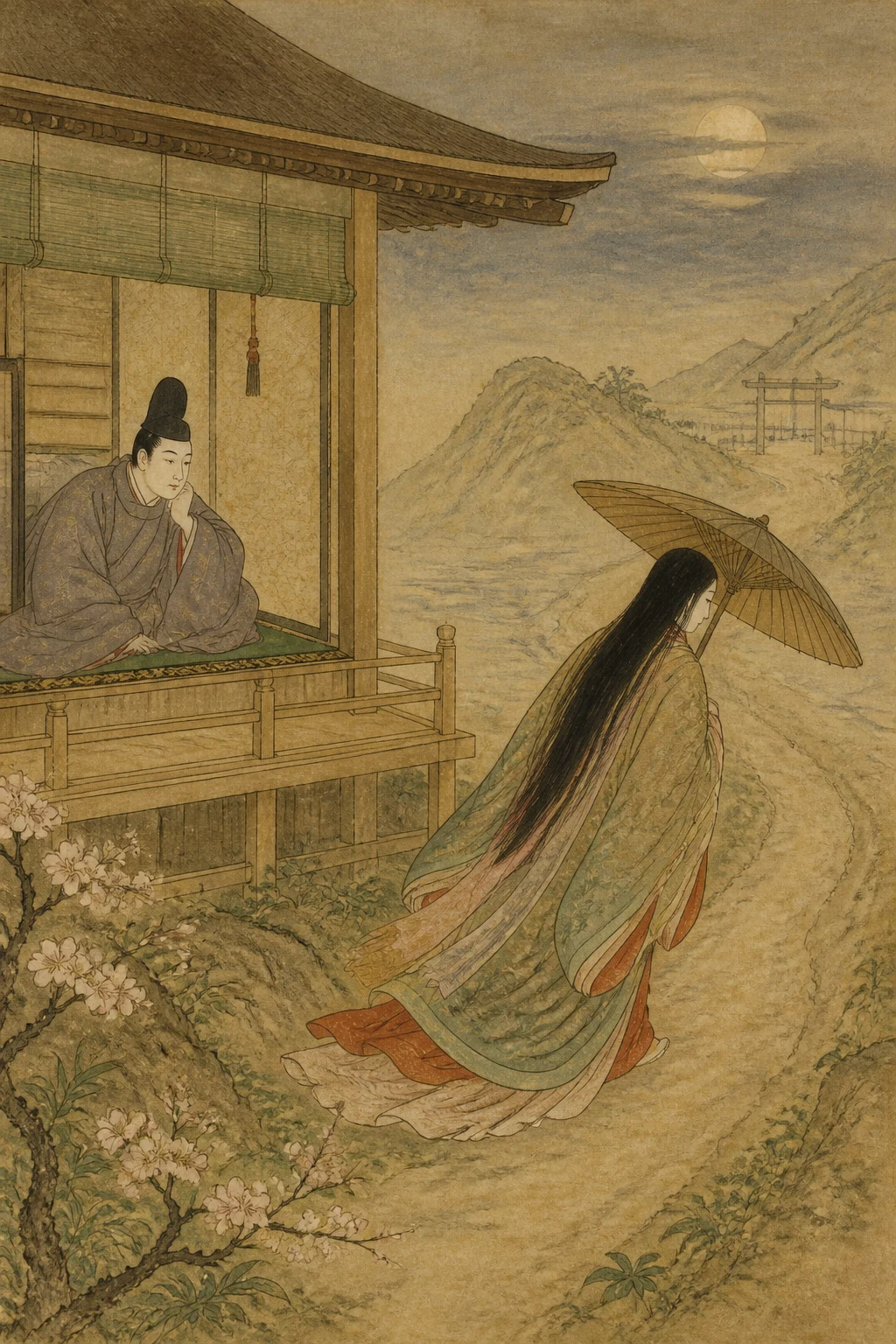
Across the way lived a man known as the Governor of Echizen. He was the father of the lady known as Haku’s mother, a poet of great distinction. His wife was Ise no Taifu, and they had several daughters. One day Take no Taifu, feeling at a loose end, went there to hear a sermon. When the wind lifted a bamboo blind, he caught sight of an exceptionally beautiful young woman dressed in layers of crimson robes. From that moment he could think of nothing but making her his wife. He befriended a young attendant in the household and questioned her. When she told him that the lady in crimson was the eldest daughter, he pressed her further, saying, “Help me steal her away.” “That is quite out of the question. I could never do such a thing,” she replied. “Then introduce me to her nurse,” he said. “That much I can do,” she answered, and made the introduction. He set about winning the nurse over, giving her a hundred ryō of gold and other gifts, and urging her to help him carry the young lady off. Perhaps it was a bond ordained in a former life, for the nurse did indeed let him steal her away. Taking the nurse with them, they hurried straight down to Hitachi. Those left behind could only weep and grieve, to no avail. After some time they sent word to the nurse. Though they found what she had done appalling and bitterly resented it, nothing could be gained by reproaches, and so they passed the years exchanging occasional messages. Haku’s mother sent this poem to Hitachi: “Has the capital’s flower / blossomed on the eastern roads? / Such was the tidings / brought by the wind / returning from the east.” Her elder sister replied: “The east wind, blowing back, / has pierced me to the heart, / for I think of it / as a messenger / from the capital’s flower.” Years passed, and Haku’s mother went down to the province as the wife of the Governor of Hitachi, but by then her elder sister had died. The sister had left two daughters, who, hearing of their aunt’s arrival, came to visit her. There was nothing rustic about them: they were wonderfully composed, refined, and lovely. Saying that the governor’s wife resembled their late mother, they wept with her. During the four years that followed, they gave no thought to making a show of their connection and said nothing of seeking her support. When her husband’s term ended and they were about to return to the capital, the Governor of Hitachi said, “What unfeeling girls they are! Send word that we are leaving.” At her husband’s urging, Haku’s mother sent them a message announcing her departure. “We have received your message and shall come to see you,” they replied. They arrived two days before she was to leave. Each brought ten magnificent horses, any one of which would have been treasured as a prized possession, and each also presented a hundred horses laden with leather-covered chests. They seemed to think nothing of it, showing no sense that they had done anything extraordinary; they simply offered their gifts and went home. All that the Governor of Hitachi had acquired during his four years in the province was as nothing beside the contents of those chests. It was with those gifts that they were able to perform all manner of pious works and do everything else they wished. “What astonishing generosity those girls showed—what breadth of heart!” people said. Among the descendants of Ise no Taifu there have been many blessed with splendid good fortune. All the more poignant and distressing, then, that her eldest daughter should have become a provincial’s wife.