Prevod
Where did we get the story? Would you like to know? We got it from the barrel, the one with the old papers in it. Many a good and rare book has found its way to the provision dealer’s and the grocer’s, not as reading matter, but as a necessary article. They must have paper for cones to hold starch and coffee beans, paper to wrap salt herring, butter, and cheese. Handwritten papers are useful too.
Things often go into the tub that ought never to go into it. I know a grocer’s boy, the son of a provision dealer; he has risen in the world, from the cellar to the ground-floor shop; a person of wide reading—paper-cone reading, both printed and handwritten. He has an interesting collection, including several important documents from the wastepaper baskets of various overworked, absent-minded officials, and the occasional confidential letter from one lady friend to another: scandalous revelations that were to go no further, never to be mentioned to a soul. He is a living rescue society for no small portion of literature, and his field is a broad one: he has his parents’ shop and his employer’s, and there he has saved many a book, or pages from a book, that might well deserve to be read twice.
He showed me his collection of printed and handwritten papers from the tub, the richest haul being from the provision dealer’s. Among them lay a couple of pages from a large exercise book; the remarkably beautiful and legible handwriting caught my attention at once.
“The student wrote that!” he said. “The student who lived just above us and died a month ago. He suffered terribly from toothache, you can see. It’s quite amusing to read! There’s only a little of it left now; there was a whole book and a bit more. My parents gave the student’s landlady half a pound of soft soap for it. This is what I managed to keep back.”
I borrowed it, I read it, and now I pass it on. The heading was: AUNTIE TOOTHACHE I Auntie gave me sweets when I was little. My teeth stood up to them and did not decay; now I am older and have become a student; she still spoils me with sweet things and says I am a poet.
I have something of the poet in me, but not enough. Often, as I walk along the city streets, I feel as though I were walking through a great library; the houses are bookcases, each floor a shelf of books. There stands a tale of everyday life, there a good old comedy, scholarly works in every field, here trashy literature and wholesome reading. I can weave fancies and philosophies about all those volumes.
There is something of the poet in me, but not enough. Many people surely have as much of it in them as I do, yet wear neither a sign nor a collar bearing the name Poet.
To them and to me a gift from God has been granted, a blessing great enough for oneself, but far too small to be divided up and shared with others. It comes like a sunbeam, filling soul and thought; it comes like the scent of flowers, like a melody one knows but cannot remember where from.
The other evening I was sitting in my room, longing for something to read, with neither a book nor a newspaper, when just then a leaf, fresh and green, fell from the lime tree. A breath of air carried it through the window to me.
I studied its many branching veins; a tiny creature was moving across them, as though bent on making a thorough study of the leaf. Then I could not help thinking of human wisdom; we too crawl about on the leaf, know only that, and promptly begin lecturing on the whole vast tree, its roots, trunk, and crown; the great tree: God, the world, and immortality—and of it all we know only one little leaf!
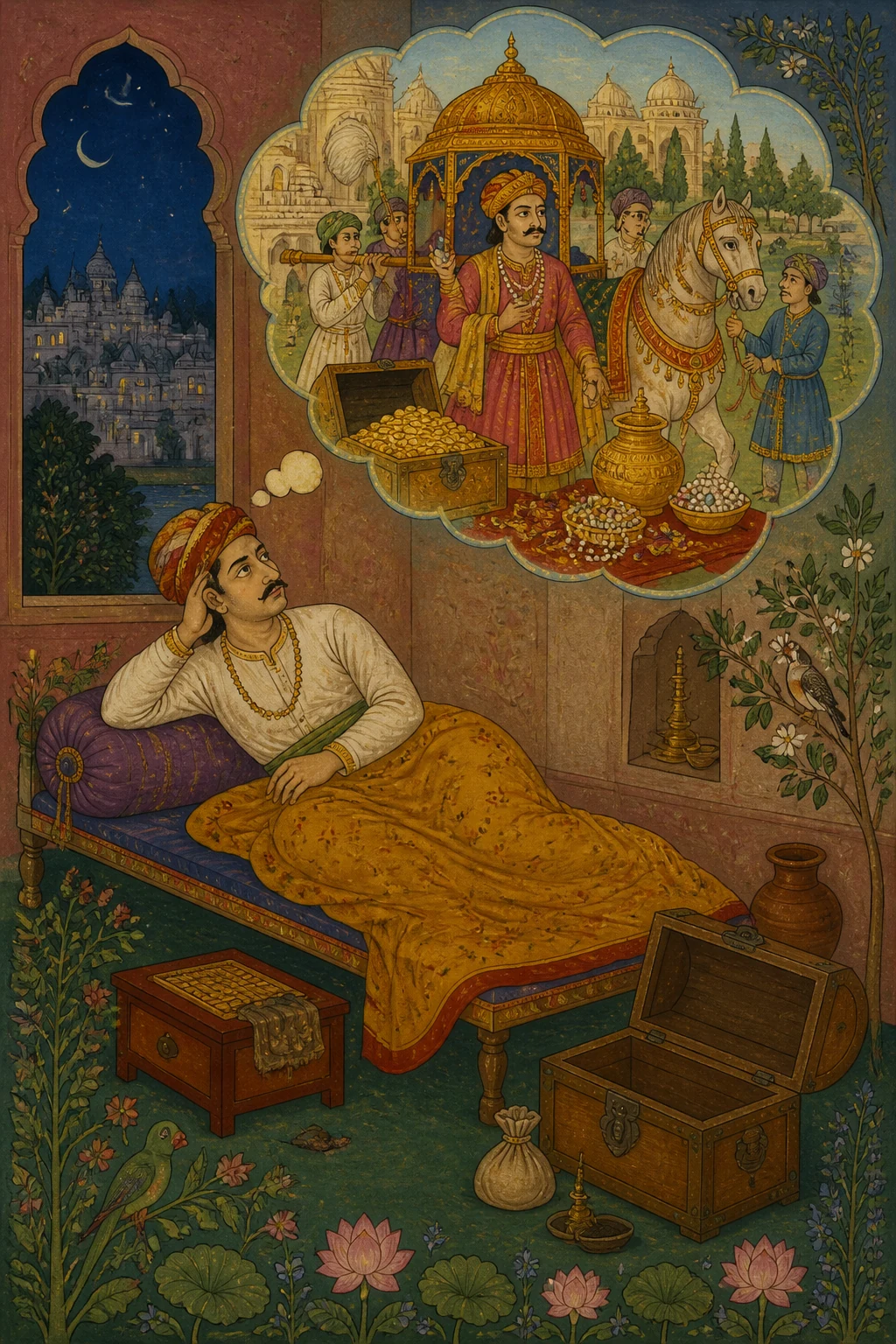
As I sat there, Auntie Mille came to visit me. I showed her the leaf with the tiny creature and told her the thoughts it had stirred in me, and her eyes shone. “You are a poet!” she said. “Perhaps the greatest we have! If I live to see it, I shall go gladly to my grave. Ever since Brewer Rasmussen’s funeral, you have amazed me with your mighty imagination!”
So said Auntie Mille, and kissed me. Who was Auntie Mille, and who was Brewer Rasmussen? II We children called Mother’s aunt Auntie; we had no other name for her.
She gave us jam and sugar, although it did our teeth a great deal of harm, but she had a weakness for the sweet children, she said. It was cruel to deny them the little bit of sweetness they loved so much.
And that was why we loved Auntie so much. She had been an old maid as far back as I could remember, always old! She stood still in age. In earlier years she had suffered a great deal from toothache and was always talking about it, and that was when her friend, Brewer Rasmussen, made his little joke and called her Auntie Toothache.
He did no brewing in his later years, lived on his investments, visited Auntie often, and was older than she was. He had no teeth at all, only a few black stumps.
As a little boy he had eaten too much sugar, he told us children, and that was how one came to look like this. Auntie surely could never have eaten sugar in her childhood; she had the loveliest white teeth.
And she took care to spare them—she did not sleep with them at night! said Brewer Rasmussen. That was being unkind, as we children knew, but Auntie said he meant nothing by it.
One morning at lunch she told us of a dreadful dream she had had during the night: one of her teeth had fallen out. “That means,” she said, “that I shall lose a true friend, a gentleman or a lady!”
“If it was a false tooth,” said the brewer with a chuckle, “then it can only mean you will lose a false friend!” “You are a rude old gentleman!” said Auntie, angrier than I had ever seen her before or have seen her since.
Later she said it was only her old friend’s teasing; he was the noblest person on earth, and when he died one day, he would become one of God’s little angels in heaven!
I thought a great deal about that transformation, and whether I would be able to recognize him in his new shape. When Auntie was young and he was young too, he had proposed to her. She had considered it too long, had sat waiting, had sat waiting far too long, and remained an old maid forever, but always a faithful friend.
Then Brewer Rasmussen died. He was taken to his grave in the most expensive hearse, with a large procession following him, people wearing decorations and uniforms. Auntie stood at the window in mourning with all of us children, except our little brother, whom the stork had brought a week before.
Now the hearse and the mourners had passed, the street was empty, and Auntie wanted to leave the window, but I did not; I was waiting for the angel, Brewer Rasmussen. He had become a little winged child of God now, after all, and he was bound to appear.
“Auntie!” I said. “Don’t you think he’ll come now? Or that when the stork brings us another little brother, he’ll bring us the angel Rasmussen?”
Auntie was quite overwhelmed by my imagination and said, “That child will be a great poet!” And she repeated it throughout my schooldays, indeed after my confirmation, and now into my student years.
She was and is my most sympathetic friend, both in the pangs of poetry and in toothache. For I have attacks of both. “Just write down all your thoughts,” she said, “and put them in your desk drawer; that is what Jean Paul did. He became a great poet, though I must admit I don’t care for him; he isn’t exciting! You must be exciting! And you will be exciting!”
The night after that conversation I lay in longing and anguish, in the urge and desire to become the great poet Auntie saw and sensed in me; I lay in the pangs of poetry! But there is a worse pain: toothache. It crushed and ground me down; I became a writhing worm, with a bag of herbs and a blister of Spanish fly:
“I know what that is!” said Auntie. A sorrowful smile played about her mouth; her teeth shone so white. * But I must begin a new chapter in the story of Auntie and me.
III I had moved into new lodgings and had been living there a month. I spoke to Auntie about them. “I live with a quiet family; they take no notice of me even if I ring three times. Otherwise it is a truly uproarious house, full of the noise and racket of wind and weather and people. I live just above the gateway; every carriage that drives in or out sets the pictures on the wall moving. The gate slams and shakes the house as though there were an earthquake. If I am lying in bed, the shocks go through every limb; but it is supposed to strengthen the nerves. When the wind blows, and it is always blowing in this country, the long window hooks outside dangle to and fro and strike the wall. The bell at the neighbour’s courtyard gate rings with every gust.
The people in our house come home in dribs and drabs, late in the evening and far into the night; the lodger directly above me, who gives trombone lessons during the day, comes home latest of all, and never goes to bed without first taking a little midnight stroll in his heavy, iron-shod boots.
There are no double windows, but there is a broken pane, which the landlady has pasted paper over; all the same, the wind blows through the crack and makes a noise like a buzzing horsefly. That is my lullaby. If I finally fall asleep, I am soon woken by a cock crowing. The cock and hen in the cellar tenant’s chicken pen announce that it will soon be morning. The little Norwegian ponies have no stable; they are tethered in the sand pit under the stairs and kick at the door and panelling to stretch their legs.
Day dawns; the porter, who sleeps in the attic with his family, comes thundering down the stairs; his wooden slippers clatter, the gate slams, the house shakes, and when that is over, the lodger upstairs begins his exercises, lifting a heavy iron ball in each hand, which he cannot keep hold of; down it falls, and down it falls again, while at the same time the youngsters of the house come rushing out, shrieking, on their way to school. I go to the window and open it for fresh air, and it is refreshing when I can get it, and the young woman in the back building is not washing gloves in cleaning fluid; that is how she earns her living. Otherwise it is a pleasant house, and I live with a quiet family.”
That was the account I gave Auntie of my lodgings; I gave it more vividly, for spoken words have a freshness that written words lack. “You are a poet!” cried Auntie. “Just write down what you have said, and you will be as good as Dickens! Indeed, you interest me a great deal more! You paint as you speak! You describe your house so that one can see it! It makes one shudder! Go on inventing! Put something living into it, people, delightful people, preferably unhappy ones!”
I did indeed write down the house as it stands, with its sounds and shortcomings, but with only myself in it, and no plot. That came later! IV It was wintertime, late in the evening, after the theatres had closed, and the weather was dreadful, a blizzard so fierce that one could scarcely force a way through it.
Auntie had been at the theatre, and I was there to see her home, but it was hard enough to walk oneself, let alone escort anyone else. All the hired carriages had been taken; Auntie lived far out in the city, whereas my lodgings were close to the theatre. Had that not been so, we should have had to stand in a sentry box until further notice.
We staggered through the deep snow, the whirling flakes sweeping around us. I lifted her, I held her up, I pushed her along. Only twice did we fall, but we fell softly.
We reached my gateway, where we shook the snow off ourselves; we shook ourselves on the stairs too, and still had enough snow left to cover the floor of the entrance hall. We took off our outer clothes and our underclothes, and every garment we could shed. The landlady lent Auntie dry stockings and a dressing gown; it was necessary, said the landlady, and added, quite truly, that Auntie could not possibly get home that night. She asked her to make do with her sitting room, where she would make up a bed on the sofa in front of the always-locked door into my room.
And so it was done. The fire burned in my stove, the tea urn was brought to the table, and the little room grew cosy, though not as cosy as Auntie’s, where in winter there are thick curtains over the door, thick curtains over the windows, and two carpets with three layers of thick paper underneath; sitting there is like being in a well-stoppered bottle of warm air. Still, as I have said, it grew cosy in my room too; outside, the wind howled.
Auntie talked and told stories; the days of her youth returned, the brewer returned, old memories. She could remember when I got my first tooth, and the joy it brought the family.
The first tooth! The tooth of innocence, shining like a little white drop of milk, the milk tooth. One came, then more, a whole rank, side by side, above and below, the loveliest children’s teeth, and yet only the advance guard, not the real ones that were to last a lifetime.
Those came too, and the wisdom teeth with them, the men at the ends of the ranks, born in pain and great tribulation. They go again, every one of them! They leave before their term of service is over; even the last tooth goes, and that is no day of rejoicing, but a day of sorrow.
Then one is old, even if one’s spirits are young. Such thoughts and talk are not cheerful, and yet we came to speak of all these things; we went back to the years of childhood and talked and talked. It was twelve o’clock before Auntie went to bed in the next room.
“Good night, my sweet child!” she called. “Now I shall sleep as though I were lying in my own chest of drawers!” And she settled down to rest; but there was no rest either in the house or outside it. The storm rattled the windows, clattered the long, dangling iron hooks, and rang the neighbour’s doorbell in the back courtyard. The lodger upstairs had come home. He took another little nightly stroll up and down, flung off his boots, and went to bed and to rest; but he snores so loudly that anyone with good ears can hear him through the ceiling.
I found no rest, I could not settle down; nor would the weather settle down; it was outrageously lively. The wind whistled and sang in its fashion, and my teeth began to grow lively too; they whistled and sang in theirs. They struck up the opening notes of a mighty toothache.
There was a draught from the window. The moon shone onto the floor. Its light came and went as the clouds came and went in the storm. Shadow and light shifted restlessly, but at last the shadow on the floor began to take a shape; I watched the moving thing and felt an icy-cold breath of air.
On the floor sat a figure, thin and long, like something a child draws with a slate pencil to look like a person; a single thin line is the body; one line and another are the arms; each leg is only a line too, and the head is a many-sided shape.
Soon the figure grew clearer; it acquired a sort of dress, very thin, very fine, but enough to show that it was female. I heard a buzzing. Was it she, or the wind humming like a horsefly in the crack in the window?
No, it was she herself, Mrs Toothache! Her Terribleness Satania infernalis—God save and preserve us from her visits. “This is a good place to be!” she buzzed. “Fine quarters here! Swampy soil, boggy ground. Here the mosquitoes have buzzed with poison in their stings; now I have the sting. It must be sharpened on human teeth. How white they shine in this fellow here in bed. They have defied sweet and sour, hot and cold, nutshells and plum stones! But I shall rock them and wrench them, manure their roots with draughts, and give them cold feet!”
It was a dreadful speech, a dreadful visitor. “So you are a poet!” she said. “Well, I shall make poetry of you in every metre of pain! I shall put iron and steel into your body, and thread every one of your nerve-threads!”
It was as though a red-hot awl were piercing my cheekbone; I twisted and turned. “An excellent set of teeth!” she said. “An organ to play upon. A grand mouth-harp concerto, with kettledrums and trumpets, piccolo flute, and a trombone in the wisdom tooth. Great poet, great music!”
Oh, how she played, and how dreadful she looked, even though all one could see of her was her hand, that shadow-grey, icy-cold hand with its long, awl-thin fingers; each was an instrument of torture: Thumb and Pointer had pincers and a screw, Longman ended in a pointed awl, Goldbrand was a gimlet, and Little Finger a syringe filled with mosquito poison.
“I shall teach you metre!” she said. “A great poet must have great toothache, a little poet little toothache!” “Oh, let me be little!” I begged. “Let me be nothing at all! And I am no poet; I only have attacks of making poetry, attacks like toothache! Go away! Go away!”
“Do you acknowledge, then, that I am mightier than poetry, philosophy, mathematics, and all music?” she said. “Mightier than all these feelings painted in pictures and carved in marble! I am older than all of them. I was born close to the Garden of Eden, outside it, where the wind blew and the wet toadstools grew. I made Eve put on clothes in the cold weather, and Adam too. You may be sure there was power in that first toothache!”
“I believe everything!” I said. “Go away! Go away!” “Well, if you will give up being a poet, never set down verse on paper, slate, or any sort of writing material, then I shall let you go; but if you write poetry, I shall return!”
“I swear!” I said. “Only let me never see or feel you again!” “See me you shall, but in a fuller figure, one dearer to you than mine is now! You shall see me as Auntie Mille, and I shall say: Write poetry, my sweet boy! You are a great poet, perhaps the greatest we have! But if you believe me and begin to write poetry, I shall set your verses to music and play them on your mouth-harp! Sweet child! Remember me when you see Auntie Mille!”
Then she vanished. As a farewell I felt something like the stab of a red-hot awl up into my jawbone; but it soon subsided, and I seemed to glide over soft water, saw the white water lilies with their broad green leaves bend and sink beneath me, wither and dissolve, and I sank with them, dissolving into peace and rest.
“Die, melt away like snow!” sang and rang the voices in the water. “Vanish into the cloud, drift away like the cloud!” Down through the water great, shining names gleamed at me, inscriptions on fluttering banners of victory, the patent of immortality—written on a mayfly’s wing.
My sleep was deep, a dreamless sleep. I heard neither the howling wind, the slamming gate, the neighbour’s ringing gate bell, nor the lodger’s strenuous gymnastics.
Bliss! Then came a gust of wind so strong that the locked door into Auntie’s room burst open. Auntie sprang up, slipped into her shoes, got into her clothes, and came in to me.
I was sleeping like an angel of God, she said, and she could not bear to wake me. I woke of my own accord and opened my eyes, having quite forgotten that Auntie was in the house; but soon I remembered, remembered my vision of toothache. Dream and reality merged into one another.
“You didn’t write anything last night after we said good night, did you?” she asked. “I wish you had! You are my poet, and you always will be!”
I thought there was something so sly about her smile. I did not know whether it was kind Auntie Mille, who loved me, or the dreadful creature to whom I had given my promise in the night.
“Have you been writing poetry, sweet child?” “No, no!” I cried. “You are Auntie Mille, aren’t you?” “Who else?” she said. And it was Auntie Mille. She kissed me, got into a cab, and drove home.
I wrote down what is written here. It is not in verse, and it shall never be printed. * Yes, there the manuscript ended. My young friend, the future grocer’s assistant, could not find what was missing; it had gone out into the world as wrapping paper for salt herring, butter, and soft soap; it had fulfilled its destiny.
The brewer is dead, Auntie is dead, the student is dead, he whose sparks of thought went into the tub. Everything goes into the tub. That is the end of the story—the story of Auntie Toothache.