Waltey
Tat, demon in opica
Pančatantra · indijska zbirka pripovediO besedilu
Tat, demon in opica
- Vir
- Pančatantra
- Avtor
- indijska zbirka pripovedi
- Jezik branja
- English
- Jezik izvirnika
- Sanskrit
- Čas branja
- 14 min branja
- Obseg
- 11 strani
- Naslov izvirnika
- Tantra 05 apariksita-karaka chunk 4
O izvirniku
Pančatantra
Indijske zgodbe o zvijači, prijateljstvu in modrosti v svetu živali in vladarjev. Bralni jezik je English, izvirnik pa prihaja iz vira Pančatantra v jeziku Sanskrit.
Besedilo
Tat, demon in opica
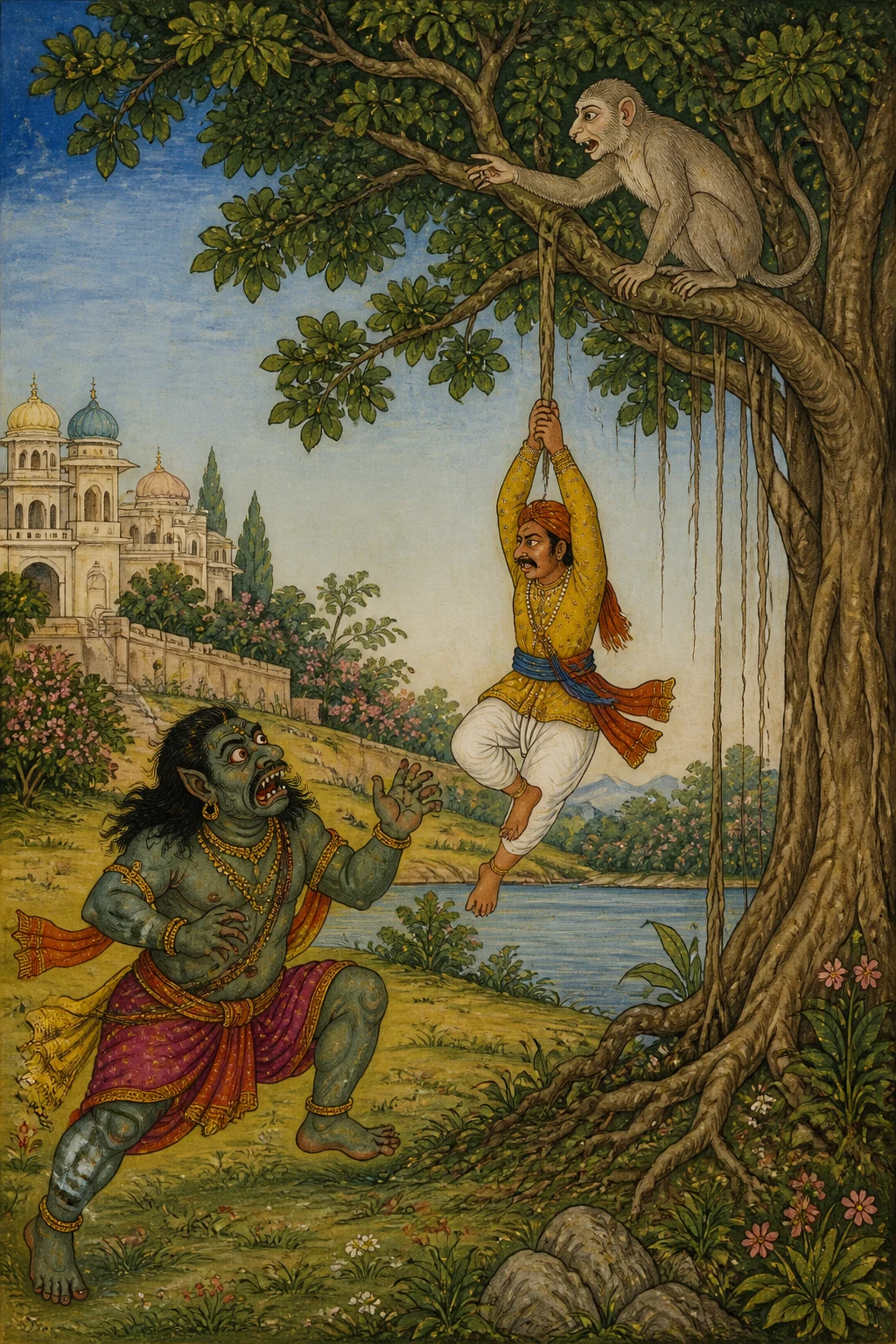
Meanwhile, the rakshasa thought, “Surely this is the creature called Vikala. Taking me for a thief, he has come in a rage to kill me. What am I to do?” While he was thinking this, the thief put a bridle in his mouth and struck him with a whip. Terrified, the rakshasa began to gallop. After they had gone some distance, the thief pulled on the reins to stop him, but he only ran faster and faster. Seeing that he paid no heed to the reins, the thief thought, “Ah, no horse behaves like this, utterly ignoring the bridle! This must be a rakshasa in the shape of a horse. If I can find a patch of soft, dusty ground, I will throw myself onto it. Otherwise, I have no hope of surviving.” As he was thinking this and calling upon his chosen deity, the horse passed beneath a banyan tree. The thief caught hold of an aerial root and clung to it. Thus separated, both were overjoyed, each having recovered some hope of staying alive.
Now a monkey who was a friend of the rakshasa lived in that banyan tree. Seeing the rakshasa so frightened, he called out, “My friend! Why are you running away from an imaginary danger? This man is food for you. Eat him!”
Hearing the monkey’s words, the rakshasa resumed his own shape and turned back with hesitant steps, his mind still full of misgivings. The thief, realizing that the monkey had called him back, angrily caught the monkey’s dangling tail in his mouth and bit it.
Thinking the thief even more formidable than the rakshasa, the monkey dared not utter a word. He merely stayed there with his eyes shut, tormented by pain. Seeing him in this state, the rakshasa recited this verse:
“Monkey, the look upon your face speaks plainly:
Vikala has caught you! He who flees lives.”
With these words he fled. “So let me go, that I may return home. You may stay here and enjoy the fruit of the tree of greed.”
Chakradhara said, “My friend, that is no reason. Good and ill befall men at the bidding of fate. As the saying goes: ‘His fortress was Trikuta, his moat the sea,
His warriors rakshasas, his wealth from the Lord of Riches;
His code of statecraft was devised by Ushanas himself—
Yet even Ravana perished at the bidding of fate.’
And again:
‘A blind man, a hunchback, and a princess with three breasts—
All three prospered through wrongdoing when fortune turned in their favor.’”
Suvarnasiddhi asked, “How was that?” Chakradhara replied: “Tale 11, The Blind Man, the Hunchback, and the Three-Breasted Princess. In the northern region of this earth there is a city called Madhupura. A king named Madhusena once ruled there. While he was enjoying the pleasures of life, a daughter with three breasts was born to him. On hearing of her birth, the king said to his chamberlains, ‘Take this three-breasted girl far away into the forest and abandon her where no one will know.’ The chamberlains replied, ‘Your Majesty, it is well known that a girl with three breasts brings misfortune. Even so, the Brahmins should be summoned and consulted, so that nothing is done contrary to your welfare in this world or the next. For:
‘He who constantly asks questions, listens, and remembers
Grows in understanding as a lotus grows beneath the sun’s rays.
And again:
‘A wise man should always ask questions.
Once, even a Brahmin seized by a mighty rakshasa won his freedom by asking a question.’”
The king asked, “How was that?” They replied: “Tale 12, The Rakshasa Named Chandakarman. Your Majesty, in a certain forest there lived a rakshasa named Chandakarman. One day, while wandering through the woods, he came upon a Brahmin. Climbing onto his shoulders, he said, ‘Now, move along!’ Terrified, the Brahmin set off carrying him. Then, noticing that the rakshasa’s feet were as soft as the heart of a lotus, the Brahmin asked, ‘Sir, why are your feet so very soft?’
The rakshasa replied, ‘I have taken a vow never to touch the ground while my feet are wet.’
Hearing this, the Brahmin began to consider a means of escape. They came to a lake, and the rakshasa said, ‘You must not leave this spot until I have bathed, performed my worship, and returned.’
When the rakshasa went into the water, the Brahmin thought, ‘Surely he will eat me when he has finished his worship. I had better hurry away, for with his feet wet he will not follow me.’
He did so, and the rakshasa, afraid of breaking his vow, did not pursue him. That is why I say, ‘A wise man should always ask questions.’”
After hearing their story, the king summoned the Brahmins and said, “Brahmins, a daughter with three breasts has been born to me. Is there any remedy for this, or not?”
“A girl born with a limb too few or too many
Will bring destruction upon her husband and the ruin of her own virtue.
And a girl with three breasts, should she come before her father’s eyes,
Will swiftly bring about his death—of this there is no doubt.
Therefore Your Majesty must avoid seeing her. If anyone is willing to marry her, give her to him and require him to leave the country. By doing so, you will act against neither your welfare in this world nor your welfare in the next.”
On hearing their advice, the king ordered a proclamation to be made everywhere to the beating of a drum: “Hear this! Whoever marries the king’s three-breasted daughter shall receive a hundred thousand gold pieces and must leave the country.”
A long time passed while this proclamation was made, but no one would accept her. Meanwhile, the girl approached womanhood, living in a secluded place under close guard.
Now in that same city there lived a blind man. A hunchback named Mantharaka guided him, holding his staff. When the two heard the proclamation, they took counsel together. “Let us touch the drum in acceptance. If fortune somehow grants us the girl and the gold, we can spend our days comfortably on the money. And if her defect brings death, at least there will be an end to the misery poverty has brought us. For it is said: ‘Modesty, affection, sweetness of voice, intelligence, the bloom of youth,
The company of a beloved, love of one’s kin, freedom from sorrow, pleasure,
Virtue, learning, wisdom like the gods’ preceptor’s, purity, concern for proper conduct—
All these arise in living beings when the vessel of the belly is full.’”
Having said this, the blind man went and touched the drum. “I will marry the girl,” he declared, “if the king will give her to me.”
The king’s officers went and reported, “Your Majesty, a blind man has touched the drum. Your Majesty must decide what is to be done.”
The king said:
“Whether blind or deaf, a leper or an outcaste,
Let him take the girl and the hundred thousand, and go abroad.”
At the king’s command, his officers took the blind man to the riverbank, married the three-breasted princess to him according to the rites, and gave him the hundred thousand gold pieces. They put them aboard a boat and told the boatmen, “Take this blind man, his wife, and the hunchback to another country, and set them ashore in some town.” This was done. On reaching a foreign land, the three bought a house in a town pointed out by the boatmen and lived comfortably. The blind man spent his time lying on a couch, while Mantharaka attended to the household affairs. As time passed, the three-breasted woman entered into an illicit affair with the hunchback. Indeed, it is aptly said:
“If fire should become cool, the moon give forth heat,
And the sea grow sweet to the taste, then women might become faithful.”
One day the three-breasted woman said to Mantharaka, “My handsome one, if we could somehow kill this blind man, we could live happily together. Find some poison somewhere, so that I may give it to him and be happy.” On another day, as the hunchback wandered about, he found a dead black snake. Delighted, he picked it up, brought it home, and said to her, “My lovely one, I have found this black snake. Cut it into pieces, season it with plenty of dried ginger and other spices, and give it to that sightless fellow, telling him it is fish. He will soon die, for he has always been fond of fish.” With these words Mantharaka went out. She cut the black snake into pieces, put them in a pot of buttermilk over a blazing fire, and, busy with the housework, spoke affectionately to the blind man. “My dear husband, I have brought the fish you love. You are always asking for it. It is cooking over the fire now. While I attend to the housework, take the ladle and stir it for a little while.” Delighted to hear this, he licked the corners of his mouth, rose quickly, took the ladle, and began to stir. As he stirred the supposed fish, the venom-laden steam touched his eyes, and the dark film covering them began to fall away. Finding the steam beneficial, he deliberately exposed his eyes to more of it. His sight returned, and when he looked into the pot, he saw nothing but pieces of black snake in the buttermilk. He thought, “Ah, what is this? She told me it was fish, but these are pieces of a black snake! I must discover exactly what this three-breasted woman is up to. Is this a plot to kill me, or the hunchback, or someone else?” With this in mind, he concealed his discovery and continued to act as blindly as before. Just then the hunchback returned and, suspecting nothing, began to embrace and kiss the three-breasted woman. The blind man watched him, but could see no weapon anywhere. Furious, he went back to the couch as before, seized the hunchback by both feet, whirled him with all his strength over his head, and struck the three-breasted woman in the chest with him.
The blow from the hunchback drove her third breast back into her chest, while the force of being whirled overhead straightened the hunchback’s body.
***********************************************************************
That is why I say, ‘A blind man, a hunchback…’ (84).”
Suvarnasiddhi said, “My friend, that is true. When fate is favorable, everything turns out well. Even so, a man should heed the advice of good people, and always conduct himself accordingly. Whoever does otherwise comes to ruin, as you have. For:
‘Sharing one belly, but with separate necks, each eating its own fruit,
Those who cannot live in harmony perish like the Bharunda birds.’”
Chakradhara asked, “How was that?” Suvarnasiddhi replied: “Tale 13, The Bharunda Bird. Beside a certain lake lived a bird called Bharunda, which had one belly but two necks. Once, while wandering along the seashore, it found a fruit, sweet as nectar, that the waves had washed ashore. As one mouth ate it, it said, ‘Ah! I have eaten many nectar-sweet fruits brought in by the ocean waves, but never have I tasted anything like this. Could it come from a heavenly parijata or sandalwood tree? Or has some mysterious turn of fate cast down this fruit made of nectar?’
As it spoke, the second mouth said, ‘If that is so, give me a little too, so that I may also enjoy its taste.’
The first mouth laughed and replied, ‘We have only one belly, and either way we shall both be satisfied. What is the use of eating separately? Better to give what remains to our beloved and please her.’
With these words it gave the rest to its mate. She tasted it and was so delighted that she showered it with embraces, kisses, affectionate attentions, and many other endearments. From that day onward, the second mouth remained resentful and dejected.
One day the second mouth found a poisonous fruit. Showing it to the other, it said, ‘You heartless wretch! You vile, selfish creature! I have found a poisonous fruit, and I am going to eat it to repay your insult.’
The other replied, ‘Fool! No, do not do that! If you do, we shall both perish.’ But even as it spoke, the offended mouth ate the fruit. In short, both perished.
***********************************************************************
That is why I say, ‘Sharing one belly, but with separate necks…’ (92).”
Chakradhara said, “That is true. Go home, then. But you must not travel alone. For it is said:
‘Do not enjoy fine food alone, nor deliberate on your affairs alone;
Do not travel a road alone, nor keep watch alone while others sleep.’
And again:
‘Even a weak companion can bring safety on the road:
A crab, taken as a companion, once saved a man’s life.’”
Suvarnasiddhi asked, “How was that?” Chakradhara replied: “Tale 14, The Brahmin and the Crab. In a certain town lived a Brahmin named Brahmadatta. He was about to set out for a village on business when his mother said to him, ‘My child, why are you going alone? Find someone to accompany you.’
He replied, ‘Mother, do not be afraid. The road is free of danger. I shall go alone, for my business cannot wait.’
Seeing that he was determined, his mother fetched a crab from a nearby well and said, ‘My child, if you must go, let this crab at least be your companion. Take it with you.’
At his mother’s bidding, he took it in both hands, placed it in a packet of camphor, put the packet in a container, and quickly set out.
As he traveled, the summer heat wore him out. He came to a tree beside the road and fell asleep beneath it. Meanwhile, a snake emerged from a hollow in the tree and approached him.
Drawn by its intense craving for camphor, the snake swallowed the packet inside the container. The crab, which was still in it, killed the snake. When the Brahmin awoke, he saw a dead black snake beside him, lying over his packet of camphor. Looking at it, he thought, “The crab has killed it.” Delighted, he said, “Ah, my mother spoke truly when she said that a man should take some companion and never travel alone. Because I followed her advice with a trusting heart, this crab has saved me from certain death. Indeed, it is well said:
‘When waning, the moon seeks refuge with the sun; when full, it swells the ocean’s waters.
Some help us in adversity; others enjoy our prosperity.
‘In a sacred formula, a holy place, a Brahmin, a god, an astrologer, a medicine, or a teacher,
The success one finds is equal to the faith one places there.’”
Having heard this, Suvarnasiddhi took his leave of Chakradhara and returned to his own home.
Thus ends the fifth book, entitled “Ill-Considered Action,” of the Panchatantra composed by the venerable Vishnusharman.
“Even so, show me that lion of a thief, so that I may kill him.”
(alt.) He who sees, truly sees. (alt.) By the king’s officers. (alt.) The Tale of Devashakti.
Izvirnik
Tantra 05 apariksita-karaka chunk 4
Naslednje strani prikazujejo izvirno besedilo za primerjavo.
Source ID: panchatantra_gretil_tantra_05_chunk_04
Source URL: https://gretil.sub.uni-goettingen.de/gretil/1_sanskr/5_poetry/4_narr/vispancu.htm
atrāntare rākṣasaś cintayāmāsa-nūnam eṣa vikāla-nāmā māṃ cauraṃ matvā kopān nihantum āgataḥ | tat kiṃ karomi ? evaṃ cintayan so 'pi tena khalīnaṃ mukhe nidhāya kaśāghātena tāḍitaḥ | athāsau bhaya-trasta-manāḥ pradhāvitum ārabdhaḥ |
cauro 'pi dūraṃ gatvā khalīnākarṣaṇena taṃ sthiraṃ kartum ārabdhavān | sa tu vegād vegataraṃ gacchati | atha taṃ tathāgaṇita-khalīnākarṣaṇaṃ matvā cauraś cintayāmāsa-aho naivaṃ-vidhā vājino bhavanty agaṇita-khalīnāḥ | tan nūnam anenāśva-rūpeṇa rākṣasena bhavitavyam | yadyapi kañcit pāṃsulaṃ bhūmi-deśam avalokayāmi tad ātmānaṃ tatra pātayāmi | nānyathā me jīvitavyam asti |
evaṃ cintayata iṣṭa-devatāṃ smaratas tasya so 'śvo baṭa-vṛkṣasya tale niṣkrāntaḥ | cauro 'pi baṭa-praroham āsādya tatraiva vilagnaḥ | tato dvāv api tau pṛthag-bhūtau paramānanda-bhājau jīvita-viṣaye labdha-pratyāśau sampannau |
atha tatra baṭe kaścid rākṣasa-suhṛd vānaraḥ sthita āsīt | tena rākṣasaṃ trastam ālokya vyāhṛtam-bho mitra ! kim eva alāyyate'līka-bhayena ? tad bhakṣyo 'yaṃ mānuṣaḥ bhakṣyatām |
so 'pi vānara-vaco niśamya, svarūpam ādhāya śaṅkita-manāḥ skhalita-gatir nivṛttaḥ | cauro 'pi taṃ vānarāhūtaṃ jñātvā kopāt tasya lāṅgulaṃ lambamānaṃ mukhe nidhāya carvitavān |
vānaro 'pi taṃ rākṣasābhyadhikaṃ manyamāno bhayān na kiñcid uktavān | kevalaṃ vyathārto nimīlita-nayanas tiṣṭhati | rākṣaso 'pi taṃ tathā-bhūtam avalokya ślokam enam apaṭhat-
yādṛśī vacana-cchāyā dṛśyate tava vānara |
vikālena gṛhīto 'si yaḥ paraiti sa jīvati
ity uktvā praṇaṣṭaś ca | tat preṣaya māṃ yena gṛhaṃ gacchāmi | tvaṃ punar anubhuṅkṣvātra sthita eva lobha-vṛkṣa-phalam |
cakradhara āha-bhoḥ akāraṇam etat | daiva-vaśāt sampadyate nṛṇāṃ śubhāśubham | uktaṃ ca-
durgas trikūṭaḥ parikhā samudro
rakṣāṃsi yodhā dhanadāc ca vittam |
śāstraṃ ca yasyośanasā praṇītaṃ
sa rāvaṇo daiva-vaśād vipannaḥ
tathā ca-
andhakaḥ kubjakaś caiva tristanī rāja-kanyakā |
trayo 'py anyāyataḥ siddhāḥ saṃmukhe karmaṇi sthite
suvarṇa-siddhiḥ prāha-katham etat ?
so 'bravīt-
kathā 11
andhaka-kubjaka-tristanī-kathā
asty atra dharā-tala uttarā-pathe madhu-puraṃ nāma nagaram | tatra madhusenā nāma rājā babhūva | tasya kadācid viṣaya-sukham anubhavatas tristanī kanyā babhūva | atha tāṃ trastanīṃ jātāṃ śrutvā sa rājā kañcukinaḥ provāca, yad-bhos tyajyatām iyaṃ trastanī gatvā dūre'raṇye yathā kaścin na jānāti |
tac chrutvā kañcukinaḥ procuḥ-mahārāja jñāyate yad aniṣṭa-kāriṇī tristanī kanyā bhavati | tathāpi brāhmaṇam āhūya praṣṭavyāḥ, yena loka-dvayaṃ na virudhyate, yataḥ-
yaḥ satataṃ paripṛcchati śṛṇoti sandhārayaty aniśam |
tasya divākara-kiraṇair nalinīva vivardhate buddhiḥ
tathā ca-
pṛcchakena sadā bhāvyaṃ puruṣeṇa vijānatā |
rākṣasendra-gṛhīto 'pi praśnān mukto dvijaḥ purā
rājā āha--katham etat ?
te procuḥ-
kathā 12
caṇḍakarma-nāma-rākṣasa-kathā
deva ! kasmiṃścid vanoddeśe caṇḍakarmā nāma rākṣasaḥ prativasati sma | ekadā tena bhramatāṭavyāṃ kaścid brāhmaṇaḥ samāsāditaḥ | tatas tasya skandham āruhya provāca-bho agresaro gamyatām |
brāhmaṇo 'pi bhaya-trasta-manās tam ādāya prasthitaḥ | atha tasya kamalodara-komalau pādau dṛṣṭvā brāhmaṇo rākṣasam apṛcchat-bhoḥ ! kim evaṃ-vidhau te pādāv atikomalau ?
rākṣasa āha-bhoḥ ! vratam asti, nāham ārdra-pādo bhūmiṃ spṛśāmi |
tatas tac chrutvātmano mokṣopāyaṃ cintayaṃs tat-saraḥ prāptaḥ | tato rākṣasenābhihitaṃ-bhoḥ ! yāvad ahaṃ snānaṃ kṛtvā devatārcana-vidhiṃ vidhāyāgacchāmi tāvat tvayātaḥ sthānād anyatra na gantavyam |
tathānuṣṭhite divjaś cintayāmāsa-nūnaṃ devatārcana-vidher ūrdhvaṃ mām eṣa bhakṣayiṣyati | tad drutataraṃ gacchāmi, yenaiṣa ārdra-pādo na mama pṛṣṭham eṣyati |
tathānuṣṭhite rākṣaso vrata-bhaṅga-bhayāt tasya pṛṣṭhaṃ na gataḥ | ato 'haṃ bravīmi-pṛcchakena sadā bhāvyam iti |
atha tebhyas tac chrutvā-rājā dvijān āhūya provāca-bho brāhmaṇāḥ ! tristanī me kanyā samutpannā, tat kiṃ tasyāḥ pratividhānam asti, na vā ?
hīnāṅgī vādhikāṅgī vā yā bhavet kanyakā nṛṇām |
bhartuḥ syāt sā vināśāya sva-śīla-nidhanāya ca
yā punas tristanī kanyā yāti locana-gocaram |
pitaraṃ nāśaty eva sā drutaṃ nātra saṃśayaḥ
tasmād asyā darśanaṃ pariharatu devaḥ | tathā yadi kaścid udvāhayati, tad enāṃ tasmai dattvā, deśa-tyāgena sa niyojayitavyaḥ iti | evaṃ-kṛte loka-dvayāviruddhatā bhavati |
atha teṣāṃ tad-vacanam ākarṇya sa rājā paṭaha-śabdena sarvatra ghoṣaṇām ājñāpayāmāsa-aho ! tristanīṃ rājakanyāṃ yaḥ kaścid udvāhayati sa suvarṇa-lakṣam āpnoti deśa-tyāgaṃ ca |
evaṃ tasyām āghoṣaṇāyāṃ kriyamāṇāyāṃ mahān kālo vyatītaḥ | na kaścit tāṃ pratigṛhṇāti | sāpi yauvanonmukhī sañjātā sugupta-sthāna-sthitā yatnena rakṣyamāṇā tiṣṭhati |
atra tatraiva nagare kaścid andhas tiṣṭhati | tasya ca mantharaka-nāmā kubjo 'gresaro yaṣṭi-grāhī | tābhyāṃ taṃ paṭaha-śabdam ākarṇya, mitho mantritaṃ-spṛśyate'yaṃ paṭahaḥ | yadi katham api daivāt kanyā labhyate | suvarṇa-prāptiś ca bhavati, tathā sukhena suvarṇa-prāptyā kālo vrajati | atha yadi tasya doṣato mṛtyur bhavati | tadā dāridryopāttasyāsya kleśasya paryanto bhavati | uktaṃ ca-
lajjā snehaḥ svara-madhuratā buddhayo yauvana-śrīḥ
kāntāsaṅgaḥ svajana-mamatā duḥkha-hānir vilāsaḥ |
dharmaḥ śāstraṃ sura-guru-matiḥ śaucam ācāra-cintā
pūrṇe sarve jaṭhara-piṭhare prāṇināṃ sambhavanti
evam uktvāndhena gatvā, sa paṭahaḥ spṛṣṭaḥ | uktaṃ ca-bhoḥ ! ahaṃ tāṃ kanyām udvāhayāmi, yadi rājā me prayacchati |
tatas tai rāja-puruṣair gatvā rājñe niveditam-deva ! andhena kenacit paṭahaḥ spṛṣṭaḥ | tad atra viṣaye devaḥ pramāṇam |
rājā prāha-
andho vā vadhiro vātha kuṣṭī vāpy antyajo 'pi vā |
parigṛhṇātu tāṃ kanyāṃ sa-lakṣāṃ syād videśagaḥ
atha rājādeśāt tai rāja-puruṣais taṃ nadī-tīre nītvā suvarṇa-lakṣeṇa samaṃ vivāha-vidhinā tristanīṃ tasmai dattvā, jala-yāne nidhāya kaivartāḥ proktāḥ-bho ! deśāntaraṃ nītvā kasmiṃścid adhiṣṭhāne'ndhaḥ sapatnīkaḥ | kubjakena saha mocanīyaḥ |
tathānuṣṭhite videśam āsādya kasmiṃścid adhiṣṭhāne kaivarta-darśite trayo 'pi mūlyena gṛhaṃ prāptāḥ sukhena kālaṃ nayanti sma | kevalam andhaḥ paryaṅke suptas tiṣṭhati, gṛha-vyāpāraṃ mantharakaḥ karoti | evaṃ gacchatā kālena tristanyā kubjakena saha vikṛtiḥ samapadyata | athavā sādhv idam ucyate-
yadi syāc chrī-talo vahniś candramā dahanātmakaḥ |
susvādaḥ sāgaraḥ strīṇāṃ tat-satīs tvaṃ prajāyate
athānyedyus tristanyā mantharako 'bhihitaḥ-bhoḥ subhaga ! yady eṣo 'ndhaḥ kathañcit vyāpādyate, tad āvayoḥ sukhena kālo yāti | tad anviṣyatāṃ kutracid viṣam, yenāsmai tat pradāya sukhinī bhavāmi |
anyadā kubjakena paribhramatā mṛtaḥ kṛṣṇasarpaḥ prāptaḥ | taṃ gṛhītvā prahṛṣṭa-manā gṛham abhyetya tām āha-subhage ! labdho 'yaṃ kṛṣṇa-sarpaḥ | tad enaṃ khaṇḍaśaḥ kṛtvā prabhūta-śuṇṭhy-ādibhiḥ saṃskāryāsmai vikala-netrāya matsyāmiṣaṃ bhaṇitvā prayaccha yena drāg vinaśyati | yato 'sya matsyāmiṣaṃ sadā priyam | evam uktvā mantharako bahir gataḥ |
sāpi pradīpte vahnau kṛṣṇa-sarpaṃ khaṇḍaśaḥ kṛtvā takra-sthālyām ādhāya gṛha-vyāpārākulā taṃ vikalākṣaṃ sa-praśrayam uvāca-ārya-putra ! tavābhīṣṭaṃ matsya-māṃsaṃ samānītam | yatas tvaṃ sadaiva tat pṛcchasi | te ca matsyā vahnau pāvanāya tiṣṭhanti | tad yāvad ahaṃ gṛha-kṛtyaṃ karomi, tāvat tvaṃ darvīm ādāya kṣaṇam ekaṃ tān pracālaya |
so 'pi tad ākarṇya hṛṣṭa-manāḥ sṛkkaṇī parilihan drutam utthāya darvīm ādāya pramathitum ārabdhaḥ | atha tasya matsyān mathnato viṣa-garbha-bāṣpeṇa saṃspṛṣṭaṃ nīla-paṭalaṃ cakṣurbhyām agalat | asāv apy andhas taṃ bahu-guṇaṃ manyamāno viśeṣān netrābhyāṃ bāṣpa-grahaṇam akarot |
tato labdha-dṛṣṭir jāto yāvat paśyati, tāvat takra-madhye kṛṣṇa-sarpa-khaṇḍāni kevalāny evāvalokayati | tato vyacintayat-aho, kim etat ? mama matsyāmiṣaṃ kathitam āsīd anayā | etāni tu kṛṣṇa-sarpa-khaṇḍāni | tat tāvad vijānāmi samyak tristanyāś ceṣṭitam | kiṃ mama vadhopāya-kramaḥ kubjasya vā ? utāho anyasya vā kasyacit ? evaṃ vicintya svākāraṃ gūhayann andhavat karma karoti yathā purā |
atrāntare kubjaḥ samāgatya niḥśaṅkatayāliṅgana-cumbanādibhis tristanīṃ sevitum upacakrame | so 'py andhas tam avalokayann api yāvan na kiñcic chastraṃ paśyati, tāvat kopa-vyākula-manāḥ pūrvavac chayanaṃ gatvā kubjaṃ caraṇābhyāṃ saṅgṛhya sāmarthyāt sva-mastakopari bhrāmayitvā tristanīṃ hṛdaye vyatāḍayat |
atha kubja-prahāreṇa tasyās tṛtīyaḥ stana urasi praviṣṭaḥ | tathā balān mastakopari bhramaṇena kubjaḥ prāñjalatāṃ gataḥ |
***********************************************************************
ato 'haṃ bravīmi-andhakaḥ kubjakaś caiva (84) iti |
suvarṇasiddhir āha-bhoḥ satyam etat | daivānukūlatayā sarvaṃ kalyāṇaṃ sampadyate | tathāpi puruṣeṇa satāṃ vacanaṃ kāryam | punar evam eva vartitavyam | atha evam eva yo vartate, sa tvam iva vinaśyati | tathā ca-
ekodarāḥ pṛthag grīvā anyānya-phala-bhakṣiṇaḥ |
asaṃhatā vinaśyanti bhāruṇḍā iva pakṣiṇaḥ
cakradhara āha-katham etat ?
so 'bravīt-
kathā 13
bhāruṇḍa-pakṣi-kathā
kasmiṃścit sarovare bhāruṇḍa-nāmā pakṣī ekodaraḥ pṛthag-grīvaḥ prativasati sma | tena ca samudra-tīre paribhramatā kañcit phalam amṛta-kalpaṃ taraṅga-kṣiptaṃ samprāptam | so 'pi bhakṣayann idam āha-aho ! bahūni mayāmṛta-prāyāṇi samudra-kallolāhṛtāni phalāni bhakṣitāni | param apūrvo 'syāsvādaḥ | tat kiṃ pārijāta-haricandana-taru-sambhavam ? kiṃ vā, kiñcid amṛta-maya-phalam idam avyaktenāpi vidhināpātitam |
evaṃ tasya bruvato dvitīya-mukhenābhihitam-bho, yady evaṃ tan mamāpi stokaṃ prayaccha, yenāham api jihvā-saukhyam anubhavāmi |
tato vihasya prathama-vaktreṇābhihitam-āvayos tāvad ekam udaram | ekā tṛptiś ca bhavati | tataḥ kiṃ pṛthag bhakṣitena ? varam anena śeṣeṇa priyā toṣyate |
evam abhidhāya tena śeṣaṃ bhāruṇḍyāḥ pradattam | sāpi tad āsvādya prahṛṣṭatamāliṅgana-cumbana-sambhāvanādy-aneka-cāṭu-parā ca babhūva | dvitīyaṃ mukhaṃ tad-dinād eva prabhṛti sodvegaṃ sa-viṣādaṃ ca tiṣṭhati |
athānyedyur dvitīya-mukhena viṣa-phalaṃ prāptam | tad dṛṣṭvāparam āha-bho nistriṃśa ! puruṣādhama ! nirapekṣa ! mayā viṣa-phalam āsāditam | tat tavāpamānād bhakṣayāmi |
apareṇābhihitam-mūrkha ! mā maivaṃ kuru | evaṃ kṛte dvayor api vināśo bhaviṣyati | athaivaṃ vadatā tenāpamānena tat phalaṃ bhakṣitam | kiṃ bahunā, dvāv api vinaṣṭau |
***********************************************************************
ato 'haṃ bravīmi-ekodarāḥ pṛthag-grīvāḥ (92) iti |
cakradhara āha-satyam etat | tad gaccha gṛham | param ekākinā na gantavyam | uktaṃ ca-
ekaḥ svādu na bhuñjīta ekaś cārthān na cintayet |
eko na gacched adhvānaṃ naikaḥ supteṣu jāgṛyāt
api ca-
api kāpuruṣo mārge dvitīyaḥ kṣema-kārakaḥ |
karkaṭena dvitīyena jīvitaṃ parirakṣitam
suvarṇa-siddhiḥ prāha-katham etat ?
so 'bravīt-
kathā 14
brāhmaṇa-karkaṭaka-kathā
kasmiṃścid adhiṣṭhāne brahmadatta-nāmā brāhmaṇaḥ prativasati sma | sa ca prayojana-vaśād grāmaṃ prasthitaḥ sva-mātrābhihitaḥ, yad-vatsa ! katham ekākī vrajasi ? tad anviṣyatāṃ kaścid dvitīyaḥ sahāyaḥ |
sa āha-amba ! mā bhaiṣīḥ | nirupadravo 'yaṃ mārgaḥ | kārya-vaśād ekākī gamiṣyāmi |
atha tasya taṃ niścayaṃ jñātvā samīpastha-vāpyāḥ sakāśāt karkaṭam ādāya mātrābhihitaṃ-vatsa, avaśyaṃ yadi gantavyam | tad eṣa karkaṭo 'pi sahāyo bhavatu | tad enaṃ gṛhītvā gaccha |
so 'pi mātur vacanād ubhābhyāṃ pāṇibhyāṃ na saṅgṛhya karpūra-puṭikā-madhye nidhāya, pātra-madhye saṃsthāpya śīghraṃ prasthitaḥ |
atha gacchan grīṣmoṣmaṇā santaptaḥ kañcin mārgasthaṃ vṛkṣam āsādya, tatraiva prasuptaḥ | atrāntare vṛkṣa-koṭarān nirgatya sarpas tat-samīpam āgataḥ |
sa cābhyantara-gatāṃ karpūra-puṭikām atilaulyād abhakṣayat | so 'pi karkaṭas tatraiva sthitaḥ san sarpa-prāṇān apāharata | brāhmaṇe'pi yāvat prabuddhaḥ paśyati, tāvat samīpe mṛta-kṛṣṇa-sarpo nija-pārśve karpūra-puṭikopari sthitas tiṣṭhati | taṃ dṛṣṭvā vyacintayat-karkaṭenāyaṃ hataḥ iti | prasanno bhūtvābravīc ca-bhoḥ ! satyam abhihitaṃ mama mātrā yat puruṣeṇa ko 'pi sahāyaḥ kāryaḥ | naikākinā gantavyam | yato mayā śraddhā-pūrita-cetasā tad-vacanam anuṣṭhitaṃ tenāhaṃ karkaṭena sarva-vyāpādanād rakṣitaḥ | athavā sādhv idam ucyate-
kṣīṇaḥ śrayati śaśī ravim ṛddho vardhayati payasāṃ nātham |
anye vipadi sahāyā dhanināṃ śriyam anubhavanty anye
mantre tīrthe dvije deve daivajñe bheṣaje gurau |
yādṛśī bhāvanā yasya siddhir bhavati tādṛśī
evam śrutvā suvarṇasiddhis tam anujñāpya svagṛhaṃ prati nivṛttaḥ |
iti śrī-viṣṇu-śarma-viracite pañcatantre aparīkṣita-kārakaṃ nāma
pañcamaṃ tantraṃ samāptam
yady apy evaṃ tathāpi tvaṃ darśaya taṃ caurasiṃhaṃ yathā vyāpādayāmi |
(alt.) yaḥ paśyati sa paśyati
(alt.) rāja-puruṣaiḥ
(alt.) devaśakti-kathā
Nadaljuj z branjem