Prevod
Canthus, you the deadly Fates overtook in Libya. You came upon grazing flocks, and with them was a shepherd who killed you as he defended his sheep, which you meant to carry off to your needy companions. He struck you with a stone; nor was he a feeble man: Caphaurus, grandson of Phoebus of Lycoreia and the revered maiden Acacallis, whom Minos had once banished to Libya—his own daughter—when she bore the heavy burden of the god’s child. There she gave Phoebus a glorious son, whom men call both Amphithemis and Garamas.
Amphithemis in time lay with a nymph of Lake Tritonis, and she bore him Nasamon and mighty Caphaurus, who then killed Canthus over his sheep. Yet he himself did not escape the heroes’ ruthless hands once they learned what he had done. Hearing the news, the Minyans went back and lifted up their comrade’s body, then buried him in the earth with tears; and they took the sheep away with them.
There, on that same day, pitiless doom seized Mopsus, son of Ampycus. His prophetic skill could not save him from his bitter fate, for there is no averting death. On the sand lay a dreadful serpent, sheltering from the midday heat, slow to harm anyone who did not seek to harm it; nor would it dart headlong after someone who shrank away.
But once it had injected its dark venom into any living creature that the life-giving earth sustains, the road to Hades was not even a cubit long—not even if Paeeon himself, if I may speak so openly, were to treat the wound, when the serpent had merely grazed it with its teeth.
For when godlike Perseus flew over Libya—Eurymedon too was a name his mother called him—carrying the Gorgon’s freshly severed head to the king, every drop of dark blood that fell to earth brought forth a brood of those serpents.
On the tip of its spine Mopsus planted the sole of his left foot as he stepped forward. Writhing about in pain, the serpent bit through the flesh between his shinbone and calf. Medea and her handmaids shuddered, but he boldly felt the bleeding wound, for no overpowering pain tormented him.
Poor man! Already beneath his skin a lethargy was stealing through him, loosening his limbs, and a thick mist poured over his eyes. At once he sank to the ground with leaden limbs and grew cold, helpless. His companions and the heroic son of Aeson gathered round him, stunned by the grievous calamity.
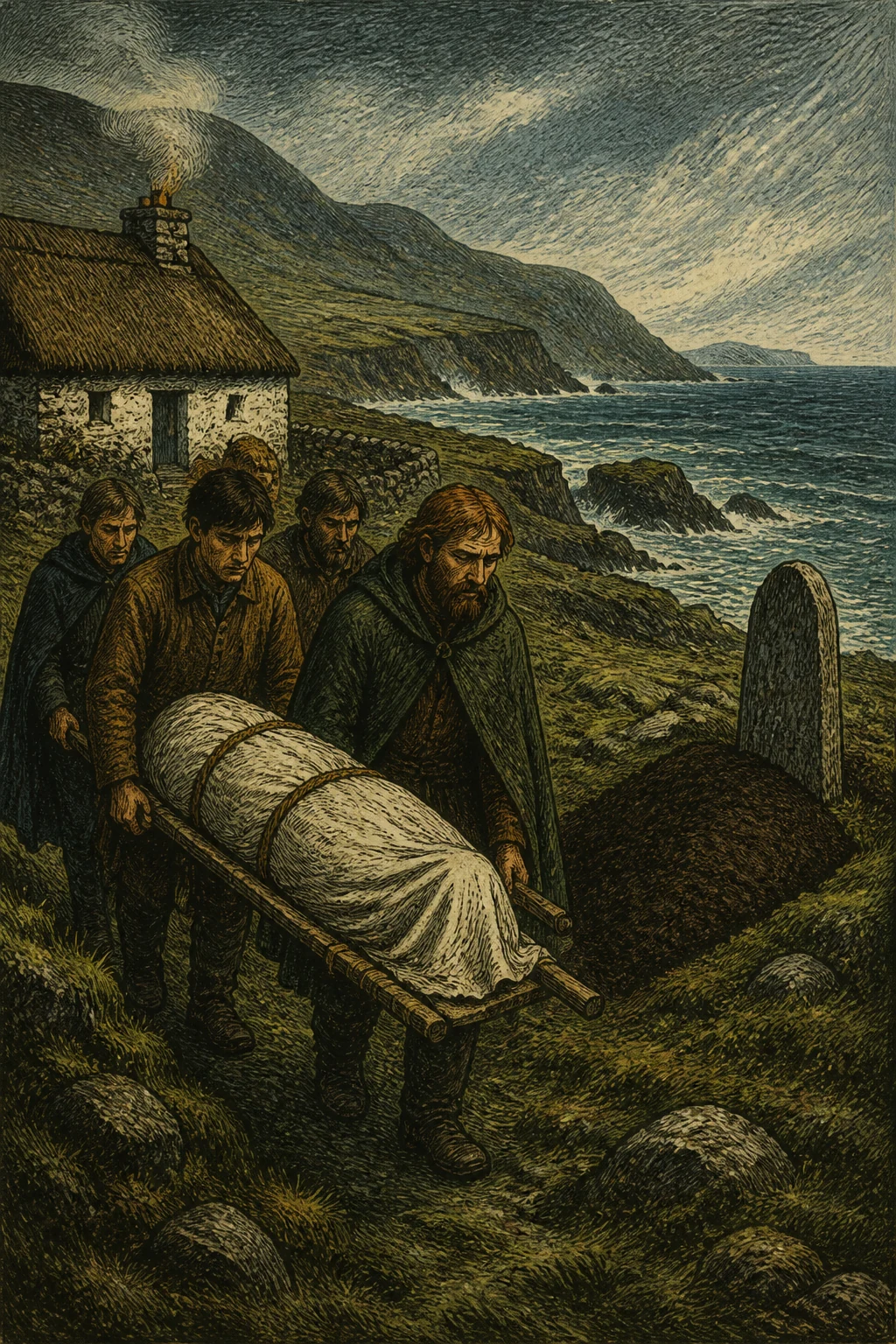
Even in death he could not lie in the sunlight for so much as a little while. The venom at once rotted his flesh within, and the hair decayed and streamed from his skin. Swiftly, urgently, they dug a deep grave with bronze mattocks. Men and maidens alike cut off locks of their hair, mourning the dead man’s pitiful suffering. Three times they circled him in their armor, then heaped earth over him, with all his funeral honors duly paid.
But when they boarded the ship, with a south wind ready to speed them over the sea, and sought to find the channels leading out of Lake Tritonis, for a long time they could devise no plan, but wandered aimlessly all day.
As a serpent goes twisting along a crooked path when the sun’s fiercest glare scorches it, turning its head this way and that with a hiss, its eyes flashing like sparks of fire in its fury as it seeks a crevice through which to creep into its lair, so Argo wandered long, searching for the lake’s navigable outlet. Then Orpheus urged them to bring Apollo’s great tripod out of the ship and set it up as an offering to the gods of the land, to win their help on the homeward journey.
They went ashore and were setting up Phoebus’ sacred gift when mighty Triton came to meet them in the likeness of a young man. He lifted a clod of earth and held it out to the heroes as a gift of hospitality, saying, “Take this, my friends. Here and now I have no splendid gift at hand to offer strangers who have come to me.
“But if you are seeking a passage through this sea, as travelers in foreign lands so often need to do, I will tell you. My father Poseidon has made me well acquainted with these waters. I am ruler of the coast, if you have ever heard in your distant homeland of Eurypylus, born in Libya, nurse of wild beasts.”
So he spoke, and Euphemus gladly stretched out his hands for the clod, then answered him: “Hero, if you know anything of the land of Apis and the Minoan Sea, tell us the truth in answer to our questions.
“We did not come here willingly. Driven by terrible storms against the bounds of this land, we carried our ship aloft across the country, bowed beneath its weight, until we reached these waters of the lake. Nor do we know where a sea route opens that will bring us to the land of Pelops.”
So he spoke. The other stretched out his hand and pointed into the distance, showing them the sea and the lake’s deep outlet. “There is the passage to the sea, where the still, deep water looks darkest. On either side the white breakers shimmer and bristle; between them runs a narrow way for you to sail out.
“That misty sea beyond leads past Crete to the holy land of Pelops. But when you leave the lake and enter the sea’s swell, keep close along the shore on your right, following it as long as it stretches northward. When the coast curves away in the other direction, your safe course lies straight ahead from the jutting headland.
“Go, then, with joyful hearts, and let no one grudge the labor of limbs in the full strength of youth.” So he spoke in friendship. At once they boarded the ship, eager to row out of the lake.
They bent eagerly to their oars. Meanwhile Triton took up the great tripod and seemed to step into the lake. Yet no one saw him go: so suddenly had he vanished nearby, tripod and all. Their hearts rejoiced, for one of the blessed gods had met them with goodwill.
They urged Aeson’s son to take the finest of their sheep and sacrifice it to him with a prayer. Quickly he chose one, lifted it up, and cut its throat over the stern, speaking these words of prayer: “Divine one, whoever you are who appeared beside the shores of this lake—whether the sea-born daughters call you Triton, marvel of the sea, or Phorcys, or Nereus—be gracious to us, and grant us a joyful end to our homeward voyage.”
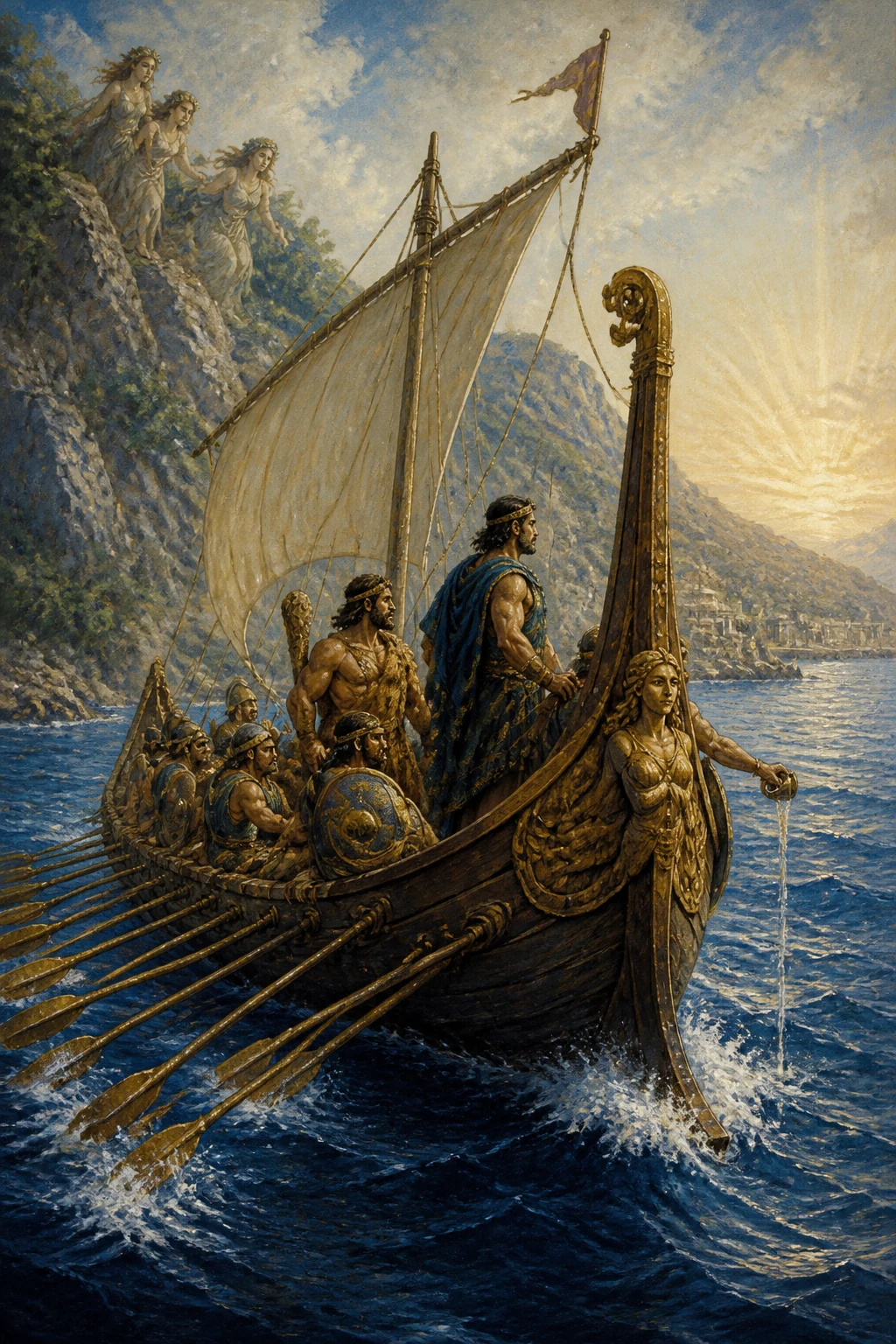
So he prayed, and as he cut the victim’s throat he cast it from the stern into the water. Then the god rose from the depths in the form that was truly his. As a man takes hold of a swift horse’s thick mane and leads it obediently into the broad circuit of a racecourse, running beside it while the horse follows with head proudly raised, and the bright bit rings on either side as it champs it in its mouth, so Triton seized hollow Argo’s towrope and led her onward to the sea. From the crown of his head, over his back and flanks, down to his belly, his body in its marvelous stature was like that of the blessed gods. But below his waist a long sea-monster’s tail divided to either side, and he lashed the water’s surface with its spines, whose curved tips forked like the horns of the moon.
He led her on until he had sent her forward on her course into the open sea, then suddenly plunged into the great depths. The heroes cried aloud at the awe-inspiring marvel they had seen. There stand the harbor of Argo, memorials of the ship, and altars to Poseidon and Triton; for they remained there through that day. But at dawn they spread their sails and sped before the west wind, keeping the deserted land close on their right.
Early the next morning they saw the headland, and beyond the jutting cape the sea bending far inland. At once the west wind dropped, and a breeze came from the bright south; their hearts rejoiced at its breath.
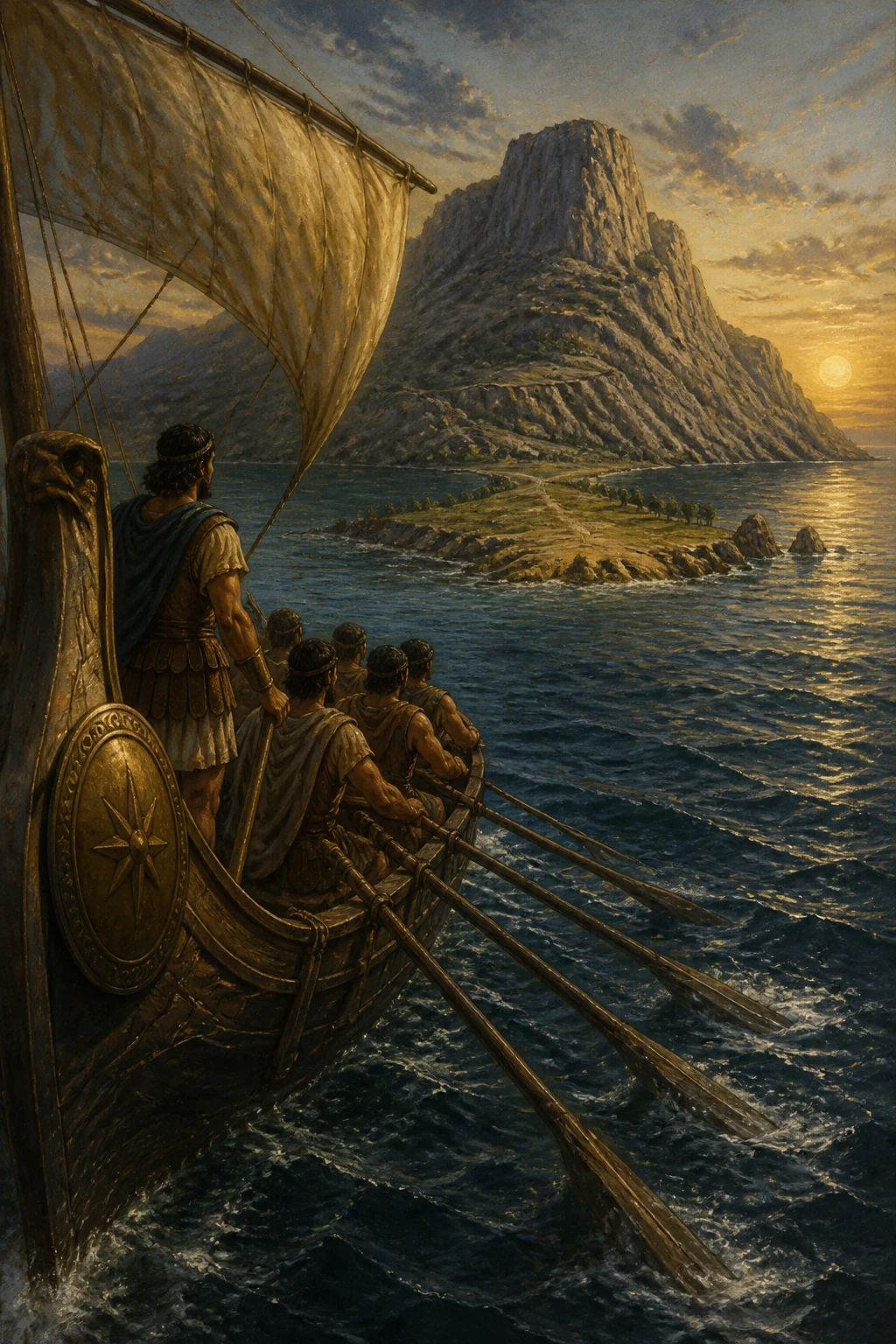
When the sun had set and the evening star rose, bringing rest to weary plowmen, the wind failed in the black night. They furled their sails, lowered the tall mast, and strained at their polished oars all night and through the day, and again through the night that followed. Far off, rugged Carpathos welcomed them; from there they meant to cross to Crete, which towers above the other islands in the sea.
But bronze Talos, tearing rocks from a solid cliff, kept them from fastening their mooring ropes to shore as they approached the shelter of the Dictaean harbor. The last survivor of the bronze race of men sprung from ash trees, he had remained among the demigods; and the son of Cronus had given him to Europa as guardian of the island, to circle Crete three times on his bronze feet.
All the rest of his body and limbs were bronze and unbreakable, but beneath the sinew at his ankle ran a blood-filled vein. The thin membrane enclosing it held the boundary between his life and death.
Though worn down by hardship, the heroes took fright and quickly backed their ship away from land with their oars. And they would have withdrawn from Crete in misery, tormented alike by thirst and suffering, had Medea not spoken to them as they retreated: “Listen to me. I believe that I alone can subdue this man for you, whoever he may be, even if his whole body is bronze—unless his life is everlasting.
“Only be willing to hold the ship here, beyond the range of his stones, until he yields to my power.” So she spoke. They rowed the ship beyond the reach of his missiles, waiting to see what unexpected device she would employ. She held the folds of her purple robe against her cheeks on either side and mounted the deck; Aeson’s son took her hand in his and guided her as she passed across the rowing benches.
There she sought to appease with incantations the Fates that devour the spirit, the swift hounds of Hades, who wheel through all the air and swoop upon the living. Three times she invoked them with spells, three times with prayers. Then, her mind intent on evil, she bewitched bronze Talos’ eyes with her own hostile gaze. She ground her deadly anger against him and sent forth visions of destruction in the fury of her wrath.
Father Zeus, great wonder stirs within my heart, if destruction comes upon us not only through disease and wounds, but someone can harm us even from afar! So Talos, bronze though he was, yielded to the dread power of Medea, mistress of many drugs. As he heaved up heavy boulders to prevent them from entering the harbor,
he scraped his ankle against a sharp spur of rock. The ichor flowed from him like molten lead, and he could no longer stand firm upon the jutting cliff. As a huge pine high in the mountains, which woodcutters have left half severed by their keen axes when they come down from the forest, is first shaken by the night’s gusts, then breaks at the base and crashes down, so for a while he swayed upon his tireless feet, then fell helpless with an immeasurable crash.
That night the heroes camped on Crete. When dawn shone anew, they founded a shrine to Minoan Athena, drew water, and went aboard, eager to row beyond Cape Salmonis as soon as they could.
As they sped over the great gulf of the Cretan Sea, they were suddenly struck with terror by the night they call the shrouded night. No stars pierced that deadly darkness, nor any gleam of moonlight: black chaos had descended from heaven, or some other gloom had risen from the deepest abyss.
They could not tell at all whether they were borne through Hades or upon the waters. Helpless, they entrusted their homeward course to the sea, wherever it might carry them. But Jason raised his hands and cried aloud to Phoebus, calling on him to save them. Tears streamed down in his anguish, and he promised countless gifts for Pytho, countless gifts for Amyclae, and countless gifts to bring to Ortygia.
Then you, son of Leto, swift to hear, came down from heaven to the Melantian rocks that stand in the sea. Leaping upon one of those twin crags, you raised your golden bow high in your right hand, and the bow sent a brilliant radiance shining all around.
Then a little island of the Sporades appeared to their sight, opposite the small island of Hippuris. There they cast anchor and halted. Soon Dawn rose and shed her light, and in a shady grove they made a splendid sanctuary and a shaded altar for Apollo. They called Phoebus Aegletes, the Radiant, because of his far-seen light; and they named the barren island Anaphe, because Phoebus had made it appear to them in their distress.
They offered such sacrifices as men could prepare upon a deserted shore. But when Medea’s Phaeacian handmaids saw them pouring water over the burning brands, they could no longer hold back their laughter, accustomed as they were to seeing oxen slaughtered in great numbers at the house of Alcinous.
The heroes answered them with shameless jests, delighting in their mockery, and merry taunts and a lively battle of words flared up between them. From that sport of the heroes comes the custom by which women on the island still bandy words with men when they seek the favor of radiant Apollo, guardian of Anaphe, with sacrifices.
But when they had loosed their moorings from that place too, under a clear sky, Euphemus recalled a dream of the night, honoring the glorious son of Maia. He had dreamed that the divine clod of earth lay at his breast in the crook of his arm, nourished by white streams of milk. Small though the clod was, a woman emerged from it, like a maiden. Overcome with desire, he lay with her in love; then he grieved as though he had embraced a daughter whom he himself had reared with his own milk. But she comforted him with gentle words: “I am of Triton’s line, my friend, the nurse of your children, not your daughter; for Triton and Libya are my parents.
“Entrust me to the maidens of Nereus, to dwell in the sea near Anaphe. In time I shall rise into the sunlight, ready to receive your descendants.” The memory struck his heart, and he told Aeson’s son. Jason pondered the prophecies of the Far-shooter, then spoke aloud: “My friend, a great and glorious honor is indeed allotted you.
“For if you cast this clod into the sea, the gods will make it an island, where your children’s children shall dwell. It was Triton who placed this gift of hospitality from the Libyan mainland in your hands. No other immortal but he met you and gave it to you.”
So he spoke, and Euphemus did not disregard the interpretation of Aeson’s son. Rejoicing in the prophecy, he cast the clod beneath the waves. From it rose the island of Calliste, the holy nurse of Euphemus’ children. They once lived on Sintian Lemnos, but when Tyrrhenian men drove them from Lemnos they came as suppliants to Sparta. Later, when they left Sparta, Theras, the noble son of Autesion, led them to the island of Calliste and changed its name to Thera after himself. But these things happened long after Euphemus’ time.
From there they sped away across the boundless swell and came to the shores of Aegina. At once they held a friendly contest over fetching water, to see who could fill his vessel and be first back to the ship.
For both their need and a strong fair wind urged them on. There to this day the young men of the Myrmidons shoulder brimming jars and race on nimble feet along the course, competing for victory.
Be gracious, race of blessed heroes! May these songs grow sweeter for people to sing from year to year. For now I have reached the glorious end of your labors. No further trial befell you as you sailed back from Aegina, nor did any tempest of winds stand in your way. In peace you passed the land of Cecrops and Aulis, sailed inside Euboea and past the towns of the Opuntian Locrians, and gladly stepped ashore upon the coast of Pagasae.