Prevod
Sultan Majinuni married his uncle’s daughter. Their first child was a boy, their second a boy, their third a boy, their fourth a boy, their fifth a boy, and their sixth a boy. Their seventh and youngest child was also a boy. The Sultan was delighted to have fathered such lions.
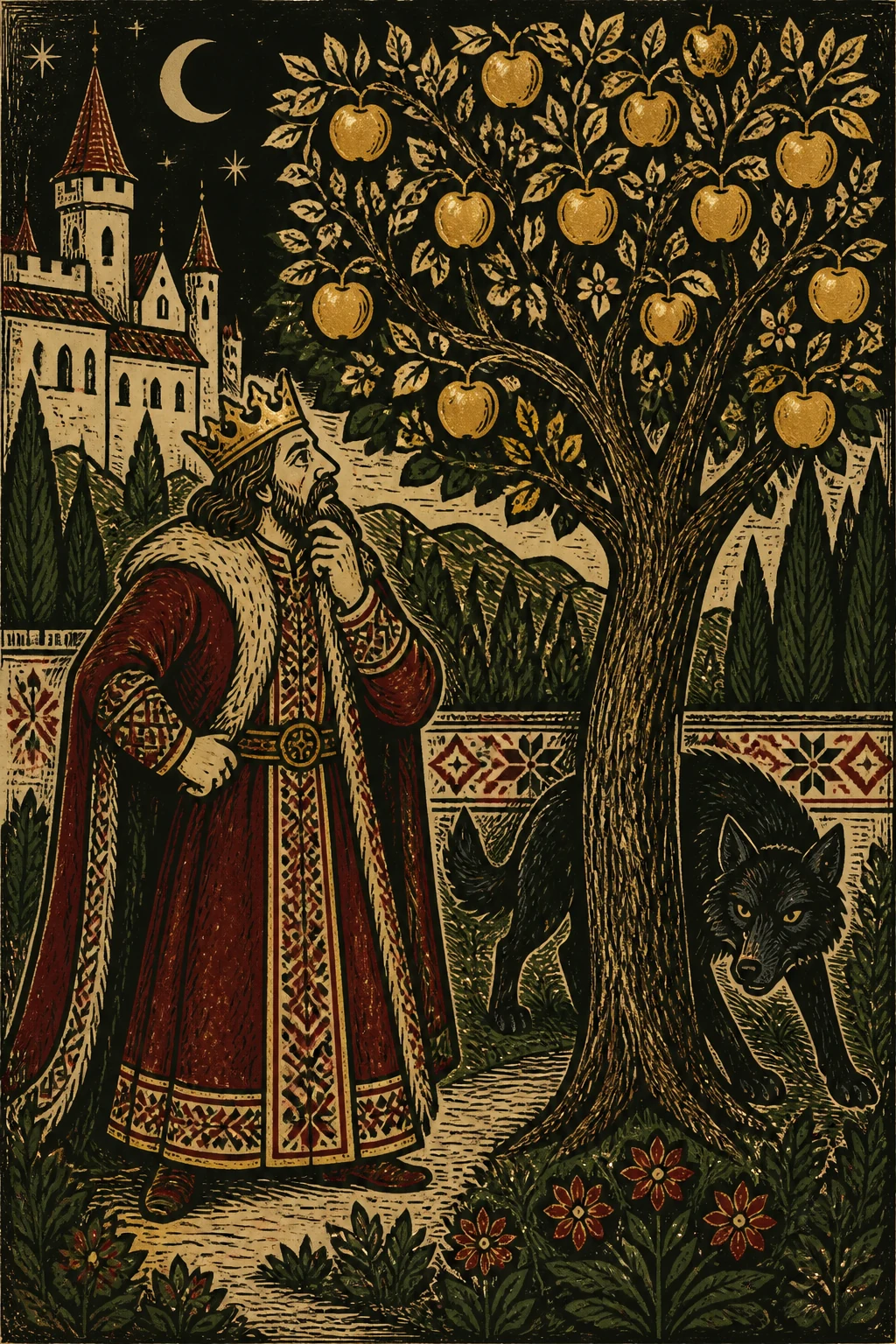
In time the Sultan laid out a great garden. He planted every fruit in the world that he knew of, and those he did not know he asked others about, obtained, and planted too. He planted a single date palm, as well as every kind of vegetable. Each day he visited the garden three times: at seven in the morning, at three in the afternoon, and at half past five.
The Sultan brought up his children and sent them to school. They studied until they had completed their schooling, and were taught to write, which they mastered. But of all his children, the seventh was the one his father did not love. That boy did nothing but linger in his mother’s kitchen, always under her feet. His father was very angry with him for forever keeping his mother company.
He had spoken to him often, but the boy would not listen. He had beaten him, but he would not listen. He had confined him, but he would not listen. At last the Sultan grew weary of his ways and left him alone. Time passed, and the Sultan’s date palm put out a crown of blossom. A month later, when it showed signs of bearing fruit, he was overjoyed. He summoned the vizier and told him, “My date palm is bearing fruit.” He told the emir, “My date palm is bearing fruit.” He told the judges, “My date palm is bearing fruit.” He also told all the wealthy gentlemen of the town. After some days the dates began to ripen. He summoned all six of his sons. “That other boy does not belong among you,” he said. “He stays at home like a woman. Now, my sons, give me your advice.” “About what, Father?” they asked. “I want one of you to watch over that palm until the dates are ripe, so that I may eat them. I cannot leave it unattended. I fear the slaves may eat the dates, or birds may come and eat them. So I want you to go and guard the palm.” The son he had chosen answered, “Yes, indeed!” and went off.
A fine house had been built there. He stayed there until night, then gathered all the slaves on the estate and had them drum and dance beneath the palm. The young man was afraid. “If I sleep inside,” he said, “a slave may come in the night, climb the palm, and steal the dates. Or a great bird may come in the night and eat them, now that they are ripe. So let us dance here beneath the palm until morning.”
They drummed and danced until midnight, when they began to feel very cold, too cold to bear. They danced on until four in the morning, then all lay down beneath the palm. The boy remained sitting up. One of his slaves rose and said to him, “Master, do lie down.” “How can I sleep,” he replied, “when I was sent here to guard the palm?” “It is four o’clock now,” the slave said, “and the cocks are crowing. What could come to this palm at such an hour? Nothing would dare. Neither man nor bird will come.” “I cannot go to sleep,” said the boy. “Go and lie down. It is already growing light.” “Do you know,” the boy said, “I believe I will go and sleep.” He went off and lay down.
A little while later a bird swooped down and ate the dates, leaving not a single one. Then it flew away. At daybreak the overseer looked at the palm and saw that there were no dates. He ran straight to his young master and found him asleep. He woke him, calling, “Young master! Young master!” The boy started awake. “What do you want?” he asked. “Your father sent you to guard the palm, but you did not guard it, and a bird has eaten every date.” “Tell me the truth.” “It is the truth. Get up and see for yourself.” The boy rose, went to the palm, and saw that there were no dates. He was bewildered. “When I go to my father,” he thought, “shall I tell him people ate the dates? Shall I say a bird ate them? Or shall I say there was heavy rain last night and a great storm, and all the dates were blown to the ground? He will tell me, ‘Go and gather them up and bring them to me, so I can see these dates the storm and rain brought down.’ But there are none on the ground, and my story will prove a lie. Ah, what am I to do? I shall go to Father and tell him that Bedouins came and drove me away, and when I returned and looked at the palm, the dates were gone. He will ask, ‘With all those slaves of yours, could you not fight them?’ That story too will prove a lie. The old man will not believe it. Tomorrow I shall go to Father and say, ‘I guarded the palm until dawn, when it was already growing light. Then I left to stretch out for a little while. Before long it was daylight, and a slave came and woke me, saying, “Master, there is not a single date on the palm.” I got up and went to the palm, and when I looked, it was true: there were no dates. So I have come to you, Father. You are the knife, I am the flesh. Do with me whatever you will.’ Yes, that is the right thing to say. Better to tell the truth than a lie.” He set off for his father’s house. He found his father sitting on the veranda with his five sons. He approached and greeted him. “Give me the news from the garden,” said his father. “Good news and bad.” “How is it bad, and how is it good?” “The bad news is that a bird has eaten every date on the palm. Not one remains.” “Where were you when a bird was eating my dates?” “I guarded the palm until dawn, when the cocks were crowing and it was already light. Then I left to stretch out for a little while. Before long the overseer came and woke me. I woke and asked, ‘What do you want?’ He said, ‘Did you come here to guard the palm?’ ‘I came to guard it,’ I said. ‘Well, there is not a single date on it.’ I got up and went to the palm, and when I looked, I saw that it was true: not one date remained. That is the news from the garden. I have nothing more to tell.”
“I asked you for the news from the garden,” his father said, “and you told me there were two kinds: good and bad. I have heard the bad news—that a bird has eaten my dates. Now tell me the good.” “Is it not good news that I, your son, have returned safely?” “You are no son of mine. I want nothing to do with you. A son who does nothing but eat and sleep! If someone asked you, ‘Here, throw this dust into your father’s eyes,’ you would not refuse. What sort of son are you? I want nothing to do with you. Be off, my lad.”
“The next time my palm bears fruit,” he told them, “I shall send another son. Perhaps he will guard it, and I shall get some dates to taste.” Many months passed, and the palm bore an abundance of fruit such as had never been seen. In time the dates were nearly ripe; I believe they had only a day to go. The Sultan chose a son and sent him. “My son, I am sending you to the garden. This year I long to taste these dates.” “Father, I am going now. Tomorrow morning at seven, send someone to fetch your dates.” “Very good, my son. I should like to taste them tomorrow.”
The boy set off. When he reached the garden, he slept soundly until, I believe, about one in the morning. Then he got up and went to the palm. He saw the beautiful dates, their clusters hanging down. The palm was flourishing splendidly. “Ah!” he said. “Tomorrow my father will eat these dates. I shall keep watch. That fool came here only to sleep for nothing, and now Father hates him. Tonight I shall stay here and see this bird that comes to eat the dates. Today I shall see it for myself.” He sat down and read for a long time. He heard the cocks crowing, looked up at the palm, and saw that the dates were still there. “Oh, tomorrow my father will eat dates! Does he think I am like that fool?” It began to grow a little light, and drowsiness came over him. “Ah, let me lean against the trunk of the palm for a moment.” Sleep overcame him. As soon as he was asleep, the bird swooped onto the palm and ate the dates, leaving not a single one, while he lay sleeping beneath it with his Qur’an tucked under his arm.
At daybreak his overseer came. He looked at the palm: there were no dates. Glancing down, he saw his master asleep beneath the tree. “Master! Master!” he called. “Yes!” the boy answered. “You have been sleeping, and a bird has eaten every date.” “Is that true?” “Look up and see.” He looked up and saw that the dates were gone. He was stunned. His wits deserted him, his ears stopped hearing, his legs trembled, and his tongue grew heavy. He was utterly overcome.
His slave came up to him. “Master, what is wrong?” “I am very ill today,” he replied. “Nearer death than recovery.” “What is your illness, master?” “My head does not hurt, nor my stomach, nor my side, nor my back, nor my waist, nor my feet, nor my hands. Every part of my body is well, and every part of my body is sick.”
“What kind of illness is this, master?” “The cause of this illness is my fear of my father today. At seven o’clock he will send someone to fetch the dates. I told him, ‘Tomorrow at seven you will taste the dates.’ Now have I not become a liar? Have I not become a fool? My father will drive me away as he drove away my brother, because he has been deprived of his dates.”
“Well, master, what can you do now that it has happened?” “Ah, what can I do? I shall go before he sends anyone here.” He set off. On the road he met a man carrying a large bowl, a white cloth to cover the dates, and a sharp knife for cutting a cluster from the palm. “Where are you going?” he asked. “Your father has sent me to you. He told me to have you cut a cluster of ripe dates and put it in this bowl for me to take back.” “Father wants ripe dates, but the dates there are unripe. Turn back; let us go home.” “Very well,” the man said.
When he reached their doorway, he saw his father sitting with his four brothers. “Good morning, sir!” he said. “Welcome,” his father replied. “Did you see the man I sent?” “I saw him, sir.” “I told him to have you cut a ripe cluster of dates.” “Never mind a ripe one—is there even an unripe one left?”
“Ah! What did you go there to do? People say that to have children is to be saved. Yet for me, does having children mean death? Two young men have gone to the garden, and not one has brought me the first taste of my dates. What use is having children, then? People say, ‘To have children is to be saved.’ Where is this salvation? Do not say, ‘You have children; they will restore your spirit.’ My salvation is to ask for something and receive it, so that my heart rejoices. My salvation is for you to see someone about to strike me and fight him to defend me, your father. My salvation is to send you somewhere and have you go, knowing how to speak to people, how to converse with them, knowing the old and the young, the rich and the poor. That is my salvation. But you, my sons—this is the second year I have had no dates to eat. My own dates! I hear of them with my ears, but never see them with my eyes. Now get out of my sight. Be off.” The boy rose and went away.
Then he said to them, “You four sons who remain: when the palm next bears fruit, whichever of you goes and guards it and brings me dates to taste, I shall hold a wedding for him that lasts three months.”
Each of the young men spoke up. “Father, I shall go!” said one. “Father, I shall go!” said another. “Father, I shall go!” said the third. “Father, I shall go!” said the fourth. “Very good,” he told them. “Whoever wishes may go, but I want you to go one at a time.” “Very good, sir,” they replied.
Many months passed, and the palm bore fruit. It bore abundantly, then stopped setting fruit, and its clusters swelled. “The palm has borne fruit,” the Sultan told his sons, “and this year its crop is greater than in any other year.” “I shall go, Father,” said the eldest of those remaining. “Wait until they are ripe,” he replied. So he waited until word was brought to him.
“Sultan, the dates are beginning to ripen.” “Now, my son,” he said, “go to the garden. Tomorrow you will feed me dates.” “Father, tomorrow when seven o’clock strikes, you will see dates going into your mouth.” “My son, I pray that tomorrow I may eat these dates.” “You shall eat them, Father. Farewell; I am off.”
He set off and reached the garden. He told the people there, “Let everyone sleep in his own house, and let no one come out.” “How can we leave you alone, master?” “Never mind. Leave me. It is my own wish.” The slaves went off to bed. He ate, and when he had finished, he too lay down and slept soundly. He woke at midnight and sat beneath the palm playing cards by himself. Towards dawn a pleasant breeze blew over him, and he began to doze. Sleep overcame him. At once the bird came and ate every date, leaving not a single one, while he slept beneath the palm with his cards in his hand.
At daybreak his overseer came and saw his master asleep. He glanced up and saw that the dates were gone. “Master! Master!” he called. “Yes,” the boy answered. “You have been sleeping, master, and there is not a single date on the palm. If you do not believe me, look up and see.” The boy looked up and collapsed. The slave was astonished to see his master fall. He caught hold of him and asked, “Master, what is wrong?” “I am dead.” “How are you dead, master?” “When I came out here to the estate, I told my father that when seven o’clock struck he would see dates going into his mouth. Now he may wait until four in the afternoon, and he will not see a date go into his mouth. Never mind four in the afternoon—even in five months, he will not have a date to eat.”
“What will you do, master?” “I am not going to my father. I shall run away.” “Why run away, master? Better to go to him. If you run away, how long will you keep running?” “I shall stay away until my father’s heart is appeased.” “Master, it is not right for a gentleman to run away. Better to go to him.”
He went to his father’s house. His father had not yet risen, so he waited until he was awake. “Well, my son, give me the news from the garden.” “I have no other news. I have only one piece of news: the dates have been eaten by a bird. That is all the news I have; there is nothing more. Do with me as you will. You are the knife, I am the flesh.”
“Get out of my sight,” his father said. “I do not wish to see you.” The boy rose and went away. “Ah!” said the Sultan. “I have fathered not sons but afflictions. An affliction to bring forth from the womb! Will a son who is no use to a man in this world be of use to him in the next? What sort of sons are these, who could not even put the earth over a man’s eyes? If this is what having children means, I shall have no more.”
He waited until the following year. The palm bore fruit, and every year it bore more abundantly. “I shall see who is a man when he goes to the garden,” he said. “When I see his hand at my mouth feeding me dates, then I shall know he is my son.” He told them, “Whichever young man feeds me dates, I shall marry him to a beautiful wife and give him a wedding lasting four months.” “Very good, Father,” they replied. “This year you shall eat dates.”
Ten days passed, and the dates were full-grown. Someone came and told him they were mature. “Very good,” he said. “When you see them beginning to ripen one by one, come and tell me.” Five days later the overseer came and said, “Master, the dates are ripening, and the windfalls are dropping.” The Sultan waited three more days, then told his son, “Go.”
The young man set off joyfully and full of vigour, and reached the garden. “I shall not sleep,” he said. “I shall ride a horse round the garden all night.” He took his gun, his powder, his bullets, and his wads. He mounted his horse and rode round the garden. He rode for a long time, until one in the morning, when he heard a guinea fowl calling beyond the garden. “It is half past one now,” he said. “I shall go after that guinea fowl calling out there.” He went out and followed its cries. The guinea fowl was far away, but in the night it sounded close. When he was halfway there, the bird came to the palm behind him and ate the dates, leaving not a single one. He had still not returned, nor did he find the guinea fowl. At last he turned back.
When he reached the garden, he looked up. There were no dates. He dismounted and sat beneath the palm, weeping bitterly. His slaves came up. “Master, why are you crying?” “I am not crying for fear of my father,” he told them. “I am crying because I have lost the reward he meant to give me.”
“What reward could make you weep so much?” “Father told me he would marry me to a beautiful wife and hold a wedding for me lasting four months. He also told me he would know that I was truly his son. Now, of those three things, I have gained not one. Have I not reason to weep for losing them? Well, I shall go home and give him my answer.”
That afternoon he went to his father. “Good evening, Father!” he said. His father did not answer. He fell silent. “Where are the dates?” his father asked. “The dates, Father? A bird has eaten them all.” “Go inside and tell your mother to give you a kerchief to wear, and a face veil to wear, and a gown and trousers to wear, and a shawl to wrap yourself in. Then let her find a husband and marry you off. Get out of my sight. I do not wish to see you.”
His wife came forward and said, “These young men do not go to watch over the palm. They go to play and sleep. But what can we do? Let us wait until it bears again.”
Many months passed for the Sultan. The palm bore fruit, and his overseer brought word from the estate. “Master, the palm has borne fruit.” “Has it borne as much as last year, or more this year?” “Master, when something amounts to little, one does not place one’s hopes in it. If one could put one’s hopes in such a little thing, I would tell you, master, that this palm has borne more than in any other year. But the fruit may fall. Let us wait and see until it is mature.” “Very good. When you see the first windfalls begin to drop, come and tell me.” “God willing, master,” he replied.
The Sultan had a cat of which he was very fond. It was a very beautiful cat, and he had thoroughly spoilt it. At first it used to catch little chicks. When the Sultan was told, “The cat is catching the chickens,” he replied, “They are my chickens, and it is my cat. Leave it alone.” The dates on the estate ripened, and the overseer came to tell him. “Master, the dates are very ripe. I think if they are left until tomorrow they will spoil, they are so ripe. This year there have not been many windfalls—only eight or nine a day, despite how heavily the palm is laden. Send me a son to guard the palm.” The Sultan addressed the two who remained. “Today both of you who are left must go.” “Yes, indeed, Father,” they replied. They made themselves ready and set off for the garden. They told the slaves on the estate, “We lions have come. We have come to see this bird that eats the dates. Today its appointed hour has come, and its death will be at our hands. With us here, the only thing that can save it is if our guns fail to fire.” “Very good, masters,” the slaves replied. They waited until night, then told them, “Light great fires throughout the garden.” They lit the fires, and the flames blazed so brightly in the garden that if a needle had fallen, you could have seen it by their light. They kept watch until one in the morning. Then a great rain cloud spread overhead, and a mighty storm arose. At half past two the rain came pouring down. It grew bitterly cold and utterly dark. One man could not see the man beside him. They could only hear one another’s voices and grope their way towards each other before knowing who was there. If they tried to play tricks, they would poke one another in the eyes, so deep was the darkness. All the slaves fled to their huts, and the young men too left and went to bed. The bird swooped down, ate the dates, and flew away.
Still they did not wake. The rain did not clear, and the storm did not pass. They slept until six in the morning, unaware that day had broken. The rain was still falling, the darkness was unchanged, and the storm raged as fiercely as ever. They slept on until seven. At eight their father sent a man from town. “Take this umbrella and go to the estate. What has happened to these children? We have had no word of them. Are they well or ill? Shall we have dates or not? Find out how they are and come and tell us.”
The man set off through the rain for the estate. He went to the overseer’s house, but the overseer had not yet risen. His door was shut, and he was asleep. The man knocked. “May I come in? May I come in? May I come in?” The overseer answered, “Who are you?” “It is I, Hweduni.” “Ah! What are you doing out at this hour of night, in all this rain?” “You country people are foolish indeed! You have clocks in your own houses.” “Eh, Hweduni, you are making fun of us. Where would we country people get clocks?” “You have several clocks, not just one or two.” “I do not even know what sort of clock you mean.” “Have you no cocks? Those are the clocks of the countryside. When you hear a cock crow, you know it is dawn or daylight. Are those not your clocks?”
The overseer came outside, and they greeted one another. “Well, give me the news from town.” “The news from town is good. I have been sent to see the young men. So far there has been no word of them—whether they are well, dead, or ill, whether the Sultan will get his first taste of dates or not. That is all.” “Come, I shall take you to the young men.” He went and called them. They both sat up in bed, huddled together and trembling with cold.
“Well, Hweduni, what news from town?” they asked. “Good news, young masters. Your father sends his greetings. After his greetings, he says he has heard nothing from you, and it is now ten o’clock.” “Ah! Is that true?” “Indeed, it is ten o’clock, masters.” “We thought it might only be dawn.” “No, masters. I left town at eight, when I was sent out here to the estate. So, young masters, the master asks whether he will eat dates this year or not.” One of them rose. “Tell him he shall eat dates this year—not merely this year, but this very moment. Wait while I cut some and give them to you to take to him.”
His brother said, “Are you speaking in your right mind, or are you mad?” “Why?” “I am asking whether you are speaking in your right mind, so that I may know how to answer you.” “I am speaking in my right mind. I am not mad.” “You are truly mad—so mad you need shackles, stocks, and a whipping before they can treat and cure you. If you were not mad, you would not say such a thing, to be taken back to Father.” “Why not?”
“Every season, every year, the palm has been guarded. Our brothers did not lie down to sleep, not even once, but sleep overcame them. The moment they woke, the dates had been eaten. Now we left the palm at one in the morning, came here, and have slept until ten. Will these dates have waited for us? Every time, people sleep beneath the palm, and the bird comes, eats the dates, and leaves. Eh! We have been sleeping here in the house. Will this bird have waited for us?”
“Ah! Perhaps we were lucky. With all that rain and darkness and storm, perhaps the bird did not come.” “That rain and darkness and storm would not stop the bird from coming to eat dates.” “Well, I am going to look.” “Go and look. I am not going anywhere. I know there are no dates. Why should I trouble myself for nothing, getting wet and cold and soaked with dew, when I know there are no dates on the palm and a bird has eaten them all? But this fellow going there is a fool. He wants to deceive himself. If you do not believe me, wait until he returns.”
The other went to the palm and found not a single date. Even the windfalls on the ground were gone. He returned to his brother. “Well, are there dates?” “Ah, my good fellow! Anyone seeing that palm would not believe it if he were told it had borne fruit this year, or that only yesterday it was full of dates. The palm has been so ravaged that there is not even a sign to show it ever bore fruit.”
“Did I not tell you, right here, that there was nothing? Now give me your advice. Is there any advice to give? Shall we go to our father and tell him, ‘A bird has eaten the dates. We did not get even one. We have come to you. You are the knife, we are the flesh. Do with us whatever you will’?” “Very well. Let us go.”
They went to their father’s house and found him sitting in the inner hall. They greeted him, but he did not answer. His wife came forward and said, “My lord, when the children greet you, answer them. Your anger is a poison that kills them, while your happiness brings beauty to their faces. Why behave like this, raging at your own children, whom you have the power to treat however you wish? There is no need to be angry with them, to show them wrath, or to make them suffer.” “Well, my wife, go and cut them women’s cloths, and give them head coverings too. These young men have become women. They are no use to a man while he lives in this world; will they be of use to him in the next? As for me, I shall have nothing more to do with them.”
Months passed, and the palm bore fruit. It finished setting fruit, and the clusters swelled. Though the dates were still small and young, anyone seeing them from a distance would have thought them mature, so plump were they, so luxuriant was the palm, so vigorous its fruit, and so heavily laden every cluster.
The overseer set off on foot straight to his master’s house and found his mistress there. “Mistress, where is the master?” he asked. “He is inside. Wait,” she told him. Before long the master came out. “Well, overseer! What news of the plantation?” he asked. “All is well on the plantation, master, all is well. As for the news, master, the date palm has borne an abundance of fruit, and the dates are so plump that anyone seeing them while they are still green would think them ripe. Tell him they are unripe and he would not believe you. And every branch says to its neighbour, ‘Move over and make room for me.’”
“It grieves me,” he replied, “that I, a man with seven sons, have had my dates eaten by a bird for five years, without tasting so much as a single fruit of the new crop. And this year too the bird will eat them.”
The boy who stayed in the kitchen heard these words spoken by Sultan Majnuni. He got up and said, “Father, this year you shall eat dates. Father, if this year I do not feed you dates with my own hand, and all the wealthy people in the town, and all the Europeans in the town, and all the Banyans, and all the Indians, and the poor people of our town—why, there are five branches on this palm. I shall give one branch to each community, and there are five communities in the town: we Arabs, the Europeans, the Banyans, the Indians, and all the poor. So, Father, this year I am going to guard the date palm.”
His father and mother laughed heartily, thinking everything he said was nonsense. Neither his father nor his mother believed him. “Our child is talking,” they thought. “Let us leave him to talk until he has talked himself out.”
At last word was brought to the Sultan that the dates were ripe. The Sultan sent out a call for someone to guard the palm. His seventh and youngest son heard of it and said, “How is this, Father? You have sent out a call for someone to guard the date palm, when I, your one remaining son, am still here.” “Ah!” he replied. “Six were of no use to me; will you alone be any use? My heart is filled with dread over this palm. I hear that it has borne plentifully, and that the dates are fine. I am afraid to send you and still miss the chance to eat them.” “Today I can bear it no longer,” the boy said. “Let me go, Father, and see what my luck will bring: whether you will eat dates or go without them.”
His wife said, “My lord, let the child go. Let us try. Perhaps we shall get dates to eat, or perhaps we shall not. Let the child go.” “My wife,” he replied, “I do not refuse to let the child go, but my heart has no faith in him.” “Never mind, my lord. Let him go.” The boy said, “Father, if you and Mother and I are alive tomorrow, then tomorrow you shall eat dates.” “Your brothers spoke in just the same way,” he replied. “‘Father, you shall eat dates,’ they said, yet I ate none.” Then he told him, “Very well, off you go to the plantation.”
When he reached the garden, he told all the plantation slaves, “Go to bed.” “Ah, master!” they said. “Are we to leave you here alone?” “The night will not devour me merely because I fear it,” he told them. “Then farewell, master,” they said. “Farewell,” he replied.
The young man went inside and slept soundly until the seventh hour of the night struck. Then he rose and went to the date palm. He sat down chewing popped grain, among which he had mixed some pebbles. He would chew the grain, and whenever he began to doze, his teeth would strike a pebble and he would wake. He went on like this until the bird came, and he saw it.
“There is no one here,” the bird said, for the young man was sitting some distance from the palm. But when it landed on the tree, the young man sprang up, and just as it stretched out its beak to eat the dates, he seized its wing.
The bird flew up from the palm, carrying the young man with it, until they were high in the air. “Human being,” the bird said, “you have followed me all the way up here! If you fall from here, you will be dead long before you reach the ground. Let me go my way, and I will let you go yours.” The young man replied, “Today I will not let you go. Wherever you go, I shall go with you.” “I have not eaten your dates. Let me go my way.” “Today I will not let you go. I am like a tick on a cow’s tail.” “Let me go. Day is breaking.” “Do you not hear what I am telling you? I will not let you go today unless you kill me. My six brothers have lost my father’s favour because of you, for he has never tasted his dates. Why should I let you go today? Today my father will see you, my six brothers will see you, my mother will see you, and everyone in our town will see you: old and young, slave and free, women and men. They will all see you today, and then my father’s heart will rejoice.”
“Let me go,” the bird said. “Day is breaking, and I have eaten none of your dates today. Please let me go, so that I may go my way and you may go yours.” “I will not let you go today unless you kill me.” “So you will not let me go? Then I shall fly far away with you now.”
It flew so high with him that the earth below looked like a star. “Well, can you see your home?” it asked. “I can see it, like a star.” “If I drop you here, will you survive?” “I would rather you dropped me to my death than let you go today. I will never let you go. Even if you fly right up to heaven, I will not let you go today.”
“Day is breaking,” it said. “I want to leave. Let me go, child. Please, I must be on my way.” “I will not let you go today. Wherever you pass, I shall pass with you; wherever you settle, I shall settle with you; wherever you die, I shall die with you. But today I will not let you go.”
The bird descended to the ground. “Now you are back home,” it said. “Give me leave to go my way.” “I will not let you go.” “Please, child, let me go.” “Of my brothers, one was given a woman’s headcloth, another a petticoat, and another was dressed in a gown and veil. None of these things would have happened to them but for you, coming here to eat the dates.”
“Please,” the bird said, “it is growing light now, master. Let me go. This is the last time: I will never come here again, never eat these dates again, never even pass through this neighbourhood. Please, young man, let me go my way.”
Then it said, “If you will not let me go, let us make a pledge to one another.” “What pledge?” he asked. “I will give you this pledge: shelter me from the sun, and I will shelter you from the rain.” “What do you mean? I do not understand.” “Take my words to heart. Wherever you may go, you will find me.” “How shall I find you?” “Take this feather and put it in the fire. When I smell it, wherever I may be, I shall come. Now day is breaking. Please, do not let people see me. Let me go my way.” “Very well, farewell. Go your way.” “Farewell, my friend,” it said. “Whenever you call me,
even if I am at sea, I shall come.” “Very well,” he replied. The bird flew away. The boy returned to the palm and looked at the tree and its dates, and his heart was filled with joy. He felt as though someone had come and said to him, “Rise and enter Paradise,” so light and happy was his spirit, so strong his body, so bright his eyes. The young man laughed with delight. “This is my good fortune,” he said, “mine, who sit in the kitchen. Six lions came here, each with a sword and shield, a dagger at his waist and a staff in his hand, and each young man said to the next, ‘Move aside and make room for me.’ First, they were strong young men; second, they were handsome; third, they were far better known in the town than I, who sit in the kitchen. Yet God has given this good fortune to me. What God has set in place, no human being can remove; only He who set it there.”
The young man rose and said, “Farewell, date palm. I am going to sleep. The one who used to eat your fruit will eat it no more. Today a mere sleeper has put his elders to shame.” Then he went away and slept.
When dawn broke, he came back to the palm, wrapped himself in his sheet, and lay down to sleep. Then the overseer woke. “Let me go and look at the palm today,” he said, “and see whether we can get any scraps the bird has left. For on this palm one never sees a date.” He set out, and when he was halfway there, he looked towards the palm and saw it standing laden with lovely fruit.
He ran back to the house, beating a drum, and all his fellow slaves came, men and women, even bringing the children. “Well, overseer, tell us the news you have brought us!” “What news have I brought you?” he asked. “Tell us, our overseer!” “Our master has not fathered a child,” he told them. “He has fathered a lion! Go and see how the kitchen boy has honoured his father today.” “How so, overseer?” “Today is the day when people will eat dates.” “Truly, overseer?” “Yes indeed. But do not go and wake him yet. Let us first go and offer him gifts. Whoever has a chicken, bring a chicken; whoever has a goat, bring a goat; whoever has rice, bring rice; whoever has unhusked rice, bring that; whoever has wheat, bring wheat; whoever has money, bring money. But do not bring millet or maize.”
The people went home and came back, some bringing chickens, some goats, some rice, some unhusked rice, some wheat, and some money. They brought drums as well, and found him asleep beneath the date palm. They lifted him up and carried him to his father, with horns and shawms, drums and handclapping and trills of joy.
When his father heard the uproar coming along the road, and saw branches of the palm being carried in woven baskets, the plantation slaves approaching in delight, and his son borne aloft, Sultan Majnuni knew: “Today I shall eat dates.” He called, “My wife!” “Here I am, my lord,” she answered. “Today the lord of the kitchen will feed us dates.” Hearing this, the woman left her cooking and hurried upstairs. “What is it, my lord?” she asked. “Look out of the window.” She looked and saw her son approaching in triumph with the rejoicing slaves.
His father ordered the soldiers, “Go out and bring the boy to me.” The soldiers ran and brought him before his father. “Well, my son, what news?” “I have no news except this: open your mouth, and I shall give you your first taste of the dates.” “Yes indeed! This is what it means to have a son. Give me a taste, my child.” He plucked a date and put it into his father’s mouth. Then he plucked another and put it into his mother’s mouth.
“My son, this is what it means to have a child,” his father said, “not like those fools, those good-for-nothings. Tell me, my son, what did you do to that bird? Who was with you when you watched for it?” “I watched for that bird alone. You will never see it again, nor will it ever return in its lifetime, or yours, or the lifetimes of those who come after.”
“My son,” he said, “nothing you have done has pleased me so much as giving me this first taste of the dates. For five years I have not tasted the new crop. And I have six sons, not merely one! Yet you, whom I called a fool, are the one who has given me dates to taste. I want nothing to do with those others.”
Their mother went to her husband and said, “Do not disown them. A man disowns a child when it is illegitimate. If you, Sultan Majnuni, disown these children, people will call them bastards, and I, your wife, shall be unable to show my face. Wherever I go, into whatever gathering, I shall not be able to lift my eyes to anyone, woman or man, free person or slave, young or old. They will say I have borne children unlawfully. My lord, do you want people to say such things to me?” “Certainly not,” he replied. “I do not want people to speak ill of you, whether in this way or in any other. I want to speak kindly to you, so that everyone who hears of it, in this country or another, will be told, ‘Sultan Majnuni speaks sweetly to his wife. He does not anger her. Whatever his wife wishes, he does.’ Then others will treat you in the same way.” “Thank you, my lord,” she said. “That is what I wished of you, and now I have it. Let the young men remain in peace.”
Now the youngest son was greatly loved by his father, his grandmother, his father’s sister, and his mother’s brother, more than his six brothers were. But their mother loved the six more than the youngest. She told her husband, “I will not leave the many for the few. I will not abandon six sons to love one.”
So they lived on, until one day the Sultan’s cat caught a calf. Someone went and told the Sultan, “The cat has caught a calf.” “My cat and my calf,” he replied. “Very well, master,” they said.
Two or three days later, it caught a full-grown she-goat. “Master,” they told him, “the cat has caught a she-goat today.” “My goat and my cat,” he replied.
Two days later, it caught a cow. Someone went and told him, “Master, the cat has caught a cow.” “My cow and my cat,” he replied. Two days after that, it caught a donkey. “Sultan,” they told him, “the cat has caught a donkey.” “My donkey and my cat.” A day later, it caught a horse. “Master,” they told the Sultan, “the cat has caught a horse.” “My cat and my horse.” Then it caught a camel. “Today the cat has caught a camel,” they told him. “What do you want with it?” he asked. “My cat and my camel. You dislike this cat and want me to kill it. Every day you bring me nothing but complaints. I will not kill it. Leave it to eat camels—even people, if it wishes.”
The next day it caught someone’s child. They went and told the Sultan, “The cat has caught someone’s child.” “My cat and my child,” he replied. The day after that it caught a grown man. “Master, the cat has caught a man,” they told him. “My cat and my man.”
The cat moved out of town and settled among the weeds at Mnazimoja. If someone passed on the way to fetch water, it ate him. If it saw a cow passing on its way to pasture, it caught and ate it. If it saw a goat, it caught and ate it. Whatever it saw passing along that path, it caught and ate.
The people went to the Sultan. “What is this, master? You are our Sultan, our lord, our shield. Yet you have left that cat alone, and it has gone to live at Mnazimoja. If a person passes, it eats him; if a cow passes, it eats it; if a donkey passes, it eats it; if a goat passes, it eats it. Whatever passes along the Mnazimoja road, it catches and eats. At night it comes down into the town, and whatever it sees here, it catches and eats. What are we to do about this, master?”
“I think you dislike this cat in your hearts,” he told them. “You want me to kill it, but I will not kill my cat when what it eats is also mine.” The people were bewildered. No one dared kill it, though people had already been devoured. It remained on the Mnazimoja road, and people stopped using that road. Then the cat moved to another road and caught them just as before.
They went and told the Sultan, “The cat is destroying people.” “I want none of your words,” he said. “Your complaints mean nothing to me. I will not listen to them, and I will not kill the cat.”
The people abandoned that road too. The cat moved to another and did the same. “Master,” they told the Sultan, “the cat has grown worse. It is utterly savage. Nothing passes before it without being seized.” “My cat, and whatever it takes is mine,” he replied. The people moved away and stopped using that road.
Seeing that the people’s complaints had become so numerous, the Sultan stationed a man at his door. “Whoever comes here with a complaint about the cat, tell him the master is not available.” “Yes indeed, master,” the man replied.
At night the cat came into town and caught whatever it could find; at dawn it returned to the outskirts. Soon there was no one left there: those who had fled had fled, and those who had been caught had been caught. The cat moved a little farther out into the plantations, catching people and animals there. At night it came into town and caught what it could, and at dawn it went back to the fields. Whenever people went to tell the Sultan about the cat, they could not gain an audience.
The cat went farther and farther into the countryside, catching whatever it found: a chicken, a dog, a goat, a cow, a person—anything that passed before it, it seized. If it saw nothing to catch, it searched diligently for prey. At night it went into town, and at dawn back to the plantations. So it went on: the cat kept catching its victims, and the Sultan could never be reached.
Then one day the Sultan said, “Today I shall go and look over the plantations. Come, my sons, let us go and see them.” He set out with his six sons. They reached a stretch of road overgrown with weeds, the six sons behind and their father in front. The cat sprang out of the thicket and killed three of the sons. People leapt aside, crying, “The cat! The cat! The cat! The cat!” The soldiers asked, “Master, shall we hunt it down and kill it?” “Hunt it down and kill it,” he told them. “Yes indeed, master.”
“This is no longer a cat,” he said. “Its name is Nunda, now that it has come to seize even my sons.” “Master,” they replied, “that cat will not stop to choose, saying, ‘This is the master’s son; let me spare him,’ or, ‘This is the master’s wife; let me spare her,’ or, ‘This is the master’s kinsman; let me spare him.’ That cat makes no such distinctions. We fear it may even eat you.” “True, it may even eat me,” he said. “Did we not tell you, master, that this cat was finishing off the people, and you said, ‘My cat and my people’?” “Indeed, I did say that,” he replied.
When the soldiers went to shoot the cat, some were killed and others fled. The Sultan returned with his sons and buried them. When the seventh son, who was at home, heard how his brothers had been killed by the cat, he said, “Mother, I too shall go, and let the cat kill me as it killed my brothers.” “How can you go alone, my child?” “I shall go because I grieve for my brothers. When someone loses three people from this world in a single day, should he not feel anguish? I shall go away and seek the cat that killed my brothers.” “Very well, my son, but I do not want you to go. They have died, and now you would go and die too? Would that not be a wound upon a wound?” “I must go on this errand, Mother, and I shall not tell Father.”
By now the cat had fled far away. His mother had bread made for him, and he was given men to carry his provisions. He was also given a great spear, sharp as a razor, and his sword. “Mother, farewell,” he said, and set off.
When he reached the outskirts, he saw a great dog. He struck it down, tied it up, and dragged it along. As he came home he sang, “Mother, oh Mother, I have slain Nunda, the eater of people.” At last he drew near the town. His mother was upstairs and saw him, and heard him singing, “Mother, oh Mother, I have slain—” His mother answered, “My son, that is not Nunda, the eater of people.”
The boy kept singing, “Oh Mother, I have slain Nunda, the eater of people.” (Five times.) And his mother answered, “My son, that is not he.” He left the great dog there. “No, that is not Nunda,” she told him. “Nunda is huge. Give it up, my son, and stay at home.” “Mother, staying at home is not possible for me,” he replied. He went out and made his way into the forest.
He went farther than on the previous day, with the slaves who carried his food. He found a civet, killed it, tied it up, and dragged it after him. When he was halfway home, he sang, “Mother, oh Mother, I have slain Nunda, the eater of people.” (Six times.)
“My son, that is not Nunda, the eater of people.” (Three times.) He threw it aside. “My son,” she said, “will you not give up and stay at home? You will wear yourself out. Look how dark you have grown in these two days.” “Mother, I must go and avenge my brothers.” “Go, then,” she said.
He went farther into the forest than before. There he saw a genet, killed it, tied it up, and dragged it along. When he was halfway home, he sang, “Mother, oh Mother, I have slain—” “My son, that is not he.” He threw it aside.
“Where will you find this Nunda?” she asked him. “It is far away, and you do not know where it is. You will suffer greatly, my child. Your face has changed in these three days. Please stay at home.” “I must go, Mother. Of three things, God will grant me one.” “What is the first, my son?” “First, I may die.” “And the second, my son?” “Or I may find Nunda and kill it.” “And the third, my son?” “Or I may fail to find Nunda and return. Of these three things, Mother, God will surely grant me one.” “My son, I wish you might find this Nunda and bring it back, so that I may see it and my heart be at peace.” “Then farewell, Mother. I am going.”
He went farther than on the previous day, and came upon a zebra. He killed it, tied it up, and dragged it along. When he was halfway home, he sang, “Mother, oh Mother, I have slain Nunda, the eater of people.” (Eight times.)
“My son, that is not he.” He left it. “Please, my son,” she said, “stay at home. My heart is full of fear for you.” “What do you fear, Mother? If you fear that I shall die, how long could I stay here? I must die one day. I am going.” “Farewell,” she said.
He went into the forest and the wilderness, and there he caught a giraffe. He killed it, and his heart was filled with joy. “This is truly Nunda,” he said. He tied it up and dragged it along, and when he was halfway home he sang, “Mother, oh Mother, I have slain—” “My son, that is not he.” He let it go and left it there.
“My son,” she said, “you bear all these hardships alone, though you have three brothers here. Not one of them says, ‘Let us follow our little brother into the forest and help him seek this Nunda.’ Not one. They all sit at home attending to their own affairs, while you struggle alone, my son. The womb you came from is the womb they came from, and you all have one father, Sultan Majnuni. It is not as though you had two fathers, and so you must struggle alone. You have this one father.” “Mother,” he replied, “each person has his own heart. Though we were born of one womb, each of us has his own spirit.” “Then, my son, go no more. Let the days you have already spent be enough.” “Mother, this cannot be helped. I must go.” His mother wept bitterly, and his father wept bitterly, for they were afraid. “Our son will die, and he is the finest son we have. But what can we do? He will not agree to stay.”
He went into the forest and the wilderness until he found a rhinoceros lying beneath a great tree. “Today we have found that Nunda,” he told his slaves. “Where is it, master?” “There, beneath the tree.” “Yes, master. What shall we do?” “First let us eat our fill, and then go and attack it. We have found it in a good place. If it kills us, so be it.” “Very well, master,” they said. They brought out their loaves and ate until they were full. “Let each man take two guns,” he told them, “one to lay on the ground and one to hold in his hands.” “Yes indeed, master.” “And let us all fire at once.” “Yes indeed, master.” They crept slowly through the thorns and into the thicket, coming upon it from behind. They drew close and fired, and many bullets struck it. The rhinoceros rushed from the place where it had been shot, ran a little way, and fell. They followed and found it lying dead. They tied it up and spent two days dragging it along the road. When they reached the halfway point, they sang.
“Mother, oh Mother, I have slain—” “My son, that is not Nunda, the eater of people.” (Seven times.) Many people came to look at the rhinoceros, and they felt great pity for the young man. His father and mother wept bitterly. “Dear child, stay at home,” they told him. “Father,” he replied, “I will not take back what I have told you. As for dying, perhaps in all this going out day after day I am already dead and do not know it. So leave me be.” His father said, “I will give you all the wealth you desire. I will even give you my throne. You shall be Sultan, and I shall step down and live as one of your subjects, asking only that you give me food and clothing. Only do not go into the forest, my son.” “Farewell, Father. I am going. I will not listen to this.”
He went into the forest and the wilderness until he found an elephant lying in a thicket at noon. “Today we have found Nunda,” he told his slaves. “Very good, master. Where is it?” “There in the thicket. Look closely.” “Well, master, shall we not go up to it?” “If we approach it from the front, and it is looking in the direction we are coming from, will it not charge us? And if it charges, it will kill us all. Let us make a plan. We will send one man to see which way its face is turned, and he can come back and tell us.” “Good, master, that is a sound plan. And let us have our guns ready.”
One of his slaves, named Kiroboto, went out, crawling on his knees through the thicket until he was close to it. He saw it lying there, its face turned the other way.
He crawled back on his knees in the same way until he reached his master. “Well, give us your news.” “Good news, master.” “Is it Nunda?” “Master, I do not know Nunda, but this must be Nunda without a doubt. It is broad, with a great head, and its ears—master, I have seen them, and they are enormous. This is Nunda, master.”
“Come, then, let us eat before we go to it.” They brought out loaves, sweet laddu balls, and batter bread, and ate. They ate heartily until they were full.
“My friends!” he said to them. “Today may be our last meal. Today we must bid one another farewell. Those who survive will survive, and those who die will die. But if I die, let whoever survives tell my mother and father not to mourn.” “Come, master,” they told him. “Let us go. We shall survive, God willing.”
They went on their knees until they reached the thicket where he was. They said, “Tell us what to do, master.” He told them, “There is nothing else for it: let us all fire at once.” They fired together. The elephant charged them, and each man threw away the gun he carried. Even the clothes they wore seemed too heavy, and they cast them off so that they could run faster. Each found a tree and climbed it. The elephant went away and fell on the other side.
They stayed up in their trees, each in his own, from three in the afternoon until six the next morning, without food or clothes, as naked as the day they had come from their mothers’ wombs.
The young man wept bitterly in his tree. He said, “If I have never known death before, today I shall know it here.” None of them could see the others. The young man wanted to climb down, but he was afraid. “Perhaps the nunda is below and will eat me,” he said. His slaves were likewise afraid to descend. “Perhaps the nunda is below and will eat us,” they said. And they were deep in a great forest, not out in the open.
Kiroboto had seen where the beast fell, but he was afraid to climb down alone. “Perhaps, even where he has fallen,” he said to himself, “he is still alive and has not died.” But when he saw a dog come and sniff at it, he knew that it was truly dead.
He scrambled down from the tree and gave a shrill call. Another call answered him. He called a second time, then cocked his ear to one side—like this—to hear where the answering call came from, so that he could go towards it. He was answered twice, and went on until he found his two companions up in a tree. “Come down,” he told them. “The nunda is dead.” They hurried down, and together they went on until they found their master. He said, “Well, Shindano?” Shindano told him, “We have come with Kiroboto, master. The nunda is dead now. Come down, master.” He descended, and they all met below. Each searched for his clothes and put them on. They found their guns and the baskets in which they had packed their buns. In that single day the poor fellows had grown thin.
They sat down there, ate their food and drank some water, then went to the place where the nunda had fallen. When the young man saw it, he said, “It is the nunda! It is, it is!” “Ah, yes indeed, master, it is!”
For three days they dragged it along the road, until they came out of the forest. His heart was full of joy. “It is the nunda!” He sang, “O Mother, it is he!” “My son, it is not he! Ah, my son, all this trouble you have suffered! The townspeople marvel that you are so young and yet so wise.” His father said to him, “Let this be the end of it. Go no farther.” He answered, “Father, I must go. Perhaps Almighty God has ordained that I should meet my death out there in the forest.” His father said, “My son, obey what I have told you.” He replied, “Yes indeed, my lord, in everything else I shall obey you, my lord, but in this one thing grant me leave.” His father said, “Go, then. But when you return from this journey, you must not go again.” He answered, “Father, if I live to return, my heart assures me that I shall not go again.” “Very well, my son,” said his father.
He went away through forest and wilderness until he had crossed a great forest and saw a very high mountain, with a towering peak above it. He saw a path leading down to the foot of the mountain. He said, “Well, my slaves, what is your advice?” They answered, “About what, master?” He said, “First, now that we are here, I want us to climb this great mountain and reach the summit. Let us see how the land lies and whether we can go farther.” They said, “Master, we cannot possibly climb that mountain.” He told them, “If you are afraid, the sun has set; let us sleep here until tomorrow.” “Very well, master,” they replied.
They took out some buns and some stiff dough bread and ate. They took out sweetmeats too, and ate until they were full. They drank water and lay down, and slept very soundly. No one stirred until morning, when the sun was rising. Then they woke one another. “Come, get up! It is daylight. Let us make our plans while it is still early.”
They said to him, “Come, master, we are awake. Tell us your plan.” He answered, “First, let us cook rice and eat.” He told them, “Take what you need, kindle a fire with the fire drill, and cook the rice so that we may eat quickly.” They cooked the rice there, and when it was ready they said, “Master, the rice is done.” “If it is done,” he told them, “serve it.”
He said to them, “Today my heart tells me that one of three things will befall me in this world before the day is out.” They asked, “What is the first, master?” He answered, “First, my heart tells me that today I shall die.” “And the second, master?” “I think that today I shall kill the nunda.” “And the third, master?” He said, “I think I shall see my mother again, and my father, my uncle, my aunt, my brothers, and all my friends.” They answered, “May it be well, master.”
They sat down there, served the rice and ate heartily until they were full. Then they rose. He said, “Now let us climb the mountain.” “Yes indeed, master,” they answered. He led the way with his slaves, Shindano and Kiroboto. They climbed on until, halfway up the mountain, they looked about them and saw how far it was to the bottom, and how far still to the top. He said, “Do not be afraid. Let us go on.” They told him, “Let us go as far as the top of the mountain, but not climb the peak.”
They went on until they reached the top of the mountain, where they could see far into the distance. He said, “Let us rest up here. There is plenty of room. Let us sleep here tonight, and tomorrow we shall decide what to do.” They answered, “Very well, master.”
One of his slaves got up and wandered about the mountaintop. Looking down, he saw a great beast, but it was dark among the trees below, and he could not see it clearly. He called, “Master! Master!” “Yes?” he answered. “Come and look, master.” He went to where Shindano stood, and Shindano told him, “Look far down there.” When the young man looked, his heart told him that this was the nunda.
The young man went down with his gun in his hand and his spear, until he reached the middle of the mountain. He looked at the beast. “There is no doubt: this is the nunda. My mother told me its ears were small, and this one’s ears are small. She told me the nunda was broad, not long, and this one is broad, not long. She told me it had two markings like a civet’s, and this one has two markings like a civet’s. She told me its tail was thick, and this one’s tail is thick. Every feature my mother described is here.” Then he went back to his slaves.
When he reached them, he said, “Let us eat well today.” They answered, “Very well, master, let us eat.” They ate heartily: loaves and buns, batter bread and sweetmeats, until they were full. They drank water. He said, “Have you finished?” They answered, “Master, we have finished. We are only waiting for you.” He said, “I too am ready.”
“But today, my good fellows,” he told them, “let us not carry our things as we did on the first journey. Let us leave our belongings, our food and our water right here, and go down there to fight. If we win, we can come back to eat and sleep, and tomorrow set off for home. Or, if we are defeated, we can flee here, get our food and be away quickly.”
It was now late afternoon. He said, “Come down, then. Let us go.” They descended, but when they reached the middle of the mountain the two slaves grew afraid. He told them, “Come on, do not be afraid. There are only two things in this world: to live or to die. What, then, are you afraid of?” They answered, “Very well, master, let us go.” They went on until they reached the bottom.
He told them, “Let anyone wearing two cloths take one off.” “Why, master?” they asked. He answered, “We are here in the forest, and it is no small forest. We may be caught by thorns as we make our way through them, or, if we are chased, the second cloth will hamper us and we shall not be able to run. Better to wear one cloth each, and even that one we must tuck up between our legs.” They answered, “Very well, master.” They all tucked up their cloths. He said, “Come, let us go.” They went on their knees until they saw the nunda lying there in the thicket.
The master said, “This is the nunda.” His slaves answered, “It is, master.” He said, “Now the sun is setting. Shall we shoot it or leave it?” They replied, “Master, let us shoot, so that we may know whether we have hit it or missed it.” “Very well,” he said. “Have your guns ready. When I give the order, let your guns all fire together.” They answered, “God willing, master.” They crawled on their knees until they were close to it and could see it plainly. He said, “Come, now let us fire.” When the master fired his gun, the slaves’ guns all rang out as well. The nunda did not rise; those shots had been enough. They fled and climbed the mountain.
It was sunset. When they reached the top of the mountain, they sat down. They brought out loaves, buns, sweetmeats and stiff dough bread. They ate heartily until they were full, drank water and sat resting.
They asked one another, “Well, did we hit that beast?” Each said, “We hit it, master.” “Then let us sleep, and in the morning we shall see.” They slept until morning, cooked rice, ate and drank water. Then they went round the back of the mountain and found the nunda dead. They descended to the bottom and looked at it: it was dead. The young man was overjoyed, and his slaves rejoiced too. He said, “I feel hungry. Cook again, and let us eat.” They took out rice and cooked it. They cooked a great deal and ate until they had to throw some away.
He told them, “Tie it up. Come, let us drag it.” The first day they dragged it through forest and wilderness; the second day, through forest and wilderness; the third day, through forest and wilderness. On the fourth day the beast began to stink. His slaves said, “It stinks. Let us leave it.” He told them, “We shall drag this one even if only a single bone remains, and take that home with us.” When they were halfway home, the young man began to sing, “O Mother, I have slain it!” He went on until he was near the town. “Mother, Mother, Mother, I have come from far away; sing my praise!”
“Mother, Mother, Mother, I have come from far away; sing my praise! From far away; sing my praise! O Mother, I have slain the man-eating nunda!” (Repeated many times.) “The man-eating nunda!” (Repeated many times in answer.)
All the townspeople hurried out and found the young man singing, “Mother, I have come from far away. Sing my praise, Mother! I have come from far away; sing my praise!”
“O Mother, I have slain the man-eating nunda!” “My son, this is he, the man-eating nunda!” When his father heard that his son had returned and killed the nunda, he saw that there was no finer child in his line than this one. Everyone in the town—free people and slaves, women and men, young and old—went to give him gifts. He gained great wealth and won great favour in the town, and his father loved him dearly.
On the third day after his return, his father stepped down from the throne and gave it to his son. He said, “Give your mother and me our food and clothing. We want nothing more, for we have seen that you are a young man of wisdom. All the hardship that befell you, all your troubles, the sun, the rain, the darkness you endured in the forest—people told you that you would die, but you have returned, my son. So this is the gift your mother and I give you: this land is yours. That is your reward, my son. And do not say that I treated you harshly. Forgive me, my son.”
He gave orders concerning the nunda, and it was carried away, put into a pit and buried deep. He built a house over the nunda’s pit. He stationed a guard there and told him, “Everyone who passes here along this road must pay a toll and leave it here. If anyone does not pay, kill him.” So everyone who passed that way paid the toll, and the young man lived a long time with his mother and a long time with his father.
Then his father’s appointed hour came, and he died. His mother took thought: “I must not die before I have found my son a wife.” She searched diligently for a woman for him, a beautiful young woman of his own kin. He married her and entered his married home. He lived long with his wife and long among the townspeople, and the people loved him.
His mother’s appointed hour came, and she died. He observed the mourning for his mother until it was over. When they had finished mourning, he called his three brothers and said, “My brothers, advise me. Our father is dead, and our mother is dead, and our father gave me this throne before he died.”
They told him, “Our father gave you the throne. His gift to you is complete and cannot be taken back.” They said, “So now, our brother, provide us, your brothers, with food and clothes to wear. We want nothing more. We are under your authority, and whatever you tell us to do, we shall do.”
He told them, “My eldest brother, you shall be the vizier. You, the middle brother, shall be the commander, and you, the youngest, shall be my secretary.” He and his brothers lived together in wise counsel. He found a wife for each of them, and they lived with their wives and in their town. Each had children, and they took counsel together in harmony, as people should.
This is the tale Chuma told for Sultan Majnuni, and here the tale ends. If it is good, the credit belongs to us all; if it is bad, the fault is mine alone, for I am the one who told it.