Prevod
There was an old, old house farther down the street; it was almost three hundred years old, as you could tell from the beam where the date was carved among tulips and trailing hops. Whole verses were spelled out there in the old-fashioned way, and above each window a face had been carved in the beam, pulling a grimace. One storey jutted far out over the next, and just beneath the roof was a lead gutter with a dragon’s head. The rainwater was meant to run out of its mouth, but it ran out of its belly instead, for there was a hole in the gutter.
All the other houses in the street were so new and so neat, with large windowpanes and smooth walls, that you could easily see they wanted nothing to do with the old house. No doubt they thought: “How much longer must that ramshackle thing stand here making a spectacle of our street? And its bay window sticks out so far that no one can see what is happening that way from our windows! The steps are as broad as a palace’s and as high as a church tower’s. The iron railing looks just like the gate to an old burial vault, and it has brass knobs besides. How embarrassing!”
Just across the street there were also new, neat houses, and they thought as the others did. But at a window there sat a little boy with fresh red cheeks and clear, shining eyes, and he liked the old house best of all, both in sunshine and in moonlight. When he looked across at the wall where the plaster had fallen away, he could sit discovering all the strangest pictures there: exactly how the street had looked in earlier days, with steps, bay windows, and pointed gables. He could see soldiers with halberds, and gutters winding about like dragons and great serpents. What a house it was to look at! And over there lived an old man who wore knee-breeches, a coat with large brass buttons, and a wig that you could plainly see was a real wig. Every morning an old servant came to tidy up and run errands for him; otherwise the old man in the knee-breeches was quite alone in the old house. Sometimes he came to the windowpane and looked out, and the little boy nodded to him, and the old man nodded back. And so they became acquainted, and then they became friends, though they had never spoken to one another; but that hardly mattered.
The little boy heard his parents say: “The old man over there is comfortably off, but he is so terribly lonely!” The following Sunday the little boy wrapped something in a piece of paper and went down to the gateway. When the man who ran errands came past, he said to him: “Listen! Will you take this to the old man over there from me? I have two tin soldiers, and this is one of them. He shall have it, because I know he is so terribly lonely.”
And the old servant looked quite pleased, nodded, and carried the tin soldier over to the old house. Later a message came asking whether the little boy would like to come over for a visit himself. His parents gave him permission, and so he went across to the old house.
And the brass knobs on the stair railing shone much more brightly than usual; you would have thought they had been polished in honour of the visit. And it seemed as though the carved trumpeters—for there were trumpeters carved on the door, standing among tulips—were blowing with all their might; their cheeks looked much puffier than before. Yes, they were blowing: “Trattera-tra! The little boy is coming! Trattera-tra!” And then the door opened. The whole passage was hung with old portraits, knights in armour and ladies in silk gowns; and the armour clattered and the silk gowns rustled! Then came a staircase that went a long way up and a little way down, and then they were on a balcony. It was very rickety indeed, with great holes and long cracks, but grass and leaves grew up through them all. The whole balcony outside, the courtyard, and the wall were so covered with greenery that it looked like a garden, though it was only a balcony. Old flowerpots stood there, with faces and donkeys’ ears; the flowers grew just as they pleased. One pot was overflowing with carnations—that is to say, with their green shoots, one beside another—and quite distinctly they said: “The air has stroked me, the sun has kissed me, and promised me a little flower on Sunday, a little flower on Sunday!”
Then they entered a room where the walls were hung with pigskin stamped with golden flowers. “Gilding fades away, But pigskin is here to stay!”
said the walls. And there stood armchairs with such high backs, so richly carved, and with arms on either side. “Sit down! Sit down!” they said. “Oh, how I creak! Now I shall be getting rheumatism like the old cupboard! Rheumatism in my back, oh!”
And then the little boy came into the sitting room with the bay window, where the old man sat. “Thank you for the tin soldier, my little friend!” said the old man. “And thank you for coming over to see me!”
“Thank you! Thank you!” or “Crack! Crack!” said all the furniture. There was so much of it that the pieces almost got in one another’s way as they tried to see the little boy. And in the middle of the wall hung a portrait of a beautiful lady, so young and so happy, but dressed entirely in the old-fashioned way, with powdered hair and stiff, spreading clothes. She said neither “Thank you” nor “Crack,” but looked at the little boy with her gentle eyes, and he at once asked the old man: “Where did you get her?”
“At the second-hand dealer’s round the corner!” said the old man. “There are so many pictures hanging there. No one knows them or cares about them, for they have all been buried; but I knew her in the old days, and now she has been dead and gone for fifty years!”
And beneath the portrait, behind glass, hung a bunch of withered flowers. They must have been fifty years old too, they looked so ancient. And the pendulum of the great clock swung to and fro, and the hands turned, and everything in the room grew older still, but no one noticed.
“They say at home,” said the little boy, “that you are so terribly lonely!” “Oh,” he said, “the old thoughts, and all they bring with them, come to visit me, and now you come too! I am very happy here!”
And then he took a picture book down from the shelf. There were whole long processions in it, the most wonderful carriages, such as you never see nowadays, soldiers like the knave of clubs, and townspeople with waving banners. The tailors had their banner with a pair of scissors held by two lions, and the shoemakers had theirs without a boot, but with an eagle that had two heads, for shoemakers must have everything so that they can say: “That makes a pair.” Yes, that was a picture book!
And the old man went into the other room to fetch preserves, apples, and nuts; there were certainly good things to be had in the old house. “I cannot bear it!” said the tin soldier, who stood on the chest of drawers. “It is so lonely and so sad here! No, when you have known family life, you cannot get used to this! I cannot bear it! The whole day is so long, and the evening is longer still! It is nothing like your home, where your father and mother talked so cheerfully, and you and all the other sweet children made such a delightful noise. Oh, how lonely the old man is! Do you suppose he gets kisses? Do you suppose he gets loving looks, or a Christmas tree? He gets nothing except a funeral! I cannot bear it!”
“You must not take it so sadly!” said the little boy. “I think it is so lovely here; and all the old thoughts, and all they bring with them, come to visit him!”
“Yes, but I cannot see them, and I do not know them!” said the tin soldier. “I cannot bear it!” “You must!” said the little boy. And the old man came back with the happiest face, the most delicious preserves, apples, and nuts, and then the little boy forgot about the tin soldier.
Happy and contented, the little boy went home; and weeks passed and days passed, and there were nods to the old house and nods from the old house, and then the little boy went over again.
And the carved trumpeters blew: “Trattera-tra! There is the little boy! Trattera-tra!” And the swords and armour in the knights’ portraits clattered, and the silk gowns rustled, the pigskin spoke, and the old chairs had rheumatism in their backs: “Ow!” It was exactly like the first time, for over there one day and one hour were just like another.
“I cannot bear it!” said the tin soldier. “I have wept tears of tin! It is far too sad here! Better to let me go to war and lose my arms and legs! At least that would be a change. I cannot bear it! Now I know what it means to have your old thoughts come visiting, with all they bring along! Mine have visited me, and you may believe me, it is no pleasure in the long run. In the end I nearly jumped off the chest of drawers. I saw all of you over in your house as clearly as if you were really here. It was that Sunday morning again—you remember! All you children were standing in front of the table, singing your hymn, as you do every morning. You stood there devoutly with folded hands, and your father and mother were just as solemn. Then the door opened, and your little sister Maria, who is not yet two, and who always dances whenever she hears music or singing, whatever kind it may be, was put into the room—though she ought not to have been—and then she began to dance. But she could not keep time, because the notes were so long, and so she stood first on one leg and bent her head right forward, and then on the other leg and bent her head right forward, but it would not come right. You all kept very serious faces, though it must have been difficult, but I laughed inside, and that made me fall off the table and get a dent that I still have, for it was wrong of me to laugh. But now the whole thing passes through me again, and everything else I have lived through; and that must be the old thoughts and all they bring with them! Tell me, do you still sing on Sundays? Tell me a little about little Maria! And how is my comrade, the other tin soldier? Ah, he is happy indeed! I cannot bear it!”
“You have been given away!” said the little boy. “You must stay. Can you not see that?” And the old man came with a drawer full of things to look at: a chalk box, a scent box, and old playing cards, so large and so gilded that you never see their like nowadays. And more drawers were opened, and the piano was opened too. There was a landscape painted on the inside of its lid, and it sounded so hoarse when the old man played it; and then he hummed a song.
“Yes, she used to sing that!” he said, and nodded to the portrait he had bought at the second-hand dealer’s, and the old man’s eyes shone so brightly.
“I want to go to war! I want to go to war!” shouted the tin soldier as loudly as he could, and flung himself straight down onto the floor. But where had he gone? The old man searched, the little boy searched; he was gone, and gone he remained. “I shall find him!” said the old man, but he never did. There were far too many gaps and holes in the floor; the tin soldier had fallen through a crack, and there he lay as though in an open grave.
And that day passed, and the little boy went home, and the week passed, and several more weeks passed. The windows were quite frozen over; the little boy had to sit and breathe on them to make a peephole through which he could see the old house. Over there the snow had drifted into all the scrollwork and inscriptions, and lay deep over the steps, as though no one were at home. And no one was at home: the old man was dead!
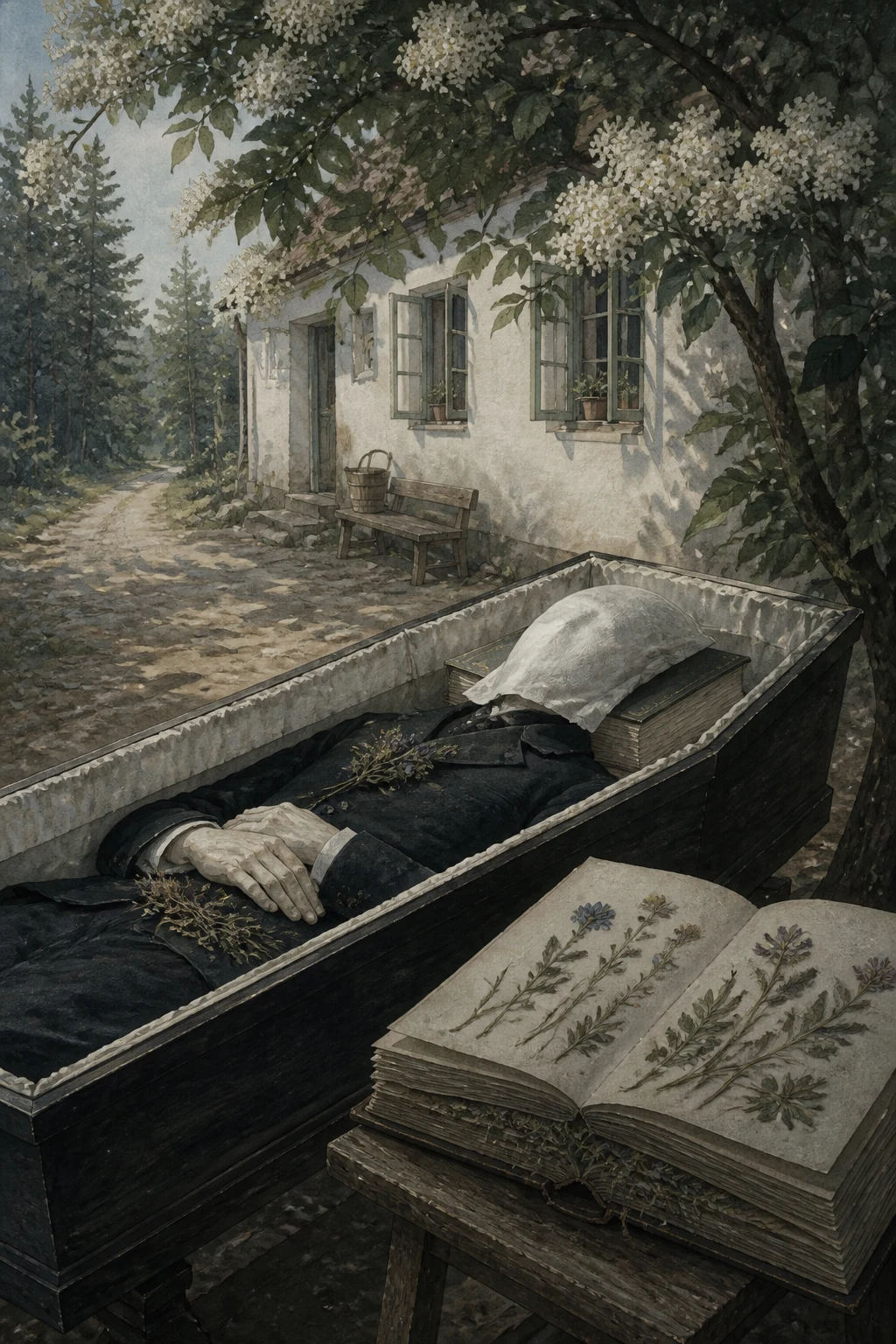
That evening a carriage stopped outside, and they carried him down to it in his coffin; he was to lie in his burial place out in the country. Away he went, but no one followed, for all his friends were dead. And the little boy kissed his finger and waved it after the coffin as it drove away.
A few days later there was an auction at the old house, and from his window the little boy watched them carrying things away: the old knights and the old ladies, the flowerpots with long ears, the old chairs and the old cupboards. Some things went here and some went there. The portrait of the lady who had been found at the second-hand dealer’s went back to the second-hand dealer’s again, and there it hung for ever after, for no one knew her any longer, and no one cared about the old picture.
In the spring they pulled down the house itself, for it was a ramshackle old thing, people said. From the street you could see straight into the room with the pigskin wall covering, which was being slashed and torn away; and the greenery round the balcony hung in wild tangles about the falling beams. And then it was all cleared away.
“That is better!” said the neighbouring houses. * * * And a beautiful house was built, with large windows and smooth white walls. But in front, where the old house had actually stood, a little garden was planted, and wild vines climbed the neighbours’ walls. In front of the garden stood a tall iron fence with an iron gate; it looked very grand, and people stopped to peer inside. And sparrows clung to the vines by the dozen, all chattering at once as best they could. But they were not talking about the old house, for they could not remember it. So many years had passed that the little boy had grown into a man—a capable man, too, who was a delight to his parents. He had just married and moved with his young wife into the house with the garden, and he stood beside her there as she planted a wildflower she thought so pretty. She planted it with her little hand and patted the earth down with her fingers. Ow! What was that? She had pricked herself. Something sharp was sticking straight up out of the soft earth.
It was—just imagine!—the tin soldier, the one who had disappeared in the old man’s room, and had tumbled and tossed among timber and rubble, and finally lain for many years in the earth.
And the young wife wiped the soldier, first with a green leaf and then with her fine handkerchief, which smelled so lovely! And to the tin soldier it was as though he were waking from a long sleep.
“Let me see him!” said the young man, laughing, and then he shook his head. “No, it cannot be the same one, but he reminds me of a story about a tin soldier I had when I was a little boy!” And then he told his wife about the old house and the old man, and about the tin soldier he had sent over to him because he was so terribly lonely. And he told it all just as it had really happened, so that the young wife’s eyes filled with tears for the old house and the old man.
“Perhaps it is the very same tin soldier after all!” she said. “I shall keep him and remember everything you have told me. But you must show me the old man’s grave!”
“I do not know where it is,” he said, “and no one knows! All his friends were dead, no one tended it, and I was only a little boy!” “How terribly lonely he must have been!” she said.
“Terribly lonely!” said the tin soldier. “But how lovely it is not to be forgotten!” “Lovely!” cried something close by, but no one except the tin soldier saw that it was a scrap of the pigskin wall covering. All its gilding was gone, and it looked like wet earth, but it had an opinion, and it spoke it aloud:
“Gilding fades away, But pigskin is here to stay.” The tin soldier, however, did not believe it.