Prevod
You might well have thought something was astir in the village pond, but nothing was astir at all! All the ducks, just as they were floating so comfortably on the water—some standing on their heads, as ducks can do—suddenly made for the shore. You could see their footprints in the wet clay, and hear their quacking a long way off. The water was thoroughly stirred up; a moment before it had been as smooth as a mirror, reflecting every tree and bush nearby, and the old farmhouse with the holes in its gable and the swallow’s nest, but above all the great rosebush laden with flowers, which hung from the wall almost out over the water. There it all stood, like a picture, only upside down; and when the water was disturbed, everything ran together and the whole picture vanished. Two duck feathers, shed by the birds as they flew, bobbed vigorously up and down; all at once they gathered speed, as though a wind were blowing, but there was no wind. Then they lay still, and the water grew mirror-smooth again. You could clearly see the gable with the swallow’s nest, and the rosebush too; each rose gazed at its own reflection. They were so lovely, but they did not know it themselves, for no one had told them. The sun shone through their delicate, fragrant petals, and each rose felt as we do when we are lost in blissful thoughts.
“How lovely it is to be alive!” said each rose. “The only thing I could wish for is to kiss the sun, because it is so warm and bright. Yes, and I should like to kiss the roses down there in the water too! They look exactly like us. I should like to kiss the sweet baby birds down there in the nest; why, there are some above us too! They poke their heads out and chirp so softly. They have no feathers at all, like their father and mother. What good neighbours we have, both above and below! Oh, how lovely it is to be alive!”
The little nestlings above and below—though those below were only reflections in the water—were sparrows, and their father and mother were sparrows too. They had taken over the empty swallow’s nest from the year before, and there they lay, quite at home.
“Are those baby ducks swimming there?” asked the young sparrows when they saw the duck feathers drifting on the water. “Ask sensible questions when you ask anything,” said their mother. “Can’t you see they are feathers, living clothes, such as I have and you will have too, only ours are finer! I only wish we had them up here in the nest, for they keep one warm. I wonder what frightened the ducks! There must have been something in the water, for it certainly wasn’t me, though I did give you quite a sharp ‘chirp’! Those thick-headed roses ought to know, but they know nothing; they only look at themselves and give off their scent. I am heartily tired of those neighbours!” “Listen to the sweet little birds up there!” said the roses. “They are beginning to want to sing too! They cannot yet, but that will come! What a great pleasure it must be! How delightful it is to have such merry neighbours!” Just then two horses came galloping up to be watered. A farm boy sat on one of them, and he had taken off all his clothes except his black hat, which was very broad and large. The boy whistled as though he were a little bird and rode out into the deepest part of the village pond. When he came over towards the rosebush, he plucked one of the roses and stuck it in his hat. Now he thought himself quite splendidly dressed, and rode away with it. The other roses gazed after their sister and asked one another, “Where has she gone?” But none of them knew.
“I should like to go out into the world!” one said to another. “But it is lovely here at home among our own green leaves! By day the sun is so warm, and at night the sky shines even more beautifully! We can see it through all the little holes in it!”
These were the stars, each of which they thought was a hole, for the roses knew no better. “We bring life to the house,” said the mother sparrow, “and swallow’s nests bring good luck, so people say. That is why they are glad to have us! But those neighbours there, a whole rosebush growing up the wall, make it damp. I expect it will be taken away; then at least some grain could grow there. Roses are only good to look at and smell, or at most to stick in your hat. Every year, as I know from my mother, they fall off, and the farmer’s wife preserves them in salt. They get a French name, which I cannot say and do not care about either; then they are put on the fire when something sweet-smelling is wanted. There, that is the story of their lives! They are only for eyes and noses. Now you know!”
When evening came, and the gnats danced in the warm air beneath the rosy clouds, the nightingale came and sang to the roses: that beauty was like sunshine in this world, and that beauty lived for ever. But the roses thought the nightingale was singing about itself, which was quite an understandable thing to think. It never occurred to them that the song was meant for them, but they were delighted with it and wondered whether all the little sparrows might grow into nightingales too.
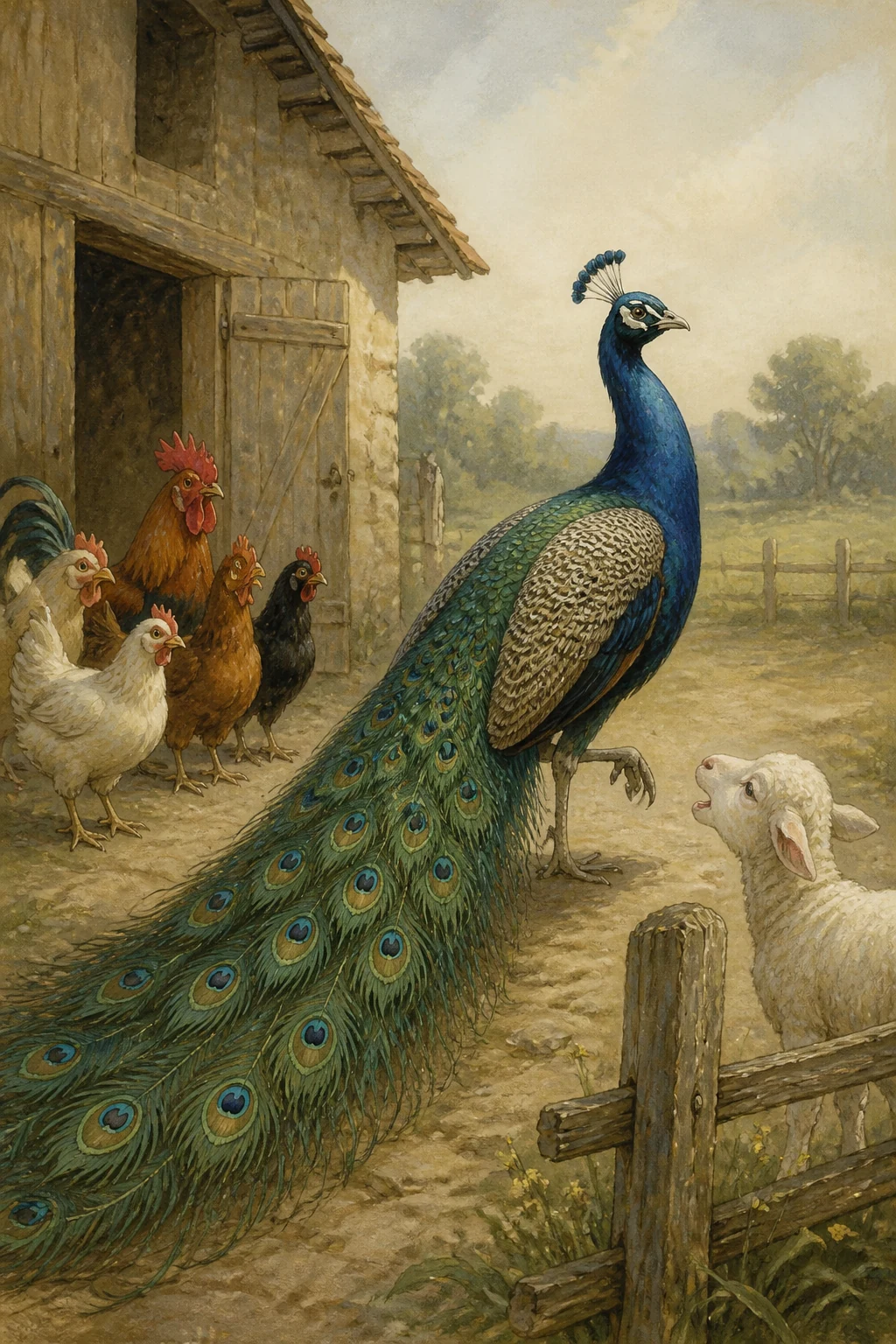
“I understood very well what that bird was singing!” said the young sparrows. “There was only one word I didn’t understand: what is beauty?” “It is nothing!” said the mother sparrow. “It is only a matter of appearances. Up at the manor house, where the pigeons have a house of their own and peas and grain are scattered in the courtyard for them every day—I have eaten with them, and you shall too! Tell me who your friends are, and I will tell you who you are!—up there at the manor house they have two birds with green necks and a crest on their heads. Their tails can spread out like a great wheel, and they have every colour under the sun, enough to hurt your eyes. They are called peacocks, and they are beauty! They ought to have a few feathers plucked; then they would look no different from the rest of us. I would have pecked them if they hadn’t been so big!”
“I will peck them!” said the smallest young sparrow, who had no feathers yet. In the farmhouse lived a young couple; they loved each other dearly, they were hardworking and full of life, and their home was so neat and pretty. On Sunday morning the young wife went out, picked a whole handful of the loveliest roses, put them in a glass of water, and set it in the middle of the chest of drawers.
“Now I can see it is Sunday!” said her husband. He kissed his dear little wife, and they sat down, read a hymn, and held each other’s hands, while the sun shone through the windows upon the fresh roses and the young couple.
“I don’t care to look at that!” said the mother sparrow, who could see straight into the room from her nest; and she flew away. She did the same the following Sunday, for every Sunday fresh roses were put in the glass, and the rosebush always bloomed as beautifully as ever. The young sparrows, who had now grown feathers, wanted to fly with her, but their mother said, “You stay here!” and so they stayed. Away she flew, but however she managed it, all at once she was caught in a horsehair snare that some boys had tied to a branch. The horsehairs tightened round her leg, oh, so tightly, as though they would cut it off. What pain, what terror! The boys rushed up and seized the bird, gripping her dreadfully hard. “It’s only a sparrow!” they said; but they did not let her fly away. They took her home, and every time she cried out, they struck her on the beak.
In the farmyard stood an old fellow who knew how to make soap for shaving and for washing hands, soap in balls and soap in bars. He was a merry old wanderer, and when he saw the sparrow the boys had brought, which they said they did not care about at all, he said, “Shall we make her beautiful?” The mother sparrow shuddered when he said it. From his box, which held the loveliest colours, he took out a great deal of shining gold leaf, and the boys had to run indoors for an egg. He took the white and smeared it all over the bird, then stuck the gold leaf on, until the mother sparrow was gilded all over. But she gave no thought to her finery; she was trembling in every limb. Then the soap-maker took a red scrap, torn from the lining of his old jacket, cut it into a jagged cock’s comb, and pasted it onto the bird’s head.
“Now you shall see the golden bird fly!” he said, and released the sparrow, who flew away in the utmost terror through the bright sunshine. How she shone! All the sparrows, and even a great crow who was no youngster, were quite frightened by the sight; but they flew after her all the same, for they wanted to know what sort of strange bird this was.
“Where from? Where from?” cried the crow. “Wait a little! Wait a little!” said the sparrows. But she would not wait a little. In fear and terror she flew towards home. She was almost sinking to the ground, and more birds kept joining the chase, large and small; some flew right up close to peck at her. “Look at that one! Look at that one!” they all cried.
“Look at that one! Look at that one!” cried her young as she approached the nest. “It must be a young peacock; it has all those colours that hurt your eyes, just as Mother said. Chirp! That is beauty!” And they pecked with their little beaks so fiercely that she could not get in. She was so overcome with terror that she could no longer even chirp, much less say, “I am your mother.” Now all the other birds pecked at her until every feather was torn away, and the mother sparrow sank, bleeding, into the rosebush.
“Poor little creature!” said the roses. “Come, we will hide you! Rest your little head against us!” The mother sparrow spread her wings once more, pressed them close to her again, and lay dead among the neighbouring family, the fresh, beautiful roses.
“Chirp!” said the young sparrows in the nest. “I cannot understand where Mother has got to! Surely this isn’t a trick of hers to make us look after ourselves? She has left us the house for our inheritance! But which of us is to have it all to ourselves when we have families?”
“Well, I cannot have the rest of you here when I settle down with a wife and children!” said the smallest. “I shall probably have more wives and children than you!” said another.
“But I am the eldest!” said a third. They all began to quarrel, beating their wings and pecking with their beaks, and thump! One after another they were pushed out of the nest. There they lay, very angry. They tilted their heads right over to one side and blinked the eye that faced upwards; that was their way of sulking.
They could fly a little, and they practised some more. At last they agreed that, so they could recognise one another when they met out in the world, they would say “Chirp!” and scrape three times with their left foot.
The young bird who remained in the nest spread himself out as much as he could, for now he was a householder; but it did not last long. That night red fire shone through the windows, flames burst out beneath the roof, the dry thatch flared up, and the whole house burned down, with the young sparrow inside. The young couple, however, escaped safely.
When the sun rose next morning and everything seemed as refreshed as after a gentle night’s sleep, nothing remained of the farmhouse but a few black, charred beams leaning against the chimney, which stood all on its own. Smoke rose thickly from the foundations, but in front of them the whole rosebush stood fresh and blooming, reflecting every branch and every flower in the still water.
“How lovely those roses look in front of the burnt-out house!” exclaimed a man passing by. “What a charming little picture! I must have it!” And he took from his pocket a little book of white paper and drew out his pencil, for he was a painter. He sketched the smoking ruins, the charred beams propped against the leaning chimney—for it was leaning more and more—but right in the foreground stood the great flowering rosebush. It was lovely indeed, and it alone was the reason the whole scene was being drawn.
Later in the day, two of the sparrows who had been born there came by. “Where is the house?” they said. “Where is the nest? Chirp, everything is burnt up, and our strong brother has burnt up with it! That is what he got for keeping the nest. The roses have come through it well! Their cheeks are still red. They certainly aren’t mourning their neighbours’ misfortune. Well, I shan’t speak to them, and this is an ugly place, in my opinion!” Then they flew away.
One day in autumn the sunshine was so lovely that you might well have thought it was midsummer. The courtyard in front of the manor house’s grand flight of steps was dry and clean, and there the pigeons strutted, black, white, and violet, gleaming in the sunshine. The old mother pigeons puffed themselves up and told their young, “Stand in a group! Stand in a group!” For that way they looked better.
“What are those little grey things running about among us?” asked an old pigeon whose eyes shimmered red and green. “Little greys! Little greys!” she said. “They are sparrows! Respectable creatures! We have always had a reputation for gentleness, so we must let them pick up a little! They don’t join in the conversation, and they scrape so prettily with their feet!”
Yes, they scraped: three times they scraped with their left foot, but they also said “Chirp!” and then they recognised one another. They were three sparrows from the burnt-down house. “There is excellent food here!” said the sparrows.
And the pigeons walked round one another, puffing out their chests and keeping their thoughts to themselves. “Do you see that puffed-up pigeon?” one said of another. “And do you see her, how she gobbles up the peas? She gets too many! She gets the best ones! Coo, coo! Look how that one is going bald on top! Do you see the darling, the spiteful creature! Grumble, grumble!” And all their eyes shone red with spite. “Stand in a group! Stand in a group! Little greys! Little greys! Grumble, grumble, coo!” It went on without stopping, and so it will a thousand years from now.
The sparrows ate well and listened closely; they even tried posing, but it did not suit them. Now they were full, so they left the pigeons and told one another what they thought of them. Then they hopped under the garden fence, and as the door to the garden room stood open, one hopped onto the threshold. He had eaten more than enough, and that made him bold. “Chirp!” he said. “I dare!” “Chirp!” said the second. “I dare too, and a little more!” And he hopped into the room. There was no one inside, as the third could plainly see, so he flew even farther into the room and said, “All the way in, or not at all! What a curious human nest this is! And all the things they have put in it! Why, what is that?”
There, right before the sparrows, the roses were blooming and reflecting themselves in the water, and the charred beams lay against the crumbling chimney! What could this mean? How had it come into the manor-house room?
All three sparrows tried to fly over the roses and the chimney, but they flew against a flat wall. The whole thing was a painting, a large, splendid picture that the painter had made from his little sketch.
“Chirp!” said the sparrows. “It is nothing! It only looks like something! Chirp! That is beauty! Can you understand it? I cannot!” And away they flew, for people were coming into the room.
Years and days went by. The pigeons had cooed many times, not to say grumbled, the spiteful creatures! The sparrows had shivered through the winters and lived well in summer. They were all engaged or married, or whatever one chooses to call it. They had young, and everyone’s young were, of course, the prettiest and cleverest. One flew here and another there, and when they met, they recognised one another by a “Chirp!” and three scrapes with the left foot. The eldest of them was quite an old bird by now. She had no nest and no young; she longed to visit a great city for once, and so she flew to Copenhagen. There stood a great house of many colours, right beside the palace and the canal, where there were boats laden with apples and pots. Its windows were wider at the bottom than at the top, and when the sparrows peeped in, each room seemed to them like the inside of a tulip, full of every imaginable colour and curving pattern. In the middle of the tulip stood white people; they were made of marble, though some were plaster, but to a sparrow’s eye it was all the same. On top of the building stood a metal chariot drawn by metal horses, and the goddess of victory, also made of metal, was driving them. It was Thorvaldsen’s Museum.
“How it shines! How it shines!” said the sparrow maiden. “This must be beauty! Chirp! Here it is certainly bigger than a peacock!” She still remembered from her childhood that a peacock was the greatest beauty her mother knew. She flew straight down into the courtyard. It was splendid there too; palm trees and branches were painted on the walls, and in the middle of the courtyard stood a great flowering rosebush. It bent its fresh branches, laden with roses, over a grave. She flew towards it, for several sparrows were hopping about there. “Chirp!” and three scrapes with the left foot. She had given that greeting many times over the years, and no one had understood it, for those who have parted do not meet every day. The greeting had become a habit; but today there were two old sparrows and a young one who said “Chirp!” and scraped with their left feet.
“Why, good day, good day!” There were three old birds from the sparrow’s nest, and a little one of the family besides. “To think we should meet here!” they said. “It is a grand place, but there is not much to eat. That is beauty! Chirp!”
Many people came out of the side rooms where the splendid marble figures stood, and approached the grave that held the great master who had shaped those marble statues. All who came stood with shining faces around Thorvaldsen’s grave, and some picked up fallen rose petals and kept them. There were people from far away, from mighty England, from Germany and France; and the loveliest lady took one of the roses and laid it against her breast. Then the sparrows thought that the roses ruled here, and that the whole house had been built for their sake. This, they thought, was really rather too much; but since all the people made so much of the roses, they would not be outdone. “Chirp!” they said, swept the ground with their tails, and looked at the roses out of one eye. They had not looked long before they were certain these were their old neighbours; and so they were. Later in the year, the painter who had sketched the rosebush beside the burnt-down house had been given permission to dig it up, and had presented it to the architect, for no roses were lovelier. The architect had planted it on Thorvaldsen’s grave, where it bloomed as an emblem of beauty, offering its red, fragrant petals to be carried away as keepsakes to distant lands.
“Have you found a position here in the city?” asked the sparrows. And the roses nodded; they recognised their grey neighbours and were so happy to see them. “What a blessing it is to live and bloom, to see old friends and kindly faces every day! Here it is as though every day were a great holy day!”
“Chirp!” said the sparrows. “Yes, these are our old neighbours! We remember their beginnings by the village pond! Chirp! What honours they have risen to! Some creatures have greatness thrust upon them in their sleep. And what is so wonderful about a red blot like that, I do not know! Besides, there is a withered leaf there; I can see that!”
And they pecked at it until the leaf fell off, and the bush stood fresher and greener, while the roses breathed their fragrance in the sunshine over Thorvaldsen’s grave, joining their beauty to his immortal name.