O besedilu
Sončeva palača
- Vir
- Ovidove preobrazbe
- Avtor
- Ovid
- Jezik branja
- English
- Jezik izvirnika
- Latin
- Čas branja
- 8 min branja
- Obseg
- 7 strani
- Naslov izvirnika
- The Palace of the Sun
O izvirniku
Ovidove preobrazbe
Pesniški tok antičnih preobrazb, kjer bogovi, ljudje in narava stalno menjavajo obliko. Bralni jezik je English, izvirnik pa prihaja iz vira Ovidove preobrazbe v jeziku Latin.
Besedilo
Sončeva palača
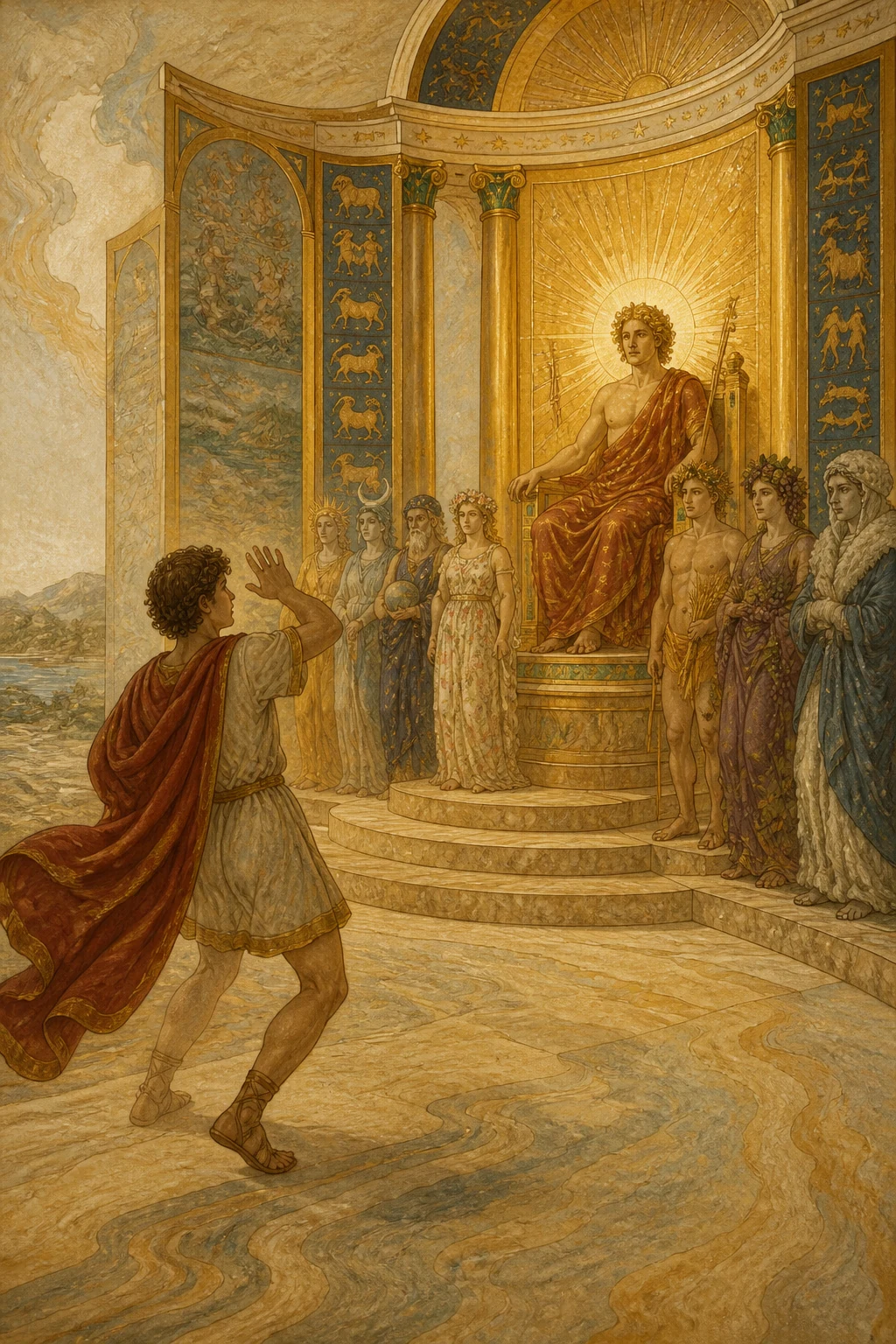
The palace of the Sun rose high on towering columns, bright with glittering gold and bronze that glowed like flame; gleaming ivory crowned its lofty gables, and its double doors shone with the radiance of silver. The workmanship surpassed the material: for there Mulciber had engraved the seas encircling the lands, the circle of the earth, and the sky that hangs above it.
The waters held the sea-blue gods: Triton with his sounding horn, Proteus of the shifting forms, and Aegaeon, his arms gripping the enormous backs of whales; Doris and her daughters, some of whom seemed to swim, while others sat upon a rock drying their green hair, and others rode on fish. Their faces were not all alike, yet not unlike: such as sisters’ faces ought to be.
The earth bore people and cities, forests and wild beasts, rivers and nymphs and all the other spirits of the countryside. Above these was set the image of the shining sky, with six signs on the right-hand door and as many on the left. When Clymene’s son had climbed the rising path and entered the home of the father whose claim he doubted, he went straight toward his father’s presence, but halted at a distance: his eyes could not endure the light any nearer. Robed in purple, Phoebus sat on a throne that gleamed with brilliant emeralds.
To his right and left stood Day and Month and Year, the Ages, and the Hours ranged at equal intervals. There stood young Spring, wreathed in a crown of flowers; there stood naked Summer, wearing a garland of grain; there too stood Autumn, stained with trodden grapes, and icy Winter, his white hair wild and bristling. From his place among them, the Sun saw the youth, awed by these unfamiliar sights, with the eyes that see all things.
“What has brought you on this journey?” he said. “What do you seek in this citadel, Phaethon, my child, whom no father could disown?” He answered, “O light shared by all the boundless world, Phoebus, my father—if you allow me to use that name, and Clymene is not hiding her shame beneath a false claim— give me proof, Father, that I may be believed your true offspring, and free my heart from this uncertainty.”
He spoke; and his father laid aside the rays that flashed about his head and bade him draw nearer. Then, embracing him, he said, “You do not deserve to be denied as mine, and Clymene has told your true parentage. And so that you may doubt no longer, ask whatever gift you wish, and I will grant it. Let the marsh by which the gods must swear, unknown to my eyes, bear witness to my promise.”
He had scarcely finished when the boy asked for his father’s chariot and, for a single day, the right to drive his wing-footed horses. The father regretted his oath. Three times and four he shook his radiant head, then said, “Your request has made my promise reckless. If only I could withhold what I have pledged! I confess, my son, this alone I would refuse you. I may still try to dissuade you. Your wish is not a safe one.
You ask too much, Phaethon, a gift unsuited either to your strength or to your tender years. Your lot is mortal; what you wish for is not mortal. Unknowing, you aspire to more than even the gods above can attain. Let each think as highly of himself as he likes: still, none but I can stand in the fiery chariot. Even the ruler of vast Olympus, who hurls fierce thunderbolts with his dreadful right hand, could not drive these horses—and whom have we greater than Jove?
The first stretch of the road is steep, and even in the morning, fresh, the horses scarcely struggle up it. Midway, it towers in the highest heaven, and often I myself am frightened to look down from there upon the sea and land; my heart trembles with alarm. The last stretch slopes sharply down and needs a steady hand: then even Tethys, who receives me in the waters below, is often afraid that I may plunge headlong.
Remember, too, that the sky is swept round in an endless whirl, drawing the lofty stars and spinning them in its swift course. I struggle against it, and its force, which masters everything else, does not master me: I ride against the rushing sphere. Imagine you have been given the chariot: what will you do? Can you confront the turning heavens, so their swift rotation does not sweep you away?
Perhaps you imagine there are groves up there, cities of the gods, and temples rich with offerings? The road leads through hidden dangers and the shapes of beasts. Even if you keep the road and are not drawn astray, you must still pass between the horns of the Bull facing you, past the Thessalian Archer’s bow and the raging Lion’s jaws, past the Scorpion curving his cruel claws in a wide sweep, and the Crab, whose claws curve the other way.
Nor will you find it easy to govern the horses, fierce with the fires they carry in their breasts and breathe from mouth and nostrils. They scarcely submit to me when their wild spirits grow heated and their necks strain against the reins. But you, my son, beware, lest I become the giver of a fatal gift: change your wish while there is still time. Surely you ask for certain proof that you were born of my blood? My fear gives certain proof: my fatherly dread proves me your father. Look at my face! If only your eyes could penetrate my breast and find a father’s anguish there!
Look about you at all the riches of the world, and from the countless treasures of heaven, earth, and sea ask something: you shall not be refused. This one thing I beg you not to ask, for its true name is punishment, not honor: Phaethon, you ask for punishment as a gift. Why clasp my neck with coaxing arms, unthinking boy? Have no doubt: whatever you wish will be granted—I have sworn by the waters of Styx—but choose more wisely.”
His warnings ended, but the boy resisted all he said, held fast to his purpose, and burned to drive the chariot. So the father, delaying as long as he could, led the youth to the lofty chariot, Vulcan’s gift. Its axle was gold, its pole was gold, and golden the curving rims of its wheels; the spokes were set in silver. Across the yoke, chrysolites and gems arranged in rows reflected Phoebus and gave back a brilliant light.
While bold Phaethon marveled at these things and studied their workmanship, watchful Aurora opened her purple doors in the shining east, revealing halls filled with roses. The stars fled, their ranks marshaled by Lucifer, who left his station in heaven last of all. When Titan saw him heading toward the earth, the world reddening, and the waning moon’s horns fading away, he ordered the swift Hours to harness the horses.
The nimble goddesses obeyed, and from their lofty stalls led out the fire-breathing steeds, well fed on the juice of ambrosia, and fitted their jingling bridles. Then the father touched his son’s face with a sacred ointment, making it able to endure the fierce flames, and set the rays upon his hair. Foreseeing grief, he sighed again and again from his troubled heart, and said: “If you can at least obey this counsel from your father, spare the whip, my boy, and use the reins with all your strength.
They hurry of their own accord; the task is to restrain their eagerness. Do not choose a straight course across the five zones: the road cuts slantwise through them in a broad curve, keeping within the bounds of three zones and avoiding the southern pole and the Bear beside the northern winds. Take this road: you will see the wheel tracks clearly. And so that heaven and earth receive an equal share of heat, neither drive the chariot too low nor urge it to the highest air.
If you rise too high, you will burn the dwellings of heaven; too low, the earth: in the middle lies your safest course. Do not stray too far right toward the coiling Serpent, nor let your left wheel lead you down toward the Altar: keep between the two. The rest I leave to Fortune, who, I pray, may help you and take better care of you than you yourself. While I speak, moist Night has reached the turning point set on the western shore. We are not free to linger: we are called for; dawn shines out, and the darkness has fled.
Take the reins in your hand—or, if your heart can still be changed, take my counsel, not my chariot, while you can, while you still stand on solid ground, before, unknowing, you mount the chariot you so unwisely wished for. Let me give light to the earth, and you watch in safety!”
Izvirnik
The Palace of the Sun
Naslednje strani prikazujejo izvirno besedilo za primerjavo.
Source ID: ovid_metamorphoses_story_010 Citation: Ovid, Metamorphoses 2.1-2.149 Original language: Latin Source: PerseusDL canonical-latinLit Source URL: https://github.com/PerseusDL/canonical-latinLit/blob/master/data/phi0959/phi006/phi0959.phi006.perseus-lat2.xml Segmentation certainty: medium 1: Regia Solis erat sublimibus alta columnis, 2: clara micante auro flammasque imitante pyropo: 3: cuius ebur nitidum fastigia summa tegebat, 4: argenti bifores radiabant lumine valvae.
5: Materiam superabat opus: nam Mulciber illic 6: aequora caelarat medias cingentia terras, 7: terrarumque orbem, caelumque quod inminet orbi. 8: Caeruleos habet unda deos, Tritona canorum 9: Proteaque ambiguum, balaenarumque prementem 10: Aegaeona suis inmania terga lacertis, 11: Doridaque et natas, quarum pars nare videtur, 12: pars in mole sedens virides siccare capillos, 13: pisce vehi quaedam: facies non omnibus una, 14: non diversa tamen, qualem decet esse sororum.
15: Terra viros urbesque gerit silvasque ferasque 16: fluminaque et nymphas et cetera numina ruris. 17: Haec super imposita est caeli fulgentis imago 18: signaque sex foribus dextris totidemque sinistris. 19: Quo simul acclivi Clymeneia limite proles 20: venit et intravit dubitati tecta parentis, 21: protinus ad patrios sua fert vestigia vultus 22: consistitque procul: neque enim propiora ferebat 23: lumina. Purpurea velatus veste sedebat 24: in solio Phoebus claris lucente smaragdis.
25: A dextra laevaque Dies et Mensis et Annus 26: Saeculaque et positae spatiis aequalibus Horae 27: Verque novum stabat cinctum florente corona, 28: stabat nuda Aestas et spicea serta gerebat, 29: stabat et Autumnus, calcatis sordidus uvis, 30: et glacialis Hiems, canos hirsuta capillos. 31: Inde loco medius rerum novitate paventem 32: Sol oculis iuvenem, quibus adspicit omnia, vidit 33: “quae” que “viae tibi causa? quid hac” ait “arce petisti, 34: progenies, Phaethon, haud infitianda parenti?”
35: Ille refert “o lux inmensi publica mundi, 36: Phoebe pater, si das usum mihi nominis huius 37: nec falsa Clymene culpam sub imagine celat, 38: pignera da, genitor, per quae tua vera propago 39: credar, et hunc animis errorem detrahe nostris.” 40: Dixerat: at genitor circum caput omne micantes 41: deposuit radios propiusque accedere iussit; 42: amplexuque dato “nec tu meus esse negari 43: dignus es, et Clymene veros” ait “edidit ortus.
44: Quoque minus dubites, quodvis pete munus, ut illud 45: me tribuente feras. Promissis testis adesto 46: dis iuranda palus, oculis incognita nostris.” 47: Vix bene desierat, currus rogat ille paternos 48: inque diem alipedum ius et moderamen equorum. 49: Paenituit iurasse patrem. Qui terque quaterque 50: concutiens inlustre caput “temeraria” dixit 51: vox mea facta tua est. Utinam promissa liceret 52: non dare! confiteor, solum hoc tibi, nate, negarem.
53: Dissuadere licet. Non est tua tuta voluntas. 54: Magna petis, Phaethon, et quae nec viribus istis 55: munera conveniant nec tam puerilibus annis. 56: Sors tua mortalis, non est mortale quod optas. 57: Plus etiam, quam quod superis contingere possit, 58: nescius adfectas. Placeat sibi quisque licebit, 59: non tamen ignifero quisquam consistere in axe 60: me valet excepto. Vasti quoque rector Olympi, 61: qui fera terribili iaculatur fulmina dextra, 62: non agat hos currus: et quid Iove maius habemus?
63: Ardua prima via est et qua vix mane recentes 64: enitantur equi: medio est altissima caelo, 65: unde mare et terras ipsi mihi saepe videre 66: fit timor, et pavida trepidat formidine pectus. 67: Ultima prona via est et eget moderamine certo: 68: tunc etiam quae me subiectis excipit undis, 69: ne ferar in praeceps, Tethys solet ipsa vereri. 70: Adde quod adsidua rapitur vertigine caelum 71: sideraque alta trahit celerique volumine torquet.
72: Nitor in adversum, nec me, qui cetera, vincit 73: impetus, et rapido contrarius evehor orbi. 74: Finge datos currus: quid ages? poterisne rotatis 75: obvius ire polis, ne te citus auferat axis? 76: Forsitan et lucos illic urbesque deorum 77: concipias animo delubraque ditia donis 78: esse? per insidias iter est formasque ferarum. 79: Utque viam teneas nulloque errore traharis, 80: per tamen adversi gradieris cornua tauri 81: Haemoniosque arcus violentique ora leonis 82: saevaque circuitu curvantem bracchia longo 83: scorpion atque aliter curvantem bracchia cancrum.
84: Nec tibi quadrupedes animosos ignibus illis, 85: quos in pectore habent, quos ore et naribus efflant, 86: in promptu regere est: vix me patiuntur, ubi acres 87: incaluere animi, cervixque repugnat habenis. 88: At tu, funesti ne sim tibi muneris auctor, 89: nate, cave, dum resque sinit, tua corrige vota. 90: Scilicet ut nostro genitum te sanguine credas, 91: pignera certa petis? do pignera certa timendo 92: et patrio pater esse metu probor. Adspice vultus 93: ecce meos; utinamque oculos in pectora posses 94: inserere et patrias intus deprendere curas!
95: Denique quidquid habet dives, circumspice, mundus, 96: eque tot ac tantis caeli terraeque marisque 97: posce bonis aliquid: nullam patiere repulsam. 98: Deprecor hoc unum, quod vero nomine poena, 99: non honor est: poenam, Phaethon, pro munere poscis. 100: Quid mea colla tenes blandis, ignare, lacertis? 101: ne dubita, dabitur (Stygias iuravimus undas) 102: quodcumque optaris: sed tu sapientius opta.”
103: Finierat monitus: dictis tamen ille repugnat 104: propositumque premit flagratque cupidine currus. 105: Ergo qua licuit genitor cunctatus ad altos 106: deducit iuvenem, Vulcania munera, currus. 107: Aureus axis erat, temo aureus, aurea summae 108: curvatura rotae, radiorum argenteus ordo; 109: per iuga chrysolithi positaeque ex ordine gemmae 110: clara repercusso reddebant lumina Phoebo.
111: Dumque ea magnanimus Phaethon miratur opusque 112: perspicit, ecce vigil nitido patefecit ab ortu 113: purpureas Aurora fores et plena rosarum 114: atria. Diffugiunt stellae, quarum agmina cogit 115: Lucifer et caeli statione novissimus exit. 116: Quem petere ut terras mundumque rubescere vidit 117: cornuaque extremae velut evanescere lunae, 118: iungere equos Titan velocibus imperat Horis.
119: Iussa deae celeres peragunt, ignemque vomentes, 120: ambrosiae suco saturos, praesepibus altis 121: quadrupedes ducunt adduntque sonantia frena. 122: Tum pater ora sui sacro medicamine nati 123: contigit et rapidae fecit patientia flammae 124: imposuitque comae radios, praesagaque luctus 125: pectore sollicito repetens suspiria dixit: 126: “Si potes his saltem monitis parere parentis, 127: parce, puer, stimulis et fortius utere loris: 128: sponte sua properant; labor est inhibere volentes.
129: Nec tibi directos placeat via quinque per arcus: 130: sectus in obliquum est lato curvamine limes, 131: zonarumque trium contentus fine polumque 132: effugit australem iunctamque aquilonibus arcton. 133: Hac sit iter: manifesta rotae vestigia cernes. 134: Utque ferant aequos et caelum et terra calores, 135: nec preme nec summum molire per aethera currum. 136: Altius egressus caelestia tecta cremabis, 137: inferius terras: medio tutissimus ibis.
138: Neu te dexterior tortum declinet ad anguem, 139: neve sinisterior pressam rota ducat ad aram: 140: inter utrumque tene. Fortunae cetera mando, 141: quae iuvet et melius quam tu tibi, consulat opto. 142: Dum loquor, Hesperio positas in litore metas 143: umida nox tetigit. Non est mora libera nobis: 144: poscimur: effulget tenebris aurora fugatis. 145: Corripe lora manu, vel, si mutabile pectus 146: est tibi, consiliis, non curribus utere nostris, 147: dum potes et solidis etiamnunc sedibus adstas 148: dumque male optatos nondum premis inscius axes.
149: Quae tutus spectes, sine me dare lumina terris!”
Nadaljuj z branjem