Prevod
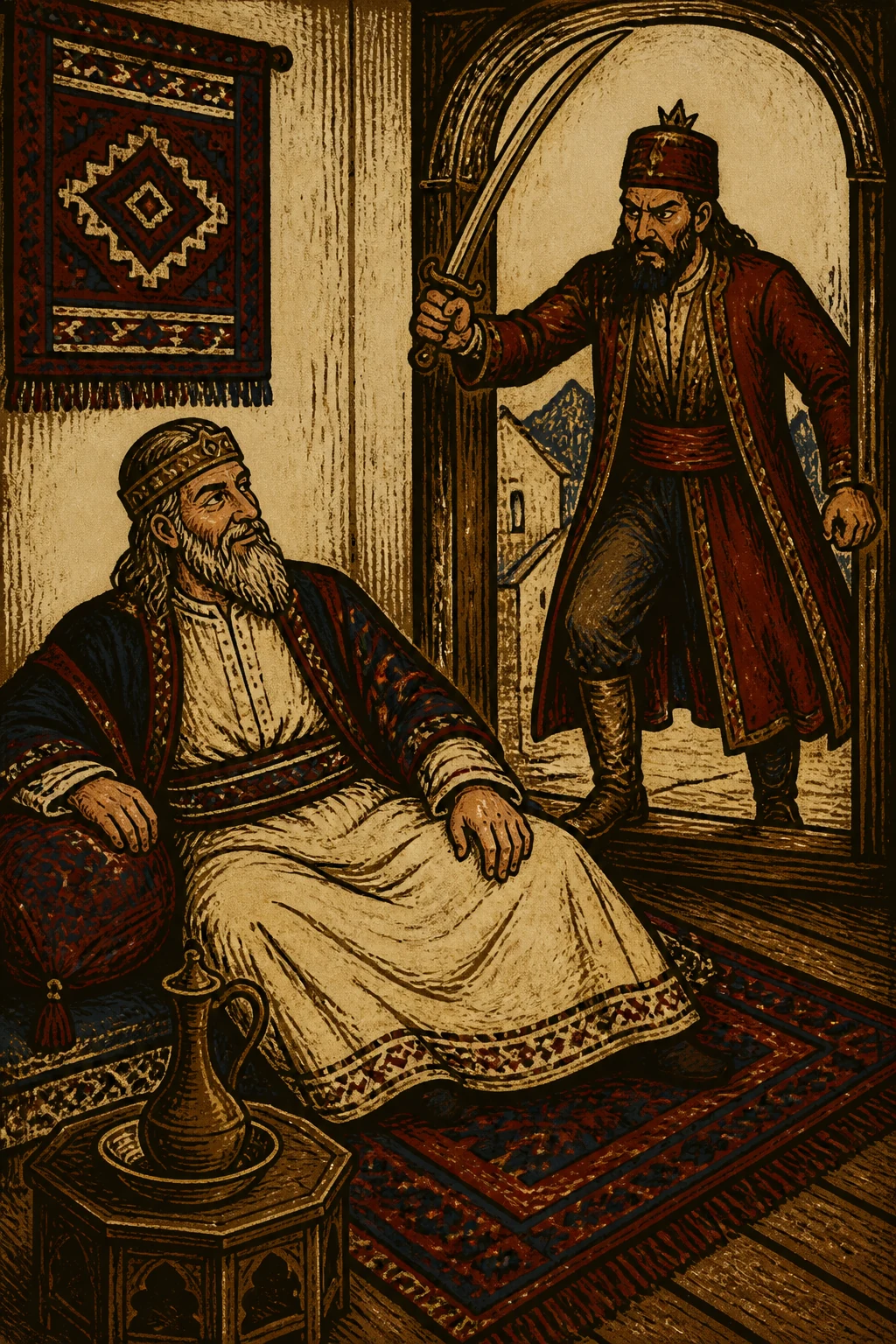
She said: It has reached me, O fortunate king, that when Nuzhat al-Zaman heard these words from the Bedouin, the light in her eyes turned to darkness. She rose, drew her sword, and struck the Bedouin Hammad upon the shoulder, cutting clean through him. Those present said to her, “Why were you so hasty to kill him?” She replied, “Praise be to God, who has prolonged my life until I could take my vengeance with my own hand!” Then she ordered the slaves to drag him away by his feet and throw him to the dogs.
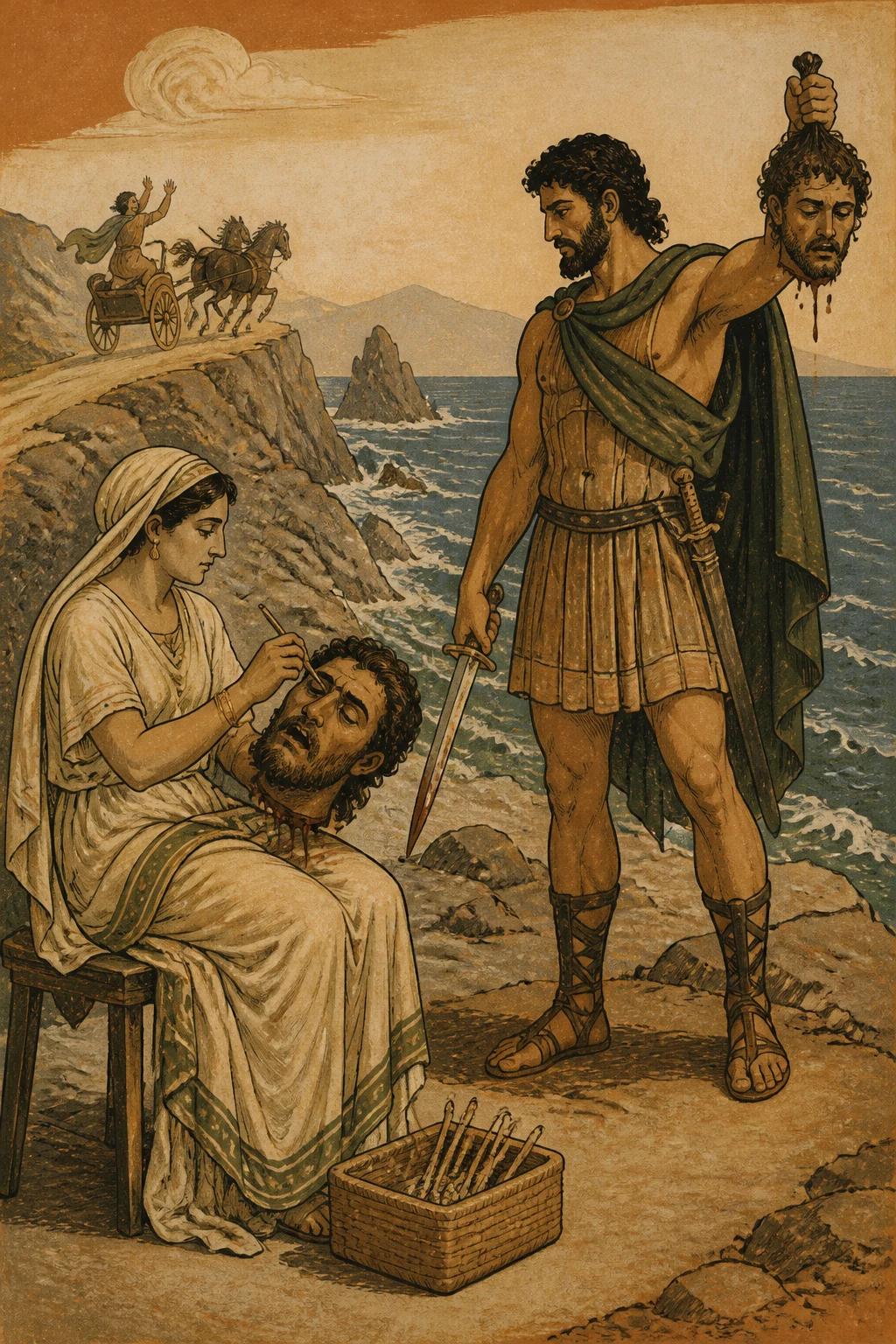
After this they turned to the two who remained of the three. One was a black slave, and they asked him, “What is your name? Tell us the truth.” He answered, “My name is al-Ghadban.” He told them what had passed between him and Queen Ibriza, daughter of King Hardub, king of the Greeks, and how he had killed her and fled. Before the slave could finish speaking, King Rumzan struck off his head with his sword, saying, “Praise be to God, who has kept me alive to avenge my mother with my own hand!” He told them that his nurse Marjana had spoken to him of this slave named al-Ghadban.
Then they turned to the third man. He was the camel driver whom the people of Jerusalem had hired to carry Daw al-Makan to the hospital in Damascus in Syria, but who had taken him and cast him into the furnace room before going on his way. They said to him, “Tell us your story, and speak the truth.” He related everything that had happened between him and Sultan Daw al-Makan: how he had carried him from Jerusalem in his weakened state, having undertaken to convey him to Damascus and leave him at the hospital; how the people of Jerusalem had brought him money; and how he had taken it and fled after throwing Daw al-Makan into the furnace room of the bathhouse. When he had finished speaking, Sultan Kan ma Kan took up a sword and struck off his head, saying, “Praise be to God, who has kept me alive until I could repay this traitor for what he did to my father! For I heard this very tale from my father, Sultan Daw al-Makan.”
The kings said to one another, “There remains only the old woman Shawahi, known as Dhat al-Dawahi, the Mistress of Calamities. She is the cause of all these afflictions, for it was she who brought these disasters upon us. Who will deliver her into our hands, that we may take our vengeance upon her and wipe away our shame?” King Rumzan, the uncle of King Kan ma Kan, said to them, “She must be brought here.” At once King Rumzan wrote a letter and sent it to his grandmother, the old woman Shawahi, known as Dhat al-Dawahi. In it he told her that he had conquered the kingdoms of Damascus, Mosul, and Iraq, routed the Muslim army, and taken their kings captive. He wrote, “You must come to me without fail, bringing Queen Safiyya, daughter of King Afridun, king of Constantinople, and whichever of the Christian nobles you please, but no troops. The country is safe, for it is now in our hands.” When the letter reached her, she read it and recognized King Rumzan’s handwriting. She rejoiced exceedingly and at once made ready to travel, together with Queen Safiyya, the mother of Nuzhat al-Zaman, and their companions. They journeyed on until they reached Baghdad, where the messenger went ahead and announced her arrival. Rumzan said, “It would be wise for us to dress as Franks and go out to meet the old woman, so that we may be safe from her deceit and cunning.” They answered, “We hear and obey.” So they put on Frankish dress, and when Qudiya Fakan saw them, she said, “By the Lord who is worshipped, if I did not know you, I should say you were Franks!” Then Rumzan went before them, and they rode out with a thousand horsemen to meet the old woman. When they caught sight of one another, Rumzan dismounted and hurried toward her. When she saw and recognized him, she too dismounted and embraced him, but he gripped her ribs so hard that he nearly crushed them. “What is this?” she cried. Before she could finish speaking, Kan ma Kan and the vizier Dandan had dismounted beside them, while the horsemen charged with a shout upon her serving girls and slave boys. They seized them all and returned to Baghdad. Rumzan ordered the city to be decorated, and for three days it was decked in finery. Then they brought out Shawahi, known as Dhat al-Dawahi, wearing a tall red cap crowned with donkey dung. A crier walked before her, proclaiming, “This is the reward of anyone who dares assail kings and the children of kings!” Then they crucified her at the gate of Baghdad, and when her companions saw what had befallen her, every one of them embraced Islam.
Then Kan ma Kan, his uncle Rumzan, Nuzhat al-Zaman, and the vizier Dandan marvelled at this wondrous history, and commanded the scribes to record it in books so that it might be read by those who came after them. They passed the rest of their days in the sweetest and most delightful life, until there came to them the Destroyer of Pleasures and the Sunderer of Companies. Such is the last that has reached us of the turns of fortune that befell King Umar al-Numan, his son Sharrkan, his son Daw al-Makan, his grandson Kan ma Kan, Nuzhat al-Zaman, and Qudiya Fakan.
Then the king said to Shahrazad, “I should like you to tell me a tale of birds.” She replied, “With love and pleasure.” Her sister said to her, “In all this time I have never seen the king so light of heart as he is tonight, and I hope that your fate will be a happy one.” But morning overtook Shahrazad, and she fell silent, leaving her permitted tale untold.