Waltey
Smrt Abu Nuvasa in njegove žene
Tunisische Märchen und Gedichte · Hans StummeO besedilu
Smrt Abu Nuvasa in njegove žene
- Vir
- Tunisische Märchen und Gedichte
- Avtor
- Hans Stumme
- Jezik branja
- English
- Jezik izvirnika
- Tunisian Arabic in Latin transcription
- Čas branja
- 7 min branja
- Obseg
- 6 strani
- Naslov izvirnika
- 009 Mût bä nwâs umártü
O izvirniku
Tunisische Märchen und Gedichte
Tunizijske pripovedi v zgodovinskem latiničnem zapisu govorjenega arabskega jezika. Bralni jezik je English, izvirnik pa prihaja iz vira Tunisische Märchen und Gedichte v jeziku Tunisian Arabic in Latin transcription.
Besedilo
Smrt Abu Nuvasa in njegove žene
One day Ba Nwas went to Rashid. His wife had died, and he sat down and wept. “My lord,” he said, “my wife is dead.” “Come,” Rashid told him, “I shall give you a slave girl of my own.” “My lord, may your kindness be multiplied!” Rashid went to Zubayda and said, “Listen, wife, I have something
to tell you.” “Good news, I hope,” she replied. “Poor Ba Nwas has lost his wife.” “Poor man! He did not deserve such a misfortune.” “I should like to give him one of my slave girls.” “I have one who would suit him,” she said. She called out, “Come here, Nur essbah!”
The girl came. “Yes, my lady?” “I have given you to a husband.” “Who is he?” “Ba Nwas, your master’s jester.” “Very well,” she replied. Zubayda had her made ready 3 and told her, “Prepare yourself.” Rashid sent for Ba Nwas. “Come here!” he said. When he came, Rashid gave him a suit of clothes fit for a king and a thousand mahbubs. Then he turned to Zubayda, who was concealed behind a curtain, and said, “I have clothed Ba Nwas: he is a man like me. Now you clothe Nur essbah: she is a woman like you.” Zubayda gave her three outfits of the kind she wore herself, together with gold ornaments, bracelets, bangles, scented ornaments 4, beads, and amber. She gave her slippers too, studded with gems and gold embroidery, and five hundred mahbubs. Then she called Ba Nwas. “Come, take your wife home.” He took her home, and they began spending his money and hers. Before long, it was all gone. He sold her jewels and her clothes, until the two of them had nothing but a sheet to sleep under. He said to her, “Now we have spent all our money. What shall we do? I gave you a great deal, and between us we have gone through it all. Go to your mistress, weep before her and throw yourself at her feet. Perhaps she will give you something for us to live on.” “I certainly will not go,” she said. “Very well. Stay here, then. I shall go to Rashid, beat my head, and tell him my wife has died and I have nothing to buy her shroud with. Perhaps he will give us something.” “Very well, go.” Rashid was sitting in his court when Ba Nwas came up to him weeping. He had rubbed pepper into his eyes to make them red and bring on the tears. “What is the matter, Ba Nwas?” Rashid asked. “My poor wife has died.”
“Ah, we must all die,” said Rashid. “Glory be to Him who alone endures!” “My lord, I have nothing to buy her shroud with or to pay the Koran reciters.” Rashid turned to Jaafar. “Give him a hundred mahbubs.” Jaafar gave him the money. Ba Nwas took the hundred mahbubs and went down rejoicing, leaping down the stairs. When he reached home, his wife asked, “How did you fare?” “Here are a hundred mahbubs,” he told her. “Now, do you know what you must do? Go to Zubayda wrapped in the lining of a rug. When she sees you dressed like that, she will pity you. When she asks what is wrong, tell her, ‘My husband Ba Nwas has died.’ If she asks, ‘Where are your jewels and the money I gave you?’ say, ‘Before he died, he sold everything.’” She wrapped herself in the lining of a rug and went up to Zubayda. Zubayda was sitting there when she came in, weeping and beating herself.
“What is the matter?” she asked. “My husband has died. He is lying at home, and he has left me nothing to buy his shroud with.” Zubayda gave her two hundred mahbubs. “Your husband was, after all, a servant of the ruler,” she said. “You must give him a proper burial.” She went home. Then Ba Nwas said to his wife, “Now Rashid will go home, and he and Zubayda will fall into an argument. She will tell him Ba Nwas has died, and he will tell her Nur essbah has died. They will quarrel away, while we sit here and watch the wonders of God unfold.” When Rashid had finished the day’s business, he went into his apartments and said to Zubayda, “Have you heard, wife? Nur essbah has died. God have mercy on her!” “What? She was here with me not an hour ago! She told me Ba Nwas had died, and I gave her money to buy his shroud.” He kept telling her that Nur essbah was the one who had died, and she kept telling him it was Ba Nwas. Rashid called out to the chief doorkeeper, “Go to Ba Nwas’s house and see whether it is he or his wife who has died.” The chief doorkeeper set off for Ba Nwas’s house. Ba Nwas and his wife were at the window and saw him coming. Ba Nwas looked out and said, “That is the chief doorkeeper. Rashid must have sent him. Lie down and pretend to be dead.” She lay down, and he covered her with a sheet as one covers the dead. The chief doorkeeper came upstairs, and Ba Nwas met him on the steps.
“Is something wrong, sir?” he asked. “My poor wife has died. Come up and see.” He went up and found the woman stretched out beneath a sheet. The chief doorkeeper looked at her and said, “Ah, we must all die! God have mercy on her!” He returned to Rashid. “Who has died?” Rashid asked him.
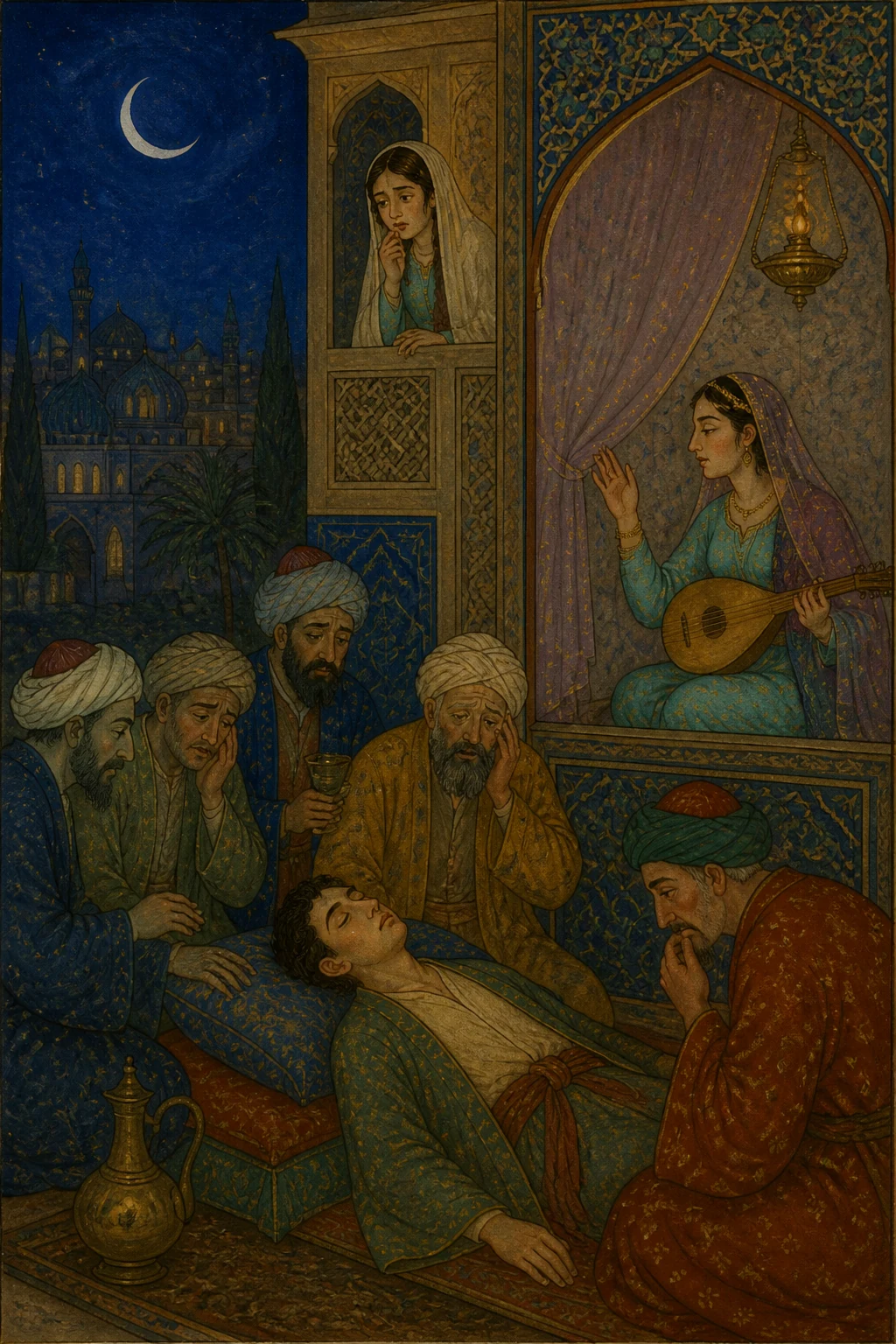
“Nur essbah is the one who has died.” Zubayda flared up. “Shame on you!” she said. Angered 4, she called the steward. “Come here, Baba Srur. Go to Ba Nwas’s house and see which of them has died.” She made him swear to tell the truth. “Do not spare my feelings or your master’s. Tell us what you see.” Baba Srur set off. The steward had scarcely entered the lane when Ba Nwas turned to his wife and said, “Baba Srur is coming. This time I shall fall down dead, and you must cover me with the sheet.” He fell down and played dead. She stretched him out like a corpse and covered him with the sheet, and he held his breath. The steward came upstairs and found Nur essbah weeping. “What is the matter?” he asked. “My husband has died.” She uncovered his face, and the steward saw that he was not breathing. Then he returned to Rashid.
Rashid was sitting there. “What news?” he asked. “My lord, it is Ba Nwas who has died.” Rashid was astonished. “He was here with me only a little while ago!” Then he said, “Bring the carriage.” Rashid and Zubayda got in, with the steward accompanying them, and off they went. Meanwhile, Ba Nwas had risen from the dead and was peering out when he saw Rashid approaching in his carriage. He turned to his wife. “Here comes Rashid! We must both fall down dead.” They both lay down, covered themselves with sheets, and held their breath. Rashid, Zubayda, and Baba Srur came upstairs and found them stretched out. They uncovered their faces and found them as dead as could be. Rashid turned and said, “If anyone can explain this affair to me, I shall give him a thousand mahbubs.” Ba Nwas sat up at once. “Here I am! Your servant is here to witness your promise!” It all turned into a great joke. Rashid and his wife burst out laughing, and Nur essbah rose too, laughing with them. Rashid gave him the money, and Zubayda gave them something as well. Then Rashid turned to Ba Nwas and said, “Tell me about this trick of yours.” “I thought it over,” he replied, “and said to myself, ‘If I go to Rashid now, he will drive me away. He will ask, “What have you done with all the money I gave you?”’ So I dreamed up this scheme out of my own head.” Rashid turned to him and said, “Well done! A trick as clever as this deserves more than a thousand mahbubs!”
Izvirnik
009 Mût bä nwâs umártü
Naslednje strani prikazujejo izvirno besedilo za primerjavo.
Ba nwâs tläffet nhâr minnhârât lirrësîd, mártü mätet, qxád jibkï, qâllù ja sîdi, márti mätet. qâllû âja naxtîk zariä mtâxï. qâllû ja sîdi, ikéttar hîrek. zä errsîd lizûbîda, qâlha rîtsi, ja mrâ, mäs' eñhábbrek. qälitlü hîr insálta. qälilhä bä nwâs miskîn, mártu mätet. qátlü ma istähel, miskîn. qâlhâ nhäbb naxtîh zäriä mizzwäri mtâxi. qátlü hâi xándi zäriä tusloh bîh. xâjëtet, qâlet îza, ja nûr essbâh!
zat, qâltilhâ naxám lelläti. qältilhä hâu xatîtek lïrâzel. qâlt âskûn errâzel? qâltilhâ ba nwâs, elfedelkäzi mtäx sîdek. qältilhä mlîëh. zâhhëzitha 3 uqaltilhâ áxmel hâdrubâs. bxát errSîd elbä nwâs, qâl âj' îza! zä, xatâh kíswa, kiswut elmulûk; waxtâh élf mähbüb. tläffet errsîd lzûbîda, uzûbîda mythubbîjâ fisstâra, qâlhâ äna hallâxt xála ba nwâs, errâzel kîfi kîfû, wúnti áhlax xalanûr essbâh, elmrâ kîfek kîfba. hàllxët xâlîha, xatâtha tläta ksâwi milli tilbis hîâ waxtâtliâ siäxt ëdhéb, mqâis uhdâid urwâhen 4 ushâb uxámbar, waxtâtha elkóntra mtáhha, mrássxa bilxadés ulkontêl; waxtâtha hamsumiét mähbüb. nädätlü, qälitlü âja hizz inártek wämsi räuwah bîlia. häzzha, räuwah bîha ldärü. qxád, bda júsruf fïhâkelflûs mtâxû 'mtáhha,
üfät elflûs fymúdda qlîla. bâx essiâxa mtáhha ulksâwi, hátta qxad hûa wäijäha ibätu filmällifa. qâlhâ áhna tâïïwa flisnä, äs nàxmëlu ana xatîtek elflûs jäser, wúnti bîh fîh ufîthum. ämsi énti lellak, ëbkîlha utyh xalîha, femmäsi mâ taxtîk nia nùsërfu. qälitlu hatt' äna mâ nimsîs, ja qälüliä mlîh, ûqxod hûni, wäna täuwa nimsi lirrSîd, unódrob xalarâsi uñqúllü márti mätet, umâ lqytsi bäs ñkef- fénhâ, femmäsi mâ jaxtîna. qátlü mlîh, barra, errsîd qâxad fiddïwân ubä mvâs tâlax jibkï; liât fixâïnîh elfilfil bas tahniâr utàhabët eddmûëx. errsîd qâllu äs bîk, ja bä nwâs? qâllu elmrêjâ matet.
qâllù alla, nmûtu elkúll; subhânu hûa eddâim! qâllu jä sîdï, ma lqyt bäs ënkeffénha unzïbilh' elqúrra. tläffet errsîd hzáxfar, qâllu axtîh miét mahbûb. xatâh. häzz elmiét mahbûb uhabát farhân, inäggez middrûz. râûwahëlhâ, qälitlu âs xämilt? qälilhä hâi miét mahbûb. qâlha rîtsi äs táxmel énti täuwa? ämsi lzûbîda utlähhäf bubtân zärräjä, ukif trâk fybtân zärräja, thënn xalîk; ukïf tqúllek äs bîk, qúllha râzli bä nwâs mät. klf tqûllek wîn siâxtek uwîn flûsek lï xatîtek, qûl mä mät illä ma bâhhum elkúll. tláhfet bubtân zärräja, tálxet lïzûbîda; zübída qâxada uhîâ tâlxa tíbki uthábbat .
qältühä äs bîk? qältühä râzli mät umläuwah fiddâr, umâ hallali bäs ñkéffenü. xatâtha mïtîn mahbûb, qältilhä râzlek mahsûb hdîm hâkem, läzim taxméllu dfîna mlîha. räuwähet. täuwa bä nwâs qâl lmártú, täuwa errsîd jàhabët liddâr, jitkäbsu hûa uzûbîda; bîâ tqiillù bä nwâs mat, uhû' iqùlylha nûr essûbâh mätet. jûqoxdu itxârkû, wáhna nûqoxdu hûni nitfàrrëzù fïxazéb rábbi. täuwa errsîd ufa elhúküm mtâxu, dhál liddâr, qälilhä rîtsi ja mrâ, nûr essbâh mätet, ráhmt allá xalîha! qâlet ûh, hâi täuwa känt ahdâja, mä izîsi sâxa, uqälitll ba nwâs mât, waxtîtha bäs tkéffënû. qxad hûa iqùlylha nûr essbâh hîâ lï mätet, uhîâ tqullü bä nwâs hûa lï mât, xâjet errsîd, qâl lbasbâuwâb ämsi lïdâr bä nwâs, sûf, mat hûa willä mártu. msä bäsbäüwäb, msä Idar ba nwâs. bä nwâs hû' umártü fissebbäk
wisûfu flbasbäüwäb zêihum liddâr. hzár, qälilhä hâda bäsbäüwäb errësîd jibxätü; úrqud, àxmer-riihëk mîtâ. ráqdet uxâttâha bilmälhfa, kîflï nxattîu elmîjët. tláx bäsbäüwäb lilxalî, xûrdu bä nwâs fiddrûz. qâllù inäk lä säu, jä sîdï? qâllu elmrêjâ mâtitlï, ëtlax §ûf. tláx ulqâ 'lmrâ mâmdûda, mxuttîjâ bilmälhfa. hzár bäsbäüwäb, qâllu allá, elkúll nmûtù! ráhmt allá xalîha! wâllâ lirrsîd; qâllu askûn mât?
qâllu nûr essûbâh hîâ lï mätet. thàrqëd-zùbîda , qâlet hâma xalîk. txásset 4 unädät lqaiddâr, qátlü îza jä baba srûr, ämsi ldâr bä nwâs usûf askûn mät mynhum. uhällfyttü, qátlü lä thamîni lä äna, lä sîdek; qûl elháqq, élli tsûf, qûl. msä bâba srûr. qäid eddâr féll mizzáñqa ubä nwâs tläffet elmártü, qälilhä bâba srûr zêi; häni ana ntyh nmût, uxâttîni bilmälhfa. tâh, mât, siblittu kîf elmîjet uxâttâtu bilmälhfa uqtáx ennqyq. tláx qaîddâr, jilqa nûr essbâh tibkï. qâl äs bîk? qâlet râzli mât. xarrâlu wuzhü, säfu qâtax ennqyq. wâ'lla lirrsîd.
errsîd qâxad, qâllu âs fémma myñhbár? qâllû ja sîdï, bS nwâs hû' élli mât. thráq errsîd, qâl täuwa kän hdâjâ. qâl zîb serjûl. rkib errâîd uzûbîda uqâid eddâr mxâhum utémmu hältyn. bä nwâs tâ/Œwa qâm millmût ubdä itúll, jáhhi säf errsîd zêi fïkarrôsa. tläffet el¬ mártü, qâl hâu errsîd zêi. qâl läzim ntîhu litnîn nmûtû. râqdu litnîn utxâttâu bilmlähef uqáttxu ennqyq litnîn. tláx errsîd uzûbîda ubâba srûr. jilqaûhum mâmdûdîn mesbûlîn, xarrâu xalauzûhum, lqaûbum mûta mnämis tläft'et errsîd, qâl lûkan min ihabbàrnï xála halqúdja, naxtîh élf mahbûb; ubä nwâs tqâxad, qâllû liât, hdîmek râu mâshûd, liât! wallät fédelka, dáhku errsîd umàrtû, uqâmet zäda nûr essbâh utádhak. xatâb elflûs uzûbîda xâtât. tläffet errsîd lbä nwâs, qâllû
'hkîli helxámla lï xâmiltha. qâllû hammémt bîni ubïnxàqlï, qùlt täuwa nimsi lirresîd, itarrâdnï, iqúlli halflûs élli xatïthûmlek, âs xamilt bîhum? râni talláxt battálxa hâdï minqâmûs râsi. tläfft errsîd, qâllû sahhêt! xámla kîfen hâdï dâmra tistähel xâlîha áktar min élf mahbûb!
Nadaljuj z branjem