Waltey
Skrinja z razbojniki
001 The Box Of Robbers
American Fairy Tales · L. Frank BaumO besedilu
Skrinja z razbojniki
- Vir
- American Fairy Tales
- Avtor
- L. Frank Baum
- Jezik branja
- Slovenščina
- Jezik izvirnika
- English
- Čas branja
- 14 min branja
- Obseg
- 11 strani
- Naslov izvirnika
- 001 The Box Of Robbers
O izvirniku
American Fairy Tales
Dvanajst Baumovih avtorskih ameriških pravljic, igrivih, mestnih in zavestno modernih. Bralni jezik je Slovenščina, izvirnik pa prihaja iz vira American Fairy Tales v jeziku English.
Besedilo
Skrinja z razbojniki
Nihče ni nameraval tisto popoldne pustiti Marthe same, a naneslo je, da so morali vsi po takšnem ali drugačnem opravku. Gospa McFarland se je udeležila tedenskega kartanja, ki ga je prirejala Ženska zveza proti igram na srečo. Snubec Marthine sestre Nell je povsem nepričakovano prišel ponjo, da bi jo odpeljal na dolgo vožnjo. Očka je bil kot po navadi v pisarni. Mary Ann je imela prost dan. Emeline pa bi seveda morala ostati doma in paziti na deklico; toda Emeline je bila nemirnega duha.
»Bi vas motilo, gospodična, če bi samo stopila čez uličico in rekla besedo ali dve služkinji gospe Carleton?« je vprašala Martho. »Seveda ne,« je odvrnila deklica. »Le zadnja vrata raje zakleni in vzemi ključ s seboj, ker bom zgoraj.«
»O, to bom seveda storila, gospodična,« je rekla navdušena služkinja in odhitela, da bi preživela popoldne s prijateljico, Martho pa pustila čisto samo v veliki hiši, za povrh še zaklenjeno.
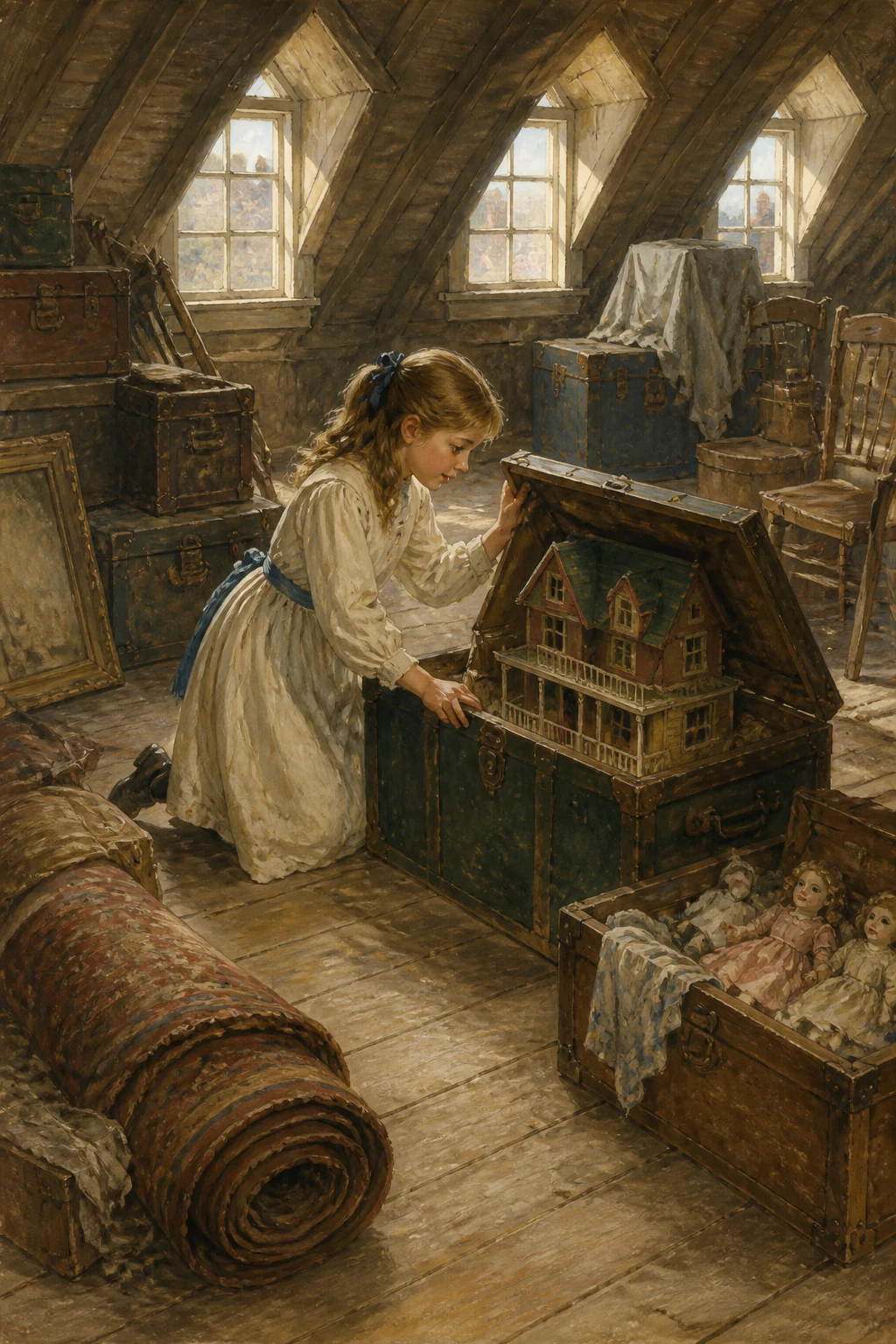
Deklica je prebrala nekaj strani v svoji novi knjigi, naredila nekaj vbodov na vezenini in se s štirimi najljubšimi punčkami začela igrati »obiske«. Potem se je spomnila, da je na podstrešju hišica za punčke, ki je že več mesecev ni uporabljala, zato se je odločila, da jo bo obrisala in uredila.
S to mislijo se je povzpela po zavitih stopnicah v veliko sobo pod streho. Tri podstrešna okna so jo dobro osvetljevala in v njej je bilo toplo in prijetno. Ob stenah so stale vrste zabojev in skrinj, kupi starih preprog, poškodovano pohištvo, svežnji odsluženih oblačil in druga bolj ali manj dragocena ropotija. Vsaka urejena hiša ima takšno podstrešje, zato mi ga ni treba opisovati.
Hišico za punčke je nekdo prestavil, toda Martha jo je po krajšem iskanju našla daleč v kotu ob velikem dimniku. Potegnila jo je na plano in opazila, da za njo stoji črna lesena skrinja, ki jo je stric Walter poslal iz Italije pred mnogimi, mnogimi leti — pravzaprav še pred Marthinim rojstvom. Mamica ji je nekoč pripovedovala o njej: da zanjo nimajo ključa, ker je stric Walter želel, da ostane zaprta, dokler se ne vrne domov; in da je ta potepuški stric, ki je bil silen lovec, odšel v Afriko lovit slone, potem pa o njem niso več ničesar slišali.
Zdaj ko je skrinja po naključju pritegnila njeno pozornost, si jo je deklica radovedno ogledovala. Bila je precej velika — celo večja od mamičine potovalne skrinje — in vsa okovana z žeblji s potemnelimi medeninastimi glavicami. Tudi težka je bila, kajti ko jo je Martha skušala na enem koncu privzdigniti, je ugotovila, da je ne more niti za las premakniti. Ob strani pokrova pa je bila ključavnica. Sklonila se je, da bi jo pregledala, in videla, da bi potrebovala kar velik ključ, če bi jo hotela odpreti.
Tedaj si je deklica, kakor lahko uganete, zaželela odpreti veliko skrinjo strica Walterja in pogledati, kaj je v njej. Vsi smo namreč radovedni in deklice niso nič manj radovedne od nas drugih.
»Ne verjamem, da se bo stric Walter sploh kdaj vrnil,« je pomislila. »Očka je nekoč rekel, da ga je gotovo ubil kakšen slon. Ko bi le imela ključ —« Nenadoma je obmolknila in veselo plosknila z ročicami, saj se je spomnila velike košare ključev na polici v omari za perilo. Bili so vseh vrst in velikosti; morda bi kateri odklenil skrivnostno skrinjo!
Švignila je po stopnicah navzdol, našla košaro in se z njo vrnila na podstrešje. Nato je sedla pred skrinjo, okovano z medeninastimi žeblji, in začela v nenavadni stari ključavnici preizkušati ključ za ključem. Nekateri so bili preveliki, večina pa premajhna. Eden je šel v ključavnico, vendar se ni hotel obrniti; drugi se je tako močno zataknil, da se je nekaj časa bala, da ga nikoli več ne bo mogla izvleči. Nazadnje pa je, ko je bila košara že skoraj prazna, star medeninast ključ nenavadne oblike zlahka zdrsnil v ključavnico. Martha je radostno vzkliknila in ga obrnila z obema rokama; nato je zaslišala oster »klik« in naslednji hip se je težki pokrov sam od sebe sunkovito odprl!
Deklica se je za trenutek nagnila čez rob skrinje, a ob pogledu, ki se ji je ponudil, je osuplo odskočila. Počasi in previdno se je iz skrinje razvozlal moški, stopil na tla, pretegnil ude, nato pa snel klobuk in se presenečeni deklici vljudno priklonil.
Bil je visok in suh, njegov obraz pa je bil videti močno porjavel ali ožgan od sonca. Nato se je iz skrinje prikazal še drugi moški, ki je zehal in si mel oči kakor zaspan šolar. Bil je srednje postave in njegova koža se je zdela prav tako močno porjavela kot koža prvega.
Medtem ko je Martha z odprtimi usti strmela v ta nenavadni prizor, je iz skrinje prilezel še tretji moški. Imel je enako polt kot njegova tovariša, vendar je bil majhen in debel.
Vsi trije so bili nenavadno oblečeni. Nosili so kratke suknjiče iz rdečega žameta z zlatimi našitki in hlače do kolen iz nebesno modrega satena s srebrnimi gumbi. Čez nogavice so imeli navzkriž ovite široke rdeče, rumene in modre trakove, njihovi klobuki pa so imeli široke krajce in visoke koničaste vrhove, s katerih so plapolali dolgi, živobarvni trakovi.
V ušesih so imeli velike zlate obroče, za pasovi pa vrste nožev in pištol. Njihove oči so bile črne in bleščeče in imeli so dolge, strašne brke, na koncih zavihane kakor prašičji repek.
»Ojej, kako sta bila težka!« je vzkliknil debeli, ko si je potegnil žametni suknjič navzdol in ometel prah z nebesno modrih hlač. »Čisto sta me zmečkala.«
»Temu se ni bilo mogoče izogniti, Luigi,« je lahkotno odvrnil suhi; »pokrov skrinje me je pritiskal nate. Kljub temu ti izrekam svoje obžalovanje.« »Kar se mene tiče,« je rekel mož srednje postave, brezskrbno zvil cigareto in jo prižgal, »moraš priznati, da sem ti bil dolga leta najbližji prijatelj; zato nikar ne bodi neprijeten.«
»Na podstrešju ne smete kaditi,« je rekla Martha, ki se je ob pogledu na cigareto spet zbrala. »Lahko bi zažgali hišo.« Mož srednje postave, ki je prej sploh ni opazil, se je ob teh besedah obrnil k njej in se priklonil.
»Ker me prosi dama,« je dejal, »se bom odpovedal cigareti,« in jo vrgel na tla ter jo pohodil. »Kdo ste?« je vprašala Martha, ki je bila dotlej preveč osupla, da bi jo bilo strah.
»Dovolite, da se predstavimo,« je rekel suhi in elegantno zamahnil s klobukom. »To je Lugui,« debeli je pokimal; »in to je Beni,« mož srednje postave se je priklonil; »jaz pa sem Victor. Mi smo trije razbojniki — italijanski razbojniki.«
»Razbojniki!« je vzkliknila Martha z zgroženim pogledom. »Natanko tako. Morda na vsem svetu ni še treh razbojnikov, ki bi bili tako strašni in divji kakor mi,« je ponosno dejal Victor.
»Tako je,« je rekel debeli in resno pokimal. »Ampak to je hudobno!« je vzkliknila Martha. »Da, res je,« je odvrnil Victor. »Neznansko in silno hudobni smo. Morda na vsem svetu ne bi našli treh mož, ki bi bili bolj hudobni od teh, ki zdaj stojijo pred vami.«
»Tako je,« je odobravajoče rekel debeli. »Ampak ne bi smeli biti tako hudobni,« je rekla deklica; »to je — to je — grdo!« Victor je povesil oči in zardel.
»Grdo!« je zgroženo zasopel Beni. »To je težka beseda,« je žalostno dejal Luigi in zakopal obraz v dlani. »Nikoli si nisem mislil,« je zamrmral Victor z glasom, ki se mu je lomil od ganjenosti, »da bom kdaj deležen takšne žaljivke — in to od dame! Vendar ste morda govorili nepremišljeno. Pomisliti morate, gospodična, da imamo za svojo hudobijo opravičilo. Kajti kako naj bomo, vas vprašam, razbojniki, če nismo hudobni?«
Martha je bila v zadregi in je zamišljeno zmajala z glavo. Potem se je nečesa spomnila. »Ne morete biti več razbojniki,« je rekla, »ker ste zdaj v Ameriki.«
»V Ameriki!« so vsi trije hkrati vzkliknili. »Seveda. Na aveniji Prairie v Chicagu ste. Stric Walter vas je v tej skrinji poslal sem iz Italije.«
Ob tej novici so bili razbojniki videti silno zbegani. Lugui je sedel na star gugalnik s polomljeno prečko in si obrisal čelo z rumenim svilenim robcem. Beni in Victor sta se sesedla na skrinjo in jo gledala z bledima obrazoma in izbuljenimi očmi.
Ko si je nekoliko opomogel, je Victor spregovoril. »Vaš stric Walter nam je storil veliko krivico,« je očitajoče dejal. »Odpeljal nas je iz naše ljubljene Italije, kjer so razbojniki zelo spoštovani, in nas pripeljal v tujo deželo, kjer ne bomo vedeli, koga naj oropamo in koliko naj zahtevamo za odkupnino.«
»Tako je!« je rekel debeli in se krepko udaril po stegnu. »In v Italiji smo si pridobili tako imeniten sloves!« je obžalujoče dejal Beni. »Morda vas je stric Walter hotel poboljšati,« je pripomnila Martha.
»Ali torej v Chicagu ni razbojnikov?« je vprašal Victor. »No,« je odvrnila deklica in zdaj še sama zardela, »mi jim ne pravimo razbojniki.« »S čim pa naj se potem preživljamo?« je obupano vprašal Beni.
»V velikem ameriškem mestu se da početi marsikaj,« je rekla deklica. »Moj oče je odvetnik« (razbojniki so se zdrznili), »mamin bratranec pa je policijski inšpektor.«
»Ah,« je rekel Victor, »to je dobra služba. Policijo je treba nadzorovati, zlasti v Italiji.« »Povsod!« je dodal Beni. »Lahko pa bi počeli tudi kaj drugega,« je spodbudno nadaljevala Martha. »Lahko bi vozili tramvaje ali bili prodajalci v veleblagovnici. Nekateri postanejo celo mestni svetniki, da si služijo kruh.«
Razbojniki so žalostno zmajali z glavami. »Nismo primerni za takšno delo,« je rekel Victor. »Naš posel je ropanje.« Martha je skušala najti rešitev. »V plinarni je precej težko dobiti službo,« je rekla, »lahko pa bi postali politiki.«
»Ne!« je z nenadno srditostjo vzkliknil Beni; »ne smemo se odreči svojemu vzvišenemu poklicu. Vedno smo bili razbojniki in razbojniki moramo ostati!« »Tako je!« se je strinjal debeli.
»Tudi v Chicagu morajo biti ljudje, ki jih lahko oropamo,« je vedro pripomnil Victor. Martha je bila v stiski. »Mislim, da so jih že vse oropali,« je ugovarjala.
»Potem pa lahko oropamo roparje, saj imamo nadpovprečne izkušnje in nadarjenost,« je rekel Beni. »Ojoj, ojoj!« je zastokala deklica; »le zakaj vas je stric Walter poslal sem v tej skrinji?«
Razbojniki so postali radovedni. »To bi tudi mi radi vedeli,« je vneto izjavil Victor. »Toda nihče ne bo nikoli izvedel, saj se je stric Walter izgubil med lovom na slone v Afriki,« je prepričano nadaljevala.
»Potem moramo sprejeti svojo usodo in ropati po svojih najboljših močeh,« je rekel Victor. »Dokler ostajamo zvesti svojemu ljubljenemu poklicu, se nam ni treba sramovati.«
»Tako je!« je vzkliknil debeli. »Brata! Začnimo takoj. Oropajmo hišo, v kateri smo.« »Odlično!« sta zavpila druga dva in skočila na noge.
Beni se je grozeče obrnil k deklici. »Ostani tukaj!« je ukazal. »Če se premakneš za en sam korak, boš sama kriva za svojo kri!« Nato je z nežnejšim glasom dodal: »Nikar se ne boj; tako vsi razbojniki govorijo s svojimi ujetniki. Ampak seveda mladi dami v nobenem primeru ne bi storili nič žalega.«
»Seveda ne,« je rekel Victor. Debeli je izvlekel velik nož izza pasu in z njim zamahnil nad glavo. »Pri krvi!« je srdito vzkliknil.
»Pri bananah!« je s strašnim glasom zavpil Beni. »Poguba našim sovražnikom!« je zasikal Victor. Nato so se vsi trije skoraj prepognili in se s pištolami z napetimi petelini v rokah ter bleščečimi noži med zobmi tiho splazili po stopnicah navzdol. Martha je ostala za njimi, trepetajoča od strahu in preveč zgrožena, da bi sploh zaklicala na pomoč.
Nikoli ni vedela, kako dolgo je ostala sama na podstrešju, nazadnje pa je zaslišala mačje korake razbojnikov, ki so se vračali, in jih zagledala, kako drug za drugim prihajajo po stopnicah navzgor.
Vsi so v naročjih nosili težke tovore plena, Lugui pa je na vrhu kupa najlepših maminih večernih oblek lovil ravnotežje pite s suhim sadjem. Za njim je prišel Victor s polnim naročjem okrasnih drobnarij, medeninastim svečnikom in uro iz salona. Beni je nosil družinsko Sveto pismo, košaro s srebrnim priborom iz kredence, bakren kotliček in očkov krzneni plašč.
»O, kakšno veselje!« je rekel Victor in odložil svoj tovor; »kako prijetno je spet ropati.« »O, kakšna blaženost!« je rekel Beni; toda kotliček mu je padel na nožni prst in takoj je začel od bolečin poskakovati naokrog, pri tem pa je mrmral čudne besede v italijanščini.
»Veliko bogastva imamo,« je nadaljeval Victor in držal pito, medtem ko je Lugui svoj plen dodajal na kup; »in vse iz ene same hiše! Ta Amerika mora biti bogata dežela.«
Nato si je z bodalom odrezal kos pite, ostanek pa podal tovarišema. Vsi trije so sedli na tla in pojedli pito, medtem ko jih je Martha žalostno opazovala.
»Morali bi imeti votlino,« je pripomnil Beni; »plen moramo namreč spraviti na varno. Ali veš za kakšno skrivno votlino?« je vprašal Martho. »Obstaja Mamutova jama,« je odgovorila, »ampak je v Kentuckyju. Zelo dolgo bi se morali peljati z vlakom, da bi prišli do nje.«
Trije razbojniki so zamišljeno molče žvečili pito, že naslednji trenutek pa jih je preplašilo zvonjenje električnega hišnega zvonca, ki ga je bilo jasno slišati celo na odmaknjenem podstrešju.
»Kaj je to?« je hripavo vprašal Victor, medtem ko so vsi trije planili na noge z izvlečenimi bodali. Martha je stekla k oknu in videla, da je bil le poštar, ki je vrgel pismo v nabiralnik in spet odšel. Toda dogodek ji je dal zamisel, kako naj se znebi svojih nadležnih razbojnikov, zato je začela lomiti roke, kakor da je v hudi stiski, in zavpila:
»Policija je!« Razbojniki so se resnično preplašeni spogledali in Lugui je trepetaje vprašal: »Ali jih je veliko?« »Sto dvanajst!« je vzkliknila Martha, potem ko se je pretvarjala, da jih šteje.
»Potem smo izgubljeni!« je izjavil Beni; »s toliko nasprotniki se nikoli ne bi mogli bojevati in ostati živi.« »Ali so oboroženi?« je vprašal Victor, ki se je tresel, kakor da ga zebe.
»O, da,« je rekla. »Imajo puške in meče in pištole in sekire in — in —« »In kaj?« je vprašal Lugui. »In topove!« Trije hudobneži so glasno zastokali in Beni je z votlim glasom rekel:
»Upam, da nas bodo hitro ubili in nas ne bodo mučili. Povedali so mi, da so ti Američani pobarvani Indijanci, ki so krvoločni in strašni.«
»Tako je!« je zasopel debeli in se stresel. Nenadoma se je Martha obrnila od okna. »Moji prijatelji ste, kajne?« je vprašala. »Predani smo ti!« je odgovoril Victor.
»Obožujemo te!« je vzkliknil Beni. »Zate bi umrli!« je dodal Lugui, ki je mislil, da bo tako ali tako vsak hip umrl. »Potem vas bom rešila,« je rekla deklica. »Kako?« so v en glas vprašali vsi trije.
»Zlezite nazaj v skrinjo,« je rekla. »Potem bom zaprla pokrov, da vas ne bodo mogli najti.« Omamljeno in neodločno so se ozirali po sobi, ona pa je vzkliknila:
»Pohiteti morate! Kmalu bodo tu, da vas aretirajo.« Tedaj je Lugui skočil v skrinjo in se zleknil na dno. Beni se je prekucnil za njim in se stisnil ob zadnjo steno. Victor jima je sledil, a je prej še elegantno poljubil dekličino roko.
Nato je Martha pritekla bliže in skušala potisniti pokrov navzdol, vendar se ni hotel zaskočiti. »Bolj se morate stisniti,« jim je rekla. Lugui je zastokal. »Po svojih najboljših močeh se trudim, gospodična,« je rekel Victor, ki je bil najbliže vrhu; »toda čeprav smo prej prav lepo šli vanjo, se nam skrinja zdaj zdi nekoliko premajhna.«
»Tako je!« se je z dna oglasil zamolkli glas debelega. »Vem, kaj zaseda prostor,« je rekel Beni. »Kaj?« je zaskrbljeno vprašal Victor.
»Pita,« je odvrnil Beni. »Tako je!« je slabotno prišlo z dna. Nato je Martha sedla na pokrov in ga z vso svojo težo pritisnila navzdol. Na njeno veliko veselje se je ključavnica zaskočila; skočila je dol, napela vse moči in obrnila ključ.
Ta zgodba nas uči, naj se ne vmešavamo v reči, ki se nas ne tičejo. Kajti če bi se Martha vzdržala odpiranja skrivnostne skrinje strica Walterja, ji ne bi bilo treba znositi po stopnicah navzdol vsega plena, ki so ga razbojniki prinesli na podstrešje.
Izvirnik
001 The Box Of Robbers
Naslednje strani prikazujejo izvirno besedilo za primerjavo.
No one intended to leave Martha alone that afternoon, but it happened that everyone was called away, for one reason or another. Mrs. McFarland was attending the weekly card party held by the Women’s Anti-Gambling League. Sister Nell’s young man had called quite unexpectedly to take her for a long drive. Papa was at the office, as usual. It was Mary Ann’s day out. As for Emeline, she certainly should have stayed in the house and looked after the little girl; but Emeline had a restless nature.
“Would you mind, miss, if I just crossed the alley to speak a word to Mrs. Carleton’s girl?” she asked Martha.
“’Course not,” replied the child. “You’d better lock the back door, though, and take the key, for I shall be upstairs.”
“Oh, I’ll do that, of course, miss,” said the delighted maid, and ran away to spend the afternoon with her friend, leaving Martha quite alone in the big house, and locked in, into the bargain.
The little girl read a few pages in her new book, sewed a few stitches in her embroidery and started to “play visiting” with her four favorite dolls. Then she remembered that in the attic was a doll’s playhouse that hadn’t been used for months, so she decided she would dust it and put it in order.
Filled with this idea, the girl climbed the winding stairs to the big room under the roof. It was well lighted by three dormer windows and was warm and pleasant. Around the walls were rows of boxes and trunks, piles of old carpeting, pieces of damaged furniture, bundles of discarded clothing and other odds and ends of more or less value. Every well-regulated house has an attic of this sort, so I need not describe it.
The doll’s house had been moved, but after a search Martha found it away over in a corner near the big chimney.
She drew it out and noticed that behind it was a black wooden chest which Uncle Walter had sent over from Italy years and years ago—before Martha was born, in fact. Mamma had told her about it one day; how there was no key to it, because Uncle Walter wished it to remain unopened until he returned home; and how this wandering uncle, who was a mighty hunter, had gone into Africa to hunt elephants and had never been heard from afterwards.
The little girl looked at the chest curiously, now that it had by accident attracted her attention.
It was quite big—bigger even than mamma’s traveling trunk—and was studded all over with tarnished brassheaded nails. It was heavy, too, for when Martha tried to lift one end of it she found she could not stir it a bit. But there was a place in the side of the cover for a key. She stooped to examine the lock, and saw that it would take a rather big key to open it.
Then, as you may suspect, the little girl longed to open Uncle Walter’s big box and see what was in it. For we are all curious, and little girls are just as curious as the rest of us.
“I don’t b’lieve Uncle Walter’ll ever come back,” she thought. “Papa said once that some elephant must have killed him. If I only had a key—” She stopped and clapped her little hands together gayly as she remembered a big basket of keys on the shelf in the linen closet. They were of all sorts and sizes; perhaps one of them would unlock the mysterious chest!
She flew down the stairs, found the basket and returned with it to the attic. Then she sat down before the brass-studded box and began trying one key after another in the curious old lock. Some were too large, but most were too small. One would go into the lock but would not turn; another stuck so fast that she feared for a time that she would never get it out again. But at last, when the basket was almost empty, an oddly-shaped, ancient brass key slipped easily into the lock. With a cry of joy Martha turned the key with both hands; then she heard a sharp “click,” and the next moment the heavy lid flew up of its own accord!
The little girl leaned over the edge of the chest an instant, and the sight that met her eyes caused her to start back in amazement.
Slowly and carefully a man unpacked himself from the chest, stepped out upon the floor, stretched his limbs and then took off his hat and bowed politely to the astonished child.
He was tall and thin and his face seemed badly tanned or sunburnt.
Then another man emerged from the chest, yawning and rubbing his eyes like a sleepy schoolboy. He was of middle size and his skin seemed as badly tanned as that of the first.
While Martha stared open-mouthed at the remarkable sight a third man crawled from the chest. He had the same complexion as his fellows, but was short and fat.
All three were dressed in a curious manner. They wore short jackets of red velvet braided with gold, and knee breeches of sky-blue satin with silver buttons. Over their stockings were laced wide ribbons of red and yellow and blue, while their hats had broad brims with high, peaked crowns, from which fluttered yards of bright-colored ribbons.
They had big gold rings in their ears and rows of knives and pistols in their belts. Their eyes were black and glittering and they wore long, fierce mustaches, curling at the ends like a pig’s tail.
“My! but you were heavy,” exclaimed the fat one, when he had pulled down his velvet jacket and brushed the dust from his sky-blue breeches. “And you squeezed me all out of shape.”
“It was unavoidable, Luigi,” responded the thin man, lightly; “the lid of the chest pressed me down upon you. Yet I tender you my regrets.”
“As for me,” said the middle-sized man, carelessly rolling a cigarette and lighting it, “you must acknowledge I have been your nearest friend for years; so do not be disagreeable.”
“You mustn’t smoke in the attic,” said Martha, recovering herself at sight of the cigarette. “You might set the house on fire.”
The middle-sized man, who had not noticed her before, at this speech turned to the girl and bowed.
“Since a lady requests it,” said he, “I shall abandon my cigarette,” and he threw it on the floor and extinguished it with his foot.
“Who are you?” asked Martha, who until now had been too astonished to be frightened.
“Permit us to introduce ourselves,” said the thin man, flourishing his hat gracefully. “This is Lugui,” the fat man nodded; “and this is Beni,” the middle-sized man bowed; “and I am Victor. We are three bandits—Italian bandits.”
“Bandits!” cried Martha, with a look of horror.
“Exactly. Perhaps in all the world there are not three other bandits so terrible and fierce as ourselves,” said Victor, proudly.
“’Tis so,” said the fat man, nodding gravely.
“But it’s wicked!” exclaimed Martha.
“Yes, indeed,” replied Victor. “We are extremely and tremendously wicked. Perhaps in all the world you could not find three men more wicked than those who now stand before you.”
“’Tis so,” said the fat man, approvingly.
“But you shouldn’t be so wicked,” said the girl; “it’s—it’s—naughty!”
Victor cast down his eyes and blushed.
“Naughty!” gasped Beni, with a horrified look.
“’Tis a hard word,” said Luigi, sadly, and buried his face in his hands.
“I little thought,” murmured Victor, in a voice broken by emotion, “ever to be so reviled—and by a lady! Yet, perhaps you spoke thoughtlessly. You must consider, miss, that our wickedness has an excuse. For how are we to be bandits, let me ask, unless we are wicked?”
Martha was puzzled and shook her head, thoughtfully. Then she remembered something.
“You can’t remain bandits any longer,” said she, “because you are now in America.”
“America!” cried the three, together.
“Certainly. You are on Prairie avenue, in Chicago. Uncle Walter sent you here from Italy in this chest.”
The bandits seemed greatly bewildered by this announcement. Lugui sat down on an old chair with a broken rocker and wiped his forehead with a yellow silk handkerchief. Beni and Victor fell back upon the chest and looked at her with pale faces and staring eyes.
When he had somewhat recovered himself Victor spoke.
“Your Uncle Walter has greatly wronged us,” he said, reproachfully. “He has taken us from our beloved Italy, where bandits are highly respected, and brought us to a strange country where we shall not know whom to rob or how much to ask for a ransom.”
“’Tis so!” said the fat man, slapping his leg sharply.
“And we had won such fine reputations in Italy!” said Beni, regretfully.
“Perhaps Uncle Walter wanted to reform you,” suggested Martha.
“Are there, then, no bandits in Chicago?” asked Victor.
“Well,” replied the girl, blushing in her turn, “we do not call them bandits.”
“Then what shall we do for a living?” inquired Beni, despairingly.
“A great deal can be done in a big American city,” said the child. “My father is a lawyer” (the bandits shuddered), “and my mother’s cousin is a police inspector.”
“Ah,” said Victor, “that is a good employment. The police need to be inspected, especially in Italy.”
“Everywhere!” added Beni.
“Then you could do other things,” continued Martha, encouragingly. “You could be motor men on trolley cars, or clerks in a department store. Some people even become aldermen to earn a living.”
The bandits shook their heads sadly.
“We are not fitted for such work,” said Victor. “Our business is to rob.”
Martha tried to think.
“It is rather hard to get positions in the gas office,” she said, “but you might become politicians.”
“No!” cried Beni, with sudden fierceness; “we must not abandon our high calling. Bandits we have always been, and bandits we must remain!”
“’Tis so!” agreed the fat man.
“Even in Chicago there must be people to rob,” remarked Victor, with cheerfulness.
Martha was distressed.
“I think they have all been robbed,” she objected.
“Then we can rob the robbers, for we have experience and talent beyond the ordinary,” said Beni.
“Oh, dear; oh, dear!” moaned the girl; “why did Uncle Walter ever send you here in this chest?”
The bandits became interested.
“That is what we should like to know,” declared Victor, eagerly.
“But no one will ever know, for Uncle Walter was lost while hunting elephants in Africa,” she continued, with conviction.
“Then we must accept our fate and rob to the best of our ability,” said Victor. “So long as we are faithful to our beloved profession we need not be ashamed.”
“’Tis so!” cried the fat man.
“Brothers! we will begin now. Let us rob the house we are in.”
“Good!” shouted the others and sprang to their feet.
Beni turned threateningly upon the child.
“Remain here!” he commanded. “If you stir one step your blood will be on your own head!” Then he added, in a gentler voice: “Don’t be afraid; that’s the way all bandits talk to their captives. But of course we wouldn’t hurt a young lady under any circumstances.”
“Of course not,” said Victor.
The fat man drew a big knife from his belt and flourished it about his head.
“S’blood!” he ejaculated, fiercely.
“S’bananas!” cried Beni, in a terrible voice.
“Confusion to our foes!” hissed Victor.
And then the three bent themselves nearly double and crept stealthily down the stairway with cocked pistols in their hands and glittering knives between their teeth, leaving Martha trembling with fear and too horrified to even cry for help.
How long she remained alone in the attic she never knew, but finally she heard the catlike tread of the returning bandits and saw them coming up the stairs in single file.
All bore heavy loads of plunder in their arms, and Lugui was balancing a mince pie on the top of a pile of her mother’s best evening dresses. Victor came next with an armful of bric-a-brac, a brass candelabra and the parlor clock. Beni had the family Bible, the basket of silverware from the sideboard, a copper kettle and papa’s fur overcoat.
“Oh, joy!” said Victor, putting down his load; “it is pleasant to rob once more.”
“Oh, ecstacy!” said Beni; but he let the kettle drop on his toe and immediately began dancing around in anguish, while he muttered queer words in the Italian language.
“We have much wealth,” continued Victor, holding the mince pie while Lugui added his spoils to the heap; “and all from one house! This America must be a rich place.”
With a dagger he then cut himself a piece of the pie and handed the remainder to his comrades. Whereupon all three sat upon the floor and consumed the pie while Martha looked on sadly.
“We should have a cave,” remarked Beni; “for we must store our plunder in a safe place. Can you tell us of a secret cave?” he asked Martha.
“There’s a Mammoth cave,” she answered, “but it’s in Kentucky. You would be obliged to ride on the cars a long time to get there.”
The three bandits looked thoughtful and munched their pie silently, but the next moment they were startled by the ringing of the electric doorbell, which was heard plainly even in the remote attic.
“What’s that?” demanded Victor, in a hoarse voice, as the three scrambled to their feet with drawn daggers.
Martha ran to the window and saw it was only the postman, who had dropped a letter in the box and gone away again. But the incident gave her an idea of how to get rid of her troublesome bandits, so she began wringing her hands as if in great distress and cried out:
“It’s the police!”
The robbers looked at one another with genuine alarm, and Lugui asked, tremblingly:
“Are there many of them?”
“A hundred and twelve!” exclaimed Martha, after pretending to count them.
“Then we are lost!” declared Beni; “for we could never fight so many and live.”
“Are they armed?” inquired Victor, who was shivering as if cold.
“Oh, yes,” said she. “They have guns and swords and pistols and axes and—and—”
“And what?” demanded Lugui.
“And cannons!”
The three wicked ones groaned aloud and Beni said, in a hollow voice:
“I hope they will kill us quickly and not put us to the torture. I have been told these Americans are painted Indians, who are bloodthirsty and terrible.”
“’Tis so!” gasped the fat man, with a shudder.
Suddenly Martha turned from the window.
“You are my friends, are you not?” she asked.
“We are devoted!” answered Victor.
“We adore you!” cried Beni.
“We would die for you!” added Lugui, thinking he was about to die anyway.
“Then I will save you,” said the girl.
“How?” asked the three, with one voice.
“Get back into the chest,” she said. “I will then close the lid, so they will be unable to find you.”
They looked around the room in a dazed and irresolute way, but she exclaimed:
“You must be quick! They will soon be here to arrest you.”
Then Lugui sprang into the chest and lay flat upon the bottom. Beni tumbled in next and packed himself in the back side. Victor followed after pausing to kiss her hand to the girl in a graceful manner.
Then Martha ran up to press down the lid, but could not make it catch.
“You must squeeze down,” she said to them.
Lugui groaned.
“I am doing my best, miss,” said Victor, who was nearest the top; “but although we fitted in very nicely before, the chest now seems rather small for us.”
“’Tis so!” came the muffled voice of the fat man from the bottom.
“I know what takes up the room,” said Beni.
“What?” inquired Victor, anxiously.
“The pie,” returned Beni.
“’Tis so!” came from the bottom, in faint accents.
Then Martha sat upon the lid and pressed it down with all her weight. To her great delight the lock caught, and, springing down, she exerted all her strength and turned the key.
This story should teach us not to interfere in matters that do not concern us. For had Martha refrained from opening Uncle Walter’s mysterious chest she would not have been obliged to carry downstairs all the plunder the robbers had brought into the attic.
Nadaljuj z branjem