O besedilu
Sedem golobčkov
- Vir
- Pentameron
- Avtor
- Giambattista Basile
- Jezik branja
- English
- Jezik izvirnika
- Neapolitan
- Čas branja
- 23 min branja
- Obseg
- 18 strani
- Naslov izvirnika
- Jornata IV VIII LI SETTE PALOMMIELLE
O izvirniku
Pentameron
Baročna, divja starejša plast evropske pravljice, polna obratov in pretiravanj. Bralni jezik je English, izvirnik pa prihaja iz vira Pentameron v jeziku Neapolitan.
Besedilo
Sedem golobčkov
_Seven brothers leave home because their mother has borne them no sister. At last she gives birth to a girl, but while they await the news and the agreed signal, their mother mistakes the signs, and they go wandering abroad. Their sister grows up, sets out to seek them, and finds them; after various adventures, they return home rich._ _The tale of the Two Little Pizzas was truly a pie stuffed to bursting, and pleased everyone’s palate so well that they were still licking their fingers.
But Paola had already braced herself to tell her story, and the Prince’s command was like the wolf’s eye, striking everyone else dumb; so she began as follows._ Those who do a kindness always find kindness in return. A good deed is a grappling hook for friendship and a crook that catches love: whoever does not sow does not reap. Ciulla has already served you an example as an appetizer, and I shall give you another for dessert, if you will remember what Caro said: speak little at the feast. So kindly lend me your ears, and may Heaven always make them grow, that you may hear things to your pleasure and delight.
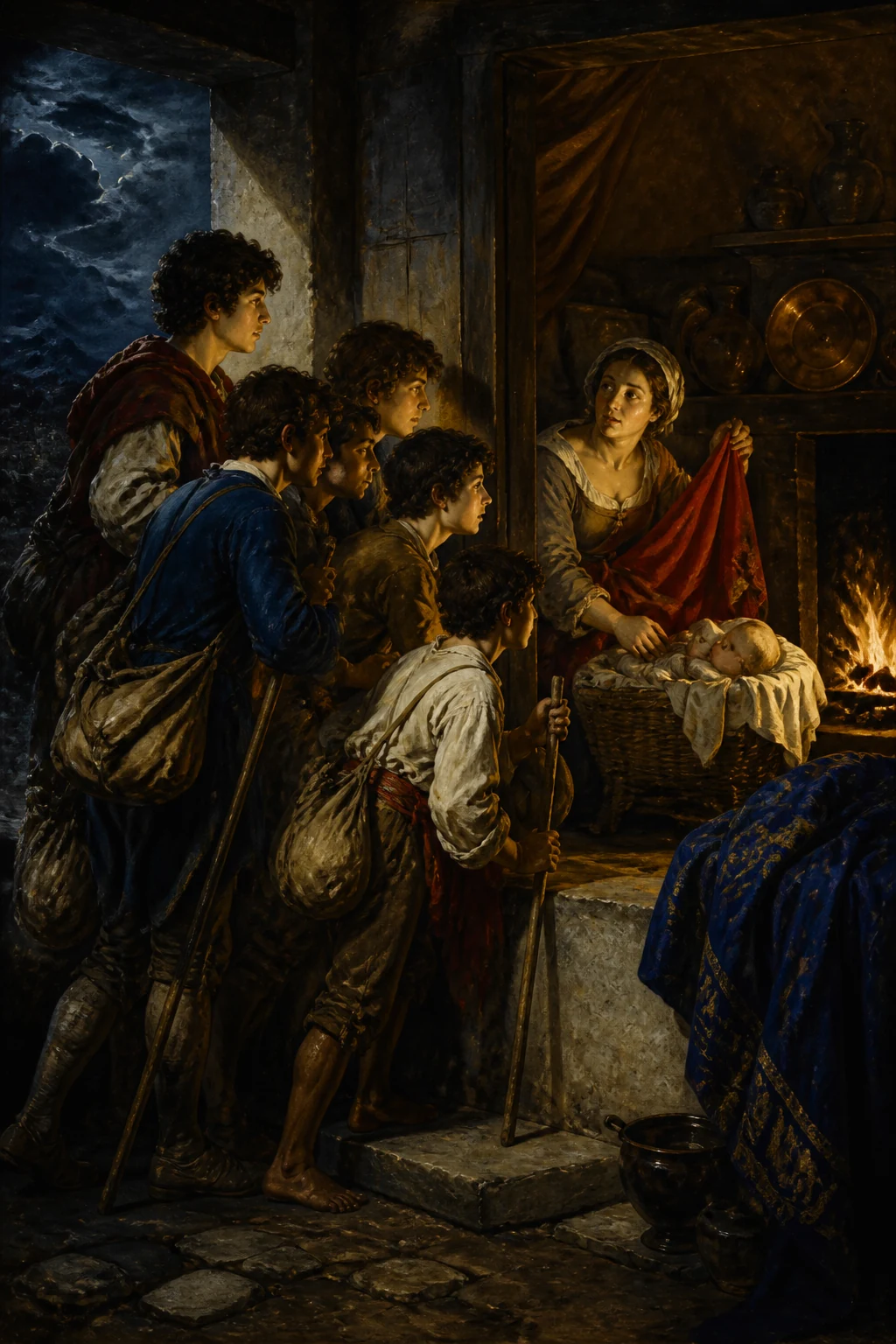
Once upon a time, in the village of Arzano, there lived a good woman who brought a boy into the world every year, until she had seven of them, looking like the god Pan’s seven-reeded pipe, each taller than the next. Once they were past their first tender years, they said to their mother Jannetella, who was pregnant again, “You must know, Mother dear, that if, after so many sons, you do not give us a daughter, we have firmly resolved to leave this house and wander through the world like young blackbirds, scattered far and wide.” Hearing this dreadful announcement, their mother begged Heaven to rid her sons of this desire and spare her the loss of seven jewels such as they were. When the hour of her delivery was near, the sons said to Jannetella, “We shall withdraw to that hill, or ridge, facing the house. If you bear a boy, put an inkwell and a pen in the window; if you bear a girl, put out a spoon and a distaff. If we see the sign of a girl, we shall come home and spend the rest of our lives beneath your wings; but if we see the sign of a boy, forget us, for you may count us flown.” After the sons had gone, Heaven willed that Jannetella should give birth to a lovely little girl. She told the midwife to signal to the brothers, but the woman was so muddled and distracted that she put out the inkwell and the pen. When the seven brothers saw this, they took to their heels and walked and walked, until, after three years’ journeying, they reached a wood where the trees danced a country dance to the music of a stream, which played its counterpoint over the stones. In this wood stood the house of an ogre whose eyes had been put out by a woman while he slept, and who therefore hated the whole sex so fiercely that he ate every woman he could lay hands on. The young men reached the ogre’s house weary from their journey and faint with hunger, and asked whether, out of pity, he would give them a morsel of bread. The ogre replied that he would feed them if they would enter his service: they would have nothing to do but look after him, one each day in turn, as if he were a little lapdog. Hearing this, the young men felt they had found both father and mother, and, having struck their bargain, they stayed in the ogre’s service. He learned their names by heart, calling now for Giangrazio, now Cecchitiello, now Pascale, now Nuccio, now Pone, now Pezzillo, and now Carcavecchia, for these were the brothers’ names. He gave them a room on the lower floor of his house and enough to keep body and soul together. Meanwhile their sister grew up, and when she heard that her seven brothers, through the midwife’s carelessness, had gone wandering through the world and had never been heard of again, she took it into her head to search for them. She pleaded and pleaded with her mother until the poor woman, driven out of her wits by so many entreaties, dressed her as a pilgrim and gave her leave to go. So she walked and walked, asking everywhere whether anyone had seen seven brothers, and passed through so many lands that at last she heard news of them at an inn. There she was shown the way to the wood, and one morning, when the Sun was using the penknife of his rays to scrape away the inkblots Night had made upon the paper of the sky, she reached the place. Her brothers recognized her with great joy, cursing the inkwell and the pen that had falsely written down so many misfortunes for them. After a thousand caresses, they warned her to keep hidden in their room so that the ogre would not see her; and furthermore, whatever food came into her hands, she must give a share to a cat that lived there, or it would do her some mischief. Cianna, for that was their sister’s name, wrote these counsels in the notebook of her heart, and shared everything she had with the cat like a good companion, always dividing fairly and saying, “This for me, this for thee, this for the King’s daughter,” giving it a portion even of a fennel bulb. Now it happened that the brothers went hunting for the ogre and left her a little basket of chickpeas to cook. As she was sorting them, she unfortunately found a hazelnut among them, which proved the stumbling stone of her peace; for she popped it into her mouth without giving half to the cat. Out of spite, the creature ran to the hearth and pissed on the fire until it went out. Seeing this, Cianna did not know what to do. Contrary to her brothers’ orders, she left their rooms, went into the ogre’s apartment, and asked for a little fire. Hearing a woman’s voice, the ogre said, “Welcome, master! Wait a moment: you have found what you were looking for.” With that he took a Genoese whetstone, oiled it, and began to sharpen his tusks. Cianna, seeing the cart headed for disaster, snatched up a firebrand, ran back to her room, and barred the door, piling behind it poles, chairs, bed trestles, little chests, stones, and everything else in the room. Once the ogre had put an edge on his teeth, he rushed to the room, and, finding it shut, began kicking the door to smash it in. The seven brothers came running at the noise and found this uproar, while the ogre reproached them as traitors for making their room a refuge for his enemies. Giangrazio, who was the eldest and had more sense than the others, saw how badly matters stood and said to the ogre, “We know nothing of this business. Perhaps this accursed woman slipped into our room by chance while we were out hunting. But since she has fortified herself inside, come with me, and I shall take you by a way where we can fall upon her without her being able to defend herself.” So they took the ogre by the hand and led him to a very deep pit, gave him a shove, and sent him tumbling down:
then, taking a shovel they found on the ground, they covered him with earth. They made their sister open the door and gave her a thorough scolding for her mistake and the danger she had exposed herself to, telling her to use her wits better in future and take care not to gather any herbs around the place where the ogre was buried, for if she did, all seven of them would turn into little doves. “Heaven forbid,” Cianna answered, “that I should ever do you such harm!” And so they took possession of the ogre’s goods and made themselves masters of the whole house, living happily while they waited for winter to pass, so that, when the Sun presented the earth with a green gown embroidered with flowers as a gift upon entering the house of Taurus, they might set out for home. It happened that, while the brothers were up in the mountains gathering wood against the cold, which grew sharper every day, a poor pilgrim came into the forest. He had jeered at a great monkey sitting in a pine tree, and the creature had thrown a pinecone onto his head, raising such an enormous lump that the poor fellow was howling like a damned soul. Cianna came out at the noise and, taking pity on his pain, at once picked a sprig of rosemary from a bush that had grown over the ogre’s pit. With chewed bread and salt she made him a poultice, gave him something to eat, and sent him on his way. As she was laying the table and waiting for her brothers, seven little doves came flying in and said to her, “Oh, better that your hands had been lopped off, you cause of all our misery, before you picked that accursed rosemary and sent us roaming far and wide! Have you eaten cats’ brains, sister, that you let our warning slip your mind? Here we are turned into birds, at the mercy of the talons of kites, sparrowhawks, and goshawks; here we are made companions to wagtails, blackcaps, goldfinches, kestrels, linnets, little owls, jackdaws, magpies, wheatears, gnatsnappers, wood grouse, shrikes, larks, moorhens, woodcocks, golden orioles, gulls, chaffinches, wrens, tits, reed warblers, wrynecks, skylarks, wigeons, flycatchers, hoopoes, bats, little grebes, hedge sparrows, robins, nuns, mallards, tufted ducks, teal, siskins, and storm petrels. A fine thing you have done! Now we shall return to our own country only to find nets spread and limed twigs waiting for us. To heal one pilgrim’s head you have broken the heads of seven brothers, and there is no remedy for our misfortune unless you find the mother of Time and have her tell you how to deliver us from our trouble.” Cianna, like a plucked quail in her dismay at what she had done, begged her brothers’ forgiveness and offered to roam the whole world until she found the old woman’s house. She begged them to remain at home until she returned, lest some misfortune befall them, and set off, never stopping to rest. Though she travelled on foot, her longing to help her brothers served her as a post mule, carrying her three miles an hour. At last she reached a shore where the sea was thrashing the rocks with the flat of its waves because they would not answer the Latin lesson it set them. There she saw a great whale, which said to her, “My lovely girl, what are you about?” “I am looking for the house of Time’s mother,” she answered. “Do you know what you should do?” replied the whale. “Go straight along this shore, and when you come to the first river, follow it upstream, and you will find someone to show you the way. But do me a kindness: when you find that good old woman, ask her on my behalf whether she can discover some means by which I may travel safely, without so often striking rocks or running aground on the sand.” “Leave it to me,” said Cianna, and, thanking the whale for showing her the way, she began trotting along the beach. After a long journey she reached the river, which, like a tax collector, paid silver coins into the bank of the sea, and followed it upstream. Coming to a lovely countryside where the meadow mimicked the sky, displaying its green mantle starred with flowers, she found a mouse, which said to her, “Where are you going all alone, beautiful woman?” And she answered:
“I am looking for Time’s mother.” “You still have a very long way to go,” the mouse replied, “but do not lose heart: everything has an end. Keep walking towards those mountains, which, as independent lords of these fields, claim the title of Highness, and you will hear more and more of what you seek. But do me a kindness: when you reach the house you are looking for, ask that good old woman what remedy we might find to free ourselves from the tyranny of cats. After that, command me as you please: I shall be your slave.” Cianna promised to do him this favour and set off towards the mountains, which, though they seemed close by, never seemed to grow any nearer. At last she reached them as best she could and sat down wearily on a stone, where she saw an army of ants carrying a great store of grain. One turned towards her and said, “Who are you, and where are you going?” Cianna, who was courteous to everyone, answered, “I am an unfortunate young woman, and on a matter of great importance to me I am seeking the house of Time’s mother.” “Go farther on,” replied the ant, “and where these mountains open onto a broad plain, you will hear news of her. But do us a great kindness: try to find out from the old woman what we ants might do to live a little longer. It seems to me one of the great follies of earthly things that we should toil to gather so much and lay in such stores of food for so short a life, which, like an enchanter’s candle, goes out just when our years are at their richest.” “Be at ease,” said Cianna, “for I shall repay the kindness you have done me.” Crossing the mountains, she found herself on a lovely plain. After walking some distance, she came upon a great oak, a witness to antiquity, a sweetmeat from the bridal feast of that happy age, a morsel Time still gives this bitter century of its lost delights. Forming lips from its bark and a tongue from its pith, it said to Cianna, “Where, where are you hurrying in such distress, my child? Come into my shade and rest.” She thanked it warmly but excused herself, saying that she was in haste to find Time’s mother. Hearing this, the oak said, “You are not far from her. Before you have travelled another day, you will see a house upon a mountain, and there you will find what you seek. But if your courtesy is as great as your beauty, try to learn what I might do to regain my lost honour, for from being the food of great men I have become fodder for pigs.” “Leave that care to Cianna,” she replied, “for I shall see what I can do for you.” With that she departed, and, walking without a moment’s rest, reached the foot of a spoilsport of a mountain, which thrust its head up to trouble the clouds. There she found a little old man who, exhausted by walking, had lain down in some hay. At the sight of Cianna, he recognized her at once as the girl who had treated the lump on his head. When he heard what she was seeking, he told her that he was bringing Time the rent for the land he had sown; that Time was a tyrant who had usurped everything in the world and demanded tribute from everyone, especially men of his age; and that, since he had received a kindness at Cianna’s hands, he now wished to repay it a hundredfold by giving her some sound advice concerning her journey up the mountain. He regretted that he could not accompany her, for his age, condemned rather to descend than to climb, compelled him to remain at the mountain’s foot, to settle his accounts with Time’s clerks—the troubles, sorrows, and illnesses of life—and pay the debt of nature. And so he said to her, “Now listen carefully, my fair and innocent daughter. You must know that on the top of that mountain you will find a ramshackle house so old that it has forgotten when it was built. Its walls are cracked, its foundations rotten, its doors worm-eaten, its furniture musty; in short, everything is worn out and ruined. Here you will see broken columns, there shattered statues, and nothing whole except a quartered coat of arms above the door, on which you will see a serpent biting its tail, a stag, a raven, and a phoenix. Once inside, you will see noiseless files, saws, scythes, and pruning knives lying on the floor, and hundreds upon hundreds of little jars of ashes, labelled like apothecaries’ pots. On them you may read Corinth, Saguntum, Carthage, Troy, and a thousand other cities gone sour, which he keeps as memorials of his exploits.
“Now, when you come near this house, hide to one side until Time goes out. Once he has left, go inside, and you will find a very, very old woman whose beard touches the ground and whose hump reaches the sky. Her hair, like the tail of a dapple-grey horse, covers her heels; her face is like a ruff, its folds stiffened by the starch of years. She sits upon a clock fixed to the wall:
“and because her eyelids are so large that they cover her eyes, she will not be able to see you. As soon as you enter, take the weights off the clock; then call the old woman and beg her to grant what you desire. She will immediately call to her son to come and eat you, but since the clock that carries his mother will have lost its weights, he will be unable to move, and so she will be forced to give you what you want. But believe none of the oaths she swears unless she swears by her son’s wings:
“then trust her and do as she tells you, and you will be satisfied.” As he spoke, the poor fellow crumbled away like a body buried in a crypt when it is exposed to the open air. Cianna gathered up his ashes and, mingling them with a measure of tears, dug a grave and buried them, praying that Heaven would grant him peace and rest. Then she climbed the mountain, which left her quite breathless, and waited for Time to come out. He was an old man with a very, very long beard, wearing a very, very old cloak covered all over with little labels sewn to it, bearing this person’s name and that person’s. He had great wings and ran so swiftly that she immediately lost sight of him. Entering his mother’s house, she could not help smiling at the sight of that wretched old husk:
and, at once seizing the clock weights, she told the old woman what she wanted. The old woman gave a shriek and called her son, but Ciannella said, “You may batter your head against these walls, but you certainly will not see your son while I hold these weights.” Finding herself checked, the old woman began to coax her, saying, “Let them go, my darling. Do not hinder my son’s running, something no living person in the world has ever done before. Let them go, as you hope for God’s protection, and I promise by my son’s strong acid, with which he eats away everything, that I shall do you no harm.” “You are wasting your time,” replied Cianna. “You will have to say something better if you want me to let them go.” “I swear by those teeth that gnaw all mortal things that I shall tell you whatever you wish to know.” “You will make no chaff of me,” Cianna answered, “for I suspect you mean to trick me.” “Come, then,” said the old woman, “I swear by those wings that fly everywhere that I shall do you more kindness than you can imagine.” Cianna released the weights and kissed the old woman’s hand, which smelled of mould and reeked of damp. Seeing the young woman’s good manners, she said, “Hide behind that door, and when Time comes home I shall make him tell me what you wish to know. When he goes out again—for he never stays still in one place—you can slip away. But do not let him hear you, for he is such a glutton that he does not spare even his own children; and when all else fails, he eats himself, then sprouts anew.” Cianna did as the old woman told her, and soon Time arrived. Swiftly and lightly, he gnawed everything that came to hand, down to the plaster on the walls. As he was about to leave, his mother told him everything she had heard from Cianna, begging him, by the milk she had given him, to answer each of her questions in turn. After a thousand entreaties, her son replied, “The tree may be told that it can never be dear to men while it keeps treasures buried beneath its roots. The mice will never be safe from the cat unless they tie a little bell to her leg, so that they can hear her coming. The ants will live a hundred years if they can forgo flying, for when the ant wishes to die, it grows wings.
“The whale must give a warm welcome to the sea mouse and keep it as a friend, for it will always serve as her guide and she will never go astray. And the little doves will return to their former selves when they alight upon the pillar of wealth.” Having said this, Time began running his accustomed course, and Cianna took leave of the old woman and went down the mountain. At that very moment the seven little doves arrived, having followed their sister’s footsteps. Exhausted by so much flying, they all went to perch upon the horns of a dead ox, and no sooner had their feet touched them than they became handsome young men again, just as before. Amazed at this, they listened to Time’s answer and understood that the horn, as the symbol of abundance, was the pillar of wealth he had meant. Rejoicing greatly with their sister, they set off along the same road Cianna had travelled. When they found the oak and told it what they had learned from Time, the tree begged them to remove the treasure from beneath it, since that was the reason its acorns had fallen into disrepute. The seven brothers found a hoe in a garden and dug until they uncovered a great earthenware jar of gold coins, which they divided into eight shares among themselves and their sister, so that they could carry it more easily.
But, wearied by the journey and the weight, they lay down to sleep beside a hedge. A band of robbers came upon them there and saw the poor wretches sleeping with their heads upon their bundles of coins;
they tied them hand and foot to some trees, took the money, and left them there, lamenting not only the fortune that had slipped from their hands almost as soon as they had found it, but their very lives, for, with no hope of help, they were in danger either of dying racked by hunger or of satisfying the hunger of some wild beast. While they were bewailing their wretched fate, the mouse came along. On hearing Time’s answer, it repaid their service by gnawing through the cords that bound them and setting them free.
But after walking another good stretch, they came upon the ant along the road. Having heard Time’s advice, she asked Cianna what was wrong, that she looked so downcast and yellow about the face. When Cianna told her of their misfortune and the outrage the robbers had done them, the ant replied, “Hush now, for here is my chance to repay the kindness you showed me. You must know that, while carrying a load of grain underground, I discovered the place where those murderous dogs hide their plunder. They have made some winding passages beneath an old building, where they store everything they steal. And now that they have gone off on some other villainous business, I shall take you there and show you the place, so that you can recover what is yours.” With that, she set off towards some ruined houses and showed the seven brothers the mouth of a pit. Giangrazio, being the boldest of them, climbed down and found all the money that had been taken from them. Having gathered it up, they set out towards the shore, where they found the Whale and told her the good advice they had received from Time, who is the father of all counsel. While they were talking about their journey and everything that had happened to them, they suddenly saw the ruffians appear, armed to the teeth, having followed their tracks. At the sight, they cried, “Alas, this time not a scrap of us poor wretches will be left! Here come the thieves with weapons in their hands, and they will flay us alive!” “Have no fear,” replied the Whale, “for I can rescue you from the fire and so repay the kindness you have shown me. Climb onto my back, and I shall carry you straight to safety.” The poor souls, seeing their enemies at their heels and finding themselves in such desperate straits, climbed onto the Whale. She drew away from the rocks and carried them within sight of Naples, but, not daring to put the young people ashore because the water was so shallow, she said, “Where would you like me to leave you? Along this coast of Amalfi?”
And Giangrazio replied, “Let us avoid it if we can, my lovely fish, for they say: at Massa, greet them and pass on; at Sorrento, grit your teeth; at Vico, bring your own; at Castellammare, neither friends nor godparents.” So the Whale, to oblige them, turned towards the Rock of Salt and left them there. They hailed the first fishing boat that passed and had it take them ashore. Then they returned to their own village, safe, sound, and rich, bringing joy to their mother and father, and thanks to Cianna’s goodness they lived happily ever after. Thus she bore true witness to the old saying, _Whenever you can, do good, and forget it._
Izvirnik
Jornata IV VIII LI SETTE PALOMMIELLE
Naslednje strani prikazujejo izvirno besedilo za primerjavo.
_Sette Fratielle parteno da la casa lloro, perchè la mamma non faceva na figlia femmena, a la fine fattone una, mentre aspettano la nova, e lo signale, la mamma fa arrore a li signe, pe la quale cosa vanno spierte. Cresce la sore, le ccerca, le ttrova, e dapò varie socciesse tornano ricche a la casa._ _Lo cunto de le ddoje Pizzelle, fu beramente pizza chiena, che dette a lo gusto de tutte, ch’ancora se ne liccano le ddeta.
Ma essennose posta ’n corzetto Paola de contare lo sujo, fu lo commannamiento de lo Prencepe uocchio de lupo, che llevaje a ttutte la parola, ed essa accossì accommenzaje a pparlare._ Chi fà piacere sempre ne trova. Lo beneficio è borpara de l’amecizie, e ccrocco de l’ammore: chi non semmena non reccoglie, si comme ve n’ha dato n’antepasto d’assempio Ciulla, e io ve ne darraggio no soprattavola, si v’allecordarrite, ca Caro disse; parla poco a lo convito. E perrò siateme cortese de no poco d’arecchie. Accossì lo cielo ve cresca sempre l’arecchie, pe ssentire cose de sfazione, e de gusto.
Era na vota a lo pajese d’Arzano na bona femmena, la quale ogn’anno scarrecava no figlio mascolo, tanto che erano arrivate a ssette, che bedie na serenga de lo Dio Pane a ssette canne, una cchiù granne dell’autra, li quale avenno motato le pprimme arecchie, dissero a Jannetella la mamma, che era n’auta vota prena: Sacce, mamma mia, ca si tu dapò tanta figlie mascole non faje na femmena, nuje simmo propio resolute de lassare sta casa, e ghire pe sso munno, comm’a li figlie de le mmerole spierte, e demierte. La mamma, che sentette sto male annunzio, pregava lo Cielo, che avesse spogliato li figlie de sto desederio, e llevata essa da perdere sette gioje comme erano li figlie. Ed essenno oramaje l’ora de lo partoro, li figlie dissero
a Jannetella: Nuje ce reterammo ncoppa a cchella tempa, o ripa, che ce stà facce fronte, se faje mascolo, miette no calamaro, e la penna ncoppa la finestra; e si faje femmena, miettece na cocchiara, e na conocchia; perchè se vedarrimmo segnale de femmena, nce ne venimmo a la casa a spennere sto riesto de vita sotto l’ascelle toje; ma si vedimmo signale de mascolo, scordatenne de nuje, ca nce puoje mettere nomme penna. Partute li figlie, voze lo Cielo, che Jannetella facesse na bella figliaccara; e ditto a la mammana, che ne desse signo a li frate, fu accossì storduta, e stonata, che nce mese lo calamaro, e la penna; la quale cosa visto li sette fratielle, se mesero la via fra le gamme, e tanto camminaro, che arrivattero dapò tre anne de
cammino a no vosco, dove l’arvole a suono de na sciommara, che faceva contrapunte pe ccoppa le pprete, facevano na mpetrecata drinto a lo quale nc’era la casa de n’Uorco, a lo quale essenno state cacciate l’uocchie dormenno da na femmena, era accossì nemmico de sto sesso, che quante nne poteva avere, tante se ne mangiava. Arrivate sti Giuvane a la casa dell’uorco, stracque de lo viaggio, allancate da la famme, le fecero ’ntennere si pe ccompassione le voleva dare quarche muorzo de pane: a li quale respose l’uorco, che l’averria dato da vivere, si lo volevano servire, ca no averriano avuto autro da fare, che guardarelo no juorno pe d’uno, comm’a Cacciottiello. Sentuto chesto li Giuvane, le parze de trovare la mamma, e lo patre, e accordatose, se restaro a
lo servizio dell’Uorco; lo quale mparatose li nomme lloro a mmente, mo chiammava Giangrazio, mo Cecchitiello, mo Pascale, mo Nuccio, mo Pone, mo Pezzillo, e mo Carcavecchia, che accossì avevano nomme li fratielle, e consignatole no vascio de la casa soja, le mmanteneva tanto, che potevano passare la vita. Ma fra tanto tiempo essenno cresciuta la sore, e ssentenno ca sette fratielle suoje pe scordamiento de la mammana, s’erano date a ccammenare pe lo munno, e non se ne sapeva cchiù nnova, le venne crapiccio de irele cercanno; e tanto fece, e tanto disse a la mamma, che scervellata da tante prieghe suoje, e vestutala da pellegrina, le dette lecienzia; la quale cammenato, e cammenato, domannanno sempre de parte ’n parte, chi avesse visto sette
fratielle, tanto corze paise, ch’a na taverna n’appe nova; e ffattose llà nvezzare la strata de chillo vosco, na matina quanno lo Sole co lo temperino de li ragge rade li scacamarrone fatte da la notte sopra la carta de lo Cielo, se trovatte a chillo luoco, dove co gusto granne fu rrecanosciuta da li frate, e mmardissero chillo calamaro, e chella penna, che scrisse fauzariamente tanta malanne lloro; e ffattole mille carizze, l’avvertèro a stare reterata drinto a chella cammara, che non la vedesse l’Uorco; ed otra a chesto, che de qualesevoglia cosa, che le venesse da mangiare ’n mano, nne desse la parte a na gatta, che steva drinto a chella cammara, autramente l’averria fatto quarche dammaggio. Cianna, che accossì se chiammava la sore, screvette sti
consiglie a lo quatierno de lo core, ed ogne cosa, ch’aveva, faceva da buon compagno co la gatta, secanno sempre justo, decenno: chesto a mme, chesto a tte, chesto a la figlia de lo Rrè, dannocenne la parte pe fi a no fenucchio. Ora soccesse, ch’essenno jute li frate a caccia pe sservizio dell’Uorco, le lassaro no panariello de cicere, che le ccocenasse, la quale scegliennole, nce trovaje pe ddesgrazia n’antrita, che fu la preta de scannalo de la quiete soja, pocca ’nvoccatasella senza darene la meza parte a la gatta, chella pe despietto, correnno a lo focolare pisciaje lo ffuoco, tanto che se stotaje. Cianna, che bedde chesto, non sapenno comme se fare, scette da chelle ccammere contra lo commannamiento de li frate, e ttrasuta drinto l’appartamiento
dell’Uorco, cercaje no poco de fuoco; l’Uorco, che sentette la voce de na femmena, disse: Ben-venga lo mastro, aspetta no poco, ca aje trovato chello, che baje cercanno: e accossì ditto, pigliaje na preta de Genoa, e ontatala d’uoglio, accommenzaje ad affilare le zanne. Cianna, che bedde lo carro male abbiato, dato de mano a no tezzone, corze a la cammara soja, e pontellaje la porta, non lassanno de schiaffarence dereto varre, segge, scanne de lietto, casciolelle, prete, e quanto nc’era drinto a la cammara. L’Uorco, comm’ebbe date lo filo a li diente, corze a la cammara, e trovannola chiusa, accommenzaje a darence cuorpe de cauce, pe la scassare: a lo quale rommore venettero arrevanno li sette frate, e trovanno sto streverio, e sentennose ’mproverare
dall’Uorco de tradeture, ca la cammara lloro era fatto lo beneviento de le nnemmiche soje: Giangrazio, ch’era lo cchiù granne, ed avea cchiù sinno de l’autre, visto lo negozio male parato, disse all’Uorco: Nuje non sapimmo niente de sto fatto, e porria essere, che sta mmardetta femmena fosse trasuta a sta cammara pe desgrazia, mentre nuje simmo state a la caccia: ma pocca s’è fortefecata da dereto, viene co mmico, ca te porto pe no luogo, dove le darrimmo adduosso senza, che se pozza defennere. Accossì pigliato l’Uorco pe la mano, lo carriattero dov’era no fuosso futo futo: e datole na spenta, lo fecero derropare a bascio: e pigliato na pala, che trovaro ’n terra, lo coperzero de terreno, e fatto aprire la sore, le ’ntronaro buono l’arecchie de l’arrore,
ch’aveva fatto, e de lo pericolo, a lo quale s’era posta, decenno, e che pe l’abbenire stesse chiù ’n cellevriello, che se guardasse de cogliere erva ’ntuorno a chillo luoco, dov’era atterrato l’Uorco, ca sarriano tornate tutte sette Palommielle. Lo Cielo mme ne guarde, respose Cianna, ch’io ve facesse sto danno; e accossì puostose ’n possessione de la rroba dell’Uorco, e mpatronutose de tutta la casa, stevano allegramente, aspettanno, che passasse la ’nvernata, e quanno lo Sole desse pe nferta a la terra de la possessione pigliata a la casa de lo Taoro na gonnella verde regamata de sciure, se potessero mettere ’n viaggio pe tornare a la casa lloro. Accorze, che trovannose li frate a fare legna a la montagna pe repararese da lo friddo, che cresceva
de juorno ’n juorno, arrevaje a chillo vosco no povero pellegrino, lo quale avenno fatto l’abbaja a no gatto maimone, che stava sopra a na pigna, l’aveva terato no frutto de chillo arvolo ncoppa la catarozza, che nc’era fatto no vruognolo accossì spotestato, che lo scuro gredava comm’arma dannata. Cianna sciuta a lo remmore, piatosa de lo male sujo, couze subeto na cimma de rosamarina da na troffa, ch’era nasciuta ncoppa lo fuosso dell’Uorco, e co ppane mazzecato, e ssale le fece no nchiastro, e datole da fare colazione, nne lo mannaje; e mentre apparecchiava a tavola aspettanno li frate, eccote vedde venire sette Palommielle, li quale le dissero; O che meglio te fossero cioncate le mmano, o causa de tutto lo mmale nuostro, nnanze, che ccogliere chella
mmardetta rosamarina, che nce fa ire pe la marina. E ch’aje magnato cellevrielle de gatta, o sore mia, che te aje fatto scire da mente l’aviso nuostro? eccote deventate aucielle, soggette a le granfe de nigle, de sproviere, e d’asture; eccote fatte compagne d’acquarule, de capofusche, de cardille, de cestarelle, de cardole, de coccovaje, de cole, de ciaole, de codejanche, de zenzelle, de capune sarvateche, de crastole, de covarelle, de gallenelle, de gallinarcere, de lecore, de golane, de froncille, de reille, de parrelle, de paglioneche, de capo tortielle, de terragnole, de sciurole, de pappamosche, de paposce, de scellavattole, de semmozzarielle, de sperciasepe, de rossielle, de monacelle, de mazzarole, de morette, de paperchie, de lugane, e de
turzelupiche. Aje fatto la bella prova; mo simmo tornate a li paise nuostre pe bederece aparate rezze, e poste viscate: pe ssanare la capo de no pellegrino, aje rotta la capo a ssette frate, che non c’è rremmedio a lo male nuostro, si non truove la mamma de lo tiempo, che te mpare la strata a ccacciarence d’affanno. Cianna comm’a cquaglia pelata de l’arrore ch’aveva fatto, cercaje perdonanza a li frate, e s’afferze de ntorniare tanto lo munno, finchè trovasse la casa de sta vecchia; e pregannole a stare sempre a la casa, azzò non le soccedesse quarche desgrazia, fi tanto, ch’essa tornava, commenzaje a ccammenare, senza stracquarese maje, che si bè marciava a pede, lo desederio d’ajutare li frate, le serveva de mula de percaccio, co la quale faceva
tre mmiglia ad ora, e arrevato a no lito, dove lo maro co la sparmata de ll’onne zollava li scuoglie che non bolevano responnere a lo latino, che le deva a ffare, vedde na grossa valena, la quale le disse: Bella giovane mia, che baje facenno? ed essa, vao cercanno la casa de la mamma de lo tiempo. Saje che buoje fare, leprecaje la valena, và sempre deritto pe sta marina, e lo primmo sciummo, che truove, tira capo ad auto, che trovarraje chi te mostrarrà lo cammino: ma famme no piacere, comme truove sta bona vecchia, cercale ’n grazia da parte mia, che mme trova quarche remmedio, ch’io pozza cammenare secura senza mmorrare tante vote a scuoglie, e dare tanta vote a l’arena. Lassa fare a sto fusto, disse Cianna, e rrengraziatala de la via, che l’aveva mostrata,
commenzaje a trottare pe chella chiaja, e dapò luongo viaggio arrivata a chillo sciummo, che comm’a commessario de fiscale sborzava monete d’argiento a la banca de lo maro, pigliaje lo cammino ad auto, e arrevato a na bella campagna, dove lo prato faceva la scigna de lo cielo a mmostrare stellato de sciure lo manto verde, trovaje no sorece, lo quale le disse: dove vaje accossì ssola, bella femmena? ed essa: cerco la mamma de lo tiempo; troppo aje da cammenare, soggionse lo sorece: ma non te perdere d’armo; ogne cosa ha capo: cammina puro verzo chelle mmontagne, che comme a ssignure libere de sti campe, se fanno dare lo titolo d’autezza, ca sempre averraje meglio nova de chello, che cirche; ma famme no piacere, comme si arrivata a la casa, che desidere,
fatte a dicere da sta bona vecchiarella, che rremmedio porriamo trovare pe llevarece da la terannia de li Gatte, e po commanname, ca m’accatte pe schiavo. Cianna promettuto de farele sto piacere, s’abbiaje verzo chelle mmontagne, le quale sibè parettero vecine, non s’arrevaro maje: pure comme meglio potte arrivatace, se sedette stracqua ncoppa a na preta, dove vedde n’aserceto de formiche, che carriavano na gran mmonezione de grano; una de le quale votatase a Cianna, le disse, chi si, e dove vaje? e Cianna ch’era cortese co ttutte, le disse: Io sò na sfortonata giovene, che pe ccosa, che me mporta, cerco la casa de la mamma de lo tiempo. Cammina cchiù ’nnanze, respose la formica, ch’a lo sboccare de chelle mmontagne a na gran largura te ne sarrà dato nova,
ma fanne no gran piacere, vide de scanzare sta vecchia, che porriamo fare nuje autre formiche pe ccampare quarche tiempo, che mme pare na gran pazzia de le ccose terrene a fare tanto acchietto, e provisione de mazzecatorio, pe na vita accossì ccorta: che comme a ccannela de ncantatore a la mmeglio afferta dell’anne, se stuta. Quietate, disse Cianna, ca te voglio rennere la cortesia, che m’aje fatta: e passate chelle mmontagne, se vedde a no bello chiano, pe lo quale cammenato no piezzo, trovaje no grann’arvolo de cierzo testemmonio de l’antichetà, confiette de chella zita, ch’era contenta, e boccune che dace lo tiempo a sto siccolo ammaro de le ddocezze perdute; lo quale formanno lavra de le scorze, e llengue de lo medullo, decette a Cianna: Dove,
dove accossì affannata, figliola mia? viene sotto all’ombre meje, e rreposate; ed essa decennole a gran merzè, se scusaje, ca jeva de pressa a trovare la mamma de lo tiempo. La quale cosa sentuto la cerqua, le disse: tu nne si poco lontano, che non camminarraje n’autra jornata, che bedarraje sopra na montagna na casa, dove trovarraje chello, che ccirche: ma s’aje tu tanta cortesia quanto aje bellezza, procura sapere, che porria fare pe rrecuperare lo nnore perduto; pocca da posto d’uommene granne so fatto civo de puorce. Lassa lo penziero a Cianna, essa respose, ca vederraggio de te servire; e accossì ditto partette, e cammenanno senza reposare maje, arrivatte a li piede de na montagna sconcecajuoco, la quale jeva co la capo a dare fastidio
a le nnugole, dove trovaje no vecchiariello, che pe stracquezza de cammenare, s’era corcato ’n miezo a cierto ffieno, lo quale vedenno Cianna, la conoscette subito, ch’era chella, che l’aveva mmedecato lo vruognolo, e ’ntiso chello che ghieva cercanno la giovene, le decette, ch’isso portava lo cienzo a lo tiempo dell’affitto de la terra, ch’avea semmenato, e che lo tiempo era no teranno, che s’aveva osorpato tutte le ccose de lo munno, e boleva tributo da tutte, e particolaremente da uommene de l’età soja, e perchè aveva receputo beneficio da la mano de Cianna, nce l’è benuta a rrennere a ciento duppie, co darele quarche buono avvertemiento circa la venuta soja a chesta montagna; dove le despiaceva de non poterela accompagnare, pocca l’età soja connannata
cchiù priesto a scennere, ch’a ssaglire, l’astregneva a rrestarese a le ffaude de chelle mmontagne pe sautare li cunte co li scrivane de lo tiempo, che so li travaglie, li disguste, e le ’nfermetà de la vita, e ppagare lo debeto de la natura. E perzò le decette: ora siente buono, bella figlia mia, senza peccato, agge da sapere, qualemente cosa ncoppa la cimma de chella montagna trovarraje no scassone de casa, che non s’allecorda quanno fu ffravecata, le mmura songo sesete, le pedamente fracete, le porte carolate, li mobele stantive, e ’n somma ogne cosa conzomata, e destrutta, da ccà bide colonne rotte, da llà statue spezzate, non essennoce autro sano, che n’arma sopra la porta quartiata, dove nce vedarraje no serpe, che se mozzeca la coda, no
ciervo, no cuorvo, e na fenice, comme si ttrasuta drinto, vedarraje pe tterra limme sorde, serre, fauce, e ppotature, e cciento, e ciento caudarelle de cennere, co li nomme scritte comme arvarelle de speziale, dove se lejano Corinto, Sagunto, Cartagene, Troja, e mmille autre Cettà jute a l’acito; le quale conserva pe mmammoria de le ’mprese soje. Ora comme si becino a sta casa, nascunnete da parte, nfi ch’esce lo tiempo, e sciuto, trasetenne drinto, ca trovarraje na vecchia vecchia, che co la varva tocca la terra, e co lo scartiello arriva a lo cielo, li capille comm’a ccoda de cavallo liardo le coprono li tallune: la facce pare no collaro a lattochiglia co le ccrepe teseche pe la posema dell’anne, la quale sta seduta sopra n’alluorgio ’mpizzato a no muro:
e perchè le pparpetole so accossì granne, che l’ammarrano l’uocchie, non te porrà vedere: tu comme si trasuta leva subeto li contrapise da l’allorgio, e pò chiammata la vecchia, pregala a darete sfazione de chello, che desidere, la quale darrà subeto na voce a lo figlio, che venga a mmagnarete: ma perchè l’alluorgio che ttene sotta la mamma, le mancano li contrapise, isso non porrà cammenare, e accossì sarrà costretta a darete chello, che buoje. Ma non credere a nnesciuno joramiento, che te faccia, se non jura pe l’ascelle de lo figlio: all’ora dalle credeto, e fa chello, che te dice, ca sarraje contenta.
Accossì decenno, restaje lo poveriello desfatto, comm’a ccuorpo muorto de jusoncuorpo, quanno vede la luce dell’ajero. Cianna pigliato chella cennere, e mmescatoce no mesoriello de lagreme, le fece no fuosso, e l’atterraje, pregannole da lo cielo quiete, e rrepuoso. E ssagliuta la montagna, che le fece pigliare l’appietto, aspettaje, che scesse lo tiempo, lo quale era no viecchio co na varva longa longa, portava no mantiello viecchio viecchio, lo quale era tutto chino de cartelle cosute co li nomme de chisto, e de chillo: aveva l’ascelle granne, correva accossì beloce, che lo perdette subeto de vista; e ttrasuto a la casa de la mamma, appe a sorrejere de vedere chillo nigro scuorzo: e dato subeto de mano a li contrapise, disse a la vecchia, chello,
che desederava, la quale, jettanno no strillo, chiammaje lo figlio; ma Ciannella le disse: puoje tozzare la capo a ste mmura ca non vederraje cierto figlieto, mentre io tengo sti contrapise, e la vecchia vedennose stroncato li passe, commenzaje a llosengarela, dicennole, lassala ire, bene mio no ’mpedire la corzeta a ffigliemo, cosa che n’ha fatto ancora nesciuno ommo vevente a lo munno; lassale ire, si Ddio te guarde, ca io te mprommetto pe ll’acqua forte de figliemo, co la quale rode ogne cosa, ca non te farraggio male; nce pierde lo tiempo, respose Cianna, meglio vuoje dicere, si vuoje che le llassa. Te juro pe chille diente che rosecano tutte le ccose mortale, ca te farraggio a ssapere quanto desidere. Non ne faje spagliocca, leprecaje Cianna, ca faccio ca tu
mme gabbe; e la vecchia; ora susso, io te juro pe chelle ascelle, che bolano pe tutto, ca io te voglio fare cchiù piacere de chello che te mmagene; e Cianna lassato li contrapise, vasaje la mano a la vecchia, la quale senteva de muffa, e ffeteva de liento, che bedenno la bona crianza de sta giovane, le disse: Nascunnete dereto a chella porta, che benuto che sarrà lo tiempo, mme farraggio dicere chello, che buoje sapere. E comme isso torna a scire, perchè non stace maje fermo a no luoco, tu puoje sbignare: ma non te fare a ssentire, ca isso è accossì cannarone, che non perdona manco a li figlie, e quanno tutto manca, se magna isso stisso, e po torna a sguigliare. E fatto Cianna quanto le disse la vecchia; ecco arrivare lo tiempo, lo quale priesto
priesto, auto, e llieggio rosecato quanto le venne pe mmano pe fi a la caucerogna de le mmure, mentre voleva partire, la mamma le disse tutto chello, che aveva sentuto da Cianna, pregannolo, pe lo llatte, che l’aveva dato, a rresponnere cosa pe ccosa a quanto le domannava; e lo figlio dapò mille preghere, le respose: All’arvolo se pò responnere, che non pò essere maje caro a le gente, mentre tene atterrate tresore sotto a le rradeche. A li surece, che maje sarranno secure da la gatta, si no l’attaccano na campanella a la gamma, pe ssentirela quanno vene. A le fformiche, che camparanno ciento anne, si se ponno spesare de volare, che quanno la formica vò morire, mette l’ascelle.
A la Valena, che faccia bona cera, e se tenga pe ammico lo sorece marino, che le serverrà sempre pe guida, che non jarrà maje traverza; ed a li Palommielle, che quanno se posarranno sopra la colonna de la recchezza, tornarranno a ll’essere de primma. Ditto chesto lo tiempo, commenzaje a ccorrere la soleta posta, e Cianna lecenziatase da la vecchia, se ne scese da la montagna a bascio, a lo stisso tiempo, che nc’erano arrivate li sette palommielle secotanno le ppedate de la sore, li quale stracque da tanto volare, jezero tutte a posarese sopra le ccorna de no voje, ch’era muorto, che non tanto priesto nce appero puosto li piede, che tornaro belle giuvene comme primma, e mmaravigliate de sto fatto, sentettero la resposta de lo tiempo, e
ccompresero, che lo cuorno, commo simmolo de la copia, fosse la colonna de la recchezza, azzennata da lo Tiempo, e fatta na granne prejezza co la sore, s’abbejattero pe lo stisso cammino, ch’aveva fatto Cianna, e ttrovato l’arvolo de Cerqua, e rreferutole chello ch’aveva ntiso da lo Tiempo, l’arvolo le pregaje a levarele lo tresoro de sotta, mentre era causa, che la gliantra soja aveva scapetato de repotazione: e li sette fratielle trovato na zappa ’n miezo a n’uorto, scavattero tanto, ficchè trovaro no gruosso ziro de moneta d’oro, de la quale nne fecero otto parte fra loro, e la sore, pe ppoteresela portare commodamente.
Ma essenno stracque da lo viaggio, e da lo piso, se mesero a dormire a canto a na sepala; dove arrivato na mano de malantrine, e bisto dormire sti negrecate co le capo ncoppa le mappate de li tornise; legatole de mano, e de piede a certe arvole, se pigliaro li frisole, e le llassaro: facenno lo trivolo non sulo de lo bene, che appena trovato l’era scappato da le mmano, ma de la vita lloro, che senza speranza d’ajuto, stevano a rriseco o de morire ciesse de la famme, o de fare, che cessasse la famme a quarche animale servateco. E mmentre se gualiavano de la negrecata sciorte loro, venne arrivanno lo sorece, che ssentuto la resposta de lo Tiempo pe buono miereto de lo servizio, rosecaje le ffonecelle, con che stevano legate, e le dette libertà.
Ma camminate n’autro buono piezzo, trovaro pe la strata la formica, la quale ’ntiso lo consiglio de lo tiempo, addemmannaje a Cianna, che cosa avesse, che stava accossì moscia, e de colore gialluoteco; e dittole la desgrazia passata, e lo corrivo fattole da li latre, la formica respose: Zitto, ca mme vene pe ttaglio de dareve lo cagno de lo piacere ch’aggio receputo; ora sacciate, ca mentre portava no carreco de grano sotterra, aggio visto no luoco, dove sti cane assassine ncaforchiano li furte lloro; perchè hanno fatto sotta na fraveca vecchia cierte caracuoncole, dove stipano tutte le ccose arrobbate; e mo che so ghiute pe quarch’autro arravoglio, io ve nce voglio accompagnare, e mmezzateve lo luoco, azzò pozzate recoperare lo buostro. Accossì dditto, pigliaje
la strata verzo certe ccase scarropate, e mmostraje a li sette frate no voccaglio de fuosso, addove calato drinto Giangrazio, comme cchiù anemuso dell’autre, trovaje tutte li denare, che l’erano state levate, e pigliannoselle se posero a cammenare vierzo la marina, dove trovata la Valena, le decettero lo buono parere datole da lo tiempo, lo quale è patre de li consiglie, e mmentre stavano trascorrenno de lo viaggio loro, e de quanto l’era socciesso, ecco veddero spontare l’aliviente, armate a rrasulo, ch’erano venute pe la pista de le ppedate lloro, la quale cosa vista, dissero: oimè, chesta è la vota, che non ce resta sporchia de nuje negrecate, perchè mo se ne veneno li mariuole armata mano, e nce levarranno lo cuojero; non dobetare, respose la Valena,
ca so bona a ccacciareve da lo ffuoco, pe ve rennere la pareglia de lo buono ammore, che m’avite mostrato, e perrò sagliteme ’ncoppa la schena, ca ve portarraggio subeto a lluoco securo. Li scure, che se viddero li nnemmice a le spalle, e l’acqua ’n canna, sagliettero sopra la Valena, la quale allargannose da li scuoglie, le pportaje a bista de Napole, dove non se confidanno de sbarcare sti giuvene ped’essere lo mare seccagne, disse, dove volite, che ve lasse: pe sta Costa d’Amarfe?
e Giangrazio respose: vi se nne potimmo fare de manco, bello pesce mio, perchè a Massa, se dice saluta, e passa; a Sorriente, strigne li diente; a Vico porta co ttico, a Castiello a mare nè ammice, nè compare; e la Valena pe ddarele gusto, votaje carena a la vota de lo scuoglio de lo ssale, addove le lassaje, che a la primma varca de pescature, che passaje, se fecero mettere ’n terra, e ttornate a lo pajese lloro sane, belle, e rricche, consolanno la mamma, e lo patre, gaudettero pe la bontà de Cianna felice vita, la quale fece na fede autenteca a lo mutto antico, _Sempre che puoje, fa bene, e scordatenne._
Nadaljuj z branjem