Prevod
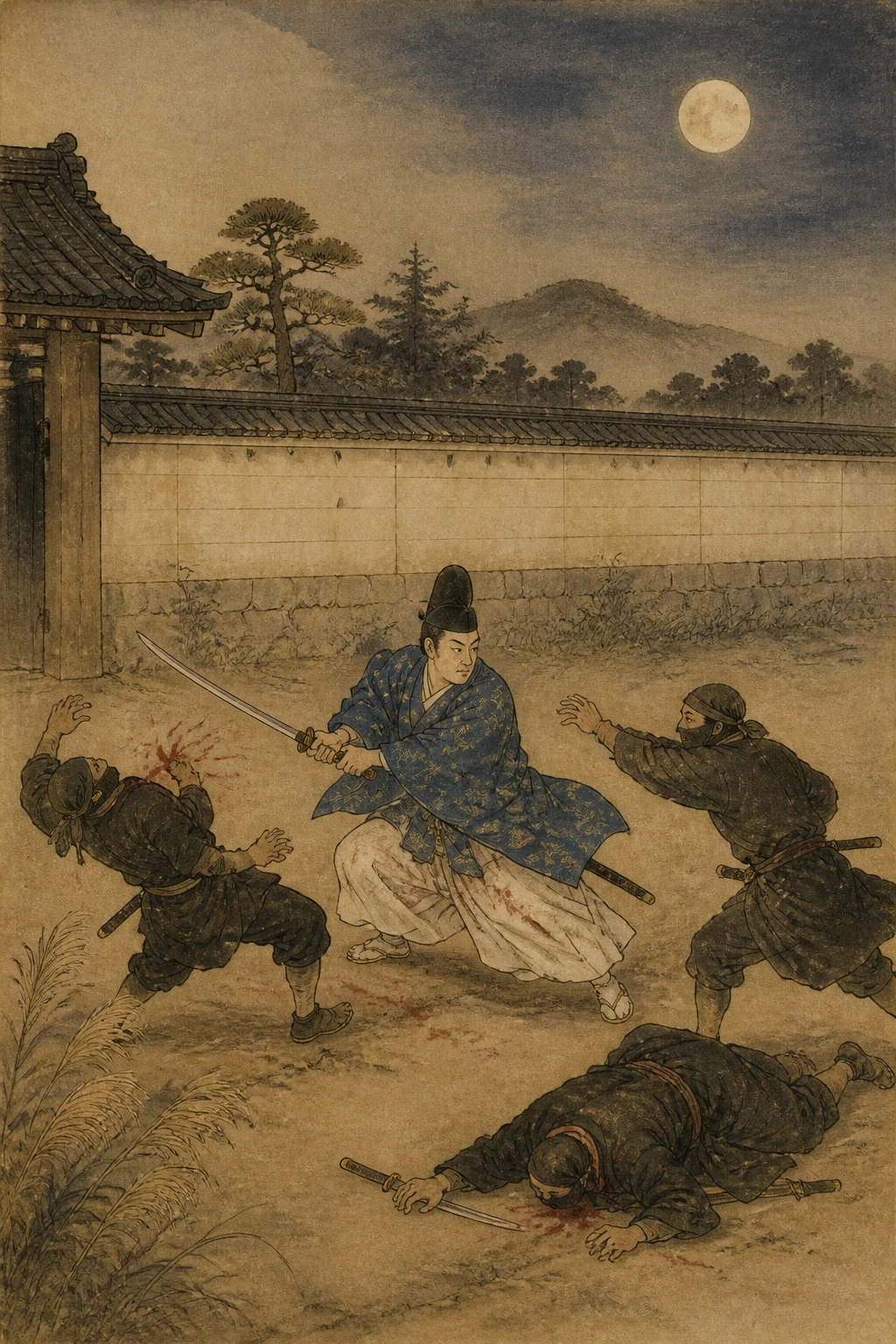
Long ago there lived a fearsome chief of thieves called Hakamadare. It was about the tenth month, and he needed clothes, so he went prowling about likely places, hoping to lay his hands on a few robes. Around midnight, when everyone had fallen quiet, he saw a man in the hazy moonlight who seemed to be wearing several layers of clothing. With the sides of his full trousers tucked up, and dressed in what looked like a silk hunting robe, the man was strolling all alone, playing a flute, in no hurry to get anywhere. “Ah,” thought Hakamadare, “here is someone who has come out expressly to provide me with clothes.” He meant to rush upon him and strip him, but an unaccountable dread came over him. He followed for two or three blocks, yet the man gave no sign of thinking that anyone was at his heels and only went on playing his flute. Hakamadare decided to test him and ran up with loud, stamping strides. Still playing, the man glanced back, and something in his manner made it impossible to lay hands on him. Hakamadare darted away. Several times he tried approaching this way and that, but the man showed not the slightest alarm. “What an extraordinary fellow!” he thought, and followed him for more than ten blocks. At last, thinking, “Surely I cannot let it end like this,” he drew his sword and rushed at him. This time the man stopped playing, turned to face him, and asked, “Who are you?” Hakamadare lost all courage and, quite beside himself, sank to the ground. “What sort of fellow are you?” the man asked again. Feeling certain now that even if he tried to flee, the man would never let him escape, he said, “I am a robber, sir.” “Who are you?” the man demanded. “They call me Hakamadare,” he answered. “I have heard of a fellow by that name. What a reckless, extraordinary wretch you are!” said the man. Then, with no more than “Come along with me,” he set off again, playing his flute just as before. From his manner, Hakamadare felt certain that he would not let him get away, even if he tried. Like a man whose soul had been seized by a demon, he followed until they reached a house. Wondering whose house it was, he discovered that the man was Yasumasa, the former governor of Settsu. Yasumasa called him inside and gave him a thickly padded robe. “Whenever you need clothes, come and tell me,” he said. “Do not make the mistake of attacking someone whose mettle you do not know.” After Hakamadare was captured, he told this story. “It was bewildering—uncanny and terrifying. Such was the bearing of that formidable man.”