Prevod
There was once a very rich man, a minister to the Sultan. He lived his life and had one child, a son named Ali. When the boy reached the age of twenty-five, his father died, leaving him and his mother behind.
Ali inherited his father’s wealth and spent lavishly. At last he went bankrupt and became a poor, despised man, with not a soul in the town who would acknowledge him, neither his own friends nor his father’s. He was still a young man, and he wandered about the town.
Everyone who saw Ali would ask him, “What did you do with your wealth, Ali, to go bankrupt so quickly? Your father left you a great fortune. Had you any sense, Ali, your wealth would have lasted.” Ali would answer, “He who does not understand the meaning is not told the meaning.”
This became his constant answer. Whoever questioned him, he would say, “He who does not understand the meaning is not told the meaning.” Before long, everyone in the town knew that if you asked Ali, “What did you do with your wealth?” he would answer, “He who does not understand the meaning is not told the meaning.”
At last word reached the Sultan. People told him, “Ali, the son of your minister, has gone bankrupt. When people ask him, ‘What did you do with your wealth, Ali, that it vanished so quickly? Your late father left you a great fortune. Had you any sense, Ali, it would have lasted you, for there was so much of it,’ Ali answers whoever questions him, ‘He who does not understand the meaning is not told the meaning.’”
The Sultan said, “Call Ali here, so that I may ask him whether what people say is true, or whether they are slandering him.” The judge rose and said, “Yes, Sultan, these reports are true.” The Sultan sent a soldier to summon Ali at the hour of court, and all those who attended the Sultan’s court were to come and hear whether the things Ali was said to have spoken were true or false.
Ali went and borrowed a ragged kanzu from a poor man, for no one trusted him enough to lend him clothes. Even that kanzu he obtained only through pleading and begging.
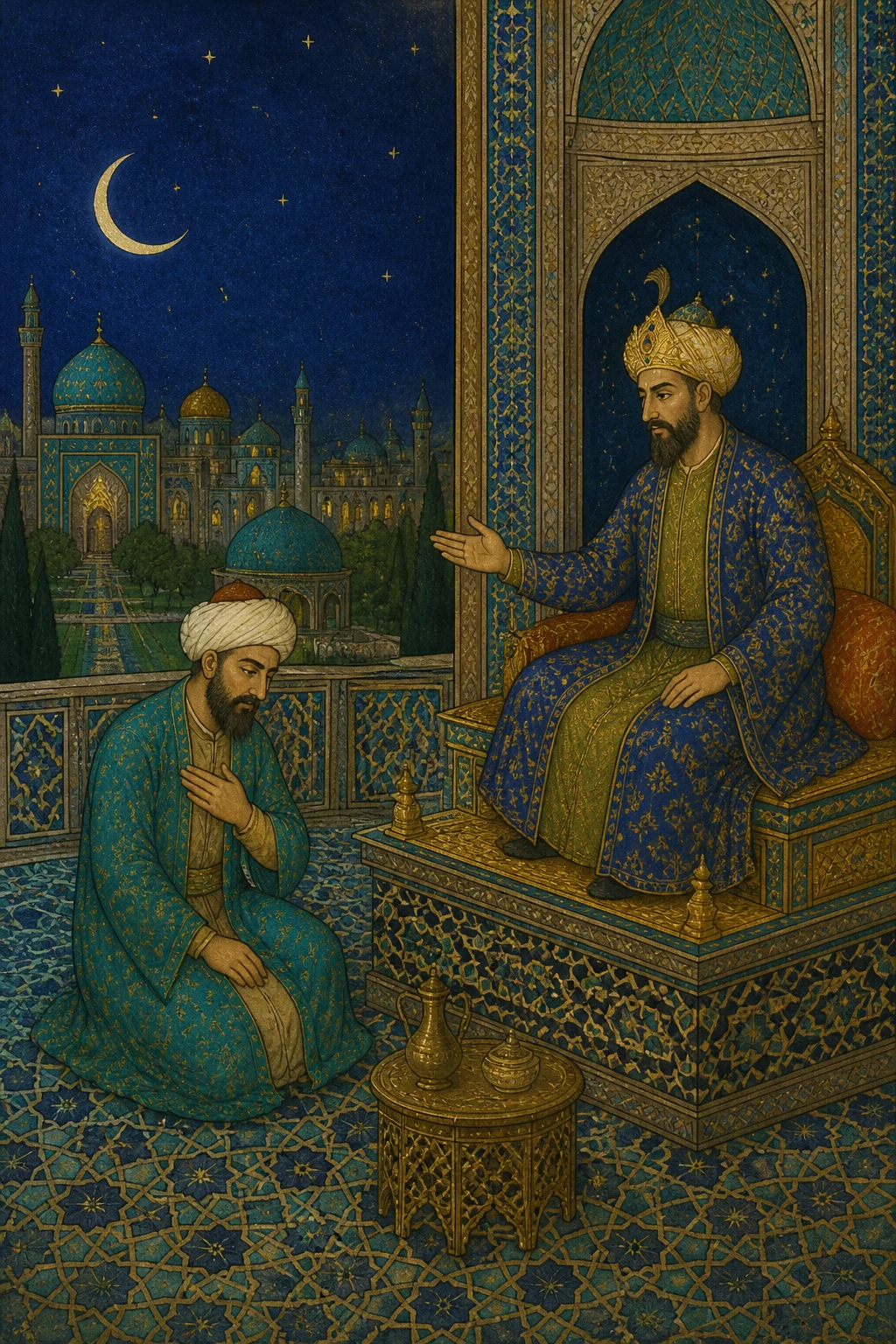
He came to the Sultan’s gate. The court was packed with people, and the Sultan was seated. The Sultan rose and called, “Ali!” He answered, “At your service.” The Sultan said, “Ali, I have heard that your wealth is gone, and that when people question you, you answer, ‘He who does not understand the meaning is not told the meaning.’”
He replied, “Yes, my lord. I divided my wealth into four portions. One portion I cast into the sea; one portion I burned; one portion I lent and shall never be repaid; and with one portion I paid a debt, but have not finished paying it.”
The Sultan said to him, “Ali, sell dear, not cheap.” Ali replied, “Yes indeed, my dear lord.” He left and went his way. At once the Sultan’s minister rose in court and said, “My lord, I know the meaning of these words.” The Sultan answered, “If you can discover their meaning by your own wits, without asking Ali, I, the Sultan, will give you my sultanate. Everything in my dominion, all that speaks and all that does not speak, I give to you. It shall be yours. But if you cannot discover the meaning of these words by your own wits, I shall take all your property. And you must not ask Ali.”
The minister said, “If I cannot discover the meaning of these words by my own wits, I give you, Sultan, everything I possess, all that speaks and all that does not speak, except my wife, who is other people’s daughter and must return to her family. And my head, Sultan, shall be yours to take.”
The Sultan said, “And I shall step down from the throne and become your minister, I who am Sultan.” The minister rose and went home. He bowed his head and thought, then fetched every book in his house. He opened them, searching for the meaning of Ali’s words, but could not find a single one that contained them. So he sat thinking and pondering. “I told the Sultan that I would understand these words by my own wits, yet I have reflected and considered, and still I do not understand them.”
He called, “Juma! Where does that young man Ali live?” The servant asked, “Which Ali, master?” He said, “That young man who had so much wealth, the son of the late minister Hassan, who went bankrupt. Do you not know where he lives? Please take me to him. I have something to ask him. And what I have told you, you must tell no one else. I have set you free so that no one may learn of this matter.”
He answered, “Yes indeed! Yes indeed! I know where he lives. Far away at the very end of the town, there is a little lean-to near the shore. He stays there with that poor cripple who goes about begging. That man is his friend, and he lives with him. He has nowhere else.”
The minister set out at midnight, when everyone was asleep, taking only this one servant, who was his confidant. They walked until they arrived. The minister knocked on the little lean-to and called, “Ali! Ali!” Ali was frightened and did not answer. He called again, “Ali!”
Ali said to his friend, “Wake up, wake up!” His friend asked, “What is it?” He answered, “Someone has knocked on our hut. I wonder, at this hour of the night, is he drunk, or has he come to steal something here? Yet we are paupers and have nothing. Perhaps someone bears us a grudge and wants to take our lives.” He added, “But let us sit quietly and listen first. When he knocks on the door a third time, we shall answer. Perhaps we shall recognize his voice.”
His friend said, “How can you be so foolish, Ali? A man has come in the middle of the night, and we do not know where he is from. People do not usually come knocking at our door. What can this man want of us, unless he has one of three things in mind? If God has granted me insight into these things I am considering in my heart, then it is as Almighty God wills.”
Ali said, “What do you mean, my friend? What are these three things you are considering in your heart? Tell me, so that I too may know, and we may both understand. Tell me the first.”
He said, “First, he wants to steal. Second, he wants to kill us. Third, perhaps he thinks his wife or his slave woman is here. Those are the thoughts in my heart.” Ali answered, “I do not know, my friend. Whatever comes from God is good.”
Ali said, “If he knocks now, I shall answer. If he kills me, let him kill me; if he spares me, so be it. I have no choice but to answer.” The minister knocked and called, “Ali!” He answered, “At your service. Who are you, calling me at this hour of the night, when it is already midnight?” The man replied, “It is I. I have business with you.” Ali said, “I do not know who you are, sir.” He answered, “Do not be afraid. I have come to call you for good, not for evil.” Ali said, “Sir, if you wish to call me, wait until morning.” The minister answered, “I cannot wait here even a single minute. All this talking inside is only delaying you. Please, Ali, come out and hear what I have called you for.”
Ali said, “Very well, sir. I shall put my ear to the door. Tell me your name, and then I shall feel safe enough to come out, for I shall know who you are.”
The minister came close and said, “It is I, the Sultan’s minister. Please come out. I have something to tell you, and it is a private matter.” “Very well, my lord.” Ali went to his poor friend and said, “The Sultan’s minister has come to call me. Whoever refuses a summons refuses what he is summoned for.”
His friend said, “Go, my friend. Perhaps some good awaits you.” Ali opened the door and saw the minister with his one servant. “Good evening, my lord,” he said. “Greetings, Ali,” the minister replied. “Come, let us go to my house.” Ali answered, “Very well, my lord.”
The minister and Ali went together to his house. As the minister went upstairs, one o’clock in the morning was striking. He called his maid, “Mrashi!” She answered, “At your service.” “Tell your mistress to prepare food quickly, before two o’clock strikes, and then come back.”
When Mrashi returned, she said, “Here I am, master.” He told her, “Mrashi, open the chest and bring a length of turban cloth, a white embroidered cap, a kanzu of khuzurungi cloth, and a Seyedia cotton kikoi. I have tied them all together in a red kerchief. Bring them quickly.”
The minister then said to Ali, “I have called you here for your own good. Please let no one know what I say. Keep it to yourself.” Ali answered, “Certainly, my lord. Could I ever reveal your words, my lord?”
He said, “Ali, I want you to explain the words that were reported to the Sultan, and tell me what the Sultan said to you in reply.” Ali answered, “The Sultan told me, ‘Sell dear, not cheap.’”
“Ali, Ali, please explain these words to me.” “How can I explain them to you, when the Sultan told me, ‘Sell dear, not cheap’?” “I shall give you my estate.” Ali answered, “The Sultan told me, ‘Sell dear, not cheap.’”
He said, “Ali, take all my warehouses in the town.” Ali said, “The Sultan told me, ‘Sell dear, not cheap.’” The minister said, “Ali, take all my estates.”
Ali said, “The Sultan told me, ‘Sell dear, not cheap.’” The minister said, “Take everything I possess.” Ali said, “The Sultan told me, ‘Sell dear, not cheap.’”
The minister said, “Take all that speaks and all that does not speak among my possessions, and explain these words to me.” Ali said, “The Sultan told me, ‘Sell dear, not cheap.’”
The minister rose and said, “I shall give you the whole house I live in, and everything it contains, except my wife, who is other people’s daughter and must return to her family.” Ali replied, “Then write me a deed in your own hand.”
The minister called Mrashi. She answered, “At your service, master.” He said, “Bring a pen, ink, and paper from the little cupboard.” Mrashi went and brought them. The minister took the paper and ink and wrote out a deed for Ali: “I have given him everything I possess, all that speaks and all that does not speak, including the house in which I myself live, except my wife, who is other people’s daughter and must return to her family.” The minister took the deed and handed it to Ali.
“It is now four o’clock. Let us go and pray first. When we return from prayers, I shall give you the explanations you seek.” They went downstairs and off to pray, then returned from the mosque. The minister said, “Come now, Ali, tell me, for day is breaking.”
Ali said, “The meaning of ‘He who does not understand the meaning is not told the meaning’ is this: if I explain something to a person without sense, he will not understand. That is why I say to everyone who questions me, ‘He who does not understand the meaning is not told the meaning.’ But when the Sultan summoned me and asked me, I did not withhold the explanation, for the Sultan has sense. And so he answered me, ‘Sell dear, not cheap.’ There is the answer to your question.”
“Then explain how the wealth was lost.” Ali said, “I divided my wealth into four portions. One portion I cast into the sea; one portion I burned; one portion I lent and shall never be repaid; and with one portion I paid a debt, but have not finished paying it.”
“Then tell me, Ali, what does it mean to cast one portion into the sea?” Ali said to the minister, “Forgive me, and bear with whatever I may say. The portion cast into the sea was the money I spent in debauchery with women. That money is lost and I shall never recover it. It is as though I had cast it into the sea, for what sinks into the sea cannot be recovered.”
“And what is the meaning of burning one portion?” Ali said, “I ate lavishly, dressed lavishly, and spent lavishly. That is what I mean by burning it, for it will never return to my hands.”
“Tell me about the third portion. What do you mean by lending it and never being repaid?” He told the minister, “It is like the money a man gives as his wife’s marriage payment. It will never return. That is what I mean when I tell you I have lent it and shall never be repaid.”
He said, “Tell me about the fourth portion. What do you mean when you say you have paid a debt but have not finished paying it?” He told the minister, “It is like a man who gives his mother money, wishing to gladden her heart. But I, her child, do not know whether my mother’s heart is content with what I have done for her. So I say to myself, ‘Perhaps my mother is not yet content with the money I have given her.’ That is what I mean when I tell you that I have paid, but have not finished paying.”
He said, “Thank you, Ali. I have understood your words.” By then the sun was rising, and six o’clock had already struck. The minister sat there, his heart full of joy. “Today I shall gain the sultanate, for I have understood it by my own wits.” He waited until nine o’clock, when the Sultan held court. The minister left his house with nothing but the single kanzu he wore, and went out with joy in his heart.
He walked until he reached the Sultan’s gate. The people there and all the soldiers were astonished. “Ah! The chief minister, who manages all the Sultan’s affairs, comes wearing nothing but a kanzu, without even shoes on his feet!” Everyone marvelled at him, but not one of them knew what was in his heart. Those who knew no better said, “Perhaps his wife has died. That must be why he has come to the Sultan in this state.”
The minister came forward and said, “Good morning, my lord.” The Sultan answered, “May God grant you a good morning, Minister. Welcome.” He sat down. The Sultan said, “Tell me your news. What tidings do you bring?” He answered, “Good tidings. I have come to give you the meaning of those words over which you and I made our agreement, Sultan. I have understood them by my own wits, Sultan.”
The Sultan said, “Explain the first to me.” He answered, “When people asked Ali why his fortune was gone, he told them, ‘He who does not understand the meaning is not told the meaning,’ because those people were fools. Even if he told them, they would not know how to answer him. Is it not better, then, not to tell those who do not understand? For whoever says something to another expects an answer. Would you speak to someone who does not know how to reply? That is why he would not tell them.” The Sultan said, “Yes, indeed, these words are true.” He added, “Minister, explain these four portions to me.”
He said, “The first portion, Sultan, was cast into the sea; another was burned; another was lent and will never be repaid; and with another he paid a debt, but has not finished paying it.”
He said, “Yes, Minister, your words are indeed true. Now tell me the meaning of that portion cast into the sea.” The minister answered, “It is the money Ali took and spent in debauchery away from home. That money was lost. That is what he means by saying that one portion went into the sea.”
He said, “Yes, Minister, that is indeed true.” The Sultan continued, “Once money has been given to women, it cannot be recovered. His words are true: it is as though it had gone into the sea. Now explain the second portion, the one that was burned.”
The minister said, “Ali ate lavishly, dressed lavishly, and spent lavishly. That is what he means by saying that money was burned, for it will never return to his hands.” The Sultan said, “Yes, Minister, these words are indeed true. Once you have spent money on food and bought fine clothes and worn them, it is gone and will not return. Ali has spoken truly: it is as though that portion had been burned.” He said, “Minister, tell me the meaning of the third portion.”
The minister said, “The third portion he lent and will never be repaid.” “What does he mean by lending this money and never being repaid?” The minister said, “It is the money he gave a woman as her marriage payment. When you part from her, she does not return your money. That is why he said, ‘I have lent it and shall never be repaid.’”
He said, “Yes, Minister, these words are indeed true.” The Sultan continued, “A man who gives a woman her marriage payment will not get it back. When you, the husband, have gone bankrupt, that woman will not feel moved to give it to you. Now that you are poor, she sees you as a fool. She no longer acknowledges you as the man who was her husband. Now that you are destitute, you have become ugly too, and she treats you as a fool because you have no money. Yet when you had money, you were a handsome man, a sensible young fellow, and you looked like a Sultan’s son.”
The minister rose and said, “It is true, Sultan. When a man has no money, he is nobody in the eyes of others.” The Sultan said, “Minister, explain the fourth portion to me: paying, yet not having finished paying.”
He told the Sultan, “It means that Ali took one portion of his wealth and gave it to his mother. Yet Ali does not know whether his mother’s heart is content with the money her son has given her. So Ali says, ‘Perhaps my mother is not pleased with what I have done for her.’ That is why Ali says, ‘I have paid, but have not finished paying.’”
The Sultan said, “Yes, Minister.” He rose from his chair and stood before the court, which was packed with people. He called an officer and said, “Go to the barracks and order the commander to have the drum beaten. My minister has now become Sultan, and I have become his minister. All you soldiers, and all who live in the town—Arabs, Swahilis, and all the people of Ngazidja—obey the Sultan.”
The minister rose and took possession of the sultanate. Two days passed. A man walking past the house that had belonged to the minister found Ali at the window, looking out and ordering the groom to saddle a horse, for he wished to go riding. The Arab called, “Ali!” He answered, “Yes?” “Why are you in this house?” Ali replied, “Did not the Sultan tell me, ‘Sell dear, not cheap’? Well, I sold dear.”
“Ah!” The Arab was astonished. How had this Ali come to be in the chief minister’s house? Still, it was no concern of his, and he let the matter rest. Another Arab passed and found Ali downstairs in the reception room. He called, “Ali!” Ali answered, “Yes?” He said, “Why do I find you here, Ali?” Ali replied, “Is this not my house?” “How has this become your house?” “The Sultan told me, ‘Sell dear, not cheap,’ and I sold dear, you see.”
The Arab left and went to the Sultan’s gate. He said, “My master, my lord, I found your servant Ali in your minister’s house. I called, ‘Ali!’ and he answered, ‘Yes?’ I asked, ‘What are you doing in this house?’ Ali replied, ‘The Sultan told me, “Sell dear, not cheap,” and I sold dear.’”
The Sultan was astonished. “So this is what the minister has done to me! We made an agreement that he was not to ask Ali. Yet it turns out he went and asked Ali, and lost all his property in the bargain! Now he has lost on both sides: he has lost his wealth and lost the sultanate as well. Go quickly and call Ali here.” “Very well, my lord.”
The man hurried away and found Ali about to board a boat for an outing. He called, “Ali!” Ali said, “Yes?” He told him, “Quickly! You are summoned to the Sultan.” Ali said, “Very well. The Sultan is still my Sultan.”
Ali went upstairs and called, “Mrashi, find me some fine clothes among those in the chests, for you know them better than anyone else.” Mrashi opened a chest and took out a fine robe, a handsome turban, a splendid shawl, a dagger with a gold-mounted hilt, an Arab Al Busaidi sword, and a little bottle of rose perfume from Istanbul. She brought them to her master.
When Ali saw the clothes, he was delighted. He took them and dressed, then went downstairs with the Arab. They walked until they reached the Sultan’s gate. He was told, “Go into the reception room.” He entered and sat down.
The Sultan came downstairs to hold court, accompanied by the man who had formerly been Sultan and was now minister. The minister was called and answered, “Yes?” He was asked, “Did our conditions mean nothing? Did I not stipulate that you must discover the meaning by your own wits, and not go and ask Ali?” He answered, “Yes.” “Yet you went behind my back and asked Ali.” He said to the Sultan, “I did not ask Ali.” The Sultan said, “Ah! Is Ali not here? Let us call him to stand before you, so that we may establish whether you discovered the meaning by your own wits, or whether Ali told you.” He answered, “Yes, call Ali here.”
The Sultan rose and called Ali. He answered, “At your service, my dear lord.” “Come here,” he said. “How is it, Ali, that you have gone to live in the minister’s house? What do you mean by it?” Ali replied, “Yes, Sultan, you told me, ‘Sell dear, not cheap.’ And here is the deed the minister wrote for me. Read it, Sultan, and you will know that this is true.”
The Sultan took the deed and read it. He said, “Indeed, Ali, you sold dear, not cheap.” The Sultan rose and called the minister. He answered, “At your service, my dear lord.” The Sultan addressed the people: “All of you here in court, great and small—Banyan, Arab, Mahri, Ngazidja, Swahili, and all the people of this land—I have dismissed this man. He holds neither the ministry nor the sultanate. His standing is now that of any other person in the town. And this Ali is now my chief minister. Whoever has a request, man or woman, Arab or European, let them all go to Ali. He is the one who will settle your affairs.”
And this tale was told by Ninsa.