Prevod
Poor Johannes was so sorrowful, for his father was very ill and could not live. There was no one but the two of them in the little room; the lamp on the table was nearly burned out, and it was very late in the evening.
"You have been a good son, Johannes!" said his sick father. "Our Lord will surely help you make your way in the world!" He looked at him with grave, gentle eyes, drew a deep breath, and died; it was just as though he had fallen asleep. But Johannes wept. Now he had no one at all in the whole world, neither father nor mother, sister nor brother. Poor Johannes! He knelt beside the bed and kissed his dead father's hand, shedding so many salt tears; but at last his eyes closed, and he fell asleep with his head on the hard wooden bedstead.
Then he dreamed a strange dream. He saw the Sun and the Moon bowing before him, and he saw his father alive and well again, and heard him laughing as he always laughed when he was truly happy. A beautiful girl, with a golden crown upon her long, lovely hair, held out her hand to Johannes, and his father said, "Do you see what a bride you have won? She is the loveliest in all the world." Then he woke, and all that beauty was gone. His father lay cold and dead in the bed, and there was no one there with them. Poor Johannes!
The following week the dead man was buried. Johannes walked close behind the coffin; never again would he see the dear father who had loved him so much. He heard the earth being thrown down onto the coffin and saw the last corner of it, but with the next shovelful that too was gone. Then it seemed as though his heart would break, so sorrowful was he. All around him they sang a hymn; it sounded so beautiful that tears came into Johannes's eyes. He wept, and it eased his grief. The sun shone brightly on the green trees, as though it wanted to say, "You must not be so sorrowful, Johannes! Look how lovely and blue the sky is. Your father is up there now, asking the good Lord to let all go well with you!"
"I will always be good!" said Johannes. "Then I too shall go up to Heaven to be with my father, and what joy it will be when we see each other again! How much I shall have to tell him, and he will show me so many things and teach me so much about all the beauty in Heaven, just as he taught me here on Earth. Oh, what joy it will be!"
Johannes pictured it so clearly that he smiled, though the tears were still running down his cheeks. The little birds sat up in the chestnut trees, chirping, "Tweet, tweet!" They were so happy, even though they too were at the funeral; but surely they knew that the dead man was now up in Heaven, with wings far larger and more beautiful than theirs, and that he was happy now because he had been good here on earth. That was why they rejoiced. Johannes watched them fly from the green trees far out into the world, and he too longed to fly away with them. But first he carved a large wooden cross to set on his father's grave, and when he brought it there that evening, the grave had been adorned with sand and flowers. Strangers had done this, for they had all been so fond of his dear father, who was now dead.
Early the next morning Johannes packed his little bundle and tucked his whole inheritance into his belt: fifty rigsdalers and a few silver skillings. With these he meant to wander out into the world. But first he went to the churchyard, to his father's grave, said the Lord's Prayer, and spoke his farewell. "Goodbye, dear Father! I will always be a good man, and then surely you may ask the good Lord to let things go well with me!"
Out in the fields where Johannes walked, all the flowers stood fresh and lovely in the warm sunshine, nodding in the wind as though they meant to say, "Welcome to the green countryside! Isn't it lovely here?" But Johannes turned once more to look at the old church where he had been christened as a little child, and where every Sunday he had gone with his old father and sung his hymn. Then, high up in an opening in the tower, he saw the church's little household spirit standing in his pointed red cap, shading his face with his bent arm, for otherwise the sun would have dazzled his eyes. Johannes nodded goodbye to him, and the little fellow waved his red cap, laid his hand upon his heart, and blew him kiss after kiss, to show how well he wished him and how much he hoped his journey would be a happy one.
Johannes thought of all the beautiful things he was now to see in the great, splendid world, and walked farther and farther away, farther than he had ever been before. He knew none of the towns he passed through, nor any of the people he met; now he was far away among strangers.
The first night he had to lie down to sleep in a haystack in a field, for he had no other bed. But he thought it was perfectly lovely; the king himself could have had nothing finer. The whole field beside the stream, the haystack, and the blue sky overhead made a beautiful bedchamber. The green grass with its little red and white flowers was his carpet; the elder bushes and wild-rose hedges were his bouquets; and for a washbasin he had the whole stream, with its clear, fresh water, where the reeds bowed to wish him both good evening and good morning. The moon was a great night-lamp high beneath the blue ceiling, and it would not set the curtains on fire. Johannes could sleep quite peacefully, and so he did, waking only when the sun rose and all the little birds around him sang, "Good morning! Good morning! Aren't you up yet?"
The bells were ringing for church, for it was Sunday. People were going to hear the preacher, and Johannes went with them, sang a hymn, and listened to the word of God. It was just as though he were in his own church, where he had been christened and had sung hymns with his father.
Out in the churchyard there were many graves, and on some of them the grass had grown tall. Then Johannes thought of his father's grave, which would come to look like these now that he could no longer weed it and tend it. So he sat down and pulled up the grass, set upright the wooden crosses that had fallen, and put back the wreaths the wind had blown from the graves, thinking, Perhaps someone will do the same for my father's grave, now that I cannot!
Outside the churchyard gate stood an old beggar leaning on his crutch. Johannes gave him the silver skillings he had, and went happily and contentedly on into the wide world.
Towards evening a dreadful storm arose. Johannes hurried to find shelter, but soon it was dark night. At last he reached a little church standing all alone on a hill. Fortunately the door was ajar, and he slipped inside; here he would stay until the storm had passed.
"I'll sit down in a corner here!" he said. "I'm quite tired, and could do with a little rest." So he sat down, folded his hands, and said his evening prayer, and before he knew it he was asleep and dreaming, while the lightning flashed and the thunder rolled outside.
When he woke again it was the middle of the night, but the storm had passed, and the moon shone in through the windows. In the middle of the church stood an open coffin with a dead man in it, for he had not yet been buried. Johannes was not at all afraid, for he had a clear conscience, and he knew very well that the dead harm no one; it is living, wicked people who do harm. Two such living, wicked men were standing beside the dead man, who had been placed here in the church before being laid in his grave. They meant to do him harm, not to let him lie in his coffin, but to throw him outside the church door, the poor dead man.
"Why would you do that?" Johannes asked. "It is cruel and wicked. Let him sleep in Jesus' name!" "Oh, nonsense!" said the two horrible men. "He cheated us! He owes us money he couldn't pay, and now he's gone and died as well, so we shan't get a penny. That's why we mean to have our revenge. He shall lie like a dog outside the church door!"
"I have only fifty rigsdalers!" said Johannes. "That is my whole inheritance, but I will gladly give it to you if you will honestly promise to leave the poor dead man in peace. I shall manage well enough without the money; I have strong, healthy limbs, and Our Lord will always help me!"
"Well," said the horrible men, "if you're willing to pay his debt like that, we certainly shan't do him any harm, you may be sure!" They took the money Johannes gave them, laughed loudly at his kindness, and went away. But Johannes laid the body straight in the coffin again, folded its hands, said farewell, and went on quite contentedly through the great forest.
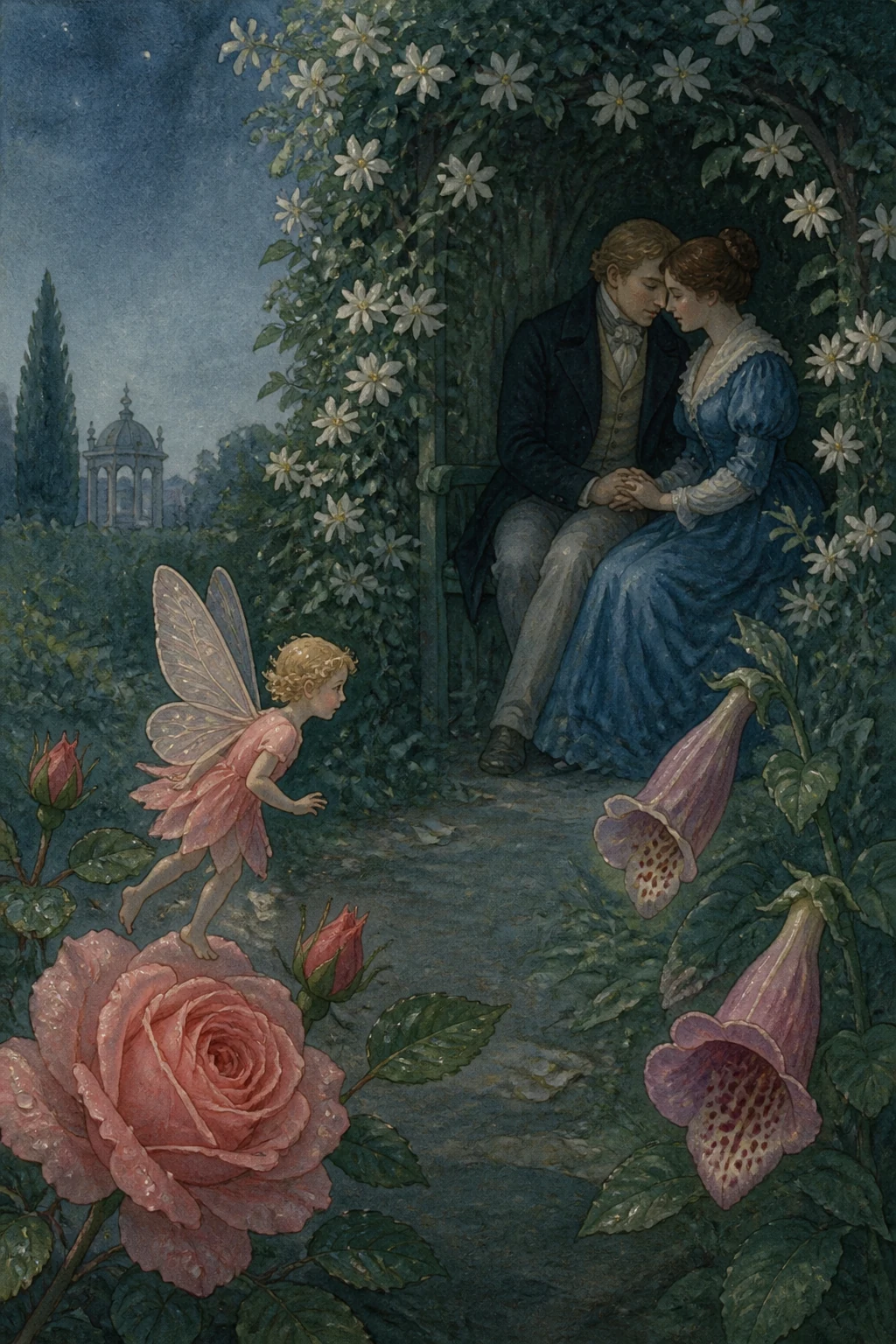
All around him, wherever the Moon could shine between the trees, he saw lovely little elves playing merrily. They did not let him disturb them; they knew he was a good, innocent young man, and only wicked people are forbidden to see the elves. Some were no bigger than a finger and wore their golden hair pinned up with gold combs. Two by two they swung upon the great dewdrops resting on the leaves and the tall grass. Sometimes a drop rolled away, and they tumbled down among the long blades of grass, while all the other little creatures laughed and shouted. It was tremendous fun! They sang, and Johannes clearly recognized all the lovely songs he had learned as a little boy. Great, brightly patterned spiders with silver crowns on their heads had to spin long suspension bridges and palaces from hedge to hedge; when the fine dew settled on them, they looked like shining glass in the clear moonlight. So it went on until the Sun rose. Then the little elves crept into the flower buds, and the wind caught their bridges and castles and sent them sailing through the air like great cobwebs. Johannes had just come out of the forest when a strong man's voice called behind him, "Hello there, friend! Where are you bound?"
"Out into the wide world!" said Johannes. "I have neither father nor mother, and I'm a poor lad, but Our Lord will surely help me!" "I'm going out into the wide world too!" said the stranger. "Shall we travel together?"
"Gladly!" said Johannes, and so they went on together. They soon grew very fond of each other, for both were good people. But Johannes could tell that the stranger was much wiser than he was. He had been almost all round the world and could tell stories about every imaginable thing.
The sun was already high when they sat down beneath a great tree to eat their breakfast. Just then an old woman came along. Oh, she was so old and bent, leaning on a crutch, with a bundle of firewood on her back that she had gathered in the forest. Her apron was tucked up, and Johannes saw three large bundles of fern fronds and willow twigs sticking out of it. When she was quite close to them, one foot slipped; she fell and gave a loud scream, for she had broken her leg, the poor old woman.
Johannes wanted them to carry her home at once, but the stranger opened his knapsack, took out a jar, and said he had an ointment that would make her leg sound and well immediately, so that she could walk home herself as though she had never broken it. In return, however, he wanted her to give him the three bundles she had in her apron.
"That's a handsome price!" said the old woman, nodding her head in a very odd way. She was reluctant to part with her bundles, but it was not pleasant to lie there with a broken leg either. So she gave them to him, and as soon as he had rubbed the ointment on her leg, the old woman got up and walked much better than before. That was what the ointment could do. But then, it was not the sort you could buy at the apothecary's.
"What do you want with those bundles?" Johannes now asked his travelling companion. "They're three fine little brooms!" he said. "I happen to like them, for I'm a curious fellow!"
Then they walked on for another good stretch. "Look at the weather coming!" said Johannes, pointing straight ahead. "Those are terribly thick clouds!" "No," said his travelling companion, "they aren't clouds, they're mountains. Beautiful great mountains, where you climb right above the clouds into the fresh air! It's glorious, I can tell you! Tomorrow we shall surely have come that far into the world!"
They were not as near as they seemed. It took a whole day's walking to reach the mountains, where dark forests rose straight towards the sky and rocks were as big as an entire town. It would certainly be a hard journey to cross them, so Johannes and his travelling companion went into the inn to rest well and gather strength for tomorrow's march.
A great many people had gathered downstairs in the inn's large taproom, for a man was giving a puppet show. He had just set up his little theatre, and the people sat all around to watch the play. Right at the front an old, fat butcher had taken the very best seat. His great bulldog—oh, how fierce it looked!—sat beside him, staring just like everyone else.
Now the play began, and a fine play it was, with a king and a queen seated on a splendid throne, golden crowns on their heads and long trains to their robes, for they could afford such things. The prettiest wooden puppets, with glass eyes and great handlebar moustaches, stood at every door, opening and closing them to let fresh air into the room! It was a delightful play, and not at all sad; but just as the queen rose and walked across the floor—well, heaven knows what the great bulldog was thinking! Since the fat butcher was not holding him, he leaped straight onto the stage and seized the queen by her slender waist. "Crick, crack!" it went. It was quite dreadful!
The poor man who put on the whole play was terribly frightened and grieved for his queen, for she was the prettiest puppet he had, and now the nasty bulldog had bitten her head off. But afterwards, when the people had gone away, the stranger who had come with Johannes said he could mend her. He took out his jar and rubbed the puppet with the ointment he had used to help the poor old woman when she broke her leg. The moment the ointment was applied, the puppet was whole again; indeed, she could even move all her limbs by herself, without anyone pulling the string. The puppet was like a living person, except that she could not speak. The man who owned the little puppet theatre was delighted. Now he did not need to hold that puppet at all; she could dance by herself. None of the others could do that.
Later, when night came and everyone in the inn had gone to bed, someone began to sigh so deeply and went on for so long that they all got up to see who it could be. The man who had put on the play went over to his little theatre, for that was where the sighing came from. All the wooden puppets lay jumbled together, the king and all the guards, and it was they who were sighing so pitifully and staring with their great glass eyes, for they longed to have a little ointment rubbed on them, like the queen, so that they too could move by themselves. The queen sank right down upon her knees and held up her lovely golden crown, pleading, "Take this, only rub the ointment on my husband and my courtiers!" Then the poor man who owned the theatre and all the puppets could not help crying, for he truly felt so sorry for them. He promised the travelling companion all the money he took at the following evening's performance if he would only rub the ointment on four or five of his prettiest puppets. But the travelling companion said he wanted nothing but the great sabre the man wore at his side. When he had been given it, he rubbed the ointment on six puppets, who at once began to dance. It was so delightful that all the girls—the real, living girls—who were watching began to dance too. The coachman and the cook danced, the waiter and the chambermaid, all the guests, and the fire shovel and the tongs; but those two fell over as soon as they tried their first steps. Yes, it was a merry night!
The next morning Johannes and his travelling companion left them all behind and went up into the high mountains, through the great fir forests. They climbed so high that the church towers far below them at last looked like little red berries amid all the green, and they could see far away, for miles and miles, into places where they had never been! Never before had Johannes seen so much of the beautiful world at once. The Sun shone so warmly from the fresh blue sky, and he heard the hunters blowing their horns among the mountains, so sweetly and joyfully that tears of happiness came into his eyes, and he could not help saying, "Dear Lord! I could kiss you for being so good to us all and giving us all the beauty there is in the world!"
His travelling companion also stood with folded hands, looking out over the forest and the towns in the warm sunshine. Just then a wonderfully beautiful sound rang out above their heads. They looked up: a great white swan was soaring in the air. It was so beautiful, and sang as they had never heard any bird sing before; but its song grew fainter and fainter, it bowed its head, and sank very slowly to their feet, where it lay dead, the beautiful bird.
"Two such lovely wings," said the travelling companion, "as white and large as this bird's, are worth money. I'll take them with me! Now do you see how useful it was to get a sabre?" With a single stroke he cut both wings from the dead swan; he meant to keep them.
They now travelled many, many miles over the mountains, until at last they saw before them a great city with more than a hundred towers shining like silver in the sunshine. In the middle of the city stood a magnificent marble palace roofed with red gold, and here the king lived.
Johannes and his travelling companion did not go straight into the city, but stayed at the inn outside it to put themselves in order, for they wanted to look respectable when they walked through the streets. The innkeeper told them that the king was such a good man, who never did anyone any harm of any kind; but as for his daughter—heaven preserve us!—she was a wicked princess. She had beauty enough; no one could be so lovely and so fair as she was. But what good was that? She was a cruel, wicked witch who had caused so many handsome princes to lose their lives. She had given everyone permission to woo her; anyone might come, whether prince or beggar, it was all the same. He had only to guess three things she asked him about. If he could, she would marry him, and he would become king of the whole country when her father died; but if he could not guess the three things, she had him hanged or beheaded. So cruel and wicked was the beautiful princess. Her father, the old king, was deeply grieved by it, but he could not forbid her to be so wicked, because he had once said he would never have anything at all to do with her suitors; she could do just as she pleased. Whenever a prince came to guess and win the princess, he could never manage it, and so he was hanged or beheaded. After all, he had been warned in good time; he need not have wooed her. The old king was so distressed by all this sorrow and misery that for one whole day every year he knelt with all his soldiers and prayed that the princess might become good, but she would do nothing of the kind. The old women who drank spirits dyed them quite black before drinking them. That was how they mourned, and there was nothing more they could do.
"The horrible princess!" said Johannes. "She really ought to be given a whipping; it would do her good. If only I were the old king, I'd soon make her squeal!"
Just then they heard people outside shouting hurrah! The princess was passing, and she truly was so beautiful that everyone forgot how wicked she was, and that was why they cheered. Twelve lovely maidens, all in white silk dresses, each with a golden tulip in her hand, rode coal-black horses beside her. The princess herself rode a snow-white horse adorned with diamonds and rubies; her riding habit was of pure gold, and the whip in her hand looked like a sunbeam. The golden crown upon her head was like little stars from the heavens, and her cloak was sewn from more than a thousand lovely butterfly wings. Yet she herself was far more beautiful than all her clothes.
When Johannes saw her, his face turned as red as blood, and he could scarcely say a word. The princess looked exactly like the beautiful girl with the golden crown whom he had dreamed of on the night his father died. He thought her so lovely that he could not help loving her dearly. Surely it could not be true, he said, that she was a wicked witch who had people hanged or beheaded when they could not guess what she asked of them. "Anyone is allowed to woo her, even the poorest beggar. I really will go up to the palace! I cannot help it!"
They all told him not to do it; he would certainly meet the same fate as all the others. His travelling companion also advised him against it, but Johannes thought all would be well. He brushed his shoes and his coat, washed his face and hands, combed his lovely golden hair, and went quite alone into the city and up to the palace.
"Come in!" said the old king when Johannes knocked at the door. Johannes opened it, and the old king came to meet him in his dressing gown and embroidered slippers, with his golden crown on his head, his sceptre in one hand, and his golden orb in the other. "Wait a moment!" he said, tucking the orb under his arm so that he could offer Johannes his hand. But as soon as he heard that this was a suitor, he began to cry so much that both sceptre and orb fell to the floor, and he had to wipe his eyes on his dressing gown. The poor old king!
"Don't do it!" he said. "It will end badly for you, just as it has for all the others. Come and see!" Then he led Johannes into the princess's pleasure garden, and a dreadful sight it was! In every tree hung three or four princes who had wooed the princess but had been unable to guess the things she asked them. Whenever the wind blew, all the bones rattled, so that the little birds were frightened and never dared come into that garden. All the flowers were tied to human bones for support, and grinning skulls stood in the flowerpots. What a garden for a princess! "There, you see!" said the old king. "You will end up like all the others you see here, so you had better give it up. You truly make me unhappy, for I take it so much to heart!"
Johannes kissed the good old king's hand and said that all would be well, for he loved the beautiful princess so dearly. Just then the princess herself rode into the palace courtyard with all her ladies, so they went out to greet her. She was lovely, and held out her hand to Johannes, and he loved her even more than before. Surely she could not be a cruel, wicked witch, as everyone said she was. They went up into the hall, and the little pages offered them preserves and peppernuts, but the old king was so sorrowful that he could not eat anything; besides, the peppernuts were too hard for him.
It was now decided that Johannes should return to the palace the next morning, when the judges and the whole council would be assembled to hear how he managed with his guessing. If he succeeded, he would have to come twice more; but no one had ever yet guessed correctly the first time, and so they had forfeited their lives.
Johannes was not at all troubled about how things would turn out. He was perfectly happy, thought only of the beautiful princess, and firmly believed that the good Lord would help him. How, he had no idea, nor did he wish to think about it. He danced along the road on his way back to the inn, where his travelling companion was waiting for him.
Johannes could not stop telling him how kindly the princess had treated him and how beautiful she was. Already he longed so much for the next day, when he would go to the palace and try his luck at guessing.
But his travelling companion shook his head and was very sorrowful. “I am so fond of you!” he said. “We might have had so much more time together, and now I must lose you already! My poor, dear Johannes, I could weep, but I will not spoil your happiness on what may be our last evening together. We shall be merry, very merry; tomorrow, when you are gone, I may weep!”
Everyone in the town had soon heard that a new suitor had come for the princess, and there was great sorrow. The theatre was closed, all the cake-sellers tied black crape round their sugar pigs, and the king and the priests knelt in the church. There was such sorrow, for surely Johannes could fare no better than all the other suitors.
Towards evening the travelling companion made a large bowl of punch and told Johannes that now they must be very merry and drink the princess’s health. But after Johannes had drunk two glasses, he grew so sleepy that he could not possibly keep his eyes open, and he fell asleep. The travelling companion lifted him very gently from his chair and laid him on the bed. Then, when the night had grown dark, he took the two great wings he had cut from the swan and fastened them to his shoulders. He put into his pocket the largest bundle of switches he had received from the old woman who had fallen and broken her legs, opened the window, and flew over the town straight to the palace, where he settled in a corner just beneath the window of the princess’s bedchamber.
The whole town was perfectly still. The clock struck a quarter to twelve, the window opened, and the princess flew out over the town towards a great mountain, wearing a long white cloak and long black wings. But the travelling companion made himself invisible, so that she could not see him at all, flew after her, and lashed her with his switches until the blood flowed wherever he struck. Oh, how they raced through the air! The wind caught her cloak and spread it out on every side like the sail of a great ship, and the moon shone through it.
“How it hails! How it hails!” said the princess at every stroke of the switches, and it served her right. At last she reached the mountain and knocked. There was a rumbling like thunder as the mountain opened, and the princess went inside. The travelling companion followed, for no one could see him; he was invisible. They passed through a great long passage where the walls glittered most strangely: more than a thousand glowing spiders were running up and down them, shining like fire. Then they entered a great hall built of silver and gold. Flowers as large as sunflowers shone red and blue upon the walls, but no one could pick them, for their stems were hideous venomous snakes, and the flowers were flames pouring from their mouths. The whole ceiling was covered with shining glow-worms and sky-blue bats beating their thin wings. It was a most extraordinary sight. In the middle of the floor stood a throne, borne by four horse skeletons harnessed with the red fire-spiders. The throne itself was made of milky-white glass, and its cushions were little black mice biting one another’s tails. Above it was a canopy of rose-red cobwebs, studded with the prettiest little green flies, which shone like jewels. In the middle of the throne sat an old troll with a crown on his ugly head and a sceptre in his hand. He kissed the princess on the forehead and seated her beside him on the costly throne, and now the music began. Great black grasshoppers played the mouth harp, and the owl beat his own belly, for he had no drum. It was a curious concert. Little black goblins, each with a will-o’-the-wisp on his cap, danced round the hall. No one could see the travelling companion; he had stationed himself just behind the throne and heard and saw everything. The courtiers who now came in looked so fine and grand, but anyone who could see properly would have known what they really were. They were nothing but broomsticks with cabbages for heads, which the troll had brought to life by magic and dressed in embroidered clothes. But that hardly mattered, since they were only there for show.
When the dancing had gone on for a while, the princess told the troll that she had a new suitor, and asked what she should think of for him to guess the next morning, when he came to the palace.
“Listen!” said the troll. “I shall tell you what to do! Choose something very simple, and then it will never occur to him. Think of one of your shoes. He will never guess that. Then have his head cut off, but do not forget to bring me his eyes when you come back here tomorrow night, for I want to eat them!”
The princess curtsied very low and said she would not forget the eyes. The troll opened the mountain, and she flew home again, but the travelling companion followed her and beat her so hard with his switches that she sighed deeply at the terrible hailstorm and hurried as fast as she could through the window into her bedchamber. The travelling companion flew back to the inn, where Johannes was still asleep, unfastened his wings, and lay down on the bed himself, for he had good reason to be tired.
It was very early in the morning when Johannes awoke. The travelling companion got up too and told him that during the night he had had a very strange dream about the princess and her shoe, and urged him to ask whether the princess had been thinking of her shoe. For that, of course, was what he had heard from the troll inside the mountain; but he would tell Johannes nothing about that, and only urged him to ask whether she had been thinking of her shoe.
“I may as well ask one thing as another,” said Johannes. “Perhaps your dream may turn out to be quite right, for I always believe that the Lord will help me! But I shall say goodbye to you all the same, for if I guess wrong, I shall never see you again!”
Then they kissed one another, and Johannes went into the town and up to the palace. The whole hall was crowded with people. The judges sat in their armchairs with eiderdown pillows beneath their heads, for they had so much to think about. The old king stood wiping his eyes with a white handkerchief. Now the princess entered; she was even more beautiful than the day before, and greeted them all so sweetly. But she gave Johannes her hand and said, “Good morning to you!”
Now Johannes had to guess what she had been thinking of. Heavens, how kindly she looked at him! But the moment she heard him say the single word “shoe,” her face turned chalk-white and she trembled all over. Yet that could do her no good, for he had guessed correctly!
Goodness, how delighted the old king was! He turned a splendid somersault, and everyone clapped for him and for Johannes, who had now guessed correctly the first time.
The travelling companion was pleased too when he heard how well things had gone. But Johannes clasped his hands and thanked the good God, who would surely help him the other two times as well. The very next day he was to guess again.
The evening passed just as the one before had done. When Johannes was asleep, the travelling companion flew after the princess to the mountain and beat her even harder than before, for this time he had taken two bundles of switches. No one saw him, and he heard everything. The princess was going to think of her glove, and he told Johannes this as though it had come to him in a dream. So Johannes was able to guess correctly, and there was great rejoicing at the palace. The whole court turned somersaults, just as they had seen the king do the first time; but the princess lay on the sofa and would not say a single word. Now everything depended on whether Johannes could guess the third time. If all went well, he would marry the beautiful princess and inherit the whole kingdom when the old king died. If he guessed wrong, he would lose his life, and the troll would eat his lovely blue eyes.
The evening before, Johannes went to bed early, said his evening prayer, and slept quite peacefully. But the travelling companion fastened the wings to his back, buckled the sabre at his side, took all three bundles of switches with him, and flew to the palace.
It was a pitch-dark night. The storm raged so fiercely that tiles flew off the roofs, and the trees in the garden where the skeletons hung swayed like reeds in the wind. Lightning flashed every moment, and the thunder rolled as though it were a single peal lasting all night long. Now the window flew open and the princess flew out. She was as pale as death, but she laughed at the foul weather and thought it was not fierce enough. Her white cloak whirled through the air like the sail of a great ship, but the travelling companion lashed her so hard with his three bundles of switches that blood dripped down to the earth, and at last she could scarcely fly any farther. Finally she reached the mountain.
“What hail and wind!” she said. “I have never been out in such weather.” “One can have too much of a good thing,” said the troll. Then she told him that Johannes had guessed correctly the second time as well. If he did the same tomorrow, he would have won, and she could never come out to the mountain again or work such magic as she had before. That was why she was so sorrowful.
“He shall not guess!” said the troll. “I shall think of something that has never entered his head! Otherwise he must be a greater sorcerer than I am. But now let us be merry!” And he took the princess by both hands, and they danced round with all the little goblins and will-o’-the-wisps in the hall. The red spiders sprang merrily up and down the walls, and the fire-flowers seemed to sparkle. The owl beat his drum, the crickets chirped, and the black grasshoppers played their mouth harps. It was a merry ball!
When they had danced long enough, the princess had to go home, or she might be missed at the palace. The troll said he would go with her, so that they could be together a little longer.
Off they flew into the foul weather, and the travelling companion wore out all three bundles of switches on their backs. Never had the troll been out in such a hailstorm. Outside the palace he said goodbye to the princess and whispered to her, “Think of my head.” But the travelling companion heard him clearly, and at the very moment when the princess slipped through the window into her bedchamber and the troll was about to turn back, he seized him by his long black beard and, with his sabre, cut his hideous troll’s head clean off at the shoulders, before the troll even had time to see what was happening. He threw the body into the lake for the fish, but merely dipped the head in the water, tied it up in his silk handkerchief, and took it home to the inn. Then he lay down to sleep.
The next morning he gave Johannes the handkerchief, but told him not to untie it until the princess asked what she had been thinking of.
There were so many people in the great hall of the palace that they were packed on top of one another like radishes tied in a bunch. The council sat in their chairs with their soft pillows, and the old king wore new clothes. His golden crown and sceptre had been polished and looked very fine indeed. But the princess was quite pale and wore a coal-black dress, as though she were going to a funeral.
“What have I been thinking of?” she asked Johannes. At once he untied the handkerchief, and was quite frightened himself when he saw the hideous troll’s head. A shudder ran through everyone, for it was a dreadful sight, but the princess sat like a statue of stone and could not utter a single word. At last she rose and gave Johannes her hand, for he had guessed correctly. She looked neither to one side nor the other, but sighed deeply. “Now you are my master! This evening we shall be married!”
“That is what I like to hear!” said the old king. “That is how it shall be!” Everyone shouted hurrah, the guards’ band played in the streets, the bells rang, and the cake-sellers took the black crape off their sugar pigs, for now there was rejoicing. Three whole roast oxen, stuffed with ducks and chickens, were set in the middle of the market square, and everyone could cut himself a piece. The finest wine flowed from the fountains, and if you bought a penny pretzel at the baker’s, you were given six large buns besides—and buns with raisins in them, too.
That evening the whole town was illuminated, the soldiers fired cannons, and the boys let off crackers. Up at the palace there was eating and drinking, clinking of glasses and dancing, and all the fine gentlemen and beautiful young ladies danced with one another. Far away you could hear them singing:
“Here are pretty girls aplenty, longing for a merry round; let the drummer play his march now, pretty girl, come turn around. Dance and stamp, till your soles fall off—tra-la!”
But the princess was still a witch and felt no love at all for Johannes. The travelling companion remembered this, and so he gave Johannes three feathers from the swan’s wings and a little bottle with a few drops of liquid in it. He told him to have a large tub filled with water placed beside the bridal bed, and when the princess was about to get into bed, he was to give her a little push so that she fell into the water. There he must dip her three times, first throwing in the feathers and the drops. Then she would be freed from her enchantment and come to love him dearly.
Johannes did everything the travelling companion had advised. The princess screamed loudly as he plunged her beneath the water, and struggled in his hands like a great coal-black swan with glittering eyes. When she came up out of the water the second time, the swan was white except for a single black ring round its neck. Johannes prayed devoutly to the Lord and let the water close over the bird a third time. At that very moment it changed into the most beautiful princess. She was lovelier than ever, and with tears in her beautiful eyes she thanked him for breaking her enchantment. The next morning the old king came with his whole court, and congratulations went on until well into the day. Last of all came the travelling companion, with his stick in his hand and his knapsack on his back. Johannes kissed him again and again and said that he must not go away; he must stay with him, for he owed all his happiness to him. But the travelling companion shook his head and said gently and kindly, “No, my time is over now. I have only paid my debt. Do you remember the dead man whom those wicked men wanted to harm? You gave everything you possessed so that he might rest in peace in his grave. I am that dead man!”
And in that instant he was gone. The wedding festivities lasted a whole month. Johannes and the princess loved each other dearly, and the old king lived many happy days, letting their tiny children ride on his knee and play with his sceptre. But Johannes was king over the whole kingdom.