O besedilu
Požeruh v trebuhu
- Vir
- Beside the Fire
- Avtor
- Douglas Hyde
- Jezik branja
- English
- Jezik izvirnika
- Gaeilge
- Čas branja
- 19 min branja
- Obseg
- 16 strani
- Naslov izvirnika
- 004 An Alp-luachra
O izvirniku
Beside the Fire
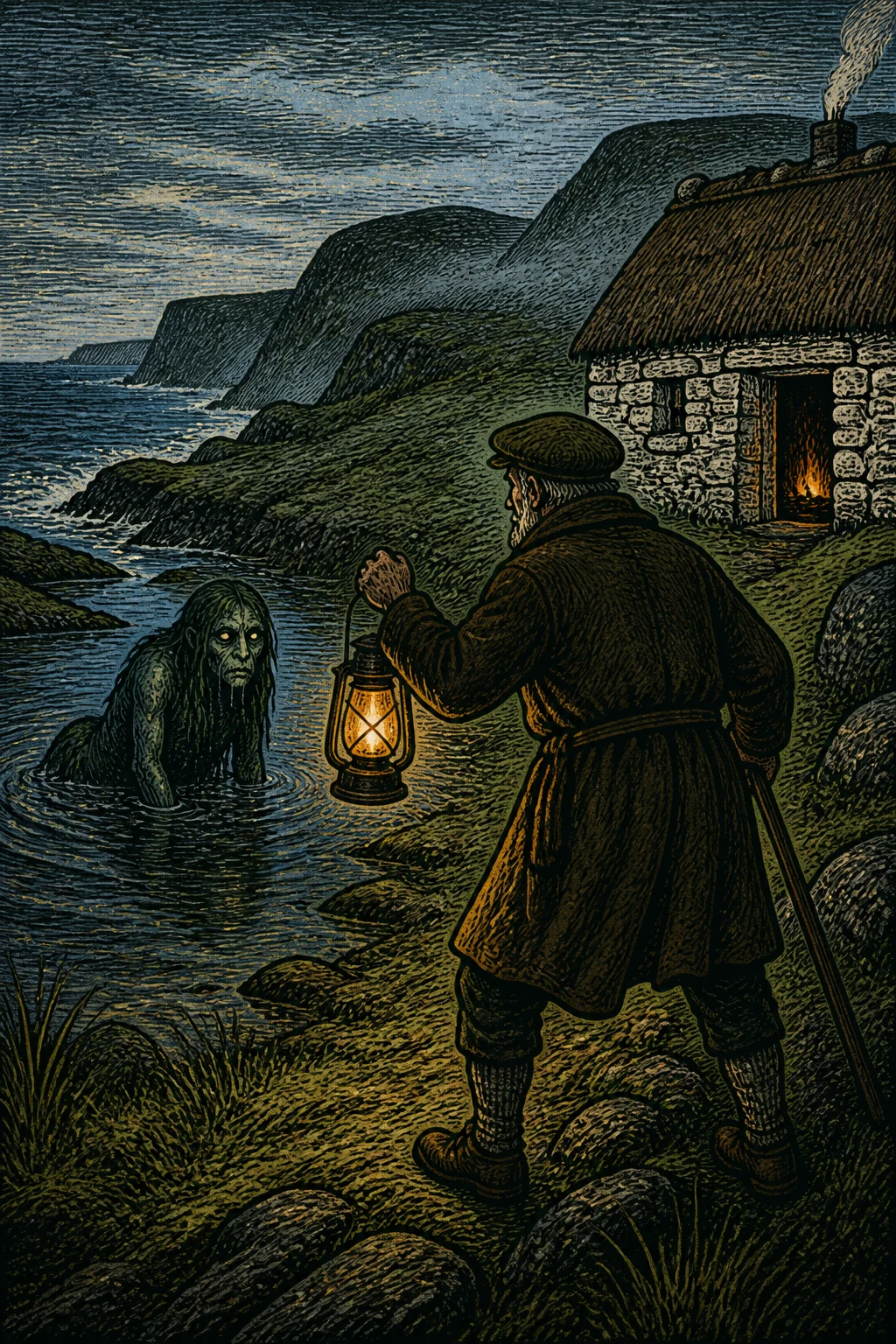
Irske pripovedi ob ognju: preobrazbe, prikazni, zvijače in otoško ustno izročilo. Bralni jezik je English, izvirnik pa prihaja iz vira Beside the Fire v jeziku Gaeilge.
Besedilo
Požeruh v trebuhu
There was once a man living in the province of Connacht who had plenty of wealth, a good wife and a young family, and nothing to trouble or distress him. He would have called himself a happy, contented man, as fortunate as anyone alive. He lived like this for many years, without sorrow or anxiety, enjoying good health, with neither sickness nor disease afflicting him or his children. Then one fine day in autumn, while he was watching his men making hay in the meadow beside his house, he drank some buttermilk, for the day was hot, and stretched himself out on the newly mown grass. Wearied by the heat of the day and by the work he had been doing, he soon fell asleep. He remained there for three or four hours, until all the hay had been gathered and his labourers had left the field.
When he awoke, he sat up, not knowing where he was, until at last he remembered that he was lying in the field behind his own house. He got up and went home. On the way he felt something like a pain or a sharp twinge in his stomach, but he paid it no heed. He sat down by the fire and began to warm himself.
“I fell asleep,” he said, “on the fresh grass in the field where they were making the hay.” “What has happened to you?” his wife asked. “You don’t look well.”
“Well, indeed, I don’t know,” he said, “but I’m afraid there’s something wrong with me. I feel very strange. I’ve never felt like this before. Still, I’ll be better when I’ve had a good sleep.”
He went to bed, lay down and fell asleep, and did not wake until the sun was high. Then he got up, and his wife said to him, “What was wrong with you, that you slept so long?”
“I don’t know,” he said. He went into the kitchen, where his daughter was making a cake for breakfast, and she said to him, “How are you today, Father? Are you any better?”
“I had a good sleep,” he said, “but I’m not a whit better than I was last night. Indeed, if you’ll believe me, I think there’s something inside me, running back and forth in my stomach from side to side.”
“Perhaps,” said his daughter, “you caught a chill lying out on the fresh grass yesterday. If you’re no better this evening, we’ll send for the doctor.”
Evening came, but the poor man was no better, and they had to send for the doctor. He said that he was in pain, though he could not tell exactly where the pain was, and when the doctor was slow in coming he grew very impatient. Everyone in the house did all they could to encourage him.
The doctor came at last and asked what was wrong with him. Once again he said that there was something like a little bird hopping about in his stomach. The doctor undressed him and examined him carefully, but could see nothing amiss. He put his ear to the man’s side and to his back, but heard nothing at all, though the poor man kept saying, “Now! Now! Don’t you hear it? Now! Aren’t you listening to it hopping?” But the doctor could detect nothing, and at last he concluded that the man was out of his mind and had nothing wrong with him.
When he came out, he told the mistress of the house that there was nothing wrong with her husband, except that he imagined himself ill. He would send some medicine the following day to give him a good sleep and cool the heat in his body. He did so, and the poor man swallowed all the medicine and slept for a long time again. But when he woke the next morning he was worse than ever, though he said that he no longer heard the thing hopping inside him.
They sent for the doctor again, and he came, but could do nothing. He left more medicine with the man and said that he would return in another week to see him. The poor man got no relief from anything the doctor left, and when the doctor returned he found him worse than before. Still he could do nothing, nor had he any idea what sort of illness the man had. “I won’t take any more money from you,” he told the mistress of the house, “since I can do nothing in this case. And as I don’t understand what is wrong with him, I won’t pretend that I do. I’ll come to see him from time to time, but I’ll take no money from you.”
The woman could scarcely contain her anger. When the doctor had gone, she gathered the household together and they took counsel. “That rogue of a doctor,” she said, “isn’t worth a straw. Do you know what he said? That he wouldn’t take any more money from us, and that he had no knowledge of anything. The rascal! The scoundrel! He’ll never cross this threshold again. We’ll go to the other doctor. If he is farther away, I don’t care; we must have him.” Everyone in the house agreed with her, and they sent for the other doctor. When he came, he knew no more than the first, except that he knew very well how to take their money. He came often to see the sick man, and every time he came he had another name for the illness, each longer than the last—names that neither he himself nor anyone else understood, but which he used to frighten the people.
They went on like this for two months, with nobody knowing what was wrong with the poor man. When this doctor did him no good, they fetched another, and then another, until at last they had tried every doctor in the county. They lost a great deal of money on them and had to sell some of their cattle to pay their fees.
For half a year they kept doctors attending him and giving him medicines, while the poor man, who had once been stout and well nourished, grew lean and thin, until there was no flesh left on him, only skin and bones.
At last he became so weak that he could scarcely walk, and he lost his appetite. It was a great struggle for him to swallow a morsel of soft bread or even a drink of fresh milk. Everyone said that he would be better off dead, and small wonder, for he was no more than a shadow of a man.
One day, while he was sitting on a chair at the door of the house, warming himself in the sunshine, with all the household away and nobody there but himself, a poor old man who went from place to place begging alms came up to the door. He recognised the master of the house sitting in the chair, though he was so changed and wasted that anyone would scarcely have known him. “Here I am again, asking alms in God’s name,” said the poor man. “But glory be to God, master, what has happened to you? You’re not the same man I saw when I was here half a year ago. May God help you.”
“Ah, Séumas,” said the sick man, “I’m the one who can’t tell you what has happened to me. But I know one thing: I won’t be long in this world.”
“I’m sorry to see you as you are,” said the beggar. “Can’t you tell me how it began? What did the doctors say?”
“The doctors!” said the sick man. “My curse on them! They know nothing at all. But I ought not to be cursing, with death so close to me. The devil take them, they know nothing.”
“Perhaps,” said the beggar, “I could do something to make you better, if you’d tell me what’s wrong with you. They say I have some knowledge of diseases and of the herbs that are good for curing them.”
The sick man laughed. “There isn’t a physician in the county,” he said, “who hasn’t been here attending me. Haven’t I sold half the cattle on my farm to pay them? But I’ve had no relief or help from any of them. Still, I’ll tell you how it first happened.” And he gave him an account of every pain he had felt and everything the doctors had prescribed.
The beggar listened carefully, and when he had finished the whole story, he asked him, “What sort of field was it where you fell asleep?”
“It was a meadow,” said the sick man, “but it had just been mown at the time.” “Was it wet?” asked the beggar. “It wasn’t,” he said.
“Was there a little stream or a run of water flowing through it?” asked the beggar. “There was,” he said. “Can I see the field?” “Indeed you can, and I’ll show it to you now.”
He rose from his chair and, ill as he was, dragged himself along until he reached the place where he had lain asleep that afternoon. The beggar examined the spot for a long time. Then he bent over the grass and went back and forth, stooping with his head down, searching among the plants and herbs. At last he straightened up and said, “It’s just as I thought.” He bent down again and began searching as before. The second time he raised his head, he had a little green herb in his hand. “Do you see that?” he said. “Anywhere in Ireland that this herb grows, there’s an alp-luachra near it, and you’ve swallowed an alp-luachra.”
“How do you know that?” asked the sick man. “If that were so, surely the doctors would have told me before now.”
“May God give you sense! Never mind the doctors,” said the beggar. “They’re nothing but a pack of fools. I tell you again, and believe me, it was an alp-luachra you swallowed. Didn’t you say yourself that you felt something hopping in your stomach on the first day you fell ill? That was the alp-luachra. As the place in your stomach was strange to it at first, it was restless there, moving back and forth. But after a couple of days it settled down and made itself comfortable. That’s why you’re growing so thin: that alp-luachra is getting the goodness out of every morsel you eat. And you told me yourself that one of your sides was swollen. That’s the side where the ugly thing has made its home.”
The man did not believe him at first, but the beggar kept talking, assuring him that he was telling the truth. When the wife and daughter came home, he spoke to them in the same way, and they were ready enough to believe him.
The sick man himself did not believe it, but they all kept talking to him until at last they prevailed on him. He allowed them to summon three doctors together, so that this new story could be told to them. The three came together, and when they had heard what the beggar had to say, and what the women said, they laughed and declared that they were all fools. It was some quite different complaint that afflicted the master of the house, and the name they gave his illness this time was a new one, three times longer than any before it. They left a bottle or a couple of bottles for the poor man to drink and went away, mocking the women’s claim that he had swallowed an alp-luachra.
When they had gone, the beggar said, “I’m not at all surprised that you’re getting no relief, with fools like those attending you. There isn’t a doctor or physician in Ireland now who can do you any good but one man, and that is Mac Diarmada, the Prince of Coolavin, on the shore of Lough Gara—the best doctor in Connacht or in all the five provinces.” “Where is Lough Gara?” asked the sick man. “Down in County Sligo. It’s a great lake, and the Prince lives on its shore,” he said. “If you take my advice, you’ll go there, for it’s your last chance. And you, mistress,” he said, turning to the wife, “ought to insist that he go, if you want your husband to live.”
“Indeed,” said the woman, “I’d do anything that would save him.” “Then send him to the Prince of Coolavin,” he said. “I’d do anything myself to save my life,” said the sick man, “for I know I haven’t long to live in this world unless something is done to help me and give me relief.”
“Then go to the Prince,” said the beggar. “Anything you think will do you good, Father, you ought to do,” said the daughter. “Nothing will do him any good but going to the Prince,” said the beggar.
So they argued and disputed until nightfall. The beggar was given a bed in the barn, and in the morning he began arguing again that they ought to go to the Prince. The wife and daughter agreed with him, and at last they prevailed on the sick man. He said he would go, and his daughter said she would go with him to look after him, while the beggar said he would accompany them to show them the way. “And I,” said the wife, “will be at death’s door with worry, waiting for you to come back.”
They harnessed the horse and put it to the cart, took a week’s provisions—bread, bacon and eggs—and set out. They could not go very far the first day, for the sick man was so weak that he could not bear the jolting of the cart. But he was much better on the second day. They all stayed that night at a farmer’s house by the roadside, and went on again in the morning. On the afternoon of the third day they reached the Prince’s home. He had a pleasant thatched house among the trees on the shore of the lake.
They left the horse and cart in a little village near the Prince’s house, and all walked on together until they reached it. They went into the kitchen and asked whether they might see the Prince. The servant said that he was eating his meal, but that he might come when he was finished.
At that very moment the Prince himself came in and asked what they wanted. The sick man rose and told him that he had come to seek his honour’s help, and he related the whole story. “Now, can your honour give me any relief?” he asked when he had finished.
“At any rate, I’ll do my best for you, since you’ve come so far to see me. It would be a poor return if I didn’t do my best. Come up to the parlour. What that old man with you said is true. You’ve swallowed an alp-luachra, or something of the kind. Come up to the parlour with me.”
He took him upstairs. His meal that day was a large piece of salted beef. He cut off a great portion, put it on a plate and gave it to the poor man to eat.
“Oh! What is your honour doing now?” said the poor man. “I haven’t swallowed so much as that of any meat for three months. I have no appetite. I can’t eat anything.”
“Be quiet, man,” said the Prince. “Eat that when I tell you.” The poor man ate as much as he could, but when he laid down his knife and fork, the Prince made him pick them up again and begin afresh. He kept him there eating until he was ready to burst, and at last he could not have swallowed another morsel for a hundred pounds.
When the Prince saw that he could swallow no more, he brought him out of the house and told the daughter and the old beggar to follow. He led the man out to a fine green meadow in front of the house, with a little stream of water running through it.
He brought him to the bank of the stream and told him to lie down on his stomach, hold his head over the water and open his mouth as wide as he could, keeping it almost touching the water. “And stay quietly like that without moving, on your life,” he said, “until you see what happens to you.”
The poor man promised to keep still. He stretched himself on the grass, held his mouth open over the stream and remained there without moving.
The Prince went back about five yards behind him, drawing the daughter and the old man along with him. His last words to the sick man were, “Be sure, on your life, that you don’t stir, whatever happens to you.”
The poor man had not been lying like that for a quarter of an hour when something began to stir inside him. He felt something coming up his throat and going back down again. It came up and went back three or four times in succession. At last it came as far as his mouth and stood on the tip of his tongue, but it took fright and went back again. After a little while it came up a second time, stood on the tip of his tongue and finally jumped down into the water. The Prince was watching him closely and called out, “Don’t move yet,” for the man was about to get up.
The poor man had to open his mouth again and remain as he was. He had not been there a minute before a second creature came up his throat in the same way, retreating a couple of times as though frightened. At last, like the first, it came up into his mouth and stood on the tip of his tongue. When it smelled the water beneath it, it jumped down into the stream.
The Prince laughed and said, “Now they’re getting thirsty. The salt in the beef has worked on them. Now they’ll come tumbling out.” And before the words were out of his mouth, the third fell into the water with a splash. A moment later another jumped down, and then another, until they had counted five, six, seven, eight, nine, ten, eleven, twelve.
“There’s a dozen of them now,” said the Prince. “That’s the brood. The old mother hasn’t come yet.” The poor man was about to rise again, but the Prince called to him, “Stay where you are. The mother hasn’t come.”
He remained as he was, but no more came out, though he waited more than a quarter of an hour. The Prince himself began to grow uneasy, fearing that the old alp-luachra would not move at all. The poor man was so tired and weak that he would rather have got up than stayed where he was, and despite everything the Prince said he was beginning to rise, when the Prince caught one of his legs and the beggar the other, and they held him down against his will.
They waited another quarter of an hour without speaking. At the end of that time the poor man felt something stirring again in his side, but seven times worse than before, and he could scarcely keep himself from crying out. The thing moved about inside him for a good while, and he thought it was tearing his body open from within. Then it began to come up, reached his mouth and went back again. At last it came so far that the poor man put two fingers into his mouth, thinking to catch it. But quickly as he put his fingers in, the old alp-luachra retreated quicker still. “Oh, you rascal!” said the Prince. “Why did you do that? Didn’t I tell you not to stir? If it comes up again, keep still.” They had to wait half an hour, for the old mother of the alp-luachras was frightened and afraid to come out. But at last she came up again. Perhaps she was so thirsty that she could no longer resist the tempting smell of the water, or perhaps she was lonely after all her children had left her. At any rate, she came out to the edge of his mouth and stood on his tongue for as long as it would take to count to eighty. Then she jumped into the water as her brood had done before her, and the sound of her fall was seven times louder than the splashes her children had made.
The Prince and the other two watched all this, scarcely daring to draw breath for fear they might frighten
the ugly creature. As soon as she jumped into the water, they pulled the man back and set him on his feet again.
For a little while he could not speak, but the first words he said were, “I’m a new man.” The Prince kept him in his own house for a fortnight and gave him great care and good nourishment. Then he let him go, with the daughter and the beggar, and refused to take so much as a penny from them.
“I’d rather have this than ten pounds in my hand,” he said, “that my cure has turned out so well. God forbid that I should take a penny or a halfpenny from you. You’ve lost quite enough to doctors already.”
And he was so grateful to the poor beggar that he kept him in his own house until the day he died. And for as long as he himself lived, he never set foot on the green grass again. What is more, if sickness or illness came upon him, it was not the doctors he would call—and small wonder!
Izvirnik
004 An Alp-luachra
Naslednje strani prikazujejo izvirno besedilo za primerjavo.
bin f C0I65 f'Al-6bl]A A 5-ConnACCAlb AOn U A1]\ AlilAin, AJUf
bi iTiAoni 50 leon Aije, Ajup beAn itiaiu Aguf mtii]Ai^in bi^ei^j Aju]' ni ]\Aib t)A'OAiii A5 ct^i buAi-ojieA-o ni. cpiobloToe Ai]i, A^uf -oeupfA yein 50 ^i/yib -pe 'nnA yeAp* comp6]\-
CAITIAll fAfC^, A^Up 50 ]\Alb An C-At) A.1]l, COlil ttlAIC AJUf
Ai|\ "ouine Aii\ bic d. bi beo. Dhi ye mA]A pn jAn b]i6n ^^.n buATopeAt) Ai]\ yeAt) Tn6|ii.in btiA-o^in 1 ft<since liiAic Ajii-p 5An cinneAf n^. aicit) Aip |:6in nA Aip a ctoinn, no 50 ■DCAini^ 1^ b]ieA5 AnnpAn bpojniA]!, a ]AAib ye •oe^]1CA■6 Ai|A A CU1X) -OAOine A5 -oeunAih pei]\ Annp^>.n moinpeup a bf A n-Aice te n^ ceAC pern, A^up iiiaia bi o.n li. yo ceic "d'oI ■pe "oeoc blACAice A^uppin ye e p^ein piAp ai]\ An bpeup vy bAince, Ajup niAp bf pe p^puigce te ceAp An t^Ae Ajup leip ^n obAip» A bi ye A.5 -oeunMii, too cuic ye ^An ihoitt 'nnA co-oIa-6, A5up "o'yAn ye iriApi pin ai]i peAt) cpi no ceicpe UAip no 50 ]iAib An peup uile cpApcA Ajup 50 ]\Aib A -uAoine oibpe imci5ce Ap An bpo.i]ic.
TluAi]A "ouipij pe Ann pn, ywo ye pnAp ai]i a coin, A^up ni pAib popAi^e CIA An aic A]\Aibpe,no ^uy cuiriinigpepAOi TJeipe 5ii]A AnnpAn bp^ipc ai|i cul a ci^e p-ein tjobtpe 'nnA ttii-oe. 'O'eipi^ ]'e Ann pin Ajup cuAm ye Aipv Aip cuin a cije pein, A^up Aip n-imceAcc "06, niocAi5 pe mA]t piAn no
mt>.]\ 5peini A.nn ^ boil^, X)\o]\ cuip ye ■puim 6>nti, acc f^uit) ye poy ^5 ^n ceine ^511]' ^or^J^S V^ 'S"^ cei^e^-o ^rein.
"bhime mo co-ol^t)," e>.]\ ye^ye^^vi, " Aip Vn bpeup u|v Ann i'a' bpAipc 'nn^ -jAAib pAt) aj ■oeunAih An yei]i."
" C]Aeu-o A bAin -oiiir," a]i fife, " nt yeiicAnn cu 50 mAic."
"tnuife! rtiAifeAt) I ni'lpof ajaiti," a]i feifeAn, " acc CA fAicciof ojAm 50 bfuil |\u-o eijin onm, if AifceAc a liiocAi^nn me fern, ni ]iAib me mA]\ pn AfiAiii f oiiiie fed, Act belt) me niof fCAjif nuAi]\ a bfui^fit) me cot)lAt) mAic."
ChuAit) fe -o'a leAbuio Ajuf lum fe fiof, Ajuf cuic fe Ann A cox)'La'6, Ajuf nio]\ "ouipj fe 50 f Aib An jf lAn a]\"o. "O'eifig fe Ann fui Ajuf -ou&Aif c a beAn leif, " CjieuD -oo bi Of c nuAif finn' cu co'oIa'6 com f a-oa pn ?"
"tlilpof AjAm," Af feifeAn.
C]nJAi"6 fe AnnfAn 5-cifceAnAc, n'Aic a bi AingeAn a^ ■oeunAm caca le Ii-ajait) An bfeAC-fAfc (biA'bnA mAi-one), Ajuf "onbAif c pf e leif , **Cia An caoi bftnl cu An-ouijbfuil Aon bifeAC of c a ACAif ?"
" "PuAi^v me co-qIa-o mAic," Af feifeAn, " acc nf'L me blAf n'lOf feAff 'nA bi me Afeif, Aguf 50 -oeimin oa 5-cfei-ofeA me, f Aoilim 50 bpnl f n-o ei5in Afci5 lonnAm, A5 fic Aiionn 'f AnAll Ann mo boilg o CAOib 50 CAOib.
*' AfAn'i feitJif," Af f An in^eAn, "if flAi^xjeAn a fUAif cu At)' tui^e Ainuig Ane Aif An bfeu]\ tif, Ajuf munA b};inL cu nio]' feA]i|\ AnnfAn C]\Acn6nA cuifpmf-o po]' ai|i An r)Occui]u"
U^mi^ ATI rn^cnoriA, acc bt An Duine bocc Ann-p^n jcaoi ceu-onA, Aju]' b'eijm -ooib poy cu]\ ai|\ An X)occtJi]A. "bhi ye Aj ]AA-6 50 i^Aib piAn ai]a, aju]' nAC ]AAib poy ^i^e 50 ccA^c CAt) e An aic Ann a ]AAib An ibiAn, •^juf nuAiji nAC 1\Aib An "ooccuiii ceAcc 50 Iuac bf -j^gAnniAU^At) Tr>6]\ ai];. bill muinnci]\ An ci^e A5 -oeunAiii tnle f'6i]\c "o'yeua p6-o "oeunAiii le meipneAc a cu]\ Ann.
UAinij An 'ooccui^^ ^aoi "oei^ie, aju^^ 'o'pA]:|\ui5 fe "66 c]Aeu-o "oo bi aiji, -^juf •oubAi]\c i'ei]'eAn i>.]\\y 50 ^\Aib ]\ux> eijin m&~]\ einin Ag teimmg Ann a bol^. tloccui^ An "ooccuiiA e '^5tl]" ^\mne ye b]\eAt:nu5A'6 niAic ai]\, acc ni irACAi"6 I'e ■OAt)Aiii a bi a]' An m-bcAlAC 'Lei]\ Chui]i ye a cltiAi" te nA CAoib '^5l-1]' le nA •6]vtiiiii, acc nio]\ cuaLato l^e i\ti'0 M]\ hit ax> 56 yisih An •otnne bocc e yem A5 l\A-6— "Anoi]' ! lloi]'! nAc 5-cltiinn cu e? noi]M nAc nAC b]:uit cu '5 ei^xeACC teiy, Ajteminij?" Acc nio]\ cu^ An -ooccui]! ]\ut) Ai]\ bic ):aoi -oeAiiA, a^uj' j'Aoit 1'e ■jTAOi •6ei]\e 50 ]\Aib An yeA]\ a]' a ceiLt, ■^Ji-i]' nAc ]iAib
t5 At) Alii A1]\.
'OubAi^\c i^e be mnAOi An cije nu ai]\ CAinij ^^e AniAC, nAC ]\Aib Aon yux) ai]a a ireA^A, accjuji cpeit* ye yeix\ 50 ]AAib ^^e cmn, •^5llf 50 5-cin]\]:eA-6 i^e TDjMi^AnnA cmje An I a £>.\\\ nA liiA^^Ac A beA]\]:A-6 cot)lA-6 niAic -66, ^511]' a yoc- ■pocAt) CCA-)" A cui]\p. Ilinne I'e y■i\^, '^5l-1]' f^-ui^ An "oume bocc nA "oiMigAnnA tnle ^Jti]' iruAip ye co-oIax) m6\\ A]\i]' ACC nuAi]\ 'ouipj I'e c^iy niATom bi ^^e nio^- ineAyA 'nA'|\iAni, ACC "oubAijic ye ni-y cuaIato ye An ])u-o aj beminij CAob A]"ci5 "oe Anoif.
Chtii]A pAt) poy Aip An •ooccui]\ isy'iy, aju]" CAinij ye ACC niop yexixi ye yux) ai]a bic oeunAiii. 'O'f'Ag ye "o^iug- AnnA eile leif An b]reA|i, aju]' ■oubAipc ye 50 "ociucirAt) 1'e i>.y\y 1 t;-ceAnn i^eAcctiiuine eile le nA freicpnc. Hi bj:uAi|A An X)Uine bocc ^roiin^fn ai]\ bic Ap A]a ^^.5 An "oocciii]\ lei]", Ajuf nuAi]A x)Aini5 An t)occtji|\ i>~y]y |:uAip ]'e e
niof ine^fA via ^loniie pn ; acc nfo]t f-eut) -pe Aon ]\ii-o •6e-^riMii xs^u]' ni ^AAib yio^' ai^ bic Aije cAt) e'n cineAl cinni]- •oo bi Ai|i. " til belt) me A5 ^l^cAt) •oVi^Ajm uaic I'eAfCA," i>.\\ -pei^^eAn, le mriAoi An cfge, "iiia^a nAc "ocij liom ]uid Ai|i bic •oeAnAtTi Annj-An s-cuij' yeo; ajui' iiia^a nAc •octiigiin qAeut) aca ai]a, ni leijp-o me o]im 6 tjo cinjnnc. UiucjrAit) mete nA yeicpnc 6 Am 50 h-Am acc ni jlAcpATo me Aon Aiii^iot) uaic."
If Ai]A eigm •o'peu'O An beAn An feAf 5 -oo bi iii|i|ii "oo congmAiL AfceAc. 11tiAi|\ bi An 'oocciii]i imcigce qMiinmt y\ mtnnncif An cije le ceile Ajuf jIac pAt) coiiiAifle, "An •ooccuijA b^AA-OAC pn," a^a pfe, " ni pu cfAicnin e. "bpttit po-p Ajuib cjieut) "oubAiiAC ye? nAC nglACfAt) ye Aon Aiiijiox) UAinn feAfCA, Ajuf "oubAifC ye nAC jiAib eolAf Ai]A bic Aije A1]A -OAtiAni. " Sup" Ai]\ ! An biceAiimAc ! ni ciucfATo -pe CAf An CAijAfeAc yd 50 b]AAC. IxAcpAmAoi-o 50 "ocf An •oocciiin eile, mA ca feniop ■pAi'oe tiAinn, yem, if ciimA tiom pn, cAicpmi"o a fA^Ait." Dhi uite •otnne a bi Annf A ceAc Aif Aon pocAl teice, Aguf cuip pAt) pof Aif An "ooccuif eile, Ajuf nuAiji CAinig fe ni jiAib Aon eolAf •00 b' feAf]A Ai^e-feAn 'nA'oobi a^ ah ^-ceu'o-'oocciiijA acc AiiiAin 50 f Alb eolAf 50 le6]i Ai^e Aif a n-Aifjio-o -oo jIaca'o. UAinig fe leif An -omne cinn 'o'feic]'inc, 50 minic, ^5Uf ^^c aiti a CAinij fe -00 bi Ainm eile Aige niof fAi-oe 'nA A ceile ai]A a cmneAf, AinmneACA (AnniAnnA) nAf CU15 f e f em, n a tDinne Aif bic eile, acc bi f 1 At) A-ije le f5Ann]nj JAt) nA n-t)A0ine.
'O'f An pAt) niAf pn ai]a feAt) t)A mi, jAn pof aj tjuine Aip bic c]ieut) t)o bt ai]\ An bpeAf bocc, Ajuf nuAif nAc lAAib An loocctJi^A pn A5 t)eAnAiti itiaic Aip bic "66, |:uAi|t pAt) t)occuiii eile, A^uf Ann pn t)occt3ip eile, no 50 ]iAib uile t)Occui]\ A bi Annp a' ^-contJAe aca, f aoi '6e^\^e, Ajuf
CA>ill p^t) 6. l^n M]^5i"0 teoj ■6.511^' b'ei^iu x)6ib cui-o -o'i. n-CAll^c x)\6l l,e1i-Ai]\5iot) y^JMt te f>A> n-toc.
Dhf pA^t) m^i^ pn le teic-1i)li^"DAirj ^5 conjtiiAil •ooccvnn 1e^y, A51.1]' n^v "ooccuipi-o ^5 r/^b-M]AC ■ojAujA.nn^ -oo, ^^uf Ml -ouine bocc a. bf i\iMriA.]\ be^CMJce ^Aoniie pn, 4>>5 ei]\i je tom A^JUf r^-n^, 50 ni\c ^Mb lln]'.^ -jreolA. M]i, a>cc 4vn cjAoicion a^u]' n^ cniwiii^ Miu\in.
bill I'e y^oi "oeiixe coiii ■oon^ pn 511]^ ^i]a eijin -D'yeu-o fe pub^t, AJU]' -o'lniti^ 4>v joile u^i-6, ^^i-'f bii-o iiioja ^n C]iioblof-o Leip 51^enn A.]\Ain buij, no "oeoc b^nne m\\ "oo j'lug^t) A.5UI" bi tnte 'onine A.5 ]\^x) 50 iTi-b'yeA]i]i •06 hi.y pAJMb, Aju]" but) beA^5 A-n c-ion^n^^.'o pn; iti^]\ n^c ]\Mb Ann Acr 111^]^ bei-6eA.-6 -p^Aite 1 mbin-oent.
Aon i<N xsiiuxin, nuM]\ bi i^e 'nr^ piToe ai]a ci^CAOi]\ ^5 ■oop^s]' xsn ni^e, 'ji. ^jAi-^nuj^-o yein A.nn ■pA.n ceA.]% •^^uf muinnci|A An cije uile imcijce AmAc, aju]- ^^n -oume Ann Acc e ^ein, CAinij^ ■peAnt)uine bocc a bi A5 ia^a^aai-o "o^ipce o A1C 50 I1-AIC ftiA]" cum An 'oo]AAip A5U]" x)'Aiuni5 ye f.-eAjA An cige 'nnA fui-oe Ann^^A' ^-cacaoi]^, acc bf I'e coiii Vi-Acnuigce pn aju]- coiii CAicce pn <^u\\ ai^a eigin -o'aicneocA-o -oume e. "Ua me Ann I'o a]\'i^^ aj ia|\]aat6 "oeipce Ann Ainm "Oe," An|" An I'eA-p bocc, " acc 5t6i]\ "oo "Oia A mAi5i]'ci]\ c]Aeut) -oo bAin "ouic nf cu^^a An -peAiA ceu'onA A connAijic me 'Leic-btiA"6A;n 6 fom nuAi]\ bf me Ann I'o, 50 b]:6i]U5*OiA o]\c."
"A^AA A SheumAi]'," ^]\ i^An yeA]^ cinn, "1]' mife nAC b]reu-o]:At) innpnc "ouic c]\eu-o -oo bAin "OAm, acc ca pof A^Am A1]A Aon |AU"o, nAC mbei"6 me bfAt) ai^ An c-^^AoJAt
ro."
"Acc CA b]\6n 0]Am "o'yeicpnc mA]A ca cu," a]\ j^An ve\\^ceAc, "nAC t)ci5 leAC innpnc "OAm cia An caoi a^a co-puig ■pe leAC ? cpeu"o a 'oubAi]\c nA "ooccui|at6 ?"
"TIa •ooccui]ai-6 !" A]\ I'An ]:eA]A cmn, "mo liiAllAcc opjiA ! ni'l po]' Ai]A 'OA'OAm aca, acc nf coip "OAm beic A5
e-5>]xuine Ajuf tni]'e com ^056.^' pn nom' hi^y, "yu]:" o\\\\6>. ni'l eol^i" M]\ bic ac^."
"b'ei"oi]\," A.]A ■pA.n -oeiiAceA^c, "50 bpeu-oiTMnn -p^in bife^^c CA.bo.ipc -ouic, rxs n-inne6|'^ -o^m qieux) t-ri. o\\x:. X)ei]\ pAX) 50 mbt-oim coIa^c ^i]\ Mcf-oili), ^S^r ^ip tiA. lui'beA^nnA.ib aca iiiaic le nA> beigeAf."
1\inne An ye^-y cmn 5^.1^6. "llt'l ireA^jvleijif ^nn i^a.' 5-con-OAe," A]\ I'e, "nAc^\Mb /snn fo biom ; n^-c bpuib te^c i>.r\ e^llAij A> bf ^.5^111 is^\ b.n b):eiltii "oiotc^ le n^ n-ioc ! i^cc ni b]-ni<i^i)^ me -|.-6i]\i5in "oi- ti>.-^i>.x) 6 "oume ai]\ bic a.ca>, i>.cx: ^^^ue6yi>.^^6 me -oinc-i^e mA]A •o'ei]\i5 fe -o^m is^\\ vzuy." A^uy isnn y\n cug -j'e cuncA^' "oo a.i]a uibe pi^n ^ liiocuij; •j'e, Ajuf •Ml^ mbe put) a "d'ohtdui j n^ "ooccuiin-o.
'0'ei]'c An -oeijAceAc beip 50 cu]\AmAC, Agup nuAi]i c)\iocnui 5 pe An pjeut uile, "a'piApiAuij ye -oe, " cAt) e An pope pAipce 1 Ai]\ Ap CU1C uu -00 co-oIa-6 r "
"1p m6mpeu]A a bf Ann," Ap pAn -ouine cmn, '* acc bT ye 50 -oii^eAc bAjnce, Ann pAn Am pm."
"TlAib pe plinc," App An 'oei]\ceAC.
"Ill pAib," Ap peipeAn.
"1lAib -|^\ocAn tnpge no CAipe a' pic cpf-o?" A]\p An "oeipceAc.
*' bill," A]i peipeAn.
"An 'ocigtiom An foAipc peicpnc?"
" U15 50 "oeimin, Ajup CAipbeunpAit) me "ouic Anoip e."
tD'eipi^ pe Ap A CACAOip Agup coiii 'oon a Ajup bi pe, pcpAC- Aii pe e pein ai]i ajai-o, no 50 'ocAinij pe cum nA h-Aice Ann Ap luit) pe 'nnA co'otA'6 An c]AAcn6nA pin. Dli]\eACnuij peAp-nA-'oeipce Aip An aic, CAmAtt pA-OA, Agu]' Ann pin c]\om pe Aip An bpeup Ajup cuai-o pe Anonn 'p AnAll Agup A co]ip tubcA Ajup A ceAnn cpomCA A5 pmeujiCACc Ann pnA buibeAnnAib, Ajup AmeApg An luibeA]mAi5 'oo bf
"O'eipij pe pAOi -oeijAe, Ajup t)ubAipc pe, "UApeniAjA pAOil me," Agup cpom pe e pein pfop A]\fp, A^up coj-uig
^5 CUA]AC115A"6 rriAH )\oniie pn. ^65 ye /^ ce^nii An Vi>.]\6^ tiAi|i, Aguy "bt luib "beAg jt^^y Ann a lAiiii. "An "byeiceAnn cu pn," A]A -pe, *' A1C Ai]A bic Ann 6i^;inn a byA^Ann An luib yeo Ann, btonn Alp-tuAc]\A AnAice teiy, Ajuy fiui^ cu
Alp-luACHA."
"Cat) e An caoi biruil poy a^a-o pn ?" A]iy An "ouine cinn, " IDA mbut) inAjt pn -oo bt ye, iy "0615 50 n-mne6]'A'6 nA •ooccuiyit) -oAni 6 yoniie yeo."
" 50 "ocujAix) IDiA CI All -ouir, nAbAC leiynA -oocciiiyib," Ayy An tDeiyccAc, "ni'l lonncA acc baIIca AiTiAtDAn. A "oeiinin leAr Ay y, Ajuy cyem nnye, jtiy Alp-luAcyA a yliiig cu; nAc "oubAiyc cu yem ^uy tiiocuij cu yuo eipn A5 leimni^ Ann "oo bolg An c6a"o Ia 'y^^T ^^ beic cinn. b'e yni An Alp-luAcyA, a^u]' niAy vo bt An aic yin Ann TOO bolg ycyAin]^eu]\Ac leiy 1 x)co]'ac, bt ye 1111-yuAirhneAC innci, A^'oul Anonn'y AnAll, acc nuAi)i bt yecuplA lAinnci, yocjAuig ye e yem, A^uy yuAi]\ ye An aic conip6]\CAihAil A^uy ym e An c-A"6bAy yAbyuil cu aj conjihAil corii CAnA yni : mi>.]\ uile jyenn "o'a byuil cu a^ ice btonn An AlpluAC]\A yin Aj yA^Ail An liiAic Ay. Ajuy "oubAiyc cu yem liom 50 yAib 'ooleAc-CAob acca, iy i ym An CAob 'n aic a byuil An yut) 5]iAnnA 'nnA coiimuToe."
ntoy cyeit) An yeAy e, a "ocoyAC, acc Icau An "oeiiiceAc •OA cothyAt) leiy, A5 cyucu ja"6 "66, juy b' e An ytyinne a bt ye AjyAX), Ajuy nuAi]\ CAini^ a beAn Ajuy a injeAn Aiy Aiy Ayty -oo'n ceAc, lAbAi]\ ye leo-yAn An caoi ceu-onA Ajuy bt yiA"o yeit) 50 leoji le nA cyei"oeAiiiAinc.
Tlioy cyeix) An 'oume cinn, e yem, e, acc bt yiAt) uile A5 lAbAiyc leiy, 50 byuAiy yiA-o buAi-6 Aiy, yAoi -oeiye; Ajuy CU5 ye ceAt) 'ooib cyt "ooccuii^i-oe "oo jIao"6ac AyceAc le ceile, 50 n-mne6]'A'6 ye An ygeul nuAt) yo "ooib. CAinig An cyiuy le ceile, Ajuy nuAiy -o'eiyc yiAX) leiy An nieAt) A bi An TDeiyceAC aj yA"o, A5uy le coiiiyA-o nA inbAn,. yinne yiA-o gAiye A^uy •oubAi]ic yiA-o nAc yAib lonncA acc
AiiiA-OAin uile 50 lei]i, ^511^' 5U)\b'ei\u-o eile ^miiac Y ^m&.c A bi Ai]i ye/sji-Mi-cije, A511]' 5^6 o-inin ^ bi aca ai]i a> cinne^.]" /Ml c-^m ■po, hi fevis um]\, ']" Cjii huM]\e nioj'irA.i'oe'nA lioiiiie pn. t) yA5 pAX) bui-oeul no cupl^ bui-oeul be n-oL ^5 An b]:eAp bocc, aju]' -o'linci^ pA"o leo, A5 iiiAgAX) ^-aoi An ]\viX) A -oubAijic nA innA ^vi]\ fUnj ye An Alp-luAcpA.
'OubAi]\c An -oeii^ceAc nuAijA bi piAt) nncijce. "Ili'L lonjAncAp Ai]t bic ojaiti nAc hyu^l cu i^a^aiI beipg iiiaY AiTiATDAin inA]\ lAT) pin AUA beAC. nt'l Aon tDoccuip nA yeAp-Lei^ip 1 n-6i]Ainn Anoip a '6eAn}:Ap Aon itiaic -ouic-pe Acc Aon peAp AiiiAin, Agiip ip p6 pin TIIac 'OiApmA'OA, PpionnpA Chul-11i-t)pnn ai]\ b]\UAc tocA-Ui-geA-opA An x)occuip ip peApp 1 5-ConnAccAib nA 'p^A CU15 cuigib. "Ca bpib Loc-Ui-^eA-o^iA r" £s]\y An tjinne cinn. " Sbiop 1 5-con'OAe Sbbiji^; ip boc mop e, Ajiip ca An Pjnonnp^ 'nnA c6iiintiit)e Aip a bpuAC," Ap ye, " Agnp itia jl^i-cAnn cu mo comAipbe-pe pAcpAix) cu Ann, mAp 'p e An caoi T)eipeAnnAc aca aja-o, Ajup but) c6i]i 'oinc-pe, a liiAi^ipcpeAp,'' Ap ye Ag cionco-o be mnAoi An ci^e, "•00 cli]i iac (•o'piACAib) Ai|i, •cub Ann, mA'p niAic bcAC t)'yeA]A a beic beo."
"lllAipeA-o," App An beAn, " •6eun).'Ainn put) Aip bic a pbAnocA'o e."
"TTlAp pin, cuip 50 t)Ci P]\ionnpA Chuib-t1i-t3pnn e," A]i peipeAn.
" 'OlieunpAinn pem put) ai)\ bic be mo pbAnu JAt)," App An peAp cmn "mAp CA'p AgAm nAC bpib a bpAt) AjAni be mA]iCAin Aip An c-pAoJAb po, munA nt)euncAp put) ei^in t)Am A beA]i|:Ap con^nAiii Agu]' poipi^m t)Am."
"lllAp pm, ceit) 50 t)ci An PpionnpA," Ap pAn t)6ipceAc. "tlut) Aip bic A liieApAnn cu 50 nt)eun]:Ait)pe m aic *6uic but) coip t)uic A t)eAnAiii, a ACAip," App An injeAn. "lli'L t)At)Am be t)eAnAm mAic -66 acc t)ub 50 t)ci An PpionnpA," App An t)ei]iceAc.
1]' iiiA-n pn X}\ p^t) ^5 Aji^innc aju]' ^g cuiblmc 50 -oci An oToce, A5U]" i:uA.i)\ An 'oei]\ceAC LeAbuit) cui^e 4>nn]'A' ]'ciob6l AJU]' coj-uij ye aj AiAjumc £>.]\\]- ai]\ niATOin 50 inbu-6 c6t\\ -out 50 "oct An P]\ionn]^A, aju]' "bi An beAn aju]' An injeAn ai]A Aon yocAl lei]^, ^5"]- yuAi]\ pAt) buAit) Aip An bpeA]\ cmn, -pAOi •oeine ; aju]' "oubAijtc ye 50 ^AAcpA-o I'e, Aju]' •oubAl]^c An injeAn 50 ^lAcpAX) y\ye lei]-, le t:AbAi]\c Ai]\e '66, Agu]" "oubAipc An loeiiiceAc 50 ]AAC|.-At) I'ei^-eAn be6-'pAn le CAi]^beAnu An bocAi]\ 'D6ib. ''Aju]" belt) mi^'e" i>.\\y An beAn, " ai|a pone An bAi]' te b-immbe A5 i:AnAiiiAinc lib, 50 'ociuc]:ai'6 pb ai]\ Aip"
T)'ti5nnii5 pAt) An CApAll aju]^ ciii]i pA-o-pAOi An 5cai]ac e, Agu*!' 5IAC y^isv Ion i^eActriiiume leo, A]AAn aju]^ bA^un A5ii]^ iiibeACA, A^ii]' t)'inici5 yiAX) leo. llioi\ yeux) i'ia-q •onl ]\6 yA-OA An cent) I a, iiia^ bi An l-'eA]; uinn coiii Iaj I'm nAi\i.'eut) ye An c]AACAt) a bi ye -[ta^aiI Ann^A* ^-cai^^c peAi'Aiii, Acc bi ye moy ye-^yy. An t)AiAA Ia, Ajn]" -©'i^An pi At) mle 1 t)reAC yeilineA]iA ai]i c4>oib An bocAip An oit)ce pin
A^U]' CUAIt) pAt) A1]\ AJAIt) Ajlif A1]1 inA1t)in, AgU]' An
r]\oiiiAt) Ia Ann]'An cpAcnonA CAinij piAt) 50 b-Aic-coiiiniii"6e An phyionnpA. \)h\ ceAC t)eAy ■<^i5& ■^■'1^ bnuAc An • locA, le cuiiit)AC ctnge ai]i, AineA]'^ nA 5-0^1 Ann.
ID'yA^ yiAt) All CApAll Agu]' An CAi]\c 1 inbAile beAg a bi AnAicele 1u\ic An pii|\ionnyA, A511]' fnibAilpAt) nile le ceile 50 t)-CAini5 ytcsX) cuin An cije. CIuiato -|'iAt) AfcoAC ^An 5-ci-|xeAnAC Ajtif t)'pAp\ui5 piA-o, *' a|i yeuv piAt) An P]\ionnyA ti'yeicymc." T)ubAi]ic An peApbj-'o^AnuA 50 pAib ye Ag ice a beile acc 50 tJciucpAt) I'e, b'emiji, nuAi|i bei"6eAt) I'e yett).
CAim5 An P]\ionn)'A yem A^xeAc ai]i An inoimit) pn A51.I]' t)'pApiui5 ye "oiob c]ieut) t)o bi I'lAt) A5 iA|i]AAit). '0'ei]M5 An yeAp cmn Ajuf t)ubAi]\C]'eleip juji AjiApjiAit) conjnAiii 6 nA on6i]\ t)o bi -|'e, aju]" "o'mni]' I'e An pgeul
uile •00. *' 'lloif 611 "ocij te "o'on6i]\ 6.on i'oijii j'ln u6.b6i]AC X)6.m ? " is]\ ye, nuMji c]\iocinii5 fe is -pgeut.
niot) Ai]i bit 'oeA«n|:M-6 me mo -oiccioll m\\ vo fon, mi>.]\ CAinig cu coiii ^'A"OA pn te m']f-eic]'inc--]^e. b'otc A.n ce^^Ac •OAm 5A>n mo ■oiccioll -oeuriMTi. Ua]a fUA-|' aiiii^'a bp<N]\lui]'' If pon A-n luit) A ■oubA.i]\c isn -pe^-n -ouine a^ua Ann pn leAC. Shltng cu Alp-liiAC|\A, no ]\ux) eipn eile. Ua]\ ytiAp 'p^' bpAj^Uiip liom."
Ctij pe ptiAp lei|^ e, Ajup ip e An beile a bt Aije An Ia pn 510CA m6|\ "oe mAi]\cpe6il pAillre. ^^^^^l^l^ pe jpeim mop Ajup ctii]A pe Aip plACA e, aju]' C115 pe -oo'n "omne bocc le n-ice e.
" 0]\6 ! C]\eA"o ACA"o' on6i]i A^tDeAnAiii Ann pn Anoip," App An x)tiine bocc, " nio]\ pluig me oipcA-o Ajnp coipt: tube ■o'peoil Aip bic le ]AAicce, ni'l Aon ^oile ajaiti, ni C15 liom •OA"OAm ice."
"bi -oo toyx: a -oiiine/' App An PpionnpA, " ic e pin niiAi]! A "oeipim leAC e."
"O'lc An peAp bocc An oipcAX) ■^5lJf "o'petix) pe, AccnuAip lei5 pe An p^iAn Ajnp An ^Ablog Ap a Iaihi cui]i An PpionnpA 1AC (-o'pACAib) Aip lA-o -00 cojbAil Apip, A>5up •00 copiJA-o Ap An nuA-6. Congbuij pe Ann pn e A5 ice, 50 pAib pe ]\ei-6 le plevi^'^A-o, Agiip nio]i pent) pe pAoi "oeipe Aon jpeim eile plnjAt) "oa bpAJAX) pe ceut) piincA.
tluAip connAi]\c An PpionnpA nAC •ociucpA-6 leip cuilleAt) -oo plujA-o, cuj ye ahiac Ap An ceAc e, A-jup -oubAipc p6 leip An mjin Ajtip leip An c-peAn-t)ei]iceAC ia-o no leAnAmAinc, Ajnp pnj pe An yei>.]\ leip, aiiiac 50 moinyeu]! bpeAJ jl^P "00 bi op comne An cije, Agup ppocAn beAj uij^je A5 pi cpit) An moinyeup.
Cug pe 50 bjAUAc An c-ppocAin e, ^gu]' "otibAi|ic pe leip, lume piop ai]\ a bolg ■^jup a ceAnn conjbAil op cionn
£>.r} t-Ufge, ^511)' A beuL •o'yo^'gA.ilc cotii nio]^ A-Jiif 'o'yeu'0|:A.t) ye, Agu]^ ^ congbAil, beA^^-n^c, A5 bMnc lei]- ^.n uij^^e, ■*' ■^5U]" y^n miii pn 50 ciuiti A.5U|'nA.con]\ui^, 6.i]\-o'A.nA>Tn," ^1^ V^> "5° bj-'eicp-o cu c]Aeu-o eij^eocA]" 'ouic."
^liGAtt M^ ye6.]\ bocn 50 mbei-oeAt) I'e ]'ocm]a, (>-'^\iY fin I'e d> cojip Avi]i 6>n byeu]!, £>~'^uf con^buij -|^e a« beul ifoygMtce o]' cionn A^n c-fpocAin tiifje, ^guf -o'yAn ye Ann yin g^n co^A^AUJAt).
CliUAit) 6.11 P]Monn]"A. cimciobl 01.115 i^t^c^ 6.^]\ My, m^\ a cut, •^S^r cA^p^AAving "pe A>n inje^n ^guf ^n ]'eA.n-i:eA]\ ieiy, A^ii]' If 6 An -pocAl 'oeipeAnnAc a "oubAi^iu i^e leiy An byeA^ cmn, "bi cinnce" a]! -pe, *' Agup ai|i •o'AnAm nA cui]A co|A A-pAO, CIA be Aiji bic ]\M-o ei|\e6cAf -onic."
til |AAib An "oiiineboccceAcpAiiiA-ouAipe'nnAtuToeiiiAitpm niiAi]ACO]nii5]\ii-o eijin A5co]\|\ii5At)rAob Apci^-oe Agnp liio- CA15 -j^e ]\\iX) eijin A5 ceAcc yxosy Ann a ygonnAc, Agup A5 x)ub A1]\ Aip A]\i]\ UAinig ye ptiAf, AgupcuATO pe ai|\ Aip rp'i no ceic]ie tiAijAe An-oiAij a ceite. CAini^ pe pAoi "oeijAe 50 ■oci A beut, Ajup -j^eAp I'e Aip hi^yy a ceAngA acc p^Ann- ]\ui5 pe Agtip cuAm pe aija Aip Api]^, acc 1 ^ceAnn CAniAitl big CAinig I'e I'UAp An "OApA tiAi]\, ^511]' peAp ye Aip bA]ip A ceAngA, ■6>5«p teim i^e piop pAoi -oeipe AnnpAn tii]'5e. bill An PpionnpA Ag bpeAcnuJAt) 50 geup Aip, Agup glAOt) 1^6 AiTiAc, " nA co]i]Uii5 pop," tiiA]i bi An peAp tjul A5 eipije.
b'eigin 'oo'n •ouine bocc a benb p-opgAibu A]ifp Agiip ■o'pAn pe An caoi cetnonA, iy^uy ni p^ib p6 moimit) Ann, no 50 iDCAinig An tJApA -put) puAp Ann a p50]\nAc An caoi
CeU-onA, ^5Up iUAIt) -p^ Aip Aip Ap'ip CUplA 11A1]1, AlTlAll A'f
iTiAp bi pe-pjAnnjiuigce, acc pAoi -oeipe CAinigpeipeAn mAp An ceu-o-ceAnn puAp 50 -oci An beul Agup -poAp -pe Aip bApp A ceAngAjAjup p'Aoi -oeipe nu Aip ihocuij pe bolAt) An uipge pAOi, bemi pe yiop AnnpAn cpjiocAn.
CbogMp All P|\ioiv.i]'A, AJU]' •oubxMiic I'e "tloi]' ca 'n CA|\c ^5 ceA.cc o]\]\i>^, X)'oib]M§ An -pAlAnn a bi 'yty.' m Aipcyeoil TAX) ; noif cuicyM-o pi^v AmAc." A^ufpul "oo bi An -jtocaI A]' A "beul C111C An c]itomA'6 ceAnn le "plAp" Ann^'An ui^^ge, Agup momix) 'nnA "oiai^ pn, teiTn ceAnn eite piop Ann, Agup Ann pn ceAnn eile, no ju^a c6itiai]ii j piAt), ci'nj, 1'e, peAcc, occ, nAoi, -oeic 5-cinn, Aon ccAnn t)eii5, -oa ceAnn -oeu^.
"Sin -oui^in aca Anoif " a]\ p An Ppionn^^A, "Sin e An c-aI, nio^i CAinig An c--peAn-riiACAi]i yoy."
Dhi An -peA^ bocc "out '5 eipije A-jiif, acc jIao-o ah PjiionnpA Ai]A. " "JTAn itiaii a bjruib cu, nto]A CAim^ ah
lilACAIjl."
'"O'^An pemA]\ "oo b'l ^^e, acc nto]i CAinij Aon ceAnn eile AtiiAC, A^iip -o'yAn ^-e nfo]' mo ^a ceAC|iAiiiAt) UAi]ie. bhi An P]iionnfA pein aj ei]ii5e mi-fuAimneAc, m]\ cajIa nAc 5-coiA]i6cAt) An peAn-Alc-ptuACjiA co|^ ai]a bir. bhi An ■otnne bocc corii pA^iviijce pm A^iip coiii Iaj pin 50 111' b'peApp leip eijMJe 'nA pAnAiiiAinc mA]\ a ]\Aib pe, a^u]^ Ann Aint)e6in jac puit) a •onbAi]AC An P]MonnpA bi pe aj peApAiii puAp, ntiAi]i puj An P]\ionnpA Aip a bcAC-coip A511]' An 'oei]\ceAc ai]i An 5-coip eile, Agiip "oo congbmjpiA'o piop 6 jAn bui-oeACAp "Oo.
"O'pAn piAX) ceAcpAtiiA-o UAipe eile, gAn pocAl "00 pAt), Ajtip 1 5-ceAnn An AmA pin liiocuij An "ouine bocc pti-o eigin A5 cojipuJAt) Apip Ann a c^oib, acc pcACC n-UAi]\e nio]' meApA 'nA poiiiie peo, Ajiip ip Aip eigin 'o'peii'o pe e pein -oo con^bAil o pgpcA'OAC. bhi An put) pin aj coppu- 5AX) le caiiiaII niAic Ann, Ajiip pAoil pe 50 ]iAib a cojip peiibcA An CAob Apcijleip. Ann pin copuij An nii-o a^ccacc puAp, ■6-51-ip cAini^ pe 50 -oci a beul Agup cuait) pe ai]\ Aip A]itp. UAinig pe pAOi "oeipe coiii pA"OA pn gup cuip An Touine bocc a '6a Tiieu]\ Ann a beul Agup pAoil pe 5peim pAJAil iii)i]ii, Acc niA'p obAnn cuip pe a tiieupA
'^xe^c 1]" lu/Mce 'tiA pn cua^ix) ^n q'eMi A>lc-pluAC]i^ 6.i]i
" '0|\ ! A biceMiniAi 5 !" a.]\ p^n P]\ionnp^, " c^-o cuige ]unn' cu I'm? H^^c 'ou'bM]^c me le^u jmi coja -oo cuji A]- At). tTiA C15 fe laiAf Ap'i]' iTAn 50 -pocM]!." D' ei^in "ooib yAiiAiiiAinc te teAC-iiAi*|\ niA^\ "oo "bi I'eAii-niACAin iTA n-Alp-luAciiA pjAnn^Mii^ce, A^uf "bi pAicciop v]\]\^ te6.cz aitiac. Acc CAini^ p puAf Aiiip, yAOi '6ei]\e ; b'eToi^A 50 jiAib ah iomA]\ctiT6 r:A]\c' U]\]\^ aju]nto|i yeu-o pf bolAt) An uifge a "bi A5 cu]a cACtJijce tii]A]\» feAfAiii, no b'eit)i]i 50 ]iai1d p UAijneAC Y ^if a clAinne •o'imceAcc uaici. Ai]a liiot) ai]a bic CAinijpi aiiiac jobA]!]! A belt Ajup feAf pf Ai]\ A ceAnjA coin pAt) Agup beiceA Ag coiiiAipeAni ceiqAe -pcix), ^gup Ann pn lenn p inAp "ooteim A b-At ]\oiiTipi, ApceAc'pAn uipje, A^uf bu-6 c]AUinie cojAAn A cuicim' peAcc n-iiAi|Ae, 'nA An pbAp a ]iinne a clAnn.
bill An P]nonn]'A A^up An bei]AC eile A5 b^AeAcnuJAX). Aip pm, 50 b-iomlAn, A^up but) beAg nAc pAib pAicciop
0]1]\A, A n-AnAl t)0 CA]\pAin5, A1]A CAglA JO p5Ann]\6cAt)
pAt) An beicToeAc jjiAnnA. CoitiIuac Ajup temipi A]'ceAC \e>-n inpge cAp]\Ain5 pAt) An peAp Aip Aip, Agup cuip pAt)
A1)i A t)A C01]' A]\ip e.
Dhi pe cp'i IniAipe 5 An pocAb "00 bAbAipr, acc An cent) poc^t A tDubAipc pe, but) b-e "ip t)ume nuAt) me."
Conjbui j An PpionnpA Ann a ceAc pein te coicft)eAp e, '^5^r ^^'5 r^ Aipe m6]A Ajup beAcu ja"6 mAic t>6. Leij pe •66 imceAcc Ann pm, Agup An in jeAn aju]' An t)ei]\ceAC leip, Agu]' -ou'ilcuij pe oijAeAt) Agu]' pijm t)o jlACAt) uaca.
" O'peApp bom 'ni. t)eic bpuncA ai]a mo Iaiiii pein," Ap pe, "jnp cionncuij mo teijeAp aiiiac coiii niAic yin ; nAp leigp'o'OiA 50 njlAciTAinn pijin no leic-pi'n uaic. CliAilt cu 51) Leop le t)occuipib ceAnA."
A]Ai]' ^B^r l^^i^^t^* ^^""^ V^ ^o"^ biiT6eA.c TDe'n -oei^Ace^c bocc 5U|A conjbuij ye A>nn a. cca^c ].-ein 50 -oci a. bA]' e. A5111' cotii f£>.X) -6.']' bt ^-e yein beo nioiA Iwb ye pof i>.^\ ^n b):eu]\ ^Id.^' ^]\fi\ Ajuf, ]\u-o eile ; x)^ mbeit)eA.t) cinneAf no eA]-l<sinre 6.i]i, nt h-iA."o n^ -ooccui^Mt) a. ^I^o-oa.'o i^e
but) beAj 6.t\ c-ionjiiist) ]'ni !
Nadaljuj z branjem