Waltey
Oskubljeni papagaj
Cuentos de la selva
Cuentos de la selva · Horacio QuirogaO besedilu
Oskubljeni papagaj
- Vir
- Cuentos de la selva
- Avtor
- Horacio Quiroga
- Jezik branja
- English
- Jezik izvirnika
- Español
- Čas branja
- 10 min branja
- Obseg
- 8 strani
- Naslov izvirnika
- 003 El loro pelado
O izvirniku
Cuentos de la selva
Osem avtorskih živalskih zgodb iz leta 1918, tesno povezanih z gozdnim svetom Misiones. Bralni jezik je English, izvirnik pa prihaja iz vira Cuentos de la selva v jeziku Español.
Besedilo
Oskubljeni papagaj
Once upon a time there was a flock of parrots that lived in the forest. Early in the morning they went to eat corn in the fields, and in the afternoon they ate oranges. They made a tremendous racket with their cries, and always kept one parrot on lookout in the tallest trees, to see whether anyone was coming.
Parrots are as destructive as locusts, because they tear open the ears of corn to peck at them, and afterward the rain makes them rot. And since parrots also make a tasty stew, the farmhands used to shoot them.
One day a man shot a lookout parrot out of a tree. It fell wounded and fought for quite a while before letting itself be caught. The farmhand took it home for his employer’s children, and the children nursed it, for it had only a broken wing. The parrot healed very well and became completely tame. His name was Pedrito. He learned to offer his foot; he liked to sit on people’s shoulders and tickle their ears with his beak.
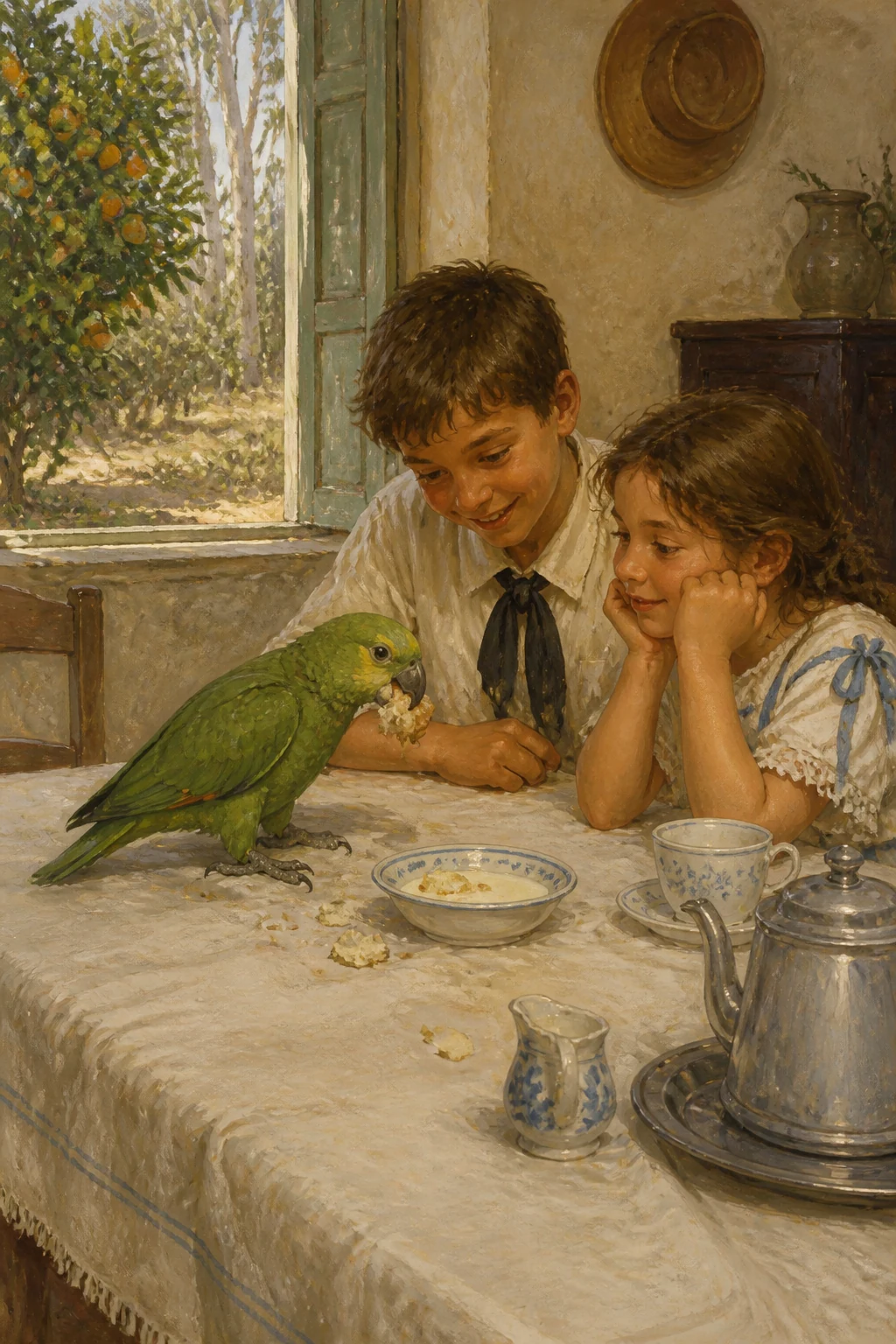
He lived at liberty and spent almost the whole day in the orange and eucalyptus trees in the garden. He also liked to tease the hens. At four or five in the afternoon, when the family had tea, the parrot would come into the dining room too, and climb up the tablecloth with his beak and feet to eat bread soaked in milk. He was mad about tea with milk.
Pedrito spent so much time with the children, and they said so many things to him, that he learned to talk. He would say, “Good morning, little parrot!...” “Yummy food!...” “Food for Pedrito!...” He said other things that cannot be repeated, for parrots, like children, learn bad words very easily.
When it rained, Pedrito would ruffle his feathers and tell himself all sorts of things in a very low voice. Then, when the weather cleared, he would fly about, shrieking like a mad thing.
As you can see, he was a very happy parrot, who, besides being free, as all birds wish to be, also had his “five o’clock tea,” just like rich people.
Now, in the midst of all this happiness, it happened that one rainy afternoon the sun finally came out after five days of storms, and Pedrito began flying about, shouting, “What a lovely day, little parrot!... Yummy food!... Shake hands, Pedrito!...” He flew far away, until he saw beneath him, far below, the Paraná River, which looked like a broad white ribbon in the distance. And he flew on and on, until at last he settled in a tree to rest.
And suddenly, through the branches, he saw two green lights shining on the ground, like enormous fireflies. “What could that be?” the parrot said to himself. “Yummy food!... What could that be?... Good morning, Pedrito!...”
The parrot always talked like this, as all parrots do, jumbling his words together without rhyme or reason, and sometimes it was hard to understand him. And because he was very curious, he climbed down from branch to branch to get closer. Then he saw that those two green lights were the eyes of a jaguar crouching there, staring at him.
But Pedrito was so pleased with the lovely day that he was not frightened at all. “Good morning, jaguar!” he said. “Shake hands, Pedrito!...” And the jaguar, in that terribly hoarse voice jaguars have, replied:
“Good morn-ing!” “Good morning, jaguar!” repeated the parrot. “Yummy food!... Yummy food!... Yummy food!...” He said “Yummy food!” so many times because it was already four in the afternoon, and he was longing for tea with milk. The parrot had forgotten that forest animals do not drink tea with milk, and so he invited the jaguar.
“Lovely tea with milk!” he said. “Good morning, Pedrito!... Would you like to have tea with milk with me, my friend?” But the jaguar grew furious because he thought the parrot was making fun of him; besides, he too was hungry and wanted to eat the talkative bird. So he answered:
“All right! Come a lit-tle clos-er. I’m deaf!” The jaguar was not deaf; he wanted Pedrito to come close enough for him to catch him with one swipe of his paw. But the parrot could think only of how delighted everyone at home would be when he arrived for tea with milk in the company of such a magnificent friend. And he flew to another branch nearer the ground.
“Yummy food at home!” he repeated, shouting as loudly as he could. “Clos-er! I can’t hear!” replied the jaguar in his hoarse voice. The parrot came a little closer and said:
“Lovely tea with milk!” “Clos-er still!” repeated the jaguar. The poor parrot came closer yet, and at that moment the jaguar made a tremendous leap, as high as a house, and caught Pedrito with the tips of his claws. He did not manage to kill him, but he tore all the feathers from his back and his entire tail. Not a single feather was left in his tail.
“Take that!” roared the jaguar. “Go and have your tea with milk...” Screaming with pain and fear, the parrot flew away. But he could not fly properly because he had lost his tail, which serves a bird as a rudder. He flew through the air, lurching from side to side, and every bird he met fled in alarm from such a strange creature.
At last he managed to get home, and the first thing he did was look at himself in the cook’s mirror. Poor Pedrito! He was the strangest, ugliest bird imaginable, all bare and tailless, and shivering with cold.
How could he show himself in the dining room looking like that? So he flew to a hollow in the trunk of a eucalyptus tree, which was like a little cave, and hid deep inside, trembling with cold and shame.
Meanwhile, everyone in the dining room was wondering where he was. “Where can Pedrito be?” they said. And they called, “Pedrito! Yummy food, Pedrito! Tea with milk, Pedrito!”
But Pedrito did not stir from his hollow or answer a word. He stayed silent and still. They looked everywhere for him, but the parrot did not appear. Then they all thought that Pedrito had died, and the children burst into tears.
Every afternoon at teatime they remembered the parrot, and how much he had loved eating bread soaked in tea with milk. Poor Pedrito! They would never see him again, because he was dead.
But Pedrito was not dead. He was still in his hollow, keeping out of everyone’s sight, because he was terribly ashamed to find himself as bare as a mouse. At night he came down to eat and went straight back up again. At dawn he slipped down once more and went to look at himself in the cook’s mirror, always very sad because his feathers were taking so long to grow.
Until at last one day, or rather one afternoon, the family was sitting at the table having tea when they saw Pedrito come in quite calmly, swaying from side to side as though nothing had happened. They were beside themselves with joy to see him alive and well, with such beautiful feathers.
“Pedrito, little parrot!” they said. “What happened to you, Pedrito? What shiny feathers our little parrot has!” But they did not know these were new feathers, and Pedrito, looking very solemn, did not say a word either. He did nothing but eat bread soaked in tea with milk. As for talking—not a single word.
So the master of the house was very surprised the following morning when the parrot flew onto his shoulder, chattering like mad. In two minutes he told him everything that had happened: his trip to Paraguay, his encounter with the jaguar, and all the rest. And he ended each part of the story by chanting, “Not a feather in Pedrito’s tail! Not a feather! Not a feather!”
Then he invited the man to go and hunt the jaguar with him. The master of the house, who was just then on his way to buy a jaguar skin to put in front of the stove, was delighted at the chance to get one for nothing. Going back into the house for his shotgun, he set off for Paraguay with Pedrito. They agreed that when Pedrito saw the jaguar, he would distract him with his chatter so that the man could creep up quietly with the gun.
And that was just what happened. The parrot perched on a branch of the tree and chattered and chattered, looking in every direction all the while to see whether he could spot the jaguar. At last he heard branches snapping, and suddenly saw two green lights beneath the tree, fixed on him: they were the jaguar’s eyes.
Then the parrot began to shout, “Lovely day!... Yummy food!... Lovely tea with milk!... Would you like tea with milk?...” The jaguar was furious to recognize the plucked parrot he thought he had killed, now covered once more in beautiful feathers. He swore that this time the bird would not escape, and his eyes flashed with rage as he answered in his hoarse voice:
“Come clos-er! I’m deaf!” The parrot flew to a nearer branch, still chattering. “Lovely bread and milk!... HE’S AT THE FOOT OF THIS TREE!...”
At these last words, the jaguar let out a roar and sprang to his feet. “Who are you talking to?” he bellowed. “Who did you tell I was at the foot of this tree?”
“Nobody, nobody!” cried the parrot. “Good morning, Pedrito!... Shake hands, little parrot!” And he went on chattering and hopping from branch to branch, drawing closer. But he had said, “He’s at the foot of the tree,” to alert the man, who was creeping nearer, crouching low, with the shotgun at his shoulder.
At last the parrot could come no closer without falling into the jaguar’s mouth, and then he cried, “Yummy food!... GET READY!” “Clos-er still!” roared the jaguar, crouching to spring.
“Lovely tea with milk!... LOOK OUT, HE’S GOING TO JUMP!” And the jaguar did indeed jump. He made an enormous leap, which the parrot dodged by shooting into the air like an arrow. But at that very instant the man, who had rested the barrel of his shotgun against a tree trunk to steady his aim, pulled the trigger, and nine pellets, each the size of a chickpea, shot like lightning into the jaguar’s heart. With a roar that made the whole forest tremble, he fell dead.
And the parrot—what cries of joy he gave! He was wild with delight, for he had taken revenge—and a fine revenge it was!—on the hideous beast that had torn out his feathers.
The man was very pleased too, because killing a jaguar is no easy matter, and now he had a skin for the stove in the dining room. When they got home, everyone learned why Pedrito had spent so long hidden in the hollow tree, and they all congratulated him on his brave deed.
They lived very happily from then on. But the parrot never forgot what the jaguar had done to him, and every afternoon, when he came into the dining room for tea, he would go up to the jaguar skin spread out in front of the stove and invite him to have tea with milk.
“Yummy food!...” he would say. “Would you like tea with milk?... Food for the jaguar!...” And everyone would burst out laughing. And so would Pedrito.
Izvirnik
003 El loro pelado
Naslednje strani prikazujejo izvirno besedilo za primerjavo.
H abía una vez una bandada de loros que vivían en el monte. De mañana, temprano iban a comer choclos a la chacra, y de tarde comían naranjas. Hacían gran barullo con sus gritos, y tenían siempre un loro de centinela en los árboles más altos, para ver si venía alguien.
Los loros son tan dañinos como la langosta, porque abren los choclos para picotearlos, los cuales después se pudren con la lluvia. Y como al mismo tiempo los loros son ricos para comer guisados, los peones los cazaban a tiros.
Un día, un hombre bajó de un tiro a un loro centinela, el que cayó herido y peleó un buen rato antes de dejarse agarrar. El peón lo llevó a la casa, para los hijos del patrón, y los chicos lo curaron, porque no tenía más que una ala rota. El loro se curó nuy bien, y se amansó completamente. Se llamaba Pedrito. Aprendió a dar la pata; le gustaba estar en el hombro de las personas y con el pico les hacía cosquillas en la oreja.
Vivía suelto, y pasaba casi todo el día en los naranjos y eucaliptos del jardín. Le gustaba también burlarse de las gallinas. A las cuatro o cinco de la tarde, que era la hora en que tomaban el té en la casa, el loro entraba también en el comedor, y se subía con el pico y las patas por el mantel, a comer pan mojado en leche. Tenía locura por el té con leche.
Tanto se daba Pedrito con los chicos, y tantas cosas le decían las criaturas, que el loro aprendió a hablar. Decía: “¡buen día, lorito!...” “¡rica, la papa!...” “papa para Pedrito!...” Decía otras cosas más que no se pueden decir, porque los loros, como los chicos, aprenden con gran facilidad malas palabras.
Cuando llovía, Pedrito se encrespaba y se contaba a sí mismo una porción de cosas, muy bajito. Cuando el tiempo se componía, volaba entonces, gritando como un loco.
Era, como se ve, un loro bien feliz, que además de ser libre, como lo desean todos los pájaros, tenía también, como las personas ricas, su "five o clock tea".
Ahora bien, en medio de esta felicidad, sucedió que una tarde de lluvia salió por fin el sol después de cinco días de temporal, y Pedrito se puso a volar gritando: "Qué lindo día, lorito!... rica, papa!... ¡la pata, Pedrito!..." Y volaba lejos, hasta que vió debajo de él, muy abajo, el río Paraná, que parecía una lejana y ancha cinta blanca. Y siguió, siguió volando, hasta que se asentó por fin en un árbol a descansar.
Y he aquí que de pronto vió brillar en el suelo, a través de las ramas, dos luces verdes, como enormes bichos de luz.
¿Qué será? — se dijo el loro. — "Rica papa!..." ¿qué será eso?... "¡buen día, Pedrito!..."
El loro hablaba siempre así, como todos los loros, mezclando las palabras sin ton ni son, y a veces costaba entenderlo. Y como era muy curioso, fué bajando de rama en rama, hasta acercarse. Entonces vió que aquellas dos luces verdes eran los ojos de un tigre que estaba agachado, mirándolo fijamente.
Pero Pedrito estaba tan contento con el lindo día, que no tuvo ningún miedo.
—Buen día, tigre! — le dijo. — "La pata, Pedrito!..."
Y el tigre, con esa voz terriblemente ronca que tiene, le respondió:
— ¡Bu-en dí-a!
—¡Buen día, tigre!—repitió el loro. — "Rica, papa!... ¡rica, papa!... rica, papa!..."
Y decía tantas veces "rica, papa!" porque ya eran las cuatro de la tarde, y tenía muchas ganas de tomar té con leche. El loro se había olvidado de que los bichos del monte no toman té con leche, y por esto lo convidó al tigre.
—Rico, té con leche! — le dijo. — "¡Buen día, Pedrito!..." ¿Querés tomar té con leche conmigo, amigo tigre?
Pero el tigre se puso furioso porque creyó que el loro se reía de él; y además, como tenía a su vez hambre, se quiso comer al pájaro hablador. Así es que le contestó:
— ¡Bue-no! ¡Acercá-te un po-co, que soy sor-do!
El tigre no era sordo; lo que quería era que Pedrito se acercara mucho para agarrarlo de un zarpazo. Pero el loro no pensaba sino en el gusto que tendrían en la casa cuando él se presentara a tomar té con leche con aquel magnífico amigo. Y voló hasta otra rama más cerea del suelo.
—¡Rica, papa, en casa! — repitió, gritando cuanto podía.
— ¡Más cer-ca! ¡No oi-go! — respondió el tigre con su ronca voz.
El loro se acercó un poco más, y dijo:
—¡Rico, té con leche!
— ¡Más cer-ca toda-vía! —repitió el tigre.
El pobre loro se acercó aún más, y en ese momento el tigre dió un terrible salto, tan alto como una casa, y alcanzó con la punta de las uñas a Pedrito. No alcanzó a matarlo, pero le arrancó todas las plumas del lomo, y la cola entera. No le quedó una sola pluma en la cola.
— ¡Tomá! — rugió el tigre — Andá a tomar té con leche ...
El loro, gritando de dolor y de miedo, se fué volando. Pero no podía volar bien, porque le faltaba la cola, que es como el timón de los pájaros. Volaba cayéndose en el aire de un lado para otro, y todos los pájaros que lo encontraban, se alejaban asustados de aquel bicho raro.
Por fin pudo llegar a la casa, y lo primero que hizo fué mirarse en el espejo de la cocinera. ¡Pobre Pedrito! Era el pájaro más raro y más feo que puede darse, todo pelado, todo rabón, y temblando de frío.
Cómo iba a presentarse en el comedor, con esa figura? Voló entonces hasta el hue co que había en el tronco de un eucalipto y que era como una cueva, y se escondió en el fondo, tiritando de frío y de vergüenza.
Pero entretanto, en el comedor todos extrañaban su ausencia.
—¿Dónde estará Pedrito ? — decían. Y llamaban: — ¡Pedrito! ¡Rica papa, Pedrito! ¡Té con leche, Pedrito!
Pero Pedrito no se movía de su cueva, ni respondía nada, mudo y quieto. Lo buscaron por todas partes, pero el loro no apareció. Todos creyeron entonces que Pedrito había muerto, y los chicos se echaron a llorar.
Todas las tardes, a la hora del té, se acordaban siempre del loro, y recordaban también cuánto le gustaba comer pan mojado en té con leclhe. ¡Pobre Pedrito! Nunca más lo verían porque había muerto.
Pero Pedrito no había muerto, sino que continuaba en su cueva sin dejarse ver por nadie, porque sentía mucha vergüenza de verse pelado como un ratón. De noche bajaba a comer, y subía en seguida. De ma drugada descendía de nuevo, muy ligero, e iba a mirarse en el espejo de la cocinera, siempre muy triste porque las plumas tardaban nucho en crecer.
Hasta que por fin un día, o una tarde, la familia, sentada a la mesa a la hora del té, vió entrar a Pedrito muy tranquilo, balanceándose, como si nada hubiera pasado. Todos se querían morir de gusto cuando lo vieron, bien vivo y con lindísimas plumas.
—Pedrito, lorito! — le decían — ¡Qué te pasó, Pedrito! ¡Qué plumas brillantes que tiene el lorito! Pero no sabían que eran plumas nuevas, y Pedrito, muy serio, no decía tampoco una palabra. No haeía sino comer pan mojado en té con leche. Pero lo que es hablar, ni las sola palabra.
Por esto, el dueño de casa se sorprendió mucho cuando a la mañana siguiente el loro fué volando a pararse en su hombro, charlando como un loco. En dos minutos le contó lo que le había pasado: su paseo al Paraguay, su encuentro con el tigre, y lo demás; y concluía cada cuento, cantando: —¡Ni una pluma en la cola de Pedrito! ¡Ni una pluma! ¡ni una pluma!
Y lo invitó a ir a cazar al tigre entre los dos.
El dueño de casa, que precisamente iba en ese momento a comprar una piel de tigre que le hacía falta para la estufa, quedó muy contento de poderla tener gratis. Y volviendo a entrar en la casa para tomar la escopeta, emprendió junto con Pedrito el viaje al Paraguay. Convinieron cuando Pedrito viera al tigre lo distraería charlando, para que el hombre pudiera acercarse despacito con la escopeta.
Y así pasó. El loro, sentado en una rama del árbol, charlaba y charlaba, mirando al mismo tiempo a todos lados, para ver si veía al tigre. Por fin sintió un ruido de ramas partidas, y vió de repente debajo del árbol dos luces verdes fijas en él: eran los ojos del tigre.
Entonces el loro se puso a gritar:
—¡Lindo día!... ¡rica, papa!... ¡rico té con leche!... ¿querés té con leche?...
El tigre, enojadísimo al reconocer en que a aquel loro pelado que él creía haber muerto, y que tenía otra vez lindísimas plumas, juró que esa vez no se le escaparía, y de sus ojos brotaron dos rayos de ira cuando respondió con su voz ronca:
— ¡Acer-cá-te más! ¡Soy sor-do!
El loro voló a otra rama más próxima, siempre charlando:
—¡Rico, pan con leche!... ESTA AL PIE DE ESTE ARBOL!...
Al oir estas últimas palabras, el tigre lanzó un rugido y se levantó de un salto.
— ¿Con quién estás hablando? — bramó.
¿A quién le has dicho que estoy al pie de este árbol?
—¡A nadie, a nadie! — gritó el loro. — Buen día, Pedrito!... ¡La pata, lorito!
Y seguía charlando y saltando de rama en rama, y acercándose. Pero él había dicho: Está al pie del árbol para avisarle al hombre, que se iba arrimando bien agachado y con la escopeta al hombro.
Y llegó un momento en que el loro no pudo acercarse más, porque sino caía en la boca del tigre, y entonces gritó:
—Rica, papa!... ATENCION!
— ¡Más cer-ca áún! — rugió el tigre, agachándose para saltar.
—Rico, té con leche!... CUIDADO, VA A SALTAR!
Y el tigre saltó, en efecto. Dió un enorme salto, que el loro evitó lanzándose al mismo tiempo como una flecha al aire. Pero también en ese mismo instante el hombre, que tenía el cañón de la escopeta recostado contra un tronco para hacer bien la puntería, apretó el gatillo, y nueve balines del tamaño de un garbanzo cada uno, entraron como un rayo en el corazón del tigre, que lanzando un bramido que hizo temblar el monte entero, cayó muerto.
Pero el loro, ¡qué gritos de alegría daba! Estaba loco de contento, porque se había vengado — ¡y bien vengado! — del feísimo animal que le había sacado las plumas.
El hombre estaba también muy contento, porque matar a un tigre es cosa difícil, y además tenía la piel para la estufa del comedor.
Cuando llegaron a la casa, todos supie ron por qué Pedrito había estado tanto tiempo oculto en el hueco del árbol, y todos lo felicitaron por la hazaña que había hecho.
Vivieron en adelante muy contentos. Pero el loro no se olvidaba de lo que le había hecho el tigre, y todas las tardes, cuando entraba en el comedor para tomar el té, se acercaba siempre a la piel del tigre, tendida delante de la estufa, y lo invitaba a tomar té con leche.
—Rica, papa!... — le decía. — ¿Querés té con leche?... ¡La papa para el tigre!...
Y todos se morían de risa. Y Pedrito también.
Nadaljuj z branjem