Prevod
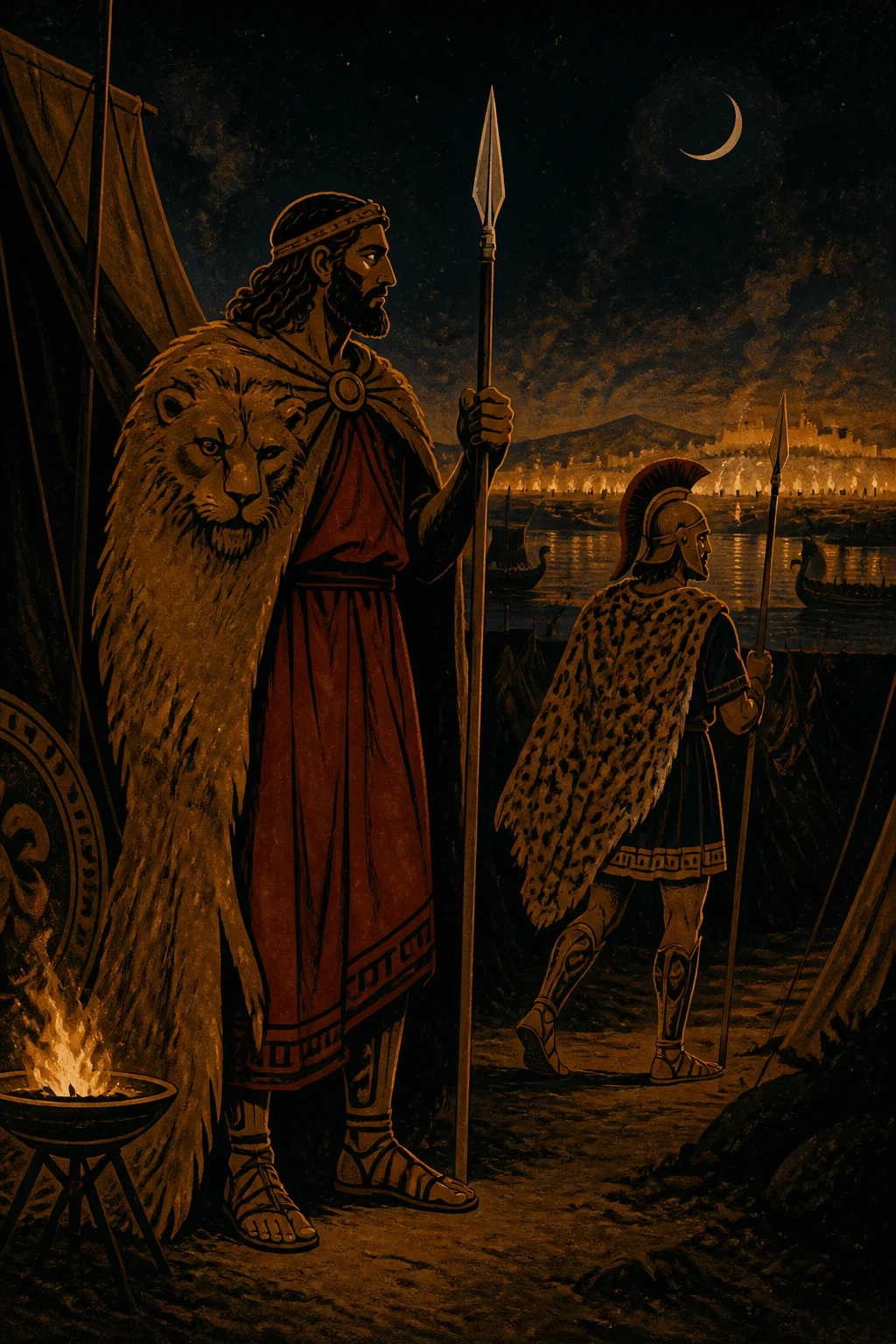
So the Trojans kept their watch. But a panic beyond all measure, the companion of chilling fear, gripped the Achaeans, and all their best men were stricken with unbearable grief. As two winds, the North Wind and the West, sweep down suddenly from Thrace and churn the teeming sea, and the dark waves rear together, casting heaps of seaweed along the shore, so the hearts within the Achaeans’ breasts were torn.
The son of Atreus, his heart struck by great sorrow, went about ordering the clear-voiced heralds to summon each man by name to the assembly, without shouting; and he himself toiled among the foremost.
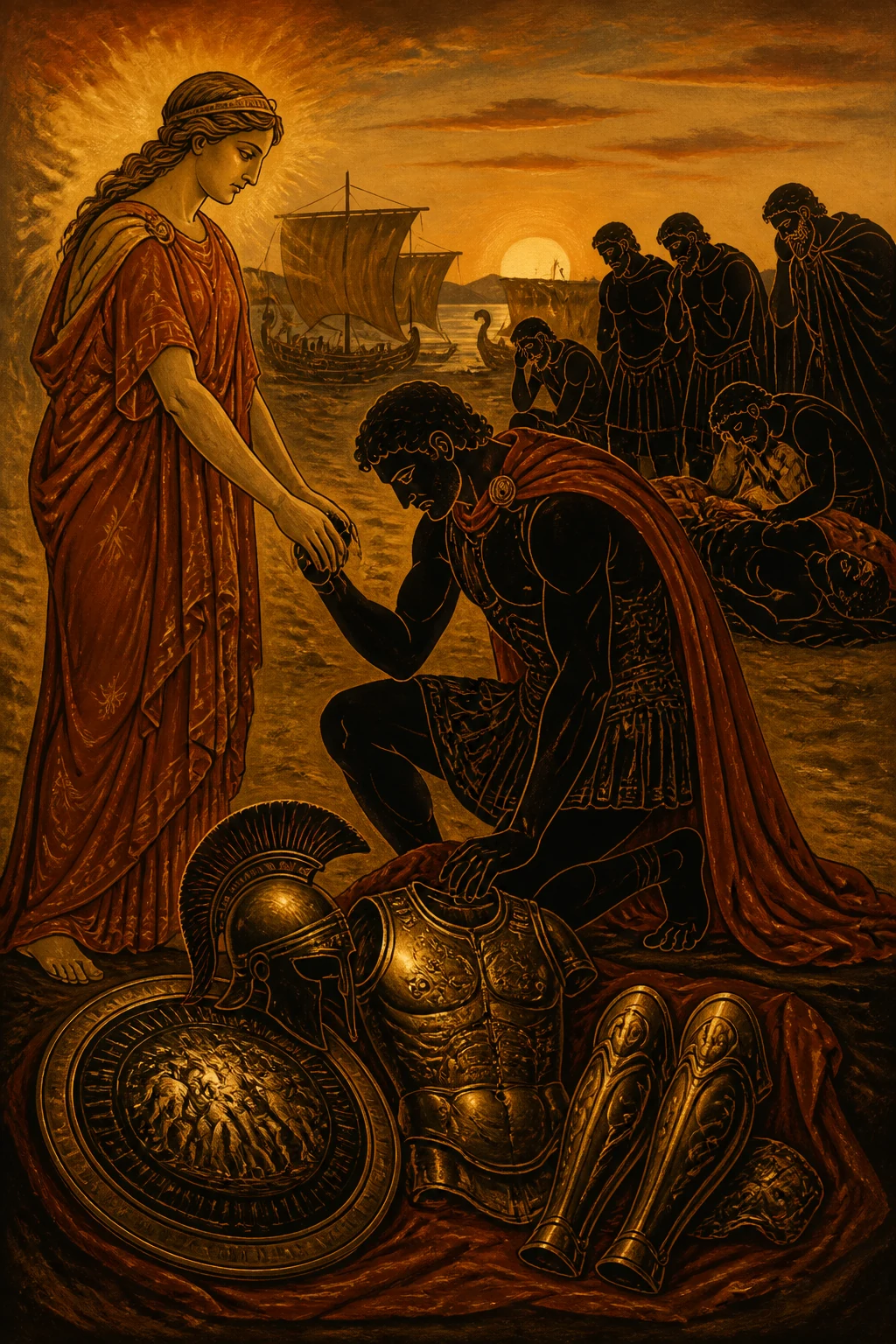
They sat in the assembly, weighed down with grief. Agamemnon rose, shedding tears like a spring of dark water that pours its shadowy stream down a sheer rock. With a deep groan he addressed the Argives: “Friends, leaders and rulers of the Argives, Zeus, the son of Cronus, has bound me fast in grievous delusion. Cruel god! Once he promised me, and bowed his head in pledge, that I should sack well-walled Ilium and return home. Now he has devised a wicked deception and commands me to go back to Argos in disgrace, after losing so many men.
“Such, it seems, must be the pleasure of almighty Zeus, who has brought down the towers of many cities and will bring down more, for his power is greatest of all. Come, then, let us all do as I say: let us flee with our ships to our own dear native land. We shall never now take Troy with its broad streets.”
So he spoke, and they all fell silent. For a long while the sons of the Achaeans sat speechless in their sorrow. At last Diomedes, master of the war cry, spoke among them: “Son of Atreus, I will be the first to challenge your folly, as is my right, my lord, in the assembly. Do not be angry.
“You were the first to reproach my courage before the Danaans, calling me unwarlike and a coward. All the Argives, young and old alike, know this. But the son of crooked-counselled Cronus has given you a divided gift: with the sceptre he granted you honour above all others, but courage he did not give you, and courage is the greatest strength.
“Strange man! Do you truly think the sons of the Achaeans are as unwarlike and cowardly as you say? If your own heart is set on going home, go. The way lies open before you, and your ships stand near the sea, the many ships that followed you from Mycenae.
“But the other long-haired Achaeans will remain until we sack Troy. And if they too wish to flee, let them sail away to their dear native land. Sthenelus and I will fight on, we two alone, until we bring Ilium to its end. For it was with a god’s blessing that we came.”
So he spoke, and all the sons of the Achaeans shouted their approval, admiring the words of Diomedes, tamer of horses. Then the horseman Nestor rose and addressed them: “Son of Tydeus, you are mighty beyond others in battle, and in counsel you have proved the best of all your age.
“No Achaean will find fault with what you have said or speak against it. Yet you have not brought your speech to its conclusion. You are still young—you might be my youngest son—yet you speak wisely before the kings of the Argives, and all you have said is just.
“But come, let me, who can claim to be older than you, speak out and carry the matter through. No one will slight my words, not even lord Agamemnon. A man without clan, without law, without hearth is he who loves the horrors of strife among his own people.
“For now, let us yield to the dark night and make our supper ready. Let the sentries take their stations beside the dug trench, outside the wall. These are my orders to the young men. And you, son of Atreus, must take the lead, for you are the greatest king.
“Give a feast for the elders: it is fitting for you, and no dishonour. Your huts are full of wine, which the Achaeans’ ships bring daily from Thrace across the broad sea. You have all you need to entertain them, and many men are under your rule.
“When many are gathered, you will listen to whoever offers the best counsel. All the Achaeans sorely need sound and prudent counsel now, for the enemy are burning countless fires close to our ships. Who could rejoice at that?
“This night will either destroy our army or save it.” So he spoke, and they listened closely and obeyed. The sentries hurried out in their armour under Nestor’s son Thrasymedes, shepherd of the people, under Ascalaphus and Ialmenus, sons of Ares, under Meriones, Aphareus, and Deipyrus, and under noble Lycomedes, son of Creon.
There were seven captains of the watch, and with each went a hundred young men carrying long spears. They took their places between the trench and the wall, lit fires there, and each prepared his supper.
The son of Atreus led the Achaean elders together into his hut and set before them a feast to satisfy their hearts. They reached for the good food laid ready before them. When they had put aside their desire for food and drink, old Nestor was the first to begin weaving a plan—Nestor, whose counsel had proved best before. With their welfare at heart, he addressed them: “Most glorious son of Atreus, Agamemnon, lord of men, with you I shall end, and with you I shall begin, for you are lord over many peoples, and Zeus has entrusted you with the sceptre and the laws, that you may take counsel for them.
“So it is your duty above all to speak and to listen, and to carry out another man’s advice when his heart prompts him to speak for our good. Whatever course is taken, its execution rests with you. Now I shall say what seems best to me.
“No one will devise a better plan than the one I have held in mind for a long time and still hold now, ever since the day, Zeus-born king, when you went and took the girl Briseis from angry Achilles’ hut. That was against my advice: I urged you again and again not to do it. But you yielded to your proud heart and dishonoured the mightiest of men, one whom even the immortals honoured. You took his prize and hold it still. Yet even now let us consider how we may make amends and win him over with gracious gifts and gentle words.”
Then Agamemnon, lord of men, answered him: “Old man, you have spoken no falsehood in recounting my blindness. I was deluded; I do not deny it. A man whom Zeus loves in his heart is worth a whole army, and now he has honoured this man and brought the Achaean people low.
“But since I was deluded and yielded to my own wretched thoughts, I am willing to make amends and offer boundless recompense. Before you all I shall name my splendid gifts: seven tripods untouched by fire, ten talents of gold, twenty gleaming cauldrons, and twelve strong horses, prizewinners who have won honours with their speed.
“No man would lack possessions or precious gold if he owned as much as my single-hoofed horses have won for me in prizes. And I will give him seven women skilled in faultless handiwork, women of Lesbos whom I chose for myself when he captured that well-built island, women whose beauty surpassed all others.
“These I will give him, and with them shall go the woman I took from him then, the daughter of Briseus. And I will swear a mighty oath that I have never entered her bed or lain with her, as is the way of men and women.
“All these things shall be his at once. And if the gods grant us leave to sack the great city of Priam, let him come when we Achaeans divide the spoil and load his ship deep with gold and bronze. Let him choose for himself twenty Trojan women, the fairest after Argive Helen.
“And if we reach Achaean Argos, that rich breast of the earth, he may become my son-in-law. I will honour him as I honour Orestes, my dearly cherished son, who is growing up amid every abundance. I have three daughters in my well-built palace, Chrysothemis, Laodice, and Iphianassa. Whichever he wishes, let him take her, without a bride-price, to the house of Peleus. And I will give her such marriage gifts as no man has ever yet bestowed upon his daughter. I will give him seven well-peopled cities: Cardamyle, Enope, grassy Hire, sacred Pherae, Antheia with its deep meadows, lovely Aepeia, and vine-rich Pedasus.
“All lie near the sea, on the borders of sandy Pylos. Men live there rich in sheep and cattle, who will honour him like a god with gifts and pay generous tribute beneath his sceptre.
“All this I would do for him if he gave up his anger. Let him yield. Hades alone is pitiless and unyielding, and for that reason mortals hate him more than all the gods. Let Achilles give way to me, for I am the greater king, and I can claim to be his elder in years.”
Then Nestor, the horseman of Gerenia, answered him: “Most glorious son of Atreus, Agamemnon, lord of men, the gifts you offer lord Achilles are beyond reproach. Come, let us choose men and send them quickly to the hut of Achilles, son of Peleus.
“Let me name those I would choose, and let them obey. First let Phoenix, dear to Zeus, lead the way; then great Ajax and noble Odysseus. Of the heralds, let Odius and Eurybates go with them.
“Bring water for our hands, and call for holy silence, so that we may pray to Zeus, the son of Cronus, and ask him to have mercy.” So he spoke, and his words pleased them all. At once the heralds poured water over their hands, and the young men filled the mixing bowls to the brim with wine and served it to everyone, pouring the first drops into the cups for the libation.
When they had poured their offerings and drunk as much as their hearts desired, they set out from the hut of Agamemnon, son of Atreus. Nestor, the horseman of Gerenia, gave them many instructions, looking intently at each in turn, especially Odysseus, and urging them to try to win over the peerless son of Peleus.
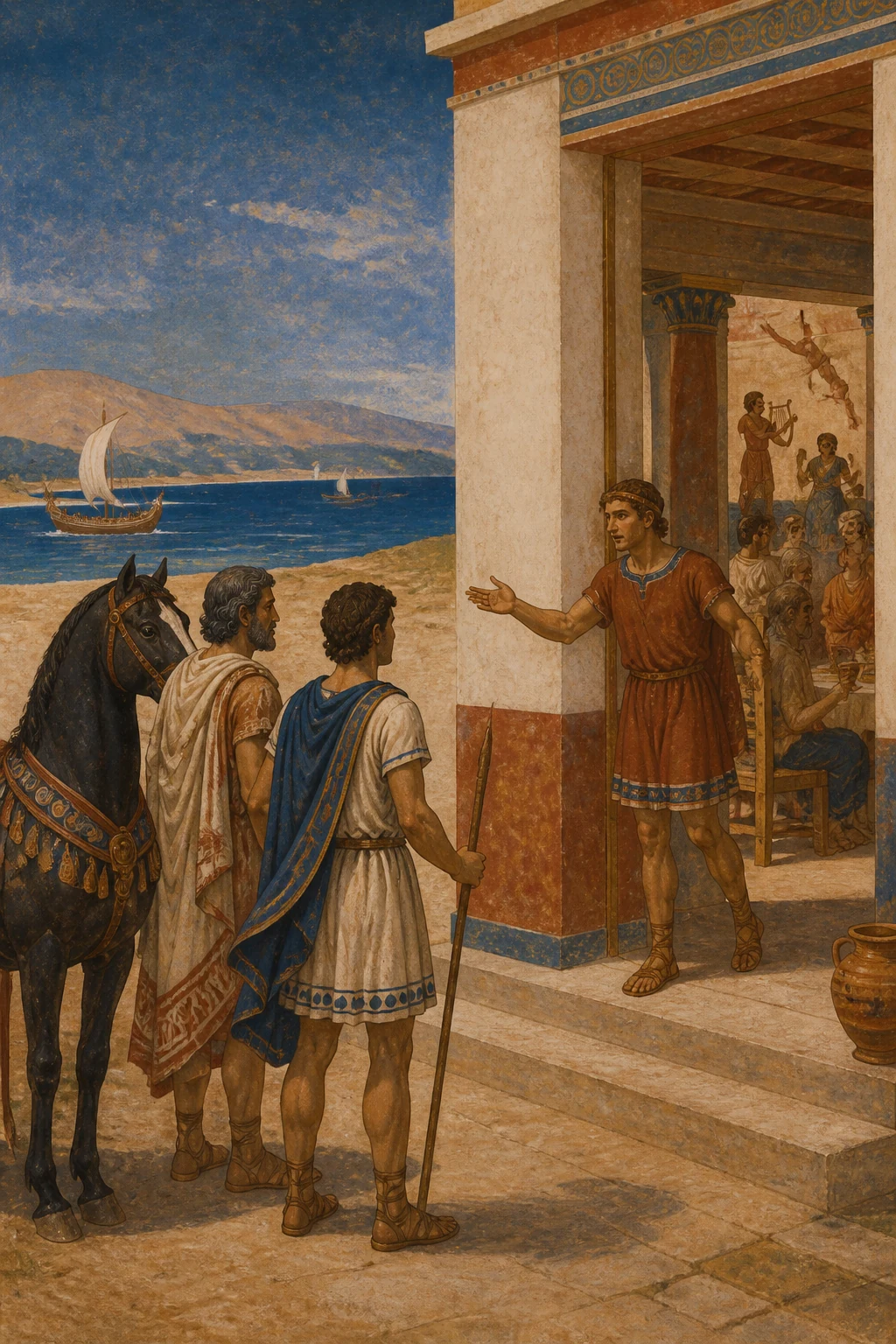
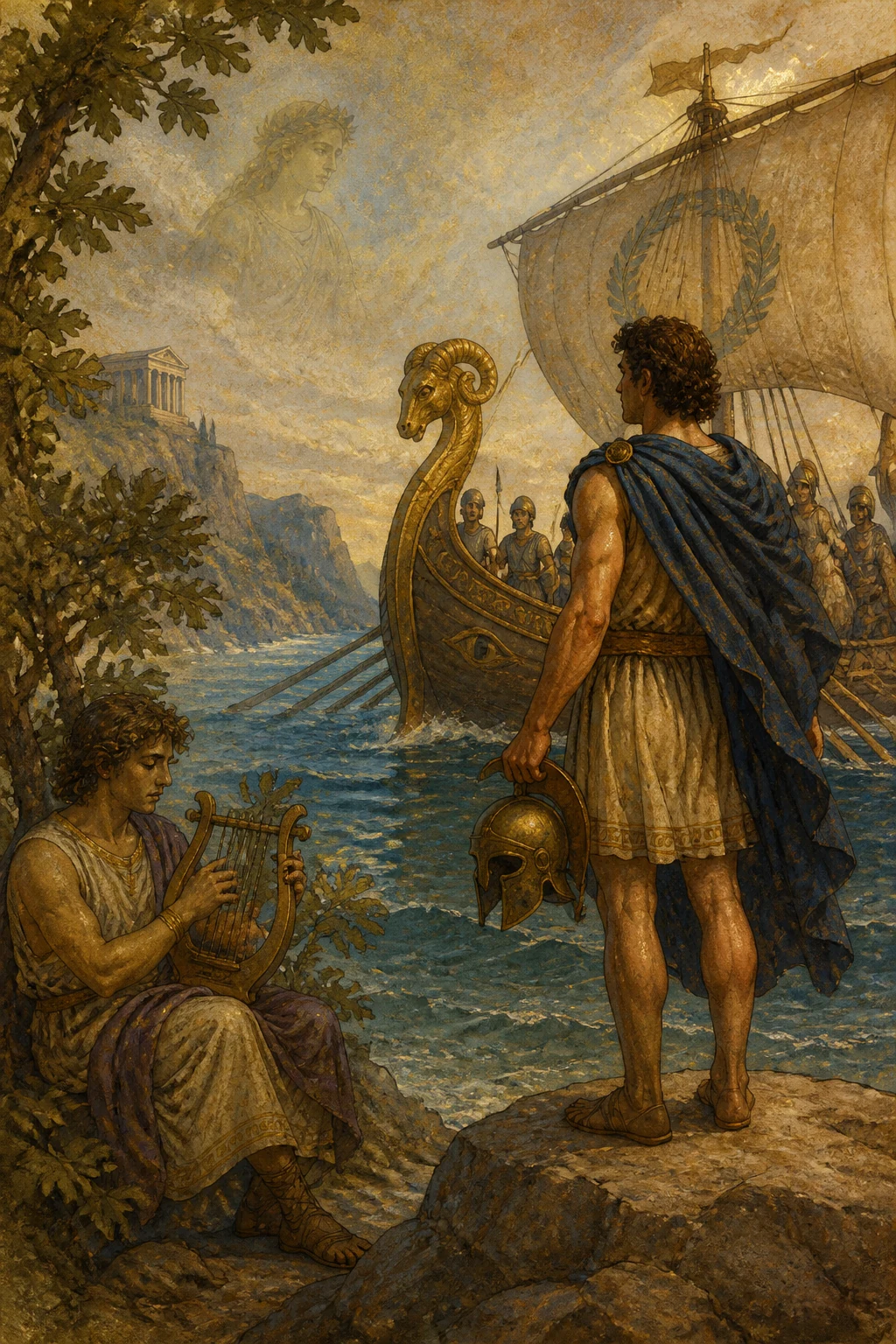
The two walked along the shore of the loud-roaring sea, praying earnestly to the earth-embracing Earth-shaker that they might easily persuade the great heart of Aeacus’ grandson. They reached the huts and ships of the Myrmidons and found him delighting his heart with a clear-toned lyre, beautiful and finely wrought, with a silver crossbar. He had taken it from the spoils when he destroyed the city of Eetion. With it he was delighting his heart and singing of the glorious deeds of men.
Patroclus sat alone opposite him in silence, waiting for Aeacus’ grandson to finish his song. The two came forward, noble Odysseus leading, and stood before him. Achilles sprang up in surprise, leaving his seat with the lyre still in his hands.
Patroclus too rose when he saw the men. In greeting, swift-footed Achilles said to them: “Welcome! Dear friends have come indeed. There must be great need. Angry though I am, you are the dearest of the Achaeans to me.”
With these words noble Achilles led them in and seated them on chairs spread with purple rugs. At once he spoke to Patroclus, who stood nearby: “Son of Menoetius, set out a larger mixing bowl, mix the wine stronger, and prepare a cup for each. These are my dearest friends beneath my roof.”
So he spoke, and Patroclus obeyed his dear companion. Achilles set a great chopping block in the firelight and laid on it the backs of a sheep and a fat goat, and the chine of a well-fed hog, rich with fat.
Automedon held the meat for him, and noble Achilles cut it. He sliced it carefully into pieces and threaded them on spits, while the son of Menoetius, a man like a god, kindled a great fire.
When the fire had burned down and the flame had faded, Achilles spread out the embers, stretched the spits above them, and, lifting them from their supports, sprinkled the meat with sacred salt. When he had roasted it and laid it on platters, Patroclus took bread and set it on the table in lovely baskets, while Achilles served the meat.
He himself sat against the opposite wall, facing noble Odysseus, and told his companion Patroclus to make an offering to the gods. Patroclus cast the portions into the fire, and they reached for the good food laid ready before them.
When they had put aside their desire for food and drink, Ajax nodded to Phoenix. Noble Odysseus noticed, filled his cup with wine, and raised it to Achilles: “Your health, Achilles! We have lacked no equal share of the feast, either in the hut of Agamemnon, son of Atreus, or here now, where there is abundance to satisfy our hearts. But the pleasures of feasting are not our concern. We see a terrible calamity before us, Zeus-nurtured prince, and we are afraid. It hangs in the balance whether we shall save our well-benched ships or lose them, unless you put on your strength.
“For the proud Trojans and their far-famed allies have made their camp close to the ships and the wall, lighting many fires throughout their army. They say they will no longer be held back, but will fall upon our black ships.
“And Zeus, the son of Cronus, flashes lightning on their right, showing them favourable signs. Hector, exulting in his strength, rages fearfully in his trust in Zeus. He respects neither men nor gods; a savage frenzy has entered him.
“He prays for holy Dawn to appear as quickly as she can. He threatens to hack the high sterns from our ships, burn the ships themselves with raging fire, and slaughter the Achaeans beside them as they stumble in confusion through the smoke.
“I dread in my heart that the gods will fulfil his threats, and that we are fated to perish here at Troy, far from horse-rearing Argos. Rise, then, if even now, at this late hour, you mean to save the sons of the Achaeans, worn down beneath the Trojans’ onslaught.
“You yourself will grieve hereafter, and once the evil is done there will be no remedy to be found. Consider well beforehand how you may ward off the day of ruin from the Danaans. Dear friend, surely your father Peleus gave you his charge on the day he sent you from Phthia to Agamemnon: ‘My child, Athena and Hera will give you strength if they choose. But you must curb your proud spirit within your breast. A friendly heart is better. Keep clear of strife that breeds mischief, so that the Argives, young and old alike, may honour you all the more.’
“Such was the old man’s charge, but you have forgotten it. Yet even now, relent and put aside the anger that eats your heart. Agamemnon offers you worthy gifts if you will give up your wrath. Listen to me, and I will recount all the gifts he promised you in his hut: seven tripods untouched by fire, ten talents of gold, twenty gleaming cauldrons, and twelve strong horses, prizewinners who have won honours with their speed.
“No man would lack possessions or precious gold if he owned as much as Agamemnon’s horses have won with their speed. And he will give you seven women skilled in faultless handiwork, women of Lesbos whom he chose for himself when you captured that well-built island, women whose beauty surpassed all others.
“These he will give you, and with them shall go the woman he took from you then, the daughter of Briseus. And he will swear a mighty oath that he has never entered her bed or lain with her, my lord, as is the way of men and women.
“All these things shall be yours at once. And if the gods grant us leave to sack the great city of Priam, you may come when we Achaeans divide the spoil and load your ship deep with gold and bronze. You may choose for yourself twenty Trojan women, the fairest after Argive Helen.
“And if we reach Achaean Argos, that rich breast of the earth, you may become his son-in-law. He will honour you as he honours Orestes, his dearly cherished son, who is growing up amid every abundance. He has three daughters in his well-built palace, Chrysothemis, Laodice, and Iphianassa. Whichever you wish, you may take her, without a bride-price, to the house of Peleus. And he will give her such marriage gifts as no man has ever yet bestowed upon his daughter. He will give you seven well-peopled cities: Cardamyle, Enope, grassy Hire, sacred Pherae, Antheia with its deep meadows, lovely Aepeia, and vine-rich Pedasus.
“All lie near the sea, on the borders of sandy Pylos. Men live there rich in sheep and cattle, who will honour you like a god with gifts and pay generous tribute beneath your sceptre.
“All this he would do for you if you gave up your anger. But if the son of Atreus himself and his gifts are all the more hateful to your heart, at least take pity on the other Achaeans, suffering throughout the camp. They will honour you like a god, for you could win tremendous glory in their eyes. Now you might kill Hector: in his deadly frenzy he would come close to you, for he declares there is no man his equal among all the Danaans whom the ships brought here.”
Then swift-footed Achilles answered him: “Zeus-born son of Laertes, resourceful Odysseus, I must speak my mind plainly and tell you how things will be, so that you do not sit beside me, one after another, and keep pressing me.
“For I hate like the gates of Hades the man who hides one thing in his heart and says another. I shall tell you what seems best to me. I do not think Agamemnon, son of Atreus, will persuade me, nor any other Danaan, since there is no gratitude for fighting on and on without rest against the enemy.
“The same fate awaits the man who hangs back and the man who fights with all his might. Coward and hero are held in equal honour; death comes alike to the man who does nothing and the man who does much. What have I gained from all the suffering in my heart, from forever staking my life in battle?
“As a bird brings every morsel she finds to her unfledged chicks, while she herself goes hungry, so I have passed many sleepless nights and spent bloody days in battle, fighting men for the sake of their wives.
“Twelve cities of men I sacked with my ships, and eleven more, I tell you, on foot in the rich land of Troy. From all of them I took treasures, many and fine, and brought them all to Agamemnon, son of Atreus. He stayed behind beside the swift ships, received them, handed out a little, and kept the greater part.
“He gave prizes to the other chiefs and kings, and they still hold them undisturbed. From me alone of all the Achaeans he took my prize, and he keeps the woman dear to my heart. Let him lie beside her and take his pleasure. But why must the Argives fight the Trojans? Why did the son of Atreus gather an army and bring it here? Was it not for fair-haired Helen?
“Are the sons of Atreus the only mortal men who love their wives? Every good and sensible man loves his own and cares for her. So I loved this woman with all my heart, though I had won her with my spear.
“But now that he has snatched my prize from my hands and cheated me, let him not try me again. I know him well, and he will not persuade me. No, Odysseus: let him devise with you and the other kings some way to keep the consuming fire from the ships.
“He has certainly laboured hard without me. He has built a wall and dug beside it a broad, deep trench, and planted stakes within. Yet even so he cannot hold back the might of man-slaying Hector. While I was fighting among the Achaeans, Hector would not venture far from his wall to give battle. He came only as far as the Scaean Gates and the oak tree. There once he stood against me alone, and barely escaped my onslaught.
“But now I have no wish to fight noble Hector. Tomorrow I shall offer sacrifice to Zeus and all the gods, load my ships well, and launch them on the sea. Then, if you wish and care to look, you will see my ships sailing at first light over the teeming Hellespont, and the men within them rowing eagerly. If the glorious Earth-shaker grants us a fair passage, on the third day I could reach fertile Phthia.
“I have many possessions there, which I left behind when I came here to my sorrow. And from here I shall take more gold and red bronze, fair-girdled women and grey iron—all that fell to my share. But the prize he gave me, lord Agamemnon, son of Atreus, has taken back in his arrogance. Tell him openly everything I command you to say, so that the other Achaeans too may resent him, if he still hopes to deceive any of the Danaans, forever cloaked in shamelessness. Dog though he is, he would not dare look me in the face. I will share neither counsel nor action with him. He has cheated me and wronged me, and never again will he beguile me with his words. Enough of him! Let him go to his ruin in peace, for Zeus the counsellor has robbed him of his wits.
“His gifts are hateful to me, and I value him no more than a hair. Not if he gave me ten or twenty times all he now possesses, and added more from elsewhere; not all the wealth that flows into Orchomenus, or into Egyptian Thebes, where the houses hold the greatest treasures—Thebes of the hundred gates, through each of which two hundred warriors pass with horses and chariots; not if he gave me gifts as countless as the sand and dust, would Agamemnon persuade my heart before he had paid in full for the outrage that has wounded me.
“And I will not marry a daughter of Agamemnon, son of Atreus—not if she rivalled golden Aphrodite in beauty and equalled grey-eyed Athena in handiwork. Even then I would not marry her. Let him choose another Achaean, one who suits him and is a greater king.
“For if the gods preserve me and I reach home, Peleus himself will surely find a wife for me. There are many Achaean girls throughout Hellas and Phthia, daughters of chiefs who guard their cities. Whichever I wish, I shall make her my beloved wife.
“Many a time my proud heart has yearned to marry a fitting bride there, a wife duly wooed, and enjoy the possessions old Peleus has acquired. For nothing is worth my life—not all the wealth they say the well-peopled city of Ilium held in former days of peace, before the sons of the Achaeans came; not all that the stone threshold of Phoebus Apollo, lord of the bow, encloses in rocky Pytho.
“Cattle and sturdy sheep can be taken as plunder; tripods and chestnut horses can be won. But a man’s life cannot be plundered or seized and brought back once it has passed the barrier of his teeth.
“My mother, the goddess Thetis of the silver feet, tells me that two fates carry me towards the end of death. If I stay here and fight around the Trojans’ city, my homecoming is lost, but my glory will never die. If I return home to my dear native land, my glorious fame is lost, but my life will be long, and the end of death will not soon overtake me.
“And I would urge the others too to sail for home, for you will never now see the end of lofty Ilium. Far-seeing Zeus has held his hand over her, and her people have taken courage.
“Go, then, and carry my answer to the Achaean chiefs, for that is the privilege of elders. Let them devise some other, better plan to save their ships and the Achaean people beside the hollow hulls. This plan they have devised will not serve them while my anger lasts. But let Phoenix stay here with us and sleep, so that tomorrow he may follow me in my ships to our dear native land, if he wishes. I will not take him by force.”
So he spoke, and they all fell silent, stunned by his words, so forcefully had he refused them. At last the old horseman Phoenix spoke, bursting into tears, for he feared greatly for the Achaean ships: “If you truly have set your heart on returning home, glorious Achilles, and have no wish at all to keep the consuming fire from the swift ships because anger has fallen upon your heart, how could I remain here alone, apart from you, dear child? It was for your sake that the old horseman Peleus sent me on the day he sent you from Phthia to Agamemnon, a mere boy, knowing nothing yet of war that spares no one, nor of the assemblies where men win distinction.
“That was why he sent me with you: to teach you all these things, to make you a speaker of words and a doer of deeds. And so I would never willingly be left behind without you, dear child—not even if a god himself promised to scrape away my age and make me young and strong again, as I was when first I left Hellas with its lovely women, fleeing the anger of my father Amyntor, son of Ormenus. He was enraged with me over his fair-haired concubine, whom he loved while dishonouring his wife, my mother. She was always clasping my knees and begging me to lie with the concubine, so that the woman would come to hate the old man.
“I obeyed her and did it. But my father found out at once and called down many curses, invoking the hateful Furies, praying that no dear son of mine should ever sit upon his knees. And the gods fulfilled his curses: Zeus of the underworld and dread Persephone.
“Then my heart could no longer bear to move about the halls with my father angry at me. My kinsmen and cousins gathered round, pleading earnestly and trying to keep me there. They slaughtered many sturdy sheep and shambling, curving-horned cattle; many hogs, plump with fat, were stretched over Hephaestus’ flame to singe, and much of the old man’s wine was drunk from his jars.
“For nine nights they slept around me, taking turns to keep watch. The fires never went out: one burned beneath the portico of the well-walled courtyard, another in the entrance hall before the doors of my chamber.
“But when the tenth dark night came upon me, I broke open the closely fitted doors of my chamber and went out. Easily I leapt over the courtyard wall, unseen by the watchmen and the serving women.
“Then I fled far away through the broad land of Hellas and came to fertile Phthia, mother of flocks, to lord Peleus. He welcomed me warmly and loved me as a father loves his only son, dearly cherished and heir to great possessions. He made me wealthy and gave me many people to rule. I lived on the borders of Phthia, reigning over the Dolopians.
“And it was I who made you what you are, Achilles, like the gods, loving you with all my heart. You would not go with anyone else to a feast or eat in the halls until I had set you on my knees, cut your meat, and fed you to your fill, holding the wine to your lips.
“Often you soaked the tunic on my breast, spluttering out the wine in your helpless infancy. So much I suffered for you, so much I toiled, knowing that the gods had granted me no child of my own. Instead I made you my son, godlike Achilles, so that one day you might defend me from a shameful fate.
“But Achilles, master your proud heart. You should not be pitiless. Even the gods can be moved, though their excellence and honour and strength are greater than ours. With sacrifices and humble prayers, with libations and the savour of burnt offerings, men turn them from their anger, entreating them whenever they have transgressed and done wrong.
“For Prayers are daughters of great Zeus, lame and wrinkled and with eyes turned aside. They follow after Ruin, tending to the harm she does. But Ruin is strong and swift of foot, and outruns them all by far, going before them over all the earth to injure men; and they come after to heal.
“Whoever reveres the daughters of Zeus when they draw near receives great help from them, and they hear his prayers. But if a man denies them and stubbornly refuses, they go to Zeus, the son of Cronus, and beg that Ruin may follow that man, so that he may be hurt and pay the price.
“Achilles, grant the daughters of Zeus the honour that sways the minds of other noble men. If the son of Atreus were bringing you no gifts and promising none to come, but remained fierce in his resentment, I would not urge you to cast aside your wrath and defend the Argives, great though their need might be. But now he offers much at once and promises more hereafter. He has sent men to entreat you, choosing the best in the Achaean army, the Argives who are dearest to you yourself. Do not dishonour their words or the journey they have made. Until now no one could blame you for your anger.
“So too have we heard of the glorious deeds of heroes long ago: when fierce anger came upon them, gifts could win them over and words persuade them. I remember a tale from long ago, not yesterday, and how it happened. I shall tell it here among you, all my friends.
“The Curetes and the Aetolians, steadfast in battle, fought around the city of Calydon and slaughtered one another. The Aetolians were defending lovely Calydon, while the Curetes were eager to sack it by force of arms.”
For Artemis of the golden throne had brought disaster upon them, angered because Oeneus had offered her no harvest sacrifice on the fertile slopes of his orchard. The other gods feasted on offerings of a hundred beasts, but to her alone, the daughter of mighty Zeus, he made no sacrifice.
Either he forgot or never thought of it: a grave blindness seized his heart. In her anger the arrow-showering goddess, daughter of Zeus, sent against him a savage, white-tusked boar from its lair. It ravaged Oeneus’ orchard, wreaking havoc everywhere, and hurled many tall trees to the ground, roots and all, with their fruit still in blossom.
Oeneus’ son Meleager killed it, gathering hunters and hounds from many cities; for a few men could never have mastered it, so huge it was, and many it sent to the grievous funeral pyre.
But over its head and shaggy hide Artemis stirred up a great din of battle between the Curetes and the high-hearted Aetolians. As long as Meleager, dear to Ares, fought among them, things went badly for the Curetes: numerous though they were, they could not hold their ground outside the walls. But when anger entered Meleager—anger that swells the heart even of other men whose minds are wise—he lay beside his wedded wife, lovely Cleopatra, nursing his fury against his dear mother Althaea. Cleopatra was the daughter of fair-ankled Marpessa, daughter of Euenus, and of Idas, the strongest man on earth in those days, who dared take up his bow against lord Phoebus Apollo for the sake of his fair-ankled bride. In their halls her father and honoured mother used to call Cleopatra Alcyone, because her mother, sharing the fate of the sorrowing halcyon, had wept when far-shooting Phoebus Apollo carried her away. Beside Cleopatra Meleager lay, brooding over his bitter anger, enraged by his mother’s curses. Grieving for her brother’s death, she had prayed long to the gods and beaten the all-nourishing earth with her hands, calling on Hades and dread Persephone. On her knees she crouched, her breast wet with tears, begging them to grant her son death; and from Erebus the Fury who walks in darkness heard her, with her pitiless heart.
Soon the clamour and crash of battle rose about the gates as the towers came under attack. The elders of the Aetolians pleaded with Meleager and sent the foremost priests of the gods to beg him to come out and defend them, promising a great reward. Where the plain of lovely Calydon was richest, they urged him to choose a splendid estate of fifty ploughlands, half of it vineyard and half open land for tillage.
Old Oeneus the charioteer pleaded with him again and again, standing on the threshold of his high-roofed chamber, shaking the close-fitted doors and imploring his son. His sisters and his honoured mother begged him earnestly, but he refused all the more. So did his companions, the dearest and most devoted of all his friends; yet even they could not move the heart within his breast—not until his chamber itself was battered hard, and the Curetes were mounting the towers and setting the great city ablaze.
Then at last his graceful wife pleaded with Meleager through her tears, recounting all the miseries that fall upon people whose city is taken: the men are slaughtered, fire lays the city waste, and strangers carry off the children and the deep-girdled women.
His heart was stirred as he listened to those horrors. He rose to go and put his gleaming armour on. Thus, yielding to his heart, he warded off the day of doom from the Aetolians; but they no longer paid him those many splendid gifts. He saved them from destruction all the same.
But do not harbour such thoughts yourself, my friend, and may no god turn you down that path. It would be worse to come to the rescue when the ships are burning. Come while gifts are offered: the Achaeans will honour you like a god.
If you enter the man-destroying battle without gifts, you will no longer win the same honour, even though you drive the fighting back.” Swift-footed Achilles answered him: “Phoenix, dear old father, cherished by Zeus, I have no need of such honour. I believe I am honoured by the decree of Zeus, which will keep me here beside the curved ships as long as breath remains in my breast and my knees have strength to move.
“And I will tell you something else: take it to heart. Do not trouble my spirit with tears and grief, seeking to please the warrior son of Atreus. You should not love him, lest you earn the hatred of one who loves you.
“It is right that you should stand with me against the man who brings me grief. Rule equally with me and share half my honour. These men will carry back my answer; you stay here and lie down in a soft bed. When dawn appears, we will consider whether to sail home or remain.”
He spoke, and with a silent movement of his brows signalled Patroclus to prepare a comfortable bed for Phoenix, so that the others would think of leaving the hut without delay. Then godlike Ajax, son of Telamon, spoke among them: “Son of Laertes, sprung from Zeus, resourceful Odysseus, let us go. I do not think this journey will achieve its purpose. We must report his answer to the Danaans at once, unwelcome though it is; they are sitting there now, waiting for us. But Achilles has made his proud heart savage within his breast—cruel man! He cares nothing for his companions’ friendship, with which we honoured him above all others beside the ships. Pitiless! A man will accept compensation even from the killer of his brother or his dead son. The killer remains in his own country after paying a great price, and the other man’s heart and proud spirit are restrained once he has accepted payment. But the gods have put an implacable, bitter heart within you, all for the sake of a single girl. Now we offer you seven, the finest there are, and many other gifts besides. Soften your heart and respect the hospitality of your own roof. We are here beneath it, chosen from the whole Danaan host, and we long to be your closest and dearest friends of all the Achaeans.”
Swift-footed Achilles answered him: “Ajax, son of Telamon, sprung from Zeus, leader of the people, all you have said seems true to my heart. But my heart swells with anger whenever I remember how the son of Atreus disgraced me among the Argives, as though I were some foreigner without honour.
“Go now and report my answer. I will take no thought for bloody war until glorious Hector, wise Priam’s son, comes slaughtering Argives as far as the Myrmidons’ huts and ships, and burns the ships with fire.
“But when he reaches my own hut and my black ship, I think Hector will be checked, eager for battle though he is.” So he spoke. Each man took up his two-handled cup, poured a libation, and went back along the ships, with Odysseus leading.
Patroclus told his companions and the serving women to prepare a comfortable bed for Phoenix as quickly as they could. The women obeyed and spread it as he had ordered, with sheepskins, a coverlet, and fine, soft linen.
There the old man lay down and waited for holy Dawn. Achilles slept in the inner part of his well-built hut, and beside him lay a woman he had brought from Lesbos, fair-cheeked Diomede, daughter of Phorbas.
Patroclus lay down on the other side, and beside him was graceful Iphis, whom noble Achilles had given him when he captured steep Scyros, the city of Enyeus. Meanwhile, when the envoys reached the hut of the son of Atreus,
the sons of the Achaeans rose from their places to greet them with golden cups and question them. Agamemnon, lord of men, was first to ask: “Come, tell me, much-praised Odysseus, great glory of the Achaeans: is he willing to keep the destructive fire from the ships, or has he refused, with anger still holding his proud heart?”
Then much-enduring, noble Odysseus answered: “Most glorious son of Atreus, Agamemnon, lord of men, he will not quench his anger. Instead, he is filled with still greater fury, and rejects both you and your gifts.
“He tells you to take counsel yourself among the Argives on how to save the ships and the Achaean army. He himself threatened to launch his well-benched, curved ships into the sea at the first light of dawn.
“He said he would advise the others too to sail home, since you will never now accomplish the overthrow of steep Ilios. Far-seeing Zeus has stretched his hand over it in protection, and its people have taken courage.
“Those were his words. These men who came with me can bear witness: Ajax and the two heralds, both men of sound judgement. Old Phoenix has stayed there to sleep, as Achilles asked, so that tomorrow he may sail with him to his own dear country, if he wishes. He will not take him by force.”
So he spoke, and they all fell silent, stunned by his report, for his words were harsh indeed. Long the sons of the Achaeans sat speechless in their grief. At last Diomedes, strong in the battle cry, spoke among them: “Most glorious son of Atreus, Agamemnon, lord of men, you should never have pleaded with the matchless son of Peleus, offering countless gifts. He is proud enough already, and now you have driven him still further into arrogance.
“Let us leave him, then, whether he goes or stays. He will fight again when the heart within his breast commands him and a god stirs him to it. Come, let us all follow the advice I give. For now, go to sleep, having satisfied your hearts with food and wine: in these lie strength and courage. But when lovely, rosy-fingered Dawn appears, quickly draw up your men and horses before the ships, urging them on, and fight among the foremost yourself.”
So he spoke, and all the kings approved, admiring the words of Diomedes, tamer of horses. Then they poured libations and went each to his own hut, where they lay down and received the gift of sleep.